

Seventeen-year-old Alvin Jerred anak Olison discovered that artificial intelligence could be more than code and clouds: it could be a confidence engine for classroom creativity, a collaborator for group work, and a bridge between curiosity and civic engagement. rview
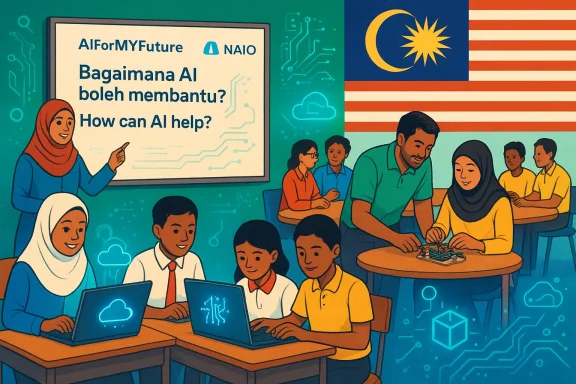
Microsoft’s AIForMYFuture—branded in full as AI for Malaysia’s Future—is a national skilling initiative launched in late 2024 that aims to equip 800,000 Malaysians with practical AI capabilities by the end of 2025. The program is delivered through a mix of online modules and in-person workshops and is run in partnership with the Malaysian government’s National AI Office (NAIO) and a network of local delivery partners, including Biji-biji Initiative, Mereka, Pepper Labs and the International Women’s Federation of Commerce and Industry Malaysia (IWFCIM).
AIForMYFuture sits inside a broader Microsoft strategy in Malaysia that combines infrastructure investment, corporate partnerships and public‑sector collaboration. The company’s wider commitment—announced in 2024—includes a multi‑billion dollar investment in cloud and AI capacity in Malaysia and work with national bodies to establish AI centers of excellence. These moves frame the program not just as a series of workshops but as a coordinated attempt to grow skills, jobs and local AI capability at scale.
This article draws on first‑hand participant stories reported in Microsoft’s feature coverage, program partner descrating public reporting to explain what AIForMYFuture looks like on the ground, why it matters to Malaysia’s digital strategy, and where risks and open questions remain.
These three vignettes provide a consistent narrative: when training is contextualized and led by human instructors, AI becomes a productivity amplifier and creativ a replacement for critical thinking. The stories illustrate that motivation, oversight and verification are central to value creation—lessons other national programs would do well to replicate.
Action points:
Action points:
Action points:
Action points:
Action points:
But real success depends on the program’s long‑term fidelity to three principles:
Yet ambition must be matched by governance. Privacy safeguards, rigorous educator training, academic integrity frameworks and careful measurement are not optional extras; they determine whether a national skilling program becomes a genuine engine of opportunity or an accelerant for existing inequities. Malaysia’s program offers a useful blueprint for other nations: combine scale with local partners, embed human oversight, and measure outcomes that matter. Doing so will turn AI literacy into AI agency—and that is the lasting promise of programs like AIForMYFuture.
Source: Microsoft Source How Microsoft’s AIForMYFuture builds confidence, creativity and community leadership - Source Asia
Microsoft’s AIForMYFuture—branded in full as AI for Malaysia’s Future—is a national skilling initiative launched in late 2024 that aims to equip 800,000 Malaysians with practical AI capabilities by the end of 2025. The program is delivered through a mix of online modules and in-person workshops and is run in partnership with the Malaysian government’s National AI Office (NAIO) and a network of local delivery partners, including Biji-biji Initiative, Mereka, Pepper Labs and the International Women’s Federation of Commerce and Industry Malaysia (IWFCIM).
AIForMYFuture sits inside a broader Microsoft strategy in Malaysia that combines infrastructure investment, corporate partnerships and public‑sector collaboration. The company’s wider commitment—announced in 2024—includes a multi‑billion dollar investment in cloud and AI capacity in Malaysia and work with national bodies to establish AI centers of excellence. These moves frame the program not just as a series of workshops but as a coordinated attempt to grow skills, jobs and local AI capability at scale.
This article draws on first‑hand participant stories reported in Microsoft’s feature coverage, program partner descrating public reporting to explain what AIForMYFuture looks like on the ground, why it matters to Malaysia’s digital strategy, and where risks and open questions remain.
 What the program actually does
Curriculum and delivery model
AIForMYFuture combines three delivery tracks:- AI Fluency modules—self‑paced online lessons that cover fundamentals of generative AI, prompt design, and practical use cases;
- Hands‑on workshops—in‑person sessions run locally by community partners that translate digital concepts into tangible projects; and
- Workforce and SME support—short courses tailored for small businesses and job seekers on applying AI to marketing, inventory, and analytics.
Who it reaches
The target audiences are intentionally broad:- Secondary and vocational students who need exposure to AI literacy and creative workflows.
- Educators and TVET (technical and vocational education and training) teachers who require lesson design, assessment alignment and productivity gains.
- Entrepreneurs and MSMEs (micro, small and medium enterprises) seeking practical tools to improve sales, inventory and customer engagement.
- Job seekers and trainees who need applied AI skills in analytics, marketing and operations.
Real people, real shifts: three case studies
Alvin — the student who found nuance and storytelling through AI
Alvin used Copilot to deepen research and shape creative decisions on a video about endangered animals. The assistant helped him explore social, economic and environmental drivers of poaching, suggest emotionally resonant filming locations, and scaffold collaborative study sturning AI into a tool that sharpened questions rather than replacing them. Alvin’s trainers described the sessions as “fun and easy to understand,” and he attributes his heightened confidence and clarity to the program’s mix of guidance and hands‑on tasks.Noorhuda — the educator who made AI part of academic rigor
Noorhuda, a PhD candidate and lecturer, uses Copilot as a structural assistant: organizing arguments, synthesizing literature, and overcoming writer’s block while retaining strict human oversight. She treats AI output as a draft—verifying data points and citations against primary sources, and keeping final academic responsibn the classroom, Noorhuda uses AI to create lesson outlines and grading rubrics and reports significant time savings—reducing grading and administrative load by hours per week—while insisting on cultural relevance and manual verification.Nur Batrishya (Batrishya) — the entrepreneur who turned time saved into community leadership
Batrishya runs a perfume brand and event planning business in Sibu. Through AIForMYFuture training she began using tools for bilingual captioning, customer behaviour analysis and event layout optimization. Tasks that previously took hours—caption brainstorming, POS audits, c to a fraction of the time, freeing her to focus on community outreach and vendor networking. Crucially, she now teaches other vendors at local meetups how to apply simple AI techniques to run their businesses better.These three vignettes provide a consistent narrative: when training is contextualized and led by human instructors, AI becomes a productivity amplifier and creativ a replacement for critical thinking. The stories illustrate that motivation, oversight and verification are central to value creation—lessons other national programs would do well to replicate.
Why this matters for Malaysia’s AI strategy
Scaling skills at national scale
Malaysia’s National AI Office (NAIO), incubated under the Ministry of Digital, has set out an agenda to accelerate AI adoption across public services and the economy. AIForMYFuture aligns with that plan by focusing on the human capital side of the equation: democratizing literacy, building teacher capacity, and connecting small businesses to practical AI tools. Microsoft’s public statements and government releases indicate that the program is a coordinated element of a national push toward AI capability.Industry and infrastructure backing
Microsoft’s investments in Malaysian cloud and AI infrastructure—backed by a broader commercial plan and a $2.2 billion regional investment announced in 2024—signal that the company sees a strategic role for Malaysia in the regional AI ecosystem. That investment helps justify large‑scale skilling; cloud regions, compute capacity and localized services make it practical for businesses and trainers to use cloud‑based AI in ways that conform to privacy and regulatory needs.Pipeline and inclusion
By training teachers, students and entrepreneurs in parallel, the program aims to create both an immediate capability uplift (workers and vendors) and a pipeline for future talent (students and TVET graduates). Local partners—Biji‑biji Initiative and others—give the program community roots that are essential for reaching marginalised groups and non‑urban learners. Early reports suggest hundreds of thousands trained already toward the 800,000 target, showing the mechanics of scale can work when government, corporate and civil actors coordinate.Strengths: what AIForMYFuture gets right
- Practicality over abstraction. The program emphasizes hands‑on, contextualized tasks—video projects, POS audits, bilingual marketing—so learners practice useful skills, not just theory.
- Multi‑stakeholder design. Partnerships with NAIO, local NGOs and industry make the initiative less likely to be a narrow corporate PR effort and more likely to meet local needs. This reduces friction at points of delivery.
- Focus on educators. Training teachers multiplies impact: a trained educator can reach dozens of students each year, embed AI literacy into curricula, and act as a local advocate. Microsoft’s AI TEACH programs and TVET-focused work are examples of this multiplier effect.
- Local language and cultural sensitivity. Bilingual content and local hubs mean the program is better positioned to be inclusive—especially in multilingual Malaysia where English‑only content would be exclusionary.
- Integration with national strategy. Alignment with NAIO and government directives ties the program into a larger policy frame, improving sustainability beyond a single campaign.
Risks, caveats and unanswered questions
While the program shows clear promise, rapid AI adoption in education and community contexts raises well‑documented risks that deserve attention.1) Privacy and data governance
AI tools—especially cloud‑based assistants like Copilot—process user text, files and sometimes metadata. That creates potential exposure for student records, confidential business data, and other personally identifiable information. Microsoft has published privacy guidance and controls for Copilot and education offerings, but operationalizing those controls across thousands of community partners and small schools is nontrivial. Recent media reports and vendor advisories show real incidents where Copilot features were handling confidential material incorrectly, underscoring the need for ongoing vigilance.Action points:
- Mandate clear data handling rules for partner organizations.
- Provide simplified checklists for trainers on what not to upload.
- Ensure opt‑out routes and explicit consent flows when student data is involved.
2) Academic integrity and over‑reliance
Generative AI can produce plausible prose and analyses quickly. Students and educators must avoid a binary reaction—neither banning nor unchecked adoption is sufficient. Research indicates that educational outcomes improve when AI is framed as an assistive tool and when institutions teach ethics, attribution and verification alongside technical skills. Without robust policy and assessment redesign, AI could shift misconduct from detectable plagiarism to subtler forms of over‑dependence.Action points:
- Build AI literacy modules that specifically address academic integrity.
- Redesign assessments to emphasize process, reflection and oral defense where appropriate.
3) Algorithmic bias and fairness
AI models inherit biases from training data. When tools recommend resources, assess performance, or create rubrics, they may embed cultural or demographic assumptions. For example, automated grading or risk flagging can disadvantage students from non‑standard backgrounds if not audited and adjusted. Scholarly reviews urge institutions to treat AI feedback as one signal among many and to retain human oversight.Action points:
- Implement human‑in‑the‑loop review policies for high‑stakes decisions.
- Periodically audit model outputs for demographic skew and discriminatory patterns.
4) Uneven access and the digital divide
Training efficacy depends on connectivity, device availability and local technical support. National progress toward 800,000 trained is promising, but outcomes vary dramatically between urban centers and rural communities. The presence of local hubs and bilingual materials mitigates this, but sustained impact will require targeted investments in connectivity, device access and follow‑up support.Action points:
- Prioritize resource allocation to underserved states.
- Combine training with device‑loan schemes or community device centers.
5) Dependency on vendor ecosystems
Large vendor‑led programs create fast adoption but can lock institutions into specific cloud, identity and tool chains. While that’s not inherently bad—cloud regions and localized services have clear technical benefits—policymakers should plan for interoperability, portability of skills, and vendor neutrality where possible.Action points:
- Teach vendor‑agnostic AI concepts alongside tool‑specific workflows.
- Define procurement standards that include data portability clauses.
How to measure success: indicators that matter
Evaluating a national skilling program requires moving beyond headcount targets to measure durable capability and economic impact. Recommended indicators:- Short‑term outputs:
- Number of participants completing AI Fluency modules.
- Number of educators certified in AI TEACH curricula.
- Medium‑term outcomes:
- Changes in job placements or MSME revenue linked to AI adoption.
- Teacher adoption rates of AI projects in classroom assessments.
- Long‑term systems effects:
- Pipeline creation: percentage of TVET graduates moving into AI‑adjacent roles.
- Reduction in digital skills gaps across states and demographic groups.
- Safety and governance metrics:
- Number of reported data incidents and resolution time.
- Frequency of model audits and bias correction actions.
Practical recommendations for similar national programs
- Design for context: Make every module locally relevant—use local case studies, languages and community partners so learners see immediate value.
- Train the trainers: Prioritize educator capacity building; teachers are the multipliers.
- **Mandate govrtner organizations to follow clear privacy and data‑handling standards before they run workshops.
- Measure learning, not just attendance: Use pre/post assessments, project deliverables and employer feedback to gauge real skill acquisition.
- Plan for continuity: Ensure funding for follow‑up labs and mentorship beyond the initial course to sustain momentum.
What success might look like — and what to watch next
If AIForMYFuture reaches its numeric goal and embeds AI literacy in Malaysia’s education, the country stands to gain multiple advantages: a more AI‑literate workforce, new SME productivity gains, and an expanded talent pipeline attractive to local and regional employers. The program’s integration with NAIO and cloud infrastructure investments suggests it could be a durable component of Malaysia’s digital industrial strategy.But real success depends on the program’s long‑term fidelity to three principles:
- Human oversight—keeping teachers and experts in charge of interpretation and ethics.
- Transparency—clear rules about data use, model limitations and where AI was involved.
- Equity—ensuring rural, multilingual and marginalized communities see measurable benefits.
Conclusion
AIForMYFuture is an ambitious experiment at national scale: corporate resources, government strategy and community partners converging to teach millions the language of AI. Early signs—real stories of students who learn nuance, educators who reclaim time for higher‑value work, and entrepreneurs who convert hours saved into community leadership—are promising.Yet ambition must be matched by governance. Privacy safeguards, rigorous educator training, academic integrity frameworks and careful measurement are not optional extras; they determine whether a national skilling program becomes a genuine engine of opportunity or an accelerant for existing inequities. Malaysia’s program offers a useful blueprint for other nations: combine scale with local partners, embed human oversight, and measure outcomes that matter. Doing so will turn AI literacy into AI agency—and that is the lasting promise of programs like AIForMYFuture.
Source: Microsoft Source How Microsoft’s AIForMYFuture builds confidence, creativity and community leadership - Source Asia
