

AIS Business and Microsoft Thailand launched “AI Ready for SMEs” on June 4, 2026, in Thailand, pairing AIS connectivity and support with Microsoft 365 Copilot, SME-focused training, and prebuilt AI agent templates for Thai small and midsize businesses. The announcement is less about one more Copilot bundle than about Microsoft’s broader strategy for making AI adoption feel local, supported, and operationally safe. For Thailand’s SME sector, the promise is enticing: enterprise-grade AI without enterprise-grade implementation pain. The risk is that “AI ready” becomes another slogan unless the package solves the mundane problems that keep smaller firms from using technology well.
The most important word in this launch is not AI. It is ready.
For large enterprises, AI readiness usually means data governance, identity management, security policy, licensing reviews, employee training, workflow redesign, and a budget line big enough to absorb failure. For SMEs, the same checklist can look absurdly heavy. A family manufacturer, a regional distributor, a small accounting firm, or a growing retailer does not have a transformation office waiting to operationalize generative AI.
That is why the AIS-Microsoft pitch is strategically interesting. It wraps Microsoft 365 and Copilot in a telecom-led support model, adds roadshows, and promises templates that convert vague AI enthusiasm into recognizable business functions. The companies are not merely asking SMEs to buy software; they are trying to reduce the perceived danger of buying software that changes how work gets done.
This is also a distribution story. Microsoft can put Copilot inside the productivity stack, but local operators like AIS can put it in front of businesses that may trust their connectivity provider more than a global software vendor. For SMEs, the path to AI adoption may not start with a CIO keynote. It may start with a package, a hotline, and a workshop.
Microsoft has been making this argument globally for years: AI is not only a feature layer in Office, Teams, Windows, GitHub, and Azure, but a productivity substrate for the next economy. The Thailand launch fits neatly into that thesis. The company needs proof that Copilot can move beyond early adopters and into ordinary business operations.
AIS, meanwhile, gets to position itself as more than a connectivity vendor. Telcos across Asia are trying to escape the low-margin trap of being pipes for someone else’s services. Bundling AI, Microsoft 365, service desk support, and training lets AIS Business sell itself as a transformation partner, not merely a network provider.
That repositioning matters because SMEs often buy technology through relationships rather than architecture diagrams. They want someone accountable when the tool breaks, the bill confuses them, or staff ignore the new system. AIS’s 24/7 service desk promise is therefore not a throwaway support detail; it is part of the product.
The practical question is whether Copilot can save enough time, reduce enough rework, or improve enough decisions to justify the license and training effort. A small business owner does not need an AI strategy deck. They need faster quotations, cleaner customer follow-ups, better inventory insight, easier payroll coordination, or less time spent stitching together reports.
That is where templates could become the most consequential part of the announcement. AIS and Microsoft say the initiative will begin with a Business Assistant AI solution, with future plans for HR, finance, and vertical use cases such as smart manufacturing. If those templates are genuinely useful, they could turn Copilot from an open-ended assistant into a guided workflow tool.
But templates also reveal the weakness of generic AI adoption. A business assistant that knows nothing about a company’s messy files, customer vocabulary, pricing exceptions, approval habits, and Thai-language business context will not magically become strategic. The value will depend on how much configuration, governance, and training are baked into the package.
Generative AI has had no shortage of publicity. Most business owners have heard some version of the claim that AI will transform everything. What many have not seen is a safe, specific, repeatable way to use it inside their own operations without exposing sensitive data, creating inaccurate outputs, or distracting employees with novelty.
A roadshow can do what a licensing page cannot. It can show a restaurant group how AI might standardize supplier communications, a factory how it might summarize maintenance records, or a professional services firm how it might draft client-ready documents from internal notes. The training component turns Copilot from an abstract Microsoft product into a local business exercise.
Microsoft Elevate coming to AIS’s online platform extends that logic. Self-paced learning is not glamorous, but it is essential if the initiative is to survive beyond launch-month enthusiasm. SMEs rarely have the luxury of sending whole departments through formal digital transformation programs. Training has to fit around the business, not the other way around.
Prebuilt agent templates could help by making automation less intimidating. A business assistant could surface reminders, summarize sales trends, prepare responses, or point owners toward anomalies. HR and finance agents could standardize repetitive administrative work. Manufacturing-specific agents could help smaller factories interpret operational signals that would otherwise remain buried in spreadsheets or emails.
Yet the more an agent does, the more governance matters. A chatbot that drafts a reply is one thing. An agent that updates a finance workflow, recommends a staffing decision, changes a customer record, or triggers a procurement step is something else entirely. SMEs need guardrails as much as they need convenience.
This is where Microsoft’s enterprise heritage can help, if applied properly. Identity, permissions, auditability, data boundaries, and integration discipline are not exciting launch phrases, but they are the difference between useful AI and operational chaos. The agent era will punish businesses that treat automation as a plug-in rather than a management system.
But SMEs do not always adopt Microsoft’s newest layer just because it appears in the stack. They need pricing that feels reachable, bundles that reduce procurement complexity, and a partner who can explain the product in practical language. AIS gives Microsoft a local route into that market.
This model also helps Microsoft avoid one of Copilot’s central adoption problems: the gap between license activation and meaningful use. Many organizations can technically turn on AI tools long before they know what employees should do with them. Bundled training, workshops, and templates create a more structured path from purchase to habit.
For AIS, the Microsoft alliance strengthens its enterprise credibility at a time when connectivity is becoming less differentiated. Networks matter, but business customers increasingly expect security, cloud, collaboration, analytics, and AI in one conversation. The telecom operator that can sell outcomes rather than bandwidth has a better chance of defending margins.
Many SMEs have files scattered across personal devices, chat apps, email threads, local drives, and half-maintained cloud folders. Their customer data may live in spreadsheets with inconsistent naming. Their approval processes may exist mainly in the owner’s head. AI does not erase that mess; in some cases, it exposes it.
This is why the phrase “AI ready” should be treated as a journey, not a state. A company may be ready to use Copilot for meeting summaries and document drafts long before it is ready for autonomous finance or HR agents. A workshop can introduce the tool, but operational maturity comes from iteration.
The companies deserve credit for emphasizing secure and practical adoption, not just speed. Still, security is not a product setting alone. It is employee training, access control, retention policy, sensitivity labeling, and disciplined use of company data. Smaller firms need simplified governance, not the absence of governance.
That matters for administrators because AI adoption will often arrive through productivity licensing rather than a formal AI platform decision. A business may not think it is undertaking a major technology shift when it buys a Microsoft 365 bundle through a telco partner. But once Copilot enters email, documents, meetings, and file search, governance becomes an IT issue whether or not IT led the purchase.
SMEs with limited IT capacity should pay particular attention to identity hygiene. If employees have overly broad access to SharePoint sites, Teams channels, mailboxes, or shared folders, AI-powered retrieval can make old permission problems newly visible. Copilot generally works within the access rights of the user, but that is not reassuring if those rights were never cleaned up.
The same applies to endpoint discipline. Windows devices used for business AI need patching, malware protection, browser control, and account separation. AI does not reduce the need for basic administration. It raises the cost of neglecting it.
The initiative’s regional roadshow design acknowledges that Bangkok alone is not the market. Economic activity outside the capital matters, and digital adoption often depends on whether training, support, and examples reach businesses where they operate. AI policy discussions can become abstract quickly; provincial workshops are where the abstraction meets payroll.
There is also a competitiveness argument. If larger companies use AI to accelerate reporting, customer engagement, design, compliance, and supply-chain management, smaller firms that feed into those ecosystems may be pressured to keep up. AI adoption may become less optional as procurement, reporting, and customer expectations change.
That pressure can be productive if it comes with support. It can be destructive if SMEs are pushed into tools they cannot govern. AIS and Microsoft are effectively betting that a packaged, supported path can make the difference.
SMEs often underuse software because they buy it for a pain point and never integrate it into daily routines. Training tied to purchase helps convert procurement into usage. On-site training for companies with 10 or more licenses is especially important because AI habits spread socially inside organizations. If a few employees learn practical workflows together, adoption becomes less dependent on individual curiosity.
The 24/7 hotline promise is also more significant than it looks. AI tools introduce new kinds of confusion: why an answer appeared, whether a file was included, whether a prompt exposed sensitive information, why one employee sees different results from another, or how to correct a bad output. SMEs need someone to call when uncertainty turns into hesitation.
The danger is support overload. If AIS becomes the front line for AI troubleshooting, it will need staff who understand not only account provisioning but also Microsoft 365 permissions, Copilot behavior, and business process context. A support desk that can reset passwords is not the same as one that can guide AI adoption.
A business owner may not care whether an AI agent is powered by the most advanced model available. They care whether it understands the company’s documents, produces usable Thai and English outputs, avoids hallucinated numbers, and does not leak sensitive information. They care whether employees actually use it after the workshop.
This is why prebuilt templates should be judged by their operational specificity. A generic “business assistant” is useful only up to a point. A finance assistant that understands common SME reporting needs, approval controls, and local accounting practices would be more valuable. A manufacturing agent that maps to real shop-floor processes would be more valuable still.
The vertical expansion plan is therefore the right instinct. SMEs do not experience AI as a category. They experience it as a solution to a particular kind of work.
That shift favors Microsoft in some ways. Its software already sits inside the workday. Its identity and productivity tools already define many business environments. Its partner channel is deep. Copilot does not need to persuade users to move into a new application universe; it needs to make the existing Microsoft universe feel more valuable.
But that advantage can also make Microsoft complacent. If Copilot is treated as an unavoidable tax on Microsoft 365 rather than a demonstrably useful layer, customers will notice. SMEs are cost-sensitive and skeptical of tools that promise transformation but require constant coaxing.
AIS’s role may help keep the offering grounded. A local partner selling to SMEs has less room for abstract platform rhetoric. If the package does not help customers, support calls and churn will make that obvious.
AI tools can make that concentration more visible and more useful, but also more sensitive. A prompt that summarizes customer complaints may be harmless. A prompt that asks for all high-margin customers, overdue invoices, or employee performance patterns enters more delicate territory. The issue is not that Copilot is inherently unsafe; it is that AI makes data access easier to exercise.
For SMEs, governance needs to be practical rather than theatrical. They should know which accounts are licensed, what data sources are connected, who can access shared documents, what employees should not paste into prompts, and how outputs should be checked before use. That is not bureaucracy. It is basic operational hygiene.
The best version of AI Ready for SMEs would make those defaults part of the package. The worst version would hand customers a powerful assistant and leave them to discover their data problems through mistakes.
The initiative should be judged on whether it creates repeatable practices. Do SMEs learn how to summarize meetings, generate proposals, analyze sales data, and draft customer communications more quickly? Do managers understand how to verify AI outputs? Do businesses clean up permissions and documents because Copilot made the need obvious? Do templates reduce setup time enough to matter?
There is also a larger ecosystem question. If AIS and Microsoft build useful vertical agents, they may encourage local software providers, consultants, and industry associations to build around Copilot. That could create a Thai SME AI ecosystem rather than a single vendor bundle.
But ecosystem claims should be earned. Many AI programs begin with big platform language and end as training portals. The difference will be whether this initiative produces working habits inside ordinary firms.
The next phase of business AI will not be won by the company with the loudest assistant icon or the most extravagant agent demo. It will be won in the dull, consequential middle ground where licensing, support, training, permissions, and workflow design meet. AIS Business and Microsoft Thailand have put a credible stake in that ground; now they have to prove that “AI ready” means more than ready to buy.
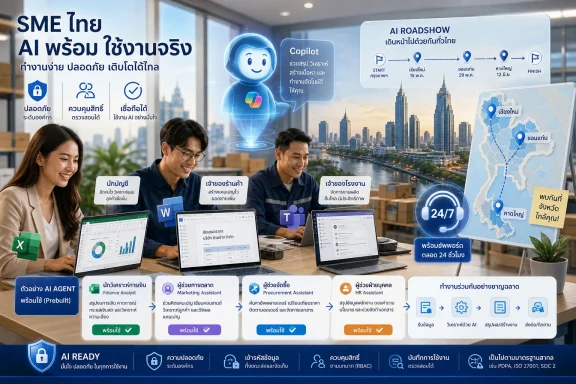 Microsoft and AIS Are Selling Confidence, Not Just Copilot
The most important word in this launch is not AI. It is ready.For large enterprises, AI readiness usually means data governance, identity management, security policy, licensing reviews, employee training, workflow redesign, and a budget line big enough to absorb failure. For SMEs, the same checklist can look absurdly heavy. A family manufacturer, a regional distributor, a small accounting firm, or a growing retailer does not have a transformation office waiting to operationalize generative AI.
That is why the AIS-Microsoft pitch is strategically interesting. It wraps Microsoft 365 and Copilot in a telecom-led support model, adds roadshows, and promises templates that convert vague AI enthusiasm into recognizable business functions. The companies are not merely asking SMEs to buy software; they are trying to reduce the perceived danger of buying software that changes how work gets done.
This is also a distribution story. Microsoft can put Copilot inside the productivity stack, but local operators like AIS can put it in front of businesses that may trust their connectivity provider more than a global software vendor. For SMEs, the path to AI adoption may not start with a CIO keynote. It may start with a package, a hotline, and a workshop.
Thailand’s SME Economy Makes This More Than a Channel Deal
The initiative targets a sector described as more than 3.13 million enterprises, representing 99.6 percent of businesses in Thailand. That number gives the announcement its political and economic weight. If AI remains a tool for banks, conglomerates, consultancies, and global manufacturers, it widens the productivity gap. If it becomes usable by SMEs, it becomes infrastructure.Microsoft has been making this argument globally for years: AI is not only a feature layer in Office, Teams, Windows, GitHub, and Azure, but a productivity substrate for the next economy. The Thailand launch fits neatly into that thesis. The company needs proof that Copilot can move beyond early adopters and into ordinary business operations.
AIS, meanwhile, gets to position itself as more than a connectivity vendor. Telcos across Asia are trying to escape the low-margin trap of being pipes for someone else’s services. Bundling AI, Microsoft 365, service desk support, and training lets AIS Business sell itself as a transformation partner, not merely a network provider.
That repositioning matters because SMEs often buy technology through relationships rather than architecture diagrams. They want someone accountable when the tool breaks, the bill confuses them, or staff ignore the new system. AIS’s 24/7 service desk promise is therefore not a throwaway support detail; it is part of the product.
Copilot’s Real Test Is the Spreadsheet, Not the Stage Demo
Microsoft 365 Copilot is easiest to understand in a demo and hardest to justify in a small business ledger. It can draft, summarize, search across work content, help with presentations, analyze documents, and act as an assistant inside Microsoft’s productivity suite. Those capabilities are impressive, but SMEs do not buy potential. They buy outcomes.The practical question is whether Copilot can save enough time, reduce enough rework, or improve enough decisions to justify the license and training effort. A small business owner does not need an AI strategy deck. They need faster quotations, cleaner customer follow-ups, better inventory insight, easier payroll coordination, or less time spent stitching together reports.
That is where templates could become the most consequential part of the announcement. AIS and Microsoft say the initiative will begin with a Business Assistant AI solution, with future plans for HR, finance, and vertical use cases such as smart manufacturing. If those templates are genuinely useful, they could turn Copilot from an open-ended assistant into a guided workflow tool.
But templates also reveal the weakness of generic AI adoption. A business assistant that knows nothing about a company’s messy files, customer vocabulary, pricing exceptions, approval habits, and Thai-language business context will not magically become strategic. The value will depend on how much configuration, governance, and training are baked into the package.
The Roadshow Is a Quiet Admission That Software Alone Won’t Work
AIS and Microsoft plan roadshows across Bangkok and key economic provinces spanning seven regions, with a goal of training more than 700 SME entrepreneurs by the end of 2026. In pure scale terms, 700 people is tiny compared with millions of SMEs. In adoption terms, it is still meaningful because the bottleneck is not awareness. It is confidence.Generative AI has had no shortage of publicity. Most business owners have heard some version of the claim that AI will transform everything. What many have not seen is a safe, specific, repeatable way to use it inside their own operations without exposing sensitive data, creating inaccurate outputs, or distracting employees with novelty.
A roadshow can do what a licensing page cannot. It can show a restaurant group how AI might standardize supplier communications, a factory how it might summarize maintenance records, or a professional services firm how it might draft client-ready documents from internal notes. The training component turns Copilot from an abstract Microsoft product into a local business exercise.
Microsoft Elevate coming to AIS’s online platform extends that logic. Self-paced learning is not glamorous, but it is essential if the initiative is to survive beyond launch-month enthusiasm. SMEs rarely have the luxury of sending whole departments through formal digital transformation programs. Training has to fit around the business, not the other way around.
The Agent Templates Are Where the Ambition Gets Riskier
The phrase AI agent has become the industry’s current magic spell. It implies software that does not merely answer questions but performs work, follows processes, and acts on behalf of users. For SMEs, that promise is powerful because many smaller companies are under-administered by design. One person may handle sales, operations, customer service, and finance before lunch.Prebuilt agent templates could help by making automation less intimidating. A business assistant could surface reminders, summarize sales trends, prepare responses, or point owners toward anomalies. HR and finance agents could standardize repetitive administrative work. Manufacturing-specific agents could help smaller factories interpret operational signals that would otherwise remain buried in spreadsheets or emails.
Yet the more an agent does, the more governance matters. A chatbot that drafts a reply is one thing. An agent that updates a finance workflow, recommends a staffing decision, changes a customer record, or triggers a procurement step is something else entirely. SMEs need guardrails as much as they need convenience.
This is where Microsoft’s enterprise heritage can help, if applied properly. Identity, permissions, auditability, data boundaries, and integration discipline are not exciting launch phrases, but they are the difference between useful AI and operational chaos. The agent era will punish businesses that treat automation as a plug-in rather than a management system.
The Local Partner Model May Be Microsoft’s Best SME Strategy
Microsoft has spent decades winning business markets by embedding itself where work already happens. Windows put Microsoft on the desk. Office put it in the document. Exchange and Teams put it in communication. Copilot is the attempt to put Microsoft in the cognitive layer of work.But SMEs do not always adopt Microsoft’s newest layer just because it appears in the stack. They need pricing that feels reachable, bundles that reduce procurement complexity, and a partner who can explain the product in practical language. AIS gives Microsoft a local route into that market.
This model also helps Microsoft avoid one of Copilot’s central adoption problems: the gap between license activation and meaningful use. Many organizations can technically turn on AI tools long before they know what employees should do with them. Bundled training, workshops, and templates create a more structured path from purchase to habit.
For AIS, the Microsoft alliance strengthens its enterprise credibility at a time when connectivity is becoming less differentiated. Networks matter, but business customers increasingly expect security, cloud, collaboration, analytics, and AI in one conversation. The telecom operator that can sell outcomes rather than bandwidth has a better chance of defending margins.
The Price of Accessibility Is Managing Expectations
The most dangerous version of this initiative is the one where SMEs are told AI will immediately transform productivity across the business. That is not how these deployments usually work. Copilot can be powerful, but it depends heavily on data quality, user behavior, permissions, and realistic workflows.Many SMEs have files scattered across personal devices, chat apps, email threads, local drives, and half-maintained cloud folders. Their customer data may live in spreadsheets with inconsistent naming. Their approval processes may exist mainly in the owner’s head. AI does not erase that mess; in some cases, it exposes it.
This is why the phrase “AI ready” should be treated as a journey, not a state. A company may be ready to use Copilot for meeting summaries and document drafts long before it is ready for autonomous finance or HR agents. A workshop can introduce the tool, but operational maturity comes from iteration.
The companies deserve credit for emphasizing secure and practical adoption, not just speed. Still, security is not a product setting alone. It is employee training, access control, retention policy, sensitivity labeling, and disciplined use of company data. Smaller firms need simplified governance, not the absence of governance.
Windows Shops Should Watch the Microsoft 365 Angle Closely
For WindowsForum readers, the most relevant part of this launch is not Thailand alone. It is the direction of travel for Microsoft’s ecosystem. Copilot is increasingly being packaged less as a standalone assistant and more as the connective tissue across Microsoft 365, Windows, cloud services, and business workflows.That matters for administrators because AI adoption will often arrive through productivity licensing rather than a formal AI platform decision. A business may not think it is undertaking a major technology shift when it buys a Microsoft 365 bundle through a telco partner. But once Copilot enters email, documents, meetings, and file search, governance becomes an IT issue whether or not IT led the purchase.
SMEs with limited IT capacity should pay particular attention to identity hygiene. If employees have overly broad access to SharePoint sites, Teams channels, mailboxes, or shared folders, AI-powered retrieval can make old permission problems newly visible. Copilot generally works within the access rights of the user, but that is not reassuring if those rights were never cleaned up.
The same applies to endpoint discipline. Windows devices used for business AI need patching, malware protection, browser control, and account separation. AI does not reduce the need for basic administration. It raises the cost of neglecting it.
The Thai Market Gives Microsoft a Useful Proving Ground
Thailand is a compelling test case because its SME economy is large, varied, and digitally uneven. Some firms are already cloud-native exporters or technology-enabled manufacturers. Others still rely on informal processes, consumer messaging apps, and manual reporting. A successful SME AI program has to serve both ends of that spectrum without pretending they are the same.The initiative’s regional roadshow design acknowledges that Bangkok alone is not the market. Economic activity outside the capital matters, and digital adoption often depends on whether training, support, and examples reach businesses where they operate. AI policy discussions can become abstract quickly; provincial workshops are where the abstraction meets payroll.
There is also a competitiveness argument. If larger companies use AI to accelerate reporting, customer engagement, design, compliance, and supply-chain management, smaller firms that feed into those ecosystems may be pressured to keep up. AI adoption may become less optional as procurement, reporting, and customer expectations change.
That pressure can be productive if it comes with support. It can be destructive if SMEs are pushed into tools they cannot govern. AIS and Microsoft are effectively betting that a packaged, supported path can make the difference.
The Package Is Sensible Because SMEs Buy Bundles of Trust
The AIS “SME AI Ready” package combines Microsoft 365 and Copilot with AIS support. The first 1,000 Copilot package customers receive access to a Copilot workshop, and customers subscribing to 10 or more licenses receive private on-site training. These incentives are conventional, but they are aimed at a real adoption problem.SMEs often underuse software because they buy it for a pain point and never integrate it into daily routines. Training tied to purchase helps convert procurement into usage. On-site training for companies with 10 or more licenses is especially important because AI habits spread socially inside organizations. If a few employees learn practical workflows together, adoption becomes less dependent on individual curiosity.
The 24/7 hotline promise is also more significant than it looks. AI tools introduce new kinds of confusion: why an answer appeared, whether a file was included, whether a prompt exposed sensitive information, why one employee sees different results from another, or how to correct a bad output. SMEs need someone to call when uncertainty turns into hesitation.
The danger is support overload. If AIS becomes the front line for AI troubleshooting, it will need staff who understand not only account provisioning but also Microsoft 365 permissions, Copilot behavior, and business process context. A support desk that can reset passwords is not the same as one that can guide AI adoption.
Copilot’s SME Future Depends on Boring Implementation Details
The technology industry loves the dramatic version of AI: agents, automation, copilots, synthetic workers, and frontier models. SMEs live in the undramatic version: invoices, quotes, staffing, compliance, inventory, customer messages, and monthly reports. The AIS-Microsoft initiative will succeed only if it respects that distance.A business owner may not care whether an AI agent is powered by the most advanced model available. They care whether it understands the company’s documents, produces usable Thai and English outputs, avoids hallucinated numbers, and does not leak sensitive information. They care whether employees actually use it after the workshop.
This is why prebuilt templates should be judged by their operational specificity. A generic “business assistant” is useful only up to a point. A finance assistant that understands common SME reporting needs, approval controls, and local accounting practices would be more valuable. A manufacturing agent that maps to real shop-floor processes would be more valuable still.
The vertical expansion plan is therefore the right instinct. SMEs do not experience AI as a category. They experience it as a solution to a particular kind of work.
The AI Race Is Moving From Availability to Adoption
In 2023 and 2024, the AI race was largely about availability: who had the model, who had the chatbot, who had the cloud capacity, who had the splashiest demo. By 2026, the contest is increasingly about adoption. The winners will be the companies that make AI mundane enough to use.That shift favors Microsoft in some ways. Its software already sits inside the workday. Its identity and productivity tools already define many business environments. Its partner channel is deep. Copilot does not need to persuade users to move into a new application universe; it needs to make the existing Microsoft universe feel more valuable.
But that advantage can also make Microsoft complacent. If Copilot is treated as an unavoidable tax on Microsoft 365 rather than a demonstrably useful layer, customers will notice. SMEs are cost-sensitive and skeptical of tools that promise transformation but require constant coaxing.
AIS’s role may help keep the offering grounded. A local partner selling to SMEs has less room for abstract platform rhetoric. If the package does not help customers, support calls and churn will make that obvious.
The Governance Conversation Has to Start Before the First Prompt
Security-minded readers should resist the temptation to view SME AI adoption as a lightweight version of enterprise AI adoption. The organizations may be smaller, but the risks are real. Customer data, employee records, pricing documents, supplier contracts, and financial files are often concentrated in fewer hands.AI tools can make that concentration more visible and more useful, but also more sensitive. A prompt that summarizes customer complaints may be harmless. A prompt that asks for all high-margin customers, overdue invoices, or employee performance patterns enters more delicate territory. The issue is not that Copilot is inherently unsafe; it is that AI makes data access easier to exercise.
For SMEs, governance needs to be practical rather than theatrical. They should know which accounts are licensed, what data sources are connected, who can access shared documents, what employees should not paste into prompts, and how outputs should be checked before use. That is not bureaucracy. It is basic operational hygiene.
The best version of AI Ready for SMEs would make those defaults part of the package. The worst version would hand customers a powerful assistant and leave them to discover their data problems through mistakes.
The Real Scorecard Will Be Written After the Workshops
Launch announcements are optimistic by design. The harder evidence will come later: renewal rates, active usage, support patterns, customer stories, template adoption, and whether trained entrepreneurs continue using Copilot after the novelty fades. The goal of training more than 700 SME entrepreneurs by the end of 2026 is a start, not a destination.The initiative should be judged on whether it creates repeatable practices. Do SMEs learn how to summarize meetings, generate proposals, analyze sales data, and draft customer communications more quickly? Do managers understand how to verify AI outputs? Do businesses clean up permissions and documents because Copilot made the need obvious? Do templates reduce setup time enough to matter?
There is also a larger ecosystem question. If AIS and Microsoft build useful vertical agents, they may encourage local software providers, consultants, and industry associations to build around Copilot. That could create a Thai SME AI ecosystem rather than a single vendor bundle.
But ecosystem claims should be earned. Many AI programs begin with big platform language and end as training portals. The difference will be whether this initiative produces working habits inside ordinary firms.
The Copilot Bundle’s Lesson for Every Small Business IT Plan
The AIS-Microsoft launch is specific to Thailand, but the lessons travel well. SMEs everywhere are being told that AI is now essential, yet many lack the staff, time, and governance maturity to adopt it cleanly. The smartest approach is neither blind enthusiasm nor blanket refusal. It is staged adoption with clear use cases and visible controls.- SMEs should start with low-risk, high-frequency workflows such as drafting, summarizing, translating, and preparing internal reports before moving into agents that take action.
- Administrators should review Microsoft 365 permissions and shared data structures before enabling AI features broadly.
- Business owners should measure Copilot against saved time, improved quality, and reduced administrative drag rather than against demo-stage expectations.
- Training should be treated as part of the deployment, because unused AI licenses are just another form of shelfware.
- Prebuilt agents should be evaluated by how well they match real business processes, not by how impressive the word “agent” sounds.
The next phase of business AI will not be won by the company with the loudest assistant icon or the most extravagant agent demo. It will be won in the dull, consequential middle ground where licensing, support, training, permissions, and workflow design meet. AIS Business and Microsoft Thailand have put a credible stake in that ground; now they have to prove that “AI ready” means more than ready to buy.
References
- Primary source: The Fast Mode
Published: 2026-06-15T05:12:07.755168
AIS Business, Microsoft Thailand Launch AI Ready for SMEs with Copilot Integration
AIS Business and Microsoft Thailand Launch AI Ready for SMEs with Copilot Integrationwww.thefastmode.com - Official source: news.microsoft.com
- Related coverage: ais.th
SME AI Ready ยกระดับการทำงานด้วยพลัง AI และ Microsoft 365 พร้อมโทรและเน็ตในแพ็ก
ปลดล็อกศักยภาพการทำงานยุคใหม่ที่เข้าใจคนทำธุรกิจ SME ด้วยแพ็กเกจโทรและเน็ต พร้อม Microsoft 365 และ Copilot ผู้ช่วย AI อัจฉริยะที่ช่วยให้ทุกการทำงานเร็วขึ้น ง่ายขึ้น และมีประสิทธิภาพมากกว่าเดิม ไม่ว่าจะสรุปประชุม สร้างเอกสาร วิเคราะห์ข้อมูล หรือช่วยคิดไอเดีย ก็ทำได้ครบจบ ใช้งานลื่นไหลทุกที่...www.ais.th - Related coverage: zestmatesolution.com
AIS Microsoft AI Ready for SMEs 2026 Copilot SME ไทย | ZestMate Blog
AIS Business จับมือ Microsoft Thailand ประกาศ AI Ready for SMEs 4 มิ.ย. 2026 รวม Microsoft 365 Copilot AI Agent Templates และ Microsoft Elevate สำหรับ SME ไทย 3.13 ล้านรายwww.zestmatesolution.com - Official source: microsoft.com
- Related coverage: m365.co.th

- Official source: techcommunity.microsoft.com
- Related coverage: content.shi.com
- Related coverage: nttdata.com
