

Akkuro, by Topicus is using Azure Red Hat OpenShift in Switzerland to run its Akkuro Lending platform, combining regulated in-country document processing, Azure OpenAI-powered extraction, and repeatable Kubernetes deployment so Swiss SME lenders can move credit decisions from weeks toward days. The story matters because it is not another abstract “AI in banking” pitch. It is a case study in where financial automation actually succeeds: not at the chatbot layer, but at the messy boundary between paper, compliance, and production infrastructure.
Modern SME lending has always had a technology problem hiding inside an operational one. Banks and specialist lenders can build slick portals, automate customer onboarding, and push applicants through digital forms, but the decisive evidence still arrives as documents: financial statements, PDFs, scans, spreadsheets, bank files, and attachments that rarely look the same twice.
That is where “digital lending” often slows to a crawl. A borrower may submit everything online, yet the lender’s internal process still depends on someone turning unstructured material into structured facts. Revenue, liabilities, cash flow, collateral, anomalies, and missing data have to be found, checked, and prepared before a credit decision can be trusted.
Akkuro’s argument is that document intelligence should not be a sidecar to the lending process. It should be built into the workflow so that when a case is opened, the relevant financial data is already extracted, structured, and ready for review. That is a more modest claim than replacing credit professionals with AI, but it is also a more credible one.
The difference is important. In financial services, automation that merely accelerates bad inputs is dangerous. Automation that makes inputs usable earlier in the process can change the economics of lending without pretending that risk judgment has disappeared.
That requirement turns architecture into strategy. If a document-processing system has to ship sensitive financial documents to an external service in another jurisdiction, it may be technically impressive and commercially unusable. If it stays compliant but requires manual handling and bespoke infrastructure, it can preserve regulatory comfort while undermining the promise of digital lending.
This is the uncomfortable middle ground many banks inhabit. They want AI-assisted processing, but not at the cost of data residency. They want elastic infrastructure, but not infrastructure that makes auditability opaque. They want faster decisions, but not a black box that creates a new model-risk problem.
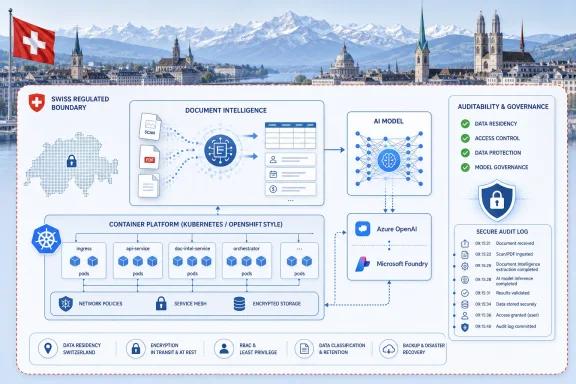
Akkuro’s deployment on Azure Red Hat OpenShift is best understood as an answer to that tension. The platform gives Akkuro a standardized Kubernetes environment that can be reproduced across regulated markets, while Azure’s Switzerland North region allows the company to keep processing within national boundaries. That combination is the story: not “AI solves lending,” but “AI becomes deployable when the platform respects the jurisdiction.”
For a lending software provider, that matters because repeatability is a product feature. Akkuro already had an EU environment. According to Microsoft’s account, it was able to replicate that environment in Switzerland in weeks rather than rebuild the platform for a new jurisdiction. That is the difference between a cloud-native architecture that travels and a one-off deployment that becomes another legacy system the moment it goes live.
The practical architecture is hybrid in the small sense, not the marketing sense. Akkuro’s core lending services run on Azure Red Hat OpenShift. Supporting workloads also use Azure Kubernetes Service. Structured lending and application data rely on Azure SQL Managed Instance, while Azure Virtual Machines remain part of the estate for components with technical requirements that have not yet been containerized.
That is what real modernization usually looks like. It is not a clean-room migration where every workload becomes a perfect microservice. It is a governed platform that lets the new core run in containers while the less portable pieces move at a more realistic pace.
Traditional OCR has long been useful for reading characters, but lending requires more than character recognition. A system has to understand the role of a value in a financial statement, deal with inconsistent layouts, infer document structure, and produce data that can feed downstream decisioning. That is where newer model-based document processing has become attractive to financial software vendors.
Akkuro says the system processes 70 to 90 percent of documents without manual intervention and reached 83 percent median accuracy in one production evaluation. Those numbers should be read carefully. They are not a universal benchmark for every bank, every document type, or every borrower segment. But they are meaningful because the documents are inconsistent and unstructured, exactly the material that has traditionally forced trained analysts into repetitive extraction work.
The more interesting detail is the feedback loop. Microsoft says Akkuro built a blind evaluation capability that lets the team test prompt changes against real production documents without engineers accessing the underlying customer data. That is the operational discipline AI systems need in regulated industries: iteration without casual exposure, improvement without turning customer records into a developer playground.
For incumbent institutions, document-heavy workflows often persist because they are embedded in teams, policies, and exceptions accumulated over years. A greenfield lender can design the business around a different assumption: that automation prepares the case, humans handle judgment and exceptions, and the platform captures enough evidence to satisfy governance.
That does not make the task easy. A system with no historical corpus cannot simply be trained on years of local lending files. It has to perform in the wild, improve safely, and avoid becoming brittle as document formats change. Akkuro’s engineering challenge was therefore not just building a model pipeline; it was building a production system that could evolve while staying inside regulatory boundaries.
This is where the “future-proof” language from software vendors usually deserves skepticism. AI systems age quickly because models, prompts, evaluation methods, and customer expectations shift quickly. But the more defensible version of future-proofing is architectural: make the environment repeatable, observable, governed, and capable of controlled change. That is what Akkuro is trying to sell.
But for banks and regulated lenders, speed is only useful if it survives audit. A faster process that produces inconsistent outputs, loses track of model behavior, or obscures where data moved is not transformation. It is a future remediation project.
That is why in-country processing is more than a compliance checkbox. If sensitive documents stay within Swiss boundaries, if the workflow is governed, and if extracted data enters a controlled lending process, the automation becomes easier to defend. It gives the institution a story it can tell auditors, boards, and regulators: the system did not bypass controls; it moved the controls earlier and made the inputs more consistent.
The labor impact is also subtler than the usual AI replacement narrative. Akkuro’s pitch is not that underwriters disappear. It is that analysts and loan officers stop spending as much time on routine extraction and sorting, then focus on exceptions and judgment. Whether that holds at scale depends on implementation, but it is the version of financial AI most likely to survive contact with regulators.
Akkuro’s deployment is a good example of that strategy. Azure Red Hat OpenShift supplies the managed application platform. Azure regions address residency requirements. Azure SQL Managed Instance and Virtual Machines support the less fashionable but still essential parts of the workload. Foundry and Azure OpenAI bring model-driven document interpretation into the same governed environment.
This is Microsoft playing to its enterprise strengths. The company does not need every customer to build an AI-native bank from scratch. It needs customers to believe that they can modernize sensitive workflows without stitching together a dozen ungoverned services. In financial services, the platform sale often beats the feature sale.
Red Hat’s role also matters. OpenShift remains attractive to enterprises that want Kubernetes but also want opinionated tooling, lifecycle management, and a platform model familiar to large IT organizations. By delivering it through Azure, Microsoft gets to participate in workloads that might otherwise remain in private infrastructure or move to a different hyperscaler.
Accuracy in document intelligence depends heavily on document mix, field definitions, tolerance for errors, and the downstream review process. An 83 percent median accuracy figure can be very good for messy financial documents if humans are still reviewing exceptions and critical values. It would be less reassuring if treated as a fully autonomous credit input without controls.
Likewise, “70 to 90 percent” automation leaves a wide range because real portfolios vary. Standardized documents from repeat borrowers are different from scans, edge cases, handwritten annotations, and unusual balance-sheet formats. The work that remains manual may also be the hardest and highest-risk work.
That does not weaken the case for the platform. It clarifies it. The serious value proposition is not perfection; it is triage at scale. If the system can reliably handle routine extraction, identify uncertain cases, and improve over time without violating data controls, it changes the staffing and responsiveness model for SME lending.
The presence of Azure Virtual Machines running Windows Server components is a reminder that modernization rarely eliminates the Microsoft estate. It rearranges it. Containerized services may carry the core application, while Windows workloads continue to support specific technical requirements, integrations, or legacy components that are not ready to move.
For sysadmins, the important lesson is that AI adoption will often arrive through business applications rather than standalone AI projects. A lending platform, claims system, compliance workflow, or ERP extension will quietly add model-driven extraction and classification. The operational questions then become familiar ones: where is the data, who has access, how is it logged, how is it patched, and what breaks during an upgrade?
That is where managed platforms like Azure Red Hat OpenShift become politically useful inside enterprises. They provide a boundary between application teams that want velocity and infrastructure teams that need supportability. Whether that boundary is enough depends on the organization’s governance maturity, but the direction of travel is clear.
Still, the Swiss context makes the story harder to wave away as generic AI boosterism. Data residency constraints, audit requirements, and banking workloads create a more demanding test than a proof-of-concept demo. If the system can run inside those boundaries and still reduce decision time, the architecture deserves attention.
The more interesting claim is that Akkuro can repeat the model across regulated markets. That is where Azure Red Hat OpenShift earns its place in the narrative. If the platform can be copied into a new region, connected to local data services, and governed consistently, Akkuro gains a deployment pattern rather than a single successful installation.
That is also where the competitive pressure will land. Every financial software provider is racing to add document intelligence, but not every provider can make it jurisdiction-aware, operationally repeatable, and acceptable to compliance teams. In banking software, where the AI runs may become as important as what the AI can do.
Source: Microsoft Akkuro Lending streamlines Swiss digital SME lending with Azure Red Hat OpenShift | Microsoft Customer Stories
 The Real Lending Bottleneck Is Not the Loan Officer
Modern SME lending has always had a technology problem hiding inside an operational one. Banks and specialist lenders can build slick portals, automate customer onboarding, and push applicants through digital forms, but the decisive evidence still arrives as documents: financial statements, PDFs, scans, spreadsheets, bank files, and attachments that rarely look the same twice.That is where “digital lending” often slows to a crawl. A borrower may submit everything online, yet the lender’s internal process still depends on someone turning unstructured material into structured facts. Revenue, liabilities, cash flow, collateral, anomalies, and missing data have to be found, checked, and prepared before a credit decision can be trusted.
Akkuro’s argument is that document intelligence should not be a sidecar to the lending process. It should be built into the workflow so that when a case is opened, the relevant financial data is already extracted, structured, and ready for review. That is a more modest claim than replacing credit professionals with AI, but it is also a more credible one.
The difference is important. In financial services, automation that merely accelerates bad inputs is dangerous. Automation that makes inputs usable earlier in the process can change the economics of lending without pretending that risk judgment has disappeared.
Switzerland Turns Cloud Architecture Into a Compliance Test
The Swiss deployment raises the stakes because the usual cloud shortcut is unavailable. Akkuro and its customer Kamuno, a Swiss digital lender backed by Urner Kantonalbank, had to keep financial data stored and processed in-country. The platform also needed auditable workflows and enough operational control to satisfy a banking environment.That requirement turns architecture into strategy. If a document-processing system has to ship sensitive financial documents to an external service in another jurisdiction, it may be technically impressive and commercially unusable. If it stays compliant but requires manual handling and bespoke infrastructure, it can preserve regulatory comfort while undermining the promise of digital lending.
This is the uncomfortable middle ground many banks inhabit. They want AI-assisted processing, but not at the cost of data residency. They want elastic infrastructure, but not infrastructure that makes auditability opaque. They want faster decisions, but not a black box that creates a new model-risk problem.
Akkuro’s deployment on Azure Red Hat OpenShift is best understood as an answer to that tension. The platform gives Akkuro a standardized Kubernetes environment that can be reproduced across regulated markets, while Azure’s Switzerland North region allows the company to keep processing within national boundaries. That combination is the story: not “AI solves lending,” but “AI becomes deployable when the platform respects the jurisdiction.”
OpenShift Is the Boring Part, Which Is Why It Matters
Azure Red Hat OpenShift is not the flashiest part of Microsoft’s customer story, but it is probably the most important. The service is a managed OpenShift platform jointly operated by Microsoft and Red Hat, giving customers a Kubernetes-based application platform without requiring them to own every patching, control-plane, and lifecycle chore themselves.For a lending software provider, that matters because repeatability is a product feature. Akkuro already had an EU environment. According to Microsoft’s account, it was able to replicate that environment in Switzerland in weeks rather than rebuild the platform for a new jurisdiction. That is the difference between a cloud-native architecture that travels and a one-off deployment that becomes another legacy system the moment it goes live.
The practical architecture is hybrid in the small sense, not the marketing sense. Akkuro’s core lending services run on Azure Red Hat OpenShift. Supporting workloads also use Azure Kubernetes Service. Structured lending and application data rely on Azure SQL Managed Instance, while Azure Virtual Machines remain part of the estate for components with technical requirements that have not yet been containerized.
That is what real modernization usually looks like. It is not a clean-room migration where every workload becomes a perfect microservice. It is a governed platform that lets the new core run in containers while the less portable pieces move at a more realistic pace.
Microsoft Foundry Moves the AI From Demo to Workflow
The AI portion of the project is built around Microsoft Foundry and Azure OpenAI in Foundry Models, used to interpret unstructured financial documents and convert them into structured data inside the lending workflow. The phrasing matters: this is not AI floating above the business process, waiting for someone to copy and paste a prompt. It is document intelligence wired into the application path.Traditional OCR has long been useful for reading characters, but lending requires more than character recognition. A system has to understand the role of a value in a financial statement, deal with inconsistent layouts, infer document structure, and produce data that can feed downstream decisioning. That is where newer model-based document processing has become attractive to financial software vendors.
Akkuro says the system processes 70 to 90 percent of documents without manual intervention and reached 83 percent median accuracy in one production evaluation. Those numbers should be read carefully. They are not a universal benchmark for every bank, every document type, or every borrower segment. But they are meaningful because the documents are inconsistent and unstructured, exactly the material that has traditionally forced trained analysts into repetitive extraction work.
The more interesting detail is the feedback loop. Microsoft says Akkuro built a blind evaluation capability that lets the team test prompt changes against real production documents without engineers accessing the underlying customer data. That is the operational discipline AI systems need in regulated industries: iteration without casual exposure, improvement without turning customer records into a developer playground.
Kamuno Shows Why Greenfield Lenders Have an Advantage
Kamuno is a useful first customer because it did not have a large legacy lending operation to defend. It launched with no historical data and an intentionally lean operating model, which forced Akkuro’s system to learn and improve in production. That is a difficult constraint, but it also avoids one of banking technology’s classic traps: building new automation around old habits.For incumbent institutions, document-heavy workflows often persist because they are embedded in teams, policies, and exceptions accumulated over years. A greenfield lender can design the business around a different assumption: that automation prepares the case, humans handle judgment and exceptions, and the platform captures enough evidence to satisfy governance.
That does not make the task easy. A system with no historical corpus cannot simply be trained on years of local lending files. It has to perform in the wild, improve safely, and avoid becoming brittle as document formats change. Akkuro’s engineering challenge was therefore not just building a model pipeline; it was building a production system that could evolve while staying inside regulatory boundaries.
This is where the “future-proof” language from software vendors usually deserves skepticism. AI systems age quickly because models, prompts, evaluation methods, and customer expectations shift quickly. But the more defensible version of future-proofing is architectural: make the environment repeatable, observable, governed, and capable of controlled change. That is what Akkuro is trying to sell.
Speed Is the Visible Benefit, Auditability Is the Hidden One
Microsoft’s customer story emphasizes that credit decisions can move from weeks to days, and in some cases toward same-day outcomes. That is the obvious business win. SMEs applying for credit do not care which orchestration layer runs the lender’s back end; they care about getting an answer before the business opportunity disappears.But for banks and regulated lenders, speed is only useful if it survives audit. A faster process that produces inconsistent outputs, loses track of model behavior, or obscures where data moved is not transformation. It is a future remediation project.
That is why in-country processing is more than a compliance checkbox. If sensitive documents stay within Swiss boundaries, if the workflow is governed, and if extracted data enters a controlled lending process, the automation becomes easier to defend. It gives the institution a story it can tell auditors, boards, and regulators: the system did not bypass controls; it moved the controls earlier and made the inputs more consistent.
The labor impact is also subtler than the usual AI replacement narrative. Akkuro’s pitch is not that underwriters disappear. It is that analysts and loan officers stop spending as much time on routine extraction and sorting, then focus on exceptions and judgment. Whether that holds at scale depends on implementation, but it is the version of financial AI most likely to survive contact with regulators.
Microsoft’s Cloud Strategy Looks Strongest When It Is Not About Copilot
There is a broader Microsoft angle here. Much of the company’s AI messaging revolves around Copilot and productivity software, but regulated enterprise workloads often need something less glamorous: a stack that combines infrastructure, data residency, identity, containers, databases, and model access under a governance story IT can live with.Akkuro’s deployment is a good example of that strategy. Azure Red Hat OpenShift supplies the managed application platform. Azure regions address residency requirements. Azure SQL Managed Instance and Virtual Machines support the less fashionable but still essential parts of the workload. Foundry and Azure OpenAI bring model-driven document interpretation into the same governed environment.
This is Microsoft playing to its enterprise strengths. The company does not need every customer to build an AI-native bank from scratch. It needs customers to believe that they can modernize sensitive workflows without stitching together a dozen ungoverned services. In financial services, the platform sale often beats the feature sale.
Red Hat’s role also matters. OpenShift remains attractive to enterprises that want Kubernetes but also want opinionated tooling, lifecycle management, and a platform model familiar to large IT organizations. By delivering it through Azure, Microsoft gets to participate in workloads that might otherwise remain in private infrastructure or move to a different hyperscaler.
The Numbers Are Promising, But They Are Not the Whole Verdict
The headline figures — 70 to 90 percent automated document processing, 83 percent median accuracy, decisions moving from weeks to days — are strong customer-story numbers. They suggest meaningful operational gains, especially if the previous baseline included hours of manual review per application. But they should not be mistaken for a complete public performance audit.Accuracy in document intelligence depends heavily on document mix, field definitions, tolerance for errors, and the downstream review process. An 83 percent median accuracy figure can be very good for messy financial documents if humans are still reviewing exceptions and critical values. It would be less reassuring if treated as a fully autonomous credit input without controls.
Likewise, “70 to 90 percent” automation leaves a wide range because real portfolios vary. Standardized documents from repeat borrowers are different from scans, edge cases, handwritten annotations, and unusual balance-sheet formats. The work that remains manual may also be the hardest and highest-risk work.
That does not weaken the case for the platform. It clarifies it. The serious value proposition is not perfection; it is triage at scale. If the system can reliably handle routine extraction, identify uncertain cases, and improve over time without violating data controls, it changes the staffing and responsiveness model for SME lending.
The WindowsForum Angle Is Enterprise Plumbing, Not Desktop Drama
For WindowsForum readers, this may look at first like a cloud-finance story far removed from the daily world of Windows endpoints, Windows Server, and administrator tooling. It is not. The deployment reflects the world many IT departments now operate in: Windows Server still present, SQL still central, Kubernetes increasingly unavoidable, and AI services being pulled into line-of-business workflows whether infrastructure teams asked for them or not.The presence of Azure Virtual Machines running Windows Server components is a reminder that modernization rarely eliminates the Microsoft estate. It rearranges it. Containerized services may carry the core application, while Windows workloads continue to support specific technical requirements, integrations, or legacy components that are not ready to move.
For sysadmins, the important lesson is that AI adoption will often arrive through business applications rather than standalone AI projects. A lending platform, claims system, compliance workflow, or ERP extension will quietly add model-driven extraction and classification. The operational questions then become familiar ones: where is the data, who has access, how is it logged, how is it patched, and what breaks during an upgrade?
That is where managed platforms like Azure Red Hat OpenShift become politically useful inside enterprises. They provide a boundary between application teams that want velocity and infrastructure teams that need supportability. Whether that boundary is enough depends on the organization’s governance maturity, but the direction of travel is clear.
The Swiss Deployment Makes the Sales Pitch Harder to Dismiss
Customer stories are marketing documents by design, and this one is no exception. It presents Akkuro, Microsoft, and Kamuno as aligned actors in a successful deployment. It does not dwell on cost, integration pain, model failure modes, or the internal governance work required to get a regulated lender comfortable with automated document processing.Still, the Swiss context makes the story harder to wave away as generic AI boosterism. Data residency constraints, audit requirements, and banking workloads create a more demanding test than a proof-of-concept demo. If the system can run inside those boundaries and still reduce decision time, the architecture deserves attention.
The more interesting claim is that Akkuro can repeat the model across regulated markets. That is where Azure Red Hat OpenShift earns its place in the narrative. If the platform can be copied into a new region, connected to local data services, and governed consistently, Akkuro gains a deployment pattern rather than a single successful installation.
That is also where the competitive pressure will land. Every financial software provider is racing to add document intelligence, but not every provider can make it jurisdiction-aware, operationally repeatable, and acceptable to compliance teams. In banking software, where the AI runs may become as important as what the AI can do.
Akkuro’s Swiss Build Narrows the AI Promise to Something Banks Can Actually Use
The practical lessons from this deployment are narrower than the hype cycle, but more useful. Akkuro is not claiming that AI makes credit risk disappear. It is claiming that document-heavy lending can be made faster and more consistent when extraction, governance, and deployment are treated as one system.- Akkuro Lending uses Azure Red Hat OpenShift as the core platform for regulated, repeatable deployment of its lending services.
- The Swiss deployment keeps financial document processing in-country, addressing a central data-sovereignty requirement for sensitive lending workflows.
- Microsoft Foundry and Azure OpenAI in Foundry Models are used to turn unstructured documents into structured data inside the lending process.
- Akkuro reports that 70 to 90 percent of documents can be processed without manual intervention, with an 83 percent median accuracy figure from one production evaluation.
- Kamuno’s greenfield digital lending model shows why new lenders may adopt this architecture faster than incumbents with entrenched document processes.
- The remaining risk is not whether AI can read documents, but whether institutions can govern model behavior, exceptions, data access, and continuous improvement over time.
Source: Microsoft Akkuro Lending streamlines Swiss digital SME lending with Azure Red Hat OpenShift | Microsoft Customer Stories
