Alaska Air Group is embarking on a sweeping technology overhaul after a string of high-impact outages exposed brittle on-premises infrastructure, overconcentrated cloud dependencies, and the real-world operational costs of modern IT failures — and the company’s public statements, an external audit, and market moves now point to an intentional shift toward cloud-first redundancy as the central pillar of its remediation plan.
Background
In late October 2025 Alaska Air Group suffered a cascade of system failures that reverberated across its operational and customer-facing systems. A primary data-center incident in Seattle forced mass cancellations and a prolonged recovery as crews, aircraft and passenger flows were manually rebalanced. In the same window, a widely publicized outage in Microsoft’s global edge fabric (Azure Front Door) degraded web and mobile check‑in capabilities for customers, forcing airports and agents to revert to manual processes. Those two events together created a mixed failure mode — a simultaneous loss of both internal operational control and external customer touchpoints — that magnified passenger impact and handed investors a visible signal of systemic IT risk. Public reporting and the carrier’s own disclosures show that the operational fallout was material. Independent outlets reported different tallies for cancellations and passengers affected — a reminder that early incident metrics are often provisional. One widely cited reconstruction placed the worst of the impact at more than 400 canceled flights and roughly 49,000 disrupted itineraries; other contemporary accounts reported somewhat lower cancellation counts during contained phases of the incidents. That variance does not change the core fact: Alaska Air’s operations were severely impaired for multiple days as teams executed manual workarounds and recovery playbooks.What happened — concise timeline and operational anatomy
The Seattle data-center failure (on-prem incident)
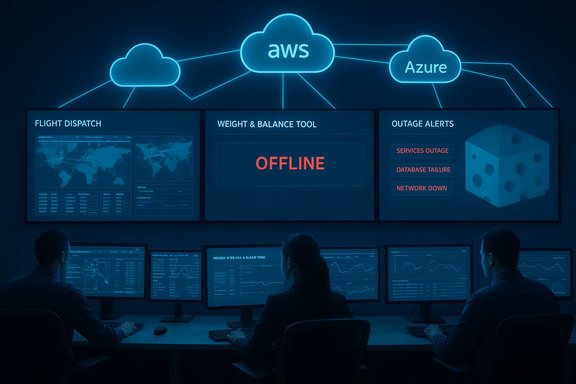
- A primary data-center failure in Seattle impacted core operational tooling, including a critical aircraft weight-and-balance calculator used in preflight dispatch and load planning. When that device became unreliable, airlines must err on the side of safety; the carrier canceled flights while teams revalidated manifests and restored accurate weight-and-balance data. The result was an immediate, high-impact operational disruption that required aircraft and crew repositioning and manual re-check processes at scale.
The hyperscaler edge outage (Azure Front Door)
- Days later, Microsoft reported an inadvertent configuration change in Azure Front Door — the company’s global Layer‑7 edge and application delivery fabric — which created widespread HTTP gateway errors, latency spikes and DNS routing anomalies. Because many consumer-facing airline flows (web check-in, mobile boarding pass delivery, API callbacks to ancillary services) are fronted by global edge services, the control-plane failure at Microsoft effectively cut off customers from the airline’s online portals even when the airlines’ backend compute remained healthy. This kind of control-plane event behaves like a “door slammed shut” at the network edge: origin servers can be fully operational but unreachable.
The compound effect
- The compound nature — an internal data-center outage followed by an external cloud control-plane failure — is what made the situation uniquely damaging. Manual processes that normally serve as fallbacks were overwhelmed, and the time needed to re-synchronize schedules and passenger flows stretched recovery windows. Investors, customers and regulators all took note.
The company’s response: audit, spending, and a public pivot toward cloud redundancy
Alaska Air Group engaged Accenture for a “top‑to‑bottom” audit of its IT estate and signaled a multiyear increase in technology investment, splitting spending between capital and operating budgets. The carrier’s CFO, Shane Tackett, told Bloomberg that the company will “incrementally be using more cloud to create redundancy and resiliency,” and that the review will inform whether the airline should continue to operate on-prem data centers or move more workloads to public cloud providers over time. Those comments were subsequently echoed in trade and market reports. Key public details about the remediation program:- A formal external audit with Accenture to map vulnerabilities, change‑control processes, and third‑party dependencies.
- An annual increment in technology spending described as “tens of millions” of dollars, apportioned between CAPEX and OPEX.
- A planned evaluation of multiple cloud providers (public mentions include Amazon Web Services and Microsoft Azure) as candidates for resilient architectures and active-active redundancy models.
Technical analysis: why the failures happened and what a credible cloud migration must fix
Why the data‑center outage escalated
The data-center failure exposed classic single-point-of-failure risk:- Critical stateful services (crew scheduling, weight-and-balance calculations, flight manifests) were concentrated in a limited number of physical locations without sufficiently automated, tested failover to a geographically isolated peer.
- Manual runbooks and human-dependent recovery steps became a bottleneck under load, extending the effective downtime as staff manually reconciled systems and processes.
Why an edge control‑plane outage is so damaging
Edge platforms like Azure Front Door perform TLS termination, global HTTP(S) load balancing, WAF protections and hostname mapping for millions of enterprise apps. A control-plane misconfiguration in such a fabric can:- Prevent requests from ever reaching origin servers.
- Break authentication/token flows that rely on centralized identity providers.
- Create DNS and cache tails that prolong perceived outage even after a rollback. Microsoft’s documentation confirms these functions and the operational role of Front Door in global routing and TLS termination.
What a robust cloud-first architecture must deliver
Moving workloads to cloud providers can deliver resiliency — but only when design and governance mitigate new classes of risk. Recommended architectural properties include:- Active‑active or warm‑standby deployments across multiple, geographically separate regions or providers to avoid single‑vendor or single‑region blast radii.
- Partitioned control-plane and management paths so that a single misconfiguration cannot propagate globally and operators retain out‑of‑band admin access.
- Independent identity and authentication fallbacks so token issuance is not a single point of failure for check‑in or boarding flows.
- Rigorous canarying, staged rollouts and automated rollback triggers in CI/CD pipelines to prevent global deployments of faulty configuration.
- Regular, realistic failover drills (including chaos engineering) that test human runbooks at operational scale.
Cloud choices: multi-cloud, multi-region, and vendor tradeoffs
Alaska’s public remarks — and subsequent press reconstructions — indicate the airline will evaluate providers including AWS and Azure. That is sensible: each hyperscaler offers different resilience primitives, geographic coverage and vendor-specific managed services that can accelerate migration. But migrating critical airline systems is not a binary “move to cloud” decision; it is a portfolio strategy involving:- Workload profiling (what must remain low-latency or close to operational systems vs. what can be cloud-hosted).
- Data residency and compliance mapping (crew and flight-safety systems frequently trigger stricter controls).
- A staged migration plan with pilot workloads, clear rollback and “lift-and-shift” vs. “re-architect” tradeoffs.
- Active‑Active Multi‑Region in a single cloud: cheaper operational model, fast recovery inside that cloud, but single-vendor risk remains.
- Multi‑Cloud Active‑Active: highest resilience to provider-specific control-plane failures, but complexity and cost rise sharply; data replication, networking and orchestration must be solved.
- Hybrid with on‑prem “safety islands”: keep a hardened, geographically dispersed on‑prem or colocation fallback for the most safety-critical tooling while migrating non-critical and customer-facing layers to cloud with multi-region failover.
Operational and organizational changes Alaska must adopt
A successful migration is as much organizational as technical. Key non-technical controls Alaska should adopt:- Executive sponsorship and a clear migration road map with measurable SLAs and RTO/RPO targets.
- Procurement and contract changes: incorporate SLA clauses, incident transparency requirements, and post-incident RCA commitments from hyperscalers into vendor agreements.
- Change management modernization: enforce deployment gates, automated validations and strict separation of duties for control-plane changes.
- Communications playbook: pre-prepared customer and airport messaging templates to minimize confusion and build trust during outages.
Market impact and investor perspective
The outages had visible market consequences. Share movement during early January showed investor sensitivity to the operational disruptions and the company’s revised spend profile. Quoted trading data around early January 2026 put Alaska’s share price near the high-$40s — a level that reflected investor concern but also expectations that the remediation and cloud investments could unlock stronger reliability and booking momentum later in 2026. Different market trackers and news wires show slightly varying daily closes, which is normal; for instance, a data aggregator reported a close of $49.98 on Jan 9, 2026, while other feeds confirm volatility in the surrounding trading days. Market writers have described Alaska’s planned tech investments as “tens of millions” annually, a material recurring outlay that will weigh on near-term free cash flow but could pay off through reduced cancellation risk and operational leverage. It’s important to treat near-term share price moves as noisy; the structural question investors will watch is whether Alaska’s reliability metrics (on-time performance, cancellations per 1,000 flights) improve measurably as new redundancy architectures come online. If they do, the airline will likely recapture booking momentum and regain a premium for reliability in business and leisure markets.Strengths of Alaska’s approach — and where risks remain
What’s promising:- The company engaged a top-tier consultancy (Accenture) to run an external audit rather than relying solely on internal incident reviews — a move that increases the chance of identifying governance and vendor‑management failings beyond narrow technical fixes.
- Public commitments to multi-year technology investment signal seriousness and provide runway for architectural rework that goes beyond quick patches.
- Management visibility and executive-level communications indicate the board understands the reputational and regulatory stakes.
- Vendor concentration: shifting to a cloud provider can reduce some failure modes but creates others; without multi‑path ingress, independent identity providers, and cross‑cloud fallbacks, the airline risks trading on‑prem single points for cloud control‑plane single points.
- Execution complexity: active-active, cross-region and multi-cloud setups are expensive and operationally demanding. Badly planned migrations can introduce data consistency and latency bugs that are just as dangerous operationally as outages.
- Organizational change: successful cloud migrations require developer and operations retraining, modernized runbooks, and dependable CI/CD pipelines. These cultural elements must be funded and led from the top.
Practical roadmap: phased technical steps Alaska should follow
- Short term (0–3 months)
- Complete the Accenture audit and publish a clear remediation plan with priorities and timelines.
- Map all control‑plane dependencies (DNS, identity, CDN, WAF) and identify three highest‑impact single points of failure.
- Implement out‑of‑band admin paths for critical services (emergency CLI/console access not reliant on the same edge fabric).
- Execute focused tabletop exercises for end‑to‑end passenger processing failover.
- Medium term (3–12 months)
- Migrate non-safety-critical customer touchpoints (web, mobile APIs) into a multi-region cloud configuration with geo-redundant backends and independent identity fallbacks.
- Introduce canary and staged deployments, automated rollbacks, and infrastructure-as-code for all environments.
- Negotiate vendor SLA enhancements with clarity on incident post-mortems and remediation commitments.
- Long term (12–36 months)
- Evaluate and pilot active‑active multi-cloud configurations for the highest‑availability customer flows where cost justifies the complexity.
- Harden on‑prem “safety islands” for mission-critical flight operations tooling until cloud-based equivalents are operability-proven and certified.
- Institutionalize continuous chaos testing and regular large-scale failover rehearsals.
Broader lessons for airlines and critical infrastructure operators
Alaska’s sequence of incidents is not unique — other carriers and sectors have faced the same control‑plane and data-center fragility. The episode crystallizes several industry-level takeaways:- Cloud convenience is not the same as cloud resiliency; the two must be engineered together with explicit multi-path, multi-provider fallbacks.
- Control planes deserve the same scarcity-of-failure thinking as power systems and network backbones; partitioning and staged deployment are essential.
- External audits and third‑party reviews are becoming standard governance steps for mission‑critical operators that rely on hyperscalers.
Conclusion
Alaska Air Group’s planned technological revamp — a blend of external audit findings, targeted investment, and a pivot to cloud-enabled redundancy — is a sensible and necessary response to a high‑visibility operational failure that impacted thousands of passengers. But the work ahead is hard: cloud migration is not a panacea and requires disciplined architecture, rigorous testing and improved governance to avoid recreating single points of failure in a different guise. The carrier’s commitment to spend and its engagement of Accenture are the right first steps; success will depend on disciplined execution, sensible multi‑path design, and the slow hardening of human and technical processes through repeated, realistic testing. The prize is clear: if Alaska can demonstrably improve reliability, it will restore passenger confidence and create a lasting competitive advantage.Source: techi.com The Alaska Air Technological Revamping after Flights Uneasiness