

Alaska Air Group is executing a major technology remediation program after a sequence of high‑impact outages exposed brittle on‑premises infrastructure and dangerous concentration of control‑plane dependencies in cloud edge services, prompting an external audit, increased technology spending, and a public pivot toward multi‑path redundancy.
Alaska Air’s outages in late 2025 combined two distinct failure modes: a primary data‑center hardware failure that disabled mission‑critical operational tooling and, days later, a global outage in Microsoft’s Azure Front Door edge fabric that degraded the airline’s public web and mobile flows. The twin incidents overlapped in time and effect, producing operational paralysis that required manual workarounds at scale and forced the carrier to bring in outside experts for a top‑to‑bottom review of its IT estate. Independent reconstructions and company disclosures place the operational toll in the hundreds of canceled flights and tens of thousands of disrupted itineraries: one commonly cited figure is roughly more than 400 canceled flights and about 49,000 passengers affected during the recovery period. These figures were reported to investors and the public during incident updates and helped trigger the formal Accenture engagement.
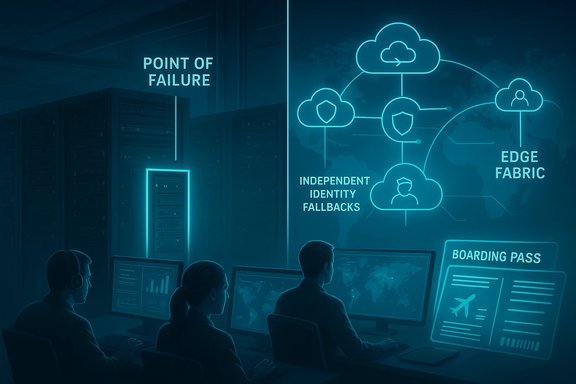
This compound mode also exposed a structural risk: moving some services to cloud platforms reduced certain operational exposures but left the airline susceptible to cloud control‑plane events that are out of the carrier’s direct control. In short, cloud migration without deliberate multi‑path ingress, independent identity fallbacks, and tested failover procedures exchanged one class of risk for another.
Source: Cargo Facts Alaska Air undertakes tech upgrades after painful outages
 Background
Alaska Air’s outages in late 2025 combined two distinct failure modes: a primary data‑center hardware failure that disabled mission‑critical operational tooling and, days later, a global outage in Microsoft’s Azure Front Door edge fabric that degraded the airline’s public web and mobile flows. The twin incidents overlapped in time and effect, producing operational paralysis that required manual workarounds at scale and forced the carrier to bring in outside experts for a top‑to‑bottom review of its IT estate. Independent reconstructions and company disclosures place the operational toll in the hundreds of canceled flights and tens of thousands of disrupted itineraries: one commonly cited figure is roughly more than 400 canceled flights and about 49,000 passengers affected during the recovery period. These figures were reported to investors and the public during incident updates and helped trigger the formal Accenture engagement. What happened — a concise timeline and technical anatomy
The on‑prem data‑center failure (late October 2025)
A primary operations site suffered a hardware or site failure that took key flight‑dispatch tooling offline — notably, a critical aircraft weight‑and‑balance calculator and related preflight planning systems. That single‑site impact removed automated decision support used to validate manifests and load planning, forcing dispatch teams to delay or cancel flights until safe operational parameters could be re‑verified manually. The immediate operational outcome was a mass disruption that cascaded through crew positioning and aircraft rotations.The Azure Front Door outage (29 October 2025)
On October 29, 2025, Microsoft reported an inadvertent configuration change in Azure Front Door (AFD) — Microsoft’s global Layer‑7 ingress, routing and application delivery fabric — which produced widespread HTTP gateway errors, authentication failures and DNS/routing anomalies for tenants that rely on AFD as the canonical public entry point. Because AFD performs ingress, TLS termination, URL routing and identity callbacks for many services, a control‑plane error produced a high blast radius: origin services remained operable in many cases but were unreachable from customers and admin portals until the edge fabric was remediated. Microsoft and multiple downstream status pages describe the proximate trigger as an accidental tenant configuration deployment and catalogue the phased rollback and re‑balancing Microsoft performed to restore service. The observable effect for Alaska and other affected organizations was simple but severe: customers could not check in via website or app, boarding‑pass issuance and ancillary commerce failed, and airports reverted to paper boarding passes and manual baggage workflows — operations that dramatically slowed processing throughput and amplified delay cascades.Why the combination was uniquely damaging
Airline operations rely on tight orchestration: aircraft, crews, gates and passenger flows are all choreographed to tight margins. The two faults that hit Alaska in close succession — an internal single‑site failure that removed the airline’s internal dispatch automation, followed by an external global edge outage that prevented customers and some operational staff from accessing cloud‑hosted portals — produced a “Swiss‑cheese” alignment where multiple defensive layers failed simultaneously. Manual fallbacks that normally mitigate isolated problems were overwhelmed when both internal control and external customer touchpoints were impaired.This compound mode also exposed a structural risk: moving some services to cloud platforms reduced certain operational exposures but left the airline susceptible to cloud control‑plane events that are out of the carrier’s direct control. In short, cloud migration without deliberate multi‑path ingress, independent identity fallbacks, and tested failover procedures exchanged one class of risk for another.
Alaska Air’s immediate and strategic response
- Engaged Accenture for a full, independent audit of its IT estate and recovery processes. The audit’s remit includes architecture, change management, vendor dependencies and incident response playbooks.
- Announced a multiyear increase in technology spending described publicly as “tens of millions” annually to harden redundancy and implement remediation actions. Management has signalled that this spend will be split across capital and operating budgets.
- Implemented short‑term tactical fixes: additional storage and network switching capacity, emergency runbook hardening, and prioritized remediation for the most critical single‑point systems. These measures are intended to stabilize operations while the audit completes and strategic design work begins.
Technical diagnosis — root causes and systemic failures
Architectural factors
- Single primary site for safety‑adjacent tooling. Critical flight‑dispatch systems were dependent on a single on‑premises primary data center without an adequately tested hot failover, creating a classic single‑point failure.
- Concentrated control‑plane dependency. Guest‑facing and some operational flows relied on AFD. A control‑plane error in AFD made many otherwise healthy origins unreachable, demonstrating that edge fabrics, while powerful, centralize risk if not architected with multiple ingress paths.
- Hybrid complexity. The airline’s hybrid estate—mixed legacy, on‑prem and cloud—introduced migration friction and operational complexity that makes full active‑active redundancy more difficult and expensive.
Process and governance factors
- Change management and canarying gaps. The Azure incident illustrates the need for staged deployment controls, multi‑actor approvals for wide‑scope ingress changes, and effective canarying that would catch bad configurations before they propagate globally. Microsoft’s own post‑incident actions included blocking further AFD changes and rolling back to a last‑known‑good configuration, underscoring the right containment steps but also the need for better preventive controls.
- Insufficient live failover rehearsals. Manual runbooks and offline procedures were overwhelmed; routine, realistic failover drills and chaos‑testing are required to harden human processes and ensure that practiced responses scale when needed.
Cross‑validation of the key facts
The most load‑bearing data points from the outages are corroborated across multiple independent sources: Reuters reported that Alaska Air will partner with Accenture for a systems audit after the outage and cited the disruption magnitude (400+ cancellations, ~49,000 passengers). Microsoft’s status updates and third‑party trackers confirm an inadvertent Azure Front Door configuration change as the proximate trigger for the global edge outage that affected many tenants, including airlines and major consumer brands. Those two lines of reporting — carrier filings and hyperscaler incident updates — together validate the broad operational narrative. Where numbers diverge in early reporting (some outlets initially reported different cancellation totals), that variance is normal in fast‑moving incidents and is resolved only when the carrier submits reconciled operational filings and regulatory disclosures. Alaska itself acknowledged that early metrics were provisional while teams reconciled manifests.A practical technical roadmap (recommended, and aligned with Alaska’s signals)
The following phased program synthesizes industry best practices with the remedial commitments Alaska has signalled. It balances immediacy with realistic execution complexity.Immediate stabilization (0–3 months)
- Harden the top three single‑point failures with hot standby or synchronous replication.
- Create out‑of‑band admin/management access paths for critical controls (console/CLI access not dependent on the same edge fabric).
- Stand up a dedicated Resilience War Room and publish short‑term KPIs (MTTR, MTTD, number of customer‑impacting incidents).
Short term (3–12 months)
- Complete the Accenture audit and triage remediation items into a prioritized backlog with published milestones.
- Migrate non‑safety‑critical customer systems into a multi‑region configuration with independent identity fallbacks and a staged canary rollout process.
- Implement automated rollback gates and canary metrics in CI/CD pipelines for control‑plane changes.
Medium/long term (12–36 months)
- Adopt an active‑active or active‑passive multi‑cloud posture for high‑availability customer touchpoints where justified by risk/reward analysis.
- Maintain hardened, geographically separated on‑prem “safety islands” for safety‑adjacent systems until cloud equivalents are proven by live failover drills and regulatory acceptance.
- Institute continuous chaos engineering, quarterly failover rehearsals, and published resilience scorecards to rebuild stakeholder confidence.
Tradeoffs and material risks of the chosen path
- Vendor concentration risk shifts rather than vanishes. Moving workloads to a single hyperscaler reduces certain operational burdens but concentrates control‑plane risk in another place. A robust approach is explicitly multi‑path: multi‑region and multi‑cloud ingress, independent identity providers, and on‑prem fallback islands.
- Cost and complexity. Active‑active multi‑cloud architectures add measurable cost and operational overhead: cross‑cloud networking, data replication, and consistent orchestration are nontrivial engineering projects that increase both CAPEX and OPEX.
- Migration risk for safety‑adjacent systems. Replatforming deeply integrated dispatch and weight‑and‑balance tooling is high risk. A hurried lift‑and‑shift could introduce subtle consistency errors; staged re‑architecture with robust simulation and certification is required.
- Expectation management. Investors may demand quick results, but architectural remediation that measurably reduces cancellation counts and improves on‑time performance is inherently medium‑term. Transparent milestone reporting is necessary to maintain market confidence.
Industry and regulatory implications
Alaska’s outages are part of a broader pattern in which hyperscaler control‑plane failures have produced outsized downstream effects on critical infrastructure sectors. That pattern is already prompting conversations about tighter vendor accountability, incident disclosure, and minimum resilience obligations for safety‑adjacent services. Expect two probable developments:- Regulators and industry bodies will press for more rigorous resilience testing and possibly stronger disclosure rules for incidents that affect public transport reliability.
- Large enterprises in critical sectors will demand contractual SLAs, audit rights and co‑ordinated post‑incident remediations from cloud vendors — and may insist on documented, tested failover playbooks as part of procurement.
Investor and business impacts
The outages imposed immediate, quantifiable costs — reaccommodation, refunds, overtime and lost ancillary revenue — and broader reputational damage that depresses future bookings and loyalty metrics. Alaska temporarily revised guidance and paused investor communications while it quantified impacts and designed remediation budgets. Market participants reacted to the uncertainty with downward pressure on the stock in the incident window; management’s public commitment to multi‑year tech investment is therefore intended to reassure investors that structural steps are being taken. Those investments will weigh on near‑term free cash flow but are defensible if they materially reduce the frequency and severity of customer‑impacting incidents.Strengths of Alaska’s approach — what’s encouraging
- Commissioning a recognized systems integrator (Accenture) for an independent audit is the right governance move: external teams can surface cross‑domain failures that internal reviews may miss.
- Public acknowledgements and concrete funding signals help restore stakeholder trust when paired with measurable milestones.
- The carrier’s stated focus on redundancy and resilience — rather than defensive secrecy — increases the likelihood the remediation will be comprehensive rather than incremental patching.
Remaining unknowns and cautionary flags
- Precise causal chains remain partially opaque: Microsoft’s post‑incident reports describe an inadvertent AFD configuration change but the detailed human or software action that allowed the faulty deployment to bypass safeguards will be clarified only in Microsoft’s final post‑incident review and in tenant‑level logs that are not public. Until those are published, some operational attributions will remain provisional.
- The exact scope and timetable of Alaska’s remediation spend — quoted as “tens of millions” — is a corporate estimate. The final price tag, including ongoing OPEX increases for multi‑cloud redundancy, could exceed initial public statements depending on architectural choices.
Bottom line — what this episode teaches enterprise IT leaders
- Architect for control‑plane failure: treat ingress, DNS, and identity as first‑class resilience concerns and build alternate administrative paths.
- Test people as much as systems: realistic, repeated failover rehearsals and chaos exercises expose weak runbooks before a customer‑impacting incident.
- Avoid binary thinking: the right posture for critical infrastructure is hybrid resilience — a blend of hardened on‑prem safety islands, multi‑region cloud, and cross‑provider fallbacks.
- Expect higher procurement standards: demand incident transparency, contractual RCAs, and tested remediation commitments from hyperscalers.
Conclusion
Alaska Air Group’s public pivot — an external Accenture audit, tactical near‑term hardening, and a stated multi‑year investment to enable cloud‑backed redundancy — is the correct and necessary response to a dual‑mode outage that combined an on‑prem data‑center failure with a global cloud edge control‑plane incident. The work ahead is technically difficult and organizationally demanding: migrating safety‑adjacent systems, instituting multi‑path ingress and modernizing change governance will cost money and require cultural change. Yet these steps are essential: modern airline operations cannot tolerate brittle single points of failure, whether they live in a server room in Seattle or in a hyperscaler’s global edge fabric. The carriers and cloud providers that learn these lessons, invest in disciplined architecture and publicly measure resilience will be the ones that turn a costly crisis into durable competitive advantage.Source: Cargo Facts Alaska Air undertakes tech upgrades after painful outages
