

Alef Education completed a two-year migration of its digital learning ecosystem to Microsoft Azure on June 4, 2026, moving 14 environments with help from Microsoft, Core42, and Xebia to support AI-powered education services for schools, teachers, and students worldwide. The announcement is not just another cloud win for Microsoft; it is a signal that education technology is being pulled into the same sovereignty-and-AI bargain now reshaping government, healthcare, finance, and critical infrastructure. Alef’s move matters because learning platforms are no longer peripheral classroom tools. They are becoming national-scale data systems that must be fast, intelligent, compliant, and politically trustworthy all at once.
Alef Education’s migration to Azure is being framed as a technical milestone, but the more interesting story is strategic. A UAE-based education technology company has moved its full digital learning ecosystem onto Microsoft’s global cloud while leaning on Core42’s sovereign cloud capabilities, including its Insight controls platform. That combination tells us where large-scale education platforms are headed: not simply to the cloud, but to clouds wrapped in local governance, jurisdictional assurances, and AI-readiness.
The numbers are substantial. Alef says its platform supports more than 2 million students, 84,000 teachers, and 19,000 schools worldwide. That makes the migration less like a software vendor changing hosting providers and more like a public-sector-adjacent infrastructure shift, because the service touches children, educators, schools, and government education systems at meaningful scale.
The project also took time. According to the announcement, the initiative ran for two years, with one year of planning and one year of execution, and involved 165 specialists across Alef Education, Microsoft, Core42, and Xebia. In enterprise IT terms, that is the opposite of a lift-and-shift press release dressed up as transformation. It suggests a controlled, staged re-platforming effort across production, testing, data, and operational environments.
For Microsoft, the win lands at the intersection of three priorities it has been pushing hard: Azure growth, AI workloads, and sovereign cloud adoption. For Alef, it offers scale and partner reach. For the wider market, it shows that edtech platforms trying to sell into governments and regulated education systems increasingly need to answer the same uncomfortable questions as banks and ministries: where does the data live, who controls it, who can audit it, and how safely can AI be layered on top?
That model is fading. The modern AI learning platform wants to observe how students progress, identify gaps, recommend interventions, generate insights for teachers, and potentially adapt content to individual learners. Those features depend on data pipelines, analytics, identity, security, compute elasticity, and machine-learning infrastructure that are difficult to maintain credibly on fragmented or aging infrastructure.
Alef’s Azure migration should be understood in that context. The announcement repeatedly ties the move to security, scalability, resilience, and AI-powered education. Those are not decorative terms. If an education platform is expected to serve millions of students while producing timely insights for teachers, it needs infrastructure that can absorb seasonal traffic spikes, regional deployments, analytics workloads, and future AI services without turning every expansion into a bespoke engineering project.
This is where Azure gives Microsoft an obvious pitch. It can offer global infrastructure, enterprise identity, monitoring, security tooling, data services, and AI services under one commercial and technical umbrella. For customers that already sell to governments or school networks, that bundle is attractive because procurement teams often prefer fewer accountable vendors over a constellation of niche providers.
But the move also increases dependency. Once a learning company centralizes its platform on Azure, its roadmap becomes more closely tied to Microsoft’s pricing, regional availability, compliance posture, service reliability, and AI platform direction. That is not necessarily a bad trade, but it is a real one. Cloud migrations simplify some problems by concentrating them elsewhere.
That matters because education data is sensitive in a uniquely political way. It includes children’s identities, performance histories, behavioral signals, school affiliations, teacher interactions, and potentially government-linked records. When AI is introduced, the stakes rise again, because the platform may infer things about learning ability, risk, intervention needs, or future academic pathways.
Governments therefore do not want only a fast cloud. They want assurances about residency, control, access, auditability, and legal exposure. A hyperscale platform may provide the compute and services, but sovereign controls help make the arrangement sellable to public institutions that must answer to domestic regulators and political leadership.
The UAE context is especially important. The country has spent years positioning itself as an AI and digital government hub, and partnerships involving Microsoft, G42, Core42, and local institutions sit inside that wider national strategy. Alef’s migration becomes one more example of a model the UAE is trying to export: use global cloud infrastructure, wrap it in local sovereignty mechanisms, and apply it to sectors where trust is as important as performance.
For WindowsForum readers, this is a familiar pattern wearing a new vertical-market jacket. The same concerns that enterprise admins debate around Microsoft 365, Entra ID, Azure regions, government cloud, and data boundaries are now appearing in K-12 and national education technology. The classroom is becoming another regulated endpoint in the cloud sovereignty debate.
Once Alef is fully on Azure and formally inside Microsoft’s partner ecosystem, it becomes easier to package its services for governments, schools, and private education operators already standardizing around Microsoft cloud contracts. In many markets, Microsoft is not merely a technology supplier; it is a procurement pathway, a compliance vocabulary, and a trusted enterprise brand.
That partner status can help Alef sell beyond the UAE, particularly where ministries and large school operators prefer vendors with hyperscaler-backed security and scalability claims. It also gives Microsoft a vertical AI story in education at a time when every major cloud provider is trying to prove that AI is not just a developer demo but a sector-specific productivity engine.
The quotes from Microsoft’s UAE public-sector leadership emphasize personalized, engaging, effective education and teacher insight. That is the language of AI optimism, but it is also the language of platform expansion. The more educational workflows become data-driven, the more infrastructure providers become embedded in the daily operation of schools.
This is the understated power of cloud strategy. Microsoft does not need to own the curriculum or run the classroom to become central to education. It needs to provide the trusted substrate on which increasingly intelligent classroom systems run. Alef’s migration advances that substrate strategy.
Core42 describes sovereign architecture as essential for AI-powered services reaching millions of students and educators. That claim is persuasive because AI systems amplify governance problems. It is one thing to store educational records securely. It is another to train, tune, query, or infer from those records in ways that schools, parents, ministries, and regulators can understand and control.
The challenge is that “sovereign cloud” can mean different things depending on the vendor, country, workload, and contract. Sometimes it means data residency. Sometimes it means local operations personnel. Sometimes it means encryption controls, legal isolation, policy enforcement, audit tooling, or national ownership structures. The phrase is useful but slippery.
That is why the presence of a named controls platform matters. Insight gives the partnership something more concrete to point to than a vague promise of local trust. Still, customers will need to evaluate what controls are technical, what controls are contractual, and what controls are operational. Sovereignty is not a checkbox; it is an architecture and a governance model that must hold up under audits, incidents, and political pressure.
For Alef, the bet is that Core42 helps answer those questions before they become blockers in government procurement. For Microsoft, it creates a partner-mediated route into sovereign workloads. For schools and ministries, the practical test will be whether the architecture produces clearer accountability or simply adds another layer of vendor complexity.
Fourteen environments is a useful clue. Large digital ecosystems usually have development, staging, production, analytics, regional, integration, and disaster-recovery surfaces that cannot simply be copied into a new cloud region over a weekend. Each environment carries configuration drift, security assumptions, integration points, and operational habits.
The one-year planning period is equally revealing. Serious migrations begin before the first workload moves. Teams must decide what to rehost, refactor, retire, replace, or rebuild. They must identify data gravity, latency constraints, compliance boundaries, identity dependencies, and vendor integrations. If the migration is tied to AI capabilities, they must also think about future data architecture rather than merely reproducing yesterday’s topology in a new hosting account.
This is where many organizations underappreciate the work. A successful cloud migration is less about moving servers and more about deciding which operational model the company wants to become. Alef’s announcement suggests that the migration was treated as a strategic transformation, not a hosting substitution. That is the right framing, even if the public details are necessarily selective.
That benefits the hyperscalers. Microsoft, Google, and Amazon Web Services all want educational workloads, but Microsoft has a particular advantage in institutional environments where Windows, Office, Teams, identity, endpoint management, and Azure already have a strong footprint. A learning platform built on Azure can be presented as part of a broader digital education stack rather than a standalone tool.
At the same time, the market is not just about convenience. Governments increasingly view cloud and AI platforms through lenses of national capability, economic strategy, and digital sovereignty. Education is part of that because schooling shapes future workforces and produces some of the richest longitudinal data a state can hold.
Alef’s migration therefore sits at the intersection of commercial expansion and national digital policy. The company gains infrastructure and go-to-market reach. Microsoft gains a flagship regional education workload. Core42 strengthens its sovereign cloud positioning. The UAE gets another proof point for its ambition to be seen as a secure AI innovation hub.
The open question is whether that model travels cleanly outside the UAE. Different countries have different data laws, procurement rules, political sensitivities, and cloud preferences. A sovereign cloud story that works in one jurisdiction may need substantial adaptation in another. Alef’s global ambitions will depend not just on Azure’s footprint but on the company’s ability to localize trust.
Cloud infrastructure can help build that confidence, but it cannot guarantee it. Security incidents, misconfigured permissions, weak governance, opaque AI models, or poorly explained data use can undermine even the most sophisticated architecture. Azure and sovereign controls provide tools; institutional trust comes from how those tools are implemented and governed.
Alef’s next challenge will be proving that the migration translates into visible improvements. Faster performance, better availability, richer analytics, smoother scaling, and stronger administrative controls are outcomes that customers can observe. AI promises are harder. Personalized education is an appealing phrase, but schools will want evidence that personalization improves learning rather than merely increasing dashboard complexity.
There is also a teacher adoption problem. AI learning platforms often promise to reduce burden by surfacing insights and automating routine analysis. In practice, badly designed systems can create more alerts, more metrics, and more administrative interpretation work. If Alef’s Azure foundation enables more intelligent services, the company will still need to make those services fit naturally into classroom workflows.
That is the distinction between infrastructure success and product success. The migration may be complete, but the educational value of the migration is still ahead. The platform has moved; now the user experience has to justify the move.
That pattern is likely to repeat across healthcare, transportation, public safety, utilities, financial services, and education. Organizations are not adopting AI in isolation; they are reworking cloud architecture so AI can be deployed with enough governance to survive procurement, audit, and public scrutiny. The infrastructure decision becomes the AI decision.
For Windows-heavy environments, the implications are practical. Identity integration, endpoint access, Teams or Microsoft 365 adjacency, Azure monitoring, security operations, and compliance reporting all become part of the educational platform conversation. A school system buying an AI learning platform may indirectly be deepening its Microsoft stack even if the purchase order is written for edtech.
Admins should also notice the scale of coordination. A two-year program involving 165 specialists is a reminder that serious migrations require governance and patience. The promise of cloud elasticity does not eliminate architecture discipline. If anything, AI-era workloads make that discipline more important because data flows, model interactions, and compliance obligations multiply quickly.
The lesson is not that every organization should copy Alef’s exact vendor mix. The lesson is that cloud, AI, and sovereignty are now being bought together. Treating them as separate projects will increasingly look outdated.
Alef now has a cleaner story to tell governments and private school partners. It can say its platform runs on Azure, uses sovereign controls through Core42, and has completed a complex multi-environment migration. That is a strong enterprise sales narrative.
But the same narrative creates pressure. If the platform is now more scalable, customers will expect expansion without degradation. If it is more secure, they will expect transparent governance and strong incident response. If it is more intelligent, they will expect AI features that are meaningful, explainable, and educationally useful.
This is the bargain of modernization. Successful migration removes excuses. It creates the conditions for better products, but it also makes customers less patient with old limitations. Alef’s technical milestone is therefore also a product-management deadline.
The company’s collaboration with Microsoft and Core42 gives it a powerful foundation. Whether that becomes durable advantage will depend on execution in classrooms, ministries, and markets far beyond the migration team.
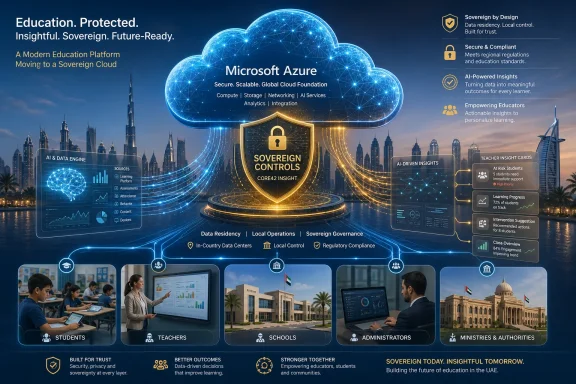 Alef Moves the Classroom Into the Sovereign Cloud Era
Alef Education’s migration to Azure is being framed as a technical milestone, but the more interesting story is strategic. A UAE-based education technology company has moved its full digital learning ecosystem onto Microsoft’s global cloud while leaning on Core42’s sovereign cloud capabilities, including its Insight controls platform. That combination tells us where large-scale education platforms are headed: not simply to the cloud, but to clouds wrapped in local governance, jurisdictional assurances, and AI-readiness.The numbers are substantial. Alef says its platform supports more than 2 million students, 84,000 teachers, and 19,000 schools worldwide. That makes the migration less like a software vendor changing hosting providers and more like a public-sector-adjacent infrastructure shift, because the service touches children, educators, schools, and government education systems at meaningful scale.
The project also took time. According to the announcement, the initiative ran for two years, with one year of planning and one year of execution, and involved 165 specialists across Alef Education, Microsoft, Core42, and Xebia. In enterprise IT terms, that is the opposite of a lift-and-shift press release dressed up as transformation. It suggests a controlled, staged re-platforming effort across production, testing, data, and operational environments.
For Microsoft, the win lands at the intersection of three priorities it has been pushing hard: Azure growth, AI workloads, and sovereign cloud adoption. For Alef, it offers scale and partner reach. For the wider market, it shows that edtech platforms trying to sell into governments and regulated education systems increasingly need to answer the same uncomfortable questions as banks and ministries: where does the data live, who controls it, who can audit it, and how safely can AI be layered on top?
AI Learning Has Outgrown the Old Edtech Stack
A decade ago, digital education platforms could get away with being primarily content-delivery systems. They hosted lessons, quizzes, dashboards, and gradebooks. The operational challenge was uptime during school hours, not real-time inference, personalized sequencing, sovereign controls, and cross-border commercial expansion.That model is fading. The modern AI learning platform wants to observe how students progress, identify gaps, recommend interventions, generate insights for teachers, and potentially adapt content to individual learners. Those features depend on data pipelines, analytics, identity, security, compute elasticity, and machine-learning infrastructure that are difficult to maintain credibly on fragmented or aging infrastructure.
Alef’s Azure migration should be understood in that context. The announcement repeatedly ties the move to security, scalability, resilience, and AI-powered education. Those are not decorative terms. If an education platform is expected to serve millions of students while producing timely insights for teachers, it needs infrastructure that can absorb seasonal traffic spikes, regional deployments, analytics workloads, and future AI services without turning every expansion into a bespoke engineering project.
This is where Azure gives Microsoft an obvious pitch. It can offer global infrastructure, enterprise identity, monitoring, security tooling, data services, and AI services under one commercial and technical umbrella. For customers that already sell to governments or school networks, that bundle is attractive because procurement teams often prefer fewer accountable vendors over a constellation of niche providers.
But the move also increases dependency. Once a learning company centralizes its platform on Azure, its roadmap becomes more closely tied to Microsoft’s pricing, regional availability, compliance posture, service reliability, and AI platform direction. That is not necessarily a bad trade, but it is a real one. Cloud migrations simplify some problems by concentrating them elsewhere.
Sovereignty Is No Longer a Regional Add-On
The Core42 piece of this announcement is what prevents the story from being merely “edtech company moves to Azure.” Core42, part of the UAE’s broader AI and cloud ecosystem, provides sovereign cloud capabilities designed for regulated industries and public-sector customers. Its Insight platform is positioned as a controls layer for data sovereignty, compliance, and governance concerns.That matters because education data is sensitive in a uniquely political way. It includes children’s identities, performance histories, behavioral signals, school affiliations, teacher interactions, and potentially government-linked records. When AI is introduced, the stakes rise again, because the platform may infer things about learning ability, risk, intervention needs, or future academic pathways.
Governments therefore do not want only a fast cloud. They want assurances about residency, control, access, auditability, and legal exposure. A hyperscale platform may provide the compute and services, but sovereign controls help make the arrangement sellable to public institutions that must answer to domestic regulators and political leadership.
The UAE context is especially important. The country has spent years positioning itself as an AI and digital government hub, and partnerships involving Microsoft, G42, Core42, and local institutions sit inside that wider national strategy. Alef’s migration becomes one more example of a model the UAE is trying to export: use global cloud infrastructure, wrap it in local sovereignty mechanisms, and apply it to sectors where trust is as important as performance.
For WindowsForum readers, this is a familiar pattern wearing a new vertical-market jacket. The same concerns that enterprise admins debate around Microsoft 365, Entra ID, Azure regions, government cloud, and data boundaries are now appearing in K-12 and national education technology. The classroom is becoming another regulated endpoint in the cloud sovereignty debate.
Microsoft Gets More Than a Customer Win
Microsoft’s role in this story is commercially obvious but strategically deeper. Alef is now recognized as a verified Microsoft Partner, according to the announcement, opening expanded go-to-market opportunities through Microsoft’s global network. That matters because platform migrations often become sales-channel alignments.Once Alef is fully on Azure and formally inside Microsoft’s partner ecosystem, it becomes easier to package its services for governments, schools, and private education operators already standardizing around Microsoft cloud contracts. In many markets, Microsoft is not merely a technology supplier; it is a procurement pathway, a compliance vocabulary, and a trusted enterprise brand.
That partner status can help Alef sell beyond the UAE, particularly where ministries and large school operators prefer vendors with hyperscaler-backed security and scalability claims. It also gives Microsoft a vertical AI story in education at a time when every major cloud provider is trying to prove that AI is not just a developer demo but a sector-specific productivity engine.
The quotes from Microsoft’s UAE public-sector leadership emphasize personalized, engaging, effective education and teacher insight. That is the language of AI optimism, but it is also the language of platform expansion. The more educational workflows become data-driven, the more infrastructure providers become embedded in the daily operation of schools.
This is the understated power of cloud strategy. Microsoft does not need to own the curriculum or run the classroom to become central to education. It needs to provide the trusted substrate on which increasingly intelligent classroom systems run. Alef’s migration advances that substrate strategy.
Core42’s Sovereign Layer Is the Political Glue
Core42’s involvement gives the announcement its regional and regulatory logic. A global hyperscaler can bring scale, but sovereign cloud partners can make that scale palatable in markets where national control over data is a first-order concern. The combination lets Microsoft participate in sensitive sectors without asking every customer to accept a generic public-cloud trust model.Core42 describes sovereign architecture as essential for AI-powered services reaching millions of students and educators. That claim is persuasive because AI systems amplify governance problems. It is one thing to store educational records securely. It is another to train, tune, query, or infer from those records in ways that schools, parents, ministries, and regulators can understand and control.
The challenge is that “sovereign cloud” can mean different things depending on the vendor, country, workload, and contract. Sometimes it means data residency. Sometimes it means local operations personnel. Sometimes it means encryption controls, legal isolation, policy enforcement, audit tooling, or national ownership structures. The phrase is useful but slippery.
That is why the presence of a named controls platform matters. Insight gives the partnership something more concrete to point to than a vague promise of local trust. Still, customers will need to evaluate what controls are technical, what controls are contractual, and what controls are operational. Sovereignty is not a checkbox; it is an architecture and a governance model that must hold up under audits, incidents, and political pressure.
For Alef, the bet is that Core42 helps answer those questions before they become blockers in government procurement. For Microsoft, it creates a partner-mediated route into sovereign workloads. For schools and ministries, the practical test will be whether the architecture produces clearer accountability or simply adds another layer of vendor complexity.
Xebia’s Role Points to the Unfashionable Work Behind Cloud Transformation
The migration also involved Xebia, which had previously been associated with the effort to move Alef’s applications, infrastructure, and data to Azure. That detail matters because cloud transformation is often sold as a platform story but delivered as a systems-integration grind. The glamorous pieces are AI, sovereignty, and global scale; the hard pieces are dependency mapping, cutover planning, observability, data migration, test environments, rollback paths, and staff coordination.Fourteen environments is a useful clue. Large digital ecosystems usually have development, staging, production, analytics, regional, integration, and disaster-recovery surfaces that cannot simply be copied into a new cloud region over a weekend. Each environment carries configuration drift, security assumptions, integration points, and operational habits.
The one-year planning period is equally revealing. Serious migrations begin before the first workload moves. Teams must decide what to rehost, refactor, retire, replace, or rebuild. They must identify data gravity, latency constraints, compliance boundaries, identity dependencies, and vendor integrations. If the migration is tied to AI capabilities, they must also think about future data architecture rather than merely reproducing yesterday’s topology in a new hosting account.
This is where many organizations underappreciate the work. A successful cloud migration is less about moving servers and more about deciding which operational model the company wants to become. Alef’s announcement suggests that the migration was treated as a strategic transformation, not a hosting substitution. That is the right framing, even if the public details are necessarily selective.
The Education Sector Is Becoming a Cloud Battleground
Education has always been a tempting market for technology vendors because it is large, socially important, and institutionally sticky. But AI changes the vendor calculus. Platforms that once competed on content libraries or classroom usability now compete on analytics, adaptive learning, data governance, integration, and trust.That benefits the hyperscalers. Microsoft, Google, and Amazon Web Services all want educational workloads, but Microsoft has a particular advantage in institutional environments where Windows, Office, Teams, identity, endpoint management, and Azure already have a strong footprint. A learning platform built on Azure can be presented as part of a broader digital education stack rather than a standalone tool.
At the same time, the market is not just about convenience. Governments increasingly view cloud and AI platforms through lenses of national capability, economic strategy, and digital sovereignty. Education is part of that because schooling shapes future workforces and produces some of the richest longitudinal data a state can hold.
Alef’s migration therefore sits at the intersection of commercial expansion and national digital policy. The company gains infrastructure and go-to-market reach. Microsoft gains a flagship regional education workload. Core42 strengthens its sovereign cloud positioning. The UAE gets another proof point for its ambition to be seen as a secure AI innovation hub.
The open question is whether that model travels cleanly outside the UAE. Different countries have different data laws, procurement rules, political sensitivities, and cloud preferences. A sovereign cloud story that works in one jurisdiction may need substantial adaptation in another. Alef’s global ambitions will depend not just on Azure’s footprint but on the company’s ability to localize trust.
The Real Product Is Confidence
The most important word in the announcement may not be “AI.” It may be “trusted.” In education technology, trust is the scarce resource. Parents need to trust that children’s data is not being mishandled. Teachers need to trust that AI-generated insights help rather than surveil them. Governments need to trust that platforms comply with policy. Schools need to trust that services will not fail during exams, term starts, or national rollouts.Cloud infrastructure can help build that confidence, but it cannot guarantee it. Security incidents, misconfigured permissions, weak governance, opaque AI models, or poorly explained data use can undermine even the most sophisticated architecture. Azure and sovereign controls provide tools; institutional trust comes from how those tools are implemented and governed.
Alef’s next challenge will be proving that the migration translates into visible improvements. Faster performance, better availability, richer analytics, smoother scaling, and stronger administrative controls are outcomes that customers can observe. AI promises are harder. Personalized education is an appealing phrase, but schools will want evidence that personalization improves learning rather than merely increasing dashboard complexity.
There is also a teacher adoption problem. AI learning platforms often promise to reduce burden by surfacing insights and automating routine analysis. In practice, badly designed systems can create more alerts, more metrics, and more administrative interpretation work. If Alef’s Azure foundation enables more intelligent services, the company will still need to make those services fit naturally into classroom workflows.
That is the distinction between infrastructure success and product success. The migration may be complete, but the educational value of the migration is still ahead. The platform has moved; now the user experience has to justify the move.
Windows and Azure Admins Should Read This as a Pattern
For IT pros, Alef’s announcement is a useful case study because it compresses several current enterprise trends into one project. A sector-specific application provider moves its full ecosystem to Azure. The migration is tied to AI enablement. Sovereign cloud controls are used to satisfy regulated-market requirements. A systems integrator handles the messy operational work. Partner status turns infrastructure alignment into a sales motion.That pattern is likely to repeat across healthcare, transportation, public safety, utilities, financial services, and education. Organizations are not adopting AI in isolation; they are reworking cloud architecture so AI can be deployed with enough governance to survive procurement, audit, and public scrutiny. The infrastructure decision becomes the AI decision.
For Windows-heavy environments, the implications are practical. Identity integration, endpoint access, Teams or Microsoft 365 adjacency, Azure monitoring, security operations, and compliance reporting all become part of the educational platform conversation. A school system buying an AI learning platform may indirectly be deepening its Microsoft stack even if the purchase order is written for edtech.
Admins should also notice the scale of coordination. A two-year program involving 165 specialists is a reminder that serious migrations require governance and patience. The promise of cloud elasticity does not eliminate architecture discipline. If anything, AI-era workloads make that discipline more important because data flows, model interactions, and compliance obligations multiply quickly.
The lesson is not that every organization should copy Alef’s exact vendor mix. The lesson is that cloud, AI, and sovereignty are now being bought together. Treating them as separate projects will increasingly look outdated.
The Migration Leaves Alef With Less Room to Hide
There is a subtle accountability shift after a migration like this. Before, performance or scale limitations could be attributed to legacy infrastructure, fragmented hosting, or the complexity of transition. Afterward, the platform is supposed to be ready for the future. That raises expectations.Alef now has a cleaner story to tell governments and private school partners. It can say its platform runs on Azure, uses sovereign controls through Core42, and has completed a complex multi-environment migration. That is a strong enterprise sales narrative.
But the same narrative creates pressure. If the platform is now more scalable, customers will expect expansion without degradation. If it is more secure, they will expect transparent governance and strong incident response. If it is more intelligent, they will expect AI features that are meaningful, explainable, and educationally useful.
This is the bargain of modernization. Successful migration removes excuses. It creates the conditions for better products, but it also makes customers less patient with old limitations. Alef’s technical milestone is therefore also a product-management deadline.
The company’s collaboration with Microsoft and Core42 gives it a powerful foundation. Whether that becomes durable advantage will depend on execution in classrooms, ministries, and markets far beyond the migration team.
The Classroom Cloud Has a New Checklist
Alef’s Azure migration is a signpost for how AI education platforms will be judged in the next phase. The winning platforms will not be the ones that merely claim to use AI. They will be the ones that can prove they can operate at national scale, protect sensitive data, satisfy local governance demands, and help teachers rather than burying them in analytics theater.- Alef Education says it has completed a full migration of its digital learning ecosystem to Microsoft Azure after a two-year initiative split between planning and execution.
- The migration covered 14 environments and involved 165 specialists from Alef Education, Microsoft, Core42, and Xebia.
- The platform supports more than 2 million students, 84,000 teachers, and 19,000 schools worldwide, making infrastructure resilience and governance central to its credibility.
- Core42’s sovereign cloud capabilities, including Insight, are central to the partnership because education data and AI workloads raise jurisdictional and compliance concerns.
- Alef’s verified Microsoft Partner status turns the migration into a commercial channel opportunity, not just an engineering milestone.
- The real test will be whether Azure-backed scale produces better learning outcomes, clearer teacher insight, and stronger trust for governments and schools.
References
- Primary source: TechAfrica News
Published: Thu, 04 Jun 2026 14:00:35 GMT
Alef Education Completes Full Migration to Microsoft Azure to Power AI Learning - TechAfrica News
This milestone further strengthens Alef Education’s collaboration with Microsoft and Core42, reinforcing a shared commitment to accelerating trusted, AI-driven education and advancing the UAE’s position as a global hub for secure digital innovation.techafricanews.com - Related coverage: core42.ai
Alef Education Announces Collaboration with Microsoft and Core42 to Accelerate AI-Powered Learning Regionally and Globally through Sovereign Cloud
G42 and iGenius partner to launch Europe's largest AI compute cluster, advancing AI infrastructure and digital transformation across key industries in Europe. www.core42.ai
- Official source: azuremarketplace.microsoft.com
Microsoft Marketplace | cloud solutions, AI apps, and agents
azuremarketplace.microsoft.com
- Official source: news.microsoft.com
- Related coverage: alef.com
- Related coverage: asiaeducationreview.com
Xebia to Migrate Alef Education's Entire IT Ecosystem to Microsoft Azure
Xebia, a world-leading provider of AI-driven digital transformation, cloud and software engineering, today revealed a historic partnership with Alef Education, Abu Dhabi-based leading AI-driven learning solutions provider...www.asiaeducationreview.com

- Official source: microsoft.alef.com
Services – Microsoft ALEF Portal
microsoft.alef.com
- Related coverage: annualreport.alefeducation.com
