

Algolia’s presence at Shoptalk Luxe 2026 crystallizes a clear industry pivot: discovery is moving off the website and into AI-driven, agentic surfaces, and Algolia is pitching itself as the plumbing that will keep luxury brands visible, accurate, and in control as that shift accelerates. //www.algolia.com/about/news/algolia-collaborates-with-microsoft-to-drive-real-time-product-data-to-shopping-experiences)
The announcement coming out of Algolia ahead of Shoptalk Luxe (January 27–29, 2026) is as much strategic positioning as it is a product update. Algolia will be on the floor at Booth F40 with live demos that highlight Agent Studio and new integrations designed to deliver real-time, retailer-approved product data into conversational and agentic experiences. The company frames this as essential for luxury retailers, sual fidelity, and inventory accuracy can make—or quickly break—high-value customer relationships.
Algolia’s messaging is consistent with the vendor’s recent public statements and partnerships: the company reports powering 1.75 trillion searches annually for more than 18,000 businesses, claims deep adoption among luxury brands, and has been publicly demonstrating Agent Studio as a toolset for building production-grade, observable AI assistants. Those metrics and product narratives appear repeatedly in Algolia’s press materials and event write-ups.
Key behavioral signals support this urgency. Algolia’s own sent materials—shows a pronounced reliance on AI tools for luxury decision-making, including generative AI for validating splurge purchases and AI image search for product discovery. While these figures are company-provided and should be interpreted with typical vendor caution, they align with the broader market trend toward agentic shopping surfaces documented by platform vendors and retail conferences this season.
That said, this is an operational play as much as a technical one. The companies winning in the agentic commerce era will be those that combine retrieval sophistication with rigorous systems integration, transparent measurement, and governance that preserves brand integrity and customer trust. Luxury retailers must therefore treat any agentic channel as an extension of their operational fabric—not an experimental vanity project.
Conclusion
Agentic commerce is arriving with momentum, and Algolia’s Shoptalk Luxe demonstrations crystallize a practical playbook: provide the canonical product truth, stream it in real time to the places shoppers now use first, and govern the way your brand appears in those experiences. That approach reduces hallucination risk, protects conversion, and gives luxury brands the controls they need to sustain premium customer relationships in an increasingly off-site discovery world. The technology is ready for serious pilots—and the operational work is what will separate winners from the rest.
Source: Business Wire https://www.businesswire.com/news/h...n-Search-and-Discovery-at-Shoptalk-Luxe-2026/
 Background / Overview
The announcement coming out of Algolia ahead of Shoptalk Luxe (January 27–29, 2026) is as much strategic positioning as it is a product update. Algolia will be on the floor at Booth F40 with live demos that highlight Agent Studio and new integrations designed to deliver real-time, retailer-approved product data into conversational and agentic experiences. The company frames this as essential for luxury retailers, sual fidelity, and inventory accuracy can make—or quickly break—high-value customer relationships. Algolia’s messaging is consistent with the vendor’s recent public statements and partnerships: the company reports powering 1.75 trillion searches annually for more than 18,000 businesses, claims deep adoption among luxury brands, and has been publicly demonstrating Agent Studio as a toolset for building production-grade, observable AI assistants. Those metrics and product narratives appear repeatedly in Algolia’s press materials and event write-ups.
Why this matters: the off-site discovery problem for luxury retail
Shopping is no longer only about a web storefront. Consumers increasingly begin discovery inside AI assistants, image search, and multimodal conversational surfaces—places where brand-control, merchandising rules, and canonical product attributes can get lost. For luxury brands, which trade on curated imagery, exacting prodscarce inventory, the stakes are especially high: misrepresented materials, wrong SKU recommendations, or stale prices can damage brand trust and erode lifetime value. Algolia’s pitch is straightforward: give brands a way to supply authoritative product truth to the agents consumers now use first.Key behavioral signals support this urgency. Algolia’s own sent materials—shows a pronounced reliance on AI tools for luxury decision-making, including generative AI for validating splurge purchases and AI image search for product discovery. While these figures are company-provided and should be interpreted with typical vendor caution, they align with the broader market trend toward agentic shopping surfaces documented by platform vendors and retail conferences this season.
What Algolia is showing at Shoptalk Luxe
Algolia’s presence at Shoptalk Luxe centers on three demo pillars:- Agent Studio in action: Live demonstrations of Agent Studio show how teams can build, test, and deploy AI agents that combine retris, and production-grade governance. Agent Studio is positioned as an enterprise tool for creating assistants that are observable, orchestrated, and suitable for customer-facing shopping tasks.
- Real-time product feeds for agentic discovery: Demos highlight how Algolia enriches and streams product data—inventory, pricing, attributes, and provenance—so that conversational agents surface retailer-approved results rather than stale crawler-derived listings. This is framed as an antidote to hallucinations and a path toward consistent cross-surface experiences.
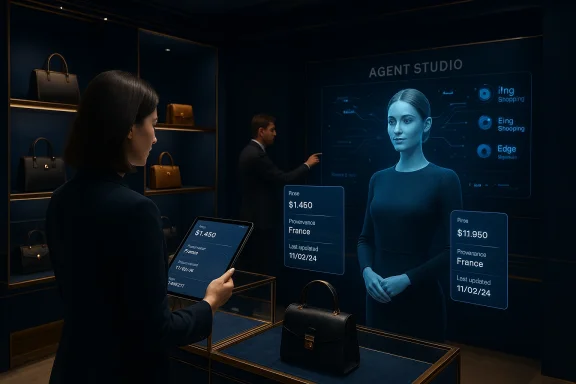
- Microsoft integration scenarios: Algolia is showcasing how its enriched product data can be integrated into Microsoft Copilot, Bing Shopping, and Edge, ensuring product accuracy in those agentic surfaces. Attendees will see examples of how product records with timestamps, source IDs, and confidence metadata feed into conversational cards and comparison widgets.
Agent Studio: a deeper look
Agent Studio is Algolia’s enterprise play for building production-ready AI agents. The platform blends retrieval, memory, and policy-driven governance—three elements retailers need to make agentic commerce reliable at scale.Technical highlights
- Unified keyword + vector retrieval: Agent Studio couples semantic vector search with traditional keyword matching so agents can resolve both natural-language intents and precise SKU lookups. This combination helps map colloquial shopper prompts to canonical SKUs and attributes.
- Event-driven orchestration: The platform supports chaining retrieval steps, transforming results, and conditioning agent responses on operational signals like inventory or shipping status—critical when an assistant must decide whether a product is recommendable in a given moment.
- Observability and provenance: Agent Studio emphasizes traceability: each product recommendation can be tied to a canonical merchant record with a last-updated timestamp and source metadata. This reduces hallucination risk and eases dispute resolution when a buyer sees differing information across surfaces.
Business implications
For luxury retailers, Agent Studio promises not just smarter recommendations but also brand-safe executions—agents that honor merchandising rules, product presentation standards, and legal/marketing constraints. This is especially important for a sector where product storytelling and provenance are part of the value proposition.The Algolia–Microsoft tie-up: what it is and why it matters
Algolia’s collaboration with Microsoft is the clearest immediate example of how canonical, real-time product data will be used to populate agentic shopping surfaces. The integration, announced publicly earlier in January 2026, scopes Algolia feeds into Copilot, Bing Shopping, and Edge—letting retailers push enriched attributes and operational signals directly into Microsoft’s discovery and shopping experiences.What the integration delivers
- Fresh inventory and pricing: Near-real-time updates reduce the risk that an assistant recommends a sold-out or mispriced item.
- Normalized attributes: Standardized colors, sizes, GTINs, and variant mappings improve matching and reduce mismatches between agent language and merchant catalogs.
- Provenance metadata: Last-updated timestamps and source IDs allow agents (and, by extension, consumers) to know where a product record originated, which is essential for trust and auditability.
Strengths of Algolia’s approach
- Operational focus: Algolia is not just selling better search relevance; it is selling a data hygiene and deliveme product truth**—that addresses concrete reliability problems in agentic commerce. That operational emphasis is exactly what retailers need to support off-site discovery.
- Unified retrieval model: Combining vector and keyword search reduces the tradeoff between semantic relevance and exact SKU retrieval—vital for a domain where both natural-language discovery and preciter.
- Platform partnerships: The Microsoft integration gives Algolia reach into major consumer touchpoints. For brands that want to be discoverable inside Copilot and Bing, having a vendor that can pipe authoritative data into strong commercial value add.
- Luxury-friendly capabilities: The demos and narrative are explicitly tailored to the luxury sector’s needs—image fidelity, rich attribute sets, brand-protecting merchandising rules—which reduces the gap between technical demo and real-world brand requirements.
Risks, trade-offs, and unanswered questions
No vendor solution is a panacea. The Algolia story is compelling, but there are practical and strategic risks retailers must weigh.- Operational readiness and scale: Streaming real-time inventory and pricing into agentic surfaces requires tight integration with ERP, PIM, and inventory systems. For legacy retailers—or those with complex wholesale/consignment models—the integration work and edge cases (returns, cancellations, split shipments) are non-trivial. Early pilots show promise, but broad rollout demands operaTransparency and measurement: Agentic placements (the conversational equivalents of sponsored slots) will drive new retail media opportunities. But platforms must provide clear, auditable reporting and disclosure for merchants to trust and buy these placements. Without transparent measurement hooks, the economics for retail media in agentic channels remain speculative.
- Dependency and gatekeeping: Routing product truth through third-party vendors and platform integrations raises questions about dependence on platform policy, ranking algorithms, and access controls. Brands must plan for scenarios where platform terms or indexing behaviors change, and ensure they retain direct-to-consumer channels as primary customer relationships.
- **Privacy and eding enriched attributes (including, in some cases, personalized signals) into agent surfaces must be balanced against privacy requirements and consumer expectations. Retailers will need govsure data minimization, consent compliance, and secure telemetry.
- Hallucination mitigation vs. overfitting: While canonical feeds reduce hallucinations, agents that rely too heavily on merchant-supplied metadata without cross-checks may still produce confident but incorrect claims, especially when long-form product narratives are generated from attribute sets. Observability and human-in-the-loop checks remain necessary.
Practical checklist for luxury retailers considering Algolia and agentic channels
- Audit catalog readiness
- Inventory completeness, GTINs/UPC, image quality, and enriched attributes must be standardized before feeding an agentic pipeline. Prioritize SKU-level provenance and last-updated timestamps.
- Map systems and integration surface
- Identify ERP, PIM, and inventory sources, and design a low-latency update path. Decide whether events (webhooks) or periodic syncs meet your freshness requirements.
- Define merchandising and governance rules
- Specify which SKUs can be promoted in agent responses, how to apply brand tone rules, and when to present limited-edition or exclusive offers. Implement policy controls to enforce these rules at the retrieval layer.
- Pilot with measurement in mind
- Run a pilot with clear KPIs (conversion, click-to-purchase, post-click refunds/disputes) and insist on transparent attribution from the platform or partner. Measure agent-originated traffic separately.
- Plan for dispute handling
- Create operational playbooks for mismatches (price errors, OOS recommendations) with SLA-based reconciliation processes and consumer remediation flows.
Competitive and ecosystem context
Algolia is not the only company pursuing retrieval-powered experiences and agentic commerce integrations, but its unified retrieval engine and event-driven enrichment pipeline give it a differentiated position—especially when combined with Microsoft’s agentic commerce initiatives. Platforms such as Microsoft are actively building “brand agent” and in-chat checkout capabilities, and require canonical feeds to keep those features credible; that creates a market opportunity for retrieval and product-data specialists. Retailers evaluating options should compare:- Retrieval quality (keyword + vector performance)
- Freshness guarantees and latency SLAs
- Metadata richness and provenance controls
- Governance, explainability, and observability features
- Integration complexity and total cost of ownership
Examples from early pilots and what and Microsoft have publicly named early pilot participants—ranging from specialty retailers to larger omnichannel groups—testing how attribute alignment and fresher feeds affect discoverability and conversion inside agentic environments. Early takeaways include:
- Conversion improvement when feeds are accurate: Retailers that provided canonical, enriched attributes reported fewer post-click failures and higher conversion rates in pilot scenarios.
- Operational gaps are the dominant inhibitor: The primary failure mode in pilots was not retrieval accuracy but operational reconciliation—inventory sync delays, variant mapping errors, and inconsistent attribute taxonomies.
Final analysis: practical optimism, not hype
Algolia’s Shoptalk Luxe presence and its Microsoft collaboration signal an important industry inflection point. The vendor’s core proposition—real-time, retailer-approved product data feeding agentic surfaces—addresses widely recognized failure points in AI-assisted shopping: hallucinations, stale offers, and loss of brand control.That said, this is an operational play as much as a technical one. The companies winning in the agentic commerce era will be those that combine retrieval sophistication with rigorous systems integration, transparent measurement, and governance that preserves brand integrity and customer trust. Luxury retailers must therefore treat any agentic channel as an extension of their operational fabric—not an experimental vanity project.
- Strength to watch: Algolia’s unified search model and enterprise tooling (Agent Studio) directly address the core technical challenges of agentic discovery.
- Primary caution: Successful adoption hinges on catalog hygiene, end-to-end operational SLAs, and measurement transparency—areas where many retailers remain underinvested.
Practical next steps for WindowsForum readers and retail technologists
- Inventory your metadata readiness—start with SKU-level audits and attribute standardization.
- Run a focused pilot—limit scope to a category or a curated collection to minimize complexity while proving core hypotheses.
- Insist on measurement and transparency—don’t accept opaque placement or attribution reporting.
- Build governance into the pipeline—policy-driven filters and human review points reduce downstream risk.
- Prepare the post-click experience—ensure checkout, shipping, and returns flows can meet agent-driven demand without friction.
Conclusion
Agentic commerce is arriving with momentum, and Algolia’s Shoptalk Luxe demonstrations crystallize a practical playbook: provide the canonical product truth, stream it in real time to the places shoppers now use first, and govern the way your brand appears in those experiences. That approach reduces hallucination risk, protects conversion, and gives luxury brands the controls they need to sustain premium customer relationships in an increasingly off-site discovery world. The technology is ready for serious pilots—and the operational work is what will separate winners from the rest.
Source: Business Wire https://www.businesswire.com/news/h...n-Search-and-Discovery-at-Shoptalk-Luxe-2026/
