

Alphabet closed a watershed quarter in which it reported more than $100 billion in revenue for the first time — a milestone that crystallizes a shift from experimentation to commercial-scale AI, but also forces a hard look at whether the company can turn unprecedented usage into durable, high-margin growth engines over the next decade.
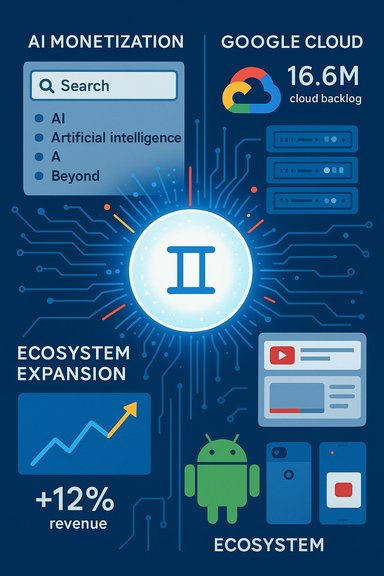
Alphabet’s Q3 2025 results provide the factual spine for any serious discussion about its next decade. Consolidated revenue reached $102.3 billion, up 16% year over year, driven by strong performance in Search, YouTube advertising, and Google Cloud. Management’s commentary emphasized that AI — centered on the Gemini model family and the Gemini app — is now embedded across product surfaces, from Search and YouTube to Workspace and Google Cloud. Two other concrete numbers define the scale of Alphabet’s current opportunity and risk profile: Google Cloud revenue was reported near $15.2 billion (roughly +34% YoY), and the company said its cloud backlog (remaining performance obligations) expanded materially, with management tying that growth to multi-year AI contracts. Alphabet also disclosed elevated capital expenditure plans tied to AI infrastructure build-out. These figures are the basis for the three strategic growth drivers investors and IT leaders should watch: AI monetization, Google Cloud scaling into a second profit engine, and ecosystem expansion.
Key execution items for margin expansion:
YouTube alone combines multiple monetization vectors — ad revenue, creator revenue-sharing, subscriptions, live sports, and Shorts — and is now being augmented by AI toolkits that can increase creator throughput and content supply. That expansion yields more ad inventory and more opportunities for premium subscription upsells.
Source: The Globe and Mail 3 Key Growth Drivers That Could Shape Alphabet's Next Decade
 Background
Alphabet’s Q3 2025 results provide the factual spine for any serious discussion about its next decade. Consolidated revenue reached $102.3 billion, up 16% year over year, driven by strong performance in Search, YouTube advertising, and Google Cloud. Management’s commentary emphasized that AI — centered on the Gemini model family and the Gemini app — is now embedded across product surfaces, from Search and YouTube to Workspace and Google Cloud. Two other concrete numbers define the scale of Alphabet’s current opportunity and risk profile: Google Cloud revenue was reported near $15.2 billion (roughly +34% YoY), and the company said its cloud backlog (remaining performance obligations) expanded materially, with management tying that growth to multi-year AI contracts. Alphabet also disclosed elevated capital expenditure plans tied to AI infrastructure build-out. These figures are the basis for the three strategic growth drivers investors and IT leaders should watch: AI monetization, Google Cloud scaling into a second profit engine, and ecosystem expansion. Why these three drivers matter: a quick primer
- AI monetization: Converts engagement (queries, views, seats) into higher revenue per user rather than merely substituting free interactions. The challenge is to ensure AI adds monetizable events or premium product tiers, not just redistributes existing attention away from ad-bearing surfaces.
- Google Cloud scale: Turns capex-heavy infrastructure into recurring enterprise revenue and — importantly — operating leverage and higher margins if product mix shifts from raw compute to managed AI services.
- Ecosystem expansion: Keeps users, creators, developers, and advertisers inside Alphabet’s orbit across Search, YouTube, Android, Chrome, and Workspace, creating cross-sell pathways that amplify monetization as AI features proliferate.
AI monetization: from scale to sustainable unit economics
What Alphabet has delivered so far
Alphabet has moved quickly to embed Gemini across consumer and enterprise products. The company reported that the Gemini app surpassed 650 million monthly active users, with model throughput figures in the billions of tokens per minute for API usage — numbers that demonstrate scale rarely seen outside a handful of tech platforms. Management credited AI integrations for incremental query growth in Search and for higher engagement metrics on YouTube. Multiple independent outlets corroborated these headline metrics, and the company’s own investor materials provide line-item context tying AI adoption to both consumer product engagement and enterprise contract growth. However, raw MAU and token statistics are directional signals of demand rather than direct proof of monetization. The critical question is whether AI interactions increase the amount advertisers and enterprise customers are willing to pay, or whether they compress existing monetizable interactions.How AI can — and should — lift revenue per user
There are several monetization levers Alphabet can and appears to be pursuing:- Ad yield enhancement: conversational AI can surface intent more effectively and create ad-serving opportunities that command higher CPMs if the AI surfaces produce clearer commercial intent.
- Premium subscriptions and seat licensing: advanced Gemini capabilities inside Workspace, paid tiers in the Gemini app, or subscription add-ons for creators and enterprises can produce recurring revenue independent of ad cycles.
- Creator toolkits and content supply: AI editing, short-form generation, and translation tools can increase the volume and quality of content on YouTube and Shorts, expanding ad inventory and improving engagement metrics that lift revenue per viewer.
- Enterprise AI stack monetization: selling models, fine-tuning, managed inference, and vertical AI solutions as bundled products on Google Cloud creates a seat-plus-consumption model that ties product use to cloud consumption.
Risks and measurement pitfalls
- Conversational compression: If AI answers replace pages of search results or ad-bearing impressions with a single, unpaid answer, the net ad inventory could shrink. That would make AI a revenue subtractor rather than an augmenter. This is a measurable, high-priority risk.
- Metrics reliability: MAU/DAU and token counts are company-reported and sensitive to definitional changes (what counts as an “active session,” how tokens are counted, etc.. Analysts should treat these as directional and seek corroboration through ad yield trends, ARPU (average revenue per user) movement, and paid-subscription growth.
- Per-interaction economics: Detailed per-token or per-inference margins are typically proprietary and not publicly disclosed; absent such granularity, external models must use proxies like revenue-per-search, CPMs, and Cloud gross margins to estimate economic viability. Flagged as unverifiable without internal disclosures.
Google Cloud: the structural second engine
Scale, backlog, and margin trajectory
Google Cloud showed material acceleration in Q3 2025: reported revenue near $15.2 billion (+34% YoY) and management highlighted a substantially larger cloud backlog tied to multi-year AI contracts. The company said Cloud operating income and margins improved materially year over year, reflecting a shift in mix toward AI-hosting and higher-value managed services. These figures are not subtle signals — they indicate that customers are moving from pilots to contractual, recurring commitments. A larger backlog (management reported a sequential increase to roughly $155 billion in remaining performance obligations) provides forward visibility, but investors should treat backlogs cautiously: bookings must convert into billed revenue without excessive discounting or capacity commitments that undercut per-unit economics.Why the margin path matters more than pure revenue growth
The long-term attractiveness of Cloud is not merely top-line growth; it is operating leverage. As a cloud franchise scales, fixed costs (data centers, networking, and specialized accelerators like TPUs) are amortized and higher-margin services (managed hosting, RAG — retrieval-augmented generation — and vertical AI stacks) should lift gross and operating margins. Alphabet signaled Cloud margin improvements in the quarter, but converting capex into a durable margin tailwind is non-trivial.Key execution items for margin expansion:
- High utilization of GPU/TPU fleets — idle accelerators destroy economics.
- Shift toward managed services and verticalized products that command premium pricing.
- Effective regional capacity expansion without incurring stranded assets or mismatched power/real-estate costs.
Capex intensity and conversion risk
Alphabet has increased capital expenditure substantially — part of the company’s stated plan was to invest aggressively in AI infrastructure — and the timing of depreciation and utilization matters. Elevated capex (management discussed multi-year increases to support AI workloads) implies near-term margin pressure until cloud utilization and higher-margin products scale. Analysts and IT leaders must watch conversion cadence from backlog to recognized revenue and monitor Cloud gross margin progression quarter to quarter.Ecosystem expansion: moat, distribution, and optionality
The continuing power of distribution
Alphabet’s ecosystem — Search, YouTube, Android, Chrome, Workspace, and Play — remains the durable moat that gives AI initiatives an unfair advantage. Android and Chrome provide default pathways to billions of devices; Search and YouTube provide rich behavioral signals that improve model performance and ad targeting; Workspace and Google One provide natural subscription frameworks for paid AI features. This distribution decreases customer acquisition costs for new AI features and speeds adoption across consumer and enterprise bases.YouTube alone combines multiple monetization vectors — ad revenue, creator revenue-sharing, subscriptions, live sports, and Shorts — and is now being augmented by AI toolkits that can increase creator throughput and content supply. That expansion yields more ad inventory and more opportunities for premium subscription upsells.
Hardware and device-level AI
As certain AI workloads move toward on-device inference for latency, privacy, or cost reasons, hardware becomes strategically relevant. Pixel devices, Nest, and wearable form factors create an optional path to embed local inference and capture premium experiences that tie into subscription models. These hardware plays are unlikely to drive near-term revenue materiality but increase long-term optionality for differentiation and capture of higher-margin device-tied subscriptions.Long-shot bets: Waymo and other moonshots
Autonomous driving (Waymo), life sciences (Verily), and other “moonshots” remain optionality rather than core drivers. If one of these bets scales materially, it would create a multi-hundred-billion-dollar upside scenario; but the timeline is long and uncertainties are substantial. Treat Waymo as low-probability, high-impact optionality in valuation work.Verifying the load-bearing claims (cross-checks)
To ensure the thesis rests on verified facts rather than marketing spin, cross-check key claims from at least two independent sources:- Consolidated revenue of $102.3 billion and the 16% YoY figure appear in Alphabet’s investor materials and were reported by major news outlets, confirming the headline result.
- Google Cloud revenue of roughly $15.2 billion (+34% YoY) and a materially larger backlog were disclosed by Alphabet and corroborated by independent financial press coverage.
- Gemini’s 650+ million MAU figure was explicitly stated by company executives in the earnings call and corroborated in subsequent news coverage describing viral product features that drove the growth. Use these usage numbers as scale signals, but treat detailed per-interaction economics as internal and therefore partially unverifiable externally.
- Capex guidance and elevated infrastructure spend are documented in company commentary and reported across financial outlets; exact multi-year outlays may be modeled differently by various analysts, so treat aggregate capex numbers as directional with sensitivity to modeling assumptions.
A practical checklist: what to watch in the next 12–24 months
Investors and CIOs should track specific, measurable milestones that convert rhetorical AI progress into investable signals:- Quarterly revenue-per-search and YouTube CPM trends — do AI features lift or compress ad yields?
- Google Cloud: recognized revenue growth versus reported backlog/RPO conversion cadence. Are multi-year AI contracts converting into billed revenue without heavy discounting?
- Cloud gross margin and segment operating margin trajectory — is Google Cloud sustaining margin expansion as it scales?
- Subscription ARPU and paid-seat growth for Workspace, YouTube Premium, and Gemini — signs that paid upgrades are sticking.
- Any voluntary disclosures of inference or per-token economics, or standardized metering metrics from Vertex AI/Gemini Enterprise — critical for assessing unit economics. Flagged as unlikely in the near term but materially important if released.
Competitive and regulatory headwinds
- Competition: Microsoft’s seat-based Copilot monetization, AWS’s absolute scale and custom silicon, and specialized “neocloud” GPU providers all pressure pricing and distribution. Each competitor approaches monetization differently: Microsoft via seat upgrades, AWS via scale and ecosystem breadth, and Google via productized AI integrated across distribution channels. This diversity means competition will shape both pricing and feature bundles.
- Regulation: Antitrust and privacy enforcement remain active risks in multiple jurisdictions. Any forced changes to defaults, bundling, or data flows could meaningfully affect Alphabet’s long-term monetization. Regulators could also compel behavioral remedies that limit cross-product data flows — a non-trivial risk to the ecosystem thesis.
- Open models and efficiency gains: Rapid algorithmic improvements or high-quality open models that run efficiently on cheaper hardware could compress hyperscaler pricing power for inference and training. This risk increases the importance of product differentiation and integrated services over pure capacity plays.
Strengths, vulnerabilities, and a balanced verdict
Notable strengths
- Unmatched distribution across Search, YouTube, Android, and Workspace provides low-cost channels for AI adoption and rapid signal acquisition.
- Full-stack control — models (Gemini), accelerators (TPUs), and tooling (Vertex AI) — gives Alphabet levers to optimize latency, costs, and product tightness.
- A growing Cloud backlog that, if converted efficiently, can produce durable, contractually visible revenue.
Material vulnerabilities
- Capex and utilization risk: Elevated spending must be matched by high accelerator utilization and a shift to higher-margin managed services. Otherwise, depreciation and idle capacity will pressure margins.
- Monetization mismatch: AI that replaces rather than supplements monetizable events risks compressing long-term ad dollars. This is the central commercial risk to the thesis.
- Regulatory uncertainty and competitive bundling: Potential forced changes to defaults, data sharing, or bundling can erode cross-product monetization advantages.
A realistic verdict
Alphabet is no longer being judged on whether it can build world-class AI — it can. The pressing question is whether the company can convert that capability into repeatable, margin-accretive revenue at scale. If Alphabet executes on three fronts — clear AI monetization that lifts ARPU, Google Cloud margin expansion through productized managed services, and ecosystem leverage without regulatory fracturing — it can sustain multi-year, respectable growth and produce a diversified cash profile. If any one of those pillars breaks — especially Cloud conversion or ad-yield preservation — the investment case weakens materially.Conclusion: signals that will decide the next decade
Alphabet’s Q3 2025 results mark a pivotal inflection: the company has scaled AI to commercial proportions and backed that with material infrastructure spending. The three growth drivers — AI monetization, Google Cloud’s structural rise, and ecosystem expansion — are the right lenses for judging the company’s path forward. What separates plausible optimism from durable value creation will be a string of measurable, high-quality signals:- sustained and growing revenue per user in ad products,
- repeatable conversion of Cloud backlog into recognized, high-margin revenue, and
- demonstrable growth in paid subscriptions and enterprise seat monetization.
Source: The Globe and Mail 3 Key Growth Drivers That Could Shape Alphabet's Next Decade
