

Amazon enters 2026 with the kind of narrative investors have been waiting for: a re‑accelerating AWS, a marquee multi‑year compute agreement that recalibrates cloud market dynamics, visible retail margin expansion and automation gains, and a valuation that many institutions now describe as undervalued relative to the company’s growth trajectory and profit mix.
Amazon has always been a two‑headed company: a massive, low‑margin global retail engine and a high‑margin cloud computing juggernaut in Amazon Web Services (AWS). In 2025 those two stories began to line up more clearly. AWS showed its first consistent, material re‑acceleration since the 2022 slowdown, retail margins started to improve thanks to advertising and automation, and management signaled a capital spending program aimed squarely at AI demand. Those moving parts are the reason analysts and value investors are re‑examining Amazon’s 12‑month outlook. This feature unpacks the drivers that could determine where Amazon will be in one year, scores the most investable levers, quantifies the valuation battlefield, and lays out the principal risks that could derail a 2026 rerating.
That said, investors should treat margin improvements and robotics gains as real but execution‑sensitive. Capital intensity, competitive cloud dynamics, and macro multiples are genuine tail risks that can neutralize the rerating story. Transparency around large compute agreements and independent verification of operational efficiency will be the difference between a confident investment case and a fragile one.
Amazon in 12 months will likely be a larger, more AI‑centric company than it was a year ago — but the investment payoff depends on whether the market awards that transformation with a higher multiple or punishes the company for the inevitable short‑term capex drag.
Source: The Globe and Mail Where Will Amazon Be in 1 Year?
 Background
Amazon has always been a two‑headed company: a massive, low‑margin global retail engine and a high‑margin cloud computing juggernaut in Amazon Web Services (AWS). In 2025 those two stories began to line up more clearly. AWS showed its first consistent, material re‑acceleration since the 2022 slowdown, retail margins started to improve thanks to advertising and automation, and management signaled a capital spending program aimed squarely at AI demand. Those moving parts are the reason analysts and value investors are re‑examining Amazon’s 12‑month outlook. This feature unpacks the drivers that could determine where Amazon will be in one year, scores the most investable levers, quantifies the valuation battlefield, and lays out the principal risks that could derail a 2026 rerating.Where the growth is coming from: AWS and AI compute
AWS re‑acceleration — not a one‑quarter fluke
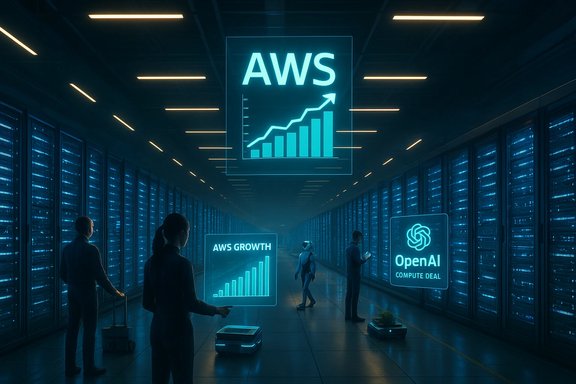
By Q3 2025 AWS delivered ~20% year‑over‑year revenue growth, the fastest pace the unit had posted in several quarters and a clear acceleration from mid‑2025. That growth was driven largely by rising AI workloads, enterprise adoption of managed LLM services (Bedrock, SageMaker), and a deliberate capacity build‑out to serve big model training and inference. Management has publicly stated capacity was being increased to close a backlog of large customer commitments. Why this matters: cloud revenue re‑acceleration restores the structural earnings power of Amazon because AWS drives disproportionate operating income relative to its top‑line share. AWS’s operating margin remains a central input to any bull case on Amazon stock.The OpenAI pact: scale, timing, and strategic implication
In a landmark development, OpenAI and Amazon announced a multi‑year arrangement for AWS to supply large volumes of compute capacity over the next several years — widely reported as a roughly $38 billion agreement spanning around seven years. The deal brings immediate revenue to AWS and, perhaps more importantly, validates AWS as a preferred infrastructure partner for frontier model builders. Deployment is intended to be phased and largely completed by the end of 2026, with potential extensions thereafter. Two practical impacts of the OpenAI relationship:- It creates a long‑duration, high‑intensity demand stream for AWS GPU and CPU clusters during a time when AI compute scarcity remains a pricing lever.
- It strengthens Amazon’s argument that its data‑center buildouts and custom silicon (including Trainium family chips) are competitive differentiators for specialized AI workloads.
Custom silicon and software stack: Trainium, Bedrock and Agent frameworks
Amazon has been expanding its own silicon (Trainium) and pairing it with software offerings like Bedrock and SageMaker. These elements are complementary: custom chips grant potential unit cost advantages for model training, and Bedrock/SageMaker provide a path for enterprises to deploy and monetize models within AWS. Amazon’s push into agentic AI frameworks (AgentCore, Agent orchestration) further differentiates its platform-level offerings versus commodity GPU hosting. Those stacks matter when large customers evaluate total cost, latency, and integration demands.The retail engine: higher margins through ads and automation
Advertising: a high‑margin growth lever
Amazon’s advertising business reported roughly $17.7 billion in quarterly revenue and grew about 24% year‑over‑year in the most recent quarter — a growth profile materially above core retail margins. Advertising adds a one‑to‑three percentage point margin uplift to the overall retail business because ad revenue carries much higher gross margins than product sales. Amazon is embedding AI into ad creation, optimization, and targeting — accelerating advertiser demand and conversion rates. Why this matters to investors: ad revenue scales rapidly without proportional fulfillment costs, which helps convert revenue growth into operating income more efficiently than the pure retail business can on its own.Fulfillment automation and DeepFleet: margin tailwinds
Amazon has invested heavily in warehouse robotics and generative AI orchestration for its fleet. Company disclosures and independent reporting document Amazon’s deployment of a fleet that has crossed significant scale milestones — often cited as surpassing one million operational robots — orchestrated by a foundation model dubbed DeepFleet that optimizes robot routing and traffic inside fulfillment centers. Reported efficiency gains (travel time reductions in the low double digits) translate into meaningful productivity improvements across millions of daily picks and deliveries. Key mechanics:- Robotics replace or augment repetitive, low‑margin fulfillment tasks and compress per‑order variable costs.
- DeepFleet and related AI systems reduce latency, improve throughput and lower error rates — benefits that compound across Amazon’s scale.
- Savings are showing up incrementally in North America operating results: sales rose while adjusted operating income expanded faster, indicating operating leverage is in motion.
North America segment: improving operating leverage
Amazon’s North America segment reported double‑digit year‑over‑year sales growth while adjusted operating income expanded substantially in the quarter cited. That kind of operating leverage — revenue rising faster than the cost base — is the clearest on‑ramp to higher consolidated margins and a central bullish argument for the stock. Importantly, part of the reported volatility in operating income is attributable to special items (legal settlements, severance) that management flagged as non‑recurring. Adjusting for those items shows the underlying retail operating improvement is intact.Valuation: why the rerating argument has traction
The multiple disconnect: Amazon versus its retail peers
As of early 2026 snapshots, Amazon’s forward P/E sits in a mid‑20s range depending on the data vendor, while some leading bricks‑and‑mortar retail peers are trading at multiples reported in the upper 30s to low 40s. Comparing forward multiples is a blunt tool — base rates, growth profiles, capital intensity and margin structures differ — but the comparison is useful for framing the upside if Amazon’s growth and margin story continues to improve. A straight‑line thought experiment often used by analysts: if Amazon’s forward earnings multiple expanded to align with higher‑quality retail comp multiples (e.g., ~40x), it would imply a materially higher share price over a 12‑month horizon, assuming the earnings base holds or grows. That calculation is a back‑of‑envelope way to show potential rerating magnitude, not a prediction. Market multiple compression/expansion depends on macro sentiment, interest rates, and execution.Why the market could re‑rate Amazon
There are three interlinked conditions that could drive multiple expansion:- Continued AWS topline acceleration above 20% as AI workloads scale and long‑duration compute deals (like OpenAI’s) convert into visible revenue.
- Sustained retail operating margin improvement driven by advertising scale and automation savings.
- A lower discount rate environment — i.e., falling long‑term yields and a risk‑on market — which typically supports multiple expansion for growth‑at‑reasonable‑prices names.
The bull case: path to outperformance in 12 months
- AWS growth re‑accelerates to a sustained 20–25% range driven by AI workloads, Bedrock/ SageMaker adoption and multi‑year compute contracts.
- Retail operating margin expands via ad monetization and robotics cost saves, adding several billion dollars to operating income.
- The market gives Amazon credit for a higher multiple (closer to the 35–40x range some peers trade at), producing 20–40% upside in price over the next 12 months in a constructive macro environment.
The bear case: key scenarios that could keep Amazon flat or lower
- Capital intensity becomes a headwind: Amazon’s massive capex program to build AI capacity raises depreciation and interest burdens; if revenue growth lags capex timing, margins could compress. Management warned capex will remain elevated.
- Competition and price pressure in cloud: Microsoft and Google are growing faster on percentage terms; if AWS sacrifices price to retain market share against Azure/Google Cloud, unit economics could worsen.
- Execution risk in robotics and labor: automation rollouts scale operational complexity; safety, labor relations, or maintenance issues could blunt the efficiency gains that form the margin thesis. Some claims around fleet size and efficiency gains are based primarily on Amazon disclosures and third‑party reporting and should be treated as company‑provided figures until independently verified.
Quantifying the one‑year scenarios
Example scenario math (illustrative)
- Baseline: assume a near‑term forward EPS estimate of roughly $7–8 (data vendors differ). Apply the current consensus multiple (~25x) to get the baseline implied price.
- Upside rerate: holding EPS flat or modestly growing to $8–9, expanding the multiple to 40x implies a materially higher share price — roughly consistent with the common analyst exercise that equates a 40x multiple with a mid‑three‑hundred dollar target. This is a sensitivity exercise and not a firm forecast.
Risks and red flags investors must track
1) Capex tapering or mis-timing
Amazon’s capex increased materially to support AI compute. If that capex does not translate into revenue growth fast enough, depreciation will pressure operating margins and free cash flow. Management has already signaled higher capex into 2026.2) Concentration and counterparty dynamics
Large multi‑year compute deals concentrate revenue and operational complexity. If a large customer renegotiates terms or delays usage, AWS utilization and pricing could shift unfavorably. These are real operational contracts and often contain complex clauses; their impact should be assessed as they convert to revenue.3) Competitive intensity and pricing
Microsoft’s Azure and Google Cloud are growing faster percentage‑wise. If AWS needs to defend share, price concessions or accelerated hardware discounts could compress margins. Track per‑provider revenue growth rates and backlog commentary.4) Robotics claims vs. independent verification
Amazon’s statements about robotics scale and DeepFleet efficiency gains are plausible and supported by multiple reporting outlets, but many metrics originate with the company. Independent audits of efficiency gains are rare in operational disclosures; treat large efficiency assumptions as directional until multiple independent datasets corroborate them.5) Macro and multiple risk
The rerating consensus depends heavily on market sentiment for growth stocks. If interest rates remain elevated or macro growth disappoints, multiples could compress industry‑wide, limiting Amazon’s upside even if execution is solid.Practical takeaways for investors
- For long‑term investors seeking exposure to AI infrastructure and durable retail franchise growth, Amazon offers a blended opportunity: high‑quality cloud cash flows plus a retail arm that is monetizing scale more effectively. Key SEO phrases to watch for new developments: AWS growth 2026, Amazon OpenAI deal, Amazon robotics DeepFleet, and Amazon advertising revenue.
- For shorter‑term traders, monitor three data points closely over the next 12 months: AWS sequential growth rates and operating margins, retail operating income trends excluding one‑time items, and capex guidance versus deployed capacity. Those three indicators will largely determine whether multiple expansion is justified.
- Valuation windows: Amazon’s forward P/E sits meaningfully below some retail peers when using headline multiples; that gap represents a potential rerating path but only if execution and macro conditions support the earnings profile that justifies higher multiples. Be cautious: peer multiples are not immutable benchmarks and can be re‑priced themselves.
Final assessment: where will Amazon be in one year?
If AWS continues to accelerate and the OpenAI and other large compute agreements convert into steady, visible AWS revenue, while retail operating margins keep expanding thanks to advertising and automation, Amazon is positioned to outperform. A plausible scenario given current evidence is mid‑teens to low‑30s percentage upside over 12 months driven by a combination of EPS growth and multiple expansion.That said, investors should treat margin improvements and robotics gains as real but execution‑sensitive. Capital intensity, competitive cloud dynamics, and macro multiples are genuine tail risks that can neutralize the rerating story. Transparency around large compute agreements and independent verification of operational efficiency will be the difference between a confident investment case and a fragile one.
Amazon in 12 months will likely be a larger, more AI‑centric company than it was a year ago — but the investment payoff depends on whether the market awards that transformation with a higher multiple or punishes the company for the inevitable short‑term capex drag.
Quick checklist for the next 12 months (actionable monitoring)
- Quarterly AWS revenue growth and AWS operating margin trends.
- Progress and public disclosures on multi‑year compute partnerships (deployment timelines, capacity on‑line).
- Retail adjusted operating income excluding one‑offs and advertising revenue trajectory.
- Capex guidance updates and depreciation impact on margins.
- Independent corroboration of robotics deployment scale and measured efficiency gains.
Source: The Globe and Mail Where Will Amazon Be in 1 Year?
