

A July 16 comparison claiming a “17x gap” between Amazon Bedrock, Azure AI Foundry, and Google Vertex AI gets its headline from model-catalog counts, but several of its central claims are already out of date or misleading.
Most notably, the article says Azure AI Foundry is the only major cloud platform with first-party access to OpenAI’s GPT-5 family. That was no longer true when it was published. AWS announced general availability of OpenAI GPT-5.5, GPT-5.4 and Codex on Amazon Bedrock on June 1, 2026. The service now offers those models under Bedrock’s normal AWS governance and billing controls, with pricing aligned to OpenAI’s first-party rates.
Microsoft’s Foundry documentation currently lists more than 1,900 models across Azure-sold, partner and community collections. That is a substantially larger catalog than Bedrock’s directly managed selection, but treating it as a 17x capability lead is a stretch.
Catalog totals mix very different products: hosted serverless APIs, community models, specialist models, embeddings, image generators, and models requiring separate deployment arrangements. Availability also varies by region, subscription, compliance boundary and capacity. A Windows shop deciding between clouds is unlikely to choose based on whether a portal exposes 100, 200 or 1,900 entries.
The practical question remains simpler: which models are approved for the workload, available in the required region, supported by the application stack, and priced predictably at expected volume?
But Bedrock is no longer automatically ruled out by a GPT requirement. AWS’s June release means organizations can evaluate newer OpenAI models alongside Amazon, Anthropic, Meta, Mistral, Google and other offerings without leaving their AWS account structure. Bedrock’s newer service tiers also show that its pricing is no longer just a single “serverless versus provisioned” choice: AWS now offers Standard, Priority, Flex and Reserved options depending on latency and capacity requirements.
Vertex AI remains the natural fit for Google Cloud customers with data already in BigQuery or a workflow built around Gemini and Google’s ML tooling. Google’s published Vertex pricing continues to show Gemini 2.5 Pro at $1.25 per million input tokens and $10 per million output tokens for requests up to 200,000 input tokens, with higher long-context rates. That is a usable reference point, but it is not proof that Vertex is categorically cheaper or more expensive than its rivals.
For Windows and enterprise IT teams, the decision should start with identity, networking, residency, logging, existing cloud commitments and a representative evaluation set—not a catalog-count headline. Teams that need GPT models can now test both Azure AI Foundry and Amazon Bedrock, while Google Cloud shops should evaluate Vertex AI where its data and ML integrations reduce operational work.
Run a small, region-specific proof of concept with real prompts and full retrieval, storage and egress costs before committing to any platform.
Most notably, the article says Azure AI Foundry is the only major cloud platform with first-party access to OpenAI’s GPT-5 family. That was no longer true when it was published. AWS announced general availability of OpenAI GPT-5.5, GPT-5.4 and Codex on Amazon Bedrock on June 1, 2026. The service now offers those models under Bedrock’s normal AWS governance and billing controls, with pricing aligned to OpenAI’s first-party rates.
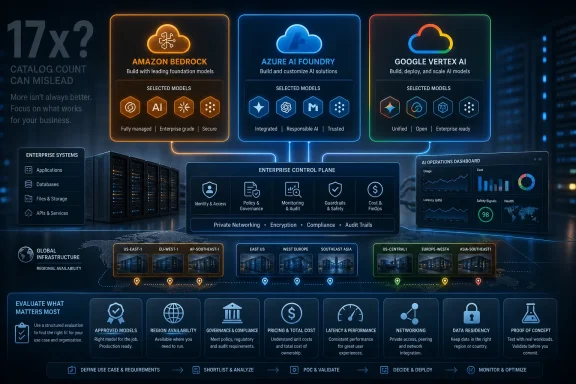 The “17x” number is not a useful comparison
Microsoft’s Foundry documentation currently lists more than 1,900 models across Azure-sold, partner and community collections. That is a substantially larger catalog than Bedrock’s directly managed selection, but treating it as a 17x capability lead is a stretch.Catalog totals mix very different products: hosted serverless APIs, community models, specialist models, embeddings, image generators, and models requiring separate deployment arrangements. Availability also varies by region, subscription, compliance boundary and capacity. A Windows shop deciding between clouds is unlikely to choose based on whether a portal exposes 100, 200 or 1,900 entries.
The practical question remains simpler: which models are approved for the workload, available in the required region, supported by the application stack, and priced predictably at expected volume?
The platform split is now less clean
Azure AI Foundry still has its strongest case in Microsoft-centric environments. Its OpenAI integrations, Azure identity controls, and links to Microsoft 365, Teams, SharePoint and Copilot make it the obvious candidate for organizations already operating heavily inside the Microsoft estate.But Bedrock is no longer automatically ruled out by a GPT requirement. AWS’s June release means organizations can evaluate newer OpenAI models alongside Amazon, Anthropic, Meta, Mistral, Google and other offerings without leaving their AWS account structure. Bedrock’s newer service tiers also show that its pricing is no longer just a single “serverless versus provisioned” choice: AWS now offers Standard, Priority, Flex and Reserved options depending on latency and capacity requirements.
Vertex AI remains the natural fit for Google Cloud customers with data already in BigQuery or a workflow built around Gemini and Google’s ML tooling. Google’s published Vertex pricing continues to show Gemini 2.5 Pro at $1.25 per million input tokens and $10 per million output tokens for requests up to 200,000 input tokens, with higher long-context rates. That is a usable reference point, but it is not proof that Vertex is categorically cheaper or more expensive than its rivals.
What admins should take from it
The cited comparison also presents broad latency, training-speed and monthly-cost advantages as settled facts, despite acknowledging a lack of controlled three-way benchmarks. Those claims should be treated as workload-specific marketing or third-party estimates unless the test methodology, model versions, regions, throughput settings and prompt mix are published.For Windows and enterprise IT teams, the decision should start with identity, networking, residency, logging, existing cloud commitments and a representative evaluation set—not a catalog-count headline. Teams that need GPT models can now test both Azure AI Foundry and Amazon Bedrock, while Google Cloud shops should evaluate Vertex AI where its data and ML integrations reduce operational work.
Run a small, region-specific proof of concept with real prompts and full retrieval, storage and egress costs before committing to any platform.
References
- Primary source: tech-insider.org
Published: 2026-07-16T15:54:57+00:00
Bedrock vs Azure AI Foundry vs Vertex AI: 17x Gap [2026]
Amazon Bedrock vs Azure AI Foundry vs Vertex AI compared: pricing, 1,700 vs 100 models, compliance, agents, and real 2026 deployment data.tech-insider.org - Official source: learn.microsoft.com
Microsoft Foundry Models overview - Microsoft Foundry | Microsoft Learn
Discover and deploy AI models with Microsoft Foundry Models. Browse 1,900+ models from OpenAI, Meta, and more to build scalable AI solutions. Explore now.learn.microsoft.com