

Amazon says its Leo satellite broadband network has passed 390 deployed spacecraft after a July 2 Atlas V launch from Cape Canaveral, giving the former Project Kuiper constellation enough orbital mass to support initial continuous service at selected latitudes later in 2026. That does not make Amazon a Starlink peer yet. It does mean the long-theoretical second American mass-market low-Earth-orbit broadband network is moving from PowerPoint rivalry into operational rivalry. As GSMArena noted from Amazon executive Chris Weber’s update, the company is now talking like a provider preparing to sell service, not merely a launch customer trying to catch up.
The timing matters because Starlink has spent the last several years turning satellite internet from a rural last resort into a normal consumer and enterprise connectivity product. Amazon, by contrast, has been the looming entrant: deep pockets, retail reach, AWS relationships, device design chops, and a launch manifest big enough to reshape commercial spaceflight, but not yet a service customers could actually buy. The shift from “Project Kuiper” to “Amazon Leo” was branding; the shift past roughly 390 satellites is operational intent.
For years, Amazon’s satellite internet effort had a strange dual identity. On paper, it was one of the most serious challengers to SpaceX’s Starlink: a planned constellation of more than 3,200 low-Earth-orbit satellites, backed by one of the world’s most valuable companies and tied to a web services empire that already sells networking, edge computing, and cloud infrastructure to governments and enterprises. In orbit, however, Amazon had little to show until full-scale deployment began in 2025.
That gap made every “Starlink rival” headline feel premature. Starlink was signing up households, shipping terminals, serving aircraft, boats, emergency responders, and militaries, while Amazon was still discussing manufacturing facilities, regulatory milestones, and launch contracts. The difference between a satellite constellation and a satellite internet business is not aspiration; it is orbital density, ground infrastructure, user terminals, billing, support, and enough capacity in the right places at the right time.
Weber’s latest statement, amplified by GSMArena and echoed in Reuters’ reporting, changes the tone because it uses the language of service readiness. Amazon says more than 390 Leo satellites have been deployed and that this is enough to support continuous service across initial latitudes. That phrase is doing a lot of work. It does not mean global service, and it does not mean every cell has commercial-grade capacity, but it does mean Amazon believes it has crossed a minimum viable network threshold.
The latest milestone followed a United Launch Alliance Atlas V mission from Cape Canaveral that carried 29 more Amazon Leo satellites to orbit. Space.com reported that this brought the constellation to about 400 spacecraft across 15 missions using Atlas V, SpaceX Falcon 9, and Arianespace Ariane 6 rockets. The irony of Amazon relying partly on SpaceX to deploy a Starlink competitor is not lost on anyone in the industry, but it is also the practical reality of modern launch capacity: if you need hundreds of satellites in orbit quickly, you buy rides wherever credible rockets are available.
But the rebrand did not alter the central challenge. Amazon is entering a market where the first mover has not merely arrived first but has defined the category. Starlink has made satellite broadband feel fast, app-driven, portable, and familiar. It has also normalized consumer expectations that would have sounded fanciful in the geostationary satellite era: self-installation, real-time gaming in some conditions, mobile use, roaming plans, maritime service, and rapid disaster deployments.
Amazon’s pitch will inevitably lean on being Amazon. The company can sell hardware through its own store, bundle service with business procurement channels, integrate with AWS edge services, and court telecom partners that may prefer a second supplier to a SpaceX-dominated market. The consumer story will matter, but the more strategic story may be enterprise, government, mobility, and wholesale relationships.
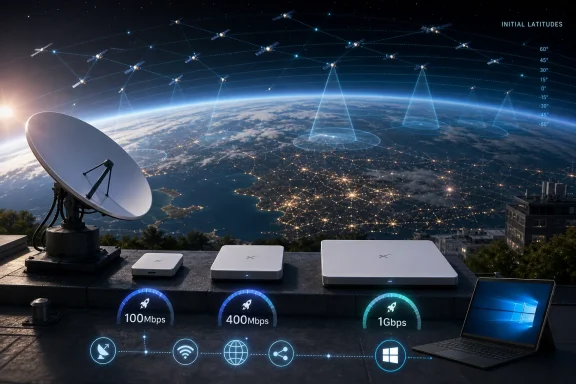
The receiver lineup points in that direction. According to Amazon’s materials and GSMArena’s summary, Leo will offer three terminals: a compact Nano unit around seven inches by seven inches with downloads up to 100Mbps, a Pro model around eleven inches by eleven inches with downloads up to 400Mbps, and a much larger Ultra terminal around twenty inches by thirty inches with downloads up to 1Gbps. That is not a single rural broadband box; it is a tiered hardware strategy for different markets.
The Nano terminal suggests Amazon wants low-cost, portable, or space-constrained installations. The Pro unit looks like the mainstream home and small-business workhorse. Ultra is the tell: a 1Gbps-class terminal is aimed at serious enterprise, backhaul, industrial, and possibly government use cases where bandwidth, redundancy, and service-level expectations matter more than living-room aesthetics.
Amazon has previously said Leo service would begin in northern and southern latitudes and expand gradually toward the Equator as the constellation grows. That is not a footnote; it is the rollout map. Early customers may see availability based less on national borders than on orbital mechanics and network capacity. The first service areas could include places where Amazon can offer continuous coverage without yet having the density needed for heavy demand everywhere.
This is why “almost ready” needs an asterisk. Amazon may be almost ready to begin service, but not almost ready to match Starlink’s footprint, terminal availability, mobility options, or installed base. A network with about 400 satellites can begin proving itself commercially. A network designed for more than 3,200 satellites has not reached its mature form until the launch cadence remains high for years.
That distinction matters for buyers. If you are a rural household that can already order Starlink, Amazon Leo’s existence does not automatically produce a better option tomorrow. If you are an enterprise procurement team, however, even limited initial coverage may be enough to start pilots, redundancy planning, and price discovery. A second credible network changes negotiations before it changes every user’s speed test.
For WindowsForum readers, the practical angle is not just whether Leo can stream 4K video. It is whether a second LEO network gives homes, small businesses, branch offices, field teams, and emergency setups another resilient path to the internet. In a world where Windows devices increasingly assume persistent cloud connectivity — for Microsoft 365, Intune, Entra ID, OneDrive, Teams, Windows Update, Defender, and remote management — the last mile remains the least glamorous but most decisive link.
Space.com’s latest launch coverage put Starlink at nearly 11,000 satellites, a figure that underscores the scale gap. Even allowing for differences in satellite generations, orbital shells, and retired spacecraft, Amazon is not close to matching the raw constellation depth. Starlink has been learning in public at global scale while Amazon has been compressing years of deployment into a catch-up campaign.
Still, first-mover advantage is not the same as permanent monopoly. Satellite broadband is capital intensive, politically sensitive, and capacity constrained. Customers in remote areas often have few alternatives, which makes competition unusually valuable. Governments dislike single-provider dependencies, especially when the provider is tied to one powerful founder, one launch company, and one geopolitical actor.
Amazon’s strongest argument may be that it does not need to beat Starlink everywhere to matter. It can be a second network for redundancy. It can target enterprise accounts already inside AWS. It can partner with telecom carriers that want satellite backhaul. It can serve regions where regulators or customers prefer not to rely solely on SpaceX. It can compete on hardware segments, procurement simplicity, and integration rather than only on satellite count.
That does not make the road easy. Amazon must prove that its terminals are affordable, that installation is straightforward, that latency is competitive, that capacity holds up under load, and that service plans are understandable. A waitlist is not a market. A launch milestone is not a support organization. The next phase is where Amazon’s famous logistics discipline meets the messy, weather-exposed reality of consumer networking.
Amazon was nowhere near that number. The FCC recently granted a waiver, a decision trade publications and outlets such as TechSpot framed as a major reprieve. The agency’s logic, according to public reporting, was that allowing Amazon more time would promote competition by supporting a second large satellite broadband constellation.
That is a revealing regulatory compromise. On strict milestone math, Amazon missed the spirit of the original deployment pace. On market-structure logic, punishing Amazon too harshly would have reinforced Starlink’s dominance. The FCC effectively decided that the public interest is better served by a delayed competitor than by a cleaner but more concentrated market.
This matters because Leo’s story is not only technological. It is infrastructural policy. Satellite broadband sits at the intersection of rural connectivity, spectrum rights, space debris risk, launch economics, national security, and platform competition. A second large LEO network is not merely another ISP option; it is a counterweight in a strategic communications layer.
For Amazon, the waiver buys time but not credibility. Credibility will come from launch cadence, service quality, and customer retention. Regulators can preserve the lane; Amazon still has to drive in it.
Amazon has described more than 80 launches as part of the constellation buildout. Its recent launch tempo shows why that number is necessary. Dozens of satellites per mission sound impressive until measured against a target constellation of more than 3,200 spacecraft, plus replacements over time. LEO satellites do not sit permanently above one location like old-school geostationary spacecraft; they move fast, need replenishment, and require constellation density to deliver consistent service.
The July 2 Atlas V mission was symbolically important because it reportedly marked the final Atlas V mission for Amazon Leo, with future ULA missions shifting to Vulcan. That transition matters because Atlas V is a legacy workhorse nearing retirement, while Vulcan is supposed to carry heavier future Leo payloads at higher cadence. Amazon’s ability to scale depends on the reliability and availability of these newer heavy-lift vehicles.
Blue Origin’s New Glenn adds another layer of intrigue because Amazon founder Jeff Bezos also founded Blue Origin. If New Glenn becomes a reliable Leo launcher, Amazon gains a strategically aligned heavy-lift pipeline. If New Glenn struggles, Amazon remains dependent on a patchwork of external providers, including its chief satellite broadband rival’s launch company.
That is the uncomfortable beauty of the modern space economy. Competitors are also suppliers, partners are also bottlenecks, and the fastest way to orbit may run through the company you are trying to challenge. Amazon can afford that awkwardness. Whether it can operationalize around it faster than Starlink continues to expand is the harder question.
The Nano terminal’s promised download speeds of up to 100Mbps may not excite fiber customers, but it could be transformative for remote sites, field operations, small homes, vehicles in approved use cases, or locations where the alternative is weak cellular or old DSL. A seven-inch square terminal also suggests Amazon has paid attention to installation friction. Smaller hardware widens the universe of places where a dish can be mounted, packed, or deployed.
The Pro terminal, at up to 400Mbps, is the obvious competitor for the core Starlink customer: a household, small office, cabin, farm, or mobile professional who needs modern broadband where wired infrastructure is poor. This is the version that will likely shape consumer perception. If Pro is easy to buy, install, and manage, Amazon has a real retail product. If it is supply constrained or expensive, Leo remains a niche service at launch.
Ultra is where the enterprise strategy becomes explicit. A 1Gbps-class satellite terminal is overkill for many households, but not for remote industrial sites, broadcast operations, defense-adjacent deployments, maritime connectivity, disaster response hubs, mining, energy, agriculture, or carrier backhaul. It also gives Amazon something to sell into AWS-adjacent conversations: resilient connectivity tied to cloud workloads and edge infrastructure.
The missing variable is price. Amazon can advertise speeds and terminal sizes, but adoption will depend heavily on equipment cost, monthly service fees, data policies, congestion behavior, and installation terms. Starlink’s history shows that LEO broadband customers will tolerate expensive hardware when the alternative is no broadband at all. A second entrant creates the possibility of price pressure, but only if Amazon has enough capacity to compete rather than ration access.
For a sysadmin, the question is not whether Leo can replace fiber in a headquarters building. It is whether Leo can create a viable failover path for a branch office, a construction trailer, a temporary clinic, a mobile command center, a farm office, or a rural worker’s home. Connectivity resilience has become part of endpoint reliability.
The rise of Intune, Entra ID, Defender for Endpoint, Windows Autopilot, and cloud-delivered policy means remote devices are only as manageable as their network path allows. A Windows laptop offline for a day is an inconvenience. A fleet of unmanaged endpoints in a rural operation because the only broadband provider is down becomes a security and operations problem.
Leo could also matter for Windows 365 and Azure Virtual Desktop deployments in underserved areas. Cloud PCs and virtual desktops do not remove networking requirements; they concentrate them. Low-latency satellite broadband is still not magic, but LEO networks can make interactive remote computing more plausible than older geostationary satellite links ever did.
The caveat is latency consistency. Peak download speeds make headlines, but jitter, packet loss, handoffs, congestion, and weather performance shape real user experience. Teams calls, RDP sessions, VPNs, software updates, and device enrollment all reveal network flaws quickly. Amazon’s challenge is not to win the speed-test screenshot; it is to make the connection boring.
LEO networks are genuinely useful in places where laying fiber is impractical or prohibitively expensive. They can serve scattered households, remote work sites, ships, aircraft, disaster zones, and regions where terrestrial networks are fragile. They can also be deployed faster than trenching new cable across difficult terrain.
But satellite capacity is finite. A constellation that works well for sparse rural users can become strained if too many customers cluster in the same cells. The economics of satellite broadband reward serving hard-to-reach users, but the marketing often drifts toward mainstream urban and suburban customers who are easier to bill and support. Regulators and customers should watch whether Leo’s early service actually prioritizes underserved areas or simply starts where capacity and revenue align.
There is also the affordability problem. A rural household does not merely need theoretical service availability; it needs hardware and monthly pricing that fit a budget. If Leo launches as a premium product with high equipment costs, its public-interest case will depend more on enterprise, government, and subsidy programs than on direct consumer relief.
Amazon has advantages here, particularly in distribution and device manufacturing. If any company can turn satellite terminals into a mainstream retail logistics problem, it is Amazon. But rural broadband is littered with companies that underestimated installation, support, and local conditions. The network may be in orbit, but the customer experience ends on a roof, a pole, a porch, or a muddy job site.
That crowding brings benefits and risks. More satellites can mean more connectivity, more competition, and more resilience. It can also mean more space debris concerns, more optical astronomy interference, more spectrum disputes, and more dependence on private infrastructure for public communications.
Amazon’s acquisition plans around Globalstar, announced earlier in 2026, show where the market may go next. The company said Globalstar’s satellites, spectrum, and operational expertise would support future direct-to-device services for Leo. That puts Amazon into the same strategic conversation as Apple’s satellite emergency messaging, cellular satellite partnerships, and Starlink’s direct-to-cell ambitions.
The long-term goal is not just a dish on a roof. It is a layered connectivity fabric where phones, vehicles, terminals, aircraft, ships, sensors, and cloud services interact through a mix of terrestrial and orbital networks. That future is technically difficult and commercially alluring. It also raises hard questions about lock-in, emergency access, lawful intercept, international governance, and who controls connectivity when terrestrial networks fail.
For Amazon, Leo can become more than a broadband product if it fits into AWS, devices, logistics, and communications infrastructure. That is the bigger threat to competitors. Amazon rarely enters a market simply to sell one device; it enters to build a platform around purchasing, identity, subscriptions, cloud services, and developer access.
The company must also manage expectations carefully. “Up to” speeds are marketing language, not guarantees. Initial service will almost certainly vary by latitude, capacity, gateway access, local approvals, and congestion. Early adopters may be joining a network that improves rapidly, but they may also encounter the rough edges common to new infrastructure.
Starlink benefited from a certain amount of early-adopter forgiveness because it was visibly better than many alternatives. Amazon will get less patience because it is entering a market with an established benchmark. Customers will compare Leo not to old satellite internet but to Starlink, 5G home broadband, fixed wireless, cable, and fiber where available.
Amazon’s customer-service reputation is also complicated. The company is brilliant at logistics and self-service commerce, but broadband support is a different animal. When internet service fails, customers do not want a return label; they want diagnostics, uptime, clear outage information, and a human path when the app cannot solve the problem.
For business customers, the bar is higher still. They will want contractual clarity, account management, predictable hardware supply, security documentation, API visibility, and integration with existing network operations. Amazon has the enterprise muscles through AWS, but Leo will need to prove it is not merely an Amazon retail gadget with a sky-facing antenna.
Amazon’s opportunity is real because the market wants a second serious LEO broadband provider. Starlink’s lead is real because operating a global satellite internet network is brutally hard, and SpaceX has spent years learning by doing. If Leo launches smoothly later this year, the first win will not be dethroning Starlink; it will be making satellite broadband a competitive market instead of a one-company category. For users, administrators, and anyone who has ever watched a cloud-managed Windows fleet go dark because the last mile failed, that competition cannot arrive soon enough.
The timing matters because Starlink has spent the last several years turning satellite internet from a rural last resort into a normal consumer and enterprise connectivity product. Amazon, by contrast, has been the looming entrant: deep pockets, retail reach, AWS relationships, device design chops, and a launch manifest big enough to reshape commercial spaceflight, but not yet a service customers could actually buy. The shift from “Project Kuiper” to “Amazon Leo” was branding; the shift past roughly 390 satellites is operational intent.
 Amazon Finally Has Enough Satellites to Stop Sounding Hypothetical
For years, Amazon’s satellite internet effort had a strange dual identity. On paper, it was one of the most serious challengers to SpaceX’s Starlink: a planned constellation of more than 3,200 low-Earth-orbit satellites, backed by one of the world’s most valuable companies and tied to a web services empire that already sells networking, edge computing, and cloud infrastructure to governments and enterprises. In orbit, however, Amazon had little to show until full-scale deployment began in 2025.That gap made every “Starlink rival” headline feel premature. Starlink was signing up households, shipping terminals, serving aircraft, boats, emergency responders, and militaries, while Amazon was still discussing manufacturing facilities, regulatory milestones, and launch contracts. The difference between a satellite constellation and a satellite internet business is not aspiration; it is orbital density, ground infrastructure, user terminals, billing, support, and enough capacity in the right places at the right time.
Weber’s latest statement, amplified by GSMArena and echoed in Reuters’ reporting, changes the tone because it uses the language of service readiness. Amazon says more than 390 Leo satellites have been deployed and that this is enough to support continuous service across initial latitudes. That phrase is doing a lot of work. It does not mean global service, and it does not mean every cell has commercial-grade capacity, but it does mean Amazon believes it has crossed a minimum viable network threshold.
The latest milestone followed a United Launch Alliance Atlas V mission from Cape Canaveral that carried 29 more Amazon Leo satellites to orbit. Space.com reported that this brought the constellation to about 400 spacecraft across 15 missions using Atlas V, SpaceX Falcon 9, and Arianespace Ariane 6 rockets. The irony of Amazon relying partly on SpaceX to deploy a Starlink competitor is not lost on anyone in the industry, but it is also the practical reality of modern launch capacity: if you need hundreds of satellites in orbit quickly, you buy rides wherever credible rockets are available.
The Name Changed, but the Business Problem Did Not
Amazon renamed Project Kuiper as Amazon Leo in late 2025, presenting the new name as a plain-language nod to low Earth orbit. That was sensible branding. “Kuiper” sounded like a codename that escaped the lab; “Leo” sounds like something a customer might see on a router box, a business proposal, or an Amazon account page.But the rebrand did not alter the central challenge. Amazon is entering a market where the first mover has not merely arrived first but has defined the category. Starlink has made satellite broadband feel fast, app-driven, portable, and familiar. It has also normalized consumer expectations that would have sounded fanciful in the geostationary satellite era: self-installation, real-time gaming in some conditions, mobile use, roaming plans, maritime service, and rapid disaster deployments.
Amazon’s pitch will inevitably lean on being Amazon. The company can sell hardware through its own store, bundle service with business procurement channels, integrate with AWS edge services, and court telecom partners that may prefer a second supplier to a SpaceX-dominated market. The consumer story will matter, but the more strategic story may be enterprise, government, mobility, and wholesale relationships.
The receiver lineup points in that direction. According to Amazon’s materials and GSMArena’s summary, Leo will offer three terminals: a compact Nano unit around seven inches by seven inches with downloads up to 100Mbps, a Pro model around eleven inches by eleven inches with downloads up to 400Mbps, and a much larger Ultra terminal around twenty inches by thirty inches with downloads up to 1Gbps. That is not a single rural broadband box; it is a tiered hardware strategy for different markets.
The Nano terminal suggests Amazon wants low-cost, portable, or space-constrained installations. The Pro unit looks like the mainstream home and small-business workhorse. Ultra is the tell: a 1Gbps-class terminal is aimed at serious enterprise, backhaul, industrial, and possibly government use cases where bandwidth, redundancy, and service-level expectations matter more than living-room aesthetics.
“Initial Latitudes” Is the Phrase to Watch
The most important phrase in Weber’s update is not “390 satellites.” It is “initial latitudes.” Low-Earth-orbit broadband is often described as if satellites simply blanket the globe once enough of them are launched. In practice, coverage depends on orbital planes, ground gateways, regulatory approvals, spectrum coordination, user density, and the geometry of where satellites are at any given moment.Amazon has previously said Leo service would begin in northern and southern latitudes and expand gradually toward the Equator as the constellation grows. That is not a footnote; it is the rollout map. Early customers may see availability based less on national borders than on orbital mechanics and network capacity. The first service areas could include places where Amazon can offer continuous coverage without yet having the density needed for heavy demand everywhere.
This is why “almost ready” needs an asterisk. Amazon may be almost ready to begin service, but not almost ready to match Starlink’s footprint, terminal availability, mobility options, or installed base. A network with about 400 satellites can begin proving itself commercially. A network designed for more than 3,200 satellites has not reached its mature form until the launch cadence remains high for years.
That distinction matters for buyers. If you are a rural household that can already order Starlink, Amazon Leo’s existence does not automatically produce a better option tomorrow. If you are an enterprise procurement team, however, even limited initial coverage may be enough to start pilots, redundancy planning, and price discovery. A second credible network changes negotiations before it changes every user’s speed test.
For WindowsForum readers, the practical angle is not just whether Leo can stream 4K video. It is whether a second LEO network gives homes, small businesses, branch offices, field teams, and emergency setups another resilient path to the internet. In a world where Windows devices increasingly assume persistent cloud connectivity — for Microsoft 365, Intune, Entra ID, OneDrive, Teams, Windows Update, Defender, and remote management — the last mile remains the least glamorous but most decisive link.
Starlink’s Lead Is Enormous, but Not Unassailable
The temptation is to frame this as Amazon versus SpaceX in a clean two-company duel. That is emotionally satisfying and commercially incomplete. Starlink is not merely ahead in satellite count; it is ahead in operational experience, manufacturing iteration, consumer hardware, network management, regulatory presence, and brand recognition.Space.com’s latest launch coverage put Starlink at nearly 11,000 satellites, a figure that underscores the scale gap. Even allowing for differences in satellite generations, orbital shells, and retired spacecraft, Amazon is not close to matching the raw constellation depth. Starlink has been learning in public at global scale while Amazon has been compressing years of deployment into a catch-up campaign.
Still, first-mover advantage is not the same as permanent monopoly. Satellite broadband is capital intensive, politically sensitive, and capacity constrained. Customers in remote areas often have few alternatives, which makes competition unusually valuable. Governments dislike single-provider dependencies, especially when the provider is tied to one powerful founder, one launch company, and one geopolitical actor.
Amazon’s strongest argument may be that it does not need to beat Starlink everywhere to matter. It can be a second network for redundancy. It can target enterprise accounts already inside AWS. It can partner with telecom carriers that want satellite backhaul. It can serve regions where regulators or customers prefer not to rely solely on SpaceX. It can compete on hardware segments, procurement simplicity, and integration rather than only on satellite count.
That does not make the road easy. Amazon must prove that its terminals are affordable, that installation is straightforward, that latency is competitive, that capacity holds up under load, and that service plans are understandable. A waitlist is not a market. A launch milestone is not a support organization. The next phase is where Amazon’s famous logistics discipline meets the messy, weather-exposed reality of consumer networking.
The FCC Reprieve Shows How Close Amazon Cut It
Amazon’s progress also has to be read against the regulatory clock. The company received Federal Communications Commission approval in 2020 for a constellation of 3,232 satellites, with milestone requirements that originally pushed Amazon to deploy half of the system by July 30, 2026, and the remainder by July 30, 2029. That first milestone would have required more than 1,600 satellites in operation by the end of this month.Amazon was nowhere near that number. The FCC recently granted a waiver, a decision trade publications and outlets such as TechSpot framed as a major reprieve. The agency’s logic, according to public reporting, was that allowing Amazon more time would promote competition by supporting a second large satellite broadband constellation.
That is a revealing regulatory compromise. On strict milestone math, Amazon missed the spirit of the original deployment pace. On market-structure logic, punishing Amazon too harshly would have reinforced Starlink’s dominance. The FCC effectively decided that the public interest is better served by a delayed competitor than by a cleaner but more concentrated market.
This matters because Leo’s story is not only technological. It is infrastructural policy. Satellite broadband sits at the intersection of rural connectivity, spectrum rights, space debris risk, launch economics, national security, and platform competition. A second large LEO network is not merely another ISP option; it is a counterweight in a strategic communications layer.
For Amazon, the waiver buys time but not credibility. Credibility will come from launch cadence, service quality, and customer retention. Regulators can preserve the lane; Amazon still has to drive in it.
The Launch Manifest Is Amazon’s Real Product Roadmap
Consumer tech companies like to present launches as events. Satellite companies experience them as supply chain throughput. Amazon Leo’s roadmap is written not only in terminals and service tiers, but in rockets: ULA Atlas V and Vulcan, Arianespace Ariane 6, Blue Origin New Glenn, and even SpaceX Falcon 9.Amazon has described more than 80 launches as part of the constellation buildout. Its recent launch tempo shows why that number is necessary. Dozens of satellites per mission sound impressive until measured against a target constellation of more than 3,200 spacecraft, plus replacements over time. LEO satellites do not sit permanently above one location like old-school geostationary spacecraft; they move fast, need replenishment, and require constellation density to deliver consistent service.
The July 2 Atlas V mission was symbolically important because it reportedly marked the final Atlas V mission for Amazon Leo, with future ULA missions shifting to Vulcan. That transition matters because Atlas V is a legacy workhorse nearing retirement, while Vulcan is supposed to carry heavier future Leo payloads at higher cadence. Amazon’s ability to scale depends on the reliability and availability of these newer heavy-lift vehicles.
Blue Origin’s New Glenn adds another layer of intrigue because Amazon founder Jeff Bezos also founded Blue Origin. If New Glenn becomes a reliable Leo launcher, Amazon gains a strategically aligned heavy-lift pipeline. If New Glenn struggles, Amazon remains dependent on a patchwork of external providers, including its chief satellite broadband rival’s launch company.
That is the uncomfortable beauty of the modern space economy. Competitors are also suppliers, partners are also bottlenecks, and the fastest way to orbit may run through the company you are trying to challenge. Amazon can afford that awkwardness. Whether it can operationalize around it faster than Starlink continues to expand is the harder question.
The Hardware Lineup Reveals a More Ambitious Target Than Rural Broadband
The three Leo terminals tell us Amazon is not thinking about satellite internet as one product. It is thinking in market segments. Nano, Pro, and Ultra map neatly onto portability, mainstream broadband, and high-capacity professional use.The Nano terminal’s promised download speeds of up to 100Mbps may not excite fiber customers, but it could be transformative for remote sites, field operations, small homes, vehicles in approved use cases, or locations where the alternative is weak cellular or old DSL. A seven-inch square terminal also suggests Amazon has paid attention to installation friction. Smaller hardware widens the universe of places where a dish can be mounted, packed, or deployed.
The Pro terminal, at up to 400Mbps, is the obvious competitor for the core Starlink customer: a household, small office, cabin, farm, or mobile professional who needs modern broadband where wired infrastructure is poor. This is the version that will likely shape consumer perception. If Pro is easy to buy, install, and manage, Amazon has a real retail product. If it is supply constrained or expensive, Leo remains a niche service at launch.
Ultra is where the enterprise strategy becomes explicit. A 1Gbps-class satellite terminal is overkill for many households, but not for remote industrial sites, broadcast operations, defense-adjacent deployments, maritime connectivity, disaster response hubs, mining, energy, agriculture, or carrier backhaul. It also gives Amazon something to sell into AWS-adjacent conversations: resilient connectivity tied to cloud workloads and edge infrastructure.
The missing variable is price. Amazon can advertise speeds and terminal sizes, but adoption will depend heavily on equipment cost, monthly service fees, data policies, congestion behavior, and installation terms. Starlink’s history shows that LEO broadband customers will tolerate expensive hardware when the alternative is no broadband at all. A second entrant creates the possibility of price pressure, but only if Amazon has enough capacity to compete rather than ration access.
Windows Users Should Care Because Cloud PCs Still Need Real Networks
Satellite broadband can feel distant from the normal Windows beat, but it increasingly belongs in the same conversation as endpoint management and hybrid work. Modern Windows is a cloud-tethered operating environment. Microsoft’s ecosystem assumes connectivity for identity, policy, sync, patching, telemetry, collaboration, security response, and increasingly AI-assisted features.For a sysadmin, the question is not whether Leo can replace fiber in a headquarters building. It is whether Leo can create a viable failover path for a branch office, a construction trailer, a temporary clinic, a mobile command center, a farm office, or a rural worker’s home. Connectivity resilience has become part of endpoint reliability.
The rise of Intune, Entra ID, Defender for Endpoint, Windows Autopilot, and cloud-delivered policy means remote devices are only as manageable as their network path allows. A Windows laptop offline for a day is an inconvenience. A fleet of unmanaged endpoints in a rural operation because the only broadband provider is down becomes a security and operations problem.
Leo could also matter for Windows 365 and Azure Virtual Desktop deployments in underserved areas. Cloud PCs and virtual desktops do not remove networking requirements; they concentrate them. Low-latency satellite broadband is still not magic, but LEO networks can make interactive remote computing more plausible than older geostationary satellite links ever did.
The caveat is latency consistency. Peak download speeds make headlines, but jitter, packet loss, handoffs, congestion, and weather performance shape real user experience. Teams calls, RDP sessions, VPNs, software updates, and device enrollment all reveal network flaws quickly. Amazon’s challenge is not to win the speed-test screenshot; it is to make the connection boring.
The Rural Broadband Promise Needs a Skeptical Lens
Amazon, like SpaceX, frames LEO broadband partly around connecting unserved and underserved communities. That is a worthy goal, and it is also a familiar one in telecom history. Every generation of wireless, satellite, and broadband policy has promised to close the rural gap; the results have often been uneven because economics, geography, local permitting, subsidies, and maintenance are stubborn.LEO networks are genuinely useful in places where laying fiber is impractical or prohibitively expensive. They can serve scattered households, remote work sites, ships, aircraft, disaster zones, and regions where terrestrial networks are fragile. They can also be deployed faster than trenching new cable across difficult terrain.
But satellite capacity is finite. A constellation that works well for sparse rural users can become strained if too many customers cluster in the same cells. The economics of satellite broadband reward serving hard-to-reach users, but the marketing often drifts toward mainstream urban and suburban customers who are easier to bill and support. Regulators and customers should watch whether Leo’s early service actually prioritizes underserved areas or simply starts where capacity and revenue align.
There is also the affordability problem. A rural household does not merely need theoretical service availability; it needs hardware and monthly pricing that fit a budget. If Leo launches as a premium product with high equipment costs, its public-interest case will depend more on enterprise, government, and subsidy programs than on direct consumer relief.
Amazon has advantages here, particularly in distribution and device manufacturing. If any company can turn satellite terminals into a mainstream retail logistics problem, it is Amazon. But rural broadband is littered with companies that underestimated installation, support, and local conditions. The network may be in orbit, but the customer experience ends on a roof, a pole, a porch, or a muddy job site.
The Space Around Earth Is Becoming a Commercial Network Layer
The Leo milestone is part of a larger shift: low Earth orbit is becoming a contested network layer, not just a place for science missions and occasional communications satellites. Starlink, Amazon Leo, OneWeb-style enterprise constellations, Chinese megaconstellations, direct-to-device services, Earth observation networks, and national security systems are all contributing to a more crowded orbital environment.That crowding brings benefits and risks. More satellites can mean more connectivity, more competition, and more resilience. It can also mean more space debris concerns, more optical astronomy interference, more spectrum disputes, and more dependence on private infrastructure for public communications.
Amazon’s acquisition plans around Globalstar, announced earlier in 2026, show where the market may go next. The company said Globalstar’s satellites, spectrum, and operational expertise would support future direct-to-device services for Leo. That puts Amazon into the same strategic conversation as Apple’s satellite emergency messaging, cellular satellite partnerships, and Starlink’s direct-to-cell ambitions.
The long-term goal is not just a dish on a roof. It is a layered connectivity fabric where phones, vehicles, terminals, aircraft, ships, sensors, and cloud services interact through a mix of terrestrial and orbital networks. That future is technically difficult and commercially alluring. It also raises hard questions about lock-in, emergency access, lawful intercept, international governance, and who controls connectivity when terrestrial networks fail.
For Amazon, Leo can become more than a broadband product if it fits into AWS, devices, logistics, and communications infrastructure. That is the bigger threat to competitors. Amazon rarely enters a market simply to sell one device; it enters to build a platform around purchasing, identity, subscriptions, cloud services, and developer access.
The Waitlist Is the Beginning of the Reality Check
Amazon’s waitlist is a useful signal, but not proof of demand at scale. Many enthusiasts will sign up out of curiosity. Enterprises will sign up to evaluate redundancy. Rural users will sign up because any plausible alternative is worth exploring. The real test begins when Amazon publishes prices, availability maps, service terms, installation requirements, and expected performance by region.The company must also manage expectations carefully. “Up to” speeds are marketing language, not guarantees. Initial service will almost certainly vary by latitude, capacity, gateway access, local approvals, and congestion. Early adopters may be joining a network that improves rapidly, but they may also encounter the rough edges common to new infrastructure.
Starlink benefited from a certain amount of early-adopter forgiveness because it was visibly better than many alternatives. Amazon will get less patience because it is entering a market with an established benchmark. Customers will compare Leo not to old satellite internet but to Starlink, 5G home broadband, fixed wireless, cable, and fiber where available.
Amazon’s customer-service reputation is also complicated. The company is brilliant at logistics and self-service commerce, but broadband support is a different animal. When internet service fails, customers do not want a return label; they want diagnostics, uptime, clear outage information, and a human path when the app cannot solve the problem.
For business customers, the bar is higher still. They will want contractual clarity, account management, predictable hardware supply, security documentation, API visibility, and integration with existing network operations. Amazon has the enterprise muscles through AWS, but Leo will need to prove it is not merely an Amazon retail gadget with a sky-facing antenna.
The Numbers That Decide Whether Leo Becomes a Rival
Amazon’s latest milestone narrows the gap between concept and service, but the next set of numbers will matter more than the satellite count alone.- Amazon says more than 390 Leo satellites have now been deployed, enough for continuous service across its initial latitudes but far short of the planned 3,232-satellite constellation.
- The company says it has completed enough launches to begin initial service in 2026, while future launches are intended to add coverage and capacity.
- The Leo terminal lineup spans a compact Nano receiver up to 100Mbps, a Pro receiver up to 400Mbps, and an Ultra receiver up to 1Gbps.
- Starlink remains far ahead in deployed satellites, commercial maturity, geographic reach, and customer experience data.
- The FCC’s recent waiver gives Amazon time to build the network despite missing the original July 30, 2026 half-constellation milestone.
- For Windows users and IT teams, Leo’s most immediate value may be redundancy, remote-site connectivity, and a second procurement option rather than instant replacement for existing broadband.
Amazon’s opportunity is real because the market wants a second serious LEO broadband provider. Starlink’s lead is real because operating a global satellite internet network is brutally hard, and SpaceX has spent years learning by doing. If Leo launches smoothly later this year, the first win will not be dethroning Starlink; it will be making satellite broadband a competitive market instead of a one-company category. For users, administrators, and anyone who has ever watched a cloud-managed Windows fleet go dark because the last mile failed, that competition cannot arrive soon enough.
References
- Primary source: gsmarena.com
Published: Thu, 02 Jul 2026 22:57:02 GMT
Amazon's Starlink competitor is almost ready - GSMArena.com news
Starlink won't be alone in the sky for long. Amazon has been building up its own Low Earth Orbit satellite constellation for a while now, even calling it...www.gsmarena.com
- Related coverage: space.com
Atlas V rocket launches 29 Amazon Leo broadband satellites to orbit from Florida | Space
A United Launch Alliance Atlas V rocket launched 29 more Amazon Leo internet satellites to orbit from Florida early Thursday morning (July 2).www.space.com - Related coverage: aboutamazon.com
Amazon rebrands Project Kuiper as Amazon Leo: What to know
Amazon Leo is a simple nod to the low Earth orbit satellite constellation that powers the network. www.aboutamazon.com
- Related coverage: press.aboutamazon.com
Amazon-to-Acquire-Globalstar-and-Expand-Amazon-Leo-Satellite-Network - US Press Center
Globalstar satellites, radio frequency spectrum, and operational expertise will enable Amazon Leo to add Direct-to-Device (D2D) services to future generations of its low Earth orbit satellite networkpress.aboutamazon.com - Related coverage: investing.com
Amazon to start initial Leo internet service this year as network nears 400 satellites By Reuters
Amazon to start initial Leo internet service this year as network nears 400 satelliteswww.investing.com - Related coverage: aboutamazon.de
Project Kuiper heißt jetzt Amazon Leo - About Amazon Deutschland
Vor sieben Jahren begannen wir, das fortschrittlichste Satellitenkommunikationsnetzwerk aller Zeiten zu entwickeln. www.aboutamazon.de
- Related coverage: techspot.com
Amazon just got a reprieve: it only has 331 Leo satellites instead of the 1,616 it needed by July | TechSpot
Amazon Leo, which was formerly known as Project Kuiper, was approved by the FCC in 2020 – with conditions attached.www.techspot.com - Related coverage: tomshardware.com
Amazon unveils Starlink rival capable of up to 1 Gbps satellite internet — Leo Ultra is an enterprise-grade terminal with 400 Mbps upload speeds | Tom's Hardware
Amazon’s rebranded satellite internet service launches the Leo Ultra phased‑array antenna and begins enterprise preview ahead of 2026 rollout.www.tomshardware.com - Related coverage: techradar.com
What is Amazon's Project Kuiper? The Starlink rival explained as its first internet satellites launch | TechRadar
Amazon's satellite broadband is coming to take on Starlinkwww.techradar.com - Related coverage: cincodias.elpais.com
Amazon Leo arranca 2026 por todo lo alto: lanza 32 satélites en el cohete Ariane 64 | Lifestyle | SmartLife | Cinco Días
Este es un claro ejemplo de que SpaceX ya no está sola y que tiene rivales de una entidad que se debe tener en cuenta.cincodias.elpais.com - Related coverage: cdn.arstechnica.net
- Related coverage: phys.org
