

Amazon MGM Studios will open a closed beta of its in‑house AI production toolkit in March, inviting select industry partners to test tools designed to accelerate pre‑production, visual effects and continuity work — a trial Amazon says will yield initial findings by May as the company looks to move generative AI from experimental labs into production‑grade studio pipelines.
The arrival of production‑grade generative tools at Amazon MGM Studios is the latest chapter in a rapid, high‑stakes push to industrialize AI across film and television workflows. Amazon’s initiative — organized inside a compact “AI Studio” team and led by entertainment executive Albert Cheng — aims to address the specific technical and creative demands of cinematic production: character consistency across shots, precise control over stylistic continuity, and tight integration with established editorial, VFX and color workflows.
Amazon’s decision follows months of in‑house experiments and deployments that the company says included upwards of 350 AI‑generated shots on a recent season of “House of David,” work the studio used to refine approaches before opening the tools to external testers. The March closed beta is positioned as a controlled next step: moving tools out of internal development and into partnered evaluation with real production teams.
At the same time, the compute and infrastructure layer that underpins such tools is under intense market pressure. Nvidia’s 2025 letter of intent to partner with OpenAI — a deal that envisaged up to $100 billion of staged investment tied to large GPU deployments — has prompted scrutiny about how finite GPU supply and strategic partnerships might shape access to the compute resources required for large‑scale generative video workflows. Nvidia has publicly reassured customers that its OpenAI relationship will not change its overall customer priorities.
Why the five‑to‑eight‑week window matters:
Nvidia’s 2025 letter of intent with OpenAI to provide systems tied to staged investment prompted a wave of commentary about whether concentrated compute commitments could crowd out other customers. Nvidia has publicly insisted the arrangement will not reduce service or supply to its broader customer base, saying: “We will continue to make every customer a top priority, with or without any equity stake.”
Industry watchers and antitrust experts, however, remain cautious. Centralized, preferential compute allocations — even if not explicitly discriminatory — can reshape competitive dynamics. Studios that rely on on‑prem or cloud GPU time for rendering, training or fine‑tuning models will watch Nvidia’s deployments closely, both for pricing impacts and queue times. Demand for “Vera Rubin”‑class accelerators and similar next‑generation devices will only intensify as more production entities adopt generative approaches.
Parallel to that, the compute conversation — represented by Nvidia’s high‑profile partnering and reassurances — will continue to shape the economics and availability of production‑grade AI. Studios and post houses must plan for both operational and supply‑chain uncertainty: negotiate tight contractual guarantees, demand technical auditability, and approach vendor pilots with a checklist that treats creative, legal and security disciplines equally.
In short: March is the test; May will be the early verdict. For creators and technologists alike, the coming months are when generative AI either proves itself as a collaborative production tool — or it becomes a cautionary tale about rushing capacity, IP and labor governance into creative practice without the scaffolding required to support it.
Source: NextBigWhat Amazon sets to trial AI production tools for film and TV in March
 Background
The arrival of production‑grade generative tools at Amazon MGM Studios is the latest chapter in a rapid, high‑stakes push to industrialize AI across film and television workflows. Amazon’s initiative — organized inside a compact “AI Studio” team and led by entertainment executive Albert Cheng — aims to address the specific technical and creative demands of cinematic production: character consistency across shots, precise control over stylistic continuity, and tight integration with established editorial, VFX and color workflows. Amazon’s decision follows months of in‑house experiments and deployments that the company says included upwards of 350 AI‑generated shots on a recent season of “House of David,” work the studio used to refine approaches before opening the tools to external testers. The March closed beta is positioned as a controlled next step: moving tools out of internal development and into partnered evaluation with real production teams.
At the same time, the compute and infrastructure layer that underpins such tools is under intense market pressure. Nvidia’s 2025 letter of intent to partner with OpenAI — a deal that envisaged up to $100 billion of staged investment tied to large GPU deployments — has prompted scrutiny about how finite GPU supply and strategic partnerships might shape access to the compute resources required for large‑scale generative video workflows. Nvidia has publicly reassured customers that its OpenAI relationship will not change its overall customer priorities.
What Amazon is trialing: scope and technical aims
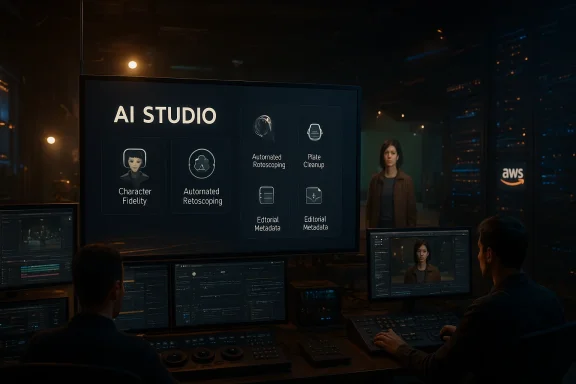
Amazon’s stated goals for AI Studio are pragmatic and narrowly technical: close gaps between consumer generative models and the exacting needs of professional production. The studio is focusing on a handful of high‑value problems:- Character and continuity fidelity: ensuring that assets generated across multiple shots, takes and lighting setups remain visually consistent.
- Automated rotoscoping, plate cleanup and background generation: reducing manual VFX hours for repetitive tasks.
- Creative asset versioning and rapid iteration: enabling real‑time alternatives for editors and directors without breaking editorial metadata flows.
- Shot‑level metadata and editorial integration: interoperating with tools such as ShotGrid, Avid, Unreal Engine and NLE panels to keep AI outputs traceable and editable.
Why these technical focuses matter
Production pipelines demand deterministic, auditable outputs. A visual effects supervisor cannot accept a tool that creates different eye color or wardrobe detail between frames. Solving that “last mile” requires methods for conditioning models on source‑level assets, embedding editorial constraints, and providing nondestructive outputs that VFX and editorial teams can refine. Amazon’s emphasis on character consistency and NLE integration directly targets those professional requirements.The closed beta: what to expect in March and why May matters
Amazon’s closed beta is deliberately curated: industry partners will be invited — not an open roll‑out — giving Amazon control over selection, the types of productions tested, and the metrics collected. The company says initial results will be shared in May, which will serve as the first measurable indicator of real‑world efficacy and studio appetite for third‑party AI tooling.Why the five‑to‑eight‑week window matters:
- Studios will field the tools against real shots and editorial schedules, not synthetic demos.
- Amazon will collect operational metrics: time saved on roto/cleanup, frame‑rate of iteration cycles, and editorial acceptance rates.
- Partners will surface integration gaps with common studio infrastructure (color pipelines, editorial metadata, QC tooling).
- The early results will heavily influence the build‑vs‑buy decision for larger studios deciding whether to maintain internal platforms or outsource to a vendor‑hosted offering.
Creative, legal and labor implications
The introduction of production‑grade generative tools forces a collision of technical capability with creative practice and legal frameworks.- Creative control and aesthetics: Directors and cinematographers require fine‑grained, repeatable control. If a tool aids speed but forces stylistic compromises, it will be resisted by creative leads.
- Writers, actors and unions: The entertainment industry’s guilds and unions are already wary of AI. Amazon’s messaging — that AI is a support rather than a replacement — aims to mitigate immediate backlash, but adoption at scale will require negotiated agreements around attribution, compensation and re‑use rights for AI‑assisted assets.
- Intellectual property and model training: Studios will demand contractual guarantees that footage, performances and design assets will not be used to train public or third‑party models. Amazon has said IP protection is a priority; beta agreements will test whether those guarantees are operationally enforceable.
The compute question: GPU capacity, supply risk and Nvidia’s role
High‑resolution generative video workflows are compute intensive, particularly when tools must produce production‑quality frames that match cinematography, high dynamic range color grading and movement across multiple cameras. That compute pressure sits squarely on the GPU supply chain.Nvidia’s 2025 letter of intent with OpenAI to provide systems tied to staged investment prompted a wave of commentary about whether concentrated compute commitments could crowd out other customers. Nvidia has publicly insisted the arrangement will not reduce service or supply to its broader customer base, saying: “We will continue to make every customer a top priority, with or without any equity stake.”
Industry watchers and antitrust experts, however, remain cautious. Centralized, preferential compute allocations — even if not explicitly discriminatory — can reshape competitive dynamics. Studios that rely on on‑prem or cloud GPU time for rendering, training or fine‑tuning models will watch Nvidia’s deployments closely, both for pricing impacts and queue times. Demand for “Vera Rubin”‑class accelerators and similar next‑generation devices will only intensify as more production entities adopt generative approaches.
AWS, vertical integration and vendor lock‑in
Amazon’s stack leverages AWS for both compute and orchestration. That provides scale and operational familiarity for many studios already using AWS for asset storage and dailies. But it also places Amazon in a dual role as infrastructure provider and tools vendor — a vertical integration that raises procurement questions:- Will third‑party studios be comfortable running creative IP through a platform owned by a major content company?
- How will pricing and service tiers be structured to avoid advantaging Amazon’s own productions?
- What interoperability guarantees will exist to extract assets and metadata for long‑term archival and cross‑vendor portability?
Strengths: what Amazon brings to the table
Amazon’s move has several concrete advantages that make its offering worth watching:- Production experience + technology: Amazon MGM Studios pairs practical production experience with deep access to AWS engineering resources — an uncommon combination for a single vendor. This positions them to build tools that understand editorial workflows, not just generate visuals.
- Focused product scope: Targeting the “last mile” problems (character consistency, plate cleanup) is a smart engineering play: it’s measurable and directly reduces manual labor in the pipeline.
- Advisory buy‑in from creatives: Involving production designers and animators in tool design increases the odds the tools will be adopted by professionals rather than dismissed as consumer‑grade gimmicks.
- Operational scale: AWS integration can provide elastic GPU throughput and global workflow stages that individual studios struggle to replicate.
Risks and downside scenarios
Adoption brings measurable risks that studios and creators must mitigate:- IP leakage and training risk: Even with contractual promises, technical misconfiguration or data handling lapses could expose assets to model training or third‑party access.
- Workforce dislocation and labor disputes: Rapid deployment without negotiated protections could trigger strikes, slowdowns, or public relations damage.
- Quality and homogenization: Overreliance on a vendor’s stylistic templates can lead to creative homogenization; unique directorial voices may be flattened.
- Vendor dependency: Long‑term reliance on an integrated tools + cloud vendor can make studios vulnerable to pricing changes, feature deprecation, or governance shifts.
- Supply chain fragility: If GPU supply tightens due to large institutional commitments (whether real or perceived), costs and availability for rendering and model training could spike.
Practical guidance for studios and creators evaluating the beta
If you are a studio tech lead, producer or post‑production chief planning to evaluate Amazon’s beta, consider a measured, checklist‑driven approach:- Legal and IP audit: Ensure contracts include clear, auditable commitments that data uploaded to the platform will not be used to train external models, and that long‑term asset ownership remains with the studio.
- Integration test: Run pilot workloads that exercise metadata preservation, editorial roundtripping and color pipeline fidelity. Confirm that outputs maintain conforming EDLs/AAF and that version control is intact.
- Security and segregation: Validate multi‑tenant isolation, key management, and access controls for dailies and raw plates.
- Provenance and watermarking: Require provenance metadata and robust watermarking/proofing that ties synthetic pixels to the generating process and can be audited later.
- Labor and stakeholder engagement: Engage unions and guilds early; pilots should be accompanied by explicit labor protections and transparent reporting on how AI was used and by whom.
- Exit and portability: Verify data export paths, archival compatibility and the ability to move assets off‑platform without loss of editorial context.
Policy and regulatory landscape: what to watch
AI in media now sits at the intersection of creative rights, labor law and competition policy:- Antitrust scrutiny: Big hardware partnerships (e.g., the Nvidia–OpenAI arrangement) invite regulatory questions about preferential access to scarce compute. Studios reliant on cloud GPUs will monitor developments closely.
- IP and training use rules: Contractual clauses banning training on proprietary footage are a short‑term fix; long term, statutory frameworks or industry standards for consent and compensation may be necessary.
- Content provenance laws: Legislatures and platforms are increasingly interested in provenance and labeling for synthetic content. Studios should be prepared for stricter compliance requirements around disclosure and attribution in the near term.
Long‑term outlook: build, buy or hybrid?
Amazon’s March beta accelerates a strategic question studios face: build bespoke internal tooling, buy third‑party platforms, or adopt hybrid models that combine both.- Large studios with heavy headcount and existing R&D may prefer internal stacks for IP control and differentiation.
- Mid‑sized studios and independents may favor third‑party platforms for cost and speed advantages.
- A hybrid outcome — internal tooling for core creative tasks, third‑party SaaS for commodity tasks — is the most likely near‑term equilibrium.
Conclusion: what to watch next
The March closed beta and the May results will be the first live measures of whether a major content company can meaningfully productize generative AI for Hollywood at scale. If Amazon demonstrates reliable, auditable time‑savings without unacceptable creative or legal tradeoffs, third‑party AI platforms could become a standard part of the studio toolkit. If the pilot raises IP, labor or technical red flags, adoption could slow and studios will double down on in‑house alternatives.Parallel to that, the compute conversation — represented by Nvidia’s high‑profile partnering and reassurances — will continue to shape the economics and availability of production‑grade AI. Studios and post houses must plan for both operational and supply‑chain uncertainty: negotiate tight contractual guarantees, demand technical auditability, and approach vendor pilots with a checklist that treats creative, legal and security disciplines equally.
In short: March is the test; May will be the early verdict. For creators and technologists alike, the coming months are when generative AI either proves itself as a collaborative production tool — or it becomes a cautionary tale about rushing capacity, IP and labor governance into creative practice without the scaffolding required to support it.
Source: NextBigWhat Amazon sets to trial AI production tools for film and TV in March
