
AMD’s December driver push — a Windows 11 WHQL build labeled Adrenalin 25.12.1 — arrives as more than a routine maintenance release: it is the first broadly distributed driver package that ties AMD’s new FSR Redstone machine‑learning upscaling stack to practical performance gains on consumer hardware, and early benchmarks reported by mainstream outlets and community testing indicate measurable framerate uplifts when Redstone features are enabled.
FSR Redstone is AMD’s next evolution of its FSR (FidelityFX Super Resolution) family — a unified brand that now bundles advanced ML‑led upscaling, ML‑accelerated frame generation, and ML ray‑regeneration / radiance caching techniques designed to drastically reduce the cost of ray tracing and path‑traced effects. The technology is positioned as AMD’s answer to NVIDIA’s recent DLSS and ray‑reconstruction initiatives: it relies heavily on dedicated ML pipelines present on the new RDNA4 / RX 9000‑series hardware to deliver the greatest benefits.
Adrenalin 25.12.1 is a WHQL‑certified Windows 11 driver release that, according to the changelog and early community reports, includes:
That said, reality is nuanced. Several risks temper the enthusiasm: vendor‑side benchmark framing, hardware exclusivity, and the normal instability risks that accompany major driver feature launches. Real‑world gains will vary by title, resolution and system configuration; independent verification from reputable third‑party labs and broad developer support will be the true test of Redstone’s practical value. Until that verification is complete, treat vendor‑provided numbers as indicative rather than definitive.
For WindowsForum readers: if you have an RDNA4 card and enjoy experimenting, 25.12.1 is worth trying — but follow a conservative testing protocol and be prepared to roll back if you need maximum day‑to‑day stability. For everyone else, monitor community and lab results over the next several weeks; the driver‑and‑game ecosystem will rapidly iterate, and clearer, reproducible data will emerge as developers ship Redstone‑aware patches and reviewers complete methodical tests.
Conclusion
Adrenalin 25.12.1 is a milestone release because it operationalizes FSR Redstone on shipping hardware and Windows 11; it demonstrates the performance potential of shifting ray‑tracing and upscaling workloads onto ML accelerators. The initial benefits are real where hardware and software align, but early adopters must balance the gains against the practical realities of driver maturity, visual tradeoffs, and the selective nature of early game support. Over the next months, adoption, developer integration, and independent benchmarks will determine whether Redstone reshapes the mid‑range gaming landscape or remains a promising — but narrowly available — performance lever.
Source: Neowin https://www.neowin.net/news/benchma...driver-brings-fsr-redstone-performance-boost/
 Background / Overview
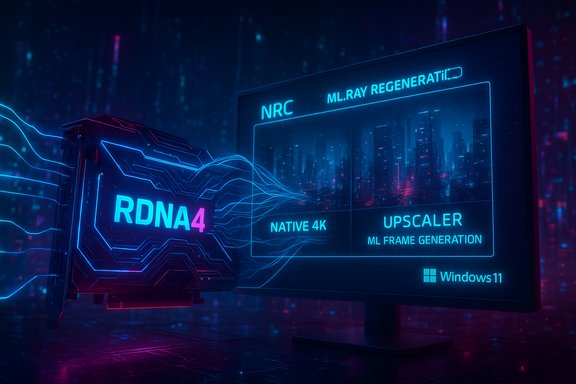
FSR Redstone is AMD’s next evolution of its FSR (FidelityFX Super Resolution) family — a unified brand that now bundles advanced ML‑led upscaling, ML‑accelerated frame generation, and ML ray‑regeneration / radiance caching techniques designed to drastically reduce the cost of ray tracing and path‑traced effects. The technology is positioned as AMD’s answer to NVIDIA’s recent DLSS and ray‑reconstruction initiatives: it relies heavily on dedicated ML pipelines present on the new RDNA4 / RX 9000‑series hardware to deliver the greatest benefits.Adrenalin 25.12.1 is a WHQL‑certified Windows 11 driver release that, according to the changelog and early community reports, includes:
- Foundational RDNA4 driver optimizations that expose and accelerate Redstone features.
- Day‑zero compatibility and game‑profile updates for titles adopting Redstone APIs.
- Generalized ray‑tracing throughput improvements and upscaling refinements aimed at high‑resolution play.
What exactly is in 25.12.1?
Core feature set
The 25.12.1 driver is not merely bug fixes — it’s a vehicle for a new feature stack:- FSR Redstone (FSR 4 and Redstone subsystems): a combined suite for ML upscaling, ML frame generation, and ML ray/regeneration caches, designed to reduce the rendering cost of indirect lighting and to insert high‑quality interpolated frames. These functions rely on dedicated AI accelerators and RDNA4‑level ML pipelines.
- RDNA4 optimizations: changes in how the driver schedules RT workloads and ML kernels, intended to improve ray‑traced scene throughput and reduce frame rendering overhead. These are described as low‑level scheduling and traversal optimizations rather than pure shader‑level improvements.
- Display / media adjustments for Windows 11: the release notes note improved AV1 handling and DisplayPort/VRR refinements that are meaningful for high‑refresh, HDR, and AV workflows when paired with the right hardware.
Platform and compatibility notes
- The Redstone features are primarily tied to RDNA4 / RX 9000‑series GPUs and depend on new ML and FP‑precision accelerators on that architecture. AMD’s public messaging and independent reporting indicate limited (or no) RDNA3/earlier backporting at launch; that exclusivity is a practical constraint for large numbers of existing Radeon owners.
- The driver is WHQL for Windows 11 and the documentation emphasizes Windows 11 feature pathways; some reporting notes Windows 10 is being de‑emphasized in release notes even though software compatibility may continue in practice. Users running older Windows builds should check compatibility before upgrading.
Benchmarks: what the early numbers show
Early benchmarking across outlets and community testers indicates consistent trends: when Redstone's ML upscaling and/or frame generation components are enabled on supported RDNA4 hardware, frame rates rise substantially — often in double‑digit percentages for ray‑traced or CPU‑bottlenecked scenarios. Specific observations include:- Titles that are heavily ray‑tracing bound show the largest relative gains after Redstone features are engaged, because the stack offloads or approximates the most expensive lighting and denoising work to ML pipelines that run more efficiently on RDNA4 silicon.
- Frame generation combined with upscaling (the common practical pairing) can push average framerates from playable into high‑refresh ranges at 1440p and 4K on RDNA4 cards, especially when the base render resolution is reduced and Redstone reconstructs high‑frequency detail. These are consistent observations in driver release commentary and early reviewer tests, though exact percentages vary by title, resolution and system configuration.
Why Redstone can improve performance (technical explanation)
At the heart of Redstone’s promise are three ML‑centric techniques that play together:- Neural Radiance Caching (NRC): a learned cache that predicts and stores indirect lighting behavior. Instead of computing thousands of bounces or relying on expensive denoisers every frame, NRC uses a neural model to approximate the contribution of indirect lighting from prior samples. This reduces the raw ray‑trace computation per frame. The technique is similar in concept to a learned light cache used by some experimental renderers.
- ML‑driven Ray Regeneration / Denoising: a model that identifies problematic ray‑traced pixels (high noise, missing bounces) and reconstructs them rather than running full‑precision, iterative ray‑tracing for every sample. The net effect is cleaner images at fewer trace samples.
- ML Frame Generation: a temporal and spatially aware generator that can create intermediate frames — much like DLSS‑style frame gen — which multiplies perceived framerate without requiring the GPU to render every native frame. When paired with upscalers, the visual and performance improvements compound.
Strengths: what 25.12.1 and Redstone do well
- Meaningful ray‑tracing acceleration: Redstone reframes ray tracing from raw brute force toward an ML‑assisted approximation pipeline. For scenes dominated by indirect lighting, NRC plus ray‑regeneration offers tangible framerate improvements while preserving a high percentage of visual fidelity.
- Modern feature stack integration: By combining upscaling, frame gen, and ray assistance in a single ecosystem, AMD gives developers modular tools to hit a broad range of performance/quality targets without building separate in‑house solutions. This lowers engineering overhead and can accelerate adoption.
- Driver‑level day‑zero updates: 25.12.1 appears to be targeted at shipping titles and holiday launch windows with driver profiles and WHQL stability that enables immediate uptake, assuming hardware compatibility. That alignment between driver and game patches is beneficial for users who expect ready‑to‑play experiences.
Risks, limitations and real‑world caveats
No update is risk‑free. The practical rollout of 25.12.1 and Redstone carries several important caveats:- Hardware exclusivity: Redstone’s ML features heavily depend on dedicated RDNA4 accelerators. Owners of RDNA3, RDNA2 or earlier GPUs should not expect the same benefits; AMD’s initial messaging and multiple independent writeups make clear that full Redstone functionality is RDNA4‑centric. This creates a sharp adoption boundary and could frustrate owners of still‑capable older cards.
- Image‑quality tradeoffs: ML upscaling and frame generation inevitably involve approximation. While Redstone is built to prioritize visual fidelity, artifacts can appear — especially in high‑motion or high‑frequency detail scenes — until game developers and driver teams refine per‑title profiles. The real‑world visual result depends on game engine hooks and profile tuning. Treat initial quality impressions as provisional.
- Driver maturity and stability: the 25.x driver family has seen mixed community feedback during the year; some intermediate releases generated reports of instability, crashes, and UI issues. While 25.12.1 is WHQL‑certified and intended to be stable, community threads illustrate that driver updates can have regressions on certain configurations. Users who require absolute stability should weigh the benefits against the potential for teething problems and consider waiting for consolidated feedback.
- Game support is required: Redstone features must be integrated or exposed by developers or through driver‑level overrides. Not every game will adopt Redstone immediately, and the best results will come where developers tune ML models and engine hooks specifically for Redstone’s pipeline. Expect a gradual rollout of widespread game support.
- Windows 11 focus: 25.12.1 is oriented for Windows 11. Users on Windows 10 or older Windows 11 builds may see reduced or missing feature exposure. If you rely on older OS versions for compatibility, plan accordingly.
How to test and evaluate the driver on your machine
If you have RDNA4 hardware and want to evaluate 25.12.1, follow this disciplined process to separate real gains from placebo effects:- Back up your profile and settings: save your Radeon profiles and note custom fan curves and OC settings.
- Clean install the driver: use a DDU (Display Driver Uninstaller) clean removal in Safe Mode, then install the WHQL package to avoid residue conflicts that occasionally cause issues with major driver updates.
- Update Windows 11 to the latest build: many driver features assume the latest OS plumbing for thread scheduling and feature exposure.
- Use in‑game benchmarks and third‑party tools (PresentMon / CapFrameX) to collect data on average FPS, 1% lows and frame times before and after enabling Redstone features.
- Test with multiple titles: pick a GPU‑bound ray‑traced title, a CPU‑bound scenario (to confirm frame‑gen benefits where CPU limits framerate), and a high‑refresh competitive title to evaluate latency and input behavior.
- Evaluate image quality on recorded clips: because frame gen and ML upscaling can introduce subtle artifacts in motion, record short clips and scrub them frame‑by‑frame or play side‑by‑side comparisons to judge fidelity.
Recommended user approach
- Enthusiasts with RDNA4 hardware who want to push for the latest image/performance tradeoffs should try 25.12.1 after creating a recovery point and backing up profiles.
- Content creators and stability‑critical users should wait for broader third‑party lab validation and multiple game patches that mature Redstone support.
- Users on non‑RDNA4 hardware should not expect Redstone benefits; instead continue to use the prior stable driver line appropriate for their GPU family.
Broader industry implications
Redstone is significant beyond a single driver because it signals AMD’s strategic pivot: more of the graphics pipeline is shifting to learned, ML‑assisted approximations. That has multiple implications:- Developers gain a reusable suite of ML tools they can adopt in many engines, which reduces bespoke engineering effort for DLSS‑style features.
- The hardware arms race now includes specialized ML accelerators and precision modes (FP8, INT8) as first‑class features — that changes GPU microarchitecture priorities going forward.
- Competition with NVIDIA will accelerate on both the hardware and integration fronts; users win when the market pushes better image/perf tradeoffs and broader game support.
Final analysis and verdict
Adrenalin 25.12.1 is the practical debut vehicle for AMD’s FSR Redstone story on Windows 11, and early results are promising for gamers and creators willing to adopt RDNA4 hardware. The release brings a tidy set of ML‑led tools that — in the right titles and with proper tuning — deliver meaningful framerate gains and ray‑tracing efficiency improvements. That combination is a clear strength and a necessary step for AMD to remain competitive in modern rendering workflows.That said, reality is nuanced. Several risks temper the enthusiasm: vendor‑side benchmark framing, hardware exclusivity, and the normal instability risks that accompany major driver feature launches. Real‑world gains will vary by title, resolution and system configuration; independent verification from reputable third‑party labs and broad developer support will be the true test of Redstone’s practical value. Until that verification is complete, treat vendor‑provided numbers as indicative rather than definitive.
For WindowsForum readers: if you have an RDNA4 card and enjoy experimenting, 25.12.1 is worth trying — but follow a conservative testing protocol and be prepared to roll back if you need maximum day‑to‑day stability. For everyone else, monitor community and lab results over the next several weeks; the driver‑and‑game ecosystem will rapidly iterate, and clearer, reproducible data will emerge as developers ship Redstone‑aware patches and reviewers complete methodical tests.
Conclusion
Adrenalin 25.12.1 is a milestone release because it operationalizes FSR Redstone on shipping hardware and Windows 11; it demonstrates the performance potential of shifting ray‑tracing and upscaling workloads onto ML accelerators. The initial benefits are real where hardware and software align, but early adopters must balance the gains against the practical realities of driver maturity, visual tradeoffs, and the selective nature of early game support. Over the next months, adoption, developer integration, and independent benchmarks will determine whether Redstone reshapes the mid‑range gaming landscape or remains a promising — but narrowly available — performance lever.
Source: Neowin https://www.neowin.net/news/benchma...driver-brings-fsr-redstone-performance-boost/
