
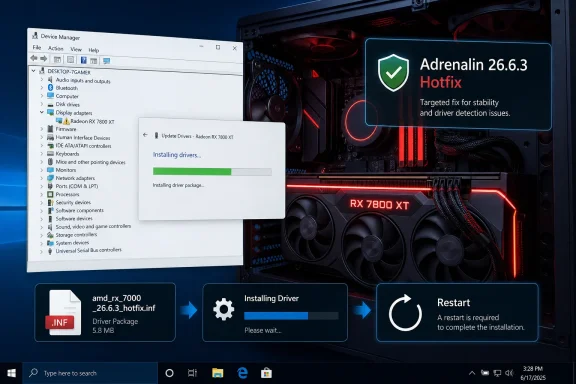
AMD released AMD Software: Adrenalin Edition 26.6.3 Hotfix Preview Driver on June 24, 2026, to address an intermittent Windows 10 installation failure affecting Radeon RX 7000-series and newer graphics cards after the previous 26.6.2 driver left some systems showing a Device Manager yellow-bang error. The speed of the response matters, but so does the narrowness of the fix. This was not a sweeping Radeon driver reset; it was a targeted patch for a very specific collision between AMD’s newest GPU stack and Microsoft’s aging-but-still-widely-used desktop OS. The episode is a reminder that Windows 10 may be nearing the end of its mainstream life, but it is still very much alive in the machines that gamers, creators, and small offices actually use.
The immediate story is simple: Adrenalin 26.6.2 landed, Windows 10 users with newer Radeon cards began reporting broken installs, and AMD followed with 26.6.3 as a hotfix. In Device Manager terms, the “yellow bang” is the sort of visual shorthand every Windows troubleshooter recognizes: something loaded badly, the device is not happy, and the operating system is no longer treating the driver stack as healthy.
The affected population appears to have been owners of Radeon RX 7000-series and newer GPUs running Windows 10. That matters because those cards sit on AMD’s more recent graphics architecture line, where driver development is moving fastest. These are not orphaned budget cards from a decade ago; they are precisely the products AMD needs to keep looking polished against Nvidia.
The underlying issue was described as intermittent, which is both reassuring and maddening. Reassuring, because not every Windows 10 Radeon owner was doomed the moment they clicked update. Maddening, because intermittent install failures are the ones that waste afternoons: one reboot looks normal, the next produces a broken control panel, an incompatible-driver message, or a Device Manager code that sends users hunting through forum threads.
AMD’s quick hotfix deserves credit. A driver package that damages confidence for even a subset of users needs a fast response, and a one-day turnaround is better than the industry norm. But the existence of the hotfix also exposes how brittle the consumer graphics driver pipeline has become, especially when a vendor is trying to ship gaming optimizations, new rendering features, control-panel plumbing, and OS compatibility in one recurring package.
That is why this class of bug hits harder than a single-game performance regression. If a new driver loses a few frames in one title, enthusiasts can debate benchmark charts and wait for a profile update. If the driver does not install cleanly, the whole PC becomes suspect.
The reports around 26.6.2 followed the familiar arc of modern driver trouble. Users rolled back, ran cleanup utilities, disabled automatic driver delivery, reinstalled older packages, and compared notes about whether Windows Update had made matters worse by inserting its own driver at exactly the wrong moment. None of that is exotic to WindowsForum readers, but it is exactly the kind of maintenance tax that ordinary users thought GPU control panels had mostly outgrown.
The phrase “yellow bang” sounds almost comic until it happens on a primary workstation or gaming rig. Then it becomes the visible edge of a deeper support problem: the average user cannot easily tell whether the fault lives in AMD’s installer, Windows’ driver store, Windows Update’s timing, a previous package remnant, or the OS branch itself. That ambiguity is where trust erodes.
The hotfix, 26.6.3, is therefore a containment release. Its job is not to win headlines with new performance claims. Its job is to restore the baseline expectation that a driver installer can update a supported machine without leaving the graphics card in a half-present state.
That baseline is easy to underrate until it fails. GPU vendors increasingly market drivers as part of the product experience: a cadence of game-ready updates, upscaling support, latency controls, recording tools, AI-ish features, and power tuning. But all of that rests on an older bargain between user and vendor: the driver must first install cleanly and survive a reboot.
When that bargain breaks, the user does not care whether the release notes contain a promising rendering feature. They want the display adapter to stop looking broken in Device Manager.
Windows 10 remains attractive for users who dislike Windows 11’s interface changes, have older but still capable CPUs, rely on known-good workflows, or simply do not want to reinstall an operating system that already runs their games and applications. For many PC enthusiasts, “supported” is not an abstract lifecycle term. It means the machine boots, Steam opens, OBS records, Photoshop accelerates, and Device Manager does not complain.
AMD knows this. So does Nvidia. So does every vendor still shipping drivers that list Windows 10 as compatible for some products. The OS may be moving toward the back half of its lifecycle, but the installed base is too large to treat as an edge case without consequence.
That is the tension exposed by Adrenalin 26.6.3. Microsoft can set the support calendar, but hardware vendors inherit the human calendar. Users retire operating systems slowly, unevenly, and often only when a failure forces their hand. Driver bugs on Windows 10 do not just affect laggards; they affect the portion of the market that is deliberately staying put.
This is especially true for AMD’s full Adrenalin package, which is both a display driver and a software suite. The visible Radeon interface, recording components, tuning controls, overlay services, and background update mechanisms all sit on top of the kernel-mode foundation. A mismatch between the installed software layer and the active display driver can produce the familiar “not compatible” warning that sends users into repair mode.
Windows Update adds another wrinkle. It is designed to keep machines functional by delivering drivers when needed, but enthusiasts often experience it as an uninvited participant that installs an older or different GPU package over a manually selected one. That may not be the root cause of the 26.6.2 problem, but it is part of the support landscape users have to navigate whenever a driver install goes sideways.
The old advice still appears because it still works often enough: disconnect from the network, use AMD’s cleanup utility or a display-driver uninstaller, reboot, install the desired package, and only then let Windows back online. The fact that this advice remains common in 2026 is not a triumph of enthusiast knowledge. It is an indictment of how fragile the handoff remains between Windows and GPU vendors.
That urgency creates a brutal testing matrix. AMD must validate different Radeon generations, desktop and mobile variants, Windows 10 and Windows 11 builds, clean installs and upgrades, multiple monitor configurations, overlay conflicts, game engines, anti-cheat systems, content-creation workloads, and increasingly complex upscaling stacks. Even a well-run QA process can miss an intermittent installer issue that depends on a particular OS state.
The problem is not that AMD shipped a bug. Every driver vendor ships bugs. The problem is that the driver package is now expected to be both fast-moving and infrastructure-grade stable, which are opposing pressures.
Nvidia has its own history of hotfixes and regressions, and Intel’s Arc drivers have spent years visibly maturing in public. AMD is not uniquely guilty here. But AMD is in a particularly sensitive position because Radeon’s market argument often depends on momentum: better drivers, improved day-one support, more aggressive feature rollouts, and the sense that the platform is closing gaps. Installer failures puncture that narrative more efficiently than a modest benchmark loss.
For Windows 10 users, that split creates an uncomfortable overlap. A user can have a new Radeon GPU in an old Windows environment, and the vendor still has to make that pairing coherent. The hardware may be modern, but the OS assumptions are not.
This is where lifecycle language becomes slippery. A product can be supported but not equally prioritized. An OS can be compatible but less central to validation. A GPU can be current while some surrounding software assumptions are clearly migrating toward Windows 11.
The Adrenalin 26.6.3 hotfix sits right in that gray zone. AMD did not abandon Windows 10 users; it fixed the issue quickly. But the incident still suggests that Windows 10 is becoming the path where surprises are more likely, not less.
The lesson is not “never update.” For security, stability, game compatibility, and application fixes, GPU drivers matter. The lesson is that graphics drivers deserve the same change-control thinking as other low-level components.
That is especially true for fleets with mixed Windows 10 and Windows 11 systems. A driver that behaves on Windows 11 may not behave identically on Windows 10, even when the release package lists both. If the affected hardware is a workstation GPU used for creative workloads, the cost of a bad driver is not measured in lost frames; it is measured in missed work.
In managed environments, admins should treat 26.6.3 as the minimum candidate for affected Windows 10 systems that need this driver branch, while avoiding 26.6.2 on the impacted configurations. In unmanaged homes and gaming rigs, the same practical advice applies in less formal language: do not mash the update button on a production machine until early adopters have survived the first day.
It is also one of its recurring embarrassments. A modern GPU driver should not require users to know the difference between the driver store, the software package, and Windows Update’s hardware matching behavior. It should not require them to gamble on whether “factory reset” inside an installer will be enough or whether a deeper cleanup is needed.
To AMD’s credit, a hotfix driver is the correct remedy. It gives users a vendor-sanctioned path rather than leaving them to triangulate among forum posts. But the surrounding ritual still matters because many users will not discover the hotfix first. They will discover the broken install, panic, and search from a phone while their main display is in a degraded state.
This is where GPU vendors could still do better. A driver package that detects a known-bad previous install path and repairs it gracefully is more valuable than another overlay toggle. A clearer rollback prompt is more valuable than release-note boilerplate. A Windows Update coordination story that does not require enthusiasts to disable network adapters would feel almost revolutionary.
If a Windows 10 driver fails in 2021, it is a driver bug. If it fails in 2026, users wonder whether they are being nudged toward Windows 11, whether testing has quietly shifted, or whether vendors are beginning to tolerate rougher edges on the older OS. Those suspicions may be unfair in any individual case, but they are not irrational.
The industry has trained users to read support decisions as strategy. Microsoft’s hardware requirements for Windows 11 did that. GPU vendors’ shifting support tiers did that. Application developers ending support for older Windows builds did that. So when a new Radeon driver breaks on Windows 10 and gets fixed a day later, the facts say “hotfix,” but the context whispers “transition.”
AMD cannot fully escape that context. The best it can do is keep Windows 10 support boring for as long as it claims to provide it. Boring, in driver terms, is praise. Boring means the installer works, the screen comes back, Device Manager stays clean, and users forget the driver exists until a game needs it.
 AMD Fixed the Fire, but the Smoke Points at Windows 10’s Long Tail
The immediate story is simple: Adrenalin 26.6.2 landed, Windows 10 users with newer Radeon cards began reporting broken installs, and AMD followed with 26.6.3 as a hotfix. In Device Manager terms, the “yellow bang” is the sort of visual shorthand every Windows troubleshooter recognizes: something loaded badly, the device is not happy, and the operating system is no longer treating the driver stack as healthy.The affected population appears to have been owners of Radeon RX 7000-series and newer GPUs running Windows 10. That matters because those cards sit on AMD’s more recent graphics architecture line, where driver development is moving fastest. These are not orphaned budget cards from a decade ago; they are precisely the products AMD needs to keep looking polished against Nvidia.
The underlying issue was described as intermittent, which is both reassuring and maddening. Reassuring, because not every Windows 10 Radeon owner was doomed the moment they clicked update. Maddening, because intermittent install failures are the ones that waste afternoons: one reboot looks normal, the next produces a broken control panel, an incompatible-driver message, or a Device Manager code that sends users hunting through forum threads.
AMD’s quick hotfix deserves credit. A driver package that damages confidence for even a subset of users needs a fast response, and a one-day turnaround is better than the industry norm. But the existence of the hotfix also exposes how brittle the consumer graphics driver pipeline has become, especially when a vendor is trying to ship gaming optimizations, new rendering features, control-panel plumbing, and OS compatibility in one recurring package.
The Yellow Bang Is Windows’ Least Subtle Editorial Comment
A yellow bang in Device Manager is not a crash dump, a telemetry dashboard, or a polite warning. It is Windows saying, in the bluntest UI language it has, that a device has failed to initialize or is otherwise not working correctly. For GPU owners, that warning can mean degraded display behavior, fallback drivers, broken acceleration, missing Radeon software features, or a machine that feels newly untrustworthy.That is why this class of bug hits harder than a single-game performance regression. If a new driver loses a few frames in one title, enthusiasts can debate benchmark charts and wait for a profile update. If the driver does not install cleanly, the whole PC becomes suspect.
The reports around 26.6.2 followed the familiar arc of modern driver trouble. Users rolled back, ran cleanup utilities, disabled automatic driver delivery, reinstalled older packages, and compared notes about whether Windows Update had made matters worse by inserting its own driver at exactly the wrong moment. None of that is exotic to WindowsForum readers, but it is exactly the kind of maintenance tax that ordinary users thought GPU control panels had mostly outgrown.
The phrase “yellow bang” sounds almost comic until it happens on a primary workstation or gaming rig. Then it becomes the visible edge of a deeper support problem: the average user cannot easily tell whether the fault lives in AMD’s installer, Windows’ driver store, Windows Update’s timing, a previous package remnant, or the OS branch itself. That ambiguity is where trust erodes.
The Hotfix Arrived Fast Because the Broken Driver Was Sitting in a Strategic Lane
Adrenalin 26.6.2 was not just another maintenance drop. It arrived in the context of AMD’s newer Radeon stack, with attention around features and fixes for recent GPUs rather than legacy-era polish. That makes the Windows 10 failure more awkward: the affected systems were not fringe Linux dual-boots or unsupported experiments, but Windows 10 installs paired with current Radeon hardware.The hotfix, 26.6.3, is therefore a containment release. Its job is not to win headlines with new performance claims. Its job is to restore the baseline expectation that a driver installer can update a supported machine without leaving the graphics card in a half-present state.
That baseline is easy to underrate until it fails. GPU vendors increasingly market drivers as part of the product experience: a cadence of game-ready updates, upscaling support, latency controls, recording tools, AI-ish features, and power tuning. But all of that rests on an older bargain between user and vendor: the driver must first install cleanly and survive a reboot.
When that bargain breaks, the user does not care whether the release notes contain a promising rendering feature. They want the display adapter to stop looking broken in Device Manager.
Windows 10 Is “Old” Only in Corporate Roadmaps
The tempting read is that Windows 10 users should simply move on. Microsoft has spent years pushing Windows 11, and the industry has been preparing for Windows 10’s support cliff. But that view ignores the actual hardware reality on desks, under TVs, and inside gaming rooms.Windows 10 remains attractive for users who dislike Windows 11’s interface changes, have older but still capable CPUs, rely on known-good workflows, or simply do not want to reinstall an operating system that already runs their games and applications. For many PC enthusiasts, “supported” is not an abstract lifecycle term. It means the machine boots, Steam opens, OBS records, Photoshop accelerates, and Device Manager does not complain.
AMD knows this. So does Nvidia. So does every vendor still shipping drivers that list Windows 10 as compatible for some products. The OS may be moving toward the back half of its lifecycle, but the installed base is too large to treat as an edge case without consequence.
That is the tension exposed by Adrenalin 26.6.3. Microsoft can set the support calendar, but hardware vendors inherit the human calendar. Users retire operating systems slowly, unevenly, and often only when a failure forces their hand. Driver bugs on Windows 10 do not just affect laggards; they affect the portion of the market that is deliberately staying put.
The Driver Store Has Become a Three-Body Problem
Modern Windows graphics updates are not a simple matter of copying a driver and rebooting. The Radeon package, Windows’ own driver store, Windows Update, cleanup tools, OEM customizations, and previous driver remnants can all participate in the final state of the system. When something goes wrong, the user sees one symptom but may be dealing with several interacting mechanisms.This is especially true for AMD’s full Adrenalin package, which is both a display driver and a software suite. The visible Radeon interface, recording components, tuning controls, overlay services, and background update mechanisms all sit on top of the kernel-mode foundation. A mismatch between the installed software layer and the active display driver can produce the familiar “not compatible” warning that sends users into repair mode.
Windows Update adds another wrinkle. It is designed to keep machines functional by delivering drivers when needed, but enthusiasts often experience it as an uninvited participant that installs an older or different GPU package over a manually selected one. That may not be the root cause of the 26.6.2 problem, but it is part of the support landscape users have to navigate whenever a driver install goes sideways.
The old advice still appears because it still works often enough: disconnect from the network, use AMD’s cleanup utility or a display-driver uninstaller, reboot, install the desired package, and only then let Windows back online. The fact that this advice remains common in 2026 is not a triumph of enthusiast knowledge. It is an indictment of how fragile the handoff remains between Windows and GPU vendors.
AMD’s Release Cadence Is Now a Product Feature and a Product Risk
Radeon drivers are no longer quiet plumbing. They are part of the marketing cycle for new games, new GPU launches, and new image-reconstruction technologies. AMD needs to move quickly because the GPU market punishes hesitation: if a major title lands and Radeon performance or feature support lags, the comparison charts write themselves.That urgency creates a brutal testing matrix. AMD must validate different Radeon generations, desktop and mobile variants, Windows 10 and Windows 11 builds, clean installs and upgrades, multiple monitor configurations, overlay conflicts, game engines, anti-cheat systems, content-creation workloads, and increasingly complex upscaling stacks. Even a well-run QA process can miss an intermittent installer issue that depends on a particular OS state.
The problem is not that AMD shipped a bug. Every driver vendor ships bugs. The problem is that the driver package is now expected to be both fast-moving and infrastructure-grade stable, which are opposing pressures.
Nvidia has its own history of hotfixes and regressions, and Intel’s Arc drivers have spent years visibly maturing in public. AMD is not uniquely guilty here. But AMD is in a particularly sensitive position because Radeon’s market argument often depends on momentum: better drivers, improved day-one support, more aggressive feature rollouts, and the sense that the platform is closing gaps. Installer failures puncture that narrative more efficiently than a modest benchmark loss.
The New Radeon Split Makes Older Definitions of Support Less Useful
The hotfix specifically matters for Radeon RX 7000 and newer GPUs, a boundary that now carries more meaning than a simple product-family label. AMD’s driver strategy has increasingly separated the newest Radeon architectures from older ones when it comes to fresh feature work, game optimizations, and expanded API support. That does not mean older cards instantly stop functioning, but it does mean the newest stack is where the action is.For Windows 10 users, that split creates an uncomfortable overlap. A user can have a new Radeon GPU in an old Windows environment, and the vendor still has to make that pairing coherent. The hardware may be modern, but the OS assumptions are not.
This is where lifecycle language becomes slippery. A product can be supported but not equally prioritized. An OS can be compatible but less central to validation. A GPU can be current while some surrounding software assumptions are clearly migrating toward Windows 11.
The Adrenalin 26.6.3 hotfix sits right in that gray zone. AMD did not abandon Windows 10 users; it fixed the issue quickly. But the incident still suggests that Windows 10 is becoming the path where surprises are more likely, not less.
For Admins, This Is Another Argument Against Blind Driver Uptake
Enterprise IT departments usually do not need reminding to stage driver updates, but smaller shops and power users often run closer to consumer defaults. GPU driver updates can look harmless compared with BIOS updates or cumulative Windows patches. In practice, they can be just as disruptive when they break display initialization or acceleration.The lesson is not “never update.” For security, stability, game compatibility, and application fixes, GPU drivers matter. The lesson is that graphics drivers deserve the same change-control thinking as other low-level components.
That is especially true for fleets with mixed Windows 10 and Windows 11 systems. A driver that behaves on Windows 11 may not behave identically on Windows 10, even when the release package lists both. If the affected hardware is a workstation GPU used for creative workloads, the cost of a bad driver is not measured in lost frames; it is measured in missed work.
In managed environments, admins should treat 26.6.3 as the minimum candidate for affected Windows 10 systems that need this driver branch, while avoiding 26.6.2 on the impacted configurations. In unmanaged homes and gaming rigs, the same practical advice applies in less formal language: do not mash the update button on a production machine until early adopters have survived the first day.
Enthusiast Workarounds Are Useful, but They Should Not Be the User Interface
The Radeon community responded the way PC communities always respond: quickly, experimentally, and with a mixture of sound advice and superstition. Rollbacks to 26.6.1, cleanup passes, offline installs, Windows Update blocking, and repeated reboots all appeared as users tried to restore a working driver state. That collective troubleshooting is one of the strengths of the PC ecosystem.It is also one of its recurring embarrassments. A modern GPU driver should not require users to know the difference between the driver store, the software package, and Windows Update’s hardware matching behavior. It should not require them to gamble on whether “factory reset” inside an installer will be enough or whether a deeper cleanup is needed.
To AMD’s credit, a hotfix driver is the correct remedy. It gives users a vendor-sanctioned path rather than leaving them to triangulate among forum posts. But the surrounding ritual still matters because many users will not discover the hotfix first. They will discover the broken install, panic, and search from a phone while their main display is in a degraded state.
This is where GPU vendors could still do better. A driver package that detects a known-bad previous install path and repairs it gracefully is more valuable than another overlay toggle. A clearer rollback prompt is more valuable than release-note boilerplate. A Windows Update coordination story that does not require enthusiasts to disable network adapters would feel almost revolutionary.
The Windows 10 Clock Makes Every Driver Regression Feel Political
Windows 10 is not just another operating system version now. It is a countdown. That changes how users interpret every bug.If a Windows 10 driver fails in 2021, it is a driver bug. If it fails in 2026, users wonder whether they are being nudged toward Windows 11, whether testing has quietly shifted, or whether vendors are beginning to tolerate rougher edges on the older OS. Those suspicions may be unfair in any individual case, but they are not irrational.
The industry has trained users to read support decisions as strategy. Microsoft’s hardware requirements for Windows 11 did that. GPU vendors’ shifting support tiers did that. Application developers ending support for older Windows builds did that. So when a new Radeon driver breaks on Windows 10 and gets fixed a day later, the facts say “hotfix,” but the context whispers “transition.”
AMD cannot fully escape that context. The best it can do is keep Windows 10 support boring for as long as it claims to provide it. Boring, in driver terms, is praise. Boring means the installer works, the screen comes back, Device Manager stays clean, and users forget the driver exists until a game needs it.
The Repair Note Radeon Owners Should Actually Remember
The practical read of this episode is narrow but important. Adrenalin 26.6.2 is the suspect release for Windows 10 systems with Radeon RX 7000-series and newer GPUs, and Adrenalin 26.6.3 is the hotfix AMD rushed out to address the install issue. Users already stable on an older branch do not need to treat this as a reason to panic, but anyone on the affected configuration should be cautious about 26.6.2.- Users running Windows 10 with Radeon RX 7000-series or newer GPUs should avoid Adrenalin 26.6.2 and use the 26.6.3 hotfix if they need that branch.
- A yellow-bang warning in Device Manager after the update points to a driver installation or initialization failure, not a normal Radeon software quirk.
- Rolling back to a known-good driver remains a reasonable recovery step if the hotfix does not install cleanly on an already-broken system.
- Windows Update can complicate GPU driver recovery, so users should watch for unwanted driver replacement during troubleshooting.
- Admins should stage Radeon driver updates on representative Windows 10 hardware before approving them broadly.
- The incident is another signal that Windows 10 support may remain available, but it is no longer the safest assumption in the newest GPU driver paths.
References
- Primary source: Neowin
Published: Wed, 24 Jun 2026 18:00:00 GMT
Loading…
www.neowin.net - Independent coverage: Wccftech
Published: Wed, 24 Jun 2026 17:57:00 GMT
Loading…
wccftech.com - Independent coverage: videocardz.com
Published: Wed, 24 Jun 2026 17:37:40 GMT
Loading…
videocardz.com - Related coverage: overclock3d.net
AMD confirms major Windows 10 bug in its 26.6.2 GPU drivers - OC3D
AMD Software 26.6.2 is causing issues for Radeon GPU users on Windows 10. No FSR 4 upgrades for RDNA 3 users on Windows 10.overclock3d.net - Related coverage: errors.decodesignals.com
Loading…
errors.decodesignals.com - Related coverage: igorslab.de
AMD Adrenalin 26.6.1: Radeon driver adds new game profiles and fixes …
On June 2, 2026, AMD released the driver AMD Software: Adrenalin Edition 26.6.1.www.igorslab.de
- Related coverage: techspot.com
AMD Radeon Adrenalin Graphics Driver 26.6.2 Download | TechSpot
Download AMD Radeon Adrenalin Graphics Driver 26.6.2. OS support: Windows (all). Category: Graphics Cardswww.techspot.com - Related coverage: windowscentral.com
AMD kills Windows 10 support in its latest Adrenalin update — Battlefield 6 picks up bug fixes and optimizations | Windows Central
Also on the killing floor are new game and Vulkan extension support for RDNA 1 and RDNA 2 GPUs.www.windowscentral.com - Related coverage: gazlog.jp
Loading…
gazlog.jp - Related coverage: elchapuzasinformatico.com
Loading…
elchapuzasinformatico.com - Related coverage: patchbot.io
Loading…
patchbot.io - Related coverage: techradar.com
Loading…
www.techradar.com