

AMD released AMD Software: Adrenalin Edition 26.6.4 on June 29, 2026, for Windows 10 and Windows 11 systems, fixing an intermittent Windows 10 installation problem tied to 26.6.2 and crashes in some FSR 4.1 games on Radeon RX 7000 graphics cards. The driver is a small package with unusually large implications, because it arrives days after AMD extended one of its most visible graphics features to last-generation hardware. The message is simple: FSR 4.1 on RDNA 3 is real, but the first public lap needed a pit stop. For Windows users, especially those still on Windows 10, this is less a feature drop than a reminder that GPU drivers are now where operating systems, AI models, game engines, and hardware generations all collide.
On paper, Adrenalin 26.6.4 is the sort of driver release that barely deserves a push notification. AMD lists two fixed issues: an intermittent install failure seen when installing Adrenalin 26.6.2 on Windows 10 systems with Radeon RX 7000 series and newer products, and intermittent crashes in some games when FSR Upscaling 4.1 is enabled on Radeon RX 7000 series graphics cards. There is no marquee game optimization, no new control-panel redesign, and no grand platform announcement.
That is precisely why the release matters. AMD had just used the 26.6.2 branch to broaden FSR 4.1 support beyond the newest Radeon RX 9000 family and into RX 7000 cards, a move that made RDNA 3 owners feel less like spectators in the company’s AI-upscaling strategy. When the driver that unlocks that feature then trips over installation on Windows 10 and crashes in some FSR 4.1 scenarios, the story stops being “free upgrade” and becomes “first-week reliability.”
This is the tension AMD has to manage. The company wants to sell FSR 4.1 as a platform benefit, not a niche checkbox for buyers of brand-new GPUs. But features that live in the driver stack must survive the boring parts of PC gaming: mixed Windows versions, older installs, game-specific rendering paths, overlay utilities, capture features, and creator apps sharing the same machine.
Adrenalin 26.6.4 does not change the strategic picture. It patches the credibility gap created by the previous drop. In the GPU driver business, that distinction is not academic.
But the PC installed base is never clean. A driver that behaves nicely on a fresh Windows 11 gaming tower may run into edge cases on a Windows 10 system that has seen years of chipset updates, rollback attempts, overlay tools, anti-cheat modules, and Windows Update driver interventions. AMD’s own fixed-issue language is careful: the install issue was intermittent, not universal, and it concerned Windows 10 systems with RX 7000 series and newer graphics products.
That phrasing is doing work. It suggests a bug broad enough to merit a public driver update but not necessarily one that every user could reproduce. For the affected group, however, subtlety is irrelevant. A driver that fails to install is not a minor defect; it is a locked door.
The FSR 4.1 crash fix is more damaging to the feature’s reputation because it hits after installation, exactly where users expect the payoff. If a game crashes only when the new upscaler is enabled, the average player does not separate AMD’s model path, the game integration, and the driver version. They simply conclude that the shiny new setting is unstable and turn it off.
That creates an awkward burden for GPU vendors. They are shipping increasingly advanced features that rely on modern scheduling, shader compiler behavior, AI model delivery, and game runtime interactions, but they must do so across operating systems with different assumptions and user populations. Windows 10 users are often the people least eager to change a working setup, which means a failed driver install becomes more than a technical bug. It validates their suspicion that the upgrade treadmill is being imposed on them.
AMD’s release notes make 26.6.4 look like a direct corrective. The fixed issue calls out Adrenalin 26.6.2 specifically, not a vague long-running Windows 10 problem. That specificity is useful for users trying to decide whether to move forward, because it frames 26.6.4 as the branch AMD wants them on if 26.6.2 misbehaved.
Still, IT-minded users should read the fix conservatively. If 26.6.2 installed cleanly and 26.6.3 already incorporated the hotfix path, 26.6.4 may not change much for that machine unless the user also encountered the FSR 4.1 crash. If 26.6.2 failed, however, this is the first stop before more disruptive tactics like cleanup utilities, offline installs, or rolling back to an older package.
The problem is that advanced upscaling now behaves less like a graphics option and more like a semi-platform. It depends on driver support, game hooks, machine-learning inference paths, and per-title behavior. When it works, users see better image reconstruction and potentially more useful performance headroom. When it fails, it can crash a game that was otherwise stable.
That makes this 26.6.4 fix more significant than the changelog’s brevity suggests. AMD is not only fixing “some games”; it is protecting the first impression of FSR 4.1 on a major installed base. Enthusiasts are forgiving of rough edges when they are modding a leaked DLL into a game folder. They are less forgiving when the feature is officially supported through a WHQL-style mainstream driver channel.
The strategic prize is obvious. If AMD can keep bringing new rendering features backward to previous-generation GPUs, it strengthens the value story of buying Radeon hardware. If those rollouts feel brittle, users will remember the instability more than the generosity.
There are also non-gaming issues. AMD notes that AI Bundle components may fail to install in some regions with limited access to HuggingFace and GitHub. That line is easy to skip, but it says something important about where driver packages are headed. Graphics software is no longer only a signed display driver and a control panel; it is increasingly a delivery mechanism for AI-adjacent tooling, dependencies, and model-driven features that may depend on external infrastructure.
The creator-app issues are even more sobering. AMD says model flickering or rendering failure may appear in Maxon Cinema 4D and Blender on Radeon RX 7000 series and newer graphics products, and recommends affected users install Adrenalin 26.3.1. It also flags intermittent Blender crashes on some models, again recommending 26.3.1 for affected users.
That recommendation is practical but revealing. For gamers chasing FSR 4.1, the newer branch is attractive. For creators depending on Blender or Cinema 4D stability, AMD is effectively telling some users that the safer answer may be to step back several releases. That is the old workstation-versus-gaming driver dilemma reappearing inside a consumer driver channel.
If your machine is stable on an older branch and you do not care about FSR 4.1 right now, the calculus is different. GPU drivers are not security patches in the same way monthly Windows cumulative updates are, and there is rarely a universal obligation to install the newest optional graphics package on day one. Enthusiasts often update because they want the feature, the game profile, or the fix. Production users update because they have validated a need.
That distinction matters for mixed-use PCs. A Radeon RX 7900 XT system that is both a weekend gaming box and a weekday Blender workstation may face conflicting incentives. The newer driver may fix FSR 4.1 crashes in games, while AMD’s own notes still steer some Blender and Cinema 4D users back to 26.3.1 if they encounter rendering problems.
For sysadmins managing labs, esports rooms, classrooms, or small creator fleets, this is a reminder to treat graphics drivers like any other component of endpoint change management. A tiny release can carry a narrow fix and a known regression profile at the same time. The right answer is not always “latest”; it is “latest that matches the workload.”
There is also a less flattering reading: the 26.6.x sequence is beginning to look like a public stabilization sprint. Users saw the headline FSR 4.1 enablement, then the install problem, then the hotfix, then another driver with the same install correction plus a crash fix for FSR 4.1. For enthusiasts who follow driver releases closely, this is familiar. For normal users, it feels like churn.
The challenge for AMD is that graphics drivers have become product launches. A driver can unlock a feature that changes review narratives, Reddit threads, game settings guides, and buyer sentiment. That raises the bar for first-week polish, because users experience the driver as part of the product they bought.
Nvidia has lived with this reality for years through DLSS, Reflex, Studio drivers, and game-ready releases. Intel is learning it in public with Arc. AMD’s FSR 4.1 expansion to RX 7000 is arguably the right move, but it also means AMD’s driver QA has to carry more reputational weight than it did when upscaling was simpler and less hardware-attached.
The safest approach is to treat this as a targeted fix rather than a celebratory upgrade. Check the exact problems AMD says it fixed, compare them with your own system, and pay attention to the known issues if you use Blender, Cinema 4D, Battlefield 6, AMD Record and Stream, or the AI Bundle components. A driver can be the answer to one problem and the wrong move for another workload.
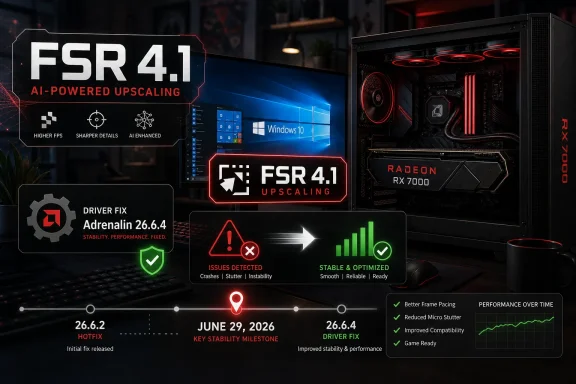 AMD’s Small Driver Is Really a Confidence Patch
On paper, Adrenalin 26.6.4 is the sort of driver release that barely deserves a push notification. AMD lists two fixed issues: an intermittent install failure seen when installing Adrenalin 26.6.2 on Windows 10 systems with Radeon RX 7000 series and newer products, and intermittent crashes in some games when FSR Upscaling 4.1 is enabled on Radeon RX 7000 series graphics cards. There is no marquee game optimization, no new control-panel redesign, and no grand platform announcement.That is precisely why the release matters. AMD had just used the 26.6.2 branch to broaden FSR 4.1 support beyond the newest Radeon RX 9000 family and into RX 7000 cards, a move that made RDNA 3 owners feel less like spectators in the company’s AI-upscaling strategy. When the driver that unlocks that feature then trips over installation on Windows 10 and crashes in some FSR 4.1 scenarios, the story stops being “free upgrade” and becomes “first-week reliability.”
This is the tension AMD has to manage. The company wants to sell FSR 4.1 as a platform benefit, not a niche checkbox for buyers of brand-new GPUs. But features that live in the driver stack must survive the boring parts of PC gaming: mixed Windows versions, older installs, game-specific rendering paths, overlay utilities, capture features, and creator apps sharing the same machine.
Adrenalin 26.6.4 does not change the strategic picture. It patches the credibility gap created by the previous drop. In the GPU driver business, that distinction is not academic.
FSR 4.1 Arrived on RX 7000, Then Immediately Met the Real PC Market
The most important context is AMD’s decision to bring FSR 4.1 to Radeon RX 7000 series cards. That matters because RX 7000 hardware is not ancient inventory; it is the previous mainstream enthusiast generation, still present in plenty of gaming desktops, boutique systems, and high-refresh 1440p rigs. Extending the newer upscaling path to those cards gives AMD a cleaner answer to the usual complaint that GPU vendors reserve software progress for the latest silicon.But the PC installed base is never clean. A driver that behaves nicely on a fresh Windows 11 gaming tower may run into edge cases on a Windows 10 system that has seen years of chipset updates, rollback attempts, overlay tools, anti-cheat modules, and Windows Update driver interventions. AMD’s own fixed-issue language is careful: the install issue was intermittent, not universal, and it concerned Windows 10 systems with RX 7000 series and newer graphics products.
That phrasing is doing work. It suggests a bug broad enough to merit a public driver update but not necessarily one that every user could reproduce. For the affected group, however, subtlety is irrelevant. A driver that fails to install is not a minor defect; it is a locked door.
The FSR 4.1 crash fix is more damaging to the feature’s reputation because it hits after installation, exactly where users expect the payoff. If a game crashes only when the new upscaler is enabled, the average player does not separate AMD’s model path, the game integration, and the driver version. They simply conclude that the shiny new setting is unstable and turn it off.
The Windows 10 Fix Lands in the Shadow of an Aging Platform
The Windows 10 angle is not incidental. Windows 10 remains deeply embedded in the gaming and enthusiast world, even as Microsoft continues to push the PC market toward Windows 11 and newer hardware security baselines. AMD cannot afford to treat Windows 10 as a second-class testing target while large numbers of Radeon owners still use it as their daily gaming OS.That creates an awkward burden for GPU vendors. They are shipping increasingly advanced features that rely on modern scheduling, shader compiler behavior, AI model delivery, and game runtime interactions, but they must do so across operating systems with different assumptions and user populations. Windows 10 users are often the people least eager to change a working setup, which means a failed driver install becomes more than a technical bug. It validates their suspicion that the upgrade treadmill is being imposed on them.
AMD’s release notes make 26.6.4 look like a direct corrective. The fixed issue calls out Adrenalin 26.6.2 specifically, not a vague long-running Windows 10 problem. That specificity is useful for users trying to decide whether to move forward, because it frames 26.6.4 as the branch AMD wants them on if 26.6.2 misbehaved.
Still, IT-minded users should read the fix conservatively. If 26.6.2 installed cleanly and 26.6.3 already incorporated the hotfix path, 26.6.4 may not change much for that machine unless the user also encountered the FSR 4.1 crash. If 26.6.2 failed, however, this is the first stop before more disruptive tactics like cleanup utilities, offline installs, or rolling back to an older package.
The Upscaler Wars Have Become Driver Wars
FSR started life as a more open, broadly compatible response to Nvidia’s DLSS strategy, but the industry has moved beyond simple spatial upscaling. The modern fight is about model quality, frame generation, latency management, game integration, and how much of the experience is gated by hardware generation. FSR 4.1’s arrival on RX 7000 cards is part of that broader contest.The problem is that advanced upscaling now behaves less like a graphics option and more like a semi-platform. It depends on driver support, game hooks, machine-learning inference paths, and per-title behavior. When it works, users see better image reconstruction and potentially more useful performance headroom. When it fails, it can crash a game that was otherwise stable.
That makes this 26.6.4 fix more significant than the changelog’s brevity suggests. AMD is not only fixing “some games”; it is protecting the first impression of FSR 4.1 on a major installed base. Enthusiasts are forgiving of rough edges when they are modding a leaked DLL into a game folder. They are less forgiving when the feature is officially supported through a WHQL-style mainstream driver channel.
The strategic prize is obvious. If AMD can keep bringing new rendering features backward to previous-generation GPUs, it strengthens the value story of buying Radeon hardware. If those rollouts feel brittle, users will remember the instability more than the generosity.
Known Issues Show the Driver Stack Is Still Carrying Too Much Weight
The known-issues list in 26.6.4 is a useful map of where AMD’s graphics software remains under pressure. Battlefield 6 appears multiple times, with references to application crashes or driver timeouts on Ryzen AI 9 HX 370, texture flickering or corruption when using AMD Record and Stream, and FSR Upscaling or FSR Frame Generation appearing inactive in Adrenalin while enabled on Radeon RX 9000 series products. That is a lot of unresolved surface area around one major game.There are also non-gaming issues. AMD notes that AI Bundle components may fail to install in some regions with limited access to HuggingFace and GitHub. That line is easy to skip, but it says something important about where driver packages are headed. Graphics software is no longer only a signed display driver and a control panel; it is increasingly a delivery mechanism for AI-adjacent tooling, dependencies, and model-driven features that may depend on external infrastructure.
The creator-app issues are even more sobering. AMD says model flickering or rendering failure may appear in Maxon Cinema 4D and Blender on Radeon RX 7000 series and newer graphics products, and recommends affected users install Adrenalin 26.3.1. It also flags intermittent Blender crashes on some models, again recommending 26.3.1 for affected users.
That recommendation is practical but revealing. For gamers chasing FSR 4.1, the newer branch is attractive. For creators depending on Blender or Cinema 4D stability, AMD is effectively telling some users that the safer answer may be to step back several releases. That is the old workstation-versus-gaming driver dilemma reappearing inside a consumer driver channel.
Radeon Owners Are Being Asked to Pick Their Risk Profile
The sensible upgrade decision depends on what kind of Radeon user you are. If you own an RX 7000 card, play FSR 4.1-supported games, and ran into crashes with the feature enabled, 26.6.4 is the driver AMD clearly wants you to try. If you are on Windows 10 and 26.6.2 refused to install, the new package is even more directly relevant.If your machine is stable on an older branch and you do not care about FSR 4.1 right now, the calculus is different. GPU drivers are not security patches in the same way monthly Windows cumulative updates are, and there is rarely a universal obligation to install the newest optional graphics package on day one. Enthusiasts often update because they want the feature, the game profile, or the fix. Production users update because they have validated a need.
That distinction matters for mixed-use PCs. A Radeon RX 7900 XT system that is both a weekend gaming box and a weekday Blender workstation may face conflicting incentives. The newer driver may fix FSR 4.1 crashes in games, while AMD’s own notes still steer some Blender and Cinema 4D users back to 26.3.1 if they encounter rendering problems.
For sysadmins managing labs, esports rooms, classrooms, or small creator fleets, this is a reminder to treat graphics drivers like any other component of endpoint change management. A tiny release can carry a narrow fix and a known regression profile at the same time. The right answer is not always “latest”; it is “latest that matches the workload.”
AMD’s Fast Fix Is Welcome, But the Cadence Is Getting Messy
There is a positive reading here: AMD identified real issues in the 26.6.x line and moved quickly. The Windows 10 install fix had already appeared in a hotfix path, and 26.6.4 consolidates the branch into a more visible driver release. That is how a vendor should behave when a major feature rollout stumbles.There is also a less flattering reading: the 26.6.x sequence is beginning to look like a public stabilization sprint. Users saw the headline FSR 4.1 enablement, then the install problem, then the hotfix, then another driver with the same install correction plus a crash fix for FSR 4.1. For enthusiasts who follow driver releases closely, this is familiar. For normal users, it feels like churn.
The challenge for AMD is that graphics drivers have become product launches. A driver can unlock a feature that changes review narratives, Reddit threads, game settings guides, and buyer sentiment. That raises the bar for first-week polish, because users experience the driver as part of the product they bought.
Nvidia has lived with this reality for years through DLSS, Reflex, Studio drivers, and game-ready releases. Intel is learning it in public with Arc. AMD’s FSR 4.1 expansion to RX 7000 is arguably the right move, but it also means AMD’s driver QA has to carry more reputational weight than it did when upscaling was simpler and less hardware-attached.
The Practical Read for WindowsForum Readers
For WindowsForum’s audience, the news is not merely that a new Radeon driver exists. The useful story is where the driver sits in the chain of risk. Adrenalin 26.6.4 is most compelling for RX 7000 owners who want FSR 4.1 and for Windows 10 users who were blocked by the 26.6.2 installer issue. It is less obviously mandatory for stable systems that do not need the new upscaling path.The safest approach is to treat this as a targeted fix rather than a celebratory upgrade. Check the exact problems AMD says it fixed, compare them with your own system, and pay attention to the known issues if you use Blender, Cinema 4D, Battlefield 6, AMD Record and Stream, or the AI Bundle components. A driver can be the answer to one problem and the wrong move for another workload.
The Driver Branch Now Defines the Radeon Experience
AMD’s 26.6.4 release leaves Radeon users with a few concrete lessons from a busy week of driver activity:- Adrenalin 26.6.4 is the cleanest public driver target for users affected by the Windows 10 installation issue seen with 26.6.2.
- RX 7000 owners who saw crashes in some games with FSR 4.1 enabled should treat this release as the relevant corrective update.
- Users who already installed 26.6.3 for the Windows 10 hotfix may see the install fix as old news, but the FSR 4.1 crash fix still makes 26.6.4 worth evaluating.
- Blender and Cinema 4D users should read AMD’s known issues before upgrading, because AMD still recommends 26.3.1 for some affected rendering and crash problems.
- Battlefield 6 remains a visible trouble spot in the release notes, spanning crashes, driver timeouts, capture-related visual corruption, and FSR status reporting.
References
- Primary source: Neowin
Published: 2026-06-29T20:20:10.845318
Loading…
www.neowin.net - Related coverage: pcgamer.com
True to its word, AMD brings FSR 4.1 to Radeon RX 7000-series card owners with its latest Adrenalin drivers | PC Gamer
The Steam Machine will eventually get it too. Whaddya mean, so what?www.pcgamer.com - Related coverage: tomshardware.com
AMD brings official FSR 4.1 support to RX 7000 series GPUs — INT8 model now available in 300+ games, RDNA 3 APUs also getting FSR 4.1 soon | Tom's Hardware
FSR 4.1 for RX 7000 series was expected next month, in July.www.tomshardware.com - Related coverage: tweaktown.com
AMD confirms Adrenalin 26.6.2 driver fails to launch on Windows 10, recommends rolling back
AMD confirmed the issue and recommends rolling back to 26.6.1, but that means losing FSR 4.1 support on RDNA 3 until a fixed version ships. www.tweaktown.com
- Related coverage: warp2search.net
AMD Adrenalin Edition 26.6.2 Driver Brings FSR 4.1 to RX7000 GPUs
The AMD Adrenalin Edition 26.6.2 driver introduces FSR 4.1 upscaling for Radeon RX 7000 GPUs and adds support for games like Assassin's Creed Black Flag Resynced and DOOM: The Dark Ages.www.warp2search.net - Related coverage: pcguide.com
Loading…
www.pcguide.com
- Related coverage: abit.ee
AMD Releases Adrenalin 26.6.2 Driver with FSR 4.1 Support for Radeon RX 7000
AMD Radeon Software Adrenalin 26.6.2 WHQL extends FSR 4.1 upscaling to Radeon RX 7000 GPUs and adds optimisations for Assassin's Creed Black Flag Resynced and Doom: The Dark Ages.abit.ee