

AMD’s new EXPO Ultra Low Latency memory profile, introduced at Computex 2026 and now appearing in premium DDR5-6000 kits, promises Ryzen gamers up to 13 percent more frames than JEDEC memory and four percent over conventional EXPO. Those are AMD’s claims, not independently measured results supplied here, and the feature requires motherboard firmware containing AGESA 1.3.0.1b. The first G.Skill listings at €589 and €708 make the launch products difficult to recommend despite the convenience of their tighter preset timings.
Should you buy it? Current owners of good DDR5-6000 EXPO kits should not upgrade for AMD’s claimed four-percent gain at prices of €589 to €708. Consider EXPO ULL only when a compatible kit costs close to an equivalent conventional EXPO kit, your motherboard has firmware containing AGESA 1.3.0.1b, and you are prepared to validate stability after activation.
AMD introduced Extended Profiles for Overclocking, better known as EXPO, at Computex 2022 alongside the Ryzen 7000 processor family. Its purpose was straightforward: provide a memory-profile format intended for AMD Ryzen platforms.
Compared with XMP, EXPO can store 29 additional parameters, giving memory manufacturers room to define secondary and tertiary timings beyond the frequency and primary-latency figures normally emphasized in retail specifications.
Those parameters matter because memory performance cannot be reduced to a label such as DDR5-6000 CL30. The primary timings printed on a box describe only part of the delay involved in opening rows, accessing data, refreshing cells, changing operations, and moving between memory banks. Two kits with the same advertised transfer rate and CAS latency can therefore use different supporting settings.
Ultra Low Latency uses the additional profile data to provide a set of tuned secondary and tertiary timings for a compatible memory kit. Instead of asking the user to enter numerous values manually, the kit stores a ULL profile that supported motherboard firmware can read and apply.
That makes ULL an extension of profile-based memory tuning rather than a new generation of DDR5. It does not depend on a dramatic increase in transfer rate or a new type of DIMM. The initial G.Skill products remain DDR5-6000 kits, with their differences appearing in the timings selected by the ULL profile.
The practical appeal is accessibility. Experienced memory tuners already adjust subtimings, test different refresh values, and repeat memory training while searching for a combination that performs well without errors. ULL attempts to put a vendor-defined configuration behind a clearly labeled firmware option.
Certification cannot eliminate variation among processors, motherboards, firmware releases, and memory modules. It can, however, give buyers a documented starting point designed for the specific kit rather than forcing them to copy generic values from another system.
Those are two very different baselines. The 13-percent headline includes the move from a relatively conservative JEDEC configuration to a tuned DDR5-6000 setup as well as any additional contribution from ULL. The four-percent claim against conventional DDR5-6000 EXPO is more relevant to someone who already owns a well-configured Ryzen gaming PC.
The available information identifies a Ryzen 5 9600X as the test processor, but it does not include independent PC Games Hardware benchmark results confirming either percentage. The figures should consequently be read as AMD’s characterization of ULL’s potential, not as a guarantee or an independently verified average across games.
Even if AMD’s four-percent figure proves repeatable in suitable conditions, it will not apply uniformly. Memory-sensitive software may respond more strongly than workloads limited primarily by graphics performance. Resolution, graphics settings, game engine, processor, memory capacity, and the system’s existing profile can all affect the result.
A percentage measured against JEDEC memory also says little about whether an established DDR5-6000 owner should replace a working kit. Such a buyer is not starting from the slower comparison system used for the larger headline. The relevant question is whether the ULL profile provides enough improvement over that buyer’s current EXPO configuration to justify the price, installation effort, firmware dependency, and stability testing.
G.Skill told PC Games Hardware that ULL is intended primarily for non-X3D processors. That identifies the vendor’s target market, but it should not be stretched into a universal prediction about performance. The supplied facts do not establish how every X3D and non-X3D processor will scale, nor do they show that ULL is ineffective on X3D systems.
The restrained conclusion is that buyers should evaluate ULL on the exact processor and workload they intend to use. AMD’s claimed four-percent advantage may be attractive when the feature carries little or no premium. At several hundred euros above the price of many conventional memory options, it is not a persuasive reason to replace a good kit.
The Samsung-based F5-6000A3636F16G is the less aggressive of the pair. Its ULL configuration adjusts five reported timings: tRAS, tRFC, tREFI, tRRD_S, and tWR.
That list illustrates how a memory profile can change while leaving the familiar front-of-box specification largely intact. The kit is still sold as DDR5-6000, and its primary timing label does not communicate every value applied by the motherboard.
PC Games Hardware identifies tRFC and tREFI as especially relevant parts of the configuration. Both concern refresh behavior, an area in which more aggressive settings must still preserve reliable operation.
The more expensive F5-6000A3038F16G uses single-rank SK Hynix M-die and starts with primary timings of CL30-38-38-32. Its ULL profile tightens seven timings, including a reduction in tRAS from 96 to 32 and tRC from 134 to 68.
These examples also explain why users should not assume that values from one kit can be copied safely to another. Samsung and SK Hynix memory ICs can receive different profile values, and even products sharing a DDR5-6000 label may not use the same components or underlying configuration.
A profile developed for a named kit is therefore more useful than a generic recommendation to “tighten the timings.” It gives the motherboard a defined set of values associated with that module model. Whether those values remain stable on every supported system still requires verification.
Manual tuning remains available to experienced users who understand memory recovery procedures and are willing to test extensively. ULL is aimed at users who prefer a preset supplied through the memory-profile and motherboard-firmware ecosystem.
The important distinction is between convenience and certainty. ULL can simplify activation, but a selectable profile cannot guarantee identical results across every processor’s memory controller, motherboard layout, BIOS release, installed capacity, or DIMM arrangement.
AGESA is AMD’s foundational firmware code for initializing the processor, memory controller, and related platform components. Motherboard manufacturers incorporate an AGESA release into their own UEFI packages, add board-specific settings and interfaces, and distribute the completed firmware for individual products.
The requirement makes ULL a platform feature rather than something contained entirely within the DIMMs. The memory module stores profile data, but the motherboard firmware must recognize and apply it.
AGESA 1.3.0.1b also introduces the timings tCCD_L, tCCDL_WR, and tCCDL_WR2. Their inclusion reflects the broader set of memory controls involved in the updated platform support.
Activation should be treated as a deliberate firmware change:
If an explicitly labeled ULL profile is not shown, do not assume that choosing ordinary EXPO enables the same settings. Recheck the installed BIOS version, the memory kit’s ULL support, and the board manufacturer’s documentation.
The first start after a firmware update or memory-profile change may take longer while the board performs memory training. Users should follow the motherboard maker’s guidance before interrupting that process or clearing the configuration.
BIOS updates can also reset unrelated settings or alter how existing options are interpreted. Record important settings before updating, including boot order, fan curves, storage configuration, virtualization options, and any custom voltages or processor settings.
ULL should be approached in the same general way as other performance memory profiles: enable it knowingly, retain a fallback configuration, and test the system afterward. The convenience of a firmware preset does not remove the need to confirm that the resulting configuration works reliably on the individual PC.
That fallback matters because DIMM compatibility is conditional. A memory configuration involves the modules, their ICs and ranks, the motherboard, the processor’s integrated memory controller, BIOS behavior, installed capacity, and the number of populated slots. A profile that works on one combination is not proof that every nominally similar system will behave identically.
The distinction between booting and stability is equally important. Reaching Windows shows that the board completed startup with the selected profile. It does not demonstrate that the machine will remain reliable during sustained use.
The supplied facts do not establish a definitive list of failure symptoms unique to ULL. In general memory troubleshooting, however, errors or crashes that begin immediately after a profile change are reason to compare the result with the previous known-good configuration.
Conventional EXPO should therefore be the baseline against which ULL is judged. Record performance and test the machine with ordinary EXPO before enabling ULL. If the optimized profile produces no meaningful improvement, or if the system becomes unreliable, reverting to standard EXPO is the clearest first step.
This approach is especially useful for builders and administrators. It changes one variable at a time and avoids immediately altering manual timings or voltages in ways that make the original problem harder to isolate.
The same discipline applies after future firmware updates. A ULL profile that worked under one BIOS release should not automatically be assumed to behave identically after the motherboard vendor changes memory initialization code. Retest the system after a meaningful firmware change.
PC Games Hardware found the Samsung-based Trident Z5 NeoX kit in stock at Alternate for €589. The SK Hynix-based model was listed at €708.
Those prices place the kits in a category where buyers must compare a claimed single-digit advantage over conventional EXPO with potential spending on a processor, graphics card, storage, cooling, display, or additional memory capacity.
G.Skill attributes the discrepancy to higher DRAM IC costs and to retailers still holding older inventory acquired before those increases. In the company’s account, newly priced ULL products are being compared with conventional kits that entered the retail channel under different cost conditions.
That explanation provides context, but it does not make the current products good values. The relevant price for a buyer is the amount charged at the time of purchase. Future competition or inventory turnover may narrow the difference, but those possibilities should not be presented as established outcomes.
It is also too early to draw firm conclusions about retailer inventory behavior, future launch configurations, or the lasting size of the ULL premium. The two G.Skill listings show that the first examples are extremely expensive. They do not by themselves establish what every later ULL product will cost.
The correct response is to separate the feature from these launch prices.
If ULL becomes available on mainstream DDR5-6000 kits for roughly the cost of equivalent conventional EXPO memory, it could be a useful additional option. If it remains confined to exceptionally expensive modules, its audience will be limited to enthusiasts who value preset subtiming adjustments more than conventional price-to-performance calculations.
Certified kits were scheduled to begin arriving from G.Skill, Kingston, Klevv, Lexar, Team Group, V-Color, and Adata XPG starting in June 2026. Listings from a wider range of manufacturers will provide a more representative view of pricing than the first two G.Skill examples.
Buyers should compare like with like: capacity, DIMM count, frequency, primary timings, memory IC information where available, warranty terms, motherboard qualification, and actual retail price. A ULL label alone does not justify a large premium.
The supplied information does not provide enough comparative testing to quantify behavior across AMD’s processor range. Explanations based on cache size and memory access patterns may be technically plausible, but they should not replace measurements from the specific processors and applications being compared.
For current owners of a good DDR5-6000 EXPO kit, the recommendation is straightforward: do not replace it merely to pursue AMD’s claimed four-percent improvement at €589 or €708. The likely value of the existing memory, the cost of the replacement, and the limited size of the claim make such an upgrade difficult to defend.
New-system buyers can take a more flexible approach. If a compatible ULL kit costs close to an otherwise equivalent conventional EXPO kit, selecting the ULL model provides an additional profile to test. The buyer can retain standard EXPO as the baseline and keep ULL enabled only if it proves beneficial and reliable.
That recommendation depends on confirmed platform support. The motherboard must have a BIOS containing AGESA 1.3.0.1b, and the exact memory kit should be represented as ULL-compatible. A similar product name, frequency, or CAS latency is not sufficient evidence that the profile is present.
Potential specialist users include competitive overclockers, reviewers, performance-focused system integrators, and enthusiasts seeking additional performance from a fixed processor and motherboard. Those groups may place a higher value on a predefined timing set and may already have the tools and recovery knowledge needed to test it properly.
For ordinary buyers, component budgeting should still follow the system’s needs. Adequate capacity takes priority when an application would otherwise run short of physical memory. A graphics or processor upgrade may produce a larger improvement where those components are the actual bottlenecks.
ULL becomes attractive when it is included at little extra cost. It becomes difficult to justify when obtaining the profile requires purchasing memory priced far beyond an equivalent conventional kit.
Start by establishing a known-good baseline. Record performance and behavior with conventional EXPO before enabling ULL. Without that comparison, a user cannot determine whether the profile improved the machine enough to matter.
The benchmark should reflect the reason for considering the memory. A gamer should test games that are CPU-limited on that particular system and examine frame-time behavior as well as average frame rate. A workstation user should run the applications and datasets that dominate real working time.
Synthetic memory benchmarks can confirm whether measured latency or bandwidth changed in the expected direction. Dedicated memory tests can help reveal errors, but neither category should replace representative application testing.
Testing should also run long enough to cover realistic conditions. A short benchmark immediately after a cold start does not reproduce hours of gaming, rendering, compiling, or other sustained work.
Windows users should pay attention to new problems that appear only after enabling the profile. The correct first troubleshooting move is a controlled comparison: return to conventional EXPO and repeat the same workload. If the problem disappears, leave ULL disabled while checking for firmware updates or guidance for the exact motherboard and memory kit.
Avoid changing several variables simultaneously. Adding manual voltage, altering extra timings, updating drivers, and changing processor settings at the same time makes it difficult to identify which adjustment caused or resolved a problem.
Managed and business-critical systems deserve a more conservative threshold. A small potential performance gain may not compensate for the testing burden or the operational risk of changing a known-good memory configuration.
Computex 2026 — AMD introduces EXPO Ultra Low Latency and presents performance claims of up to 13 percent over the cited JEDEC configuration and four percent over conventional EXPO.
Starting June 2026 — Certified ULL kits are scheduled to begin arriving from G.Skill, Kingston, Klevv, Lexar, Team Group, V-Color, and Adata XPG.
Initial retail rollout — PC Games Hardware reports G.Skill Trident Z5 NeoX listings at €589 for the Samsung-based kit and €708 for the SK Hynix-based kit.
For motherboard manufacturers, it provides another reason to update established products with newer AGESA code. For memory vendors, it creates a way to distinguish kits through profile data that is not visible in the usual frequency-and-CAS-latency shorthand.
For users, the result is more conditional. They need the correct memory kit, suitable motherboard firmware, the explicitly labeled ULL option, and enough testing to determine whether AMD’s claimed performance advantage appears in their own workloads.
The risk is confusion rather than a lack of technical potential. Motherboard support pages vary in clarity, firmware releases do not necessarily reach every model at the same time, and vendors can place memory options under different menu names. Board-specific presets may also appear near EXPO settings without being the same thing as the profile stored by the kit.
A useful certification program must make those distinctions clear. Buyers need an intelligible compatibility chain connecting the named DIMM kit, the exact motherboard and revision, the required BIOS, the selectable profile, and the expected fallback procedure.
At current prices, the first G.Skill kits do not offer a rational upgrade path for owners of good DDR5-6000 EXPO memory. AMD’s claimed four-percent improvement over conventional EXPO is too small to justify spending €589 to €708 merely to obtain ULL.
The feature’s longer-term prospects are better than those prices suggest. If EXPO ULL becomes a low-cost addition to mainstream kits, it can give Ryzen users a convenient way to try tighter secondary and tertiary timings without configuring every value manually. Until then, buyers should view it as an optional profile, not a must-have memory standard—and should let compatibility, measured results, and retail price decide whether the label has any practical value.
Should you buy it? Current owners of good DDR5-6000 EXPO kits should not upgrade for AMD’s claimed four-percent gain at prices of €589 to €708. Consider EXPO ULL only when a compatible kit costs close to an equivalent conventional EXPO kit, your motherboard has firmware containing AGESA 1.3.0.1b, and you are prepared to validate stability after activation.
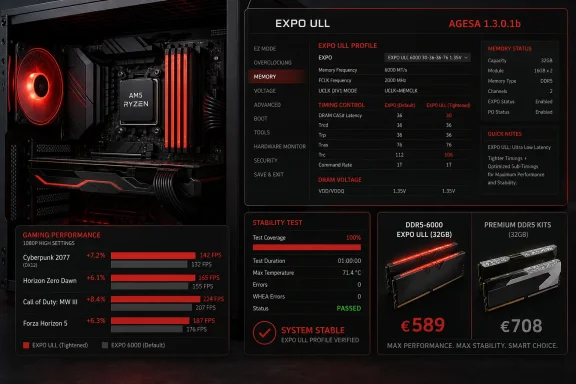 AMD Extends EXPO Beyond Primary Timings
AMD introduced Extended Profiles for Overclocking, better known as EXPO, at Computex 2022 alongside the Ryzen 7000 processor family. Its purpose was straightforward: provide a memory-profile format intended for AMD Ryzen platforms.Compared with XMP, EXPO can store 29 additional parameters, giving memory manufacturers room to define secondary and tertiary timings beyond the frequency and primary-latency figures normally emphasized in retail specifications.
Those parameters matter because memory performance cannot be reduced to a label such as DDR5-6000 CL30. The primary timings printed on a box describe only part of the delay involved in opening rows, accessing data, refreshing cells, changing operations, and moving between memory banks. Two kits with the same advertised transfer rate and CAS latency can therefore use different supporting settings.
Ultra Low Latency uses the additional profile data to provide a set of tuned secondary and tertiary timings for a compatible memory kit. Instead of asking the user to enter numerous values manually, the kit stores a ULL profile that supported motherboard firmware can read and apply.
That makes ULL an extension of profile-based memory tuning rather than a new generation of DDR5. It does not depend on a dramatic increase in transfer rate or a new type of DIMM. The initial G.Skill products remain DDR5-6000 kits, with their differences appearing in the timings selected by the ULL profile.
The practical appeal is accessibility. Experienced memory tuners already adjust subtimings, test different refresh values, and repeat memory training while searching for a combination that performs well without errors. ULL attempts to put a vendor-defined configuration behind a clearly labeled firmware option.
Certification cannot eliminate variation among processors, motherboards, firmware releases, and memory modules. It can, however, give buyers a documented starting point designed for the specific kit rather than forcing them to copy generic values from another system.
The Performance Claim Needs Context
AMD claims EXPO ULL can produce up to 13 percent more frames per second than standard JEDEC memory and four percent higher performance than conventional EXPO. According to PC Games Hardware’s account of AMD’s comparison, the JEDEC system used DDR5-5600 CL40, while the conventional EXPO system used DDR5-6000 CL28.Those are two very different baselines. The 13-percent headline includes the move from a relatively conservative JEDEC configuration to a tuned DDR5-6000 setup as well as any additional contribution from ULL. The four-percent claim against conventional DDR5-6000 EXPO is more relevant to someone who already owns a well-configured Ryzen gaming PC.
The available information identifies a Ryzen 5 9600X as the test processor, but it does not include independent PC Games Hardware benchmark results confirming either percentage. The figures should consequently be read as AMD’s characterization of ULL’s potential, not as a guarantee or an independently verified average across games.
Even if AMD’s four-percent figure proves repeatable in suitable conditions, it will not apply uniformly. Memory-sensitive software may respond more strongly than workloads limited primarily by graphics performance. Resolution, graphics settings, game engine, processor, memory capacity, and the system’s existing profile can all affect the result.
A percentage measured against JEDEC memory also says little about whether an established DDR5-6000 owner should replace a working kit. Such a buyer is not starting from the slower comparison system used for the larger headline. The relevant question is whether the ULL profile provides enough improvement over that buyer’s current EXPO configuration to justify the price, installation effort, firmware dependency, and stability testing.
G.Skill told PC Games Hardware that ULL is intended primarily for non-X3D processors. That identifies the vendor’s target market, but it should not be stretched into a universal prediction about performance. The supplied facts do not establish how every X3D and non-X3D processor will scale, nor do they show that ULL is ineffective on X3D systems.
The restrained conclusion is that buyers should evaluate ULL on the exact processor and workload they intend to use. AMD’s claimed four-percent advantage may be attractive when the feature carries little or no premium. At several hundred euros above the price of many conventional memory options, it is not a persuasive reason to replace a good kit.
ULL Changes Timings That Retail Specifications Conceal
The two G.Skill kits described by PC Games Hardware show that ULL is not one universal collection of values. Both belong to the Trident Z5 NeoX family and operate at DDR5-6000, but they use different memory ICs and receive different timing adjustments.| G.Skill model | Rated specification | Memory ICs | Reported ULL changes | Retail listing | Price |
|---|---|---|---|---|---|
| F5-6000A3636F16G | DDR5-6000, CL36-36-36-76 | Single-rank Samsung B-die | tRAS, tRFC, tREFI, tRRD_S, and tWR optimized | Alternate, in stock | €589 |
| F5-6000A3038F16G | DDR5-6000, CL30-38-38-32 | Single-rank SK Hynix M-die | Seven timings tightened, including tRAS from 96 to 32 and tRC from 134 to 68 | Alternate | €708 |
That list illustrates how a memory profile can change while leaving the familiar front-of-box specification largely intact. The kit is still sold as DDR5-6000, and its primary timing label does not communicate every value applied by the motherboard.
PC Games Hardware identifies tRFC and tREFI as especially relevant parts of the configuration. Both concern refresh behavior, an area in which more aggressive settings must still preserve reliable operation.
The more expensive F5-6000A3038F16G uses single-rank SK Hynix M-die and starts with primary timings of CL30-38-38-32. Its ULL profile tightens seven timings, including a reduction in tRAS from 96 to 32 and tRC from 134 to 68.
These examples also explain why users should not assume that values from one kit can be copied safely to another. Samsung and SK Hynix memory ICs can receive different profile values, and even products sharing a DDR5-6000 label may not use the same components or underlying configuration.
A profile developed for a named kit is therefore more useful than a generic recommendation to “tighten the timings.” It gives the motherboard a defined set of values associated with that module model. Whether those values remain stable on every supported system still requires verification.
Manual tuning remains available to experienced users who understand memory recovery procedures and are willing to test extensively. ULL is aimed at users who prefer a preset supplied through the memory-profile and motherboard-firmware ecosystem.
The important distinction is between convenience and certainty. ULL can simplify activation, but a selectable profile cannot guarantee identical results across every processor’s memory controller, motherboard layout, BIOS release, installed capacity, or DIMM arrangement.
The BIOS Is Part of the Requirement
EXPO ULL requires motherboard firmware containing AGESA 1.3.0.1b. PC Games Hardware reports support from Asus, MSI, ASRock, and other motherboard manufacturers, but owners should check the support page for their exact board model and hardware revision rather than infer compatibility from a general vendor announcement.AGESA is AMD’s foundational firmware code for initializing the processor, memory controller, and related platform components. Motherboard manufacturers incorporate an AGESA release into their own UEFI packages, add board-specific settings and interfaces, and distribute the completed firmware for individual products.
The requirement makes ULL a platform feature rather than something contained entirely within the DIMMs. The memory module stores profile data, but the motherboard firmware must recognize and apply it.
AGESA 1.3.0.1b also introduces the timings tCCD_L, tCCDL_WR, and tCCDL_WR2. Their inclusion reflects the broader set of memory controls involved in the updated platform support.
Activation should be treated as a deliberate firmware change:
- Enter the motherboard’s UEFI setup.
- Locate the memory or overclocking configuration page.
- Find the available memory profiles.
- Choose the profile explicitly labeled EXPO ULL, not the standard EXPO profile.
- Save the configuration and reboot.
- Allow the motherboard time to complete memory training before assuming that a longer-than-usual first start indicates a failure.
If an explicitly labeled ULL profile is not shown, do not assume that choosing ordinary EXPO enables the same settings. Recheck the installed BIOS version, the memory kit’s ULL support, and the board manufacturer’s documentation.
The first start after a firmware update or memory-profile change may take longer while the board performs memory training. Users should follow the motherboard maker’s guidance before interrupting that process or clearing the configuration.
BIOS updates can also reset unrelated settings or alter how existing options are interpreted. Record important settings before updating, including boot order, fan curves, storage configuration, virtualization options, and any custom voltages or processor settings.
ULL should be approached in the same general way as other performance memory profiles: enable it knowingly, retain a fallback configuration, and test the system afterward. The convenience of a firmware preset does not remove the need to confirm that the resulting configuration works reliably on the individual PC.
A Standard EXPO Baseline Remains Essential
A conventional EXPO configuration provides a useful fallback if the tighter ULL settings do not suit a particular combination of memory, CPU, motherboard, and firmware.That fallback matters because DIMM compatibility is conditional. A memory configuration involves the modules, their ICs and ranks, the motherboard, the processor’s integrated memory controller, BIOS behavior, installed capacity, and the number of populated slots. A profile that works on one combination is not proof that every nominally similar system will behave identically.
The distinction between booting and stability is equally important. Reaching Windows shows that the board completed startup with the selected profile. It does not demonstrate that the machine will remain reliable during sustained use.
The supplied facts do not establish a definitive list of failure symptoms unique to ULL. In general memory troubleshooting, however, errors or crashes that begin immediately after a profile change are reason to compare the result with the previous known-good configuration.
Conventional EXPO should therefore be the baseline against which ULL is judged. Record performance and test the machine with ordinary EXPO before enabling ULL. If the optimized profile produces no meaningful improvement, or if the system becomes unreliable, reverting to standard EXPO is the clearest first step.
This approach is especially useful for builders and administrators. It changes one variable at a time and avoids immediately altering manual timings or voltages in ways that make the original problem harder to isolate.
The same discipline applies after future firmware updates. A ULL profile that worked under one BIOS release should not automatically be assumed to behave identically after the motherboard vendor changes memory initialization code. Retest the system after a meaningful firmware change.
The Price Creates a Bad First Impression
At Computex 2026 in Taipei, AMD reportedly said ULL should add practically nothing to the price of a kit because the feature consists primarily of additional timings and fine-tuning. The first G.Skill retail listings do not reflect that ideal buying experience.PC Games Hardware found the Samsung-based Trident Z5 NeoX kit in stock at Alternate for €589. The SK Hynix-based model was listed at €708.
Those prices place the kits in a category where buyers must compare a claimed single-digit advantage over conventional EXPO with potential spending on a processor, graphics card, storage, cooling, display, or additional memory capacity.
G.Skill attributes the discrepancy to higher DRAM IC costs and to retailers still holding older inventory acquired before those increases. In the company’s account, newly priced ULL products are being compared with conventional kits that entered the retail channel under different cost conditions.
That explanation provides context, but it does not make the current products good values. The relevant price for a buyer is the amount charged at the time of purchase. Future competition or inventory turnover may narrow the difference, but those possibilities should not be presented as established outcomes.
It is also too early to draw firm conclusions about retailer inventory behavior, future launch configurations, or the lasting size of the ULL premium. The two G.Skill listings show that the first examples are extremely expensive. They do not by themselves establish what every later ULL product will cost.
The correct response is to separate the feature from these launch prices.
If ULL becomes available on mainstream DDR5-6000 kits for roughly the cost of equivalent conventional EXPO memory, it could be a useful additional option. If it remains confined to exceptionally expensive modules, its audience will be limited to enthusiasts who value preset subtiming adjustments more than conventional price-to-performance calculations.
Certified kits were scheduled to begin arriving from G.Skill, Kingston, Klevv, Lexar, Team Group, V-Color, and Adata XPG starting in June 2026. Listings from a wider range of manufacturers will provide a more representative view of pricing than the first two G.Skill examples.
Buyers should compare like with like: capacity, DIMM count, frequency, primary timings, memory IC information where available, warranty terms, motherboard qualification, and actual retail price. A ULL label alone does not justify a large premium.
Who Should Consider ULL?
G.Skill identifies non-X3D processors as the primary target for its ULL memory. That is a vendor positioning statement, not an independent finding that every non-X3D system will gain more than every X3D system.The supplied information does not provide enough comparative testing to quantify behavior across AMD’s processor range. Explanations based on cache size and memory access patterns may be technically plausible, but they should not replace measurements from the specific processors and applications being compared.
For current owners of a good DDR5-6000 EXPO kit, the recommendation is straightforward: do not replace it merely to pursue AMD’s claimed four-percent improvement at €589 or €708. The likely value of the existing memory, the cost of the replacement, and the limited size of the claim make such an upgrade difficult to defend.
New-system buyers can take a more flexible approach. If a compatible ULL kit costs close to an otherwise equivalent conventional EXPO kit, selecting the ULL model provides an additional profile to test. The buyer can retain standard EXPO as the baseline and keep ULL enabled only if it proves beneficial and reliable.
That recommendation depends on confirmed platform support. The motherboard must have a BIOS containing AGESA 1.3.0.1b, and the exact memory kit should be represented as ULL-compatible. A similar product name, frequency, or CAS latency is not sufficient evidence that the profile is present.
Potential specialist users include competitive overclockers, reviewers, performance-focused system integrators, and enthusiasts seeking additional performance from a fixed processor and motherboard. Those groups may place a higher value on a predefined timing set and may already have the tools and recovery knowledge needed to test it properly.
For ordinary buyers, component budgeting should still follow the system’s needs. Adequate capacity takes priority when an application would otherwise run short of physical memory. A graphics or processor upgrade may produce a larger improvement where those components are the actual bottlenecks.
ULL becomes attractive when it is included at little extra cost. It becomes difficult to justify when obtaining the profile requires purchasing memory priced far beyond an equivalent conventional kit.
A One-Click Profile Still Demands Validation
The phrase “one click” describes selection, not verification. Anyone deploying an aggressive memory profile should test it under conditions resembling the system’s actual workload rather than treating a successful boot as complete proof of stability.Start by establishing a known-good baseline. Record performance and behavior with conventional EXPO before enabling ULL. Without that comparison, a user cannot determine whether the profile improved the machine enough to matter.
The benchmark should reflect the reason for considering the memory. A gamer should test games that are CPU-limited on that particular system and examine frame-time behavior as well as average frame rate. A workstation user should run the applications and datasets that dominate real working time.
Synthetic memory benchmarks can confirm whether measured latency or bandwidth changed in the expected direction. Dedicated memory tests can help reveal errors, but neither category should replace representative application testing.
Testing should also run long enough to cover realistic conditions. A short benchmark immediately after a cold start does not reproduce hours of gaming, rendering, compiling, or other sustained work.
Windows users should pay attention to new problems that appear only after enabling the profile. The correct first troubleshooting move is a controlled comparison: return to conventional EXPO and repeat the same workload. If the problem disappears, leave ULL disabled while checking for firmware updates or guidance for the exact motherboard and memory kit.
Avoid changing several variables simultaneously. Adding manual voltage, altering extra timings, updating drivers, and changing processor settings at the same time makes it difficult to identify which adjustment caused or resolved a problem.
Managed and business-critical systems deserve a more conservative threshold. A small potential performance gain may not compensate for the testing burden or the operational risk of changing a known-good memory configuration.
Timeline
Computex 2022 — AMD introduces Extended Profiles for Overclocking alongside Ryzen 7000, positioning EXPO as a memory-profile format for Ryzen platforms.Computex 2026 — AMD introduces EXPO Ultra Low Latency and presents performance claims of up to 13 percent over the cited JEDEC configuration and four percent over conventional EXPO.
Starting June 2026 — Certified ULL kits are scheduled to begin arriving from G.Skill, Kingston, Klevv, Lexar, Team Group, V-Color, and Adata XPG.
Initial retail rollout — PC Games Hardware reports G.Skill Trident Z5 NeoX listings at €589 for the Samsung-based kit and €708 for the SK Hynix-based kit.
Action checklist for admins
- Confirm that the exact motherboard model and revision has a BIOS containing AGESA 1.3.0.1b.
- Confirm that the exact memory kit includes an explicitly identified EXPO ULL profile.
- Read the exact-board BIOS manual because Asus, MSI, and ASRock use different menu names and layouts.
- Save or photograph existing firmware settings, including boot order, fan curves, storage options, virtualization settings, and custom voltages.
- Update the firmware using the motherboard manufacturer’s documented procedure.
- Allow sufficient time for the first memory-training sequence after the update or profile change.
- Enter UEFI and locate the board’s memory or overclocking page.
- Select the profile explicitly labeled EXPO ULL rather than ordinary EXPO.
- Save the changes and reboot.
- Establish and preserve a stable conventional EXPO baseline for comparison and recovery.
- Run sustained memory tests and representative games or production workloads.
- Compare performance with conventional EXPO rather than relying on AMD’s headline comparison with JEDEC memory.
- If problems appear, return to conventional EXPO before attempting manual voltage or timing changes.
- Retest after later BIOS updates because firmware changes can alter memory initialization behavior.
- Deploy ULL cautiously on managed or business-critical systems.
EXPO ULL Gives AM5 Another Firmware-Level Upgrade
EXPO ULL fits AMD’s broader effort to improve platform performance through firmware, memory profiles, and partner validation rather than requiring a new socket or a different generation of memory.For motherboard manufacturers, it provides another reason to update established products with newer AGESA code. For memory vendors, it creates a way to distinguish kits through profile data that is not visible in the usual frequency-and-CAS-latency shorthand.
For users, the result is more conditional. They need the correct memory kit, suitable motherboard firmware, the explicitly labeled ULL option, and enough testing to determine whether AMD’s claimed performance advantage appears in their own workloads.
The risk is confusion rather than a lack of technical potential. Motherboard support pages vary in clarity, firmware releases do not necessarily reach every model at the same time, and vendors can place memory options under different menu names. Board-specific presets may also appear near EXPO settings without being the same thing as the profile stored by the kit.
A useful certification program must make those distinctions clear. Buyers need an intelligible compatibility chain connecting the named DIMM kit, the exact motherboard and revision, the required BIOS, the selectable profile, and the expected fallback procedure.
At current prices, the first G.Skill kits do not offer a rational upgrade path for owners of good DDR5-6000 EXPO memory. AMD’s claimed four-percent improvement over conventional EXPO is too small to justify spending €589 to €708 merely to obtain ULL.
The feature’s longer-term prospects are better than those prices suggest. If EXPO ULL becomes a low-cost addition to mainstream kits, it can give Ryzen users a convenient way to try tighter secondary and tertiary timings without configuring every value manually. Until then, buyers should view it as an optional profile, not a must-have memory standard—and should let compatibility, measured results, and retail price decide whether the label has any practical value.
References
- Primary source: PCGH
Published: Fri, 10 Jul 2026 15:40:00 GMT
- Related coverage: tomshardware.com
AMD EXPO ULL shows middling performance gains in initial tests despite eye-watering price increase — first benchmarks show up to a 4% improvement with DDR5-6000 CL36 | Tom's Hardware
You can probably achieve similar uplifts with manual tuning.www.tomshardware.com - Related coverage: amd.com
AMD EXPO™ Technology for AMD Ryzen™ Processors for Socket AM5
AMD Extended Profiles for Overclocking (AMD EXPO™) allows user-friendly memory-overclocking support, and accelerated power to achieve best gaming performance.www.amd.com - Related coverage: gskill.com
G.SKILL Releases Low Latency DDR5-6000 CL26 & CL28 Memory Kits - G.SKILL International Enterprise Co., Ltd.
2 January 2025 - G.SKILL International Enterprise Co., Ltd, the world’s leading brand of performance overclock memory and PC components, is thrilled to release new low CAS latency memory kits featuring AMD EXPO overclock profile for the new AMD Ryzen 9000 series processors and performance X870...www.gskill.com - Related coverage: docs.amd.com
AMD Technical Information Portal
docs.amd.com
- Related coverage: technetbooks.com
G.Skill Trident Z5 NeoX DDR5 Memory Arrives with AMD EXPO Ultra Low Latency Certification | Technetbook
G.Skill Trident Z5 NeoX DDR5 memory kits feature AMD EXPO Ultra Low Latency certification offering performance gains for Ryzen 7 9700X processors.www.technetbooks.com
- Related coverage: ir.amd.com
AMD Unveils Purpose-Built, FPGA-Based Accelerator for Ultra-Low Latency Electronic Trading :: Advanced Micro Devices, Inc. (AMD)
— New AMD Alveo fintech accelerator card provides trading firms and brokerages with breakthrough trade execution performance at nanosecond speed…...ir.amd.com - Related coverage: techradar.com
The best DDR5 RAM in 2025: my picks for high-performance memory | TechRadar
I've rounded up all the best DDR5 RAM kits available for current-generation AMD and Intel machines based on more than 100 hours of testing.www.techradar.com