

AMD has released GAIA 0.22.0, an update to its open-source local AI-agent framework that puts email automation front and center. As reported by Phoronix, the release expands GAIA’s Gmail and Outlook capabilities beyond inbox triage, adding follow-up tracking, persistent action items, scheduled sends and snoozes, attachment handling, and AI-written reply drafts intended to mimic a user’s writing style.
GAIA is not another cloud email assistant. AMD positions it as a local AI framework for Ryzen AI hardware, with Windows 11 and Linux support. The project’s current requirements list an AMD Ryzen AI 300-series processor and 16GB of RAM as the minimum baseline, though AMD recommends a Ryzen AI Max+ 395 system with 64GB for heavier workloads.
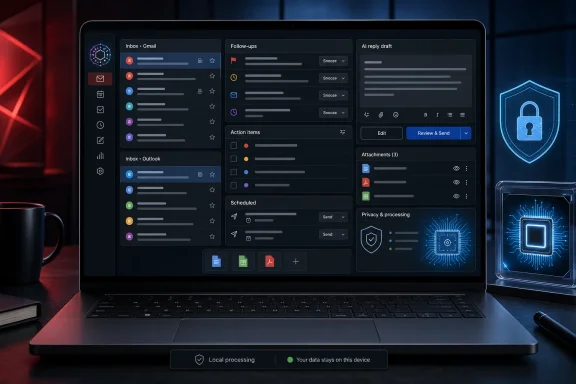
The headline feature is GAIA’s beta email agent. It can scan sent mail to identify threads that have not received a response after a configurable period, defaulting to three days. It also extracts action items from messages and retains them in a local list linked to the original email.
Scheduled sending and inbox snoozing are handled by GAIA itself rather than Gmail or Outlook APIs. The jobs are stored locally, persist through restarts, and run once GAIA is available again. A scheduled morning inbox briefing is also available but disabled by default.
Reply generation now analyzes characteristics of sent messages—including greetings, sign-offs, typical length, and formality—to produce drafts closer to the user’s own style. AMD says it stores the derived writing traits rather than the contents of historical messages. Attachments are now exposed during triage and can be included in drafted and sent messages.
AMD’s release notes are unusually direct about the maturity of the feature: the email agent remains beta, and users should treat its output as a draft to review rather than an autonomous decision-maker. GAIA requires confirmation before sending mail.
GAIA 0.22.0 fixes several email-related problems, including broken bulk triage on larger inboxes, truncation of message bodies at 4,000 characters, failures involving newly connected mailboxes, and an Outlook error that incorrectly instructed users to reconnect Google.
There are still sharp edges. Inbox pre-scan currently fails if both Gmail and Outlook are connected; AMD’s workaround is to disconnect one mailbox in GAIA’s connector settings, although ordinary triage can still cover all connected accounts. The REST API’s spam reporting is also known to under-flag messages, while the agent’s own inbox scanning is reportedly unaffected.
GAIA 0.22.0 is available now, but Windows users should test it with a non-critical mailbox before relying on its new scheduling and drafting features.
GAIA is not another cloud email assistant. AMD positions it as a local AI framework for Ryzen AI hardware, with Windows 11 and Linux support. The project’s current requirements list an AMD Ryzen AI 300-series processor and 16GB of RAM as the minimum baseline, though AMD recommends a Ryzen AI Max+ 395 system with 64GB for heavier workloads.
 Email agent gets more ambitious
The headline feature is GAIA’s beta email agent. It can scan sent mail to identify threads that have not received a response after a configurable period, defaulting to three days. It also extracts action items from messages and retains them in a local list linked to the original email.Scheduled sending and inbox snoozing are handled by GAIA itself rather than Gmail or Outlook APIs. The jobs are stored locally, persist through restarts, and run once GAIA is available again. A scheduled morning inbox briefing is also available but disabled by default.
Reply generation now analyzes characteristics of sent messages—including greetings, sign-offs, typical length, and formality—to produce drafts closer to the user’s own style. AMD says it stores the derived writing traits rather than the contents of historical messages. Attachments are now exposed during triage and can be included in drafted and sent messages.
AMD’s release notes are unusually direct about the maturity of the feature: the email agent remains beta, and users should treat its output as a draft to review rather than an autonomous decision-maker. GAIA requires confirmation before sending mail.
Windows and admin considerations
For Windows users, the release also updates the bundled Lemonade Server dependency to version 10.10.0. According to AMD’s release notes, this version allows Windows to reuse system ROCm and prevents the PC from entering suspend while an inference task is running. That matters for locally scheduled workflows, but it also means administrators should account for power-management behavior on mobile systems.GAIA 0.22.0 fixes several email-related problems, including broken bulk triage on larger inboxes, truncation of message bodies at 4,000 characters, failures involving newly connected mailboxes, and an Outlook error that incorrectly instructed users to reconnect Google.
There are still sharp edges. Inbox pre-scan currently fails if both Gmail and Outlook are connected; AMD’s workaround is to disconnect one mailbox in GAIA’s connector settings, although ordinary triage can still cover all connected accounts. The REST API’s spam reporting is also known to under-flag messages, while the agent’s own inbox scanning is reportedly unaffected.
GAIA 0.22.0 is available now, but Windows users should test it with a non-critical mailbox before relying on its new scheduling and drafting features.
References
- Primary source: Phoronix
Published: Thu, 16 Jul 2026 20:46:00 GMT
Loading…
www.phoronix.com
