

AMD’s Helios rack-scale AI platform has secured its most consequential public endorsement yet, with Microsoft confirming plans to deploy the system at scale across Azure infrastructure beginning in the second half of 2026. Built around 72 Instinct MI455X accelerators, sixth-generation EPYC “Venice” processors, Pensando networking and the ROCm software stack, Helios represents more than another GPU launch: it is AMD’s first comprehensive attempt to challenge Nvidia at the level where the AI infrastructure contest is increasingly decided—the entire rack, its interconnects, cooling, power delivery and software.
AMD’s arrival in rack-scale AI follows one of the technology industry’s most dramatic corporate recoveries. A decade ago, the company was fighting for relevance in both consumer PCs and servers, while Intel dominated mainstream processors and Nvidia established an increasingly formidable lead in accelerated computing.
The introduction of the Zen CPU architecture changed that trajectory. Ryzen restored AMD’s credibility with PC enthusiasts, but the 2017 launch of EPYC had even greater strategic significance by reopening the data center market to serious competition.
The generative AI boom then shifted data center spending toward GPUs and other accelerators. Nvidia’s CUDA software platform, high-speed NVLink fabric and integrated systems allowed it to capitalize on that transition faster than any competitor.
AMD answered first with individual Instinct accelerators, particularly the MI300X. Microsoft became an early large-scale adopter, offering MI300X-based Azure instances as an alternative to Nvidia-powered infrastructure for demanding AI workloads.
Nvidia understood this shift early. Its Grace Blackwell and subsequent Vera Rubin systems package processors, accelerators, switches, interconnects, software and thermal engineering as cohesive infrastructure rather than a collection of independent components.
Helios is AMD’s response to that model. It brings the company’s CPU, GPU, networking and software assets into a single architecture designed to operate as one computational unit.
That distinction matters because AI operators increasingly evaluate platforms by the performance, energy consumption and operating cost of an entire cluster. The relevant question is no longer simply which GPU produces the highest benchmark result, but how reliably thousands of GPUs can work together on a real model.
AMD has designed the accelerator around high-bandwidth memory and rapid communication between GPUs. Large memory pools are particularly valuable for inference because they can reduce the need to divide model weights across excessive numbers of devices, potentially simplifying deployment and lowering communication overhead.
A Helios rack organizes the accelerators in groups connected closely to EPYC host processors. AMD’s design is intended to make all 72 GPUs function as a tightly coordinated computational domain rather than as isolated cards.
CPUs continue to play an essential role even in GPU-centric AI systems. They manage data preparation, storage access, networking, scheduling, security services and the non-accelerated portions of AI applications.
That role could become more important as agentic AI systems grow more complicated. An agent may repeatedly call databases, execute software, search documents, use external tools and coordinate multiple models, creating a broader mixture of CPU and GPU work than a straightforward chatbot request.
Microsoft says the systems will support frontier-model inference, agentic applications, Azure AI services and customer deployments. Initial Helios shipments are scheduled to begin during the second half of 2026, although broad Azure availability may follow a phased rollout rather than an immediate global launch.
That demand creates a strategic incentive to diversify. Depending too heavily on one accelerator supplier can expose a cloud provider to shortages, unfavorable pricing, roadmap changes and limited negotiating power.
AMD cannot replace Nvidia across Azure in the near term, nor does Microsoft appear to be pursuing such a replacement. Instead, Helios gives Azure another architecture that can be assigned to workloads according to price, availability, memory requirements and software compatibility.
Infrastructure choice becomes especially valuable when every usable accelerator can be sold or consumed internally. Even a platform that handles only selected inference workloads can free Nvidia capacity for customers and applications that specifically require CUDA.
The MI300X deployment was an important bridge to Helios. It gave Microsoft practical experience with AMD’s accelerator hardware and ROCm software before committing to a much more deeply integrated rack-scale design.
Helios consequently represents an expansion of an existing partnership rather than an untested alliance. Microsoft still faces substantial integration work, but it is not beginning from zero.
Nvidia’s central advantage remains vertical integration. It controls the GPUs, CPUs, NVLink interconnect, networking components, system architecture and the mature CUDA software environment used by a huge portion of the AI industry.
Open standards can prevent a single vendor from controlling every layer of a data center. They can also encourage competition among switch vendors, server manufacturers and software providers.
However, openness does not automatically produce better performance or easier deployment. A tightly controlled proprietary platform can be optimized across hardware and software boundaries more quickly, particularly when one company owns the complete engineering stack.
AMD must demonstrate that Helios offers the flexibility of an open ecosystem without imposing excessive integration and troubleshooting costs. Hyperscalers may have the engineering resources to manage those complexities, but smaller providers will expect a polished, repeatable product.
The relevant calculation includes far more than hardware purchase price:
CUDA has benefited from years of optimization, extensive documentation and a large developer community. Many AI applications assume CUDA availability, while libraries and custom kernels may contain Nvidia-specific code.
That progress is essential, but compatibility is only the beginning. Production customers need stable drivers, predictable performance, comprehensive monitoring, efficient compilers and fast support when software encounters unfamiliar behavior.
A demonstration that successfully runs a model does not prove that the platform can sustain thousands of jobs across thousands of accelerators. Cloud operators will examine failure recovery, memory management, job scheduling, observability and performance consistency under mixed workloads.
A practical migration is likely to follow these steps:
Helios incorporates AMD Pensando networking and 800Gbps-class connectivity for scale-out communication. Within the rack, UALink is intended to provide direct, high-bandwidth accelerator communication.
A rack-scale platform requires control over congestion management, packet processing, security and data movement. If networking cannot keep the GPUs supplied with useful work, adding faster accelerators produces diminishing returns.
Pensando also gives AMD a larger share of the value contained in each Helios deployment. Rather than selling only CPUs and GPUs, AMD can supply networking silicon and associated software.
This is where real-world deployment becomes difficult. Performance can deteriorate because of congestion, failed links, inefficient collective operations or software that does not map workloads effectively across the topology.
Microsoft’s deployment will therefore test more than the internal design of Helios. It will test how smoothly multiple racks integrate with Azure’s network, storage, security and orchestration layers.
Those physical characteristics are not cosmetic. Many existing data centers cannot accept the latest AI racks without reinforcing floors, upgrading power distribution and installing new cooling infrastructure.
Facilities require coolant distribution units, plumbing, leak detection and maintenance processes that conventional server rooms may not possess. Operators must also account for water temperature, flow rates and redundancy.
Hyperscalers such as Microsoft are already constructing infrastructure around liquid-cooled AI systems. Enterprises operating smaller facilities may instead consume Helios remotely through Azure or another cloud provider because installing the racks locally could require a major building project.
A faster rack does not solve that problem if it consumes so much power that it cannot be deployed where customers need it. AMD’s cost-per-token argument must therefore include system efficiency under sustained workloads, not just theoretical performance.
Helios could gain an advantage if it processes more useful work within a fixed power envelope. Conversely, disappointing utilization would make its physical and electrical demands harder to justify.
That abstraction could make Helios commercially successful without most users knowing which accelerator produced their output. Cloud customers increasingly care about service-level performance and price rather than the logo printed on the underlying silicon.
Azure can potentially offer different tiers optimized for model training, high-throughput inference, low-latency applications or CPU-heavy agentic workflows. AMD-backed instances could become attractive when they offer more memory, better availability or lower cost than comparable Nvidia configurations.
Organizations should nevertheless avoid assuming that every AI workload will behave identically. Performance can vary dramatically according to model architecture, precision format, batch size, context length and software optimization.
Microsoft has described configurations approaching 500 physical CPU cores, 4TB of memory, 32TB of local NVMe storage and 400Gbps Azure Boost networking. Those specifications illustrate how rapidly cloud CPU instances are expanding alongside GPU infrastructure.
Large CPU systems can support databases, retrieval pipelines, simulation, electronic design automation and pre- or post-processing stages that surround AI models. The combination of Helios and Venice-based virtual machines gives Microsoft a broader AMD platform rather than an isolated accelerator offering.
Microsoft’s AI strategy increasingly spans local and cloud processing. Copilot+ PCs can run selected models on a neural processing unit, while larger or more capable models remain in Azure.
Users should not expect an immediate transformation. Infrastructure deployments occur gradually, and software services must be optimized before they can exploit a new platform efficiently.
The more realistic consumer benefit is incremental: additional capacity, potentially improved service reliability and stronger price competition in the cloud infrastructure that supports AI applications.
There may be indirect benefits through shared compiler research, packaging expertise and software investment. Even so, Radeon’s competitiveness will continue to depend on its own product roadmaps, drivers, game support and developer relationships.
AMD does not need to overtake Nvidia to create a highly valuable business. Capturing a meaningful minority of a rapidly expanding AI infrastructure market could generate substantial revenue and improve AMD’s leverage with suppliers and customers.
Nvidia can respond through aggressive roadmap execution, stronger cloud partnerships and deeper software integration. Its installed base gives it a considerable advantage, and many customers will pay a premium to avoid migration costs.
However, hyperscalers have enough engineering talent and purchasing power to support multiple architectures. If Microsoft, Meta, Oracle and others demonstrate successful AMD deployments, the perception that serious AI work requires Nvidia could weaken.
Venice could intensify pressure on Xeon by offering high core counts and strong efficiency for both general cloud computing and AI host workloads. Helios also shows how AMD can use CPU success as a foundation for selling GPUs, networking and complete systems.
Intel retains substantial enterprise relationships, manufacturing assets and platform expertise. Nevertheless, it must compete against an AMD portfolio that is becoming broader at the same time that Nvidia is entering CPU-centric data center territory.
Those transactions supplied adaptive computing, networking and rack-integration capabilities that AMD could not have assembled quickly through internal development alone.
This transition carries risk but also creates opportunity. Complete systems allow AMD to optimize components together and capture more revenue from each deployment.
Partners such as Celestica and HPE remain important because AMD is not attempting to become a traditional server manufacturer for every customer. Its strategy appears to combine a standardized reference architecture with manufacturing and deployment support from established infrastructure vendors.
The company has indicated that Helios-related deployments should begin in the second half of 2026, with a more substantial AI revenue contribution expected during 2027 as production and customer installations scale.
Execution timing will matter. A technically impressive platform that arrives late could lose workloads to Nvidia systems that customers can deploy sooner.
Early racks may be reserved for internal Microsoft workloads, selected customers or engineering validation. A gradual introduction would be normal for infrastructure of this complexity, but major delays would weaken AMD’s competitive position.
The industry also needs comparisons covering both latency-sensitive and throughput-oriented inference. A system can excel at generating large volumes of tokens while performing less impressively when each request demands a fast individual response.
Azure’s managed services could become a critical indicator. If Microsoft can make AMD-backed inference nearly transparent to developers, Helios will face a much lower adoption barrier.
Real evidence will include high utilization, predictable job completion and rapid recovery from hardware failures. These operational results matter more than theoretical interconnect bandwidth.
Announcements from server manufacturers, cloud providers and sovereign AI operators will also matter. A healthy ecosystem requires more than a small number of customers capable of performing their own extensive engineering.
AMD’s Helios platform marks a decisive change in the company’s ambitions: it no longer wants to supply only the processors inside someone else’s AI system, but to define the rack itself. Microsoft’s commitment gives that strategy immediate credibility, yet the difficult work begins with production deployments, where software maturity, networking efficiency, power consumption and reliability will determine whether Helios genuinely lowers the cost of AI. Nvidia remains the benchmark and the ecosystem leader, but for the first time the rack-scale market may have a challenger that combines competitive accelerators, proven server CPUs, high-speed networking and a major cloud customer—and that competition could reshape both Azure’s infrastructure and the economics of the wider AI industry.
 Background
AMD’s arrival in rack-scale AI follows one of the technology industry’s most dramatic corporate recoveries. A decade ago, the company was fighting for relevance in both consumer PCs and servers, while Intel dominated mainstream processors and Nvidia established an increasingly formidable lead in accelerated computing.The introduction of the Zen CPU architecture changed that trajectory. Ryzen restored AMD’s credibility with PC enthusiasts, but the 2017 launch of EPYC had even greater strategic significance by reopening the data center market to serious competition.
From EPYC comeback to AI contender
Successive EPYC generations gave cloud providers more cores, competitive performance per watt and an alternative to Intel’s Xeon platform. Microsoft, Amazon, Google, Oracle and other operators gradually expanded their use of AMD server processors, giving AMD the customer relationships and deployment experience needed to pursue a larger infrastructure role.The generative AI boom then shifted data center spending toward GPUs and other accelerators. Nvidia’s CUDA software platform, high-speed NVLink fabric and integrated systems allowed it to capitalize on that transition faster than any competitor.
AMD answered first with individual Instinct accelerators, particularly the MI300X. Microsoft became an early large-scale adopter, offering MI300X-based Azure instances as an alternative to Nvidia-powered infrastructure for demanding AI workloads.
Why rack-scale systems became necessary
Selling a powerful accelerator is no longer sufficient at the frontier of AI. Large models must divide computations across dozens, hundreds or thousands of chips, making communication bandwidth, memory capacity, network topology, cooling and orchestration as important as the performance of an individual GPU.Nvidia understood this shift early. Its Grace Blackwell and subsequent Vera Rubin systems package processors, accelerators, switches, interconnects, software and thermal engineering as cohesive infrastructure rather than a collection of independent components.
Helios is AMD’s response to that model. It brings the company’s CPU, GPU, networking and software assets into a single architecture designed to operate as one computational unit.
What AMD Helios Actually Is
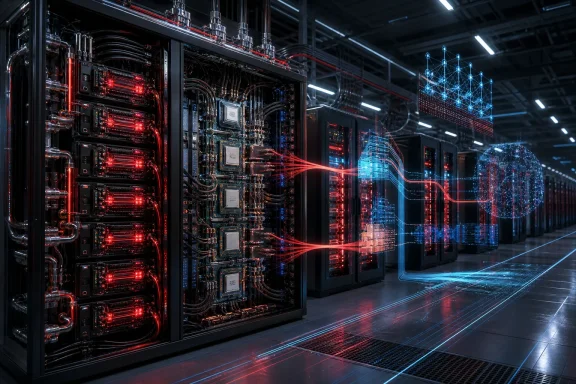
Helios is an integrated, liquid-cooled AI rack rather than a conventional server fitted with several accelerator cards. AMD’s reference design combines 72 Instinct MI455X GPUs, 18 EPYC Venice CPUs, Pensando Vulcano networking components and an open scale-up fabric based on UALink technologies.That distinction matters because AI operators increasingly evaluate platforms by the performance, energy consumption and operating cost of an entire cluster. The relevant question is no longer simply which GPU produces the highest benchmark result, but how reliably thousands of GPUs can work together on a real model.
The Instinct MI455X foundation
The MI455X sits at the center of Helios. It belongs to AMD’s MI400 generation and is intended for large-scale model training, frontier inference and high-performance computing.AMD has designed the accelerator around high-bandwidth memory and rapid communication between GPUs. Large memory pools are particularly valuable for inference because they can reduce the need to divide model weights across excessive numbers of devices, potentially simplifying deployment and lowering communication overhead.
A Helios rack organizes the accelerators in groups connected closely to EPYC host processors. AMD’s design is intended to make all 72 GPUs function as a tightly coordinated computational domain rather than as isolated cards.
Venice supplies the host compute
Sixth-generation EPYC processors, code-named Venice, handle the CPU portion of Helios. These chips use AMD’s Zen 6 architecture and are expected to offer significantly higher core density than previous EPYC generations.CPUs continue to play an essential role even in GPU-centric AI systems. They manage data preparation, storage access, networking, scheduling, security services and the non-accelerated portions of AI applications.
That role could become more important as agentic AI systems grow more complicated. An agent may repeatedly call databases, execute software, search documents, use external tools and coordinate multiple models, creating a broader mixture of CPU and GPU work than a straightforward chatbot request.
Microsoft’s Commitment Changes the Conversation
Microsoft’s decision to deploy Helios across Azure gives AMD something more valuable than a favorable benchmark: validation from one of the world’s largest infrastructure operators. Azure engineers will have to integrate the racks into real data centers, expose their capabilities through cloud services and support customer workloads under demanding availability requirements.Microsoft says the systems will support frontier-model inference, agentic applications, Azure AI services and customer deployments. Initial Helios shipments are scheduled to begin during the second half of 2026, although broad Azure availability may follow a phased rollout rather than an immediate global launch.
Azure needs alternatives to Nvidia
Microsoft has enormous demand for AI compute. It supplies infrastructure to external Azure customers while also supporting Microsoft 365 Copilot, GitHub Copilot, security products, Bing, consumer AI services and internal model development.That demand creates a strategic incentive to diversify. Depending too heavily on one accelerator supplier can expose a cloud provider to shortages, unfavorable pricing, roadmap changes and limited negotiating power.
AMD cannot replace Nvidia across Azure in the near term, nor does Microsoft appear to be pursuing such a replacement. Instead, Helios gives Azure another architecture that can be assigned to workloads according to price, availability, memory requirements and software compatibility.
Infrastructure choice becomes especially valuable when every usable accelerator can be sold or consumed internally. Even a platform that handles only selected inference workloads can free Nvidia capacity for customers and applications that specifically require CUDA.
A relationship built over many product generations
AMD and Microsoft already have a broad relationship. AMD technology has appeared in Azure servers, Surface products and multiple generations of Xbox consoles, while Microsoft has helped bring Instinct accelerators into mainstream cloud consumption.The MI300X deployment was an important bridge to Helios. It gave Microsoft practical experience with AMD’s accelerator hardware and ROCm software before committing to a much more deeply integrated rack-scale design.
Helios consequently represents an expansion of an existing partnership rather than an untested alliance. Microsoft still faces substantial integration work, but it is not beginning from zero.
The Nvidia Comparison
Helios will inevitably be compared with Nvidia’s rack-scale systems, including Blackwell-generation NVL72 products and the newer Vera Rubin roadmap. All of these platforms combine 72 accelerators with host CPUs, high-speed fabrics, networking and liquid cooling, but the similarities should not obscure important architectural and ecosystem differences.Nvidia’s central advantage remains vertical integration. It controls the GPUs, CPUs, NVLink interconnect, networking components, system architecture and the mature CUDA software environment used by a huge portion of the AI industry.
Open standards versus proprietary integration
AMD is positioning Helios as a more open alternative. Its design incorporates UALink for scale-up connectivity and standard Ethernet-based technologies for broader cluster communication, giving customers and hardware partners more freedom to assemble infrastructure around multiple suppliers.Open standards can prevent a single vendor from controlling every layer of a data center. They can also encourage competition among switch vendors, server manufacturers and software providers.
However, openness does not automatically produce better performance or easier deployment. A tightly controlled proprietary platform can be optimized across hardware and software boundaries more quickly, particularly when one company owns the complete engineering stack.
AMD must demonstrate that Helios offers the flexibility of an open ecosystem without imposing excessive integration and troubleshooting costs. Hyperscalers may have the engineering resources to manage those complexities, but smaller providers will expect a polished, repeatable product.
Performance per dollar is the real battlefield
AMD executives have emphasized total cost of ownership and cost per token rather than relying only on peak computational throughput. That is a sensible approach because AI providers ultimately care about the cost of producing useful model outputs.The relevant calculation includes far more than hardware purchase price:
- Accelerator utilization determines whether expensive silicon remains productive or waits for data and communication.
- Memory capacity affects how efficiently large models can be hosted and served.
- Power and cooling requirements shape both operating expenses and data center design.
- Software optimization controls how much theoretical hardware performance reaches applications.
- Reliability affects the amount of cluster time lost to failures, maintenance and job restarts.
- Networking efficiency becomes increasingly important as systems scale beyond one rack.
ROCm Becomes the Deciding Factor
AMD’s hardware can be competitive while the platform still struggles commercially if developers cannot use it efficiently. The contest with Nvidia therefore depends heavily on ROCm, AMD’s open software stack for GPU computing.CUDA has benefited from years of optimization, extensive documentation and a large developer community. Many AI applications assume CUDA availability, while libraries and custom kernels may contain Nvidia-specific code.
Progress beyond basic compatibility
ROCm support has improved substantially across major frameworks and model-serving tools. PyTorch, popular inference engines and distributed-computing packages increasingly run on Instinct hardware, reducing the amount of custom work needed for mainstream workloads.That progress is essential, but compatibility is only the beginning. Production customers need stable drivers, predictable performance, comprehensive monitoring, efficient compilers and fast support when software encounters unfamiliar behavior.
A demonstration that successfully runs a model does not prove that the platform can sustain thousands of jobs across thousands of accelerators. Cloud operators will examine failure recovery, memory management, job scheduling, observability and performance consistency under mixed workloads.
The migration problem
Organizations with extensive CUDA software cannot simply replace Nvidia hardware overnight. Porting may involve recompiling code, substituting libraries, rewriting custom kernels and validating model accuracy.A practical migration is likely to follow these steps:
- Identify models that already rely on well-supported frameworks rather than proprietary CUDA extensions.
- Benchmark those models on AMD hardware using realistic batch sizes, context lengths and latency targets.
- Profile memory transfers, communication overhead and kernel behavior rather than relying on headline throughput.
- Validate numerical results and model quality across representative production data.
- Deploy limited inference services before expanding into business-critical workloads.
- Standardize monitoring, scheduling and incident-response procedures across both AMD and Nvidia environments.
Networking Is Now a Core Compute Technology
AI performance increasingly depends on moving data rather than merely calculating it. Accelerators must exchange model parameters, activations and intermediate results at extremely high speeds, often under tight synchronization requirements.Helios incorporates AMD Pensando networking and 800Gbps-class connectivity for scale-out communication. Within the rack, UALink is intended to provide direct, high-bandwidth accelerator communication.
Why AMD bought Pensando
AMD’s acquisition of Pensando in 2022 initially appeared focused on data processing units and cloud networking. In retrospect, the transaction gave AMD technology and engineering expertise that could become central to its AI systems strategy.A rack-scale platform requires control over congestion management, packet processing, security and data movement. If networking cannot keep the GPUs supplied with useful work, adding faster accelerators produces diminishing returns.
Pensando also gives AMD a larger share of the value contained in each Helios deployment. Rather than selling only CPUs and GPUs, AMD can supply networking silicon and associated software.
Scaling beyond one rack
A single 72-GPU rack is only one building block in a frontier AI cluster. Training and serving the largest models may require hundreds of racks linked through a high-performance scale-out network.This is where real-world deployment becomes difficult. Performance can deteriorate because of congestion, failed links, inefficient collective operations or software that does not map workloads effectively across the topology.
Microsoft’s deployment will therefore test more than the internal design of Helios. It will test how smoothly multiple racks integrate with Azure’s network, storage, security and orchestration layers.
Data Center Power and Physical Constraints
Helios is a large, dense and heavy system. Reports have placed fully configured rack weight at several thousand pounds, while its double-width form factor and liquid-cooling requirements distinguish it sharply from traditional enterprise servers.Those physical characteristics are not cosmetic. Many existing data centers cannot accept the latest AI racks without reinforcing floors, upgrading power distribution and installing new cooling infrastructure.
Liquid cooling becomes unavoidable
Air cooling struggles to remove heat from modern AI accelerators packed at rack scale. Direct liquid cooling transfers heat more efficiently and can support substantially higher power density, but it introduces operational complexity.Facilities require coolant distribution units, plumbing, leak detection and maintenance processes that conventional server rooms may not possess. Operators must also account for water temperature, flow rates and redundancy.
Hyperscalers such as Microsoft are already constructing infrastructure around liquid-cooled AI systems. Enterprises operating smaller facilities may instead consume Helios remotely through Azure or another cloud provider because installing the racks locally could require a major building project.
Power availability limits deployment
The AI industry’s most difficult constraint may eventually be electrical capacity rather than semiconductor supply. New data center campuses require utility connections, substations, transformers, backup generation and long regulatory approval processes.A faster rack does not solve that problem if it consumes so much power that it cannot be deployed where customers need it. AMD’s cost-per-token argument must therefore include system efficiency under sustained workloads, not just theoretical performance.
Helios could gain an advantage if it processes more useful work within a fixed power envelope. Conversely, disappointing utilization would make its physical and electrical demands harder to justify.
Enterprise Impact
Most organizations will not purchase an entire Helios system. They will encounter the architecture indirectly through Azure virtual machines, managed AI services or applications that run on AMD-backed infrastructure.That abstraction could make Helios commercially successful without most users knowing which accelerator produced their output. Cloud customers increasingly care about service-level performance and price rather than the logo printed on the underlying silicon.
More choice for Windows-oriented businesses
For enterprises already committed to Windows Server, Azure, Microsoft 365 and Microsoft’s development ecosystem, the AMD expansion could provide additional infrastructure options without requiring a move to another cloud.Azure can potentially offer different tiers optimized for model training, high-throughput inference, low-latency applications or CPU-heavy agentic workflows. AMD-backed instances could become attractive when they offer more memory, better availability or lower cost than comparable Nvidia configurations.
Organizations should nevertheless avoid assuming that every AI workload will behave identically. Performance can vary dramatically according to model architecture, precision format, batch size, context length and software optimization.
New EPYC virtual machines
Microsoft is also preparing Azure offerings based on sixth-generation EPYC processors. One class is aimed at demanding AI data systems and agentic workloads, while another targets high-performance computing and semiconductor design.Microsoft has described configurations approaching 500 physical CPU cores, 4TB of memory, 32TB of local NVMe storage and 400Gbps Azure Boost networking. Those specifications illustrate how rapidly cloud CPU instances are expanding alongside GPU infrastructure.
Large CPU systems can support databases, retrieval pipelines, simulation, electronic design automation and pre- or post-processing stages that surround AI models. The combination of Helios and Venice-based virtual machines gives Microsoft a broader AMD platform rather than an isolated accelerator offering.
Consumer and Windows Ecosystem Implications
Helios will not appear inside a gaming PC, but its effects may still reach Windows users. AI services integrated into Windows, Microsoft 365, GitHub and consumer applications depend on data center capacity, and additional accelerator supply can influence availability, responsiveness and cost.Microsoft’s AI strategy increasingly spans local and cloud processing. Copilot+ PCs can run selected models on a neural processing unit, while larger or more capable models remain in Azure.
More back-end capacity for Copilot services
If Helios performs well, Microsoft could direct suitable inference workloads to AMD hardware and reserve other accelerators for training or specialized tasks. That flexibility may help the company expand AI services without tying every new feature to Nvidia supply.Users should not expect an immediate transformation. Infrastructure deployments occur gradually, and software services must be optimized before they can exploit a new platform efficiently.
The more realistic consumer benefit is incremental: additional capacity, potentially improved service reliability and stronger price competition in the cloud infrastructure that supports AI applications.
No direct signal for Radeon gaming
Helios should not be interpreted as evidence that AMD will suddenly close every gap in PC graphics. Instinct accelerators use technology developed for data centers, where memory capacity, compute density, reliability and interconnect performance matter more than gaming frame rates.There may be indirect benefits through shared compiler research, packaging expertise and software investment. Even so, Radeon’s competitiveness will continue to depend on its own product roadmaps, drivers, game support and developer relationships.
Competitive Implications for Nvidia and Intel
Nvidia remains the dominant supplier of data center AI accelerators and possesses a powerful ecosystem advantage. One Microsoft commitment does not erase that lead, but it demonstrates that major customers want credible alternatives.AMD does not need to overtake Nvidia to create a highly valuable business. Capturing a meaningful minority of a rapidly expanding AI infrastructure market could generate substantial revenue and improve AMD’s leverage with suppliers and customers.
Nvidia faces pressure at the system level
Competition from Helios may force Nvidia to defend more than GPU benchmark leadership. Customers will compare system pricing, memory, networking, energy efficiency, availability and software support.Nvidia can respond through aggressive roadmap execution, stronger cloud partnerships and deeper software integration. Its installed base gives it a considerable advantage, and many customers will pay a premium to avoid migration costs.
However, hyperscalers have enough engineering talent and purchasing power to support multiple architectures. If Microsoft, Meta, Oracle and others demonstrate successful AMD deployments, the perception that serious AI work requires Nvidia could weaken.
Intel is challenged from another direction
Intel’s immediate exposure is more complicated. It competes with EPYC in conventional servers while also attempting to build an accelerator business.Venice could intensify pressure on Xeon by offering high core counts and strong efficiency for both general cloud computing and AI host workloads. Helios also shows how AMD can use CPU success as a foundation for selling GPUs, networking and complete systems.
Intel retains substantial enterprise relationships, manufacturing assets and platform expertise. Nevertheless, it must compete against an AMD portfolio that is becoming broader at the same time that Nvidia is entering CPU-centric data center territory.
AMD’s Broader Full-Stack Strategy
Helios reflects years of acquisitions and organizational change. AMD has expanded beyond its traditional identity as a CPU and graphics chip designer by purchasing Xilinx, Pensando and the server-manufacturing operations associated with ZT Systems.Those transactions supplied adaptive computing, networking and rack-integration capabilities that AMD could not have assembled quickly through internal development alone.
From components to complete infrastructure
Selling rack-scale systems changes AMD’s responsibilities. The company must coordinate mechanical design, firmware, cooling, cabling, validation, manufacturing and field support across a far larger product.This transition carries risk but also creates opportunity. Complete systems allow AMD to optimize components together and capture more revenue from each deployment.
Partners such as Celestica and HPE remain important because AMD is not attempting to become a traditional server manufacturer for every customer. Its strategy appears to combine a standardized reference architecture with manufacturing and deployment support from established infrastructure vendors.
The economics of a larger footprint
Data center AI systems can cost millions of dollars per rack once accelerators, networking, cooling and integration are included. Even limited market penetration could therefore affect AMD’s financial results.The company has indicated that Helios-related deployments should begin in the second half of 2026, with a more substantial AI revenue contribution expected during 2027 as production and customer installations scale.
Execution timing will matter. A technically impressive platform that arrives late could lose workloads to Nvidia systems that customers can deploy sooner.
Strengths and Opportunities
Helios gives AMD a credible framework for competing in a market that increasingly rewards complete platforms rather than isolated chips. Its strongest opportunities arise from customer demand for supply diversity and lower infrastructure costs.- Microsoft provides high-profile validation. Azure deployment indicates that Helios has progressed beyond a conceptual reference design and is being prepared for production use.
- AMD can combine four major technology layers. Instinct GPUs, EPYC CPUs, Pensando networking and ROCm software allow AMD to optimize more of the system internally.
- Large accelerator memory could benefit inference. Memory capacity and bandwidth can improve the efficiency of serving large models, especially when long contexts and large parameter counts are involved.
- Open standards may attract hyperscalers. UALink and Ethernet-based designs can reduce dependence on proprietary interconnects and encourage a broader supplier ecosystem.
- Cloud abstraction can reduce migration friction. Azure can expose AMD capacity through managed services and familiar interfaces, shielding customers from some low-level software differences.
- Competition could improve pricing. A viable second supplier gives cloud operators more negotiating leverage and could reduce the cost of selected AI workloads.
- EPYC strengthens the complete platform. AMD already has a proven data center CPU business, allowing it to compete for host processing as well as accelerator spending.
- Inference growth creates room for specialization. Not every AI workload requires identical hardware, and Helios may find strong demand in high-throughput serving even where Nvidia remains preferred for some training jobs.
Risks and Concerns
Helios also introduces significant technical, commercial and operational risks. AMD must prove that the system works at scale, arrives on schedule and supports production software with minimal friction.- ROCm still trails CUDA in maturity and mindshare. Framework support has improved, but many organizations depend on Nvidia-specific libraries, kernels and operational tools.
- Rack-scale reliability remains unproven publicly. Failures involving cooling, interconnects or individual components can disrupt large distributed jobs and reduce utilization.
- Supply constraints could limit volume. Advanced packaging, high-bandwidth memory and leading-edge manufacturing capacity remain scarce across the AI industry.
- Data center requirements restrict the customer base. The rack’s weight, dimensions, power density and liquid cooling make it unsuitable for many existing facilities.
- Nvidia’s roadmap continues to advance. AMD is not competing with a static target, and Nvidia can use its software lead and rapid product cadence to defend customers.
- Pricing remains unclear. Unofficial system estimates cannot establish total cost of ownership without information about support, networking, power, software and achieved utilization.
- Open architecture can increase integration work. Customers may gain flexibility but encounter more responsibility for validating components and troubleshooting performance.
- Microsoft’s deployment does not guarantee universal adoption. Azure may use Helios selectively, and other customers could reach different conclusions based on their workloads.
What to Watch Next
The most important Helios milestones will not be launch-stage specifications. They will be evidence that AMD and Microsoft can turn the architecture into dependable, widely consumable cloud capacity.Shipment and availability dates
AMD says customer shipments will begin in the second half of 2026. Observers should distinguish initial shipments from broad production volume and generally available Azure services.Early racks may be reserved for internal Microsoft workloads, selected customers or engineering validation. A gradual introduction would be normal for infrastructure of this complexity, but major delays would weaken AMD’s competitive position.
Independent performance results
Cost-per-token claims require testing with complete models and production-like conditions. Useful evaluations should disclose model size, precision, batch configuration, context length, power consumption and software versions.The industry also needs comparisons covering both latency-sensitive and throughput-oriented inference. A system can excel at generating large volumes of tokens while performing less impressively when each request demands a fast individual response.
ROCm developer experience
Framework compatibility, driver stability and debugging tools will be watched closely. AMD’s software improvements must arrive quickly enough to support the hardware rather than following months later.Azure’s managed services could become a critical indicator. If Microsoft can make AMD-backed inference nearly transparent to developers, Helios will face a much lower adoption barrier.
Multi-rack scaling
AMD must demonstrate efficient operation beyond a single 72-GPU system. Frontier deployments depend on clusters containing thousands of accelerators, where networking and collective communication frequently determine overall performance.Real evidence will include high utilization, predictable job completion and rapid recovery from hardware failures. These operational results matter more than theoretical interconnect bandwidth.
Customer expansion
Microsoft joins a broader group of organizations working with AMD AI technology, including Meta, Oracle and OpenAI. The scale, timing and nature of those deployments will reveal whether Helios becomes a widely adopted architecture or remains concentrated among several highly customized hyperscale projects.Announcements from server manufacturers, cloud providers and sovereign AI operators will also matter. A healthy ecosystem requires more than a small number of customers capable of performing their own extensive engineering.
AMD’s Helios platform marks a decisive change in the company’s ambitions: it no longer wants to supply only the processors inside someone else’s AI system, but to define the rack itself. Microsoft’s commitment gives that strategy immediate credibility, yet the difficult work begins with production deployments, where software maturity, networking efficiency, power consumption and reliability will determine whether Helios genuinely lowers the cost of AI. Nvidia remains the benchmark and the ecosystem leader, but for the first time the rack-scale market may have a challenger that combines competitive accelerators, proven server CPUs, high-speed networking and a major cloud customer—and that competition could reshape both Azure’s infrastructure and the economics of the wider AI industry.
References
- Primary source: SSBCrack
Published: 2026-07-22T00:09:44+00:00
Loading…
news.ssbcrack.com - Related coverage: amd.com
Microsoft Azure Expanding AI Infra Choice with AMD Helios™
Microsoft and AMD expand Azure AI infrastructure with AMD Instinct MI455X and Helios, delivering more choice, scale, and efficiency.www.amd.com - Related coverage: tomshardware.com
Microsoft will deploy AMD’s Helios rack-scale AI accelerator ‘at scale’ on Azure – Radeon Instinct MI455X and Epyc Venice power will be available through Redmond’s cloud infrastructure | Tom's Hardware
But it’s not clear just how much AMD AI compute Microsoft is buyingwww.tomshardware.com