

Microsoft’s decision to deploy AMD’s Helios rack-scale AI architecture across Azure marks a consequential shift in the competition to supply the world’s largest cloud platforms. The agreement reaches far beyond another accelerator purchase: it brings together AMD Instinct MI455X GPUs, sixth-generation EPYC “Venice” processors, Pensando networking hardware, ROCm software, and Microsoft’s Azure infrastructure services as one production-scale platform. Shipments are expected to begin in the second half of 2026, giving Microsoft another source of frontier-class AI capacity while providing AMD with one of its strongest opportunities yet to challenge Nvidia at the system level.
Microsoft and AMD announced the expanded partnership on July 20, 2026, ahead of AMD’s Advancing AI event. At its center is Microsoft’s commitment to deploy the AMD Helios Rackscale Solution at scale, although neither company disclosed the number of racks, the financial value of the arrangement, its power footprint, or a detailed regional rollout schedule.
Helios will support frontier-model inference for Microsoft, Azure AI services, and customers purchasing AI capacity through Azure. Microsoft is also preparing three related Azure offerings: ND MI455X v7 virtual machines for production AI inference, HDv2 instances for AI data systems, and HXv2 instances for electronic design automation and high-performance computing.
That distinction matters. Modern AI performance increasingly depends on the entire data path rather than an accelerator’s theoretical arithmetic throughput alone. CPUs must prepare and coordinate data, network interfaces must move model state efficiently, software must schedule distributed jobs, and cooling and power systems must sustain performance without destabilizing the rack.
Enterprises should therefore distinguish among three milestones:
The relationship also reflects Microsoft’s preference for a heterogeneous infrastructure fleet. Azure uses processors from multiple external suppliers alongside Microsoft-designed silicon, allowing the company to match hardware to workload requirements and reduce dependence on any one vendor.
AI changed the scope of the challenge. Selling a strong CPU or accelerator was no longer sufficient once customers began deploying thousands of GPUs as coordinated systems. AMD needed to compete in interconnects, networking, software libraries, rack engineering, deployment tools, and serviceability.
Helios represents the culmination of that effort. It is AMD’s first comprehensive rack-scale AI reference design, intended to let cloud providers and system manufacturers deploy a coordinated AMD platform rather than assemble individual components around an accelerator.
This installed base lowers the integration barrier for Venice processors and MI455X accelerators. Microsoft already has operational experience with AMD firmware, telemetry, virtualization, security features, driver deployment, and data-center lifecycle management.
Helios still introduces substantial new complexity, especially at rack scale, but it does not arrive as an isolated experimental platform. Microsoft is extending an established AMD relationship into the most strategically important layer of cloud infrastructure.
AMD describes Helios as a reference architecture rather than a single finished appliance sold directly to every customer. OEMs and original-design manufacturers can build systems based on the blueprint, potentially creating a broader supplier ecosystem around compatible racks.
Across 72 accelerators, a complete rack provides roughly 31TB of high-bandwidth memory. AMD also claims up to 2.9 exaFLOPS of FP4 performance and 1.4 exaFLOPS of FP8 performance, although these are vendor specifications and should not be treated as direct predictions of real application throughput.
Large memory capacity can be especially important for inference. It may allow more model weights, key-value cache data, and longer context windows to remain close to the accelerator, reducing the need to move data through slower layers of the system.
AMD’s published design information indicates that Venice can scale to 256 CPU cores with substantial memory bandwidth. Raw core counts are only one factor, however; scheduling efficiency, memory locality, I/O design, and communication between CPUs and accelerators will all influence system performance.
The decision to use AMD CPUs and GPUs together gives AMD an opportunity to optimize across both sides of the compute tray. It also gives Microsoft a more vertically coordinated alternative to systems combining components from several unrelated suppliers.
Microsoft separately plans to expand its deployment of Pensando DPUs in Azure services and integrate AMD technology with Azure Boost. Azure Boost moves selected networking and storage functions away from guest virtual machines and host CPUs, improving isolation and making more compute resources available to customer workloads.
The networking component may be as strategically significant as the GPUs. Distributed AI systems frequently lose performance when accelerators wait for data or synchronization, making congestion control, collective communications, and network telemetry central to usable throughput.
No single processor architecture is necessarily optimal for that entire pipeline. Microsoft’s answer is to build a varied fleet containing merchant silicon from several suppliers, custom Microsoft hardware, and workload-specific cloud instances.
A credible AMD alternative can improve Microsoft’s negotiating position and reduce the operational risk associated with excessive dependence on one accelerator supplier. It may also help Azure allocate scarce hardware more intelligently instead of placing every AI workload onto the same premium platform.
Diversification does not automatically produce lower costs. Supporting multiple architectures creates expenses in software engineering, qualification, maintenance, scheduling, and developer support. Microsoft is effectively betting that the benefits of capacity, specialization, and supplier competition will outweigh those costs.
Reasoning and agentic systems can consume much more inference compute than simple prompt-and-response applications. They may generate internal reasoning steps, call tools, search databases, coordinate several models, and maintain larger context windows before producing an answer.
A rack with substantial memory capacity and high aggregate bandwidth could be valuable for those workloads. The real test will be whether Azure can convert the hardware into competitive tokens per second, latency, utilization, energy efficiency, and cost per completed task under production conditions.
The ND branding places it within Azure’s accelerator-focused virtual-machine portfolio. Precise configurations, regional availability, general-availability dates, reservation options, and pricing had not been fully detailed at the time of the announcement.
That could make AMD acceleration accessible to organizations that lack the resources to build a ROCm cluster. It also creates a route for software vendors to test AMD compatibility using cloud capacity before considering dedicated deployments.
Customers should not assume that an application written for Nvidia CUDA will move to MI455X without engineering work. Framework-level compatibility has improved, but production systems often depend on custom kernels, optimized attention implementations, quantization tools, communication libraries, monitoring agents, and container images.
This approach could accelerate AMD adoption because many enterprises care more about service-level outcomes than accelerator brands. If an Azure service meets latency, quality, security, and cost requirements, customers may never need to interact directly with ROCm.
The trade-off is reduced transparency. Enterprises will need clear documentation about data residency, model portability, capacity guarantees, fallback behavior, and whether workloads can move between accelerator architectures without unexpected performance changes.
Microsoft’s upcoming Azure HDv2 virtual machines are designed for that part of the stack. The company says a configuration will include nearly 500 physical sixth-generation EPYC cores, 4TB of RAM, 32TB of local NVMe storage, and 400Gb Azure Boost networking.
HDv2 is intended to provide dense CPU infrastructure for those operations. Local NVMe storage could help with temporary datasets and intermediate results, while high-speed Azure Boost networking should improve movement between data-processing nodes and accelerator clusters.
The broader implication is that Microsoft and AMD are treating AI as an end-to-end data system. The GPU remains crucial, but the surrounding CPU and storage infrastructure increasingly determines whether organizations can use accelerator capacity efficiently.
HDv2 could become useful for hosting tool-execution environments, retrieval systems, workflow engines, simulation tasks, and reinforcement-learning pipelines. This makes the VM relevant to customers building complex AI services rather than simply training one large model.
Its nearly 500 physical cores also raise software-licensing and NUMA-awareness questions. Applications that scale poorly across sockets or charge per core may not benefit economically from the largest configurations, so Azure customers will need workload-specific testing.
Microsoft says HXv2 will offer 176 sixth-generation EPYC cores running at more than 5GHz, 50 percent more addressable cache per core, configurations with approximately 2TB or 4TB of memory, and 800Gb InfiniBand connectivity.
Cloud-based EDA allows semiconductor companies to expand capacity during peak design periods without permanently maintaining enough on-premises infrastructure for the maximum load. Faster simulations can also shorten verification cycles, potentially helping products reach manufacturing sooner.
There is a notable feedback loop in the partnership: AMD can use Azure’s AMD-powered HX infrastructure to help design future EPYC processors and Instinct accelerators. Microsoft then deploys those processors in later generations of Azure hardware.
Performance will still vary significantly by application. Clock frequency and core count do not guarantee linear scaling, particularly when software depends on memory access patterns, commercial licensing models, or proprietary compiler optimizations.
For Windows-focused engineering teams, Azure can provide a bridge between familiar Windows-based design workflows and Linux-heavy HPC back ends. Microsoft’s challenge will be to ensure that identity, storage, scheduling, remote visualization, and development tools work coherently across those environments.
AMD has expanded support for major frameworks and inference engines, including PyTorch, TensorFlow, JAX, ONNX Runtime, vLLM, and Triton. The remaining challenge is not basic compatibility alone, but reliable performance across real applications and repeated software updates.
ROCm does not need to reproduce every element of CUDA to succeed on Azure. It does need to support the models and frameworks that account for a large share of production demand, while offering predictable upgrades and effective debugging.
Microsoft can help close that gap by optimizing Azure services, model catalogs, containers, schedulers, and managed runtimes for AMD hardware. Its work on distributed communication technologies also gives it expertise in reducing overhead across large accelerator deployments.
Yet open specifications do not automatically guarantee effortless portability. Customers can still become dependent on provider-specific VM types, deployment APIs, performance libraries, or managed services.
The useful measure of openness will be whether an enterprise can move a model among Azure’s AMD, Nvidia, Microsoft, and CPU infrastructure without rewriting critical portions of its application. Documentation, reproducible benchmarks, container support, and stable orchestration interfaces will matter more than branding.
AMD is now attempting to compete at that level. The company’s acquisition and integration of Pensando strengthened its networking portfolio, while its work with system manufacturers has expanded its ability to design and deliver full racks.
Helios includes a centralized power shelf, vertical busbar, and cooling manifold with quick-disconnect connections. Its modular trays are intended to reduce recabling and shorten maintenance operations.
These features matter because a high-performance rack that is difficult to service can lose its economic advantage through downtime. At hyperscale, replacing a failed component safely and quickly becomes part of system performance.
Standardization could allow multiple manufacturers to produce compatible systems and components. It may also reduce the custom engineering required each time a hyperscaler deploys a new accelerator generation.
The format nevertheless presents adoption barriers outside hyperscale data centers. Many enterprise facilities were not designed for double-wide racks, direct liquid cooling, or the associated power density, making cloud consumption the more practical route for most organizations.
For AMD, the victory is strategically valuable even without disclosed deployment numbers. Azure is a demanding environment, and successful production operation would demonstrate that Helios can satisfy hyperscale requirements for reliability, security, telemetry, automation, and serviceability.
Helios does not need to replace Nvidia across Azure to influence the market. A credible second platform can introduce price competition, improve capacity availability, and encourage developers to avoid unnecessarily restrictive hardware dependencies.
Nvidia will respond through performance improvements, software expansion, system integration, and cloud partnerships of its own. Consequently, Microsoft’s AMD adoption should be viewed as an intensification of competition rather than evidence that the market has already become balanced.
Custom chips can be optimized for Microsoft’s fleet economics, while AMD offers a broader ecosystem and externally supported platform. Nvidia supplies a mature developer environment, and CPUs continue to handle large portions of data processing and orchestration.
Azure’s competitive message is therefore choice combined with workload specialization. The operational challenge is preventing that diversity from turning into a confusing collection of incompatible services and capacity tiers.
Intel remains a significant Azure supplier and is pursuing its own CPU, accelerator, foundry, and networking strategies. Other AI accelerator developers are also seeking cloud adoption, while hyperscalers increasingly build internal silicon.
The result is not a simple two-company contest. Azure is becoming a marketplace of compute architectures, and the winners will be determined by the combined economics of hardware, software, power, availability, and customer migration effort.
If AMD capacity improves Microsoft’s inference economics, the company could use that benefit to serve more requests, support larger models, introduce richer agentic functions, or reduce dependence on scarce premium accelerators. Whether any savings reach customers through lower prices is much less certain.
Enterprises should prepare by:
Those outcomes are not guaranteed by the hardware announcement. Product quality also depends on model design, safety systems, application integration, network latency, and Microsoft’s decisions about capacity allocation.
Still, an expanded accelerator supply can remove one constraint on AI product development. If Helios performs well, AMD hardware may quietly power services used by millions of Windows PCs without users needing to know which accelerator produced a response.
Second, Microsoft needs to publish detailed specifications for ND MI455X v7, including the number of accelerators per virtual machine, local and distributed memory topology, network configuration, supported operating systems, software images, and availability zones.
Third, Azure pricing will determine whether Helios offers a genuine economic alternative. Useful comparisons should examine cost per million tokens, cost per completed agent task, latency under load, energy efficiency, and sustained availability rather than hourly VM rates alone.
Particular attention should be paid to:
Conversely, if each operator modifies the design extensively, fragmentation could weaken the benefits of standardization. AMD will need to balance customer customization with a sufficiently consistent platform for developers and system suppliers.
The Azure deployment will therefore serve as both a customer win and a public test. Success could establish Helios as a durable alternative architecture; delays or uneven software support would reinforce doubts about AMD’s ability to compete at full rack scale.
For AMD, the opportunity is unusually large. The company has already demonstrated that it can disrupt the server CPU market, but AI requires it to prove that ROCm, Pensando networking, Instinct accelerators, EPYC processors, and its manufacturing ecosystem can operate as a coordinated platform.
For Microsoft, Helios is both a capacity investment and a strategic hedge. Azure can use AMD to supplement other suppliers, match hardware more closely to workloads, and potentially improve the economics of inference-heavy services.
The decisive evidence will arrive after the racks do. If Microsoft can make ND MI455X v7 widely available, deliver reliable ROCm-based services, and show competitive production economics, the agreement could become a turning point in the AI infrastructure market. If availability remains narrow or software migration proves difficult, Helios may remain an important but secondary option.
Either way, the announcement confirms that AMD is no longer asking customers to judge it only chip against chip. With Helios entering Azure in the second half of 2026, the contest has moved to the rack, the network, the software platform, and ultimately the cost of delivering useful AI at global scale.
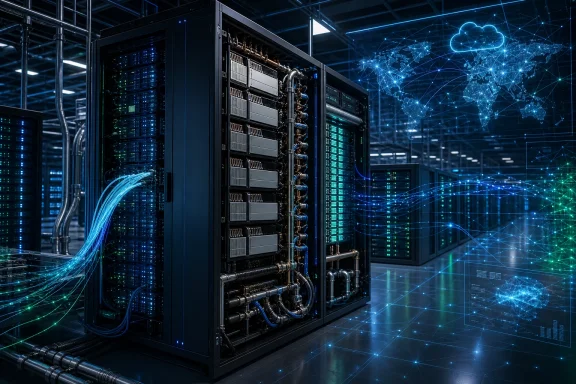 Overview
Microsoft and AMD announced the expanded partnership on July 20, 2026, ahead of AMD’s Advancing AI event. At its center is Microsoft’s commitment to deploy the AMD Helios Rackscale Solution at scale, although neither company disclosed the number of racks, the financial value of the arrangement, its power footprint, or a detailed regional rollout schedule.Helios will support frontier-model inference for Microsoft, Azure AI services, and customers purchasing AI capacity through Azure. Microsoft is also preparing three related Azure offerings: ND MI455X v7 virtual machines for production AI inference, HDv2 instances for AI data systems, and HXv2 instances for electronic design automation and high-performance computing.
More than a GPU supply agreement
Previous cloud accelerator announcements often focused on the availability of a particular GPU instance. This partnership is broader because AMD is supplying technology across the compute, networking, and software layers while Microsoft integrates that technology into Azure’s operating model.That distinction matters. Modern AI performance increasingly depends on the entire data path rather than an accelerator’s theoretical arithmetic throughput alone. CPUs must prepare and coordinate data, network interfaces must move model state efficiently, software must schedule distributed jobs, and cooling and power systems must sustain performance without destabilizing the rack.
A second-half deployment target
AMD says Helios-based systems will begin shipping to customers, including Microsoft, during the second half of 2026. That language describes the start of a ramp rather than immediate, universal Azure availability.Enterprises should therefore distinguish among three milestones:
- AMD and its manufacturing partners must ship production Helios systems.
- Microsoft must install, validate, secure, and integrate those systems into Azure regions.
- Azure must expose usable capacity through services or virtual-machine offerings with documented pricing and availability.
Background
AMD and Microsoft have worked together across Windows PCs, Xbox consoles, Azure servers, and high-performance computing for many years. In the cloud, Azure has progressively expanded its use of EPYC processors and Instinct accelerators, giving AMD an important route into enterprise workloads that were once dominated by Intel CPUs and, later, Nvidia GPUs.The relationship also reflects Microsoft’s preference for a heterogeneous infrastructure fleet. Azure uses processors from multiple external suppliers alongside Microsoft-designed silicon, allowing the company to match hardware to workload requirements and reduce dependence on any one vendor.
From EPYC servers to complete AI systems
AMD’s early data-center recovery centered on EPYC server processors. Successive Zen-based generations improved core density, memory bandwidth, performance per watt, and total cost of ownership, helping AMD re-establish itself as a credible alternative in enterprise and hyperscale computing.AI changed the scope of the challenge. Selling a strong CPU or accelerator was no longer sufficient once customers began deploying thousands of GPUs as coordinated systems. AMD needed to compete in interconnects, networking, software libraries, rack engineering, deployment tools, and serviceability.
Helios represents the culmination of that effort. It is AMD’s first comprehensive rack-scale AI reference design, intended to let cloud providers and system manufacturers deploy a coordinated AMD platform rather than assemble individual components around an accelerator.
Microsoft’s existing AMD foundation
Azure already operates AMD-based general-purpose, memory-intensive, HPC, and accelerated-computing instances. Microsoft and AMD have also collaborated on specialized infrastructure for electronic design automation, where high clock speeds, large caches, and memory performance can materially reduce chip-development time.This installed base lowers the integration barrier for Venice processors and MI455X accelerators. Microsoft already has operational experience with AMD firmware, telemetry, virtualization, security features, driver deployment, and data-center lifecycle management.
Helios still introduces substantial new complexity, especially at rack scale, but it does not arrive as an isolated experimental platform. Microsoft is extending an established AMD relationship into the most strategically important layer of cloud infrastructure.
Inside the Helios Rack
A full Helios design integrates 72 Instinct MI455X accelerators with EPYC Venice processors and AMD Pensando networking. The platform uses a double-wide Open Rack Wide format designed for the extreme power, cooling, and physical-density requirements of modern AI systems.AMD describes Helios as a reference architecture rather than a single finished appliance sold directly to every customer. OEMs and original-design manufacturers can build systems based on the blueprint, potentially creating a broader supplier ecosystem around compatible racks.
Instinct MI455X accelerators
The MI455X is based on AMD’s CDNA 5 architecture and is designed for both large-scale inference and training. AMD says each accelerator includes as much as 432GB of HBM4 memory and up to 19.6TB per second of memory bandwidth.Across 72 accelerators, a complete rack provides roughly 31TB of high-bandwidth memory. AMD also claims up to 2.9 exaFLOPS of FP4 performance and 1.4 exaFLOPS of FP8 performance, although these are vendor specifications and should not be treated as direct predictions of real application throughput.
Large memory capacity can be especially important for inference. It may allow more model weights, key-value cache data, and longer context windows to remain close to the accelerator, reducing the need to move data through slower layers of the system.
EPYC Venice host processors
The sixth-generation EPYC family, code-named Venice, uses AMD’s Zen 6 architecture. Within Helios, these CPUs coordinate accelerator workloads, prepare data, manage storage and network operations, and run the host-side software required to keep the GPU complex supplied with work.AMD’s published design information indicates that Venice can scale to 256 CPU cores with substantial memory bandwidth. Raw core counts are only one factor, however; scheduling efficiency, memory locality, I/O design, and communication between CPUs and accelerators will all influence system performance.
The decision to use AMD CPUs and GPUs together gives AMD an opportunity to optimize across both sides of the compute tray. It also gives Microsoft a more vertically coordinated alternative to systems combining components from several unrelated suppliers.
Pensando networking and DPUs
Helios incorporates Pensando Vulcano AI network interfaces for high-speed scale-out connectivity. The design also includes Pensando data processing units capable of offloading network, storage, security, and infrastructure-management tasks that would otherwise consume CPU resources.Microsoft separately plans to expand its deployment of Pensando DPUs in Azure services and integrate AMD technology with Azure Boost. Azure Boost moves selected networking and storage functions away from guest virtual machines and host CPUs, improving isolation and making more compute resources available to customer workloads.
The networking component may be as strategically significant as the GPUs. Distributed AI systems frequently lose performance when accelerators wait for data or synchronization, making congestion control, collective communications, and network telemetry central to usable throughput.
Why Microsoft Wants Helios
Microsoft is spending heavily to increase AI capacity, but demand is expanding across more categories than conventional model training. Reasoning models, autonomous agents, retrieval systems, reinforcement learning, data preparation, and continuous inference all create different hardware requirements.No single processor architecture is necessarily optimal for that entire pipeline. Microsoft’s answer is to build a varied fleet containing merchant silicon from several suppliers, custom Microsoft hardware, and workload-specific cloud instances.
Capacity and supply diversification
Adding Helios gives Microsoft another source of high-density accelerator capacity at a time when advanced GPUs, HBM memory, networking components, data-center power, and packaging remain strategically constrained resources. Even a technically excellent platform has limited value if a cloud operator cannot procure it in sufficient volume.A credible AMD alternative can improve Microsoft’s negotiating position and reduce the operational risk associated with excessive dependence on one accelerator supplier. It may also help Azure allocate scarce hardware more intelligently instead of placing every AI workload onto the same premium platform.
Diversification does not automatically produce lower costs. Supporting multiple architectures creates expenses in software engineering, qualification, maintenance, scheduling, and developer support. Microsoft is effectively betting that the benefits of capacity, specialization, and supplier competition will outweigh those costs.
Inference has become the central target
The announcement repeatedly emphasizes frontier-model inference rather than positioning Helios primarily as a training platform. That focus reflects the economics of generative AI, where a model may be trained periodically but served to users continuously.Reasoning and agentic systems can consume much more inference compute than simple prompt-and-response applications. They may generate internal reasoning steps, call tools, search databases, coordinate several models, and maintain larger context windows before producing an answer.
A rack with substantial memory capacity and high aggregate bandwidth could be valuable for those workloads. The real test will be whether Azure can convert the hardware into competitive tokens per second, latency, utilization, energy efficiency, and cost per completed task under production conditions.
Azure ND MI455X v7 for AI Inference
Microsoft plans to expose Helios through the upcoming ND MI455X v7 virtual-machine series. The offering is aimed at production-scale inference for reasoning, search, and agentic AI services.The ND branding places it within Azure’s accelerator-focused virtual-machine portfolio. Precise configurations, regional availability, general-availability dates, reservation options, and pricing had not been fully detailed at the time of the announcement.
A new option for Azure AI developers
The strategic benefit for customers is greater hardware choice without having to deploy and operate a Helios rack themselves. Azure can handle physical infrastructure, networking, failure recovery, security controls, capacity scheduling, and integration with higher-level AI services.That could make AMD acceleration accessible to organizations that lack the resources to build a ROCm cluster. It also creates a route for software vendors to test AMD compatibility using cloud capacity before considering dedicated deployments.
Customers should not assume that an application written for Nvidia CUDA will move to MI455X without engineering work. Framework-level compatibility has improved, but production systems often depend on custom kernels, optimized attention implementations, quantization tools, communication libraries, monitoring agents, and container images.
Managed compute could hide some complexity
Microsoft says AMD infrastructure will support enterprise AI workloads through Azure Foundry Managed Compute. Managed services can insulate customers from some hardware-specific details by selecting, provisioning, and operating the underlying capacity on their behalf.This approach could accelerate AMD adoption because many enterprises care more about service-level outcomes than accelerator brands. If an Azure service meets latency, quality, security, and cost requirements, customers may never need to interact directly with ROCm.
The trade-off is reduced transparency. Enterprises will need clear documentation about data residency, model portability, capacity guarantees, fallback behavior, and whether workloads can move between accelerator architectures without unexpected performance changes.
HDv2 Brings Venice to AI Data Systems
Not every AI bottleneck occurs on a GPU. Data preparation, indexing, search, reinforcement-learning environments, orchestration, and agent coordination can consume vast amounts of CPU capacity.Microsoft’s upcoming Azure HDv2 virtual machines are designed for that part of the stack. The company says a configuration will include nearly 500 physical sixth-generation EPYC cores, 4TB of RAM, 32TB of local NVMe storage, and 400Gb Azure Boost networking.
Feeding accelerators efficiently
Expensive accelerators generate poor returns when data pipelines cannot keep them busy. Before training or inference begins, information may need to be collected, filtered, tokenized, embedded, sorted, compressed, indexed, or transformed.HDv2 is intended to provide dense CPU infrastructure for those operations. Local NVMe storage could help with temporary datasets and intermediate results, while high-speed Azure Boost networking should improve movement between data-processing nodes and accelerator clusters.
The broader implication is that Microsoft and AMD are treating AI as an end-to-end data system. The GPU remains crucial, but the surrounding CPU and storage infrastructure increasingly determines whether organizations can use accelerator capacity efficiently.
Agent coordination at scale
Agentic systems may run many parallel processes involving planners, tools, databases, security policies, and external services. Those activities can require substantial CPU compute even when a language model supplies the central reasoning capability.HDv2 could become useful for hosting tool-execution environments, retrieval systems, workflow engines, simulation tasks, and reinforcement-learning pipelines. This makes the VM relevant to customers building complex AI services rather than simply training one large model.
Its nearly 500 physical cores also raise software-licensing and NUMA-awareness questions. Applications that scale poorly across sockets or charge per core may not benefit economically from the largest configurations, so Azure customers will need workload-specific testing.
HXv2 Targets Chip Design and HPC
Azure HXv2 is aimed at semiconductor design, engineering analysis, scientific simulation, and other technical workloads. It extends the HX family Microsoft and AMD introduced for memory-intensive and compute-sensitive applications.Microsoft says HXv2 will offer 176 sixth-generation EPYC cores running at more than 5GHz, 50 percent more addressable cache per core, configurations with approximately 2TB or 4TB of memory, and 800Gb InfiniBand connectivity.
Why electronic design automation matters
Electronic design automation workloads help engineers verify and optimize the processors that will power future AI systems. Tasks such as register-transfer-level simulation can depend heavily on single-thread performance, memory capacity, cache behavior, and predictable scaling.Cloud-based EDA allows semiconductor companies to expand capacity during peak design periods without permanently maintaining enough on-premises infrastructure for the maximum load. Faster simulations can also shorten verification cycles, potentially helping products reach manufacturing sooner.
There is a notable feedback loop in the partnership: AMD can use Azure’s AMD-powered HX infrastructure to help design future EPYC processors and Instinct accelerators. Microsoft then deploys those processors in later generations of Azure hardware.
Broader technical-computing potential
The 800Gb InfiniBand fabric should make HXv2 relevant to distributed-memory applications using the Message Passing Interface. Scientific simulations, computational fluid dynamics, structural analysis, and engineering models often depend on low-latency communication between nodes.Performance will still vary significantly by application. Clock frequency and core count do not guarantee linear scaling, particularly when software depends on memory access patterns, commercial licensing models, or proprietary compiler optimizations.
For Windows-focused engineering teams, Azure can provide a bridge between familiar Windows-based design workflows and Linux-heavy HPC back ends. Microsoft’s challenge will be to ensure that identity, storage, scheduling, remote visualization, and development tools work coherently across those environments.
ROCm Faces Its Biggest Cloud Test
Hardware specifications attract attention, but AMD’s software ecosystem will determine whether Helios becomes a broadly usable Azure platform. ROCm provides drivers, compilers, runtime components, communication libraries, development tools, and optimized AI libraries for Instinct accelerators.AMD has expanded support for major frameworks and inference engines, including PyTorch, TensorFlow, JAX, ONNX Runtime, vLLM, and Triton. The remaining challenge is not basic compatibility alone, but reliable performance across real applications and repeated software updates.
The CUDA comparison
Nvidia’s greatest advantage is the maturity and reach of CUDA. Years of developer adoption have produced a vast ecosystem of libraries, documentation, trained engineers, commercial tools, and applications optimized specifically for Nvidia hardware.ROCm does not need to reproduce every element of CUDA to succeed on Azure. It does need to support the models and frameworks that account for a large share of production demand, while offering predictable upgrades and effective debugging.
Microsoft can help close that gap by optimizing Azure services, model catalogs, containers, schedulers, and managed runtimes for AMD hardware. Its work on distributed communication technologies also gives it expertise in reducing overhead across large accelerator deployments.
Portability will be measured in practice
AMD presents openness as a defining Helios advantage. The rack uses open or industry-led standards including Open Rack Wide, Ultra Accelerator Link, and Ultra Ethernet, while ROCm itself follows a more open development model than CUDA.Yet open specifications do not automatically guarantee effortless portability. Customers can still become dependent on provider-specific VM types, deployment APIs, performance libraries, or managed services.
The useful measure of openness will be whether an enterprise can move a model among Azure’s AMD, Nvidia, Microsoft, and CPU infrastructure without rewriting critical portions of its application. Documentation, reproducible benchmarks, container support, and stable orchestration interfaces will matter more than branding.
Rack-Scale Engineering Changes the Competition
Helios demonstrates that the AI accelerator contest has moved beyond individual chips. Nvidia’s systems strategy combines GPUs, CPUs, high-speed links, networking, software, and rack engineering, forcing competitors to answer with similarly integrated platforms.AMD is now attempting to compete at that level. The company’s acquisition and integration of Pensando strengthened its networking portfolio, while its work with system manufacturers has expanded its ability to design and deliver full racks.
Power and cooling are product features
A 72-accelerator AI rack is also an electrical and thermal system. It cannot be installed like a conventional server without sufficient power distribution, liquid cooling, floor planning, monitoring, and facilities integration.Helios includes a centralized power shelf, vertical busbar, and cooling manifold with quick-disconnect connections. Its modular trays are intended to reduce recabling and shorten maintenance operations.
These features matter because a high-performance rack that is difficult to service can lose its economic advantage through downtime. At hyperscale, replacing a failed component safely and quickly becomes part of system performance.
Open Rack Wide changes the physical format
Helios uses a double-wide Open Rack Wide design rather than a traditional single-width enterprise rack. The wider format creates room for dense compute trays, networking, power hardware, and liquid-cooling infrastructure.Standardization could allow multiple manufacturers to produce compatible systems and components. It may also reduce the custom engineering required each time a hyperscaler deploys a new accelerator generation.
The format nevertheless presents adoption barriers outside hyperscale data centers. Many enterprise facilities were not designed for double-wide racks, direct liquid cooling, or the associated power density, making cloud consumption the more practical route for most organizations.
Competitive Implications
The Microsoft agreement gives AMD an important public reference customer for Helios. It follows other announced collaborations involving cloud operators, AI developers, infrastructure suppliers, and enterprise technology companies.For AMD, the victory is strategically valuable even without disclosed deployment numbers. Azure is a demanding environment, and successful production operation would demonstrate that Helios can satisfy hyperscale requirements for reliability, security, telemetry, automation, and serviceability.
Pressure on Nvidia
Nvidia remains the company AMD must displace or complement in most accelerated AI deployments. Its advantage spans silicon, systems, networking, software, developer loyalty, and a rapid product cadence.Helios does not need to replace Nvidia across Azure to influence the market. A credible second platform can introduce price competition, improve capacity availability, and encourage developers to avoid unnecessarily restrictive hardware dependencies.
Nvidia will respond through performance improvements, software expansion, system integration, and cloud partnerships of its own. Consequently, Microsoft’s AMD adoption should be viewed as an intensification of competition rather than evidence that the market has already become balanced.
Microsoft’s custom silicon remains part of the equation
Microsoft’s infrastructure strategy also includes its own processors and accelerators. Merchant silicon from AMD can coexist with Microsoft-designed hardware because the company serves a wide range of internal and external workloads.Custom chips can be optimized for Microsoft’s fleet economics, while AMD offers a broader ecosystem and externally supported platform. Nvidia supplies a mature developer environment, and CPUs continue to handle large portions of data processing and orchestration.
Azure’s competitive message is therefore choice combined with workload specialization. The operational challenge is preventing that diversity from turning into a confusing collection of incompatible services and capacity tiers.
Implications for Intel and other vendors
The Venice-powered HDv2 and HXv2 announcements add pressure to the server CPU market. AMD has used core density, cache technology, and workload-specific designs to win cloud deployments that historically would have defaulted to Intel Xeon.Intel remains a significant Azure supplier and is pursuing its own CPU, accelerator, foundry, and networking strategies. Other AI accelerator developers are also seeking cloud adoption, while hyperscalers increasingly build internal silicon.
The result is not a simple two-company contest. Azure is becoming a marketplace of compute architectures, and the winners will be determined by the combined economics of hardware, software, power, availability, and customer migration effort.
Impact on Enterprises and Windows Customers
Most WindowsForum readers will never administer a physical Helios rack, but the deployment could still influence the services they use. AI features in Microsoft 365, Dynamics 365, GitHub, security products, developer tools, and Windows-connected cloud services all depend on large data-center fleets.If AMD capacity improves Microsoft’s inference economics, the company could use that benefit to serve more requests, support larger models, introduce richer agentic functions, or reduce dependence on scarce premium accelerators. Whether any savings reach customers through lower prices is much less certain.
Enterprise infrastructure planning
Organizations adopting Azure AI should avoid treating accelerator selection as a one-time procurement choice. A better strategy is to define performance, latency, availability, security, and cost objectives, then evaluate which Azure architecture best meets them.Enterprises should prepare by:
- Using portable model formats and standard frameworks where practical.
- Separating application logic from hardware-specific optimization code.
- Benchmarking complete workflows instead of comparing theoretical FLOPS.
- Tracking data-transfer, storage, and managed-service charges alongside VM prices.
- Testing model quality after quantization or other architecture-specific optimization.
- Building observability that measures latency, throughput, failures, and cost per task.
Consumer consequences will be indirect
Consumers are unlikely to select an MI455X-powered instance directly. They may instead encounter Helios through faster Copilot responses, more capable AI search, improved coding assistance, or new background automation.Those outcomes are not guaranteed by the hardware announcement. Product quality also depends on model design, safety systems, application integration, network latency, and Microsoft’s decisions about capacity allocation.
Still, an expanded accelerator supply can remove one constraint on AI product development. If Helios performs well, AMD hardware may quietly power services used by millions of Windows PCs without users needing to know which accelerator produced a response.
Strengths and Opportunities
The partnership combines AMD’s emerging rack-scale platform with Microsoft’s ability to deploy infrastructure globally and package it as enterprise cloud services. Its strongest opportunities arise from coordination across the full stack rather than any single specification.Where the agreement could deliver value
- Microsoft gains another frontier-class AI platform. This can improve supply resilience and reduce the strategic risk of relying too heavily on one accelerator ecosystem.
- AMD gains a major hyperscale validation point. A successful Azure deployment would give prospective customers evidence that Helios can operate under demanding production conditions.
- Azure customers gain greater workload choice. ND MI455X v7, HDv2, and HXv2 address inference, data systems, chip design, and technical computing instead of forcing them onto a generic architecture.
- Large HBM4 capacity may benefit memory-intensive inference. More on-package memory can help accommodate large models, longer contexts, and larger inference batches.
- Pensando broadens AMD’s role in the data center. Networking and DPU deployments allow AMD to participate in infrastructure spending beyond CPUs and GPUs.
- ROCm receives a powerful distribution channel. Azure integration can make AMD software accessible to developers who would not build or operate dedicated Instinct clusters.
- Open rack and interconnect standards may expand supplier choice. If the ecosystem matures, operators could avoid dependence on a single proprietary rack implementation.
- Competition could improve AI economics. Even partial success for Helios may encourage better pricing, faster innovation, and more transparent performance comparisons across the market.
Risks and Concerns
The announcement sets ambitious expectations, but Helios has not yet proved itself through broad, long-running Azure production deployment. The absence of financial and volume details also makes it difficult to determine how large Microsoft’s initial commitment really is.Execution risks that matter
- The deployment schedule could slip. Advanced accelerators depend on cutting-edge fabrication, packaging, HBM4 supply, networking hardware, liquid-cooling components, and system-level validation.
- Vendor specifications may not translate into application performance. FP4 and FP8 peak throughput cannot predict latency, tokens per second, utilization, or cost across diverse production models.
- ROCm still faces ecosystem gaps. Unsupported libraries, custom CUDA kernels, inconsistent documentation, or delayed framework updates could slow customer migration.
- Multi-architecture operations increase complexity. Microsoft must maintain drivers, firmware, security updates, schedulers, diagnostics, and support processes across several accelerator families.
- Rack power requirements may constrain availability. Suitable data-center halls need adequate electrical delivery, cooling capacity, network fabric, and physical space.
- Open standards may fragment during early adoption. Different manufacturers could interpret reference designs or management interfaces in ways that complicate interoperability.
- Capacity may initially favor Microsoft’s internal services. Azure customers could face limited quotas or regional shortages even after Helios systems begin arriving.
- Pricing remains unknown. A technically competitive VM will not necessarily offer better economics once reservations, networking, storage, software, and managed-service charges are included.
- Security must work across the entire platform. Hardware roots of trust and attestation are useful, but firmware, management controllers, drivers, orchestration systems, and supply chains all expand the attack surface.
What to Watch Next
The next phase will reveal whether the Helios announcement represents a limited strategic deployment or a major change in Azure’s accelerator mix. Shipment timing, service availability, independent benchmarks, and customer adoption will provide more meaningful evidence than headline specifications.Key milestones for the second half of 2026
First, AMD must confirm that production Helios systems are shipping on schedule. Observers should watch for announcements from manufacturing partners, evidence of volume deployment, and clarity about HBM4 and advanced-packaging availability.Second, Microsoft needs to publish detailed specifications for ND MI455X v7, including the number of accelerators per virtual machine, local and distributed memory topology, network configuration, supported operating systems, software images, and availability zones.
Third, Azure pricing will determine whether Helios offers a genuine economic alternative. Useful comparisons should examine cost per million tokens, cost per completed agent task, latency under load, energy efficiency, and sustained availability rather than hourly VM rates alone.
Independent testing will be essential
Performance claims should eventually be tested across representative models, context lengths, batch sizes, precision formats, and networking configurations. Benchmarks created solely by a vendor can identify potential, but they rarely capture every production bottleneck.Particular attention should be paid to:
- Time to first token and inter-token latency for interactive inference.
- Throughput under continuous multi-user workloads.
- Performance of mixture-of-experts and long-context models.
- Scale-up efficiency across the 72 accelerators in one rack.
- Scale-out efficiency across multiple Helios racks.
- ROCm stability during framework and driver upgrades.
- Failure recovery when an accelerator, tray, switch, or cooling component requires service.
- Migration effort for existing CUDA-dependent applications.
Broader availability beyond Azure
AMD describes Helios as an open reference design, so its long-term impact depends partly on adoption by additional clouds, OEMs, sovereign AI operators, and research institutions. A broad ecosystem could support better software optimization and reduce the risk that Helios becomes tailored to a few hyperscale customers.Conversely, if each operator modifies the design extensively, fragmentation could weaken the benefits of standardization. AMD will need to balance customer customization with a sufficiently consistent platform for developers and system suppliers.
The Azure deployment will therefore serve as both a customer win and a public test. Success could establish Helios as a durable alternative architecture; delays or uneven software support would reinforce doubts about AMD’s ability to compete at full rack scale.
Looking Ahead
Microsoft’s adoption of AMD Helios reflects a larger transformation in cloud computing: infrastructure is being designed around complete AI pipelines rather than interchangeable servers. Accelerators, CPUs, memory, networking, software, power, and cooling now function as one product, and cloud providers increasingly differentiate themselves by how effectively they combine those layers.For AMD, the opportunity is unusually large. The company has already demonstrated that it can disrupt the server CPU market, but AI requires it to prove that ROCm, Pensando networking, Instinct accelerators, EPYC processors, and its manufacturing ecosystem can operate as a coordinated platform.
For Microsoft, Helios is both a capacity investment and a strategic hedge. Azure can use AMD to supplement other suppliers, match hardware more closely to workloads, and potentially improve the economics of inference-heavy services.
The decisive evidence will arrive after the racks do. If Microsoft can make ND MI455X v7 widely available, deliver reliable ROCm-based services, and show competitive production economics, the agreement could become a turning point in the AI infrastructure market. If availability remains narrow or software migration proves difficult, Helios may remain an important but secondary option.
Either way, the announcement confirms that AMD is no longer asking customers to judge it only chip against chip. With Helios entering Azure in the second half of 2026, the contest has moved to the rack, the network, the software platform, and ultimately the cost of delivering useful AI at global scale.
References
- Primary source: finance.biggo.com
Published: 2026-07-22T07:15:55+00:00
AMD to Deploy Integrated AI Rack 'Helios' on Azure, Expanding Strategic Partnership with Microsoft — BigGo Finance
AMD and Microsoft announced on July 20 a major expansion of their strategic partnership for AI infrastructure on the Azure cloud platform. The…finance.biggo.com - Independent coverage: Express Computer
Published: 2026-07-21T00:00:00+00:00
- Related coverage: itpro.com
AMD adds Microsoft to its growing roster of Helios customers as firm launches three new VMs for Azure users | IT Pro
Microsoft has announced it will deploy AMD’s Helios rack-scale solution as it targets data processing and AI inference gains for Azure customers.www.itpro.com - Related coverage: amd.com
Microsoft to Deploy Next-Gen AMD Instinct and AMD EPYC Processors as the Companies Expand Their Long-Term Strategic Partnership - AMD Newsroom
AMD Newsroom — official press releases, product announcements, executive briefings, and media resources from Advanced Micro Devices.www.amd.com - Related coverage: tomshardware.com
Microsoft will deploy AMD’s Helios rack-scale AI accelerator ‘at scale’ on Azure – Radeon Instinct MI455X and Epyc Venice power will be available through Redmond’s cloud infrastructure | Tom's Hardware
But it’s not clear just how much AMD AI compute Microsoft is buyingwww.tomshardware.com - Related coverage: semiconductor.samsung.com
Samsung and AMD Expand Strategic Collaboration on Next-Generation AI Memory Solutions | Samsung Semiconductor Global
Samsung Electronics Co., Ltd. today announced it has signed a Memorandum of Understanding (MOU) with AMD to expand their strategic collaboration on next-generation AI memory and computing technologies.semiconductor.samsung.com