

Microsoft is preparing one of Azure’s most consequential infrastructure expansions yet, committing to deploy AMD’s next-generation Helios rack-scale AI platform alongside new EPYC-powered virtual machines and an expanded fleet of Pensando data processing units. The agreement reaches far beyond a conventional processor purchase: AMD will supply accelerators, server CPUs, networking technology and the ROCm software foundation for systems intended to run frontier-model inference, Azure AI services and enterprise workloads. With initial Helios shipments scheduled for the second half of 2026, the partnership gives Microsoft another route to massive AI capacity while establishing AMD as a more credible full-stack alternative to Nvidia in the hyperscale data center.
Microsoft and AMD have worked together across several generations of cloud infrastructure, Windows PCs, game consoles and high-performance computing systems. In Azure, AMD EPYC processors evolved from an alternative CPU option into an important part of Microsoft’s general-purpose, memory-intensive and HPC virtual-machine portfolios.
The new agreement represents a much broader stage of that relationship. Rather than integrating an AMD processor into an otherwise Microsoft-designed server, Azure is adopting an AMD-led rack architecture in which the GPU, CPU, network adapters, DPUs, interconnects, cooling design and software stack have been engineered as a coordinated system.
AI changes the scale of the relationship. Microsoft is no longer looking only for faster host processors; it needs complete systems capable of connecting tens of thousands of accelerators without wasting power, memory bandwidth or network capacity.
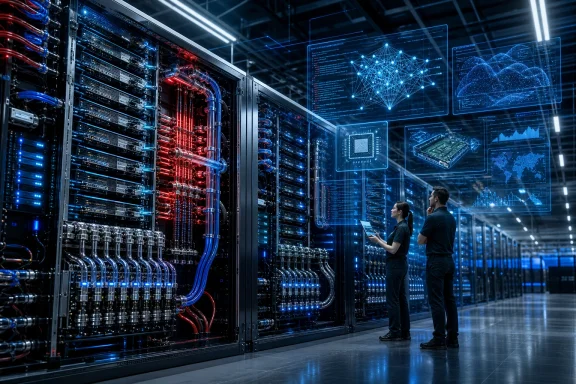
Rack-scale engineering treats the entire rack as one computing unit. Power distribution, liquid cooling, scale-up links, scale-out networking, host processors and software orchestration must work together, making system design almost as important as the specifications of an individual GPU.
Microsoft plans to expose this technology through Azure’s upcoming ND MI455X v7 virtual-machine offering. It will use the infrastructure internally for frontier AI models and Azure AI services while also making capacity available to external customers.
Shipment, deployment and broad customer availability are also different milestones. Even after hardware reaches an Azure facility, Microsoft must install the racks, connect power and cooling, qualify the software stack, validate reliability and integrate capacity into its regional cloud-control systems.
AMD says a complete rack can deliver up to 2.9 exaflops of FP4 performance and 1.4 exaflops at FP8. These lower-precision formats are increasingly important for AI inference and training, although real-world throughput will depend on model architecture, sparsity, software optimization, batch size and service-level requirements.
Memory capacity matters because larger models, longer context windows and high-concurrency inference services consume substantial space. More HBM can reduce the need to divide a model into inefficient fragments or repeatedly transfer data through slower tiers of the system.
AMD lists memory bandwidth of up to 19.6TB per second for each MI455X. That bandwidth is especially relevant for inference, where generating tokens often becomes constrained by how quickly model weights can be read rather than by the accelerator’s maximum arithmetic rate.
Scale-out networking connects one rack to other racks. Helios uses Pensando technology for this layer, with the reference design specifying up to 43TB per second of aggregate scale-out bandwidth and 800Gbps connectivity on individual AI network interfaces.
This two-level structure addresses different traffic patterns. Scale-up links prioritize tightly coupled GPU communication, while scale-out networks must move data across a larger cluster without allowing congestion, packet loss or latency spikes to disrupt distributed workloads.
The rack uses a double-wide Open Rack Wide form factor rather than the dimensions associated with conventional enterprise servers. That choice gives designers more room for accelerator trays, power systems, cooling hardware and high-density cabling, but it also requires compatible data-center space.
Modularity may prove just as important as benchmark performance. Hyperscalers cannot afford to take an entire rack offline every time a component fails, so Helios is designed to support rapid sled replacement and maintenance with minimal recabling.
Training a frontier model is extraordinarily expensive, but it occurs periodically. Inference runs every time a user submits a prompt, an agent performs a task, a business application summarizes a document or a developer calls an AI service.
The challenge becomes balancing several variables:
That workflow multiplies infrastructure consumption. It also increases demand for CPU-based search, coordination, data preparation and policy enforcement around the GPU inference stage.
Microsoft’s broader deployment therefore makes architectural sense. The company is introducing accelerator-heavy ND MI455X v7 systems while simultaneously adding CPU-focused HDv2 capacity for the surrounding data systems and agent-coordination workloads.
Those specifications position HDv2 as a high-density platform for feeding and coordinating AI systems. It could handle data preparation, indexing, search, retrieval, reinforcement-learning pipelines and fleets of agents that need substantial general-purpose processing.
A poorly balanced cluster can leave expensive accelerators idle while host systems struggle to supply data. Microsoft’s HDv2 design attempts to reduce that mismatch by combining hundreds of high-performance CPU cores with large memory and fast local storage.
A large HDv2 instance could consolidate many of these supporting services close to the AI infrastructure. However, customers will still need careful scheduling and observability because an agent that enters a repetitive or poorly constrained workflow can consume CPU, storage and network resources rapidly.
These stages frequently involve large CPU and memory workloads. The combination of nearly 500 physical cores, 4TB of RAM and local NVMe storage could make HDv2 valuable for organizations building high-volume retrieval pipelines or large search systems alongside Azure-hosted models.
Unlike HDv2, which emphasizes density and data processing, HXv2 focuses on workloads sensitive to single-thread performance, cache capacity, memory access and tightly coupled communication between nodes.
Microsoft says HXv2 will continue using AMD’s 3D V-Cache technology, with 50 percent more addressable cache per core than the preceding HX generation. Larger caches can reduce trips to main memory and improve performance in workloads whose active data sets fit into or benefit from the additional cache.
The partnership contains a notable feedback loop: AMD can use Azure HX infrastructure to help design future AMD processors, while Microsoft uses those processors to expand Azure. This kind of co-development gives both companies direct insight into the bottlenecks experienced by engineering customers.
These customers care less about marketing claims around AI tokens and more about predictable scaling across nodes. Azure will need to demonstrate that HXv2 can maintain low communication latency and consistent performance when hundreds or thousands of CPU cores participate in the same job.
Microsoft is expanding its use of AMD Pensando DPUs and integrating AMD technology with Azure Boost. The goal is to move cloud-infrastructure functions onto specialized hardware, leaving more CPU capacity available to customer workloads.
This offload has several potential benefits:
This is strategically significant for AMD. GPUs generate the headlines, but DPUs and network adapters help the company occupy more of the data-center bill of materials and make its platform harder to evaluate as a collection of interchangeable chips.
ROCm is AMD’s answer to that requirement. Its quality on MI455X will influence whether Azure customers view Helios as a genuine production option or merely as emergency capacity when other accelerators are unavailable.
AMD does not need every CUDA workload to move unchanged, but it must minimize friction in common AI workflows. Framework support, optimized attention kernels, distributed communication libraries and model-serving platforms must work reliably from the first day Azure exposes MI455X capacity.
Small incompatibilities become expensive at cloud scale. A missing operator or unstable kernel can delay deployment, force engineers to maintain hardware-specific code paths or prevent a model from reaching expected throughput.
The more Microsoft can standardize the environment, the less customers need to care about the underlying accelerator. This could help AMD adoption, but it also means Microsoft—not AMD alone—will control much of the user experience.
A model that runs on several accelerator families may still require device-specific tuning to achieve acceptable cost per token. Enterprises should therefore distinguish between functional portability and performance portability when evaluating Azure’s new AMD instances.
The immediate competitive consequence is increased leverage. A hyperscaler with credible alternatives can negotiate pricing, allocate workloads more flexibly and reduce exposure to shortages affecting one product line.
Microsoft’s commitment gives the architecture credibility because Azure operates at a scale few customers can match. If Microsoft can deploy Helios reliably and expose it through standardized cloud services, other enterprises may become more comfortable adopting AMD-powered AI infrastructure.
The competitive argument is not simply that MI455X can calculate quickly. AMD must show that Helios can deliver comparable application throughput, uptime and operational efficiency while providing greater choice or better economics.
Comparisons based only on FP4 or FP8 peak performance will be inadequate. Cloud customers ultimately pay for useful output, making metrics such as cost per million tokens, time to first token, tokens per watt and service availability more meaningful.
The market is moving toward diversified fleets rather than a single universal processor. Each cloud will attempt to route workloads to the architecture that best balances cost, availability and performance, while presenting customers with a manageable software layer above that complexity.
Azure underpins services across Microsoft’s commercial and consumer ecosystem. Additional inference capacity could support Copilot experiences, developer tools, security analysis, enterprise agents and model APIs, although Microsoft has not assigned specific products to Helios.
Potential use cases include:
Users may instead notice indirect changes: shorter waits during peak demand, faster generation, longer context support or new features that would have been too expensive to operate previously. These outcomes remain possibilities rather than guarantees because application design and service policies also shape the user experience.
A sensible migration process would involve:
Microsoft’s pricing will then determine whether the platform changes customer behavior. If MI455X instances provide compelling cost per token but carry limited availability or restrictive commitments, adoption may remain concentrated among large AI customers.
The number of racks will also reveal how strongly Microsoft believes in AMD’s platform. A limited qualification cluster would carry a different strategic meaning from a multi-region deployment measured in thousands of accelerators or hundreds of megawatts.
Important measurements will include:
Azure’s managed layers may hide much of this complexity. Even so, organizations running custom models or low-level optimization will judge the platform by how quickly they can move from an existing environment to MI455X without rewriting critical software.
That is one promise of standardized rack-scale infrastructure. If power, cooling, networking and management interfaces remain consistent across generations, Microsoft may be able to deploy future AMD accelerators faster and with less engineering effort.
Microsoft’s Helios commitment is therefore more than another Azure VM announcement: it is a vote for a diversified, rack-scale and increasingly open AI infrastructure market. AMD now has an opportunity to prove that it can compete at the level where GPUs, CPUs, networking, cooling and software become one production system, while Microsoft gains another tool for controlling the cost and availability of its rapidly growing AI services. The decisive test will arrive after the first racks are installed, when ambitious specifications must translate into reliable capacity, competitive pricing and useful performance for the businesses and users who depend on Azure.
 Background
Microsoft and AMD have worked together across several generations of cloud infrastructure, Windows PCs, game consoles and high-performance computing systems. In Azure, AMD EPYC processors evolved from an alternative CPU option into an important part of Microsoft’s general-purpose, memory-intensive and HPC virtual-machine portfolios.The new agreement represents a much broader stage of that relationship. Rather than integrating an AMD processor into an otherwise Microsoft-designed server, Azure is adopting an AMD-led rack architecture in which the GPU, CPU, network adapters, DPUs, interconnects, cooling design and software stack have been engineered as a coordinated system.
From component supplier to infrastructure partner
AMD’s data-center resurgence began with EPYC, which challenged Intel by offering high core counts, substantial memory bandwidth and competitive efficiency. Microsoft became an important EPYC customer, deploying AMD-powered Azure instances for applications ranging from ordinary enterprise computing to demanding scientific simulations.AI changes the scale of the relationship. Microsoft is no longer looking only for faster host processors; it needs complete systems capable of connecting tens of thousands of accelerators without wasting power, memory bandwidth or network capacity.
The rise of rack-scale computing
Traditional servers could be evaluated largely as self-contained machines. Modern AI clusters cannot, because their useful performance depends on how efficiently hundreds or thousands of accelerators exchange model parameters, intermediate results and inference requests.Rack-scale engineering treats the entire rack as one computing unit. Power distribution, liquid cooling, scale-up links, scale-out networking, host processors and software orchestration must work together, making system design almost as important as the specifications of an individual GPU.
What Microsoft Is Deploying
At the center of the announcement is AMD Helios, a rack-scale reference design built around 72 Instinct MI455X accelerators. The design also incorporates sixth-generation EPYC processors, code-named Venice, as well as Pensando networking and the ROCm software ecosystem.Microsoft plans to expose this technology through Azure’s upcoming ND MI455X v7 virtual-machine offering. It will use the infrastructure internally for frontier AI models and Azure AI services while also making capacity available to external customers.
The Helios hardware stack
A full Helios rack combines several AMD technology families:- Seventy-two Instinct MI455X accelerators provide the primary AI compute capacity.
- Sixth-generation EPYC Venice CPUs coordinate workloads, prepare data and host supporting services.
- Pensando Vulcano network adapters handle high-bandwidth AI traffic between systems.
- Pensando Salina DPUs offload networking, storage and security tasks from host processors.
- ROCm supplies the programming environment, libraries and framework integrations required to use the hardware.
- Open rack, interconnect and networking standards provide a path for multiple manufacturing and infrastructure partners.
A second-half 2026 timetable
AMD says Helios systems will begin shipping to customers, including Microsoft, during the second half of 2026. That schedule leaves little room for execution problems because cloud providers are racing to bring each new generation of accelerators into production as quickly as possible.Shipment, deployment and broad customer availability are also different milestones. Even after hardware reaches an Azure facility, Microsoft must install the racks, connect power and cooling, qualify the software stack, validate reliability and integrate capacity into its regional cloud-control systems.
Inside the Helios Rack-Scale Architecture
Helios is designed around the idea that AI performance increasingly depends on data movement rather than arithmetic alone. A processor may offer enormous theoretical throughput, but that capability has little value if model data cannot reach its compute engines quickly enough or if accelerators spend too much time waiting for one another.AMD says a complete rack can deliver up to 2.9 exaflops of FP4 performance and 1.4 exaflops at FP8. These lower-precision formats are increasingly important for AI inference and training, although real-world throughput will depend on model architecture, sparsity, software optimization, batch size and service-level requirements.
MI455X and HBM4 memory
Each Instinct MI455X is based on AMD’s CDNA 5 architecture and includes up to 432GB of HBM4 memory. Across 72 accelerators, a Helios rack provides approximately 31TB of high-bandwidth memory, an unusually large shared pool of accelerator-local capacity.Memory capacity matters because larger models, longer context windows and high-concurrency inference services consume substantial space. More HBM can reduce the need to divide a model into inefficient fragments or repeatedly transfer data through slower tiers of the system.
AMD lists memory bandwidth of up to 19.6TB per second for each MI455X. That bandwidth is especially relevant for inference, where generating tokens often becomes constrained by how quickly model weights can be read rather than by the accelerator’s maximum arithmetic rate.
Scale-up and scale-out networking
Within the rack, Helios uses UALink-over-Ethernet to connect its 72 GPUs, with AMD claiming as much as 260TB per second of aggregate scale-up bandwidth. Scale-up networking allows accelerators participating in one job to communicate as though they were elements of a larger coordinated machine.Scale-out networking connects one rack to other racks. Helios uses Pensando technology for this layer, with the reference design specifying up to 43TB per second of aggregate scale-out bandwidth and 800Gbps connectivity on individual AI network interfaces.
This two-level structure addresses different traffic patterns. Scale-up links prioritize tightly coupled GPU communication, while scale-out networks must move data across a larger cluster without allowing congestion, packet loss or latency spikes to disrupt distributed workloads.
Power, cooling and serviceability
A 72-GPU AI rack consumes and dissipates extraordinary amounts of energy. Helios therefore includes centralized power distribution through a vertical busbar and a liquid-cooling manifold connected to its compute and switching trays.The rack uses a double-wide Open Rack Wide form factor rather than the dimensions associated with conventional enterprise servers. That choice gives designers more room for accelerator trays, power systems, cooling hardware and high-density cabling, but it also requires compatible data-center space.
Modularity may prove just as important as benchmark performance. Hyperscalers cannot afford to take an entire rack offline every time a component fails, so Helios is designed to support rapid sled replacement and maintenance with minimal recabling.
Why Azure Is Prioritizing AI Inference
Microsoft describes the Helios deployment primarily in terms of frontier-model inference, even though AMD designed the platform for both training and inference. That emphasis reflects how the economics of generative AI are changing.Training a frontier model is extraordinarily expensive, but it occurs periodically. Inference runs every time a user submits a prompt, an agent performs a task, a business application summarizes a document or a developer calls an AI service.
Inference becomes the persistent expense
As AI adoption grows, serving models can become a larger and more predictable source of infrastructure demand than training them. A popular assistant may process millions of requests continuously, producing recurring costs for compute, networking, memory and electricity.The challenge becomes balancing several variables:
- Latency must remain low enough for interactive applications.
- Throughput must be high enough to serve many users simultaneously.
- Memory must accommodate large models and expanding context windows.
- Utilization must remain high enough to justify expensive infrastructure.
- Power consumption must stay within the limits of each data-center region.
Reasoning and agentic workloads
An ordinary chatbot might make one model request and return one answer. An AI agent may plan a task, perform a search, call a business application, inspect the result, revise its strategy and repeat the cycle several times.That workflow multiplies infrastructure consumption. It also increases demand for CPU-based search, coordination, data preparation and policy enforcement around the GPU inference stage.
Microsoft’s broader deployment therefore makes architectural sense. The company is introducing accelerator-heavy ND MI455X v7 systems while simultaneously adding CPU-focused HDv2 capacity for the surrounding data systems and agent-coordination workloads.
Azure HDv2 Targets the Data Pipeline
The new Azure HDv2 virtual machines will use sixth-generation AMD EPYC Venice processors and are designed for AI data systems rather than GPU acceleration alone. Microsoft says the instances will include nearly 500 physical CPU cores, 4TB of RAM, 32TB of local NVMe storage and 400Gbps Azure Boost networking.Those specifications position HDv2 as a high-density platform for feeding and coordinating AI systems. It could handle data preparation, indexing, search, retrieval, reinforcement-learning pipelines and fleets of agents that need substantial general-purpose processing.
Why CPUs remain essential to AI
The public AI conversation often treats the GPU as the entire system. In practice, accelerators depend on CPUs to prepare data, run databases, schedule jobs, manage storage, execute application logic and coordinate communication.A poorly balanced cluster can leave expensive accelerators idle while host systems struggle to supply data. Microsoft’s HDv2 design attempts to reduce that mismatch by combining hundreds of high-performance CPU cores with large memory and fast local storage.
Agent coordination at scale
Agentic AI may place unusual pressure on cloud CPUs. Agents can perform many small, branching operations that are not necessarily suitable for a GPU, including parsing documents, executing code, querying databases, applying security policies and managing state.A large HDv2 instance could consolidate many of these supporting services close to the AI infrastructure. However, customers will still need careful scheduling and observability because an agent that enters a repetitive or poorly constrained workflow can consume CPU, storage and network resources rapidly.
Data preparation and retrieval
Retrieval-augmented generation relies on more than the language model. Documents must be extracted, cleaned, segmented, embedded, indexed and retrieved, often under strict access-control rules.These stages frequently involve large CPU and memory workloads. The combination of nearly 500 physical cores, 4TB of RAM and local NVMe storage could make HDv2 valuable for organizations building high-volume retrieval pipelines or large search systems alongside Azure-hosted models.
Azure HXv2 Expands High-Performance Computing
Azure’s second new Venice-based series, HXv2, targets electronic design automation, scientific simulation and engineering analysis. Microsoft plans configurations with 176 EPYC cores, clock frequencies above 5GHz, nearly 2TB or 4TB of RAM and 800Gbps InfiniBand.Unlike HDv2, which emphasizes density and data processing, HXv2 focuses on workloads sensitive to single-thread performance, cache capacity, memory access and tightly coupled communication between nodes.
Electronic design automation
Chip design remains one of the most computationally demanding commercial workloads. Register-transfer-level simulation, physical verification and other EDA processes may involve enormous code bases, highly irregular execution and large working data sets.Microsoft says HXv2 will continue using AMD’s 3D V-Cache technology, with 50 percent more addressable cache per core than the preceding HX generation. Larger caches can reduce trips to main memory and improve performance in workloads whose active data sets fit into or benefit from the additional cache.
The partnership contains a notable feedback loop: AMD can use Azure HX infrastructure to help design future AMD processors, while Microsoft uses those processors to expand Azure. This kind of co-development gives both companies direct insight into the bottlenecks experienced by engineering customers.
Scientific and engineering simulations
HXv2 is not limited to semiconductor companies. Its 800Gbps InfiniBand support and large memory configurations should suit distributed-memory applications based on the Message Passing Interface, including fluid dynamics, weather modeling, structural analysis and other simulations.These customers care less about marketing claims around AI tokens and more about predictable scaling across nodes. Azure will need to demonstrate that HXv2 can maintain low communication latency and consistent performance when hundreds or thousands of CPU cores participate in the same job.
Pensando and Azure Boost Move Into the Spotlight
Networking has become one of the defining constraints of cloud infrastructure. As servers become faster, the cost of moving, filtering, encrypting and routing data can consume an increasing share of host CPU resources.Microsoft is expanding its use of AMD Pensando DPUs and integrating AMD technology with Azure Boost. The goal is to move cloud-infrastructure functions onto specialized hardware, leaving more CPU capacity available to customer workloads.
What a DPU does
A data processing unit is a programmable processor optimized for infrastructure services. It can handle networking, storage virtualization, encryption, security enforcement, telemetry and other tasks that would otherwise run on the server’s main CPU.This offload has several potential benefits:
- Customers receive a larger and more consistent share of the advertised CPU capacity.
- Network and storage functions can run with more predictable latency.
- Cloud isolation can be enforced outside the customer’s operating-system environment.
- Infrastructure services can evolve without consuming additional host cores.
- Telemetry and policy enforcement can operate closer to the network interface.
Azure Boost as a fleet-wide layer
Azure Boost represents Microsoft’s effort to accelerate networking and storage across its cloud fleet using dedicated hardware and software. Integrating Pensando more deeply into that architecture could make AMD technology relevant well beyond the Helios racks themselves.This is strategically significant for AMD. GPUs generate the headlines, but DPUs and network adapters help the company occupy more of the data-center bill of materials and make its platform harder to evaluate as a collection of interchangeable chips.
ROCm Faces Its Largest Azure Test
Hardware availability does not automatically create a viable AI platform. Developers need compilers, kernels, libraries, model-serving tools, monitoring systems and stable integrations with frameworks such as PyTorch, JAX and TensorFlow.ROCm is AMD’s answer to that requirement. Its quality on MI455X will influence whether Azure customers view Helios as a genuine production option or merely as emergency capacity when other accelerators are unavailable.
The CUDA compatibility challenge
Nvidia’s advantage extends far beyond GPU performance. CUDA has accumulated years of libraries, documentation, developer experience and application support, creating a powerful default platform for accelerated computing.AMD does not need every CUDA workload to move unchanged, but it must minimize friction in common AI workflows. Framework support, optimized attention kernels, distributed communication libraries and model-serving platforms must work reliably from the first day Azure exposes MI455X capacity.
Small incompatibilities become expensive at cloud scale. A missing operator or unstable kernel can delay deployment, force engineers to maintain hardware-specific code paths or prevent a model from reaching expected throughput.
Azure can conceal some complexity
Microsoft has an opportunity to reduce this software burden through managed services. Azure Foundry Managed Compute and other platform layers can package models, runtime images and orchestration tools so customers do not have to configure ROCm manually.The more Microsoft can standardize the environment, the less customers need to care about the underlying accelerator. This could help AMD adoption, but it also means Microsoft—not AMD alone—will control much of the user experience.
Portability versus optimization
ROCm’s support for open frameworks and industry standards may appeal to customers concerned about vendor lock-in. Yet portability and maximum performance are not always the same objective.A model that runs on several accelerator families may still require device-specific tuning to achieve acceptable cost per token. Enterprises should therefore distinguish between functional portability and performance portability when evaluating Azure’s new AMD instances.
Competitive Pressure on Nvidia and Other Cloud Platforms
Microsoft already operates a heterogeneous AI fleet that includes Nvidia accelerators and its own Maia silicon. Adding Helios at scale does not signal that Azure is abandoning either path; it shows that Microsoft does not want its AI expansion tied to one supplier.The immediate competitive consequence is increased leverage. A hyperscaler with credible alternatives can negotiate pricing, allocate workloads more flexibly and reduce exposure to shortages affecting one product line.
AMD’s rack-scale turning point
AMD has competed successfully in server CPUs, but the AI market requires it to prove that it can deliver entire production systems. Helios is therefore a test of manufacturing coordination, software maturity, network performance, cooling design and field service—not just MI455X silicon.Microsoft’s commitment gives the architecture credibility because Azure operates at a scale few customers can match. If Microsoft can deploy Helios reliably and expose it through standardized cloud services, other enterprises may become more comfortable adopting AMD-powered AI infrastructure.
Nvidia remains the benchmark
Nvidia’s rack-scale platforms combine GPUs, CPUs, NVLink fabrics, networking and a mature software ecosystem. AMD is challenging that integrated approach with a design built around open rack standards, UALink and Ethernet-oriented networking.The competitive argument is not simply that MI455X can calculate quickly. AMD must show that Helios can deliver comparable application throughput, uptime and operational efficiency while providing greater choice or better economics.
Comparisons based only on FP4 or FP8 peak performance will be inadequate. Cloud customers ultimately pay for useful output, making metrics such as cost per million tokens, time to first token, tokens per watt and service availability more meaningful.
Implications for AWS, Google Cloud and Oracle
Microsoft’s move puts pressure on every major cloud provider to offer broader accelerator choice. Oracle has already worked closely with AMD on large AI deployments, while AWS and Google continue developing their own specialized silicon alongside third-party accelerators.The market is moving toward diversified fleets rather than a single universal processor. Each cloud will attempt to route workloads to the architecture that best balances cost, availability and performance, while presenting customers with a manageable software layer above that complexity.
Enterprise and Consumer Impact
Most Windows users will never interact directly with an MI455X accelerator. Nevertheless, the deployment could affect the availability, responsiveness and cost of AI features delivered through Microsoft products.Azure underpins services across Microsoft’s commercial and consumer ecosystem. Additional inference capacity could support Copilot experiences, developer tools, security analysis, enterprise agents and model APIs, although Microsoft has not assigned specific products to Helios.
What enterprises may gain
Enterprise customers could benefit from another high-capacity option for deploying production AI. More accelerator diversity may improve availability in constrained regions and give customers greater negotiating flexibility.Potential use cases include:
- Businesses can serve private or customized language models through Azure-managed infrastructure.
- Developers can build retrieval and agentic systems combining HDv2 data processing with MI455X inference.
- Engineering organizations can use HXv2 for semiconductor, simulation and technical-computing workloads.
- Regulated customers may gain additional deployment choices as Azure expands AMD capacity across regions.
- Large customers may compare AMD and Nvidia instances using their own models rather than synthetic benchmarks.
What Windows and Copilot users may notice
Consumers are unlikely to see an “AMD Helios” label inside Copilot or Windows. Cloud services generally abstract the hardware, and Microsoft can move requests among different accelerator pools.Users may instead notice indirect changes: shorter waits during peak demand, faster generation, longer context support or new features that would have been too expensive to operate previously. These outcomes remain possibilities rather than guarantees because application design and service policies also shape the user experience.
Implications for developers
Azure developers may eventually be able to choose ND MI455X v7 instances directly or consume services running on them through managed endpoints. Direct users will need to understand ROCm containers, supported model formats, distributed-inference tools and any differences from existing CUDA deployments.A sensible migration process would involve:
- Confirming that the required framework, model operators and serving software support MI455X.
- Testing numerical behavior and output quality under the intended precision format.
- Benchmarking representative prompts, context lengths and concurrency levels.
- Measuring total cost per completed request rather than accelerator price alone.
- Validating monitoring, failure recovery and multi-region deployment before production use.
Strengths and Opportunities
The Microsoft-AMD agreement creates opportunities for both companies and for customers seeking alternatives in a capacity-constrained market.- Azure gains supply diversity. Microsoft can expand AI capacity without depending entirely on one accelerator manufacturer or one proprietary rack architecture.
- AMD gains hyperscale validation. A large Azure deployment demonstrates that Helios is intended for production use rather than remaining a technology showcase.
- Customers gain more infrastructure choice. Enterprises can compare accelerator families based on cost, availability, memory capacity and workload fit.
- Inference may benefit from abundant HBM4. The rack’s roughly 31TB of high-bandwidth memory could support large models, long contexts and high concurrency.
- Open standards may broaden the ecosystem. OCP Open Rack Wide, UALink and Ethernet-based networking could allow more system and component suppliers to participate.
- The CPU and GPU offerings complement each other. HDv2 can support data pipelines and agents, while ND MI455X v7 handles accelerated inference.
- HXv2 strengthens Azure HPC. High-frequency Venice cores, 3D V-Cache, large memory and InfiniBand target customers who need technical computing rather than generative AI alone.
- Pensando expands AMD’s role in Azure. Networking and infrastructure offload give AMD a presence beyond the headline accelerator deployment.
Risks and Concerns
The announcement also leaves important questions unanswered. Neither company disclosed the number of racks, total accelerator count, financial value, power allocation or regional deployment plan.- “At scale” remains undefined. Without a rack count or megawatt commitment, the eventual size of Microsoft’s purchase is uncertain.
- The deployment schedule could slip. New GPUs, CPUs, HBM4, network components and liquid-cooled racks must all reach production readiness together.
- ROCm must perform reliably in production. Hardware gains could be undermined by missing optimizations, unstable software or limited support for popular tools.
- Real-world performance may differ from peak specifications. Exaflop figures do not account for model efficiency, communication overhead or service latency.
- Power availability may limit expansion. AI data centers increasingly face grid, cooling and construction constraints that cannot be solved by faster silicon alone.
- Open standards can introduce integration complexity. Multiple suppliers provide flexibility, but coordination and qualification may be harder than with a vertically controlled platform.
- Customer access may lag internal deployment. Microsoft could prioritize its own AI services before making substantial MI455X capacity broadly available.
- Fragmented hardware can increase software overhead. Azure must support Nvidia, AMD and Microsoft accelerators without forcing customers to maintain numerous incompatible environments.
What to Watch Next
The first meaningful milestone will be confirmation that AMD begins volume Helios shipments during the second half of 2026. Initial hardware delivery will need to be followed by evidence of operational Azure clusters and a clear availability schedule for ND MI455X v7 instances.Microsoft’s pricing will then determine whether the platform changes customer behavior. If MI455X instances provide compelling cost per token but carry limited availability or restrictive commitments, adoption may remain concentrated among large AI customers.
Deployment scale and regional coverage
Microsoft should eventually disclose which Azure regions will receive the new systems and whether access will be offered through on-demand instances, reservations, managed services or private capacity agreements. Geographic distribution matters to customers with latency, data-residency and disaster-recovery requirements.The number of racks will also reveal how strongly Microsoft believes in AMD’s platform. A limited qualification cluster would carry a different strategic meaning from a multi-region deployment measured in thousands of accelerators or hundreds of megawatts.
Independent workload benchmarks
The most useful comparisons will involve production models rather than vendor-selected peak numbers. Evaluators should look for tests covering mixture-of-experts routing, long-context inference, reasoning workloads, retrieval systems and high-concurrency serving.Important measurements will include:
- Time to first token under realistic load.
- Sustained tokens per second per user.
- Aggregate throughput at target latency.
- Energy consumption per completed request.
- Performance across different model sizes and precision formats.
- Failure recovery and scaling efficiency across multiple racks.
ROCm’s day-one readiness
AMD promises support for major frameworks and serving environments, but production customers will want evidence. Day-one compatibility must include optimized kernels, stable containers, distributed communication, telemetry, debugging and predictable upgrade procedures.Azure’s managed layers may hide much of this complexity. Even so, organizations running custom models or low-level optimization will judge the platform by how quickly they can move from an existing environment to MI455X without rewriting critical software.
The broader AMD roadmap
Helios is not an endpoint. AMD has already discussed future Instinct generations, meaning the architecture must support a continuing annual or near-annual cadence without forcing Azure to redesign its facilities each time.That is one promise of standardized rack-scale infrastructure. If power, cooling, networking and management interfaces remain consistent across generations, Microsoft may be able to deploy future AMD accelerators faster and with less engineering effort.
Microsoft’s Helios commitment is therefore more than another Azure VM announcement: it is a vote for a diversified, rack-scale and increasingly open AI infrastructure market. AMD now has an opportunity to prove that it can compete at the level where GPUs, CPUs, networking, cooling and software become one production system, while Microsoft gains another tool for controlling the cost and availability of its rapidly growing AI services. The decisive test will arrive after the first racks are installed, when ambitious specifications must translate into reliable capacity, competitive pricing and useful performance for the businesses and users who depend on Azure.
References
- Primary source: Express Computer
Published: 2026-07-21T13:08:39+00:00
Loading…
www.expresscomputer.in - Related coverage: amd.com
Microsoft to Deploy Next-Gen AMD Instinct and AMD EPYC Processors as the Companies Expand Their Long-Term Strategic Partnership - AMD Newsroom
AMD Newsroom — official press releases, product announcements, executive briefings, and media resources from Advanced Micro Devices.www.amd.com - Official source: blogs.microsoft.com
Microsoft expands Azure AI and HPC infrastructure with AMD - The Official Microsoft Blog
AI workloads are scaling faster than any single infrastructure approach can support — with more models, new agent-driven workloads and surging compute demand driving the need for greater specialization across the stack. To meet this need, Microsoft continues to evolve Azure’s infrastructure...blogs.microsoft.com - Related coverage: tomshardware.com
Microsoft will deploy AMD’s Helios rack-scale AI accelerator ‘at scale’ on Azure – Radeon Instinct MI455X and Epyc Venice power will be available through Redmond’s cloud infrastructure | Tom's Hardware
But it’s not clear just how much AMD AI compute Microsoft is buyingwww.tomshardware.com - Related coverage: hwbusters.com
Loading…
hwbusters.com - Related coverage: computerbase.de
Loading…
www.computerbase.de