

AMD’s Instinct MI350P is showing up in Dell, HPE and Computex server demonstrations because it tackles a neglected corner of the AI market: deployments that need modern high-bandwidth memory but cannot adopt a purpose-built, rack-scale accelerator platform. The 600W PCIe 5.0 x16 card combines 144GB of HBM3E with AMD’s CDNA 4 architecture in a standard full-height, full-length dual-slot form factor—an unusually dense configuration for an air-cooled PCIe accelerator.
ServeTheHome, which recently tracked the card through Dell Technologies World, HPE Discover and Computex 2026, argues that the repeated appearances point to a practical market need rather than a mere booth-tour campaign. AMD is effectively taking the technology behind its Instinct MI350X OAM accelerator and packaging roughly half of it for conventional servers.
For organizations building on Windows Server hosts, that distinction matters even if the MI350P itself is not a Windows product. AMD’s current product page lists Linux x86-64 as the supported operating system. The card belongs in Linux-based AI inference stacks using ROCm, PyTorch, TensorFlow, vLLM-class serving software and related tooling—not in a Windows workstation, a Hyper-V host expected to run native GPU workloads, or a desktop AI box.
The MI350P’s headline specification is straightforward: 144GB of HBM3E memory and 4TB/s of peak memory bandwidth. Its less obvious advantage is that it delivers that memory capacity through a PCIe add-in card rather than through the OAM modules and specialized platforms associated with AMD’s larger Instinct systems.
That puts it in a different class from the PCIe accelerators many administrators know. NVIDIA’s RTX Pro 6000 Blackwell Server Edition, for example, uses 96GB of GDDR7. It brings Blackwell-generation features and RT cores that can be useful for mixed graphics and AI jobs, but its memory design represents a different set of trade-offs. For inference deployments where model weights, context windows, batch size, and KV cache all compete for local memory, 144GB of HBM3E on one card is the central attraction.
The practical benefit is not that every organization suddenly needs a 144GB GPU. It is that some models and workloads that would otherwise require model sharding, aggressive quantization, or multi-node design can potentially fit inside one accelerator’s memory envelope. That can reduce software complexity and avoid turning PCIe traffic into the limiting factor for a job designed around a single model instance.
AMD’s CDNA 4 architecture also targets the low-precision formats now central to inference economics. ServeTheHome highlights the MI350P’s published FP4 and MXFP6 figures, with MXFP6 occupying the useful middle ground between FP8 and FP4. Lower-precision inference can allow more model data to fit in the same physical memory, provided the model, framework, quantization method, and accuracy requirements all support it.
That proviso is important. Peak format-specific throughput is not a deployment result. The quality of kernels, model support, host CPUs, storage, networking, batching strategy, and ROCm software maturity will determine whether a real service approaches vendor performance figures.
That design explains the nearly proportional specification split. The MI350P has 128 compute units, 512 matrix cores, 144GB of HBM3E and 4TB/s of bandwidth; the larger MI350X has twice those compute and memory resources. The PCIe card’s 600W maximum typical board power is higher than workstation administrators may be accustomed to, but dramatically more deployable than the 1,000W-class MI350X OAM platform.
AMD also offers a configurable 450W mode. That option will matter in mixed-density racks and older server designs where an available PCIe slot does not automatically mean the chassis can provide 600W of board power and sufficient front-to-back airflow.
The phrase drop-in upgrade should therefore be treated cautiously. Physically, the MI350P follows PCIe CEM conventions and uses a passive cooler. Electrically and thermally, it is still a 600W data-center component with a 12V-2x6 external power connector. A server needs an appropriately rated power supply, a board and riser arrangement that support the card, and enough chassis airflow to cool a passive heatsink at sustained load.
In a well-designed AI server, those requirements are manageable. In a repurposed virtualization host or a general-purpose 2U machine, they may be the entire project.
AMD does not expose GPU-to-GPU Infinity Fabric links on the MI350P. Multiple cards communicate over PCIe Gen5 x16 rather than over the high-bandwidth fabric used in AMD’s OAM accelerator systems. That makes the product a better fit for many independent inference workloads than for a single enormous model distributed tightly across several accelerators.
An eight-card MI350P server can offer a substantial aggregate 1.15TB of HBM3E capacity, but it should not be mistaken for an eight-accelerator MI350X platform. The aggregate memory figure does not become one uniform, low-latency memory pool. Software must still divide work and move data across PCIe when a workload spans devices.
The card’s partitioning feature offers another deployment angle. AMD supports up to four partitions on the MI350P, corresponding to its four accelerator complex dies; ServeTheHome describes a one-die configuration as 36GB of memory. That can be useful where a platform team wants to allocate isolated accelerator slices to several smaller services rather than dedicate the entire board to one tenant.
Administrators should still validate the isolation model, scheduler support, observability, and failure behavior in their chosen software stack. Partitioning a GPU is not the same as making capacity appear from nowhere. It is a way to turn a large accelerator into more manageable allocation units.
That separation is increasingly common. A Windows-heavy organization can place model-serving nodes on a Linux distribution validated for ROCm, expose an internal endpoint, and let Windows applications, .NET services, and user devices consume the resulting service over the network. The operating-system boundary is normal; the real question is whether the organization has the Linux GPU operations experience to maintain drivers, containers, framework versions, monitoring, capacity controls, and security updates.
AMD lists ROCm support along with OpenMP, OpenCL and HIP APIs, plus framework support for PyTorch, TensorFlow, JAX, ONYX-RT and SGLang. Those entries establish the intended ecosystem, but they are not a substitute for checking exact version compatibility before a purchase order is issued. AI stacks move quickly, and accelerator support often depends on a narrow intersection of ROCm release, kernel version, container image, framework build, and model runtime.
Still, trade-show visibility should not be confused with a published, universal server SKU list or immediate volume availability. ServeTheHome disclosed that Dell and HPE sponsored its travel for the events, while AMD provided access to systems; the outlet’s technical observations remain useful, but buyers should seek written platform validation and support commitments from their preferred OEM.
The MI350P’s real test will come after the booths are dismantled: whether it appears in broadly orderable servers with predictable lead times, mature ROCm images, and benchmarks that reflect actual inference services rather than isolated peak-format claims. If that happens, AMD will have created a credible route to HBM-backed AI inference for organizations that want more than a workstation GPU but less than a specialized AI rack.
ServeTheHome, which recently tracked the card through Dell Technologies World, HPE Discover and Computex 2026, argues that the repeated appearances point to a practical market need rather than a mere booth-tour campaign. AMD is effectively taking the technology behind its Instinct MI350X OAM accelerator and packaging roughly half of it for conventional servers.
For organizations building on Windows Server hosts, that distinction matters even if the MI350P itself is not a Windows product. AMD’s current product page lists Linux x86-64 as the supported operating system. The card belongs in Linux-based AI inference stacks using ROCm, PyTorch, TensorFlow, vLLM-class serving software and related tooling—not in a Windows workstation, a Hyper-V host expected to run native GPU workloads, or a desktop AI box.
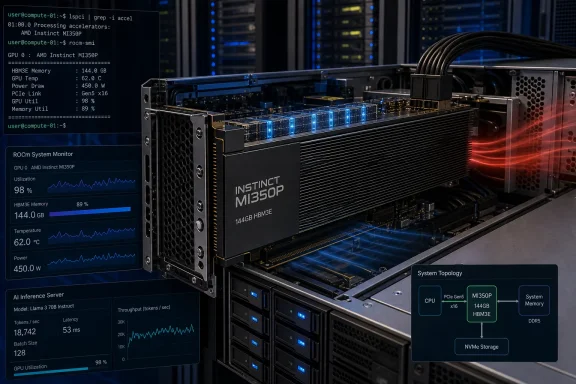 A PCIe Card With HBM Changes the Deployment Conversation
The MI350P’s headline specification is straightforward: 144GB of HBM3E memory and 4TB/s of peak memory bandwidth. Its less obvious advantage is that it delivers that memory capacity through a PCIe add-in card rather than through the OAM modules and specialized platforms associated with AMD’s larger Instinct systems.That puts it in a different class from the PCIe accelerators many administrators know. NVIDIA’s RTX Pro 6000 Blackwell Server Edition, for example, uses 96GB of GDDR7. It brings Blackwell-generation features and RT cores that can be useful for mixed graphics and AI jobs, but its memory design represents a different set of trade-offs. For inference deployments where model weights, context windows, batch size, and KV cache all compete for local memory, 144GB of HBM3E on one card is the central attraction.
The practical benefit is not that every organization suddenly needs a 144GB GPU. It is that some models and workloads that would otherwise require model sharding, aggressive quantization, or multi-node design can potentially fit inside one accelerator’s memory envelope. That can reduce software complexity and avoid turning PCIe traffic into the limiting factor for a job designed around a single model instance.
AMD’s CDNA 4 architecture also targets the low-precision formats now central to inference economics. ServeTheHome highlights the MI350P’s published FP4 and MXFP6 figures, with MXFP6 occupying the useful middle ground between FP8 and FP4. Lower-precision inference can allow more model data to fit in the same physical memory, provided the model, framework, quantization method, and accuracy requirements all support it.
That proviso is important. Peak format-specific throughput is not a deployment result. The quality of kernels, model support, host CPUs, storage, networking, batching strategy, and ROCm software maturity will determine whether a real service approaches vendor performance figures.
AMD Built a Smaller MI350 Instead of a Cut-Down Salvage Part
The MI350P is not simply a partially functional MI350X repurposed into a lower tier. AMD told ServeTheHome that it uses a purpose-built configuration with one I/O die and four accelerator complex dies, rather than the MI350X’s two I/O dies and eight accelerator complex dies.That design explains the nearly proportional specification split. The MI350P has 128 compute units, 512 matrix cores, 144GB of HBM3E and 4TB/s of bandwidth; the larger MI350X has twice those compute and memory resources. The PCIe card’s 600W maximum typical board power is higher than workstation administrators may be accustomed to, but dramatically more deployable than the 1,000W-class MI350X OAM platform.
AMD also offers a configurable 450W mode. That option will matter in mixed-density racks and older server designs where an available PCIe slot does not automatically mean the chassis can provide 600W of board power and sufficient front-to-back airflow.
The phrase drop-in upgrade should therefore be treated cautiously. Physically, the MI350P follows PCIe CEM conventions and uses a passive cooler. Electrically and thermally, it is still a 600W data-center component with a 12V-2x6 external power connector. A server needs an appropriately rated power supply, a board and riser arrangement that support the card, and enough chassis airflow to cool a passive heatsink at sustained load.
In a well-designed AI server, those requirements are manageable. In a repurposed virtualization host or a general-purpose 2U machine, they may be the entire project.
The Missing Infinity Fabric Link Defines Its Limits
The most consequential compromise is not compute throughput. It is interconnect.AMD does not expose GPU-to-GPU Infinity Fabric links on the MI350P. Multiple cards communicate over PCIe Gen5 x16 rather than over the high-bandwidth fabric used in AMD’s OAM accelerator systems. That makes the product a better fit for many independent inference workloads than for a single enormous model distributed tightly across several accelerators.
An eight-card MI350P server can offer a substantial aggregate 1.15TB of HBM3E capacity, but it should not be mistaken for an eight-accelerator MI350X platform. The aggregate memory figure does not become one uniform, low-latency memory pool. Software must still divide work and move data across PCIe when a workload spans devices.
The card’s partitioning feature offers another deployment angle. AMD supports up to four partitions on the MI350P, corresponding to its four accelerator complex dies; ServeTheHome describes a one-die configuration as 36GB of memory. That can be useful where a platform team wants to allocate isolated accelerator slices to several smaller services rather than dedicate the entire board to one tenant.
Administrators should still validate the isolation model, scheduler support, observability, and failure behavior in their chosen software stack. Partitioning a GPU is not the same as making capacity appear from nowhere. It is a way to turn a large accelerator into more manageable allocation units.
The Windows Angle Is Mostly About Infrastructure, Not Native Acceleration
For Windows-focused IT teams, the MI350P is relevant primarily as a data-center architecture decision. A company may retain Active Directory, Windows Server file services, Microsoft SQL Server workloads, Power BI gateways, and Windows management tooling while operating its inference servers on Linux beside them. The accelerator’s role is to serve an API endpoint or an internal AI platform, not to power a Windows desktop application.That separation is increasingly common. A Windows-heavy organization can place model-serving nodes on a Linux distribution validated for ROCm, expose an internal endpoint, and let Windows applications, .NET services, and user devices consume the resulting service over the network. The operating-system boundary is normal; the real question is whether the organization has the Linux GPU operations experience to maintain drivers, containers, framework versions, monitoring, capacity controls, and security updates.
AMD lists ROCm support along with OpenMP, OpenCL and HIP APIs, plus framework support for PyTorch, TensorFlow, JAX, ONYX-RT and SGLang. Those entries establish the intended ecosystem, but they are not a substitute for checking exact version compatibility before a purchase order is issued. AI stacks move quickly, and accelerator support often depends on a narrow intersection of ROCm release, kernel version, container image, framework build, and model runtime.
Visibility Is Not Yet Proof of Broad Availability
The MI350P’s presence across high-profile industry events gives buyers more confidence that OEM conversations are underway. Dell and HPE displaying the hardware matters because large-scale deployment depends on qualified server designs, power and cooling validation, support contracts, and supply—not just a GPU data sheet.Still, trade-show visibility should not be confused with a published, universal server SKU list or immediate volume availability. ServeTheHome disclosed that Dell and HPE sponsored its travel for the events, while AMD provided access to systems; the outlet’s technical observations remain useful, but buyers should seek written platform validation and support commitments from their preferred OEM.
The MI350P’s real test will come after the booths are dismantled: whether it appears in broadly orderable servers with predictable lead times, mature ROCm images, and benchmarks that reflect actual inference services rather than isolated peak-format claims. If that happens, AMD will have created a credible route to HBM-backed AI inference for organizations that want more than a workstation GPU but less than a specialized AI rack.
References
- Primary source: ServeTheHome
Published: 2026-07-17T17:00:59+00:00
The AMD Instinct MI350P is a HBM PCIe AI Accelerator That Has Been All Over - ServeTheHome
We have been seeing the AMD Instinct MI350P 144GB HBM3E PCIe accelerator everywhere over the past few weeks as this appears to be a popular GPUwww.servethehome.com
- Related coverage: amd.com
AMD Instinct™ MI350P PCIe® Cards
Deploy and scale generative and agentic AI within your existing infrastructure using AMD Instinct™ MI350P PCIe® cards – designed for high performance, leadership cost, an open, enterprise-ready AI stack, and simple deployment.www.amd.com - Related coverage: noise.getoto.net
- Related coverage: tomshardware.com
AMD announces MI350P PCIe AI accelerator card with 144GB of HBM3E — roughly 40% faster in FP16 and FP8 theoretical compute compared to Nvidia's H200 NVL competitor | Tom's Hardware
AMD now has the fastest AI accelerator card on the market that fits in a traditional PCIe slot.www.tomshardware.com