

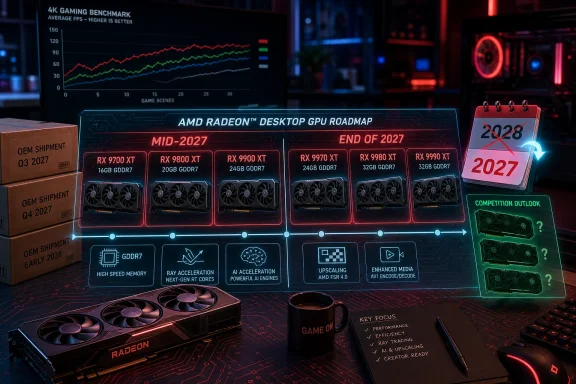
AMD’s next-generation RDNA 5 desktop graphics cards could reach OEMs in mid-2027 and launch before the end of that year, according to a new Moore’s Law Is Dead leak reported by Notebookcheck, reversing recent chatter that Radeon’s next big gaming GPU wave might slip into 2028. That is not a product announcement, and it should not be treated like one. But it is the first genuinely encouraging signal PC gamers have had in months from a graphics market that has begun to feel less like a cadence and more like a holding pattern.
The importance of the rumor is not merely that AMD might ship earlier. It is that AMD might have a reason to move first. If Nvidia’s RTX 50 Super refresh remains delayed, uncertain, or awkwardly timed, RDNA 5 could become more than the next Radeon generation; it could become AMD’s best chance in years to define the conversation before GeForce sets the terms again.
The consumer GPU market has spent the past several years training buyers not to trust calendars. Launch windows stretch, refreshes drift, and “next generation” increasingly means whatever silicon vendors can justify amid AI demand, memory pricing, wafer allocation, and console roadmaps. Against that backdrop, a mid-2027 RDNA 5 shipment target matters because it suggests AMD may be trying to turn uncertainty into leverage.
The leak, as described, says an OEM source was told it could receive first shipments of desktop RDNA 5 in mid-2027. That is not the same thing as retail shelves full of Radeon cards. OEM shipments can precede public availability by months, and early board movement can coexist with a constrained or staggered launch.
Still, the timing is meaningful. Recent reporting from Computex suggested board partners were bracing for RDNA 5 in late 2027 or even early 2028, with Nvidia’s next major GeForce generation also drifting toward a longer cycle. If AMD can move from “maybe 2028” to “shipping to OEMs in mid-2027,” the company gets something it rarely enjoys in desktop graphics: narrative initiative.
That initiative is especially valuable because RDNA 4 left AMD in a strange but defensible place. The Radeon RX 9000 series improved the value argument and gave AMD cleaner competition in mainstream and upper-midrange segments, but it did not fundamentally threaten Nvidia’s halo position. RDNA 5, if it lands early enough, could be the architecture that asks whether AMD still wants to contest the high end — or whether the company has decided the real fight is owning the profitable middle before Nvidia’s next wave arrives.
That model is now colliding with a market in which gaming graphics cards are no longer the center of the semiconductor universe. GDDR7 supply, AI accelerator demand, advanced packaging constraints, and the sheer profitability of data-center silicon all affect what consumer buyers see on shelves. The result is a GPU market where the absence of a product can be as revealing as the launch of one.
The rumored DRAM shortage is central to the current anxiety. Modern GPUs are increasingly defined not only by shader counts and clocks, but by memory capacity, bandwidth, bus width, and the cost of attaching enough VRAM to satisfy games, creators, and AI-adjacent workloads. If memory pricing is volatile, a refresh designed around larger VRAM configurations becomes harder to price cleanly.
That helps explain why Nvidia’s rumored RTX 50 Super refresh has become such a moving target. A Super lineup typically makes sense when Nvidia wants to defend a price stack, respond to competition, or clean up awkward launch configurations. But if AMD is not pressing hard at the top and memory is expensive, Nvidia has less incentive to spend precious supply on slightly improved gaming cards.
AMD faces the same market physics, but with a different strategic problem. Nvidia can afford to wait because GeForce remains the default premium brand. AMD cannot win by being merely present. It needs moments where buyers believe Radeon is not just cheaper, but earlier, more generous, or more practical.
That strategy can be rational. The halo segment is expensive, loud, and unforgiving. It demands huge dies, aggressive power targets, mature drivers, developer relations, upscaling credibility, ray tracing progress, and enough inventory to avoid turning a flagship into a paper tiger. Winning the $500-to-$800 range can be better business than losing money chasing the top benchmark chart.
But the high end has symbolic power. Enthusiasts do not merely buy flagships; they use them to judge architecture. If RDNA 5 arrives with only midrange confidence, AMD may sell cards but fail to shift perception. If it arrives with a credible high-end or upper-high-end board, the story changes.
That is why the reported Xbox connection matters. If the next Xbox platform uses RDNA 5-derived graphics silicon, AMD has an architectural incentive to align console, desktop, and possibly cloud gaming development around the same graphics foundation. A console win does not automatically translate into a killer desktop GPU, but it can give AMD volume, developer familiarity, and a long software runway.
The rumored “standard RDNA 5 GPU die” overlap between Xbox Helix and a desktop Radeon board should be treated carefully. Console silicon is customized, and desktop boards live under different thermal, memory, and pricing constraints. But the larger point is plausible: if AMD has to make RDNA 5 ready for a late-2027 console-class product, desktop Radeon may not be waiting until 2028 unless market conditions force it.
That makes the reported 2027 Xbox Helix timing important even for PC gamers who never plan to buy a console. If AMD is supporting Microsoft’s next-generation hardware on a 2027 schedule, RDNA 5 cannot be a purely abstract architecture living on a distant roadmap. It has to be real enough for partners, developers, and platform planning.
This does not guarantee desktop Radeon cards in the same window. AMD can prioritize semi-custom contracts over add-in board availability, and console silicon can ship on a schedule that desktop GPUs do not share. But the overlap weakens the argument that RDNA 5 is inherently a 2028 story.
It also hints at why AMD might care about being first. A new Xbox platform built around AMD graphics would put RDNA 5 ideas in the hands of developers for the better part of a decade. If desktop Radeon launches near that same window, AMD can tell a cleaner cross-platform story: the same rendering priorities, the same upscaling direction, the same ray tracing improvements, and the same developer-facing architecture shaping both console and PC.
That story would matter most if AMD can pair it with software maturity. Nvidia’s advantage has not been just silicon; it has been the ecosystem around the silicon. DLSS, Reflex, ray reconstruction, creator acceleration, CUDA gravity, and game-by-game optimization have built a moat that raw rasterization wins cannot easily cross. RDNA 5 needs to narrow that gap, not merely increase frame rates.
That changes the psychological market. If Nvidia launches RTX 50 Super cards in late 2026 or early 2027, AMD’s RDNA 5 has to answer a refreshed Blackwell stack. If Nvidia skips or delays that refresh, AMD may be competing against aging RTX 50 cards when it launches RDNA 5. If RTX 60 slips into 2028, AMD gets an unusually clean shot at buyers who have been waiting for something meaningfully new.
The danger for AMD is that Nvidia can still dominate without moving first. A mature GeForce lineup with stable drivers, strong software, broad OEM relationships, and entrenched brand loyalty is not easy to dislodge. Many gamers will wait for Nvidia even when AMD has a better value card on the shelf.
But waiting becomes harder when the calendar stretches. A gamer sitting on an RTX 30-series, RX 6000-series, or older card may tolerate one postponed launch. Two postponements begin to look like neglect. If RDNA 5 arrives with enough VRAM, better ray tracing, credible upscaling, and sane pricing, AMD does not need every Nvidia loyalist to switch; it only needs enough of them to stop waiting.
This is where first-mover advantage becomes real. It is not about winning a press release race. It is about occupying build guides, OEM configurations, holiday shopping lists, and developer test benches before the rival architecture appears.
A mid-2027 shipment rumor could point to review samples and OEM desktops first, with retail cards arriving later. It could also point to limited initial SKUs, with the most attractive models trailing behind. AMD may launch the architecture before the whole stack is ready, especially if it wants to claim timing against Nvidia.
The other reason for caution is that next-gen does not automatically mean transformative. RDNA 5 will be judged against real games, real drivers, real power draw, and real prices. If it arrives early but underdelivers in ray tracing, upscaling quality, or availability, the launch window will not save it.
For buyers, the practical advice remains boring because boring advice is often correct. Buy when your current system no longer does what you need, when the card you want is available near its intended price, and when independent reviews confirm performance in the games and workloads you actually use. Rumors are useful for avoiding obvious buyer’s remorse, not for suspending your entire upgrade life.
AMD’s strongest contribution in recent years has often been pressure. More VRAM at a given price point, aggressive bundles, open upscaling technologies, and strong raster performance have forced comparison even when Nvidia retained the performance crown. That pressure matters because it makes the default option work harder.
RDNA 5 could sharpen that pressure if AMD treats it as more than a routine architecture update. The PC market needs Radeon cards that are not merely good “for the money,” but good enough to make a GeForce buyer hesitate. That means competitive ray tracing, meaningful AI-assisted rendering improvements, better media and creator support, and driver confidence at launch.
It also means AMD needs to avoid turning availability into a self-inflicted wound. A great Radeon card that ships in tiny numbers at inflated prices becomes internet folklore, not market competition. If AMD wants 2027 to be its opening, it has to align silicon, board partners, software, and pricing more tightly than it has in some past launches.
The irony is that AMD does not need to beat Nvidia everywhere to change the market. It needs to beat Nvidia somewhere visible, at a time when Nvidia is not ready with a clean answer. The rumored RDNA 5 window is interesting because it might provide exactly that.
That makes the RTX 50 Super rumor relevant even if those cards never appear. Much of the alleged appeal of a Super refresh is simple: more memory in more places. If Nvidia is constrained by GDDR7 pricing or supply, the refresh becomes harder to execute. If AMD can launch RDNA 5 with attractive VRAM configurations, it can attack a visible weakness.
AMD has historically been willing to use memory capacity as a marketing weapon. That does not always translate into better performance, but it resonates because buyers understand it. A Radeon card with more VRAM at the same price is easier to explain than a nuanced debate about AI reconstruction quality.
Still, VRAM alone will not be enough in 2027. The next generation of GPUs will be judged by how well they balance memory, rendering features, latency, power efficiency, and software. A card that looks generous on a spec sheet can still lose if its upscaling is worse, its ray tracing cost is higher, or its drivers stumble in major releases.
AMD’s opportunity is to make the memory argument part of a broader trust argument. Give buyers enough VRAM, avoid absurd power draw, improve ray tracing, make FSR feel less like a fallback, and ship in volume. That combination would be more threatening to Nvidia than any single benchmark win.
That would be a rare reversal. Nvidia usually dictates the premium GPU conversation while AMD reacts with value, timing, or selective performance wins. An early RDNA 5 launch would not erase that pattern, but it would at least give AMD a chance to speak first.
For PC gamers exhausted by price spikes, VRAM anxiety, and endless rumor churn, that is why the report lands as good news. Not because RDNA 5 is guaranteed to be great. Not because 2027 is suddenly a lock. But because the market badly needs the possibility of movement.
The importance of the rumor is not merely that AMD might ship earlier. It is that AMD might have a reason to move first. If Nvidia’s RTX 50 Super refresh remains delayed, uncertain, or awkwardly timed, RDNA 5 could become more than the next Radeon generation; it could become AMD’s best chance in years to define the conversation before GeForce sets the terms again.
 AMD May Have Found the One Window Nvidia Cannot Easily Close
The consumer GPU market has spent the past several years training buyers not to trust calendars. Launch windows stretch, refreshes drift, and “next generation” increasingly means whatever silicon vendors can justify amid AI demand, memory pricing, wafer allocation, and console roadmaps. Against that backdrop, a mid-2027 RDNA 5 shipment target matters because it suggests AMD may be trying to turn uncertainty into leverage.The leak, as described, says an OEM source was told it could receive first shipments of desktop RDNA 5 in mid-2027. That is not the same thing as retail shelves full of Radeon cards. OEM shipments can precede public availability by months, and early board movement can coexist with a constrained or staggered launch.
Still, the timing is meaningful. Recent reporting from Computex suggested board partners were bracing for RDNA 5 in late 2027 or even early 2028, with Nvidia’s next major GeForce generation also drifting toward a longer cycle. If AMD can move from “maybe 2028” to “shipping to OEMs in mid-2027,” the company gets something it rarely enjoys in desktop graphics: narrative initiative.
That initiative is especially valuable because RDNA 4 left AMD in a strange but defensible place. The Radeon RX 9000 series improved the value argument and gave AMD cleaner competition in mainstream and upper-midrange segments, but it did not fundamentally threaten Nvidia’s halo position. RDNA 5, if it lands early enough, could be the architecture that asks whether AMD still wants to contest the high end — or whether the company has decided the real fight is owning the profitable middle before Nvidia’s next wave arrives.
The GPU Calendar Has Become a Supply-Chain Document
For years, gamers understood GPU launches as a rough two-year rhythm. That rhythm was never sacred, but it was legible. A new architecture arrived, a refresh followed, then the next generation reset expectations.That model is now colliding with a market in which gaming graphics cards are no longer the center of the semiconductor universe. GDDR7 supply, AI accelerator demand, advanced packaging constraints, and the sheer profitability of data-center silicon all affect what consumer buyers see on shelves. The result is a GPU market where the absence of a product can be as revealing as the launch of one.
The rumored DRAM shortage is central to the current anxiety. Modern GPUs are increasingly defined not only by shader counts and clocks, but by memory capacity, bandwidth, bus width, and the cost of attaching enough VRAM to satisfy games, creators, and AI-adjacent workloads. If memory pricing is volatile, a refresh designed around larger VRAM configurations becomes harder to price cleanly.
That helps explain why Nvidia’s rumored RTX 50 Super refresh has become such a moving target. A Super lineup typically makes sense when Nvidia wants to defend a price stack, respond to competition, or clean up awkward launch configurations. But if AMD is not pressing hard at the top and memory is expensive, Nvidia has less incentive to spend precious supply on slightly improved gaming cards.
AMD faces the same market physics, but with a different strategic problem. Nvidia can afford to wait because GeForce remains the default premium brand. AMD cannot win by being merely present. It needs moments where buyers believe Radeon is not just cheaper, but earlier, more generous, or more practical.
RDNA 5 Is Really About Whether AMD Wants the High End Back
The most interesting RDNA 5 question is not whether cards appear in 2027. It is what kind of cards they are. AMD has spent recent generations oscillating between ambition and restraint in the discrete GPU market, sometimes offering compelling performance-per-dollar while ceding the extreme high end to Nvidia.That strategy can be rational. The halo segment is expensive, loud, and unforgiving. It demands huge dies, aggressive power targets, mature drivers, developer relations, upscaling credibility, ray tracing progress, and enough inventory to avoid turning a flagship into a paper tiger. Winning the $500-to-$800 range can be better business than losing money chasing the top benchmark chart.
But the high end has symbolic power. Enthusiasts do not merely buy flagships; they use them to judge architecture. If RDNA 5 arrives with only midrange confidence, AMD may sell cards but fail to shift perception. If it arrives with a credible high-end or upper-high-end board, the story changes.
That is why the reported Xbox connection matters. If the next Xbox platform uses RDNA 5-derived graphics silicon, AMD has an architectural incentive to align console, desktop, and possibly cloud gaming development around the same graphics foundation. A console win does not automatically translate into a killer desktop GPU, but it can give AMD volume, developer familiarity, and a long software runway.
The rumored “standard RDNA 5 GPU die” overlap between Xbox Helix and a desktop Radeon board should be treated carefully. Console silicon is customized, and desktop boards live under different thermal, memory, and pricing constraints. But the larger point is plausible: if AMD has to make RDNA 5 ready for a late-2027 console-class product, desktop Radeon may not be waiting until 2028 unless market conditions force it.
The Xbox Connection Gives the Rumor a Spine
Console rumors are often messy, but they can provide useful context because console launches require long lead times. Microsoft cannot decide in autumn 2027 that it would like to ship a next-generation Xbox by Christmas. Silicon, dev kits, operating systems, backward compatibility, manufacturing, and retail logistics all have to move far earlier.That makes the reported 2027 Xbox Helix timing important even for PC gamers who never plan to buy a console. If AMD is supporting Microsoft’s next-generation hardware on a 2027 schedule, RDNA 5 cannot be a purely abstract architecture living on a distant roadmap. It has to be real enough for partners, developers, and platform planning.
This does not guarantee desktop Radeon cards in the same window. AMD can prioritize semi-custom contracts over add-in board availability, and console silicon can ship on a schedule that desktop GPUs do not share. But the overlap weakens the argument that RDNA 5 is inherently a 2028 story.
It also hints at why AMD might care about being first. A new Xbox platform built around AMD graphics would put RDNA 5 ideas in the hands of developers for the better part of a decade. If desktop Radeon launches near that same window, AMD can tell a cleaner cross-platform story: the same rendering priorities, the same upscaling direction, the same ray tracing improvements, and the same developer-facing architecture shaping both console and PC.
That story would matter most if AMD can pair it with software maturity. Nvidia’s advantage has not been just silicon; it has been the ecosystem around the silicon. DLSS, Reflex, ray reconstruction, creator acceleration, CUDA gravity, and game-by-game optimization have built a moat that raw rasterization wins cannot easily cross. RDNA 5 needs to narrow that gap, not merely increase frame rates.
Nvidia’s Silence Is the Loudest Competitive Signal
The Notebookcheck framing is right to treat Nvidia as the missing half of the story. We have no equally firm rumor that Nvidia’s RTX 60 series will arrive before AMD’s next-generation Radeon products. Instead, the rumor cycle around Nvidia has focused on the uncertain RTX 50 Super refresh and the possibility that the true next generation may not arrive until later.That changes the psychological market. If Nvidia launches RTX 50 Super cards in late 2026 or early 2027, AMD’s RDNA 5 has to answer a refreshed Blackwell stack. If Nvidia skips or delays that refresh, AMD may be competing against aging RTX 50 cards when it launches RDNA 5. If RTX 60 slips into 2028, AMD gets an unusually clean shot at buyers who have been waiting for something meaningfully new.
The danger for AMD is that Nvidia can still dominate without moving first. A mature GeForce lineup with stable drivers, strong software, broad OEM relationships, and entrenched brand loyalty is not easy to dislodge. Many gamers will wait for Nvidia even when AMD has a better value card on the shelf.
But waiting becomes harder when the calendar stretches. A gamer sitting on an RTX 30-series, RX 6000-series, or older card may tolerate one postponed launch. Two postponements begin to look like neglect. If RDNA 5 arrives with enough VRAM, better ray tracing, credible upscaling, and sane pricing, AMD does not need every Nvidia loyalist to switch; it only needs enough of them to stop waiting.
This is where first-mover advantage becomes real. It is not about winning a press release race. It is about occupying build guides, OEM configurations, holiday shopping lists, and developer test benches before the rival architecture appears.
Gamers Should Be Happy, But Not Gullible
There is good news here, but it is not the kind that should make anyone freeze a PC build for the next year. The difference between “OEM shipments in mid-2027” and “you can buy the right card at a fair price” can be enormous. Enthusiasts have learned this lesson through paper launches, launch-day sellouts, inflated partner cards, and models that technically exist but never appear in meaningful volume.A mid-2027 shipment rumor could point to review samples and OEM desktops first, with retail cards arriving later. It could also point to limited initial SKUs, with the most attractive models trailing behind. AMD may launch the architecture before the whole stack is ready, especially if it wants to claim timing against Nvidia.
The other reason for caution is that next-gen does not automatically mean transformative. RDNA 5 will be judged against real games, real drivers, real power draw, and real prices. If it arrives early but underdelivers in ray tracing, upscaling quality, or availability, the launch window will not save it.
For buyers, the practical advice remains boring because boring advice is often correct. Buy when your current system no longer does what you need, when the card you want is available near its intended price, and when independent reviews confirm performance in the games and workloads you actually use. Rumors are useful for avoiding obvious buyer’s remorse, not for suspending your entire upgrade life.
Windows PCs Need Better GPU Competition More Than They Need Another Flagship
For Windows users, the stakes go beyond brand fandom. Healthy GPU competition affects driver quality, OEM desktop pricing, laptop configurations, creator workflows, game optimization, and the pace at which rendering features become normal rather than premium. When one vendor effectively sets the high-end agenda, the whole PC ecosystem narrows around that vendor’s priorities.AMD’s strongest contribution in recent years has often been pressure. More VRAM at a given price point, aggressive bundles, open upscaling technologies, and strong raster performance have forced comparison even when Nvidia retained the performance crown. That pressure matters because it makes the default option work harder.
RDNA 5 could sharpen that pressure if AMD treats it as more than a routine architecture update. The PC market needs Radeon cards that are not merely good “for the money,” but good enough to make a GeForce buyer hesitate. That means competitive ray tracing, meaningful AI-assisted rendering improvements, better media and creator support, and driver confidence at launch.
It also means AMD needs to avoid turning availability into a self-inflicted wound. A great Radeon card that ships in tiny numbers at inflated prices becomes internet folklore, not market competition. If AMD wants 2027 to be its opening, it has to align silicon, board partners, software, and pricing more tightly than it has in some past launches.
The irony is that AMD does not need to beat Nvidia everywhere to change the market. It needs to beat Nvidia somewhere visible, at a time when Nvidia is not ready with a clean answer. The rumored RDNA 5 window is interesting because it might provide exactly that.
The Real Fight May Be Over VRAM, Not Teraflops
The next GPU cycle is likely to be argued in the language of memory as much as compute. PC gamers have become more sensitive to VRAM capacity because modern games can punish 8GB and 12GB cards in ways that are difficult to ignore. Texture packs, ray tracing, frame generation, high-resolution displays, and sloppy PC ports all increase memory pressure.That makes the RTX 50 Super rumor relevant even if those cards never appear. Much of the alleged appeal of a Super refresh is simple: more memory in more places. If Nvidia is constrained by GDDR7 pricing or supply, the refresh becomes harder to execute. If AMD can launch RDNA 5 with attractive VRAM configurations, it can attack a visible weakness.
AMD has historically been willing to use memory capacity as a marketing weapon. That does not always translate into better performance, but it resonates because buyers understand it. A Radeon card with more VRAM at the same price is easier to explain than a nuanced debate about AI reconstruction quality.
Still, VRAM alone will not be enough in 2027. The next generation of GPUs will be judged by how well they balance memory, rendering features, latency, power efficiency, and software. A card that looks generous on a spec sheet can still lose if its upscaling is worse, its ray tracing cost is higher, or its drivers stumble in major releases.
AMD’s opportunity is to make the memory argument part of a broader trust argument. Give buyers enough VRAM, avoid absurd power draw, improve ray tracing, make FSR feel less like a fallback, and ship in volume. That combination would be more threatening to Nvidia than any single benchmark win.
The Rumor Is Small, but the Strategic Opening Is Not
The concrete claim is narrow: an OEM may receive desktop RDNA 5 shipments in mid-2027, and the source now expects launch before the end of 2027. The strategic implication is wider: AMD may be positioning its next Radeon generation to arrive while Nvidia is still stretching the life of RTX 50 or preparing a later RTX 60 response.That would be a rare reversal. Nvidia usually dictates the premium GPU conversation while AMD reacts with value, timing, or selective performance wins. An early RDNA 5 launch would not erase that pattern, but it would at least give AMD a chance to speak first.
For PC gamers exhausted by price spikes, VRAM anxiety, and endless rumor churn, that is why the report lands as good news. Not because RDNA 5 is guaranteed to be great. Not because 2027 is suddenly a lock. But because the market badly needs the possibility of movement.
The Calendar Now Belongs to Whoever Ships Something Worth Buying
The useful way to read this rumor is neither celebration nor dismissal. It is a signal that the next GPU cycle may be more fluid than the recent doom loop suggested, and that AMD could have a practical route to relevance if it executes cleanly.- AMD’s RDNA 5 desktop GPUs are now rumored to reach OEMs in mid-2027, which would support a launch before the end of that year.
- The claim conflicts with recent chatter pointing to late 2027 or early 2028, so the date should be treated as plausible rather than confirmed.
- A 2027 next-generation Xbox schedule would make an RDNA 5 desktop window more believable, but console silicon does not guarantee retail GPU availability.
- Nvidia’s uncertain RTX 50 Super and RTX 60 timing could give AMD a rare chance to define the next GPU cycle first.
- The deciding factors for gamers will be price, VRAM, ray tracing, upscaling quality, driver maturity, and actual supply — not the architecture name alone.
References
- Primary source: Notebookcheck
Published: 2026-06-22T11:20:10.866175
Much-needed good news for PC gamers: Next-gen RDNA 5 GPUs could launch earlier than expected - Notebookcheck News
It was expected that both AMD and Nvidia would hold off on their next-gen gaming GPU launches until 2028. However, it now appears that AMD has had a change of heart, as the company could launch the RDNA 5 graphics card in 2027. www.notebookcheck.net
- Related coverage: techspot.com
AMD RDNA 5 GPUs may launch after Nvidia's RTX 60 series in late 2027 | TechSpot
It's not a good time for anyone building a PC. Massive demand from AI companies and data center builders has led to DRAM, NAND, and HBM manufacturing...www.techspot.com - Related coverage: techtimes.com
RTX 50 Super Reportedly Slipping to 2027:Should Gamers Buy a GPU Now or Wait?
Leaks now suggest Nvidia’s RTX 50 Super refresh may slip from 2026 into early 2027, possibly a CES 2027 reveal, though other reports claim 2026 is still on. The rumored 18GB and 24GB cards arewww.techtimes.com - Related coverage: tomshardware.com
AMD's RDNA 5 gaming GPUs are coming late next year, according to AIBs at Computex — manufacturers expect new Team Red cards in the second half of 2027 alongside Nvidia | Tom's Hardware
Some even tipped early 2028 for the hardware release window.www.tomshardware.com - Related coverage: pcgamer.com
AMD's next-gen RDNA 5 GPUs not out until late 2027 or even early 2028 according to new report citing graphics card makers at Computex | PC Gamer
In some ways, the later the better.www.pcgamer.com - Related coverage: hwlegend.tech
AMD RDNA 5: le GPU di nuova generazione attese tra il 2027 e il 2028 - HW Legend
Le GPU AMD RDNA 5 potrebbero arrivare tra il 2027 e il 2028, segnando la base tecnica di PS6 e nuova Xbox secondo i rumor.www.hwlegend.tech
- Related coverage: computerbase.de
GPU-Gerüchte: AMD RDNA 5 (UDNA) erscheint Mitte 2027 - ComputerBase
Laut einem Insider haben die neuen Radeon-GPUs (RDNA 5 oder UDNA) ihr Tape-out hinter sich und sollen Mitte 2027 erscheinen.www.computerbase.de
- Related coverage: gamesradar.com
Nvidia's RTX 50 Super GPUs will allegedly show up in early 2027, but I'd be surprised if PC players are circling their calendars | GamesRadar+
Rumors point towards Nvidia GeForce RTX 50 Super GPUs dropping in 2027, but most players might have already grabbed a vanilla model by then.www.gamesradar.com - Related coverage: tweaktown.com
AMD could release next-gen desktop RDNA 5 GPUs in 2027, near same time as next-gen Xbox
AMD is reportedly prepared to launch a next-gen RDNA 5-based GPU in 2027, uses the same GPU chiplet as the next-gen Xbox, which launches in 2027. www.tweaktown.com
- Related coverage: tomsguide.com
After missing CES, don't expect the Nvidia RTX 50 Super GPU series anytime soon | Tom's Guide
A new leak suggested that Nvidia has indefinitely delayed its GeForce RTX 50-series SUPER GPUs.www.tomsguide.com - Related coverage: windowscentral.com
AMD leak suggests RDNA 3.5 being used until 2028 and beyond | Windows Central
AMD’s long RDNA 3.5 stretch could leave future handhelds behind as Intel’s Xe roadmap rapidly advances.www.windowscentral.com
