

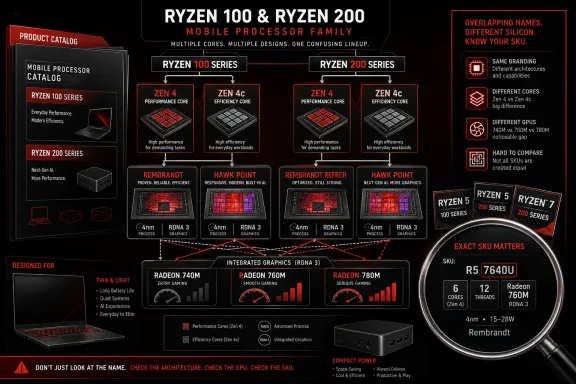
AMD has quietly added 11 processors across its Ryzen 200 and Ryzen 100 APU families, placing seven Zen 4 or hybrid Zen 4-and-Zen 4c models in Ryzen 200 and four apparently Zen 4 Hawk Point models inside a Ryzen 100 range previously associated with Zen 3+ Rembrandt silicon. The additions expand AMD’s options for laptops and potentially mini PCs, but they also make the family name a weaker guide to the hardware underneath. TweakTown, Wccftech, and the original VideoCardz reporting agree on the practical warning: buyers can no longer infer architecture or integrated graphics from “Ryzen 100” alone. The exact SKU now matters more than the series badge.
On paper, AMD’s move is straightforward. The Ryzen 200 family gains seven processors: the Ryzen 3 205, Ryzen 5 216, Ryzen 5 224, Ryzen 5 225, Ryzen 7 217, Ryzen 7 249, and Ryzen 7 253. The Ryzen 100 family gains four more: the Ryzen 9 180, Ryzen 7 165, Ryzen 7 155, and Ryzen 5 125.
The resulting stack covers 4-, 6-, and 8-core configurations, with Radeon 740M, Radeon 760M, or Radeon 780M integrated graphics. The fastest additions reach eight cores and 16 threads, matching the maximum configuration already present in Ryzen 200, while the lower tiers give OEMs more ways to tune price, power, graphics capability, and market positioning.
There is nothing inherently wrong with expanding an existing processor family. Laptop manufacturers need more than one eight-core flagship and one stripped-down entry part; they need intermediate configurations that can fit different chassis, thermal limits, and price bands.
The problem is that AMD has expanded the catalog without preserving a clean relationship between the catalog’s names and its underlying technology. TweakTown describes the result as an already confusing stack becoming more complicated, while Wccftech hardware reporter Sarfraz Khan emphasizes the unexpected use of newer Zen-era silicon within older-looking product families. VideoCardz, which Wccftech credits as the news source, reaches the same broader conclusion after comparing AMD’s product listings.
That agreement matters because this is not merely an enthusiast complaint about inelegant branding. Processor names flow into retailer databases, OEM model pages, enterprise asset records, support tickets, procurement spreadsheets, and resale listings. When the badge stops communicating the platform generation, every downstream participant has to perform more verification.
AMD teased the Hawk Point naming shift under Ryzen 200 in 2024. The latest additions show the longer-term consequence of that decision: Ryzen 200 is becoming a broad commercial container for Hawk Point configurations rather than a sharply defined new generation.
The Ryzen 100 additions go further. They place Hawk Point-class characteristics—4nm manufacturing and RDNA 3 graphics—inside a family whose existing processors were associated with 6nm Rembrandt, Zen 3+, and RDNA 2. That is not a minor clock-speed refresh within a stable platform definition; it is a substantial internal split hidden behind the same first three digits.
At the lower end, the Ryzen 3 205 is especially unusual. Wccftech lists it as a six-core processor with eight threads using a combination of Zen 4 and Zen 4c cores, rather than the symmetrical core-and-thread arrangement buyers might expect from a conventional six-core mobile Ryzen.
The table exposes how little the series number tells the buyer. A Ryzen 9 180 and Ryzen 7 253 are much closer in their disclosed specifications than their names suggest. Both are listed with eight Zen 4 cores, 16 threads, a 3.6 GHz base clock, a 4.9 GHz boost clock, and Radeon 780M graphics.
Conversely, the difference between two processors carrying the Ryzen 7 label can be substantial. The Ryzen 7 249 and Ryzen 7 217 both occupy AMD’s nominal Ryzen 7 tier, but the former has eight Zen 4 cores and Radeon 780M graphics, while the latter has six hybrid Zen 4 and Zen 4c cores paired with the much smaller Radeon 740M.
The Ryzen 7 217 may still make sense in a system designed around lower cost or different power constraints. The issue is not that AMD has created the configuration; the issue is that the name does little to expose what has been traded away.
A buyer comparing two laptop listings might reasonably treat “Ryzen 7” as a useful first-pass indicator. In this stack, that shortcut can conceal differences in core count, core topology, and graphics tier before the buyer even reaches chassis cooling, memory configuration, firmware tuning, or power limits.
The Ryzen 100 family now lacks even that level of internal consistency. Existing Ryzen 100 processors are associated with Rembrandt, a 6nm design combining Zen 3+ CPU cores with RDNA 2 graphics. AMD’s pages reportedly classify the four new models as Hawk Point products built on a 4nm process and equipped with RDNA 3 graphics.
Those characteristics point to a different platform generation. Yet AMD’s website also mentions Zen 3+ in the architecture field for the new Ryzen 100 parts, producing a specification combination that TweakTown and VideoCardz flag as internally inconsistent. Wccftech goes further, saying the Zen 3+ description is mistaken and identifying the processors as Zen 4.
That leaves buyers with an awkward hierarchy of evidence. The processor family name says Ryzen 100, the codename says Hawk Point, the process says 4nm, the GPU says RDNA 3, and the architecture label reportedly says Zen 3+. Several of those fields align with Zen 4-era Hawk Point silicon, while one points backward to Zen 3+.
The safest interpretation, and the one reflected in the source reporting, is that the new processors are Zen 4 Hawk Point parts and that AMD’s Zen 3+ label is an error. But that conclusion is being reconstructed from multiple specification fields rather than communicated cleanly by AMD.
This is a documentation failure before it is a naming failure. Reusing a family label can be defensible if the product database clearly distinguishes every model. Once the database itself presents contradictory architecture information, the normal advice to “check AMD’s specifications” no longer fully resolves the confusion.
TweakTown argues that Ryzen 100 now covers two different generations depending on the specific model. That is the central practical fact: an existing Ryzen 100 processor may be a 6nm Rembrandt design with Zen 3+ and RDNA 2, while one of the four new Ryzen 100 processors may instead be a 4nm Hawk Point design with RDNA 3.
The shift changes more than an architectural footnote. CPU generation, integrated graphics architecture, media capabilities, power behavior, driver expectations, firmware, and platform features can all be relevant when an organization standardizes a Windows device. Even where two systems run the same operating system and applications, they are not necessarily interchangeable support targets.
The Ryzen 7 217 and Ryzen 5 216 each combine Zen 4 and Zen 4c cores while retaining six cores and 12 threads. The Ryzen 3 205 also uses the hybrid arrangement, but its six physical cores provide only eight threads.
This does not automatically make the hybrid models inferior. A compact core is not equivalent to an unrelated older architecture, and performance depends on workload, power allocation, cooling, memory, and firmware. Windows scheduling behavior and AMD’s platform implementation also matter more than a simplistic “large core versus small core” label would imply.
But it does mean core count alone is insufficient. The Ryzen 5 224 and Ryzen 5 216 are both six-core, 12-thread processors, yet the former is listed as a conventional Zen 4 configuration with Radeon 760M graphics, while the latter uses Zen 4 plus Zen 4c and Radeon 740M graphics.
The processor tier becomes even less helpful with the Ryzen 7 217. Despite carrying the higher Ryzen 7 brand, it has the same six-core and 12-thread count as several Ryzen 5 models and uses the lowest of the three disclosed integrated-GPU tiers.
A knowledgeable buyer can account for those differences once the full specifications are visible. The danger lies in the sales channels where they are not. Retail titles often compress a machine into screen size, memory, storage, and “Ryzen 7,” leaving the exact processor number buried in a secondary tab or omitted altogether.
The resulting ambiguity favors the seller, not the buyer. It allows two materially different systems to occupy the same apparent performance class in search filters and advertisements. The laptop with the more recognizable tier label can look like the stronger deal even when its CPU or GPU configuration is less suitable for the buyer’s workload.
The Radeon 780M sits in the Ryzen 7 253, Ryzen 7 249, and Ryzen 9 180. These are also the eight-core, 16-thread models among the additions, making them the most straightforward high-end configurations in the group.
Radeon 760M appears in the Ryzen 5 225, Ryzen 5 224, and Ryzen 7 165. Those processors all have six Zen 4 cores and 12 threads, although their clocks and series placement differ.
Radeon 740M spans the broadest and most confusing range. It appears in hybrid six-core Ryzen 200 processors, in the unusual six-core/eight-thread Ryzen 3 205, in the six-core Ryzen 7 155, and in the four-core Ryzen 5 125.
For buyers who expect to use integrated graphics for games, accelerated creative applications, multi-display office work, or general GPU-assisted workloads, that distinction is essential. “Ryzen 7” does not guarantee Radeon 780M or even Radeon 760M in the new stack; the Ryzen 7 217 and Ryzen 7 155 both use Radeon 740M.
The same caution applies in reverse. The Ryzen 9 180’s name makes it sound like the obvious flagship of the complete Ryzen 100 family, but its disclosed configuration closely mirrors the Ryzen 7 253. Without system-level testing, there is no basis for assuming that the Ryzen 9-branded machine will be faster simply because its tier number is higher.
Actual graphics performance will still depend heavily on the laptop around the chip. Shared-memory bandwidth, memory-channel configuration, thermal design, power limits, and OEM firmware can separate two machines using the same APU. AMD’s expansion therefore creates more possible configurations without making system-level comparisons any easier.
No processor table can replace a proper laptop review. What the table can do is prevent a buyer from comparing systems that were never equivalent in the first place.
TweakTown compares AMD’s approach to Intel’s use of Core Ultra 200 branding around older silicon. Wccftech also places the new additions in a broader pattern, pointing to AMD’s expansion of an earlier Zen 2 Renoir family with the Ryzen 7 4700LE.
There are legitimate commercial reasons for this behavior. A proven processor can remain suitable for mainstream Windows systems long after it stops being technologically novel. Continued use can give OEMs a stable platform, preserve supply options, and provide performance that is entirely adequate for office work, education, home computing, or compact PCs.
The mistake is treating the product name primarily as an inventory-management tool. Consumers read a processor number as a claim about relative age and capability. If the manufacturer instead uses it as a flexible shelf into which different silicon can be placed, the name and the buyer’s interpretation begin to diverge.
That divergence is now especially visible because AMD has both Ryzen 200 and Ryzen AI 300 branding in the mobile market. TweakTown’s account argues that Hawk Point was moved under Ryzen 200 while AMD concentrated marketing attention on the AI-branded family. From AMD’s perspective, that may separate premium AI messaging from mainstream inventory; from the buyer’s perspective, it adds another naming transition to decode.
The broader strategic risk is erosion of trust in the number itself. AMD previously used mobile Ryzen names that required buyers to inspect individual digits to determine architecture. The latest approach appears simpler on the surface, but Ryzen 100’s mixture of Rembrandt and Hawk Point shows that fewer digits do not necessarily mean greater clarity.
A naming system does not need to reveal every engineering detail. It does need to support reasonably accurate comparisons. A customer should not need to know internal codenames merely to determine whether two processors in the same series use different CPU and graphics generations.
A simple name that conceals complexity is not a simpler product line. It merely transfers the work from AMD’s marketing department to buyers, reviewers, retailers, and support teams.
Enterprise support operates at a more granular level. Organizations validate complete device models, firmware packages, graphics drivers, deployment images, docking behavior, security features, and peripheral compatibility. Two laptops carrying the same broad Ryzen family can require different BIOS releases, graphics packages, and troubleshooting procedures if their underlying platforms differ.
Asset-management systems can also obscure the distinction. A report grouped only by “Ryzen 100 Series” could combine Rembrandt and Hawk Point machines, making it look as though an organization has standardized on one platform when it has actually acquired two generations.
That matters when diagnosing graphics problems, sleep failures, display issues, or performance complaints. A technician who assumes that every Ryzen 100 device shares RDNA 2 graphics may select the wrong baseline when the affected machine is one of the new RDNA 3 models.
Procurement language must therefore be more precise than the product family. A tender that specifies only “Ryzen 7” or even “Ryzen 100-series Ryzen 7” leaves room for materially different CPU and GPU combinations. The exact SKU and the complete OEM model identifier should become mandatory fields.
The same principle applies to small businesses buying from retail channels. A system listing that omits the full processor number is no longer merely incomplete; it may conceal which architecture generation the customer is purchasing.
When those products arrive, the same APU could produce meaningfully different experiences across vendors. A processor with Radeon 780M graphics in a well-cooled design with an appropriate memory configuration may behave very differently from the same nominal chip in a constrained chassis.
This is why raw base and boost clocks should be treated as identification data, not as a complete performance forecast. The Ryzen 5 225 has a 4.1 GHz base clock and 4.8 GHz boost, while the Ryzen 5 224 has a 3.3 GHz base and the same 4.8 GHz boost. Those numbers distinguish the SKUs, but they do not reveal how long a particular laptop can sustain demanding workloads.
The same applies to the two eight-core Ryzen 200 additions. The Ryzen 7 253 has a 3.6 GHz base clock, while the Ryzen 7 249 drops that to 3.1 GHz; both list a 4.9 GHz boost and Radeon 780M graphics. Their real separation will depend on how OEMs configure and cool them, not only on the five-digit label printed beside the keyboard.
This creates a trap for buyers who search by processor name and then select the least expensive system. The cheaper machine may be cheaper because of its display, memory, storage, battery, cooling, or power configuration rather than because the processor itself represents a dramatically lower class.
The inverse trap is paying more for a nominally higher Ryzen tier without checking the GPU. A Ryzen 7 217 machine may be marketed above a Ryzen 5 225 system, even though the Ryzen 5 has conventional six-core Zen 4 and Radeon 760M while the Ryzen 7 combines Zen 4 and Zen 4c with Radeon 740M.
That does not prove which laptop will be better; it proves the badge cannot answer the question. Buyers need exact-system benchmarks covering sustained CPU performance, integrated-graphics performance, acoustics, battery behavior, and memory configuration.
Wccftech treats the Zen 3+ reference as an error and reports the processors as Zen 4. TweakTown is more focused on the absurdity of AMD apparently presenting conflicting descriptions on its own pages. VideoCardz likewise concludes that the architecture field appears incorrect based on the other specifications.
The disagreement is therefore not primarily among the three reports. All three recognize the same inconsistency; they differ mostly in how forcefully they interpret it. Wccftech asserts Zen 4, while the other coverage emphasizes the conflict within AMD’s database.
That distinction should remain visible until AMD’s documentation is internally consistent. It is reasonable to identify the new chips as Zen 4 based on the source reporting and their Hawk Point, 4nm, and RDNA 3 characteristics, but it is equally important to note that AMD’s own labeling created the uncertainty.
Specification databases are part of the product. Reviewers, IT departments, resellers, and consumers rely on them for information that cannot be determined from the box. An incorrect architecture field is not cosmetic when the processor has been inserted into a family containing another architecture.
The error also weakens AMD’s best defense of the naming scheme. A company could reasonably say that broad family names are acceptable because complete technical information remains available for every SKU. That argument collapses when the detailed page is the source of the contradiction.
AMD needs more than a one-field correction. It needs a clear statement of which Ryzen 100 SKUs are Rembrandt and which are Hawk Point, accompanied by consistent CPU architecture, graphics architecture, process, and codename data across its catalog.
Retailers and OEMs then need to propagate those distinctions into their own listings. Otherwise, AMD may fix the source database while incomplete descriptions continue circulating through stores and procurement systems.
The first obligation is identification. Reviews should state the full SKU prominently, followed by the CPU architecture, core layout, graphics model, and memory configuration. For Ryzen 100, they should also identify whether the processor is Rembrandt or Hawk Point.
The second obligation is comparison. A Ryzen 7 217 should not automatically be graphed only against other Ryzen 7-branded laptops. Its six-core hybrid CPU and Radeon 740M graphics may make a Ryzen 5 225 or Ryzen 5 224 system a more revealing comparison.
Likewise, the Ryzen 9 180 should be tested against the Ryzen 7 253 where practical because their disclosed headline specifications are identical. If their system-level performance differs, reviewers will need to establish whether the cause is silicon configuration, firmware, power, cooling, or the surrounding laptop.
The third obligation is to separate CPU and GPU analysis. The tier mismatch makes a single overall benchmark score particularly misleading. A machine may offer adequate multithreaded CPU performance while being limited by Radeon 740M graphics, or it may pair Radeon 780M with a chassis that cannot sustain the processor’s potential.
Until independent systems and benchmarks emerge, performance rankings among the additions should remain provisional. The specifications tell us how AMD has divided the stack; they do not establish how the finished devices will perform.
For Windows buyers, administrators, and reviewers, the durable lessons are concrete:
 AMD Expands the Catalog but Shrinks the Meaning of the Badge
On paper, AMD’s move is straightforward. The Ryzen 200 family gains seven processors: the Ryzen 3 205, Ryzen 5 216, Ryzen 5 224, Ryzen 5 225, Ryzen 7 217, Ryzen 7 249, and Ryzen 7 253. The Ryzen 100 family gains four more: the Ryzen 9 180, Ryzen 7 165, Ryzen 7 155, and Ryzen 5 125.The resulting stack covers 4-, 6-, and 8-core configurations, with Radeon 740M, Radeon 760M, or Radeon 780M integrated graphics. The fastest additions reach eight cores and 16 threads, matching the maximum configuration already present in Ryzen 200, while the lower tiers give OEMs more ways to tune price, power, graphics capability, and market positioning.
There is nothing inherently wrong with expanding an existing processor family. Laptop manufacturers need more than one eight-core flagship and one stripped-down entry part; they need intermediate configurations that can fit different chassis, thermal limits, and price bands.
The problem is that AMD has expanded the catalog without preserving a clean relationship between the catalog’s names and its underlying technology. TweakTown describes the result as an already confusing stack becoming more complicated, while Wccftech hardware reporter Sarfraz Khan emphasizes the unexpected use of newer Zen-era silicon within older-looking product families. VideoCardz, which Wccftech credits as the news source, reaches the same broader conclusion after comparing AMD’s product listings.
That agreement matters because this is not merely an enthusiast complaint about inelegant branding. Processor names flow into retailer databases, OEM model pages, enterprise asset records, support tickets, procurement spreadsheets, and resale listings. When the badge stops communicating the platform generation, every downstream participant has to perform more verification.
AMD teased the Hawk Point naming shift under Ryzen 200 in 2024. The latest additions show the longer-term consequence of that decision: Ryzen 200 is becoming a broad commercial container for Hawk Point configurations rather than a sharply defined new generation.
The Ryzen 100 additions go further. They place Hawk Point-class characteristics—4nm manufacturing and RDNA 3 graphics—inside a family whose existing processors were associated with 6nm Rembrandt, Zen 3+, and RDNA 2. That is not a minor clock-speed refresh within a stable platform definition; it is a substantial internal split hidden behind the same first three digits.
Eleven SKUs Turn One Announcement Into Several Different Products
The 11 additions are easier to understand when treated as individual configurations rather than as two coherent product families. The Ryzen 7 253 and Ryzen 9 180, for example, have the same headline CPU configuration, clocks, and Radeon 780M graphics despite belonging to different numbered series.At the lower end, the Ryzen 3 205 is especially unusual. Wccftech lists it as a six-core processor with eight threads using a combination of Zen 4 and Zen 4c cores, rather than the symmetrical core-and-thread arrangement buyers might expect from a conventional six-core mobile Ryzen.
| Series | SKU | CPU architecture | Cores/threads | Base/boost | Integrated GPU |
|---|---|---|---|---|---|
| Ryzen 200 | Ryzen 7 253 | Zen 4 | 8/16 | 3.6/4.9 GHz | Radeon 780M |
| Ryzen 200 | Ryzen 7 249 | Zen 4 | 8/16 | 3.1/4.9 GHz | Radeon 780M |
| Ryzen 200 | Ryzen 5 225 | Zen 4 | 6/12 | 4.1/4.8 GHz | Radeon 760M |
| Ryzen 200 | Ryzen 5 224 | Zen 4 | 6/12 | 3.3/4.8 GHz | Radeon 760M |
| Ryzen 200 | Ryzen 7 217 | Zen 4 plus Zen 4c | 6/12 | 3.0/4.8 GHz | Radeon 740M |
| Ryzen 200 | Ryzen 5 216 | Zen 4 plus Zen 4c | 6/12 | 2.9/4.7 GHz | Radeon 740M |
| Ryzen 200 | Ryzen 3 205 | Zen 4 plus Zen 4c | 6/8 | 3.8/4.6 GHz | Radeon 740M |
| Ryzen 100 | Ryzen 9 180 | Zen 4 | 8/16 | 3.6/4.9 GHz | Radeon 780M |
| Ryzen 100 | Ryzen 7 165 | Zen 4 | 6/12 | 3.3/4.7 GHz | Radeon 760M |
| Ryzen 100 | Ryzen 7 155 | Zen 4 | 6/12 | 3.0/4.7 GHz | Radeon 740M |
| Ryzen 100 | Ryzen 5 125 | Zen 4 | 4/8 | 3.0/4.3 GHz | Radeon 740M |
Conversely, the difference between two processors carrying the Ryzen 7 label can be substantial. The Ryzen 7 249 and Ryzen 7 217 both occupy AMD’s nominal Ryzen 7 tier, but the former has eight Zen 4 cores and Radeon 780M graphics, while the latter has six hybrid Zen 4 and Zen 4c cores paired with the much smaller Radeon 740M.
The Ryzen 7 217 may still make sense in a system designed around lower cost or different power constraints. The issue is not that AMD has created the configuration; the issue is that the name does little to expose what has been traded away.
A buyer comparing two laptop listings might reasonably treat “Ryzen 7” as a useful first-pass indicator. In this stack, that shortcut can conceal differences in core count, core topology, and graphics tier before the buyer even reaches chassis cooling, memory configuration, firmware tuning, or power limits.
Ryzen 100 Is Where the Naming System Actually Breaks
The Ryzen 200 expansion is complicated, but its architectural foundation is at least broadly consistent. The seven new processors use Zen 4, with three models combining Zen 4 and compact Zen 4c cores, and they all use RDNA 3 graphics from the Radeon 700M family.The Ryzen 100 family now lacks even that level of internal consistency. Existing Ryzen 100 processors are associated with Rembrandt, a 6nm design combining Zen 3+ CPU cores with RDNA 2 graphics. AMD’s pages reportedly classify the four new models as Hawk Point products built on a 4nm process and equipped with RDNA 3 graphics.
Those characteristics point to a different platform generation. Yet AMD’s website also mentions Zen 3+ in the architecture field for the new Ryzen 100 parts, producing a specification combination that TweakTown and VideoCardz flag as internally inconsistent. Wccftech goes further, saying the Zen 3+ description is mistaken and identifying the processors as Zen 4.
That leaves buyers with an awkward hierarchy of evidence. The processor family name says Ryzen 100, the codename says Hawk Point, the process says 4nm, the GPU says RDNA 3, and the architecture label reportedly says Zen 3+. Several of those fields align with Zen 4-era Hawk Point silicon, while one points backward to Zen 3+.
The safest interpretation, and the one reflected in the source reporting, is that the new processors are Zen 4 Hawk Point parts and that AMD’s Zen 3+ label is an error. But that conclusion is being reconstructed from multiple specification fields rather than communicated cleanly by AMD.
This is a documentation failure before it is a naming failure. Reusing a family label can be defensible if the product database clearly distinguishes every model. Once the database itself presents contradictory architecture information, the normal advice to “check AMD’s specifications” no longer fully resolves the confusion.
TweakTown argues that Ryzen 100 now covers two different generations depending on the specific model. That is the central practical fact: an existing Ryzen 100 processor may be a 6nm Rembrandt design with Zen 3+ and RDNA 2, while one of the four new Ryzen 100 processors may instead be a 4nm Hawk Point design with RDNA 3.
The shift changes more than an architectural footnote. CPU generation, integrated graphics architecture, media capabilities, power behavior, driver expectations, firmware, and platform features can all be relevant when an organization standardizes a Windows device. Even where two systems run the same operating system and applications, they are not necessarily interchangeable support targets.
Ryzen 200 Hides Core Topology Behind Familiar Tiers
AMD’s use of Zen 4c in selected Ryzen 200 processors adds another layer that the abbreviated model name does not explain. Zen 4c belongs to the same architectural generation as Zen 4, but it is a compact implementation intended to improve core density and efficiency rather than simply duplicate a full-sized core layout.The Ryzen 7 217 and Ryzen 5 216 each combine Zen 4 and Zen 4c cores while retaining six cores and 12 threads. The Ryzen 3 205 also uses the hybrid arrangement, but its six physical cores provide only eight threads.
This does not automatically make the hybrid models inferior. A compact core is not equivalent to an unrelated older architecture, and performance depends on workload, power allocation, cooling, memory, and firmware. Windows scheduling behavior and AMD’s platform implementation also matter more than a simplistic “large core versus small core” label would imply.
But it does mean core count alone is insufficient. The Ryzen 5 224 and Ryzen 5 216 are both six-core, 12-thread processors, yet the former is listed as a conventional Zen 4 configuration with Radeon 760M graphics, while the latter uses Zen 4 plus Zen 4c and Radeon 740M graphics.
The processor tier becomes even less helpful with the Ryzen 7 217. Despite carrying the higher Ryzen 7 brand, it has the same six-core and 12-thread count as several Ryzen 5 models and uses the lowest of the three disclosed integrated-GPU tiers.
A knowledgeable buyer can account for those differences once the full specifications are visible. The danger lies in the sales channels where they are not. Retail titles often compress a machine into screen size, memory, storage, and “Ryzen 7,” leaving the exact processor number buried in a secondary tab or omitted altogether.
The resulting ambiguity favors the seller, not the buyer. It allows two materially different systems to occupy the same apparent performance class in search filters and advertisements. The laptop with the more recognizable tier label can look like the stronger deal even when its CPU or GPU configuration is less suitable for the buyer’s workload.
Radeon 700M Branding Becomes the More Useful Shortcut
The integrated graphics model may now tell buyers more about these processors than the Ryzen tier. The new stack spans Radeon 740M, Radeon 760M, and Radeon 780M graphics, all identified as part of the Radeon 700M family and based on RDNA 3.The Radeon 780M sits in the Ryzen 7 253, Ryzen 7 249, and Ryzen 9 180. These are also the eight-core, 16-thread models among the additions, making them the most straightforward high-end configurations in the group.
Radeon 760M appears in the Ryzen 5 225, Ryzen 5 224, and Ryzen 7 165. Those processors all have six Zen 4 cores and 12 threads, although their clocks and series placement differ.
Radeon 740M spans the broadest and most confusing range. It appears in hybrid six-core Ryzen 200 processors, in the unusual six-core/eight-thread Ryzen 3 205, in the six-core Ryzen 7 155, and in the four-core Ryzen 5 125.
For buyers who expect to use integrated graphics for games, accelerated creative applications, multi-display office work, or general GPU-assisted workloads, that distinction is essential. “Ryzen 7” does not guarantee Radeon 780M or even Radeon 760M in the new stack; the Ryzen 7 217 and Ryzen 7 155 both use Radeon 740M.
The same caution applies in reverse. The Ryzen 9 180’s name makes it sound like the obvious flagship of the complete Ryzen 100 family, but its disclosed configuration closely mirrors the Ryzen 7 253. Without system-level testing, there is no basis for assuming that the Ryzen 9-branded machine will be faster simply because its tier number is higher.
Actual graphics performance will still depend heavily on the laptop around the chip. Shared-memory bandwidth, memory-channel configuration, thermal design, power limits, and OEM firmware can separate two machines using the same APU. AMD’s expansion therefore creates more possible configurations without making system-level comparisons any easier.
No processor table can replace a proper laptop review. What the table can do is prevent a buyer from comparing systems that were never equivalent in the first place.
The Rebrand Solves a Catalog Problem by Creating a Trust Problem
AMD is not alone in reusing silicon or placing older designs into newer naming structures. The PC industry has long treated mature processor designs as useful tools for filling lower price bands after marketing attention moves to a newer flagship architecture.TweakTown compares AMD’s approach to Intel’s use of Core Ultra 200 branding around older silicon. Wccftech also places the new additions in a broader pattern, pointing to AMD’s expansion of an earlier Zen 2 Renoir family with the Ryzen 7 4700LE.
There are legitimate commercial reasons for this behavior. A proven processor can remain suitable for mainstream Windows systems long after it stops being technologically novel. Continued use can give OEMs a stable platform, preserve supply options, and provide performance that is entirely adequate for office work, education, home computing, or compact PCs.
The mistake is treating the product name primarily as an inventory-management tool. Consumers read a processor number as a claim about relative age and capability. If the manufacturer instead uses it as a flexible shelf into which different silicon can be placed, the name and the buyer’s interpretation begin to diverge.
That divergence is now especially visible because AMD has both Ryzen 200 and Ryzen AI 300 branding in the mobile market. TweakTown’s account argues that Hawk Point was moved under Ryzen 200 while AMD concentrated marketing attention on the AI-branded family. From AMD’s perspective, that may separate premium AI messaging from mainstream inventory; from the buyer’s perspective, it adds another naming transition to decode.
The broader strategic risk is erosion of trust in the number itself. AMD previously used mobile Ryzen names that required buyers to inspect individual digits to determine architecture. The latest approach appears simpler on the surface, but Ryzen 100’s mixture of Rembrandt and Hawk Point shows that fewer digits do not necessarily mean greater clarity.
A naming system does not need to reveal every engineering detail. It does need to support reasonably accurate comparisons. A customer should not need to know internal codenames merely to determine whether two processors in the same series use different CPU and graphics generations.
A simple name that conceals complexity is not a simpler product line. It merely transfers the work from AMD’s marketing department to buyers, reviewers, retailers, and support teams.
Windows Will Run on Both, but IT Must Support the Difference
For Windows users, the immediate temptation is to dismiss the issue because all these processors ultimately appear in ordinary x86 PCs. Applications are unlikely to ask whether a machine’s Ryzen 100 badge contains Rembrandt or Hawk Point before launching.Enterprise support operates at a more granular level. Organizations validate complete device models, firmware packages, graphics drivers, deployment images, docking behavior, security features, and peripheral compatibility. Two laptops carrying the same broad Ryzen family can require different BIOS releases, graphics packages, and troubleshooting procedures if their underlying platforms differ.
Asset-management systems can also obscure the distinction. A report grouped only by “Ryzen 100 Series” could combine Rembrandt and Hawk Point machines, making it look as though an organization has standardized on one platform when it has actually acquired two generations.
That matters when diagnosing graphics problems, sleep failures, display issues, or performance complaints. A technician who assumes that every Ryzen 100 device shares RDNA 2 graphics may select the wrong baseline when the affected machine is one of the new RDNA 3 models.
Procurement language must therefore be more precise than the product family. A tender that specifies only “Ryzen 7” or even “Ryzen 100-series Ryzen 7” leaves room for materially different CPU and GPU combinations. The exact SKU and the complete OEM model identifier should become mandatory fields.
The same principle applies to small businesses buying from retail channels. A system listing that omits the full processor number is no longer merely incomplete; it may conceal which architecture generation the customer is purchasing.
Action checklist for admins
- Record the complete processor SKU rather than only the Ryzen family or tier.
- Separate existing Rembrandt Ryzen 100 systems from the new Hawk Point Ryzen 100 models in asset and deployment groups.
- Verify the codename, process node, core configuration, and integrated GPU against both AMD and the OEM’s documentation.
- Require the full laptop or mini-PC model identifier in procurement requests and purchase records.
- Validate BIOS, chipset, and Radeon graphics packages for the exact platform instead of assuming one Ryzen 100 image covers every device.
- Test representative hardware before treating Ryzen 7 217, Ryzen 7 249, Ryzen 7 253, or similarly tiered models as performance-equivalent.
- Preserve screenshots or exported specification records when buying, particularly while AMD’s architecture labeling remains inconsistent.
OEM Choices Will Matter More Than the Processor Sticker
Wccftech expects the expanded stack to appear in newer laptops or mini PCs. That is the logical destination for a range containing multiple core counts and three integrated-GPU tiers, although the source reporting does not establish specific system designs.When those products arrive, the same APU could produce meaningfully different experiences across vendors. A processor with Radeon 780M graphics in a well-cooled design with an appropriate memory configuration may behave very differently from the same nominal chip in a constrained chassis.
This is why raw base and boost clocks should be treated as identification data, not as a complete performance forecast. The Ryzen 5 225 has a 4.1 GHz base clock and 4.8 GHz boost, while the Ryzen 5 224 has a 3.3 GHz base and the same 4.8 GHz boost. Those numbers distinguish the SKUs, but they do not reveal how long a particular laptop can sustain demanding workloads.
The same applies to the two eight-core Ryzen 200 additions. The Ryzen 7 253 has a 3.6 GHz base clock, while the Ryzen 7 249 drops that to 3.1 GHz; both list a 4.9 GHz boost and Radeon 780M graphics. Their real separation will depend on how OEMs configure and cool them, not only on the five-digit label printed beside the keyboard.
This creates a trap for buyers who search by processor name and then select the least expensive system. The cheaper machine may be cheaper because of its display, memory, storage, battery, cooling, or power configuration rather than because the processor itself represents a dramatically lower class.
The inverse trap is paying more for a nominally higher Ryzen tier without checking the GPU. A Ryzen 7 217 machine may be marketed above a Ryzen 5 225 system, even though the Ryzen 5 has conventional six-core Zen 4 and Radeon 760M while the Ryzen 7 combines Zen 4 and Zen 4c with Radeon 740M.
That does not prove which laptop will be better; it proves the badge cannot answer the question. Buyers need exact-system benchmarks covering sustained CPU performance, integrated-graphics performance, acoustics, battery behavior, and memory configuration.
AMD’s Contradictory Architecture Field Is More Than a Typo
AMD could resolve the most obvious part of this story quickly by correcting or clarifying the architecture field for the four new Ryzen 100 processors. The available product characteristics describe Hawk Point, 4nm manufacturing, and RDNA 3 graphics, while the Zen 3+ label points toward the older Rembrandt identity already used elsewhere in Ryzen 100.Wccftech treats the Zen 3+ reference as an error and reports the processors as Zen 4. TweakTown is more focused on the absurdity of AMD apparently presenting conflicting descriptions on its own pages. VideoCardz likewise concludes that the architecture field appears incorrect based on the other specifications.
The disagreement is therefore not primarily among the three reports. All three recognize the same inconsistency; they differ mostly in how forcefully they interpret it. Wccftech asserts Zen 4, while the other coverage emphasizes the conflict within AMD’s database.
That distinction should remain visible until AMD’s documentation is internally consistent. It is reasonable to identify the new chips as Zen 4 based on the source reporting and their Hawk Point, 4nm, and RDNA 3 characteristics, but it is equally important to note that AMD’s own labeling created the uncertainty.
Specification databases are part of the product. Reviewers, IT departments, resellers, and consumers rely on them for information that cannot be determined from the box. An incorrect architecture field is not cosmetic when the processor has been inserted into a family containing another architecture.
The error also weakens AMD’s best defense of the naming scheme. A company could reasonably say that broad family names are acceptable because complete technical information remains available for every SKU. That argument collapses when the detailed page is the source of the contradiction.
AMD needs more than a one-field correction. It needs a clear statement of which Ryzen 100 SKUs are Rembrandt and which are Hawk Point, accompanied by consistent CPU architecture, graphics architecture, process, and codename data across its catalog.
Retailers and OEMs then need to propagate those distinctions into their own listings. Otherwise, AMD may fix the source database while incomplete descriptions continue circulating through stores and procurement systems.
Reviewers Must Test the Name, Not Repeat It
The arrival of these processors should change how systems are reviewed. A review that describes a laptop merely as having a “Ryzen 7 processor” will be nearly useless within a stack where Ryzen 7 can mean six or eight cores, conventional or hybrid topology, and Radeon 740M, 760M, or 780M graphics.The first obligation is identification. Reviews should state the full SKU prominently, followed by the CPU architecture, core layout, graphics model, and memory configuration. For Ryzen 100, they should also identify whether the processor is Rembrandt or Hawk Point.
The second obligation is comparison. A Ryzen 7 217 should not automatically be graphed only against other Ryzen 7-branded laptops. Its six-core hybrid CPU and Radeon 740M graphics may make a Ryzen 5 225 or Ryzen 5 224 system a more revealing comparison.
Likewise, the Ryzen 9 180 should be tested against the Ryzen 7 253 where practical because their disclosed headline specifications are identical. If their system-level performance differs, reviewers will need to establish whether the cause is silicon configuration, firmware, power, cooling, or the surrounding laptop.
The third obligation is to separate CPU and GPU analysis. The tier mismatch makes a single overall benchmark score particularly misleading. A machine may offer adequate multithreaded CPU performance while being limited by Radeon 740M graphics, or it may pair Radeon 780M with a chassis that cannot sustain the processor’s potential.
Until independent systems and benchmarks emerge, performance rankings among the additions should remain provisional. The specifications tell us how AMD has divided the stack; they do not establish how the finished devices will perform.
The New Buying Rule Is Written in the Last Three Digits
The expanded lineup is not devoid of logic. Radeon 780M clusters around the eight-core models, Radeon 760M accompanies several conventional six-core parts, and Radeon 740M covers lower or more heavily segmented configurations. The problem is that this logic appears only after the full model number and specifications are examined.For Windows buyers, administrators, and reviewers, the durable lessons are concrete:
- Ryzen 200 gains seven SKUs, while Ryzen 100 gains four.
- The new Ryzen 200 processors use Zen 4 or hybrid Zen 4-and-Zen 4c configurations with RDNA 3 graphics.
- Existing Ryzen 100 processors may be 6nm Rembrandt with Zen 3+ and RDNA 2.
- The four new Ryzen 100 processors are identified by the reporting as 4nm Hawk Point models with RDNA 3 and apparently Zen 4 CPU cores.
- Ryzen 7 no longer identifies a consistent core count, core topology, or integrated-GPU tier within these additions.
- The full SKU, Radeon model, codename, and OEM system configuration are more useful purchasing data than the family badge alone.
References
- Primary source: TweakTown
Published: Thu, 09 Jul 2026 21:20:06 GMT
Loading…
www.tweaktown.com - Independent coverage: Wccftech
Published: Thu, 09 Jul 2026 11:57:30 GMT
Loading…
wccftech.com - Related coverage: amd.com
Loading…
www.amd.com - Related coverage: videocardz.com
Loading…
videocardz.com - Related coverage: tomshardware.com
Loading…
www.tomshardware.com