

AMD quietly added the Ryzen 7 4700LE on March 25, 2026, reviving Zen 2-era Renoir silicon as an OEM-only, eight-core AM4 processor that has surfaced inside a $799.99 AIGAMEPC desktop pairing DDR4 memory with a GeForce RTX 3050 8GB graphics card. VideoCardz reported the prebuilt listing, attributing the Amazon sighting to MEGAsizeGPU. That reporting establishes the source chain for the listing, but it should not be confused with independent verification of every product specification or seller claim.
The processor appears to be real and the machine appears to be offered for sale, but neither represents a new generation of PC technology. What the configuration offers is the continued economic utility of an older platform. The key question is not whether Zen 2 can still run Windows, applications and games, but whether a newly purchased PC built around it offers enough value to justify its limitations.
Available reporting describes the Ryzen 7 4700LE as a Ryzen 4000-series desktop processor based on Renoir and the Zen 2 architecture. The reported specifications include eight cores, 16 threads, a 3.6GHz base clock, boost speeds of up to 4.2GHz, 12MB of combined cache and a 65W thermal design power.
Those numbers establish the 4700LE as a credible general-purpose desktop CPU on paper. Sixteen hardware threads should be sufficient for ordinary multitasking, office software, browser-heavy workflows and many productivity tasks. A 65W rating should also allow an integrator to cool the processor without an unusually elaborate thermal design, although the finished system’s temperatures and noise cannot be judged from the rating alone.
The age is visible in the surrounding details. Zen 2 dates to 2019, while Renoir is associated with the Ryzen 4000 era. The 4700LE therefore carries a much later product introduction while retaining the platform assumptions of an earlier desktop market.
That is not inherently disqualifying. Processor architectures do not stop functioning when newer generations appear, and established hardware can be valuable when priced appropriately. The concern is whether storefront marketing emphasizes the Ryzen 7 name and eight-core specification without giving buyers enough context about the underlying architecture and platform.
Reporting from TweakTown and VideoCardz describes the 4700LE as Renoir silicon without functioning integrated graphics. The processor therefore requires a discrete graphics card, which the AIGAMEPC configuration supplies through its GeForce RTX 3050.
The OEM-only classification also shapes how the product should be evaluated. This is not presented as a conventional boxed processor intended for buyers to pair with a retail motherboard of their choice. It is intended to arrive as part of a complete system, making the integrator’s motherboard selection, firmware support, cooling, power supply and warranty central to the value proposition.
March 25, 2026 — The Ryzen 7 4700LE appears in reporting as an OEM-only AM4 desktop processor.
2026 — VideoCardz reports an AIGAMEPC prebuilt listing attributed to Amazon via MEGAsizeGPU, combining the 4700LE with an RTX 3050 8GB, 16GB of DDR4 memory and a 512GB NVMe SSD.
The timeline supplies useful context without turning age into an automatic verdict. The processor’s introduction may be recent, but its value depends on how cheaply and competently the surrounding system has been assembled.
For the buyer, however, the absence of integrated graphics removes a useful troubleshooting option. If the RTX 3050 develops a problem, the system cannot be assumed to provide display output through the motherboard’s video connectors. Diagnosing a no-display condition may require reseating the card, testing another cable or output, or temporarily installing a known-good discrete graphics card.
That limitation is easy to miss because a case may expose motherboard display connectors even when the installed processor cannot use them. The monitor must be connected to one of the RTX 3050’s outputs, not to an HDMI or DisplayPort connector on the motherboard’s rear panel.
The processor’s reported 12MB of combined cache also deserves context, but it does not support a definitive performance judgment by itself. Gaming behavior depends on architecture, clock behavior, memory configuration, software and the graphics card as well as core count and cache. Without direct benchmarks of the finished AIGAMEPC system, claims about how it compares with a Ryzen 5 5600 or another processor should be treated as general cautions rather than measured conclusions.
The same restraint applies to the eight-core specification. Eight Zen 2 cores may be useful in workloads that can use all 16 threads, while later processors with fewer cores may perform differently in lightly threaded tasks or particular games. Buyers should not treat “eight cores versus six” as a complete ranking, but the supplied reporting also does not prove that a particular six-core alternative will be faster in this exact system.
An OEM processor can be perfectly reliable when the complete machine has been validated properly. The practical issue is that buyers need to evaluate the implementation rather than relying on the CPU name alone.
The reported configuration combines the Ryzen 7 4700LE with a GeForce RTX 3050 8GB, 16GB of DDR4-3200 memory and a 512GB NVMe SSD. VideoCardz also reports Wi-Fi 6, six RGB fans and DOS as the operating system.
Nothing in that list makes the computer automatically unsuitable. The RTX 3050 supplies the discrete graphics required by the processor, 16GB is a workable memory capacity for mainstream Windows use, and an NVMe drive should provide the basic responsiveness expected from a modern desktop. The relevant question is whether the complete package is competitive at its delivered price.
The 512GB SSD could become a practical constraint for a gaming buyer. The operating system, applications, updates and recovery data will reduce the space available for games. That does not prove the included drive is inadequate for every buyer, but it makes the number and type of available storage-expansion connections important.
The RTX 3050 8GB is at least identified by model and memory capacity in the reporting. Buyers should nevertheless compare it with complete systems containing an equivalent GPU, RAM capacity and storage allocation rather than comparing the AIGAMEPC tower with machines built around materially different graphics hardware.
A price reduction from $849.99 to $799.99 does not establish value on its own. The comparison should use the total amount required to obtain a finished, supported PC:
This framework is more useful than drawing conclusions from fan count, CPU branding or a sale badge. The motherboard, power supply and slot layout are not known to be defective; they are simply unverified in the supplied reporting. The seller’s willingness to identify them is therefore part of the purchasing decision.
DOS is not a substitute for a modern Windows desktop environment. A customer expecting to unpack the tower and begin installing games may instead need to create installation media, install Windows, load device drivers and activate the operating system with a legitimate license. Depending on what the seller supplies, that can add cost, time and support complexity.
The exact license status should be resolved before purchase. Marketplace operating-system fields can be inconsistent, but the available reporting identifies DOS. Unless the seller confirms a valid Windows license and activation entitlement in writing, the safest comparison is to treat Windows as an additional cost.
That changes the value calculation. A $799.99 desktop without a Windows license is not directly equivalent to an equally priced system that includes an activated Windows installation, validated drivers, recovery tools and vendor support for reinstalling the operating system.
Installing Windows on an unfamiliar OEM configuration may be straightforward, but it can expose documentation gaps. Buyers may need to identify the motherboard and networking hardware, obtain drivers and review firmware settings. Wi-Fi 6 is useful only after the installed operating system has a working driver for the wireless adapter.
A clean installation may appeal to experienced users who prefer an uncluttered system. It is less appealing to a novice choosing a prebuilt to avoid assembly and configuration. For that buyer, the absence of a confirmed Windows license and completed setup should be treated as a material difference, not a minor footnote.
The practical concern is upgrade planning. A buyer considering a later GPU or NVMe upgrade should understand that the system begins with PCIe 3.0 connectivity. Some future components may operate with no meaningful problem for the buyer’s workload, while others may perform differently from the same component on a newer platform.
For an organization deploying these machines as workstations, the interface generation may be less important than purchase cost, reliability, warranty support and sufficient CPU thread capacity. Office applications, browsers and remote-access tools do not automatically require the newest desktop interface.
For a gaming buyer, the RTX 3050 may eventually become an upgrade target. Whether a replacement GPU encounters a meaningful CPU or interface limitation will depend on the selected card, game, settings and display resolution. Without benchmarks, it would be premature to declare a specific bottleneck or quantify a future penalty.
The reported 65W CPU TDP may make the factory processor relatively manageable, but it does not establish the power supply’s capability. A future graphics upgrade depends on the PSU’s actual manufacturer, model, rated output, connector set and build quality.
The six RGB fans also reveal little about measured cooling. Fan count does not establish airflow, acoustics, fan control or CPU-cooler quality. Those characteristics require component disclosure or independent testing.
A processor upgrade can make economic sense for someone who already owns a compatible motherboard, suitable firmware, working DDR4 memory, a good power supply and the rest of the system. Most of the platform has already been purchased.
A new prebuilt is a different calculation. The buyer is starting without an existing AM4 investment and accepting the platform because the complete system is expected to cost less than comparable alternatives. The delivered price and component quality therefore have to justify the choice.
The table does not establish a performance order. That would require relevant benchmarks using comparable memory, cooling, firmware and graphics hardware. Its purpose is to separate three purchasing situations: buying an OEM prebuilt, extending an existing AM4 machine and comparing processors across generations.
That possibility should be tested against the actual complete-system price rather than assumed from the memory standard. Component pricing changes, and an older platform is not automatically the cheapest option at the moment a buyer places an order.
The included 16GB capacity is workable, but the module arrangement matters. If the system uses one 16GB DIMM, memory performance may differ from a properly configured two-module setup. If it uses two 8GB DIMMs and the motherboard has only two slots, increasing capacity would require replacing both modules. If the board has four slots, the expansion options may be more flexible.
None of those configurations is established by the supplied reporting. They are questions for the seller, not proof that the machine has been assembled poorly.
Storage should be evaluated in the same way. A 512GB NVMe drive may be sufficient for a light software library, but a gaming buyer should confirm whether the motherboard has another M.2 slot, whether SATA connections and drive bays are available, and whether opening the case for an upgrade affects warranty coverage.
The economic comparison should therefore remain compact: total delivered price with legitimate Windows licensing, exact motherboard and PSU disclosure, RAM-slot layout, storage expansion, warranty terms, and competing systems with equivalent GPU, RAM and storage.
Neither shortcut is reliable. Gaming and application performance can depend on per-core throughput, latency, memory configuration, sustained clock behavior, cooling and the graphics workload. Core count matters, but its importance varies.
The 4700LE’s eight cores and 16 threads may be useful in workloads that can use them. Someone running several development tools, managing many active applications or using threaded productivity software may benefit. The available reporting, however, provides specifications rather than a benchmark suite for the finished AIGAMEPC desktop.
That absence calls for restraint in both directions. It would be wrong to dismiss the processor solely because it uses Zen 2, and equally wrong to declare it a bargain solely because it offers 16 threads.
The RTX 3050’s role should be handled with the same caution. Depending on the game and settings, graphics performance may matter more than CPU differences. A later GPU upgrade could change that balance, but the supplied facts do not establish where a bottleneck would occur or how severe it would be.
Independent measurements of game performance, thermals, noise, storage behavior and power consumption would provide a stronger basis for judgment. Until those exist, buyers should compare disclosed hardware, total cost and support rather than relying on predicted frame rates.
Motherboard firmware is one concern. Physical AM4 socket compatibility does not guarantee that every AM4 motherboard recognizes every processor. The supplied reporting does not identify the board or firmware revision, so buyers should confirm both rather than assume that the 4700LE can be transferred to another AM4 motherboard.
The reverse concern applies to upgrades. The included motherboard may support other AM4 processors, but actual compatibility depends on the model, firmware and power-delivery design. An upgrade plan based on an unidentified motherboard remains speculative.
Warranty handling matters for the same reason. Buyers should determine whether Qehi, AIGAMEPC, the marketplace seller or another party handles system failures. They should also obtain the warranty term, return window, return address, shipping obligations and any restocking fee before ordering.
The power supply deserves equivalent scrutiny. Its brand, model, output and connectors are not established by the supplied reports. That lack of information does not prove poor quality, but it prevents a buyer from evaluating reliability or planning a graphics-card upgrade responsibly.
The unresolved details determine whether this particular offer reaches that standard. DOS may add licensing and deployment costs. A 512GB SSD may prompt an early storage upgrade. An unidentified motherboard complicates memory, storage and CPU planning, while an unidentified power supply prevents a confident assessment of future GPU options. These are open purchase questions rather than proof of defects.
The decisive comparison is therefore the finished cost of ownership. Add a legitimate Windows license if necessary, confirm the hardware that storefront marketing leaves unnamed, account for likely storage or memory upgrades, and compare the result with current systems offering equivalent graphics, RAM, storage and warranty coverage.
If the seller provides clear answers and the adjusted price remains meaningfully lower, the AIGAMEPC tower could serve buyers who prioritize usable thread capacity and modest discrete graphics over platform novelty. If the details remain unavailable or the full cost approaches better-documented alternatives, the Ryzen 7 badge and eight-core specification are not enough to close the gap.
The 4700LE’s future will ultimately be decided less by its product name than by the systems built around it. Transparent component disclosure, competent firmware support and realistic pricing could make it a sensible budget option. Without those conditions, buyers will be better served by waiting for independent testing or choosing a machine whose complete configuration can be evaluated before the return period begins.
The processor appears to be real and the machine appears to be offered for sale, but neither represents a new generation of PC technology. What the configuration offers is the continued economic utility of an older platform. The key question is not whether Zen 2 can still run Windows, applications and games, but whether a newly purchased PC built around it offers enough value to justify its limitations.
That distinction matters because the Ryzen 7 4700LE looks more impressive in a storefront specification list than it does in architectural context. Eight cores and 16 threads remain useful, but the reported specifications pair them with 12MB of combined cache, PCIe 3.0 connectivity, DDR4 memory and no integrated graphics. It is less a return to Zen 2 than an example of how system builders can continue using established silicon when component inventories and platform costs make the resulting package commercially viable.Verdict
Buy it if: The total delivered price remains competitive after adding a legitimate Windows license, and the seller confirms acceptable motherboard, power-supply, memory, storage and warranty details in writing.
Skip it if: You want a ready-to-use Windows PC, a clearly documented upgrade path, stronger modern gaming performance or dependable support without having to investigate unnamed components.
Confirm before paying: The exact Windows edition and activation status; motherboard make and model; power-supply make, model and rated output; whether the 16GB of RAM uses one or two DIMMs and how many slots remain; the NVMe drive’s exact capacity and available storage slots; warranty length, return window and who pays return shipping; and whether the seller provides drivers and recovery instructions.
 AMD Has Launched a New Product, Not a New Processor Generation
Available reporting describes the Ryzen 7 4700LE as a Ryzen 4000-series desktop processor based on Renoir and the Zen 2 architecture. The reported specifications include eight cores, 16 threads, a 3.6GHz base clock, boost speeds of up to 4.2GHz, 12MB of combined cache and a 65W thermal design power.Those numbers establish the 4700LE as a credible general-purpose desktop CPU on paper. Sixteen hardware threads should be sufficient for ordinary multitasking, office software, browser-heavy workflows and many productivity tasks. A 65W rating should also allow an integrator to cool the processor without an unusually elaborate thermal design, although the finished system’s temperatures and noise cannot be judged from the rating alone.
The age is visible in the surrounding details. Zen 2 dates to 2019, while Renoir is associated with the Ryzen 4000 era. The 4700LE therefore carries a much later product introduction while retaining the platform assumptions of an earlier desktop market.
That is not inherently disqualifying. Processor architectures do not stop functioning when newer generations appear, and established hardware can be valuable when priced appropriately. The concern is whether storefront marketing emphasizes the Ryzen 7 name and eight-core specification without giving buyers enough context about the underlying architecture and platform.
Reporting from TweakTown and VideoCardz describes the 4700LE as Renoir silicon without functioning integrated graphics. The processor therefore requires a discrete graphics card, which the AIGAMEPC configuration supplies through its GeForce RTX 3050.
The OEM-only classification also shapes how the product should be evaluated. This is not presented as a conventional boxed processor intended for buyers to pair with a retail motherboard of their choice. It is intended to arrive as part of a complete system, making the integrator’s motherboard selection, firmware support, cooling, power supply and warranty central to the value proposition.
Timeline
2019 — AMD’s Zen 2 architecture establishes the CPU foundation later associated with the Ryzen 7 4700LE.March 25, 2026 — The Ryzen 7 4700LE appears in reporting as an OEM-only AM4 desktop processor.
2026 — VideoCardz reports an AIGAMEPC prebuilt listing attributed to Amazon via MEGAsizeGPU, combining the 4700LE with an RTX 3050 8GB, 16GB of DDR4 memory and a 512GB NVMe SSD.
The timeline supplies useful context without turning age into an automatic verdict. The processor’s introduction may be recent, but its value depends on how cheaply and competently the surrounding system has been assembled.
Renoir Loses Its Graphics and Becomes an OEM Desktop Part
Renoir is an important clue to understanding this configuration. The 4700LE is reported to require a separate graphics card, so the lack of usable integrated graphics is manageable for an integrator already building a gaming desktop around an RTX 3050.For the buyer, however, the absence of integrated graphics removes a useful troubleshooting option. If the RTX 3050 develops a problem, the system cannot be assumed to provide display output through the motherboard’s video connectors. Diagnosing a no-display condition may require reseating the card, testing another cable or output, or temporarily installing a known-good discrete graphics card.
That limitation is easy to miss because a case may expose motherboard display connectors even when the installed processor cannot use them. The monitor must be connected to one of the RTX 3050’s outputs, not to an HDMI or DisplayPort connector on the motherboard’s rear panel.
The processor’s reported 12MB of combined cache also deserves context, but it does not support a definitive performance judgment by itself. Gaming behavior depends on architecture, clock behavior, memory configuration, software and the graphics card as well as core count and cache. Without direct benchmarks of the finished AIGAMEPC system, claims about how it compares with a Ryzen 5 5600 or another processor should be treated as general cautions rather than measured conclusions.
The same restraint applies to the eight-core specification. Eight Zen 2 cores may be useful in workloads that can use all 16 threads, while later processors with fewer cores may perform differently in lightly threaded tasks or particular games. Buyers should not treat “eight cores versus six” as a complete ranking, but the supplied reporting also does not prove that a particular six-core alternative will be faster in this exact system.
An OEM processor can be perfectly reliable when the complete machine has been validated properly. The practical issue is that buyers need to evaluate the implementation rather than relying on the CPU name alone.
The $799.99 Desktop Is a Bundle That Needs Full-Cost Comparison
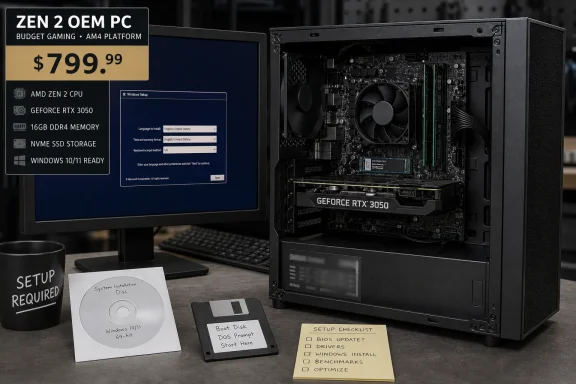
VideoCardz reported the retail sighting, attributing the Amazon listing to MEGAsizeGPU. TweakTown also discussed the system. According to that reporting, the machine is sold by system integrator Qehi under the AIGAMEPC brand for $799.99, down from a stated price of $849.99.The reported configuration combines the Ryzen 7 4700LE with a GeForce RTX 3050 8GB, 16GB of DDR4-3200 memory and a 512GB NVMe SSD. VideoCardz also reports Wi-Fi 6, six RGB fans and DOS as the operating system.
Nothing in that list makes the computer automatically unsuitable. The RTX 3050 supplies the discrete graphics required by the processor, 16GB is a workable memory capacity for mainstream Windows use, and an NVMe drive should provide the basic responsiveness expected from a modern desktop. The relevant question is whether the complete package is competitive at its delivered price.
The 512GB SSD could become a practical constraint for a gaming buyer. The operating system, applications, updates and recovery data will reduce the space available for games. That does not prove the included drive is inadequate for every buyer, but it makes the number and type of available storage-expansion connections important.
The RTX 3050 8GB is at least identified by model and memory capacity in the reporting. Buyers should nevertheless compare it with complete systems containing an equivalent GPU, RAM capacity and storage allocation rather than comparing the AIGAMEPC tower with machines built around materially different graphics hardware.
A price reduction from $849.99 to $799.99 does not establish value on its own. The comparison should use the total amount required to obtain a finished, supported PC:
| Comparison factor | What to confirm for the AIGAMEPC system | How to compare alternatives |
|---|---|---|
| Total delivered price | Purchase price, tax, shipping and the cost of a legitimate Windows license if one is not included | Use the delivered price of a system with an activated Windows installation |
| Motherboard | Exact manufacturer, model, firmware support, RAM slots and storage connections | Compare expansion options rather than the AM4 label alone |
| Power supply | Manufacturer, model, rated output and available GPU power connectors | Prefer systems that disclose the PSU and support planned upgrades |
| Memory layout | One 16GB DIMM or two 8GB DIMMs; total slot count; free slots | Compare both capacity and whether dual-channel operation is available |
| Storage expansion | Exact installed NVMe capacity and number of unused M.2 or SATA connections | Price systems with equivalent storage and similar expansion room |
| Warranty and returns | Warranty term, responsible support party, return window, shipping obligations and restocking fees | Compare practical support, not merely the stated warranty length |
| Equivalent hardware | RTX 3050 8GB, 16GB RAM and 512GB-class NVMe storage | Avoid treating a cheaper PC with weaker graphics or less memory as equivalent |
DOS Turns a Windows Purchase Into a Setup Project
For WindowsForum readers, the most consequential configuration detail may be VideoCardz’s report that the machine ships with DOS. Buyers should not assume that the advertised price includes a ready-to-use, licensed Windows installation.DOS is not a substitute for a modern Windows desktop environment. A customer expecting to unpack the tower and begin installing games may instead need to create installation media, install Windows, load device drivers and activate the operating system with a legitimate license. Depending on what the seller supplies, that can add cost, time and support complexity.
The exact license status should be resolved before purchase. Marketplace operating-system fields can be inconsistent, but the available reporting identifies DOS. Unless the seller confirms a valid Windows license and activation entitlement in writing, the safest comparison is to treat Windows as an additional cost.
That changes the value calculation. A $799.99 desktop without a Windows license is not directly equivalent to an equally priced system that includes an activated Windows installation, validated drivers, recovery tools and vendor support for reinstalling the operating system.
Installing Windows on an unfamiliar OEM configuration may be straightforward, but it can expose documentation gaps. Buyers may need to identify the motherboard and networking hardware, obtain drivers and review firmware settings. Wi-Fi 6 is useful only after the installed operating system has a working driver for the wireless adapter.
A clean installation may appeal to experienced users who prefer an uncluttered system. It is less appealing to a novice choosing a prebuilt to avoid assembly and configuration. For that buyer, the absence of a confirmed Windows license and completed setup should be treated as a material difference, not a minor footnote.
PCIe 3.0 Is a Platform Consideration, Not an Automatic Failure
PCIe 3.0 is sometimes discussed as if its presence alone makes a gaming PC obsolete. That is too broad. The impact depends on the installed hardware, workload and implementation, and the supplied reporting does not include direct benchmarks measuring the AIGAMEPC system against a newer PCIe platform.The practical concern is upgrade planning. A buyer considering a later GPU or NVMe upgrade should understand that the system begins with PCIe 3.0 connectivity. Some future components may operate with no meaningful problem for the buyer’s workload, while others may perform differently from the same component on a newer platform.
For an organization deploying these machines as workstations, the interface generation may be less important than purchase cost, reliability, warranty support and sufficient CPU thread capacity. Office applications, browsers and remote-access tools do not automatically require the newest desktop interface.
For a gaming buyer, the RTX 3050 may eventually become an upgrade target. Whether a replacement GPU encounters a meaningful CPU or interface limitation will depend on the selected card, game, settings and display resolution. Without benchmarks, it would be premature to declare a specific bottleneck or quantify a future penalty.
The reported 65W CPU TDP may make the factory processor relatively manageable, but it does not establish the power supply’s capability. A future graphics upgrade depends on the PSU’s actual manufacturer, model, rated output, connector set and build quality.
The six RGB fans also reveal little about measured cooling. Fan count does not establish airflow, acoustics, fan control or CPU-cooler quality. Those characteristics require component disclosure or independent testing.
AM4’s Long Life Creates Several Different Buying Cases
The 4700LE is not the only AM4 processor being discussed in current coverage. TweakTown connects it with broader interest in continued DDR4-era hardware, including the Ryzen 7 5800X3D. The products serve different buyers and should not be treated as interchangeable evidence about AM4’s value.A processor upgrade can make economic sense for someone who already owns a compatible motherboard, suitable firmware, working DDR4 memory, a good power supply and the rest of the system. Most of the platform has already been purchased.
A new prebuilt is a different calculation. The buyer is starting without an existing AM4 investment and accepting the platform because the complete system is expected to cost less than comparable alternatives. The delivered price and component quality therefore have to justify the choice.
| Processor | Role in the current AM4 discussion | Architecture stated in supplied reporting | Availability described | Practical significance |
|---|---|---|---|---|
| Ryzen 7 4700LE | System-builder CPU appearing in a new prebuilt | Zen 2, Renoir | OEM-only | Enables a DDR4 desktop that requires discrete graphics |
| Ryzen 7 5800X3D | Upgrade-oriented AM4 processor mentioned in coverage | Not established by the supplied fact set | Reported as re-released | Relevant mainly as an example of continued AM4 commercial activity |
| Ryzen 5 5600 | General comparison point raised in coverage | Not established by the supplied fact set | Not specified | Reminds buyers not to rank processors by core count alone |
DDR4 Does Not Prove That the System Is a Bargain
The usual argument for an AM4 system is that DDR4 memory and established motherboards can reduce platform costs. A system builder may use those savings to hit a lower retail price, include more memory or improve another component.That possibility should be tested against the actual complete-system price rather than assumed from the memory standard. Component pricing changes, and an older platform is not automatically the cheapest option at the moment a buyer places an order.
The included 16GB capacity is workable, but the module arrangement matters. If the system uses one 16GB DIMM, memory performance may differ from a properly configured two-module setup. If it uses two 8GB DIMMs and the motherboard has only two slots, increasing capacity would require replacing both modules. If the board has four slots, the expansion options may be more flexible.
None of those configurations is established by the supplied reporting. They are questions for the seller, not proof that the machine has been assembled poorly.
Storage should be evaluated in the same way. A 512GB NVMe drive may be sufficient for a light software library, but a gaming buyer should confirm whether the motherboard has another M.2 slot, whether SATA connections and drive bays are available, and whether opening the case for an upgrade affects warranty coverage.
The economic comparison should therefore remain compact: total delivered price with legitimate Windows licensing, exact motherboard and PSU disclosure, RAM-slot layout, storage expansion, warranty terms, and competing systems with equivalent GPU, RAM and storage.
Eight Cores Are Useful, but They Are Not a Complete Benchmark
The Ryzen 7 name and eight-core specification are strong retail hooks. They are also easy to overinterpret. A consumer may assume that Ryzen 7 is always faster than Ryzen 5, or that eight cores must outperform six regardless of architecture, software and system configuration.Neither shortcut is reliable. Gaming and application performance can depend on per-core throughput, latency, memory configuration, sustained clock behavior, cooling and the graphics workload. Core count matters, but its importance varies.
The 4700LE’s eight cores and 16 threads may be useful in workloads that can use them. Someone running several development tools, managing many active applications or using threaded productivity software may benefit. The available reporting, however, provides specifications rather than a benchmark suite for the finished AIGAMEPC desktop.
That absence calls for restraint in both directions. It would be wrong to dismiss the processor solely because it uses Zen 2, and equally wrong to declare it a bargain solely because it offers 16 threads.
The RTX 3050’s role should be handled with the same caution. Depending on the game and settings, graphics performance may matter more than CPU differences. A later GPU upgrade could change that balance, but the supplied facts do not establish where a bottleneck would occur or how severe it would be.
Independent measurements of game performance, thermals, noise, storage behavior and power consumption would provide a stronger basis for judgment. Until those exist, buyers should compare disclosed hardware, total cost and support rather than relying on predicted frame rates.
OEM-Only Means the Integrator Must Earn the Buyer’s Trust
The OEM-only label means the 4700LE should be evaluated as part of a finished PC rather than as an independently supported retail component. The integrator’s implementation is therefore inseparable from the processor’s value.Motherboard firmware is one concern. Physical AM4 socket compatibility does not guarantee that every AM4 motherboard recognizes every processor. The supplied reporting does not identify the board or firmware revision, so buyers should confirm both rather than assume that the 4700LE can be transferred to another AM4 motherboard.
The reverse concern applies to upgrades. The included motherboard may support other AM4 processors, but actual compatibility depends on the model, firmware and power-delivery design. An upgrade plan based on an unidentified motherboard remains speculative.
Warranty handling matters for the same reason. Buyers should determine whether Qehi, AIGAMEPC, the marketplace seller or another party handles system failures. They should also obtain the warranty term, return window, return address, shipping obligations and any restocking fee before ordering.
The power supply deserves equivalent scrutiny. Its brand, model, output and connectors are not established by the supplied reports. That lack of information does not prove poor quality, but it prevents a buyer from evaluating reliability or planning a graphics-card upgrade responsibly.
Action checklist for admins
- Confirm whether the computer includes a legitimate Windows license, which edition is supplied, whether activation is already completed and how the license can be recovered after a reinstall.
- If the listing still identifies DOS, budget for a Windows license and prepare installation media, chipset drivers, network drivers and graphics drivers before deployment.
- Obtain the exact motherboard manufacturer, model and installed firmware revision.
- Confirm that the motherboard firmware explicitly recognizes the Ryzen 7 4700LE and ask whether future firmware updates will be provided through the system vendor.
- Obtain the power-supply manufacturer, exact model, rated continuous output, efficiency certification and available PCIe power connectors.
- Verify whether the 16GB of DDR4-3200 is installed as one 16GB DIMM or two 8GB DIMMs.
- Confirm the motherboard’s total DIMM-slot count, current slot population, maximum supported capacity and validated memory speeds.
- Confirm the installed NVMe drive’s exact advertised capacity and model rather than relying only on a rounded “512GB” description.
- Ask how many M.2 slots the motherboard provides, how many are occupied and whether installing another drive disables any SATA ports.
- Confirm the number of available SATA connections, internal drive bays and required mounting hardware for future storage expansion.
- Request the written warranty term, return window, return address, restocking policy and confirmation of who pays shipping for a defective or unwanted system.
- Identify which company handles technical support and whether support covers Windows installation when the machine is sold with DOS.
- Ask whether opening the case to add RAM or storage affects warranty coverage.
- Record the motherboard, SSD, wireless adapter and GPU hardware IDs during initial deployment so replacement drivers can be located later.
- Connect the monitor to an HDMI or DisplayPort output on the RTX 3050, not to the motherboard video ports.
- Label or cover unused motherboard display connectors if the PCs will be deployed to nontechnical users.
- Test Windows activation, Wi-Fi, Ethernet, audio, all external ports, sleep and wake behavior, sustained CPU load and a graphics workload during the return period.
- Verify that the installed memory is operating in the intended channel configuration and at the advertised effective speed.
- Inspect temperatures, fan control and noise under sustained load rather than assuming that six installed fans guarantee effective cooling.
- Document the as-delivered firmware settings and create recovery media or a clean deployment image after the system passes validation.
- Compare the final deployed cost with current alternatives that include an equivalent GPU, 16GB of RAM, similar NVMe capacity and a legitimate Windows license.
The Price Must Carry the Entire Argument
The Ryzen 7 4700LE desktop is not disqualified merely because its architecture is older. Eight cores, 16 threads, DDR4 memory and an RTX 3050 can form a usable Windows or entry-level gaming system when the machine is assembled competently and priced below stronger alternatives.The unresolved details determine whether this particular offer reaches that standard. DOS may add licensing and deployment costs. A 512GB SSD may prompt an early storage upgrade. An unidentified motherboard complicates memory, storage and CPU planning, while an unidentified power supply prevents a confident assessment of future GPU options. These are open purchase questions rather than proof of defects.
The decisive comparison is therefore the finished cost of ownership. Add a legitimate Windows license if necessary, confirm the hardware that storefront marketing leaves unnamed, account for likely storage or memory upgrades, and compare the result with current systems offering equivalent graphics, RAM, storage and warranty coverage.
If the seller provides clear answers and the adjusted price remains meaningfully lower, the AIGAMEPC tower could serve buyers who prioritize usable thread capacity and modest discrete graphics over platform novelty. If the details remain unavailable or the full cost approaches better-documented alternatives, the Ryzen 7 badge and eight-core specification are not enough to close the gap.
The 4700LE’s future will ultimately be decided less by its product name than by the systems built around it. Transparent component disclosure, competent firmware support and realistic pricing could make it a sensible budget option. Without those conditions, buyers will be better served by waiting for independent testing or choosing a machine whose complete configuration can be evaluated before the return period begins.
References
- Primary source: TweakTown
Published: Thu, 09 Jul 2026 20:00:07 GMT
Mysterious AMD Ryzen 7 4700LE 'Zen 2' desktop CPU appears in a new prebuilt PC paired with an RTX 3050
AMD's Ryzen 7 4700LE, a Zen 2 desktop chip quietly launched in March, has curiously turned up in an $800 RTX 3050 prebuilt with DDR4 memory. www.tweaktown.com
- Independent coverage: videocardz.com
Published: Thu, 09 Jul 2026 11:40:30 GMT
- Related coverage: amd.com
- Related coverage: tomshardware.com
AMD revives aging Zen 2 processor for budget PCs — Ryzen 7 4700LE resurfaces in a new $800 RTX 3050 prebuilt | Tom's Hardware
AM4 is alive and kicking.www.tomshardware.com - Related coverage: trackaura.com
- Related coverage: wccftech.com
AMD Revives Zen 2 With The Ryzen 7 4700LE, An 8-Core Chip That Drops Integrated Graphics
AMD launches Ryzen 7 4700LE processor with 8 cores, 4.2 GHz boost, available OEM only; featured in Qehi prebuilt PC for $799.wccftech.com
- Related coverage: pcworld.com
AMD brought the Ryzen 7 5800X3D back because AM4 refuses to die | PCWorld
AMD’s Computex lineup includes a 10th-anniversary Ryzen 7 5800X3D for AM4 holdouts, a cheaper new 7700X3D, and a Radeon RX 9070 GRE that already feels familiar.www.pcworld.com - Related coverage: techspot.com
AMD Ryzen 5 5600 Specs | TechSpot
The AMD Ryzen 5 5600 is a desktop 6-core, 12-thread processor featuring a 3.5 GHz base clock, built on the 7 nm Vermeer (Zen 3) architecture for the Socket AM4 platform.www.techspot.com - Related coverage: pcgamer.com
'Return of the king': AMD is bringing back the Ryzen 7 5800X3D for DDR4 platforms, launching it alongside the mid-range AM5 Ryzen 7 7700X3D | PC Gamer
I suppose more options are always a good thing.www.pcgamer.com - Related coverage: computerbase.de
10 Years Anniversary Edition: Der AMD Ryzen 7 5800X3D für AM4 ist günstiger* zurück! - ComputerBase
Der AMD Ryzen 7 5800X3D ist zurück! Die 10 Years AMD AM4 Anniversary Edition macht Aufrüsten für Gamer auf Sockel AM4 wieder attraktiv.www.computerbase.de