

AMD’s CES 2026 keynote pushed the Ryzen AI 400 family front and center — AMD says these Zen 5-based APUs deliver major Windows 11 performance uplifts and AI acceleration that put Team Red ahead in the new Copilot+ PC era, but the numbers and comparisons carry important caveats that every buyer and tester should understand.
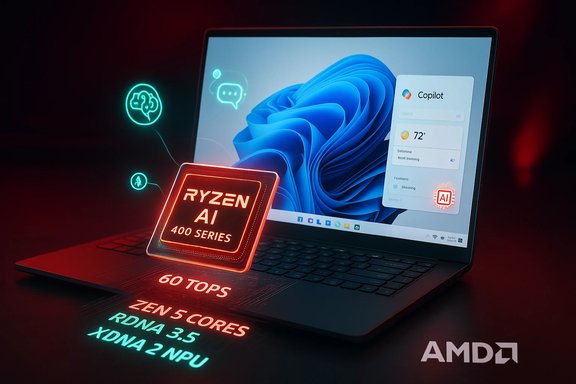
AMD used its CES stage to expand the Ryzen lineup into an AI‑first era, unveiling the Ryzen AI 400 family (and Ryzen AI PRO 400) and a set of Ryzen AI Max+ and Halo products intended for local inference, gaming, and developer workflows. The company highlights a second‑generation XDNA 2 NPU delivering up to 60 TOPS on top SKUs, faster memory, upgraded RDNA 3.5 integrated graphics, and up to 12 high‑performance CPU cores on mobile HX class parts. AMD positions the stack as ready for Microsoft’s Copilot+ certification and as optimized for Windows 11 AI experiences. The announcement included marketing charts and comparative claims versus Intel’s Core Ultra (and in AMD materials, against Intel Lunar Lake), with AMD presenting multitasking, content creation and gaming figures to support its performance leadership story. Independent trade press coverage and on‑site reporting amplified those claims while also flagging where AMD’s comparisons might be apples‑to‑oranges.
Source: Neowin https://www.neowin.net/news/amd-tou...e-benchmarks-on-ryzen-ai-400-series-vs-intel/
 Background
AMD used its CES stage to expand the Ryzen lineup into an AI‑first era, unveiling the Ryzen AI 400 family (and Ryzen AI PRO 400) and a set of Ryzen AI Max+ and Halo products intended for local inference, gaming, and developer workflows. The company highlights a second‑generation XDNA 2 NPU delivering up to 60 TOPS on top SKUs, faster memory, upgraded RDNA 3.5 integrated graphics, and up to 12 high‑performance CPU cores on mobile HX class parts. AMD positions the stack as ready for Microsoft’s Copilot+ certification and as optimized for Windows 11 AI experiences. The announcement included marketing charts and comparative claims versus Intel’s Core Ultra (and in AMD materials, against Intel Lunar Lake), with AMD presenting multitasking, content creation and gaming figures to support its performance leadership story. Independent trade press coverage and on‑site reporting amplified those claims while also flagging where AMD’s comparisons might be apples‑to‑oranges. What AMD announced: headline specifications and claims
Core product points
- Ryzen AI 400 and Ryzen AI PRO 400 Series — built on Zen 5 CPU cores (Zen 5 performance + Zen 5c efficiency hybrid in many SKUs) with integrated RDNA 3.5 graphics and XDNA 2 NPUs up to 60 TOPS. AMD states every SKU in the stack exceeds Microsoft’s Copilot+ PC TOPS requirements.
- Top mobile SKU (example): Ryzen AI 9 HX 475 — up to 12 cores / 24 threads, up to ~5.2 GHz boost, ~36 MB combined cache, LPDDR5X-8533 support, integrated Radeon 890M (RDNA 3.5) and up to 60 NPU TOPS.
- Ryzen AI Max+ and Ryzen AI Halo — product lines aimed at local model inference, higher unified memory capacity, and developer platforms with large‑model support. These target creators and on‑device AI workloads.
AMD’s performance narrative
AMD presented benchmarks showing:- Multitasking and content creation leads versus selected Intel mobile parts.
- Gaming advantages in some titles and a claimed overall uplift in CPU‑bound scenarios.
- AI inference and generative tasks markedly faster on AMD NPUs in its Procyon/Procyon‑style comparisons used in marketing.
Overview: Windows 11 performance angle
AMD emphasized Windows 11 as the primary delivery platform for on‑device AI features (Copilot+), and tied some of the Ryzen AI 400 messaging to Windows 11 performance. The company claims system‑level optimizations and the improved NPU enable “Copilot+‑ready” experiences and faster Procyon benchmarks used by OEMs. The messaging built on a longer narrative where Windows updates and scheduler optimizations have previously had an outsized impact on Ryzen platform performance. Notably, this is not the first time Windows‑level interactions have influenced Ryzen performance. Earlier Windows 11 updates (such as the 24H2/supplemental scheduler fixes) yielded measurable frame‑rate and productivity uplifts for some Ryzen parts, exposing how OS scheduler and branch‑prediction handling can change real‑world numbers even without new silicon. That history matters when interpreting any manufacturer benchmarks run on Windows builds selected by the vendor.Independent verification: what the press and specs corroborate
To validate AMD’s technical claims and contextualize the Windows 11 performance angle, the following independent sources corroborate the most important, verifiable points:- AMD’s official press release confirms the Ryzen AI 400 family, the XDNA 2 NPU up to 60 TOPS, Copilot+ positioning, and the general mobile SKU breakdown. Those are primary, verifiable product specifications.
- Trusted hardware press (Tom’s Hardware) reproduced AMD’s SKU list and spec matrix and called out the same 60 TOPS and clock/cache/memory figures for the HX‑class parts, providing a second independent record of the advertised hardware specs. Tom’s Hardware also highlighted that AMD’s comparative charts sometimes contrast the new chips against Intel Lunar Lake (last‑gen) rather than the very newest Intel announcements, a crucial context clue when assessing claimed leadership.
- Mainstream outlets (Reuters, The Verge) confirmed AMD’s CES keynote and summarized the product family and its Copilot+ ambitions; this corroboration anchors the news in independent reporting from multiple editorial teams.
What to watch: benchmarking methodology and comparison pitfalls
AMD’s CES presentations and marketing charts are useful for understanding intent and relative design goals, but they must be read carefully.Common pitfalls that can skew vendor charts
- Choice of comparison target: vendor materials frequently compare against an older or less directly comparable Intel part (for example Lunar Lake rather than the newest Panther Lake or Panther Lake variants). That can exaggerate perceived lead. Tom’s Hardware explicitly calls this out in its CES coverage.
- Power and configuration envelopes: mobile HX parts span 15–54W or 15–60W depending on OEM tuning. A 28W vs 30W comparison is not neutral; power limits and thermal solutions change outcomes dramatically. Microcenter reporting reproduced AMD’s SKUs and highlighted cTDP windows for this reason.
- Driver and firmware parity: NPUs, integrated GPUs and CPU cores all need mature drivers to reach steady performance. Marketing slides often reflect optimized firmware/driver states that may not be available to reviewers on day one.
- Use of game‑centric features: inclusion or exclusion of features like FSR, HYPR‑RX, vendor game boosters or upscalers can change apparent gaming advantages. Where AMD includes FSR comparisons, the advantage partly reflects feature stacking rather than raw architectural superiority.
Windows 11 and OS effects
Past Windows 11 updates (e.g., 24H2 and hotfixes) have demonstrably altered Ryzen performance in measurable ways, because OS scheduling, branch prediction enablement and system policy can change runtime behavior. That history means Windows‑specific claims require scrutiny: which Windows build, which update, and were any optional registry/administrative settings used during testing? The WindowsForum archival threads and community testing logs show just how sensitive Ryzen numbers have been to Windows updates in the past.Deep dive: strongest claims and which ones need independent proof
Credible, verifiable claims
- Hardware specs (core counts, clocks, cache, LPDDR5X support, 60 TOPS NPU): these are product specifications published by AMD and reproduced by reputable press outlets. They are verifiable and likely accurate.
- Copilot+ readiness: AMD’s statement that these NPUs meet or exceed Microsoft’s Copilot+ TOPS threshold is a product/marketing claim that aligns with Microsoft’s published Copilot+ hardware metrics; this is verifiable in the sense that the NPU TOPS are published and Copilot+ has public requirements.
Claims requiring caution / independent testing
- Aggregate performance leadership versus Intel: AMD’s charts (multitasking/content creation/AI/gaming) are marketing comparisons that need third‑party repeatable testing to confirm. Several outlets note AMD compared to Lunar Lake in places, which weakens force of the claim until cross‑benchmarks are available.
- Large percentage gains in specific games or AI tasks quoted in marketing decks should be treated as vendor‑supplied numbers until independent labs and reviewers replicate them under the same conditions (power limits, drivers, OS build).
- Claims of “75% faster” gaming or huge headroom in certain writeups originate from selective comparisons or press summaries that amplify marketing language; they must be independently reproduced. Such high multipliers are atypical across the board and suggest testing idiosyncrasies or algorithmic boosts (upscaling/FSR) rather than raw CPU superiority.
Practical guidance for testers and buyers
For reviewers and lab testers
- Recreate power and thermal envelopes used in vendor slides (document cTDP/TDP settings).
- Use the same Windows 11 build, driver versions, and BIOS/firmware provided to AMD during testing — then also test on current shipping driver/firmware to track differences.
- Test with and without vendor‑level AI/game features enabled (e.g., FSR, HYPR‑RX) to isolate architectural performance from software feature boosts.
- Include competing Intel Panther Lake/other current‑gen parts and ensure direct parity of GPU and RAM configurations where possible.
For consumers and buyers
- If your priority is on‑device AI and Copilot+ workflows, Ryzen AI 400 SKUs with 50–60 TOPS NPUs deliver measurable headroom for local inference. AMD’s product spec and ecosystem support (ROCm 7.2 and Adrenalin AI bundles) indicate a serious push for on‑device ML features.
- For gamers, the real‑world uplift will depend on GPU pairing and resolution: CPU‑bound 1080p scenarios and esports titles tend to show larger CPU impacts than 4K/ultra settings. Look for independent gaming tests that match your GPU and resolution before buying.
- For creators using AI‑assisted pipelines (local model inference, generative tools), the Max+ and Halo options with larger unified memory and higher local inference capability may be worth the premium if you need offline model work.
Risks, tradeoffs, and the longer horizon
Risk: marketing vs reality
AMD’s CES messaging is unambiguous: “AI everywhere.” But early‑ship systems can suffer driver immaturity or OEM tuning differences. Marketing slides are not substitutes for long‑tail reproducible tests, and buyers who base decisions solely on single‑slide comparisons may be disappointed.Risk: power and efficiency tradeoffs
Higher TOPS and higher boost clocks often mean higher local power draw in sustained workloads — thin‑and‑light systems may throttle to preserve battery life. AMD’s own materials show broad cTDP windows (15–54W) for mobile SKUs; actual sustained performance will vary by OEM cooling and power profiles.Ecosystem and tooling risk
On‑device AI benefits require developer support, frameworks (ROCm on Windows), and app integration. AMD’s announcement included ROCm 7.2 support and an AI bundle for Adrenalin, but broad ecosystem parity with competitors will take time. Developers need clear libraries, documentation and cross‑platform tools to make NPUs broadly useful beyond a handful of optimized demos.Strategic market risk for AMD
Aggressive marketing comparisons against slightly older Intel microarchitectures can prompt rapid counterplay from Intel and Qualcomm. The CPU/mobile market evolves quickly; performance leadership on a slide does not automatically translate to sustained market share or OEM preference if competitors respond with better or more efficient silicon. Reuters’ CES coverage put AMD’s announcements in the wider industry context: the AI hardware arms race is intensifying and competitors will respond.How this ties back to Windows 11 performance narratives
Windows 11 has become a focal point for vendor optimizations and occasional controversy, because OS scheduling and feature flags can swing measured performance. Community and review evidence from earlier Windows 11 updates showed Ryzen numbers are sensitive to system updates and optional Windows bits (e.g., admin mode branch‑prediction nuances and scheduler fixes). That history suggests any AMD vs Intel Windows‑centered claim should answer these questions precisely:- Which Windows 11 build was used?
- Were optional updates, registry changes or admin‑only features required?
- Which driver and firmware revisions were in use?
Conclusion — measured optimism
AMD’s Ryzen AI 400 series is an important, credible step in bringing strong on‑device NPU capability and Zen 5 performance to laptops and small form factors. The public specs (up to 60 TOPS, Zen 5 cores, RDNA 3.5 iGPU, LPDDR5X memory support) are consistent across AMD materials and independent press reporting and represent a meaningful evolution for Copilot+ and local AI scenarios. However, the performance comparisons shown at CES should be treated as vendor маркетинг — helpful for framing but not definitive. The metrics that matter most to users (gaming FPS at their target resolution, application throughput in their workloads, battery life under mixed use) require independent, reproducible testing done with transparent power, OS and driver settings. AMD’s slides are a strong signal that the company expects to compete aggressively in AI‑driven PC experiences, but the actual buyer‑facing value will be proven by third‑party benchmarks and by how quickly software and OEMs integrate the on‑device AI capabilities into real workflows. For Windows 11 users and testers, the recommended approach remains:- Wait for full independent reviews that mirror real‑world settings.
- Pay attention to the exact Windows build and driver stack used in any benchmark.
- Consider the balance between AI capability (TOPS), GPU and CPU performance, and the OEM implementation (thermal and power limits).
Source: Neowin https://www.neowin.net/news/amd-tou...e-benchmarks-on-ryzen-ai-400-series-vs-intel/
