

Advanced Micro Devices and Marvell Technology both reported AI-driven quarters in 2026, but AMD is the broader AI chip maker while Marvell is the more concentrated infrastructure supplier, making AMD the stronger all-around bet and Marvell the sharper, riskier play on hyperscale buildouts. That is the real distinction buried underneath the stock-comparison framing. These are not two versions of the same AI story. They are competing answers to where the most durable profit pools in artificial intelligence infrastructure will settle.
The easy version of the comparison says AMD makes AI chips and Marvell makes AI chips, so investors should pick the better chip stock. That framing is neat, but it is also misleading. AMD and Marvell are exposed to the same capital-spending boom, yet they sit in different places in the AI machine.
AMD is trying to become the credible merchant alternative to NVIDIA in high-performance accelerators, while also selling the EPYC CPUs that sit beside those accelerators and the Ryzen processors that still matter in PCs. Marvell is not trying to beat NVIDIA with a general-purpose GPU. It is trying to become indispensable to the hyperscalers building semi-custom AI systems, optical interconnects, switching silicon, and custom XPUs.
That makes AMD easier to understand and harder to dismiss. If cloud customers want a second source for AI accelerators, AMD has the product roadmap, supply-chain credibility, and server CPU relationships to get into the room. If the AI rack becomes more custom, more optical, and more vertically integrated, Marvell’s role becomes more valuable.
The investor’s dilemma is not whether AI demand is real. It is whether the more profitable layer is the visible accelerator franchise or the less glamorous plumbing that lets tens of thousands of accelerators behave like one system.
That matters because AMD has spent years being described in relation to somebody else. In CPUs, the reference point was Intel. In GPUs, the reference point is NVIDIA. But a Data Center segment growing 57 percent year over year begins to change the conversation from “Can AMD compete?” to “How much share can AMD reasonably take?”
The Meta agreement for up to 6 gigawatts of AMD Instinct GPUs gives that growth story credibility. It does not mean AMD has cracked NVIDIA’s moat, and it does not mean every forecasted deployment becomes shipped revenue on schedule. But it does mean the world’s largest AI infrastructure buyers are treating AMD as a strategic supplier, not merely as a bargaining chip.
The MI450 and Helios platform are crucial because they shift AMD’s pitch from component to system. AI buyers increasingly care less about a benchmarked chip in isolation and more about rack-scale performance, power, networking, software support, and deployment economics. AMD’s task is to prove that its next-generation platform is not just cheaper than NVIDIA, but operationally credible at hyperscale.
There is still an execution gap to close. NVIDIA’s advantage is not only silicon; it is software gravity, ecosystem habit, and the comfort of buying the incumbent. AMD can win meaningful business without becoming the market leader, but the bar for “meaningful” keeps rising as AI capex moves from pilot clusters to multi-gigawatt infrastructure plans.
The company’s AI demand is tied to the less visible layers of the rack: high-speed optics, Ethernet switching, interconnects, custom XPUs, and XPU-attach silicon. These are the places where AI scaling runs into physics. Moving data is becoming as important as processing data, and that gives Marvell a claim on one of the most painful bottlenecks in modern computing.
Matt Murphy’s comments about exceptional AI-related bookings are not just executive theater. Bookings matter for Marvell because custom silicon and infrastructure programs have long lead times, deep customer integration, and high switching friction once designed in. If those bookings convert as expected, Marvell’s revenue mix becomes even more levered to AI systems.
The Celestial AI and XConn acquisitions underline the strategy. Marvell is buying deeper into photonic fabric, PCIe, CXL, chiplet connectivity, and scale-up architectures because the AI rack is becoming a distributed computer. The chip that performs the math is only one part of the economic stack.
That is why Marvell can be the purer AI infrastructure trade without being the better AI chip maker in the everyday sense. It is less of a brand-name accelerator company and more of a hyperscaler co-pilot. When that model works, it can look brilliant; when a customer changes direction, it can look exposed.
Hyperscalers do not want a single-vendor world if they can avoid it. NVIDIA earned its position, but its dominance gives customers every incentive to cultivate alternatives. AMD benefits from that pressure even before it wins on pure technical parity.
The strategic question is whether AMD can turn procurement leverage into platform loyalty. A customer may buy Instinct GPUs to diversify supply, but it will only keep expanding deployments if the systems are efficient, manageable, and supported by a software stack that does not punish developers. That is the long campaign AMD is fighting.
EPYC gives AMD an advantage that is sometimes underplayed in AI stock debates. The company is not entering the data center as a stranger. It already has relationships, validation pathways, and credibility with server buyers, which can smooth the path for accelerator adoption.
Ryzen also gives AMD a cushion Marvell does not have. Client revenue is not the center of the AI story, but it helps fund the roadmap and diversify the earnings base. A broad company can disappoint in one segment and still compound; a narrow company has fewer places to hide.
This is not a fringe theory. The largest cloud companies already treat silicon as strategic infrastructure. They may still buy massive numbers of merchant accelerators, but they also want custom chips and interconnect architectures that give them cost, performance, or supply advantages.
That makes Marvell’s custom XPU business intriguing. The customer does not need Marvell to be a consumer-facing AI brand. The customer needs Marvell to execute on a complex chip program that fits into a broader rack, network, and optical architecture.
The risk is that hyperscaler ambition cuts both ways. The same customers that need partners today may pull more design work in-house tomorrow. A supplier embedded inside the rack can become indispensable, but it can also become one layer in a ruthless procurement exercise.
Customer concentration is therefore not a footnote. It is central to the Marvell thesis. If a few large cloud customers drive the majority of incremental AI demand, bookings momentum can become spectacular, but disappointment can travel through the income statement just as quickly.
That does not make the stocks doomed. Expensive companies can grow into expensive multiples if revenue accelerates, margins expand, and customers keep spending. But it does mean the margin for narrative error is thin.
AMD’s valuation asks investors to believe that Instinct ramps, EPYC strength, and client recovery can coexist without gross margins being crushed by the cost of competing against NVIDIA. The company must show not just that it can ship accelerators, but that it can sell them profitably in a market where buyers know they have leverage.
Marvell’s valuation asks investors to believe that bookings become revenue, revenue becomes earnings, and custom AI programs do not become lumpy one-off wins. The company’s narrower focus makes the upside cleaner, but it also means the stock has less insulation if AI infrastructure spending pauses or shifts.
The insider-selling concern around Marvell should be treated carefully. Insider selling is not automatically a negative signal; executives sell for taxes, diversification, estate planning, and ordinary liquidity. But persistent selling into a richly valued AI rally does add texture to the risk case, especially when the stock’s appeal depends on future conversion of today’s optimism.
This matters because AI chips are no longer just commercial products. They are strategic assets in a geopolitical contest over compute capacity. The U.S. government has shown repeated willingness to restrict the flow of advanced accelerators, and vendors must keep adjusting SKUs, forecasts, and inventory plans around that reality.
AMD can manage this risk, but it cannot eliminate it. The more important Instinct becomes to the company’s growth story, the more policy decisions can affect revenue timing and product mix. A China-specific accelerator strategy may soften the blow, but it remains vulnerable to rule changes.
Marvell is not immune to geopolitical risk, either. Any company serving advanced data-center infrastructure sits somewhere in the export-control and supply-chain conversation. But AMD’s merchant accelerator business is more visibly in the policy crosshairs because high-end GPUs are one of the clearest targets for restriction.
The result is a subtle asymmetry. AMD offers broader operating strength but carries a more obvious regulatory headline risk. Marvell offers more concentrated AI infrastructure exposure but carries more customer and program-conversion risk.
The back half of 2026 is therefore unusually important. If AMD’s guide proves conservative and Instinct demand converts into sustained Data Center acceleration, the company will look less like a challenger and more like the second pillar of merchant AI compute. That would justify a richer multiple than old AMD cycles ever deserved.
If the ramp stumbles, the market will be unforgiving. AI investors have become tolerant of enormous capital spending, but not of missed product windows. In this market, being late is almost the same as being absent.
For Marvell, the test is bookings conversion. “Exceptional AI-related bookings” is a strong phrase, but bookings must survive design schedules, customer budgets, deployment timing, and competitive pressure. The stock needs evidence that demand is not merely being pulled forward by a temporary scramble for capacity.
The more AI infrastructure becomes rack-scale, the more Marvell’s story makes sense. But the company must prove that its acquisitions, custom programs, and optical roadmap produce durable margins rather than just revenue growth. The difference between strategic supplier and expensive subcontractor will matter.
Marvell is the more direct bet on AI infrastructure complexity. If the future belongs to custom silicon, optical fabrics, and hyperscaler-specific rack architectures, Marvell could compound from a smaller base faster than AMD. But that is a narrower wager.
The distinction matters for WindowsForum readers because AI infrastructure is not an abstract Wall Street theme anymore. It influences server procurement, cloud pricing, developer platforms, workstation demand, power planning, and the shape of enterprise IT budgets. The chips being debated today will determine what kind of AI capacity is available tomorrow, and at what cost.
For sysadmins and IT pros, AMD’s rise is easier to translate into practical terms. More competition in accelerators and server CPUs can mean better availability, more pricing leverage, and broader platform choice. Marvell’s impact is less visible but potentially just as important, because faster interconnects and better rack-scale designs affect the performance and economics of the cloud services everyone consumes.
That is why this is not simply a stock-picking exercise. It is a map of how AI infrastructure is fragmenting. The old model of one dominant accelerator vendor selling into a generic data center is giving way to a more complicated world of rack-scale platforms, custom silicon, optical links, and workload-specific designs.
That is also why the risk profiles diverge. AMD must execute against the industry’s strongest incumbent. Marvell must depend on a smaller set of customers and programs while convincing investors that its place inside the rack is defensible.
For investors choosing between them, the decision is less about which company “believes in AI” and more about which bottleneck they think will command the better economics. Compute scarcity has defined the first phase of the AI boom. Data movement, power efficiency, and custom integration may define the next one.
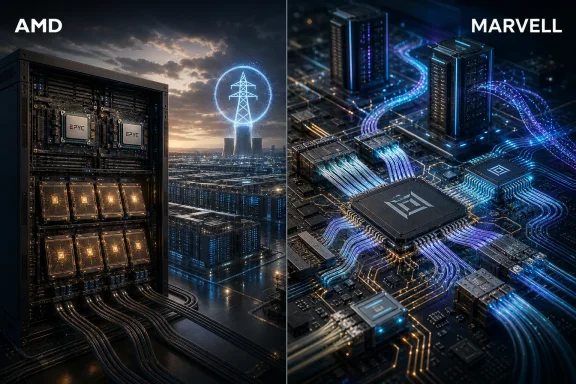 AMD Is Selling the Engine, Marvell Is Selling the Nervous System
The easy version of the comparison says AMD makes AI chips and Marvell makes AI chips, so investors should pick the better chip stock. That framing is neat, but it is also misleading. AMD and Marvell are exposed to the same capital-spending boom, yet they sit in different places in the AI machine.AMD is trying to become the credible merchant alternative to NVIDIA in high-performance accelerators, while also selling the EPYC CPUs that sit beside those accelerators and the Ryzen processors that still matter in PCs. Marvell is not trying to beat NVIDIA with a general-purpose GPU. It is trying to become indispensable to the hyperscalers building semi-custom AI systems, optical interconnects, switching silicon, and custom XPUs.
That makes AMD easier to understand and harder to dismiss. If cloud customers want a second source for AI accelerators, AMD has the product roadmap, supply-chain credibility, and server CPU relationships to get into the room. If the AI rack becomes more custom, more optical, and more vertically integrated, Marvell’s role becomes more valuable.
The investor’s dilemma is not whether AI demand is real. It is whether the more profitable layer is the visible accelerator franchise or the less glamorous plumbing that lets tens of thousands of accelerators behave like one system.
The Quarter Made AMD Look Less Like a Hope Trade
AMD’s first-quarter 2026 results gave its AI story something it has often lacked: scale. Revenue of roughly $10.25 billion and Data Center revenue of about $5.8 billion are not speculative proof points. They are operating evidence that AMD’s server and accelerator portfolio is now the center of the company rather than an adjacent growth narrative.That matters because AMD has spent years being described in relation to somebody else. In CPUs, the reference point was Intel. In GPUs, the reference point is NVIDIA. But a Data Center segment growing 57 percent year over year begins to change the conversation from “Can AMD compete?” to “How much share can AMD reasonably take?”
The Meta agreement for up to 6 gigawatts of AMD Instinct GPUs gives that growth story credibility. It does not mean AMD has cracked NVIDIA’s moat, and it does not mean every forecasted deployment becomes shipped revenue on schedule. But it does mean the world’s largest AI infrastructure buyers are treating AMD as a strategic supplier, not merely as a bargaining chip.
The MI450 and Helios platform are crucial because they shift AMD’s pitch from component to system. AI buyers increasingly care less about a benchmarked chip in isolation and more about rack-scale performance, power, networking, software support, and deployment economics. AMD’s task is to prove that its next-generation platform is not just cheaper than NVIDIA, but operationally credible at hyperscale.
There is still an execution gap to close. NVIDIA’s advantage is not only silicon; it is software gravity, ecosystem habit, and the comfort of buying the incumbent. AMD can win meaningful business without becoming the market leader, but the bar for “meaningful” keeps rising as AI capex moves from pilot clusters to multi-gigawatt infrastructure plans.
Marvell’s AI Story Is Narrower, and That Is the Point
Marvell’s quarter reads differently because the company is not pitching breadth. Revenue of about $2.4 billion is far smaller than AMD’s, but Data Center made up roughly three-quarters of the business. That concentration is both Marvell’s appeal and its vulnerability.The company’s AI demand is tied to the less visible layers of the rack: high-speed optics, Ethernet switching, interconnects, custom XPUs, and XPU-attach silicon. These are the places where AI scaling runs into physics. Moving data is becoming as important as processing data, and that gives Marvell a claim on one of the most painful bottlenecks in modern computing.
Matt Murphy’s comments about exceptional AI-related bookings are not just executive theater. Bookings matter for Marvell because custom silicon and infrastructure programs have long lead times, deep customer integration, and high switching friction once designed in. If those bookings convert as expected, Marvell’s revenue mix becomes even more levered to AI systems.
The Celestial AI and XConn acquisitions underline the strategy. Marvell is buying deeper into photonic fabric, PCIe, CXL, chiplet connectivity, and scale-up architectures because the AI rack is becoming a distributed computer. The chip that performs the math is only one part of the economic stack.
That is why Marvell can be the purer AI infrastructure trade without being the better AI chip maker in the everyday sense. It is less of a brand-name accelerator company and more of a hyperscaler co-pilot. When that model works, it can look brilliant; when a customer changes direction, it can look exposed.
The NVIDIA Alternative Is a Better Business Than It Sounds
Calling AMD the NVIDIA alternative can sound like damning with faint praise. In older semiconductor cycles, being the second supplier often meant lower margins, weaker software, and cyclical scraps. In AI infrastructure, second source status can still be a very large business.Hyperscalers do not want a single-vendor world if they can avoid it. NVIDIA earned its position, but its dominance gives customers every incentive to cultivate alternatives. AMD benefits from that pressure even before it wins on pure technical parity.
The strategic question is whether AMD can turn procurement leverage into platform loyalty. A customer may buy Instinct GPUs to diversify supply, but it will only keep expanding deployments if the systems are efficient, manageable, and supported by a software stack that does not punish developers. That is the long campaign AMD is fighting.
EPYC gives AMD an advantage that is sometimes underplayed in AI stock debates. The company is not entering the data center as a stranger. It already has relationships, validation pathways, and credibility with server buyers, which can smooth the path for accelerator adoption.
Ryzen also gives AMD a cushion Marvell does not have. Client revenue is not the center of the AI story, but it helps fund the roadmap and diversify the earnings base. A broad company can disappoint in one segment and still compound; a narrow company has fewer places to hide.
Marvell Is Betting That Hyperscalers Want Their Own Silicon
Marvell’s most compelling argument is that the AI market will not remain a simple contest among merchant GPU vendors. Google, Amazon, Microsoft, Meta, and other hyperscalers have strong incentives to customize silicon around their own workloads, power budgets, networking assumptions, and data-center designs. Marvell wants to be the partner that makes that customization possible.This is not a fringe theory. The largest cloud companies already treat silicon as strategic infrastructure. They may still buy massive numbers of merchant accelerators, but they also want custom chips and interconnect architectures that give them cost, performance, or supply advantages.
That makes Marvell’s custom XPU business intriguing. The customer does not need Marvell to be a consumer-facing AI brand. The customer needs Marvell to execute on a complex chip program that fits into a broader rack, network, and optical architecture.
The risk is that hyperscaler ambition cuts both ways. The same customers that need partners today may pull more design work in-house tomorrow. A supplier embedded inside the rack can become indispensable, but it can also become one layer in a ruthless procurement exercise.
Customer concentration is therefore not a footnote. It is central to the Marvell thesis. If a few large cloud customers drive the majority of incremental AI demand, bookings momentum can become spectacular, but disappointment can travel through the income statement just as quickly.
Valuation Has Already Heard the AI Story
The uncomfortable part of both stocks is that the market is not asleep. Forward earnings multiples in the range cited by 24/7 Wall St. are not bargain-bin prices. They reflect an investor base already willing to pay for AI growth that has not fully arrived in reported earnings.That does not make the stocks doomed. Expensive companies can grow into expensive multiples if revenue accelerates, margins expand, and customers keep spending. But it does mean the margin for narrative error is thin.
AMD’s valuation asks investors to believe that Instinct ramps, EPYC strength, and client recovery can coexist without gross margins being crushed by the cost of competing against NVIDIA. The company must show not just that it can ship accelerators, but that it can sell them profitably in a market where buyers know they have leverage.
Marvell’s valuation asks investors to believe that bookings become revenue, revenue becomes earnings, and custom AI programs do not become lumpy one-off wins. The company’s narrower focus makes the upside cleaner, but it also means the stock has less insulation if AI infrastructure spending pauses or shifts.
The insider-selling concern around Marvell should be treated carefully. Insider selling is not automatically a negative signal; executives sell for taxes, diversification, estate planning, and ordinary liquidity. But persistent selling into a richly valued AI rally does add texture to the risk case, especially when the stock’s appeal depends on future conversion of today’s optimism.
Export Controls Are the Policy Risk AMD Cannot Engineer Away
AMD’s China exposure adds a different kind of uncertainty. Export controls on advanced AI accelerators have already reshaped what U.S. chip companies can sell into China, and that policy environment is not stable enough for investors to treat it as background noise. A product can be technically strong and still be commercially constrained by regulation.This matters because AI chips are no longer just commercial products. They are strategic assets in a geopolitical contest over compute capacity. The U.S. government has shown repeated willingness to restrict the flow of advanced accelerators, and vendors must keep adjusting SKUs, forecasts, and inventory plans around that reality.
AMD can manage this risk, but it cannot eliminate it. The more important Instinct becomes to the company’s growth story, the more policy decisions can affect revenue timing and product mix. A China-specific accelerator strategy may soften the blow, but it remains vulnerable to rule changes.
Marvell is not immune to geopolitical risk, either. Any company serving advanced data-center infrastructure sits somewhere in the export-control and supply-chain conversation. But AMD’s merchant accelerator business is more visibly in the policy crosshairs because high-end GPUs are one of the clearest targets for restriction.
The result is a subtle asymmetry. AMD offers broader operating strength but carries a more obvious regulatory headline risk. Marvell offers more concentrated AI infrastructure exposure but carries more customer and program-conversion risk.
The Real Test Is Not This Quarter, but the 2026 Ramp
Quarterly results are useful, but they are not the decisive evidence in this comparison. For AMD, the decisive evidence will be MI450 volume, Helios deployments, and whether Meta-scale commitments become repeatable across other hyperscalers and cloud customers. Announcements are necessary; shipments are what change the income statement.The back half of 2026 is therefore unusually important. If AMD’s guide proves conservative and Instinct demand converts into sustained Data Center acceleration, the company will look less like a challenger and more like the second pillar of merchant AI compute. That would justify a richer multiple than old AMD cycles ever deserved.
If the ramp stumbles, the market will be unforgiving. AI investors have become tolerant of enormous capital spending, but not of missed product windows. In this market, being late is almost the same as being absent.
For Marvell, the test is bookings conversion. “Exceptional AI-related bookings” is a strong phrase, but bookings must survive design schedules, customer budgets, deployment timing, and competitive pressure. The stock needs evidence that demand is not merely being pulled forward by a temporary scramble for capacity.
The more AI infrastructure becomes rack-scale, the more Marvell’s story makes sense. But the company must prove that its acquisitions, custom programs, and optical roadmap produce durable margins rather than just revenue growth. The difference between strategic supplier and expensive subcontractor will matter.
AMD Wins on Breadth, Marvell Wins on Purity
If the question is the better AI chip maker, AMD has the stronger claim. It makes the accelerators, sells the CPUs, owns a broader compute platform, and has the scale to fund an extended fight. Its AI story is no longer hypothetical, and its non-AI segments give investors more ways to be right.Marvell is the more direct bet on AI infrastructure complexity. If the future belongs to custom silicon, optical fabrics, and hyperscaler-specific rack architectures, Marvell could compound from a smaller base faster than AMD. But that is a narrower wager.
The distinction matters for WindowsForum readers because AI infrastructure is not an abstract Wall Street theme anymore. It influences server procurement, cloud pricing, developer platforms, workstation demand, power planning, and the shape of enterprise IT budgets. The chips being debated today will determine what kind of AI capacity is available tomorrow, and at what cost.
For sysadmins and IT pros, AMD’s rise is easier to translate into practical terms. More competition in accelerators and server CPUs can mean better availability, more pricing leverage, and broader platform choice. Marvell’s impact is less visible but potentially just as important, because faster interconnects and better rack-scale designs affect the performance and economics of the cloud services everyone consumes.
That is why this is not simply a stock-picking exercise. It is a map of how AI infrastructure is fragmenting. The old model of one dominant accelerator vendor selling into a generic data center is giving way to a more complicated world of rack-scale platforms, custom silicon, optical links, and workload-specific designs.
The AI Rack Is Big Enough for Two Winners, but Not the Same Winner
The cleanest takeaway from the AMD-versus-Marvell comparison is that both companies can win without winning the same market. AMD’s upside comes from becoming the most credible alternative platform for merchant AI compute. Marvell’s upside comes from making the custom AI rack work.That is also why the risk profiles diverge. AMD must execute against the industry’s strongest incumbent. Marvell must depend on a smaller set of customers and programs while convincing investors that its place inside the rack is defensible.
For investors choosing between them, the decision is less about which company “believes in AI” and more about which bottleneck they think will command the better economics. Compute scarcity has defined the first phase of the AI boom. Data movement, power efficiency, and custom integration may define the next one.
- AMD is the better broad AI chip maker because its Data Center business now combines EPYC CPUs, Instinct GPUs, and rack-scale platform ambitions at a scale Marvell cannot match.
- Marvell is the cleaner pure-play on AI infrastructure plumbing because most of its revenue is already tied to data-center demand, optics, switching, and custom silicon.
- AMD’s Meta partnership gives its MI450 and Helios roadmap a concrete hyperscale anchor, but the company still has to prove the ramp in shipped revenue.
- Marvell’s bookings momentum is impressive, but the investment case depends on converting those bookings into durable, profitable revenue across custom programs.
- Both stocks already price in a large amount of AI optimism, so execution risk matters more than headline growth.
- The better choice depends on whether an investor wants diversified exposure to AI compute or a more concentrated bet on the architecture of hyperscale racks.
References
- Primary source: 24/7 Wall St.
Published: Wed, 01 Jul 2026 17:01:15 GMT
Advanced Micro Devices vs Marvell Technology: The Better AI Chip Maker - 24/7 Wall St.
Advanced Micro Devices (NASDAQ: AMD | AMD Price Prediction) and Marvell Technology (NASDAQ: MRVL) both just reported quarters that put AI infrastructure at the center of their stories. AMD posted $10.25 billion in Q1 revenue powered by Instinct GPUs and EPYC servers. Marvell pulled $2.418...247wallst.com - Related coverage: marvell.com
- Related coverage: investor.marvell.com
March 11, 2026 - 10-K: Annual report [Section 13 and 15(d), not S-K Item 405] | Marvell Technology, Inc. (MRVL)
Browse official DOCUMENTS including 10-Ks, 10-Qs, 8-Ks, and proxy statements.investor.marvell.com - Related coverage: investing.com
Marvell completes acquisition of XConn Technologies By Investing.com
Marvell completes acquisition of XConn Technologieswww.investing.com - Related coverage: finance.yahoo.com
Marvell Q1 2027 earnings beat on AI data center demand
The chipmaker posted record quarterly revenue of $2.42 billion and guided for $2.70 billion next quarter, citing exceptional AI-related bookingsfinance.yahoo.com - Related coverage: app.dealroom.co
Marvell reports record Q1 revenue of $2.42B, up 28% year-over-year, driven by AI demand | Dealroom.co
Marvell Technology reported first-quarter fiscal 2027 revenue of $2.418 billion, up 28% year-over-year and slightly above guidance. Non-GAAP net income was $718.0 million, or $0.80 per diluted share, whilst cash flow from operations reached a record $638.8 million. The company completed...app.dealroom.co
- Related coverage: marketscreener.com
- Related coverage: sdxcentral.com
Marvell completes $3.25B acquisition of photonic startup Celestial AI - SDxCentral
Fabless chip designer bets big on optical interconnects to boost data center capabilitieswww.sdxcentral.com - Related coverage: tomshardware.com
Nvidia invests $2 billion in Marvell to deepen NVLink Fusion partnership — signs deal with one of its biggest competitors | Tom's Hardware
The deal pulls one of the biggest custom ASIC designers into Nvidia's proprietary interconnect ecosystem.www.tomshardware.com - Related coverage: d1io3yog0oux5.cloudfront.net

