

CRN’s mid-2026 list of hot agentic AI products captures a market that has moved, in barely two years, from chatbot demos to enterprise platforms that can plan work, call tools, enforce policy, and act across live systems. The winners are not simply the flashiest assistants. They are the companies trying to own the operating layer where agents touch identity, data, security, infrastructure, and cost. That is why the real story is less “AI gets smarter” than “AI gets administrative privileges.”
The most important shift in CRN’s roundup is not that AWS, Cisco, Microsoft, Google, Dell, Nutanix, Databricks, VMware, Cynomi, and Zscaler have all found a way to bolt the word agentic onto their product lines. It is that they are converging on the same thesis: the next software user may not be a person staring at a screen, but an AI process acting on that person’s behalf.
That changes the shape of enterprise computing. A chatbot can be annoying when it hallucinates. An agent that books a meeting, changes firewall rules, pulls customer data, edits a spreadsheet, or opens a service ticket can be operationally consequential. The industry is racing to build the control planes before customers discover, painfully, that “AI productivity” also means “AI blast radius.”
The most credible products in the group are therefore not the ones promising magic. They are the ones acknowledging friction: permissions, audit trails, model routing, token costs, local inference, data residency, tool access, and rollback. Agentic AI is being sold as autonomy, but in the enterprise it will live or die by constraint.
The strategic bet is obvious. If agentic AI moves from proof-of-concept notebooks into production applications, enterprises will need a place to host the orchestration loop. They will need a runtime that can call tools, recover from errors, manage context, store memory, and enforce security policies without every developer reinventing the same brittle framework.
AgentCore’s newer web search and managed knowledge-base capabilities show AWS trying to solve two painful problems at once. Agents need fresh information, but enterprises do not want sensitive prompts and data sprayed across third-party services. Agents also need internal context, but unstructured company knowledge is usually scattered across documents, repositories, tickets, and stale wikis.
The security integration with Bedrock Guardrails is a reminder that agents are not just language models with longer prompts. They are decision engines with hands. Prompt injection, sensitive-data exposure, and harmful outputs become more serious when the model is taking actions through tools, APIs, and workflow systems.
For WindowsForum readers who live in hybrid estates, the AWS angle is familiar: the cloud provider wants to make agent infrastructure feel like just another managed service. That will appeal to platform teams that already operate inside AWS, but it also risks deeper lock-in at the very moment many enterprises are trying to keep their AI options open.
That is a higher-stakes proposition. In a Cisco-shaped enterprise, an agent could detect degradation, correlate telemetry, recommend remediation, and eventually push changes across the stack. This is the dream behind AgenticOps: not dashboards with AI summaries, but a shared operating environment where humans and agents see the same data and act from the same system of record.
The phrase “humans stay in control” appears often in this category because vendors know exactly what customers fear. Nobody wants an unsupervised agent deciding that a routing change, endpoint isolation action, or policy adjustment is a good idea at 2 a.m. The challenge is that the economic pitch of agents depends on reducing human bottlenecks, while the trust pitch depends on preserving them.
Cisco’s advantage is breadth. It already has tentacles in networking, security, observability, collaboration, and increasingly Splunk-powered telemetry. If Cloud Control can actually normalize that data into a coherent operational layer, it could give agents something most enterprise AI pilots lack: situational awareness.
The danger is platform gravity. The more agentic operations depend on Cisco’s view of the world, the more customers may ask whether the “single pane of glass” is a productivity breakthrough or another management silo with AI branding. In large IT estates, the answer may be both.
That makes Cowork strategically potent. Microsoft already owns the place where many employees live all day: Outlook, Teams, Word, Excel, PowerPoint, SharePoint, OneDrive, and Entra-governed identity. If an agent can operate across that surface without complex connectors or data movement, Microsoft gains an enormous distribution advantage.
The Anthropic collaboration is also notable. Microsoft’s AI strategy is no longer reducible to “OpenAI everywhere.” The company is moving toward a multi-model reality, where different model providers are selected for different workloads, and customers are asked to trust Microsoft’s governance layer as the stable enterprise wrapper around a shifting model market.
For admins, the big questions are practical rather than philosophical. What exactly can Cowork do without approval? How granular are the controls? How visible are its actions after the fact? Can a tenant admin distinguish between a user action, an AI-suggested action, and an AI-executed action when auditing a sensitive incident?
The product’s promise is easy to understand. Every organization has repetitive coordination work that consumes expensive human time. But the Microsoft 365 tenant is also where sensitive documents, HR discussions, financial drafts, legal strategy, and executive communications live. Cowork is compelling because it is close to the data; it is risky for the same reason.
That matters because the first generation of enterprise AI adoption was chaotic. Teams experimented with public chatbots, SaaS copilots, internal scripts, retrieval-augmented prototypes, and browser extensions, often faster than security teams could inventory them. Google’s platform pitch is that agents need the same kind of governance fabric that applications, users, and workloads already require.
The agent registry is especially important. Enterprises cannot govern what they cannot find. Once agents begin spawning sub-agents, delegating tasks, and connecting to MCP servers or internal tools, the inventory problem becomes more complex than traditional app discovery.
Agent identity is equally critical. A human user has a role, group membership, device posture, session history, and audit trail. An agent acting for that user needs its own traceable identity, or else every downstream action becomes a murky blend of user intent, model reasoning, tool execution, and vendor abstraction.
Google’s challenge is not whether it can build strong AI infrastructure. It can. The question is whether enterprises already standardized on Microsoft 365, AWS, or mixed environments will view Gemini Enterprise as a neutral enough control plane. In the agent era, neutrality may become just as valuable as model quality.
Genie One’s pitch is that a business agent should not reason from a bag of document fragments when it can work from governed, curated, operational data. The Genie Ontology is the interesting piece because it attempts to create a living context layer that maps how the business actually understands itself.
That is a more serious approach than the familiar “chat with your data” demo. Business users do not merely want a friendly interface over SQL. They want an agent that can explain why margins changed, identify upsell opportunities, or help close the books without inventing definitions along the way.
Databricks is also aiming at token economics. If an agent can answer through structured queries and known business semantics rather than stuffing enormous context windows with raw files, the result may be cheaper, faster, and more reliable. In a world where agent usage can generate runaway inference bills, that matters.
The limitation is that ontology is hard organizational work wearing a product badge. Tools can infer, map, and update context, but companies still need data discipline. Genie One may be powerful for customers already invested in Databricks-style governance; it may be less magical for organizations whose data estate remains a political battlefield.
Dell’s argument is straightforward: if you can run, build, test, and fine-tune agentic workflows on local high-performance workstations, you may avoid some of the cost and data-movement concerns of cloud-only approaches. The company’s claimed savings versus public cloud will need customer-by-customer scrutiny, but the direction is plausible. Agents that run constantly, call tools repeatedly, and process sensitive data can become expensive in a hurry.
The workstation angle also fits a familiar enterprise pattern. Before every workload becomes a managed platform, power users and specialized teams want local control. Developers, researchers, engineers, analysts, and regulated-industry workers may prefer an agentic environment close to the data and hardware they already trust.
Nutanix comes at the same problem from the private-cloud side. Its Agentic AI stack, integrated with Nvidia’s ecosystem, is designed to make GPU-dense infrastructure more manageable and economically predictable. That is not glamorous, but it is the part of AI deployment that decides whether projects survive procurement review.
The shared message from Dell and Nutanix is that agentic AI is becoming an infrastructure workload, not merely a SaaS feature. Once agents move from demos to production, somebody must manage GPUs, placement, virtualization, networking, model services, gateways, and governance. The winners may be the vendors that make AI operations boring enough to trust.
This reflects a hard lesson from cloud-native computing. Developers like flexible abstractions; security teams like boundaries. The platform’s job is to give developers useful building blocks without allowing every agent to become a privileged script with a conversational interface.
The VMware angle is also about continuity. Many enterprises are not going to rebuild their entire estate around one hyperscaler’s agent framework. They already have VMware Cloud Foundation, internal applications, private models, public models, and compliance requirements. Tanzu Agent Foundations is trying to become the place where those elements can be exposed to agents without turning the whole environment into an open buffet.
The centralized AI gateway is the control point to watch. If it can govern model access, tool availability, usage, cost, and safety filters across public and private models, it becomes a practical enforcement layer. If it becomes another complicated platform tax, developers will route around it.
Broadcom-era VMware has a trust problem with some customers because licensing and portfolio changes have made many IT leaders wary. But the technical premise here is sound: agentic applications need a runtime that treats autonomy as a risk to be managed, not a slogan to be celebrated.
Cynomi’s approach is aimed at managed service providers that need to scale advisory work without hiring an army of senior CISOs. If an agent can generate client-ready policies, remediation plans, executive reports, risk explanations, and audit support, MSPs can package higher-value security services for more customers. The appeal is obvious in the midmarket, where security needs are growing faster than budgets and talent pipelines.
The risk is that security advice can become templated theater. A virtual CISO agent that produces polished reports is useful only if the underlying assessment, prioritization, and remediation guidance are accurate. MSPs will need to treat these systems as accelerators, not substitutes for accountability.
Zscaler’s focus is more infrastructural. Agentic AI breaks many assumptions behind traditional security monitoring because agents may create ephemeral identities, call APIs at machine speed, chain tools together, and access data through browser, plugin, SaaS, and cloud layers. The old model of watching human users click known applications is not enough.
That is why the AI Access Graph concept is important. Security teams need to understand which users, agents, identities, models, applications, and data sources are interacting. Without lineage, agent activity becomes a fog of automated intent. With lineage, policies can at least be tied to observable relationships.
The broader lesson is that security vendors are moving from “block risky AI tools” to “govern AI activity as a normal enterprise traffic pattern.” That is the right evolution. Shadow AI cannot be solved by pretending agents will not be used.
But the channel should be careful not to sell autonomy faster than customers can absorb it. Many enterprises still struggle with identity hygiene, data classification, SaaS sprawl, endpoint management, logging, backup discipline, and basic change control. Dropping agentic AI into that environment will not magically modernize it. It may expose the mess faster.
The strongest partners will be the ones that start with operational readiness. Does the customer know where sensitive data lives? Are permissions overbroad? Are logs centralized? Are workflows documented? Is there a human approval model for high-impact actions? Can the organization measure token and infrastructure costs?
The weakest partners will chase demos. They will show agents drafting reports, opening tickets, and summarizing dashboards without answering what happens when the agent is wrong. In 2026, every AI sales pitch should include the recovery story: audit, rollback, escalation, containment, and cost control.
For Windows-heavy organizations, this is especially relevant. Microsoft 365, Entra ID, Intune, Defender, Azure, Windows endpoints, and legacy line-of-business applications already form a dense administrative surface. Agentic AI will either simplify that environment or create another layer of automation that nobody fully owns.
This fragmentation is not temporary noise. It reflects the fact that agents do not fit neatly into one existing category. They are part application, part user, part workload, part integration middleware, part security subject, and part cost center.
That is why enterprises should resist the urge to anoint one universal agent platform too early. The market is still sorting out which layer has the most leverage. In some companies, the Microsoft 365 work graph will dominate. In others, data platforms or cloud runtimes will matter more. In security-sensitive environments, zero-trust enforcement and local infrastructure may set the pace.
The hard part will be interoperability. Agents that cannot cross systems will be underpowered. Agents that cross systems without common identity, policy, and logging will be dangerous. The next standards fight will not be about chat interfaces; it will be about how agents authenticate, request permissions, discover tools, exchange context, and prove what they did.
This is where Microsoft’s ecosystem power, AWS’s infrastructure depth, Google’s AI stack, Cisco’s telemetry, and Zscaler’s security fabric could collide. Customers should hope for open protocols and portable governance. Vendors, predictably, will discover many reasons their version of openness works best inside their own platforms.
The agentic AI market of 2026 is moving from spectacle to systems, and that is good news for serious buyers. Chatbots made AI visible; agents will make it accountable, expensive, useful, and risky in equal measure. The companies in CRN’s list are not merely competing to build smarter assistants. They are competing to define who, or what, gets to act inside the enterprise—and the organizations that answer that governance question early will be the ones that turn agentic AI from a demo into durable advantage.
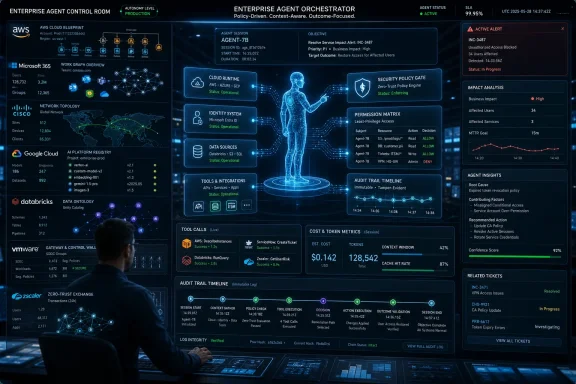 The Agent Is Becoming the New Enterprise Client
The most important shift in CRN’s roundup is not that AWS, Cisco, Microsoft, Google, Dell, Nutanix, Databricks, VMware, Cynomi, and Zscaler have all found a way to bolt the word agentic onto their product lines. It is that they are converging on the same thesis: the next software user may not be a person staring at a screen, but an AI process acting on that person’s behalf.That changes the shape of enterprise computing. A chatbot can be annoying when it hallucinates. An agent that books a meeting, changes firewall rules, pulls customer data, edits a spreadsheet, or opens a service ticket can be operationally consequential. The industry is racing to build the control planes before customers discover, painfully, that “AI productivity” also means “AI blast radius.”
The most credible products in the group are therefore not the ones promising magic. They are the ones acknowledging friction: permissions, audit trails, model routing, token costs, local inference, data residency, tool access, and rollback. Agentic AI is being sold as autonomy, but in the enterprise it will live or die by constraint.
AWS Wants the Agent Factory Before Anyone Standardizes the Assembly Line
AWS Bedrock AgentCore is the most predictable product in the list, and that is precisely why it matters. Amazon’s cloud playbook has always been to turn messy infrastructure patterns into managed primitives, then let customers assemble them at scale. AgentCore applies that same logic to agents: define the model, tools, instructions, memory, context, and guardrails, and let AWS provide the runtime machinery.The strategic bet is obvious. If agentic AI moves from proof-of-concept notebooks into production applications, enterprises will need a place to host the orchestration loop. They will need a runtime that can call tools, recover from errors, manage context, store memory, and enforce security policies without every developer reinventing the same brittle framework.
AgentCore’s newer web search and managed knowledge-base capabilities show AWS trying to solve two painful problems at once. Agents need fresh information, but enterprises do not want sensitive prompts and data sprayed across third-party services. Agents also need internal context, but unstructured company knowledge is usually scattered across documents, repositories, tickets, and stale wikis.
The security integration with Bedrock Guardrails is a reminder that agents are not just language models with longer prompts. They are decision engines with hands. Prompt injection, sensitive-data exposure, and harmful outputs become more serious when the model is taking actions through tools, APIs, and workflow systems.
For WindowsForum readers who live in hybrid estates, the AWS angle is familiar: the cloud provider wants to make agent infrastructure feel like just another managed service. That will appeal to platform teams that already operate inside AWS, but it also risks deeper lock-in at the very moment many enterprises are trying to keep their AI options open.
Cisco Sees the Agent as an Operator, Not an Office Worker
Cisco Cloud Control may be the most revealing product in the roundup because it does not begin with writing emails or summarizing meetings. It begins with the nerve center of IT: networking, security, compute, observability, and collaboration. Cisco’s wager is that agents will not merely help knowledge workers; they will operate infrastructure.That is a higher-stakes proposition. In a Cisco-shaped enterprise, an agent could detect degradation, correlate telemetry, recommend remediation, and eventually push changes across the stack. This is the dream behind AgenticOps: not dashboards with AI summaries, but a shared operating environment where humans and agents see the same data and act from the same system of record.
The phrase “humans stay in control” appears often in this category because vendors know exactly what customers fear. Nobody wants an unsupervised agent deciding that a routing change, endpoint isolation action, or policy adjustment is a good idea at 2 a.m. The challenge is that the economic pitch of agents depends on reducing human bottlenecks, while the trust pitch depends on preserving them.
Cisco’s advantage is breadth. It already has tentacles in networking, security, observability, collaboration, and increasingly Splunk-powered telemetry. If Cloud Control can actually normalize that data into a coherent operational layer, it could give agents something most enterprise AI pilots lack: situational awareness.
The danger is platform gravity. The more agentic operations depend on Cisco’s view of the world, the more customers may ask whether the “single pane of glass” is a productivity breakthrough or another management silo with AI branding. In large IT estates, the answer may be both.
Microsoft Turns Copilot Into a Coworker With Tenant-Level Consequences
Microsoft Copilot Cowork is the product Windows administrators will watch most closely because it sits inside the Microsoft 365 work graph rather than beside it. It is not just an assistant that drafts text. It is positioned as a background worker that can assemble presentations, review files, prepare users for meetings, manipulate documents, and coordinate work across email, chats, meetings, and enterprise data.That makes Cowork strategically potent. Microsoft already owns the place where many employees live all day: Outlook, Teams, Word, Excel, PowerPoint, SharePoint, OneDrive, and Entra-governed identity. If an agent can operate across that surface without complex connectors or data movement, Microsoft gains an enormous distribution advantage.
The Anthropic collaboration is also notable. Microsoft’s AI strategy is no longer reducible to “OpenAI everywhere.” The company is moving toward a multi-model reality, where different model providers are selected for different workloads, and customers are asked to trust Microsoft’s governance layer as the stable enterprise wrapper around a shifting model market.
For admins, the big questions are practical rather than philosophical. What exactly can Cowork do without approval? How granular are the controls? How visible are its actions after the fact? Can a tenant admin distinguish between a user action, an AI-suggested action, and an AI-executed action when auditing a sensitive incident?
The product’s promise is easy to understand. Every organization has repetitive coordination work that consumes expensive human time. But the Microsoft 365 tenant is also where sensitive documents, HR discussions, financial drafts, legal strategy, and executive communications live. Cowork is compelling because it is close to the data; it is risky for the same reason.
Google’s Gemini Enterprise Platform Tries to Make Agents Governable by Design
Google’s Gemini Enterprise Agent Platform is the cleanest expression of the agent-platform thesis. It combines low-code agent creation, agent-to-agent orchestration, identity, registry, gateway enforcement, observability, memory, and connections into Google’s data and security stack. In other words, Google is not just selling a model. It is selling an administrative regime for agents.That matters because the first generation of enterprise AI adoption was chaotic. Teams experimented with public chatbots, SaaS copilots, internal scripts, retrieval-augmented prototypes, and browser extensions, often faster than security teams could inventory them. Google’s platform pitch is that agents need the same kind of governance fabric that applications, users, and workloads already require.
The agent registry is especially important. Enterprises cannot govern what they cannot find. Once agents begin spawning sub-agents, delegating tasks, and connecting to MCP servers or internal tools, the inventory problem becomes more complex than traditional app discovery.
Agent identity is equally critical. A human user has a role, group membership, device posture, session history, and audit trail. An agent acting for that user needs its own traceable identity, or else every downstream action becomes a murky blend of user intent, model reasoning, tool execution, and vendor abstraction.
Google’s challenge is not whether it can build strong AI infrastructure. It can. The question is whether enterprises already standardized on Microsoft 365, AWS, or mixed environments will view Gemini Enterprise as a neutral enough control plane. In the agent era, neutrality may become just as valuable as model quality.
Databricks Knows the Agent Is Only as Smart as the Business Context
Databricks Genie One points to a different truth: many enterprise agents will fail not because the model is weak, but because the business context is incoherent. Finance data lives in one place, sales data in another, customer history in another, operational metrics in another, and the definitions of “margin,” “pipeline,” or “active customer” may vary by department.Genie One’s pitch is that a business agent should not reason from a bag of document fragments when it can work from governed, curated, operational data. The Genie Ontology is the interesting piece because it attempts to create a living context layer that maps how the business actually understands itself.
That is a more serious approach than the familiar “chat with your data” demo. Business users do not merely want a friendly interface over SQL. They want an agent that can explain why margins changed, identify upsell opportunities, or help close the books without inventing definitions along the way.
Databricks is also aiming at token economics. If an agent can answer through structured queries and known business semantics rather than stuffing enormous context windows with raw files, the result may be cheaper, faster, and more reliable. In a world where agent usage can generate runaway inference bills, that matters.
The limitation is that ontology is hard organizational work wearing a product badge. Tools can infer, map, and update context, but companies still need data discipline. Genie One may be powerful for customers already invested in Databricks-style governance; it may be less magical for organizations whose data estate remains a political battlefield.
Dell and Nutanix Bring Agentic AI Back Down to Earth
Dell’s Deskside Agentic AI and Nutanix Agentic AI are reminders that the cloud is not the only place this fight will be won. For all the excitement around hyperscaler platforms, many enterprises have latency, sovereignty, cost, and privacy reasons to run AI workloads locally or in controlled private environments.Dell’s argument is straightforward: if you can run, build, test, and fine-tune agentic workflows on local high-performance workstations, you may avoid some of the cost and data-movement concerns of cloud-only approaches. The company’s claimed savings versus public cloud will need customer-by-customer scrutiny, but the direction is plausible. Agents that run constantly, call tools repeatedly, and process sensitive data can become expensive in a hurry.
The workstation angle also fits a familiar enterprise pattern. Before every workload becomes a managed platform, power users and specialized teams want local control. Developers, researchers, engineers, analysts, and regulated-industry workers may prefer an agentic environment close to the data and hardware they already trust.
Nutanix comes at the same problem from the private-cloud side. Its Agentic AI stack, integrated with Nvidia’s ecosystem, is designed to make GPU-dense infrastructure more manageable and economically predictable. That is not glamorous, but it is the part of AI deployment that decides whether projects survive procurement review.
The shared message from Dell and Nutanix is that agentic AI is becoming an infrastructure workload, not merely a SaaS feature. Once agents move from demos to production, somebody must manage GPUs, placement, virtualization, networking, model services, gateways, and governance. The winners may be the vendors that make AI operations boring enough to trust.
VMware Tanzu Treats Wandering Agents as a Platform Risk
VMware Tanzu Agent Foundations is one of the more enterprise-realistic entries because it starts from a defensive assumption: agents will wander if you let them. A secure-by-default runtime with immutable supply chain, zero-trust networking, sandboxing, resource limits, and explicit service bindings is not a nice-to-have. It is table stakes.This reflects a hard lesson from cloud-native computing. Developers like flexible abstractions; security teams like boundaries. The platform’s job is to give developers useful building blocks without allowing every agent to become a privileged script with a conversational interface.
The VMware angle is also about continuity. Many enterprises are not going to rebuild their entire estate around one hyperscaler’s agent framework. They already have VMware Cloud Foundation, internal applications, private models, public models, and compliance requirements. Tanzu Agent Foundations is trying to become the place where those elements can be exposed to agents without turning the whole environment into an open buffet.
The centralized AI gateway is the control point to watch. If it can govern model access, tool availability, usage, cost, and safety filters across public and private models, it becomes a practical enforcement layer. If it becomes another complicated platform tax, developers will route around it.
Broadcom-era VMware has a trust problem with some customers because licensing and portfolio changes have made many IT leaders wary. But the technical premise here is sound: agentic applications need a runtime that treats autonomy as a risk to be managed, not a slogan to be celebrated.
Cynomi and Zscaler Show Where the Security Market Is Heading
Cynomi’s CISO Intelligence Agents for MSPs and Zscaler’s agentic AI security push represent two different sides of the same security shift. Cynomi is applying agents to the work of security delivery. Zscaler is trying to secure the agents themselves.Cynomi’s approach is aimed at managed service providers that need to scale advisory work without hiring an army of senior CISOs. If an agent can generate client-ready policies, remediation plans, executive reports, risk explanations, and audit support, MSPs can package higher-value security services for more customers. The appeal is obvious in the midmarket, where security needs are growing faster than budgets and talent pipelines.
The risk is that security advice can become templated theater. A virtual CISO agent that produces polished reports is useful only if the underlying assessment, prioritization, and remediation guidance are accurate. MSPs will need to treat these systems as accelerators, not substitutes for accountability.
Zscaler’s focus is more infrastructural. Agentic AI breaks many assumptions behind traditional security monitoring because agents may create ephemeral identities, call APIs at machine speed, chain tools together, and access data through browser, plugin, SaaS, and cloud layers. The old model of watching human users click known applications is not enough.
That is why the AI Access Graph concept is important. Security teams need to understand which users, agents, identities, models, applications, and data sources are interacting. Without lineage, agent activity becomes a fog of automated intent. With lineage, policies can at least be tied to observable relationships.
The broader lesson is that security vendors are moving from “block risky AI tools” to “govern AI activity as a normal enterprise traffic pattern.” That is the right evolution. Shadow AI cannot be solved by pretending agents will not be used.
The Channel Opportunity Is Huge, but So Is the Integration Hangover
CRN’s framing naturally emphasizes channel opportunity, and there is plenty of it. Agentic AI will create consulting, integration, governance, migration, training, security, compliance, and managed-service work. Customers will need help deciding what to buy, where to run it, how to connect it, and how to prevent it from becoming a liability.But the channel should be careful not to sell autonomy faster than customers can absorb it. Many enterprises still struggle with identity hygiene, data classification, SaaS sprawl, endpoint management, logging, backup discipline, and basic change control. Dropping agentic AI into that environment will not magically modernize it. It may expose the mess faster.
The strongest partners will be the ones that start with operational readiness. Does the customer know where sensitive data lives? Are permissions overbroad? Are logs centralized? Are workflows documented? Is there a human approval model for high-impact actions? Can the organization measure token and infrastructure costs?
The weakest partners will chase demos. They will show agents drafting reports, opening tickets, and summarizing dashboards without answering what happens when the agent is wrong. In 2026, every AI sales pitch should include the recovery story: audit, rollback, escalation, containment, and cost control.
For Windows-heavy organizations, this is especially relevant. Microsoft 365, Entra ID, Intune, Defender, Azure, Windows endpoints, and legacy line-of-business applications already form a dense administrative surface. Agentic AI will either simplify that environment or create another layer of automation that nobody fully owns.
The Real Contest Is for the Agent Control Plane
The common thread across these products is the race to own the agent control plane. AWS wants it in the cloud runtime. Microsoft wants it in the productivity tenant. Cisco wants it in infrastructure operations. Google wants it in the enterprise AI platform. Databricks wants it in the data intelligence layer. Dell and Nutanix want it closer to controlled infrastructure. VMware wants it in the application platform. Zscaler wants it in zero-trust enforcement.This fragmentation is not temporary noise. It reflects the fact that agents do not fit neatly into one existing category. They are part application, part user, part workload, part integration middleware, part security subject, and part cost center.
That is why enterprises should resist the urge to anoint one universal agent platform too early. The market is still sorting out which layer has the most leverage. In some companies, the Microsoft 365 work graph will dominate. In others, data platforms or cloud runtimes will matter more. In security-sensitive environments, zero-trust enforcement and local infrastructure may set the pace.
The hard part will be interoperability. Agents that cannot cross systems will be underpowered. Agents that cross systems without common identity, policy, and logging will be dangerous. The next standards fight will not be about chat interfaces; it will be about how agents authenticate, request permissions, discover tools, exchange context, and prove what they did.
This is where Microsoft’s ecosystem power, AWS’s infrastructure depth, Google’s AI stack, Cisco’s telemetry, and Zscaler’s security fabric could collide. Customers should hope for open protocols and portable governance. Vendors, predictably, will discover many reasons their version of openness works best inside their own platforms.
The 2026 Agent Boom Rewards the Skeptical Buyer
The practical lesson from CRN’s list is not to avoid agentic AI. The category is too important, and the productivity upside is too real. The lesson is to buy it like infrastructure, not like a novelty app.- Enterprises should require a clear audit trail for every meaningful agent action, especially when the agent writes back to business systems or changes configuration.
- Administrators should separate read-only assistance from action-taking autonomy and apply different approval rules to each.
- Security teams should treat agents as identities with permissions, not as features hidden inside SaaS tools.
- Finance and platform teams should model token, GPU, and runtime costs before agent usage spreads across departments.
- Data owners should fix access controls and business definitions before asking agents to reason across messy corporate knowledge.
- Channel partners should sell governance, integration, and operating models alongside the agent products themselves.
The agentic AI market of 2026 is moving from spectacle to systems, and that is good news for serious buyers. Chatbots made AI visible; agents will make it accountable, expensive, useful, and risky in equal measure. The companies in CRN’s list are not merely competing to build smarter assistants. They are competing to define who, or what, gets to act inside the enterprise—and the organizations that answer that governance question early will be the ones that turn agentic AI from a demo into durable advantage.
References
- Primary source: crn.com
Published: 2026-06-29T14:00:12.915323
The 10 Hottest Agentic AI Agents, Tools And Products Of 2026 (So Far)
The best agentic AI innovation in 2026 includes AWS Agentcore, Google Gemini, Microsoft Copilot, Cisco, Databricks, Dell Deskside, Nutanix Agentic AI and VMware.www.crn.com - Related coverage: newsroom.cisco.com
Cisco Unveils Agentic Platform for Operating and Defending Critical IT Infrastructure
Cisco Cloud Control brings together human operators and trusted AI agents together to run the world's most critical systemsnewsroom.cisco.com - Related coverage: blogs.cisco.com
The Agentic Workplace Runs on Cisco - Cisco Blogs
AI has joined the workforce. Cisco is advancing AgenticOps and the AI-ready Secure Network Architecture to help IT teams operate, secure, and scale the workplace for people and AI agents.blogs.cisco.com - Related coverage: zscaler.com
Zscaler Unveils New Product Innovations to Secure Agentic AI
Discover the industry’s first Complete Zero Trust Platform for Agentic AI, securing data access and enterprise operations.www.zscaler.com - Related coverage: zscaler.gcs-web.com
Zscaler Unveils New Product Innovations to Secure Agentic AI | Zscaler, Inc.
The Investor Relations website contains information about Zscaler, Inc.'s business for stockholders, potential investors, and financial analysts.zscaler.gcs-web.com
- Related coverage: ir.zscaler.com
How Zscaler Secures the Agentic AI Era with Zero Trust | Zscaler, Inc.
The Investor Relations website contains information about Zscaler, Inc.'s business for stockholders, potential investors, and financial analysts.ir.zscaler.com
- Related coverage: enterprisedna.co
Zscaler Launches AI Broker to Secure AI Agent Networks — Enterprise DNA
Zscaler unveiled AI Broker, AI Access Graph, and Endpoint AI Security at Zenith Live 2026, the first zero trust platform built for agentic AI.enterprisedna.co - Related coverage: gixtools.net
- Related coverage: networkworld.com
Zscaler launches zero trust platform for agentic AI | Network World
Zscaler unveiled a zero trust platform for agentic AI at its Zenith Live 2026 conference in Las Vegas.www.networkworld.com
- Related coverage: securityboulevard.com
Zscaler Launches Industry-First Zero Trust Security for Agentic AI - Security Boulevard
LAS VEGAS – Zscaler Inc. on Tuesday updated its flagship Zero Trust Exchange platform to secure how artificial intelligence (AI) agents connect, access Zscaler updated its flagship Zero Trust Exchange platform to secure how AI agents connect, access data, and operate across devices.securityboulevard.com

