

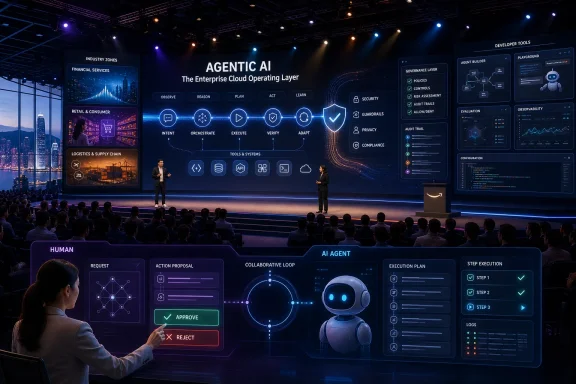
Amazon Web Services used its June 17, 2026 AWS Summit Hong Kong to frame agentic AI as the next enterprise cloud workload, pairing keynote claims about adoption with demos, training zones, industry showcases, and developer tools aimed at moving companies beyond experiments. The pitch was not subtle: agents are no longer being sold as a laboratory curiosity, but as the interface through which cloud vendors expect businesses to consume data, infrastructure, security, and software development services. That is both the promise and the warning. The industry is racing to make autonomous software feel inevitable before most enterprises have proved they can govern it.
The South China Morning Post article, produced by an advertising partner, presents AWS Summit Hong Kong 2026 as a coming-out party for agentic AI in the region. The framing is familiar to anyone who has watched the cloud industry turn architectural shifts into business imperatives: a large forecast, a packed conference hall, a parade of customer examples, and a message that hesitation now risks irrelevance later.
The statistic that does the most work is IDC’s prediction that more than 1 billion AI agents will be in use globally by 2029. That figure is meant to sound less like a forecast than a migration map. If there are going to be that many agents, the argument goes, enterprises should start building the systems, data pipelines, governance models, and security controls now.
AWS has every reason to push that view. Agentic AI is not merely another feature layered onto existing cloud consumption; it is a workload multiplier. An agent that plans, calls tools, retrieves documents, invokes APIs, writes code, validates output, and loops until a task is complete can generate far more compute, storage, database, observability, and security demand than a human typing a prompt into a chatbot.
That is why the Summit’s focus on “human-machine collaboration” should be read as cloud strategy, not just AI evangelism. If agents become a standard operating layer inside companies, the cloud provider is no longer just hosting applications. It becomes the fabric through which automated work is assigned, executed, measured, and restrained.
McKinsey’s 2025 survey found that 62 percent of organizations were experimenting with AI agents, while only 23 percent had scaled agentic systems within the company. That gap is the story of enterprise technology in miniature. Executives can approve pilots quickly; organizations scale only when the technology survives procurement, security review, workflow redesign, integration debt, training, monitoring, and the politics of changing how people work.
This is where the agentic AI conversation becomes more serious than the chatbot boom that preceded it. A chatbot can be wrong in a contained way. An agent can be wrong while taking action. It can move data, trigger a workflow, update a record, generate code, contact a customer, or make a recommendation that another automated system treats as input.
For IT leaders, the difference between an assistant and an agent is not semantic. It is operational. A tool that drafts an email is a productivity feature; a tool that decides which customer records to pull, which message to send, and when to escalate the case is part of the business process.
That distinction explains why adoption is slow even as interest is intense. Enterprises are not merely asking whether agents can perform tasks. They are asking whether agents can be trusted inside messy, regulated, permission-heavy environments where accountability still belongs to humans.
Hong Kong is also an instructive market for the agentic AI pitch. It is a dense financial, logistics, professional-services, and retail hub with cross-border complexity and heavy compliance expectations. If cloud vendors can persuade such markets that agents are safe enough for production, the argument becomes easier elsewhere.
AWS structured the event accordingly. The article describes more than 60 expert-led sessions, workshops, customer showcases, an Industry Zone, an AWS Village, a Developer Community Zone, and training areas. That is the architecture of enterprise persuasion: executives get transformation language, developers get tools, partners get a marketplace, and risk-conscious teams get sessions on security and data.
This matters because agentic AI will not be adopted through a single product SKU. It will arrive through a bundle of services: model access, orchestration frameworks, identity controls, vector databases, workflow engines, code assistants, monitoring dashboards, compliance tooling, and consulting. The Summit format mirrors that complexity.
The marketing phrase is “roadmap.” The more accurate phrase is ecosystem lock-in with a governance wrapper. AWS is trying to ensure that when companies decide they need agents, the safest path appears to be building them inside AWS’s cloud, with AWS-approved partners, AWS training, and AWS security patterns.
That is the buried economic significance of agents. A conventional application waits for events. An agent can generate them. It can decide that it needs more context, query a database, call a model again, inspect a result, create a ticket, run a test, and request another inference.
For cloud providers, that loop is attractive. It turns software autonomy into recurring infrastructure demand. It also makes annual recurring revenue an important piece of the story: if AI agents become embedded in operational workflows, they are less likely to be treated as discretionary experiments and more likely to become part of the cloud bill’s baseline.
The SCMP piece says Chris So, Managing Director of AWS Hong Kong, linked AWS’s success in reaching US$15 billion in annual recurring revenue in the first quarter of 2026 to growing adoption of AI agents. The precise accounting context matters less than the rhetorical move. AWS is tying business momentum to agent adoption, signaling to customers and partners that this is where the company believes cloud growth is going.
That is a stronger claim than “AI is popular.” It says agents are becoming a revenue engine. Once vendors talk that way, customers should expect product roadmaps, sales motions, partner incentives, and certification programs to bend around the concept.
That tells us where AWS expects near-term agentic AI to land. The early enterprise use cases are not science-fiction robots running entire companies. They are workflow assistants embedded in existing business functions: customer support, coding, analytics, compliance review, inventory planning, document processing, and internal IT operations.
The Developer Community Zone’s inclusion of Kiro, described as an agentic coding service that brings structure to coding chaos, is especially telling. Software development has become the proving ground for agentic AI because code has a rare combination of properties: it is text-heavy, tool-driven, testable, and economically valuable. If agents can help developers plan, write, refactor, test, and document software, vendors can claim measurable productivity gains without first transforming an entire business unit.
But coding agents also expose the limits of autonomy. A generated pull request still needs review. A refactor can pass local tests while breaking an assumption downstream. A dependency update can introduce licensing, security, or compatibility problems. The agent may accelerate the work, but the organization still owns the blast radius.
That is the pattern likely to repeat across industries. Agents will be most useful where tasks are structured enough to evaluate but complex enough to waste human time. They will be most dangerous where organizations confuse plausible output with controlled execution.
A traditional script usually does what it was written to do. An agent interprets goals, consumes context, and decides which tools to call. That flexibility is the point, but it also creates new classes of failure: prompt injection, tool misuse, excessive permissions, data leakage, indirect instruction attacks, runaway loops, and actions taken on untrusted information.
For WindowsForum readers, this should sound familiar. The enterprise security lesson of the last two decades is that identity, permissions, patching, logging, and least privilege matter more as systems become more connected. Agents do not repeal that lesson. They make it harsher.
A badly governed agent is not just a chatbot with a poor answer. It is a junior operator with API keys, memory, access to internal documents, and the confidence of a language model. That combination should make administrators cautious, especially in Microsoft 365, AWS, Azure, Google Workspace, Salesforce, ServiceNow, GitHub, Jira, and other systems where business context and execution rights already live side by side.
The security model for agents will need to become more like the model for human employees and service accounts. They will need identities, scopes, approvals, audit trails, revocation paths, and behavioral monitoring. They will also need clear ownership, because “the AI did it” is not an incident-response category that regulators, customers, or boards will accept.
That creates a brutal sorting mechanism. Companies with clean data estates, strong metadata, consistent permissions, and modern integration layers will move faster. Companies with fragmented file shares, stale SharePoint sites, duplicated customer records, undocumented workflows, and tribal knowledge locked inside inboxes will find that agents faithfully inherit the mess.
This is one reason cloud vendors are so eager to connect agents with broader data and infrastructure services. The agent becomes the glamorous front end for a much older enterprise project: rationalizing information architecture. The difference is that AI gives executives a new reason to fund the work.
AWS’s positioning around agentic AI, data, security, and cloud innovation is therefore not accidental. These are not four separate themes; they are the stack. The agent is only as useful as the data it can retrieve, only as safe as the permissions around that data, and only as reliable as the infrastructure that records what happened.
For sysadmins and architects, this means the agentic AI era may look less like a sudden replacement of existing IT work and more like a new justification for old backlog items. Identity hygiene, data classification, retention policies, API management, logging, endpoint security, and backup discipline all become prerequisites for automation that can touch real business processes.
That ambiguity benefits vendors. It allows almost any AI-enhanced product to be positioned as part of the agent wave. It also creates confusion for buyers, who may hear “agent” and imagine a self-directed digital worker while being sold a scripted automation with a natural-language interface.
The distinction matters because governance requirements scale with autonomy. A retrieval assistant that summarizes HR policy is one risk category. An HR agent that updates employee records, schedules interviews, and drafts offer letters is another. A finance agent that recommends invoice coding is not the same as one that approves payments.
This is where enterprises should push vendors for specificity. What tools can the agent call? What permissions does it require? How are actions approved? What happens when the model is uncertain? Can the agent be forced into read-only mode? How are prompts, intermediate steps, and outputs logged? Can administrators inspect the chain of action after the fact?
The answers to those questions will separate serious platforms from agent-washing. They will also determine whether the 23 percent of organizations that have scaled agentic AI become a leading edge or a warning label.
AWS’s advantage is infrastructure breadth. It can sell the primitives: compute, storage, databases, networking, identity, observability, security, and model access. Its challenge is that many enterprise users experience AI through applications, not through infrastructure. Microsoft can put agents where office workers already live. Salesforce can put them where sales and service teams already work. ServiceNow can put them inside IT workflows.
That makes developer adoption critical for AWS. If AWS can persuade builders to create, deploy, and govern agents on its platform, it does not need to own every front-end application. It can own the execution substrate.
This is why Kiro and the developer programming at the Summit matter. Coding agents are not just productivity tools; they are recruitment tools for the platform. A developer who uses an AWS agentic coding service to structure projects, integrate cloud services, and deploy workloads is being pulled deeper into the AWS operating model.
The same logic applies to the AWS Village and partner showcases. Agentic AI will require packaged solutions for industries that do not want to assemble everything from scratch. Partners translate a platform story into procurement-ready offerings. AWS supplies the gravitational field.
For Hong Kong and the wider Asia-Pacific region, the governance questions are especially complicated. Businesses operate across jurisdictions with different privacy expectations, data-transfer rules, industry regulations, and national AI strategies. An agent that processes customer information, recommends credit actions, or coordinates supply-chain decisions may implicate rules far beyond the team that deployed it.
Cloud providers understand this. They want to shape the governance conversation before governments define it for them. Summit sessions on security, certification, and best practices are not only customer education; they are part of the industry’s case that responsible adoption can be managed through existing enterprise controls plus new AI-specific safeguards.
There is some truth in that argument. Enterprises already know how to manage privileged accounts, audit logs, change control, segregation of duties, and incident response. But agents create strange hybrids: part application, part user, part workflow, part decision system. Treating them as ordinary software will miss important risks.
The regulatory question is not whether agents should be allowed. They already are. The question is whether companies can prove what their agents did, why they did it, which data they used, and who was accountable when the result mattered.
But the productivity story is inseparable from workforce redesign. If an agent can handle tier-one support triage, draft legal summaries, generate marketing variants, write test cases, reconcile invoices, or prepare sales research, managers will eventually ask how many people are needed for those tasks. The answer may not be immediate layoffs, but it will affect hiring, promotion paths, training budgets, outsourcing contracts, and entry-level work.
This is particularly important for developers. Coding agents may make experienced engineers faster, but they could also compress the apprenticeship ladder that produces experienced engineers in the first place. If junior developers are given fewer chances to write routine code, debug mistakes, and learn system design through repetition, companies may save time today while weakening their future talent pipeline.
The same risk applies to analysts, support staff, operations teams, and administrative workers. Agents can absorb the repetitive work through which people learn the business. If companies remove that work without building new training paths, they may end up with fewer employees who understand the systems deeply enough to supervise the automation.
This is not an argument against agentic AI. It is an argument against pretending that “collaboration” solves the organizational problem. Collaboration requires design. Without it, agents become a management tool for extracting work faster while leaving accountability, skill development, and morale to sort themselves out later.
That means controlled access, clean APIs, documented workflows, reliable monitoring, cost management, test environments, rollback plans, and human approval gates. It means knowing which processes are safe to automate and which ones should remain advisory. It means distinguishing between low-risk acceleration and high-risk delegation.
The practical deployment pattern will probably be incremental. Enterprises will start with agents that retrieve information, summarize cases, draft recommendations, and assist internal teams. They will then move toward agents that execute bounded actions under policy constraints. Fully autonomous agents operating across critical workflows will remain rare until organizations can prove reliability and accountability.
This is where the 62 percent experimentation figure becomes useful. Experimentation is not failure. It is the phase where companies learn what their systems can tolerate. The danger is not that pilots exist; the danger is that executives mistake a successful demo for production readiness.
AWS’s Summit pitch tries to shorten that path by surrounding agents with training, partner solutions, industry examples, and platform services. That is sensible. It is also self-interested. The more complex the transition becomes, the more valuable the cloud provider’s integrated stack appears.
That makes cloud cost management part of AI governance. Enterprises will need budgets not just for departments and applications, but for agent behaviors. A poorly designed agent that retries too often, retrieves too broadly, or uses expensive models unnecessarily can become a financial bug.
This will force new questions into architecture reviews. How many tool calls may an agent make? Which model tier does it use for which task? When should it stop? How is success measured? Can it degrade gracefully to a cheaper model or a human queue? What is the cost of one completed task?
These questions will feel familiar to cloud FinOps teams, but agents add another layer of abstraction. The user sees a completed workflow. The bill shows the hidden machinery. If enterprises cannot connect the two, they will struggle to calculate return on investment.
That may explain why many companies remain stuck between experimenting and scaling. The pilot looks impressive because the costs are small, the scope is narrow, and the users are motivated. Production reveals the real economics.
Vendor-positioning documents are valuable when read correctly. They show where a company wants customers to look. In this case, AWS wants enterprises to see agentic AI as an urgent, practical, cloud-native shift that can be approached through its ecosystem of services, partners, training, and developer tools.
The missing half of the story is the customer’s burden. Enterprises must decide whether agents solve real problems, whether the workflows are mature enough to automate, whether the data is trustworthy, whether the permissions are safe, and whether the cost model works. AWS can provide infrastructure and patterns, but it cannot supply organizational clarity.
That is the central tension in the agentic AI market. Vendors sell the future as a platform capability. Buyers experience it as change management.
The result is a market that can be simultaneously overhyped and genuinely important. Many agent projects will disappoint. Some will be quietly transformative. The difference will usually have less to do with keynote language than with whether the company understood the work before it automated it.
That does not mean IT should surrender to the hype. It means IT needs a better answer than skepticism. The right response is a deployment framework that separates safe assistance from risky autonomy and defines how agents earn more responsibility over time.
A sensible enterprise agent program should begin with inventory. Which workflows are repetitive, high-volume, measurable, and painful enough to justify automation? Which systems contain the data those workflows require? Which actions can be simulated before being executed? Which approvals are legally or commercially non-negotiable?
From there, organizations can design agents as governed actors, not magic employees. Give them limited permissions. Log their reasoning steps where possible. Put humans in the loop for consequential actions. Measure quality, cost, latency, user satisfaction, and incident rates. Retire agents that do not outperform simpler automation.
That approach will not satisfy the most breathless version of the agentic AI story. It will, however, keep companies from turning experimental autonomy into production chaos.
 AWS Sells the Agent as the New Cloud Customer
The South China Morning Post article, produced by an advertising partner, presents AWS Summit Hong Kong 2026 as a coming-out party for agentic AI in the region. The framing is familiar to anyone who has watched the cloud industry turn architectural shifts into business imperatives: a large forecast, a packed conference hall, a parade of customer examples, and a message that hesitation now risks irrelevance later.The statistic that does the most work is IDC’s prediction that more than 1 billion AI agents will be in use globally by 2029. That figure is meant to sound less like a forecast than a migration map. If there are going to be that many agents, the argument goes, enterprises should start building the systems, data pipelines, governance models, and security controls now.
AWS has every reason to push that view. Agentic AI is not merely another feature layered onto existing cloud consumption; it is a workload multiplier. An agent that plans, calls tools, retrieves documents, invokes APIs, writes code, validates output, and loops until a task is complete can generate far more compute, storage, database, observability, and security demand than a human typing a prompt into a chatbot.
That is why the Summit’s focus on “human-machine collaboration” should be read as cloud strategy, not just AI evangelism. If agents become a standard operating layer inside companies, the cloud provider is no longer just hosting applications. It becomes the fabric through which automated work is assigned, executed, measured, and restrained.
The Adoption Gap Is the Real Headline
The most important number in the story is not the 1 billion-agent forecast. It is the gap between experimentation and scale.McKinsey’s 2025 survey found that 62 percent of organizations were experimenting with AI agents, while only 23 percent had scaled agentic systems within the company. That gap is the story of enterprise technology in miniature. Executives can approve pilots quickly; organizations scale only when the technology survives procurement, security review, workflow redesign, integration debt, training, monitoring, and the politics of changing how people work.
This is where the agentic AI conversation becomes more serious than the chatbot boom that preceded it. A chatbot can be wrong in a contained way. An agent can be wrong while taking action. It can move data, trigger a workflow, update a record, generate code, contact a customer, or make a recommendation that another automated system treats as input.
For IT leaders, the difference between an assistant and an agent is not semantic. It is operational. A tool that drafts an email is a productivity feature; a tool that decides which customer records to pull, which message to send, and when to escalate the case is part of the business process.
That distinction explains why adoption is slow even as interest is intense. Enterprises are not merely asking whether agents can perform tasks. They are asking whether agents can be trusted inside messy, regulated, permission-heavy environments where accountability still belongs to humans.
Hong Kong Was the Stage, but the Message Was Global
The Hong Kong Convention and Exhibition Centre setting matters because AWS was not pitching agentic AI only to Silicon Valley developers or American enterprise buyers. The audience described in the report included business leaders, technology enthusiasts, and policymakers — the coalition that matters when automation moves from demo to deployment.Hong Kong is also an instructive market for the agentic AI pitch. It is a dense financial, logistics, professional-services, and retail hub with cross-border complexity and heavy compliance expectations. If cloud vendors can persuade such markets that agents are safe enough for production, the argument becomes easier elsewhere.
AWS structured the event accordingly. The article describes more than 60 expert-led sessions, workshops, customer showcases, an Industry Zone, an AWS Village, a Developer Community Zone, and training areas. That is the architecture of enterprise persuasion: executives get transformation language, developers get tools, partners get a marketplace, and risk-conscious teams get sessions on security and data.
This matters because agentic AI will not be adopted through a single product SKU. It will arrive through a bundle of services: model access, orchestration frameworks, identity controls, vector databases, workflow engines, code assistants, monitoring dashboards, compliance tooling, and consulting. The Summit format mirrors that complexity.
The marketing phrase is “roadmap.” The more accurate phrase is ecosystem lock-in with a governance wrapper. AWS is trying to ensure that when companies decide they need agents, the safest path appears to be building them inside AWS’s cloud, with AWS-approved partners, AWS training, and AWS security patterns.
Agentic AI Turns Cloud Consumption Into a Loop
The old cloud business model was already consumption-based, but much of that consumption was ultimately bounded by human activity. Users clicked, developers deployed, analysts queried, customers transacted. Agentic AI changes the rhythm because the system can initiate and iterate work without a person directly issuing each step.That is the buried economic significance of agents. A conventional application waits for events. An agent can generate them. It can decide that it needs more context, query a database, call a model again, inspect a result, create a ticket, run a test, and request another inference.
For cloud providers, that loop is attractive. It turns software autonomy into recurring infrastructure demand. It also makes annual recurring revenue an important piece of the story: if AI agents become embedded in operational workflows, they are less likely to be treated as discretionary experiments and more likely to become part of the cloud bill’s baseline.
The SCMP piece says Chris So, Managing Director of AWS Hong Kong, linked AWS’s success in reaching US$15 billion in annual recurring revenue in the first quarter of 2026 to growing adoption of AI agents. The precise accounting context matters less than the rhetorical move. AWS is tying business momentum to agent adoption, signaling to customers and partners that this is where the company believes cloud growth is going.
That is a stronger claim than “AI is popular.” It says agents are becoming a revenue engine. Once vendors talk that way, customers should expect product roadmaps, sales motions, partner incentives, and certification programs to bend around the concept.
The Demo Floor Is Where Hype Learns to Wear a Badge
Conference demos are easy to dismiss, but they reveal what vendors think buyers need to see before opening budgets. At AWS Summit Hong Kong, the demos described in the report were not abstract philosophical exercises. They were organized around financial services, retail, consumer goods, developers, training, and competitive AI challenges.That tells us where AWS expects near-term agentic AI to land. The early enterprise use cases are not science-fiction robots running entire companies. They are workflow assistants embedded in existing business functions: customer support, coding, analytics, compliance review, inventory planning, document processing, and internal IT operations.
The Developer Community Zone’s inclusion of Kiro, described as an agentic coding service that brings structure to coding chaos, is especially telling. Software development has become the proving ground for agentic AI because code has a rare combination of properties: it is text-heavy, tool-driven, testable, and economically valuable. If agents can help developers plan, write, refactor, test, and document software, vendors can claim measurable productivity gains without first transforming an entire business unit.
But coding agents also expose the limits of autonomy. A generated pull request still needs review. A refactor can pass local tests while breaking an assumption downstream. A dependency update can introduce licensing, security, or compatibility problems. The agent may accelerate the work, but the organization still owns the blast radius.
That is the pattern likely to repeat across industries. Agents will be most useful where tasks are structured enough to evaluate but complex enough to waste human time. They will be most dangerous where organizations confuse plausible output with controlled execution.
The Security Story Is Still Catching Up to the Sales Story
Every major AI platform now talks about security, and AWS is no exception. The Summit’s program reportedly included security as one of the core themes alongside agentic AI, data, and cloud innovation. That pairing is necessary because agents widen the attack surface in ways that older automation did not.A traditional script usually does what it was written to do. An agent interprets goals, consumes context, and decides which tools to call. That flexibility is the point, but it also creates new classes of failure: prompt injection, tool misuse, excessive permissions, data leakage, indirect instruction attacks, runaway loops, and actions taken on untrusted information.
For WindowsForum readers, this should sound familiar. The enterprise security lesson of the last two decades is that identity, permissions, patching, logging, and least privilege matter more as systems become more connected. Agents do not repeal that lesson. They make it harsher.
A badly governed agent is not just a chatbot with a poor answer. It is a junior operator with API keys, memory, access to internal documents, and the confidence of a language model. That combination should make administrators cautious, especially in Microsoft 365, AWS, Azure, Google Workspace, Salesforce, ServiceNow, GitHub, Jira, and other systems where business context and execution rights already live side by side.
The security model for agents will need to become more like the model for human employees and service accounts. They will need identities, scopes, approvals, audit trails, revocation paths, and behavioral monitoring. They will also need clear ownership, because “the AI did it” is not an incident-response category that regulators, customers, or boards will accept.
Data Quality Becomes Destiny
Agentic AI is often presented as a model story, but enterprises will discover that it is mostly a data story. Agents need context to act intelligently. Context lives in documents, databases, tickets, emails, calendars, repositories, CRM systems, ERP systems, and knowledge bases that were rarely designed for autonomous reasoning.That creates a brutal sorting mechanism. Companies with clean data estates, strong metadata, consistent permissions, and modern integration layers will move faster. Companies with fragmented file shares, stale SharePoint sites, duplicated customer records, undocumented workflows, and tribal knowledge locked inside inboxes will find that agents faithfully inherit the mess.
This is one reason cloud vendors are so eager to connect agents with broader data and infrastructure services. The agent becomes the glamorous front end for a much older enterprise project: rationalizing information architecture. The difference is that AI gives executives a new reason to fund the work.
AWS’s positioning around agentic AI, data, security, and cloud innovation is therefore not accidental. These are not four separate themes; they are the stack. The agent is only as useful as the data it can retrieve, only as safe as the permissions around that data, and only as reliable as the infrastructure that records what happened.
For sysadmins and architects, this means the agentic AI era may look less like a sudden replacement of existing IT work and more like a new justification for old backlog items. Identity hygiene, data classification, retention policies, API management, logging, endpoint security, and backup discipline all become prerequisites for automation that can touch real business processes.
The Vendor Vocabulary Is Running Ahead of the Engineering Reality
The term agentic AI is doing a lot of promotional work. In its strongest form, it means software that can plan, reason over context, use tools, adapt to feedback, and execute multi-step tasks with some degree of autonomy. In its weakest form, it can mean a chatbot with a workflow button.That ambiguity benefits vendors. It allows almost any AI-enhanced product to be positioned as part of the agent wave. It also creates confusion for buyers, who may hear “agent” and imagine a self-directed digital worker while being sold a scripted automation with a natural-language interface.
The distinction matters because governance requirements scale with autonomy. A retrieval assistant that summarizes HR policy is one risk category. An HR agent that updates employee records, schedules interviews, and drafts offer letters is another. A finance agent that recommends invoice coding is not the same as one that approves payments.
This is where enterprises should push vendors for specificity. What tools can the agent call? What permissions does it require? How are actions approved? What happens when the model is uncertain? Can the agent be forced into read-only mode? How are prompts, intermediate steps, and outputs logged? Can administrators inspect the chain of action after the fact?
The answers to those questions will separate serious platforms from agent-washing. They will also determine whether the 23 percent of organizations that have scaled agentic AI become a leading edge or a warning label.
AWS Is Competing for the Operating Layer of AI Work
The AWS Summit Hong Kong story is also a competitive signal. Microsoft has tied agents to Copilot, Microsoft 365, Azure AI Foundry, and enterprise identity. Google is pushing agents through Gemini, Workspace, Vertex AI, and its cloud data stack. Salesforce, ServiceNow, Oracle, SAP, Atlassian, and a long list of security and developer-tool vendors are all turning agents into the next layer of enterprise software.AWS’s advantage is infrastructure breadth. It can sell the primitives: compute, storage, databases, networking, identity, observability, security, and model access. Its challenge is that many enterprise users experience AI through applications, not through infrastructure. Microsoft can put agents where office workers already live. Salesforce can put them where sales and service teams already work. ServiceNow can put them inside IT workflows.
That makes developer adoption critical for AWS. If AWS can persuade builders to create, deploy, and govern agents on its platform, it does not need to own every front-end application. It can own the execution substrate.
This is why Kiro and the developer programming at the Summit matter. Coding agents are not just productivity tools; they are recruitment tools for the platform. A developer who uses an AWS agentic coding service to structure projects, integrate cloud services, and deploy workloads is being pulled deeper into the AWS operating model.
The same logic applies to the AWS Village and partner showcases. Agentic AI will require packaged solutions for industries that do not want to assemble everything from scratch. Partners translate a platform story into procurement-ready offerings. AWS supplies the gravitational field.
Policymakers Are in the Room Because Autonomy Changes the Stakes
The article notes that policymakers were among the Summit attendees, a detail that should not be treated as ceremonial. Agentic AI is arriving at the same time governments are trying to decide how to regulate AI safety, privacy, labor effects, critical infrastructure, and cross-border data flows. The more autonomous software becomes, the less convincing it is to regulate AI as merely a content-generation tool.For Hong Kong and the wider Asia-Pacific region, the governance questions are especially complicated. Businesses operate across jurisdictions with different privacy expectations, data-transfer rules, industry regulations, and national AI strategies. An agent that processes customer information, recommends credit actions, or coordinates supply-chain decisions may implicate rules far beyond the team that deployed it.
Cloud providers understand this. They want to shape the governance conversation before governments define it for them. Summit sessions on security, certification, and best practices are not only customer education; they are part of the industry’s case that responsible adoption can be managed through existing enterprise controls plus new AI-specific safeguards.
There is some truth in that argument. Enterprises already know how to manage privileged accounts, audit logs, change control, segregation of duties, and incident response. But agents create strange hybrids: part application, part user, part workflow, part decision system. Treating them as ordinary software will miss important risks.
The regulatory question is not whether agents should be allowed. They already are. The question is whether companies can prove what their agents did, why they did it, which data they used, and who was accountable when the result mattered.
The Workforce Pitch Needs More Honesty
The Summit’s theme of human-machine collaboration is the polite version of a harder conversation. Agentic AI is being sold as a way to augment workers, reduce drudgery, accelerate development, improve customer service, and free employees for higher-value tasks. In many cases, it will do some of that.But the productivity story is inseparable from workforce redesign. If an agent can handle tier-one support triage, draft legal summaries, generate marketing variants, write test cases, reconcile invoices, or prepare sales research, managers will eventually ask how many people are needed for those tasks. The answer may not be immediate layoffs, but it will affect hiring, promotion paths, training budgets, outsourcing contracts, and entry-level work.
This is particularly important for developers. Coding agents may make experienced engineers faster, but they could also compress the apprenticeship ladder that produces experienced engineers in the first place. If junior developers are given fewer chances to write routine code, debug mistakes, and learn system design through repetition, companies may save time today while weakening their future talent pipeline.
The same risk applies to analysts, support staff, operations teams, and administrative workers. Agents can absorb the repetitive work through which people learn the business. If companies remove that work without building new training paths, they may end up with fewer employees who understand the systems deeply enough to supervise the automation.
This is not an argument against agentic AI. It is an argument against pretending that “collaboration” solves the organizational problem. Collaboration requires design. Without it, agents become a management tool for extracting work faster while leaving accountability, skill development, and morale to sort themselves out later.
The Agent Boom Will Reward Boring IT Discipline
The loudest agentic AI stories are about autonomy, reasoning, and transformation. The companies that succeed will likely be the ones that get the boring parts right.That means controlled access, clean APIs, documented workflows, reliable monitoring, cost management, test environments, rollback plans, and human approval gates. It means knowing which processes are safe to automate and which ones should remain advisory. It means distinguishing between low-risk acceleration and high-risk delegation.
The practical deployment pattern will probably be incremental. Enterprises will start with agents that retrieve information, summarize cases, draft recommendations, and assist internal teams. They will then move toward agents that execute bounded actions under policy constraints. Fully autonomous agents operating across critical workflows will remain rare until organizations can prove reliability and accountability.
This is where the 62 percent experimentation figure becomes useful. Experimentation is not failure. It is the phase where companies learn what their systems can tolerate. The danger is not that pilots exist; the danger is that executives mistake a successful demo for production readiness.
AWS’s Summit pitch tries to shorten that path by surrounding agents with training, partner solutions, industry examples, and platform services. That is sensible. It is also self-interested. The more complex the transition becomes, the more valuable the cloud provider’s integrated stack appears.
The Bill Will Be a Governance Document
One under-discussed consequence of agentic AI is cost visibility. Agents can consume resources unpredictably because their work is iterative. A human may ask one question; an agent may turn that question into dozens of model calls, database queries, document retrievals, code executions, and validation steps.That makes cloud cost management part of AI governance. Enterprises will need budgets not just for departments and applications, but for agent behaviors. A poorly designed agent that retries too often, retrieves too broadly, or uses expensive models unnecessarily can become a financial bug.
This will force new questions into architecture reviews. How many tool calls may an agent make? Which model tier does it use for which task? When should it stop? How is success measured? Can it degrade gracefully to a cheaper model or a human queue? What is the cost of one completed task?
These questions will feel familiar to cloud FinOps teams, but agents add another layer of abstraction. The user sees a completed workflow. The bill shows the hidden machinery. If enterprises cannot connect the two, they will struggle to calculate return on investment.
That may explain why many companies remain stuck between experimenting and scaling. The pilot looks impressive because the costs are small, the scope is narrow, and the users are motivated. Production reveals the real economics.
The Sponsored Tone Should Not Obscure the Signal
Because the SCMP article was produced by an advertising partner, readers should treat its framing as promotional rather than independent analysis. It emphasizes momentum, showcases, and transformation, not the trade-offs that would dominate a skeptical postmortem. That does not make the information useless. It means the piece should be read as a vendor-positioning document.Vendor-positioning documents are valuable when read correctly. They show where a company wants customers to look. In this case, AWS wants enterprises to see agentic AI as an urgent, practical, cloud-native shift that can be approached through its ecosystem of services, partners, training, and developer tools.
The missing half of the story is the customer’s burden. Enterprises must decide whether agents solve real problems, whether the workflows are mature enough to automate, whether the data is trustworthy, whether the permissions are safe, and whether the cost model works. AWS can provide infrastructure and patterns, but it cannot supply organizational clarity.
That is the central tension in the agentic AI market. Vendors sell the future as a platform capability. Buyers experience it as change management.
The result is a market that can be simultaneously overhyped and genuinely important. Many agent projects will disappoint. Some will be quietly transformative. The difference will usually have less to do with keynote language than with whether the company understood the work before it automated it.
The Hong Kong Summit Leaves IT With a Shorter Excuse List
The practical message from AWS Summit Hong Kong 2026 is not that every company should deploy autonomous agents immediately. It is that the preparation window is closing. The tools, training paths, partner offerings, and executive narratives are now mature enough that boards and business units will increasingly ask IT why agentic AI is not moving faster.That does not mean IT should surrender to the hype. It means IT needs a better answer than skepticism. The right response is a deployment framework that separates safe assistance from risky autonomy and defines how agents earn more responsibility over time.
A sensible enterprise agent program should begin with inventory. Which workflows are repetitive, high-volume, measurable, and painful enough to justify automation? Which systems contain the data those workflows require? Which actions can be simulated before being executed? Which approvals are legally or commercially non-negotiable?
From there, organizations can design agents as governed actors, not magic employees. Give them limited permissions. Log their reasoning steps where possible. Put humans in the loop for consequential actions. Measure quality, cost, latency, user satisfaction, and incident rates. Retire agents that do not outperform simpler automation.
That approach will not satisfy the most breathless version of the agentic AI story. It will, however, keep companies from turning experimental autonomy into production chaos.
The Numbers Point to a Boom, but the Work Points to a Grind
The clearest lesson from the AWS Summit Hong Kong story is that agentic AI has crossed from speculative trend to enterprise sales motion. The market forecasts are huge, the vendor investment is visible, and the conference machinery is now aligned around turning pilots into deployments. But the operational reality remains stubborn.- IDC’s forecast of more than 1 billion AI agents by 2029 is best understood as a signal of expected workload growth, not proof that enterprises are ready for mass autonomy.
- McKinsey’s gap between experimentation and scaled deployment shows that governance, integration, workflow redesign, and trust remain the limiting factors.
- AWS is positioning agentic AI as a full-stack cloud opportunity that spans data, security, developer tools, training, partners, and industry solutions.
- Coding agents are likely to be one of the earliest serious adoption areas because software work is tool-rich, measurable, and economically urgent.
- Enterprises should treat agents as governed digital actors with identities, permissions, audit trails, budgets, and clear human accountability.
- The winners will be organizations that automate well-understood work first, rather than using agents to disguise broken processes.
References
- Primary source: South China Morning Post
Published: Tue, 23 Jun 2026 02:02:29 GMT
Agentic AI Takes Centre Stage at AWS Summit 2026 | South China Morning Post
[The content of this article has been produced by our advertising partner.]www.scmp.com - Related coverage: agentmodeai.com
McKinsey State of AI 2025: 23% scaling, 39% experimenting
McKinsey's State of AI 2025 survey: 23% of organizations are scaling agentic AI, 39% experimenting, 38% not started (n=1,491). What the gap actually measures.agentmodeai.com - Related coverage: windowscentral.com
Microsoft doubles down on agentic AI — Agent 365 prepares for a future with over 1 billion agents | Windows Central
Microsoft kicked off Ignite with a major push into agentic AI, unveiling Agent 365 as its newest tool for automating workflows.www.windowscentral.com - Related coverage: gsaglobal.org
