

Microsoft Is Selling an Operating System for the AI Business
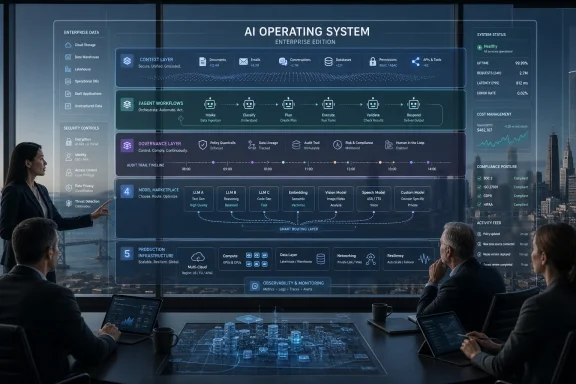
Build is still a developer conference, but Microsoft’s 2026 pitch was aimed squarely above the developer org chart. The company’s most important announcements were not isolated SDKs or model upgrades. They were pieces of a proposed enterprise architecture: context, agents, governance, model choice, and infrastructure tied together into something Microsoft can plausibly call a platform.
That framing matters because most companies are stuck between two uncomfortable truths. They have enough AI pilots to prove there is value, but not enough integrated machinery to make those pilots durable. A chatbot attached to a policy library is useful; an agent that knows the customer, the contract, the workflow, the approval path, and the exception rules is a different thing entirely.
Microsoft’s answer is to make the AI stack look more like the rest of enterprise IT. There is a data layer, a semantic layer, an application platform, a control plane, a security story, and a procurement-friendly catalog of models. In other words, Microsoft is not just trying to win the model race. It is trying to win the boring, lucrative, decisive race to become the default substrate for AI-enabled work.
That is why leaders should read Build 2026 less as a list of announcements and more as a shift in expectations. Microsoft is telling customers that agentic AI has crossed from interesting capability into operational pressure. If your organization is still treating AI as a side project, Redmond is now packaging the argument your board may use against you.
The First Lesson Is That Context Has Become the New Cloud Migration
Microsoft’s headline business concept at Build was Microsoft IQ, an enterprise intelligence layer designed to ground agents in company-specific knowledge. The idea is simple enough: a model that knows the internet is not the same as an agent that understands your business. For most organizations, the gap between those two states is where AI projects slow down, become inconsistent, or produce outputs that look polished but fail the real-world test.
Work IQ is meant to capture how work actually happens across Microsoft 365 and related systems: documents, meetings, messages, people, permissions, and organizational relationships. Fabric IQ is aimed at structured business data and shared semantic meaning, the sort of definitions that determine whether “revenue,” “active customer,” or “risk exposure” mean the same thing across departments. Foundry IQ connects that grounding to applications and custom sources, while Web IQ adds external, real-time context.
That may sound like branding, and some of it is. Microsoft is never happier than when it can turn a product boundary into a named layer. But beneath the naming exercise is a serious architectural point: agents cannot scale if every project has to rediscover the company from scratch.
This is the same problem enterprises faced during cloud adoption, only with a sharper edge. In the early cloud years, teams could spin up infrastructure quickly, but the real challenge was identity, governance, cost control, data architecture, and application modernization. AI is following the same pattern. The demo is easy; the enterprise foundation is the work.
For leaders, this makes data readiness less of a back-office concern and more of a strategic bottleneck. If your business definitions live in spreadsheets, tribal memory, disconnected BI models, or department-specific applications, an agent will not magically resolve that fragmentation. It may amplify it. Microsoft’s bet is that the company already sitting on your email, meetings, files, identities, analytics, and developer workflows can stitch together enough context to make enterprise AI useful.
Microsoft Wants the Agent to Start With Your Business, Not a Blank Prompt
The most practical way to understand Microsoft IQ is to imagine the first day of a new employee. A capable hire still needs context: who owns what, which reports matter, which customer exceptions are real, which internal definitions are political compromises, and which systems are authoritative. Today’s AI agents often start as if none of that exists.
That is why grounding has become the enterprise AI battleground. Models are increasingly capable and increasingly interchangeable for many business tasks. The durable advantage may come from the layer that tells them what matters inside a particular organization.
Microsoft’s pitch is that shared intelligence can become reusable infrastructure. Instead of building a sales agent, a finance agent, and a support agent that each reconstruct customer context in their own way, the company wants them to draw from common business meaning. That is attractive to CIOs because it promises consistency. It is attractive to CFOs because it promises reuse. It is attractive to Microsoft because it pulls more of the customer’s operational reality into Microsoft-controlled platforms.
The tension is obvious. The more useful the context layer becomes, the more strategic dependence it creates. Enterprises that standardize on Microsoft IQ may gain speed and coherence, but they will also need to understand what knowledge is being indexed, how access is controlled, how stale or conflicting data is handled, and how easily that intelligence can move if the organization changes platforms later.
This is not a reason to dismiss the approach. It is a reason to govern it like critical infrastructure. Once AI systems begin using organizational context to make recommendations, trigger workflows, or support decisions, the context layer becomes part of the company’s operating memory. Bad memory creates bad judgment.
The Second Lesson Is That Pilots Are Becoming a Management Liability
The most revealing phrase around Build 2026 was not “agentic AI.” It was “production.” Microsoft’s business argument is that organizations have spent the last few years proving AI can help with discrete tasks, and now they need to move those capabilities into systems that can be deployed, monitored, secured, updated, and measured.
That is where the Microsoft Agent Platform comes in. Built around Azure, Microsoft Foundry, Agent 365, Azure Container Apps, GitHub workflows, and the broader Microsoft security stack, the platform is meant to provide a path from prototype to governed deployment. The company is also pushing Rayfin as a way to move more quickly from concept to enterprise-grade back ends, with governance and data management treated as native requirements rather than afterthoughts.
This is an important shift because pilots can become a kind of executive camouflage. They create the impression of motion without forcing the organization to change processes, budgets, accountability, or risk models. A pilot can be celebrated in a quarterly update; a production agent needs an owner, a service-level expectation, a security review, an audit trail, a rollback plan, and a business case.
Microsoft is effectively telling leaders that the age of harmless experimentation is ending. If AI remains a scattering of proofs of concept, the problem is no longer technical curiosity. It is operating discipline.
That does not mean every agent should be rushed into production. In fact, the more serious the use case, the slower and more deliberate the rollout should be. But it does mean leaders need a portfolio view. Which pilots are learning exercises? Which are dead ends? Which have measurable value? Which should be integrated into core workflows? Without those distinctions, AI experimentation becomes an expensive form of theater.
Governance Is No Longer the Brake; It Is the Deployment Mechanism
For years, security and compliance teams have been cast as the people slowing AI adoption down. Build 2026 flips that story. Microsoft’s platform pitch assumes that agents will not reach production unless governance is built into the system from the start.
Agent 365 is central to that argument. Microsoft has described it as a control plane for observing, governing, and securing agents across an organization’s environment, including agents built outside Microsoft’s own tools. Whether customers experience it that way in practice will depend on implementation details, licensing, and integration maturity, but the strategic direction is clear. Microsoft wants agent management to become a recognizable enterprise discipline, not a collection of one-off security exceptions.
That is the right instinct. Agents introduce a different risk profile from traditional software because they can interpret instructions, call tools, retrieve information, and act across systems. A badly governed agent is not merely an inaccurate chatbot. It can become a confused operator with credentials.
The enterprise answer is not to ban agents from meaningful work. It is to narrow what they can do, make their actions observable, control the data they can see, and define when humans must approve decisions. This is tedious, but it is also how AI becomes useful beyond the demo stage.
Leaders should be especially wary of language that treats autonomy as a virtue by itself. Autonomy is valuable only when paired with scope, accountability, and recoverability. A claims-processing agent, a finance reconciliation agent, or a software maintenance agent should not be judged by how independent it sounds. It should be judged by whether it improves cycle time, reduces errors, and behaves predictably inside well-defined boundaries.
The Third Lesson Is That Model Choice Is Becoming Procurement Strategy
Microsoft also used Build 2026 to widen the model conversation. Foundry is being positioned as a place where enterprises can access frontier models from multiple providers, open-weight options, and Microsoft’s own MAI model family, with governance and deployment controls wrapped around them. The company’s message is that customers should not have to bet the business on a single model provider or a single model size.
That is a pragmatic argument. Different workloads have different economics. A reasoning-heavy planning task, a voice workflow, a transcription pipeline, a code-generation scenario, and a document classification process do not necessarily need the same model. The best enterprise AI architecture will likely resemble a portfolio, not a monoculture.
Microsoft’s MAI announcements are notable in that context. By offering its own models for reasoning, coding, speech, voice, and image scenarios, Microsoft is signaling that it does not want to be merely the cloud landlord for other companies’ AI systems. It wants a seat in the model layer too, even as it continues to promote choice through Foundry.
For business leaders, the lesson is not to obsess over benchmark leaderboards. Benchmarks matter, but they rarely map cleanly to the messy economics of enterprise work. The more important questions are operational: which model is accurate enough, fast enough, cheap enough, governable enough, and available in the right compliance boundary?
Frontier Tuning sharpens that point. Microsoft is pitching it as a way for organizations to tune models against their own workflows and data within compliance boundaries, potentially improving speed and lowering costs. If that promise holds up in real deployments, it points toward a future in which competitive advantage comes less from buying access to the smartest general model and more from shaping capable models around proprietary processes.
That is where AI strategy begins to look like business strategy again. The best model for your company may not be the one that wins a public benchmark. It may be the one that best understands how your company prices risk, handles exceptions, designs products, serves customers, or navigates regulation.
The Infrastructure Story Is Really About Trusting AI With Work That Matters
Build’s infrastructure announcements were easy to treat as secondary, but they are part of the same argument. Microsoft talked up GPU-accelerated Fabric Data Warehouse performance, Azure Cobalt 200 VMs, and Azure Infrastructure Resiliency Manager because production AI is not just a software architecture problem. It is a capacity, latency, cost, and resilience problem.
That is particularly true once AI moves from assisting knowledge workers to participating in operational workflows. A slow dashboard is annoying. A slow agent embedded in a customer support escalation, supply chain decision, or engineering simulation can become a business constraint. Performance becomes part of trust.
The GPU-accelerated Fabric Data Warehouse claim is aimed at a specific pain point: AI-scale workloads often collide with analytics systems that were not designed for large numbers of agents, queries, and applications hitting shared data at once. Microsoft wants Fabric to be the place where reporting, application back ends, and agent tool calls can coexist without customers building separate acceleration layers for every workload.
Azure Cobalt 200 fits the same pattern from the compute side. Microsoft’s custom silicon push is about controlling more of the cloud cost and performance equation as AI demand rises. Customers may not care which chip runs a workload, but they care deeply whether the workload is affordable, available, and predictable.
Resilience may be the least glamorous part of the story, and the most important. If AI is merely an assistant, downtime is inconvenience. If AI is coordinating operations, detecting anomalies, generating engineering hypotheses, managing service workflows, or driving customer interactions, downtime becomes operational risk. Microsoft’s emphasis on resiliency planning is an admission that production AI inherits the expectations of production IT.
Scientific AI Shows the Ceiling Is Higher Than Office Automation
Microsoft Discovery, now generally available, shows how far the company wants to stretch the agentic AI narrative. Rather than limiting agents to office productivity and business process automation, Microsoft is pitching Discovery as a platform for scientific research and complex problem-solving. The system uses specialized agents to search research, generate hypotheses, run simulations, and iterate on results.
This matters because many executives still think of AI in terms of productivity: write the email faster, summarize the meeting, draft the report, answer the employee’s HR question. Those use cases are real, but they are not the upper bound. The more transformative cases involve compressing long cycles of analysis, experimentation, engineering, and decision-making.
BHP’s copper innovation work is the sort of example Microsoft wants customers to notice. The point is not that every company suddenly becomes a materials science lab. The point is that agentic systems may be useful anywhere work requires searching large knowledge spaces, generating candidate solutions, testing them, and refining the result.
That should widen the leadership conversation. AI value should not be measured only in saved hours. In some domains, the value may be faster product development, shorter research cycles, better maintenance planning, improved fraud detection, richer simulations, or more responsive customer operations. The business case changes when AI stops being a writing assistant and starts becoming a way to accelerate the loop between evidence and action.
But higher-value use cases also raise the stakes. The more consequential the work, the more important it becomes to validate outputs, preserve expert oversight, and understand failure modes. Scientific and engineering agents should be treated as accelerators of expert work, not replacements for expertise.
The Real Risk Is Letting Microsoft Define the Whole Stack by Default
There is a reason Microsoft’s Build 2026 story will appeal to enterprise leaders. It is coherent. It maps neatly onto existing Microsoft estates. It promises fewer disconnected pilots, more governance, more model choice, more business context, and a clearer route to production.
That coherence is also the strategic catch. Microsoft is building a full-stack answer to enterprise AI at the same time many customers are still trying to decide what AI governance even means. If leaders do not make deliberate architecture choices now, they may wake up to find that their AI operating model has been chosen for them by licensing convenience, developer familiarity, and integration gravity.
This is not new. Microsoft’s enterprise power has always come from bundling, integration, and administrative convenience as much as from individual product superiority. Windows, Office, Active Directory, Exchange, SharePoint, Teams, Azure, GitHub, and Defender each became more compelling when used together. The AI stack is being shaped the same way.
For some organizations, that will be a strength. A deeply Microsoft-oriented company may reasonably conclude that using Microsoft’s context, agent, data, and governance layers is the fastest path to value. Integration has real economic benefit, especially when the alternative is stitching together fragile systems from multiple vendors.
For others, the right posture is more cautious. Leaders should ask what data becomes dependent on Microsoft-specific semantics, whether agents can interoperate across platforms, how model routing decisions are made, and what happens if a better model, data platform, or governance tool emerges elsewhere. The goal is not ideological purity. The goal is strategic optionality.
The organizations that fare best will not be the ones that reflexively accept or reject Microsoft’s stack. They will be the ones that understand where standardization creates leverage and where it creates lock-in.
The Boardroom Question Has Shifted From Permission to Accountability
The most important leadership change is psychological. In 2023 and 2024, executives could reasonably ask whether AI was mature enough for serious investment. By Build 2026, that question sounds increasingly dated. The technology is uneven, risky, and overmarketed, but it is also plainly capable enough to change workflows.
That means leadership accountability is moving from approval to execution. Boards and CEOs will be less impressed by the existence of AI pilots and more interested in where AI has reduced cost, improved speed, increased quality, or opened new revenue opportunities. The language of experimentation is giving way to the language of operating performance.
This is uncomfortable because many organizations are not structured for it. AI cuts across data, security, legal, HR, finance, engineering, operations, and line-of-business ownership. It does not fit neatly into a single transformation office. If it is left solely to IT, it risks becoming infrastructure without process change. If it is left solely to business units, it risks becoming fragmented and unsafe.
The better model is joint accountability. Technology leaders need to provide the platforms, controls, and integration patterns. Business leaders need to identify the workflows where AI can create measurable value and accept responsibility for redesigning work. Risk leaders need to define guardrails without turning governance into paralysis.
Microsoft’s Build message gives executives a useful forcing function. If agentic AI is becoming production infrastructure, then AI strategy belongs in operating reviews, budget cycles, workforce planning, vendor negotiations, and risk committees. It is no longer a keynote topic. It is management work.
The Three Build Signals Leaders Should Take Back to the Planning Meeting
The cleanest read of Build 2026 is that Microsoft is trying to industrialize agentic AI before enterprises industrialize it themselves. That does not make the company’s answer automatically right, but it does make the direction of travel hard to ignore. Leaders should come away with a shorter, sharper agenda than the announcement list suggests.
- Microsoft’s most important Build 2026 message was that agentic AI needs shared business context, not just stronger general-purpose models.
- Microsoft IQ turns data readiness, semantic consistency, and workplace signals into board-level AI infrastructure concerns.
- The Microsoft Agent Platform is aimed at moving agents from pilots into governed production, where security, observability, and ownership matter as much as capability.
- Model choice in Foundry and Microsoft’s MAI family point toward a portfolio approach, where cost, latency, compliance, and task fit matter more than generic benchmark bragging rights.
- Infrastructure announcements around Fabric, Cobalt, and resiliency show that production AI will be judged by performance and reliability, not just demo quality.
- The strategic risk is not adopting Microsoft’s AI stack; the strategic risk is adopting it accidentally without deciding where integration helps and where optionality must be preserved.
The next year of enterprise AI will reward leaders who can separate motion from progress. Microsoft has laid out a persuasive version of the AI-powered organization: agents grounded in company knowledge, governed through enterprise controls, deployed on cloud infrastructure, and measured against business outcomes. The hard part now moves to the customer side of the table, where every organization has to decide which workflows are ready, which data foundations are missing, and which parts of the business should stop merely testing AI and start being redesigned around it.