

Zenity spent the week of June 17, 2026, turning AI agent security from a specialist product pitch into a broader enterprise-governance campaign spanning research, conferences, analyst validation, SaaS platforms, developer tools, and U.S. public-sector distribution. The point was not subtle: the company wants security leaders to stop treating agents as chatbots with nicer branding and start treating them as privileged software actors. That framing matters because Microsoft Copilot Studio, Salesforce Agentforce, Amazon Bedrock, GitHub Copilot, Cursor, Claude, and similar tools are no longer isolated productivity toys. They are becoming a new control plane for work, and Zenity is betting that most organizations still do not know how many of those control planes they have.
The most important thing Zenity did this week was not announce a single feature, partnership, or event. It stitched together a thesis: AI agents are becoming enterprise endpoints, and the security industry’s existing vocabulary is too small to describe the risk.
That is a clever position because it borrows from a familiar history. Endpoint detection and response became unavoidable once laptops, servers, and mobile devices became too numerous and too dynamic for perimeter security to manage. Cloud security posture management emerged when cloud assets became too easy to create and too hard to inventory. SaaS security posture management followed the same arc as companies discovered that business users were quietly configuring critical workflows outside the old IT perimeter.
Agent security is trying to become the next version of that story. The agent is not just another app user, another OAuth integration, or another automation script. It can read context, invoke tools, make recommendations, write changes, and sometimes execute tasks with credentials that were originally designed around human accountability.
That is why Zenity’s messaging keeps returning to discovery, posture management, and runtime control. Discovery answers the deceptively basic question: where are the agents? Posture management asks what they can see and do. Runtime control asks whether their behavior is still aligned with business intent after deployment.
The distinction matters. A company may know that it has enabled Copilot Studio or Salesforce Agentforce and still have little understanding of the agents built by departments, contractors, citizen developers, or engineering teams. The security problem is not merely that an agent can be compromised. It is that an agent can be legitimate, sanctioned, and still over-permissioned enough to cause damage.
But agents also break the endpoint metaphor. A laptop has a user, a machine identity, a patch level, a location, and a fairly bounded set of operating behaviors. An agent may have a human owner, a service identity, a prompt-defined objective, model behavior that changes with context, and tool access that spans multiple platforms.
That makes traditional control models leaky. Identity systems can answer who or what is authenticated, but they are less good at interpreting whether an agent’s requested action makes sense in context. DLP can detect certain sensitive data movements, but it may not understand that a seemingly ordinary retrieval step is part of a larger autonomous workflow. Network controls can watch traffic, but much agent activity occurs inside SaaS platforms where the meaningful action is an API call, a document edit, a CRM update, or a ticket workflow.
The old assumption was that automation should be governed by the permissions attached to the account running it. Agentic AI makes that assumption feel reckless. If a human has access to a sales database, a finance folder, a code repository, and a customer-support system, an agent acting on that human’s behalf may inherit a dangerously broad operating surface.
This is where Zenity’s pitch becomes more than vendor opportunism. The security industry has spent years telling enterprises to apply least privilege. Agents expose how difficult that becomes when privileges are contextual, temporary, multi-system, and delegated to software that can reason its way into unexpected action paths.
Microsoft has the office documents, Teams conversations, SharePoint sites, identity layer, developer tooling, and Windows estate. Salesforce has customer records, sales workflows, service processes, and revenue operations. AWS has model-hosting infrastructure, Bedrock agents, enterprise integrations, and the gravitational pull of cloud-native development.
For WindowsForum readers, Microsoft’s role is especially important. Copilot is not a single product; it is becoming a pattern across Windows, Microsoft 365, Power Platform, GitHub, Azure, and security tooling. Copilot Studio allows organizations to build agents against business data and workflows, which is precisely where productivity gains and governance failures begin to look alike.
The uncomfortable truth for administrators is that native platform controls may not be enough on their own. Microsoft can govern Microsoft surfaces, Salesforce can govern Salesforce surfaces, and AWS can govern AWS surfaces, but most enterprise workflows do not respect those boundaries. A sales agent may draw from Microsoft 365 documents, update Salesforce records, trigger a workflow through a SaaS connector, and rely on code generated by a developer assistant.
That cross-platform reality is where independent governance vendors see their opening. Zenity’s argument is that enterprises need a layer that can inventory and monitor agents across platforms rather than trust each platform’s native dashboard to tell the whole story. The pitch will resonate with security teams that have already lived through the limits of single-vendor visibility in cloud, SaaS, and identity security.
The rise of AI coding assistants has changed the threat model for development teams. These tools are not merely suggesting snippets in an editor. Increasingly, they can inspect repositories, propose multi-file changes, run commands, connect to external context, and interact with developer environments through emerging protocols and plugins.
That makes the developer workstation a crowded place. It already has source code, credentials, build artifacts, package managers, test environments, cloud CLIs, and local secrets that should not be there but often are. Adding an AI assistant with broad file access and tool invocation can amplify mistakes that security teams were already struggling to contain.
The mention of MCP servers is particularly important because model-context plumbing is becoming the connective tissue of agentic systems. The Model Context Protocol has attracted attention because it gives AI tools a standardized way to connect to external systems and data sources. Standardization can help security teams reason about integrations, but it can also accelerate adoption faster than governance can keep up.
EDR and XDR tools were not originally designed to decide whether an AI coding assistant should read a repository file, modify a configuration, call a local tool, or use a connected server to retrieve additional context. They may detect malicious binaries, suspicious process behavior, or known exploitation patterns. They are less likely to understand intent inside an agent-mediated development workflow.
That gap is exactly where agent-security vendors will press their case. If software teams are going to let AI assistants operate inside the build path, the control plane must know not only what process ran but why it ran, what context it used, what files it changed, and whether the requested action matched policy.
That does not mean the category is settled. Analyst reports are snapshots, and “company to beat” language should not be mistaken for a permanent market verdict. But it does tell buyers that AI agent governance has moved from speculative concern to procurement conversation.
The timing helps Zenity. Enterprises have spent the past two years experimenting with generative AI, often under executive pressure to show productivity gains. Now the conversation is shifting from “which model should we use?” to “who is allowed to automate which process, with what data, under whose accountability?”
That transition favors vendors that sell control rather than novelty. It also favors vendors that can explain risk without sounding like they are simply trying to slow adoption. Zenity’s better argument is not that agents are too dangerous to deploy. It is that agents are too useful to deploy blindly.
The most interesting part of the analyst validation is that it sits alongside Zenity’s participation in OWASP, MITRE ATLAS, DEF CON, Black Hat, RSA, TROOPERS26, and Security BSides. The company is trying to speak both languages: the governance language of the CIO and the adversarial language of the security researcher. In a market as immature as agent security, credibility requires both.
Government agencies are not early adopters in the consumer-tech sense, but they can be early institutionalizers of security categories. Once a risk becomes part of procurement language, compliance frameworks, modernization programs, and budget planning, it becomes harder for vendors and agencies to ignore.
That is especially true for AI. Public-sector buyers must contend with privacy expectations, records obligations, mission risk, interagency guidance, and political scrutiny. An AI agent that acts unpredictably inside a commercial business can be a costly incident. An AI agent that mishandles sensitive government data or changes a public-service workflow can become a headline, an investigation, or a procurement freeze.
Carahsoft’s role matters because government technology buying is not simply a matter of liking a product. Agencies buy through contract vehicles, reseller ecosystems, approved procurement paths, and compliance processes that can be opaque to companies without public-sector experience. Zenity’s partnership is therefore less about publicity than access.
For enterprise buyers outside government, the public-sector move sends another signal. It implies that Zenity is trying to build a platform durable enough for regulated environments, not just fast-moving technology companies. Whether the product delivers at that level is something customers will decide, but the strategy is clear.
That can be useful, but it can also be slippery. The EU AI Act, privacy law, healthcare compliance, security management standards, and AI safety guidance do not all demand the same controls. A product that helps with agent discovery and monitoring may support compliance work, but it does not automatically make an organization compliant.
Still, the direction is right. Regulators and standards bodies are converging on a few expectations: organizations should know where AI systems are used, understand what data they process, assign accountability, evaluate risk, monitor behavior, and maintain controls across the system lifecycle. Agentic AI intensifies each of those requirements because the system is not merely producing content; it may be acting inside business processes.
This is where runtime monitoring becomes more than a feature phrase. Static reviews are useful before deployment, but agents can behave differently as tools, prompts, permissions, data sources, and model behavior change. If an agent’s authority expands through a connector or a misconfigured identity role, the risk profile changes even if the agent’s original approval record remains pristine.
The compliance challenge is therefore operational. Companies need inventories that stay current, policies that map to business intent, and logs that explain what happened after the agent was released into the wild. In other words, they need governance that behaves less like a spreadsheet and more like a security control.
By expanding summit activity to Tokyo, London, and New York, Zenity is trying to make agent security feel global before the market calcifies around larger incumbents. A call for papers on hacking AI agents, defensive strategies, and governance standards invites researchers and practitioners to fill in the evidence base that vendors alone cannot credibly supply.
That matters because agent security still suffers from too many hypothetical demos and not enough operational case studies. Security teams want to know what failures look like in production, what attacks are realistic, which controls actually help, and which risks are being inflated by vendors selling fear. A credible conference circuit can separate useful threat research from theatrical prompt-injection stunts.
The summit strategy also gives Zenity a way to shape the market’s language. If CISOs begin using terms like agent discovery, intent-aware policy enforcement, agent posture, and runtime governance, vendors that helped popularize those terms gain an advantage. Category language often becomes procurement language.
There is a risk here, too. A vendor-led summit can become an echo chamber if it amplifies only the threat model that fits the sponsor’s product. The stronger version of Zenity’s play is to make room for independent researchers, cloud-platform teams, red-teamers, compliance experts, and skeptical enterprise operators. If the market is going to trust agent-security claims, it needs adversarial debate as much as polished demos.
Shadow SaaS was about unsanctioned apps. Shadow cloud was about infrastructure created outside central control. Shadow AI started with employees pasting sensitive data into consumer chatbots. Agentic AI adds a more consequential twist: employees and teams can build or configure systems that read internal context, call tools, and perform workflow steps.
That is why discovery sits at the center of Zenity’s pitch. Before a security team can govern agents, it needs to find them across sanctioned platforms, developer environments, SaaS tools, and automation layers. The first uncomfortable audit in many organizations will not be about whether agents are secure; it will be about whether anyone can produce a reliable list of them.
The incentives are not on IT’s side. Business teams want speed. Developers want assistance. Executives want measurable AI adoption. Vendors want agent creation to be easy because usage drives platform value. Every one of those incentives encourages proliferation before governance.
This does not mean enterprises should stop building agents. It means they should assume the agent population will grow faster than central security teams expect. The practical answer is not blanket prohibition, which usually drives adoption underground, but tiered control based on data sensitivity, action authority, and business impact.
Microsoft’s Copilot strategy increasingly links user experience with enterprise data and workflow automation. Windows, Microsoft 365, Entra ID, Intune, Defender, Power Platform, GitHub, and Azure are all part of the same gravitational field. As agents become easier to build and deploy inside that ecosystem, administrators will be asked to answer questions that do not fit neatly into old management consoles.
Who owns an agent created by a business unit? Which identity does it use? Can it read documents from a SharePoint site whose permissions were never cleaned up? Can it send email, update a ticket, modify a list, query a database, or trigger a Power Automate flow? What happens when the employee who created it changes roles or leaves the company?
These are not theoretical governance riddles. They are the same operational problems that already haunt Microsoft 365 tenants: overshared files, stale groups, abandoned apps, sprawling service principals, permissive connectors, and business-critical workflows owned by individuals rather than teams. Agents give those old problems a new execution engine.
The Windows endpoint also remains part of the picture. AI coding assistants and local agent tools may run on developer machines that are managed by Intune and monitored by Defender, but the meaningful risk may occur above the operating-system layer. If the agent reads a repository, calls a tool, or connects to an MCP server, endpoint telemetry alone may not tell the full story.
The next generation of Windows administration will therefore be less about device management alone and more about activity governance across identities, apps, agents, and data. Zenity’s rise is one sign that the market sees that shift coming.
The platform vendors have distribution. Microsoft can place controls inside the admin experiences customers already use. Salesforce can govern agents where customer data lives. AWS can integrate policy into Bedrock and cloud identity. Security incumbents can extend existing telemetry and response workflows into AI activity.
Independent vendors have a different advantage: cross-platform visibility and speed. They can move where the pain is most acute without defending a single ecosystem’s boundaries. They can also be more blunt about gaps in native controls because they are not selling the platforms that created the sprawl.
The eventual market may not produce a clean winner. Large enterprises often buy native controls for baseline coverage, security platforms for correlation, and specialist tools for the newest risk surface. Agent governance could follow that pattern, with platform-native tools handling local policy and independent systems providing cross-platform inventory, risk scoring, and runtime enforcement.
Zenity’s challenge is to prove that it is not merely an early narrator of the problem. It must show that its controls work at enterprise scale, across messy environments, and against real attacks rather than idealized demos. In security, category leadership is rented, not owned.
The market is still arguing over definitions. Some “agents” are glorified workflows. Some are chatbots with tool access. Some are autonomous systems with planning, memory, connectors, and delegated authority. Some are embedded features inside larger platforms that administrators may not even recognize as agents.
That definitional mess matters because controls should match capability. A read-only assistant that summarizes documents does not require the same governance as an autonomous procurement agent that can communicate with vendors and update financial systems. A coding assistant that suggests text is different from one that can run commands and modify repositories.
Zenity’s best framing is therefore not “all agents are dangerous.” It is that enterprises need to classify agents by what they can observe, decide, and do. The more an agent can act, the more governance must move from policy documents into runtime enforcement.
Security teams should be suspicious of both extremes. The first extreme treats agents as harmless productivity features and assumes existing controls will absorb the risk. The second treats agents as uncontrollable and blocks useful adoption. The practical middle is harder: inventory everything, tier authority, enforce least privilege, monitor behavior, and build rollback paths before incidents force them.
That shift is overdue. The first wave of enterprise generative AI debate focused heavily on data leakage, hallucinations, copyright, and acceptable use. Those issues remain important, but agents introduce a different class of failure. A hallucinating chatbot may produce a bad answer; an over-permissioned agent may produce a bad action.
This is why the phrase “intent-aware policy enforcement” is more interesting than it first appears. Traditional policy often evaluates identity, resource, location, device state, and data classification. Agent policy also needs to evaluate purpose. Is the agent retrieving customer data to answer an approved support request, or is it assembling a dataset for an unauthorized export? Is it modifying code as part of a reviewed change, or rewriting files because a malicious instruction entered through a dependency or prompt?
Purpose is hard to infer, and no vendor should pretend otherwise. But as agents become more capable, security controls that ignore intent will look increasingly crude. The future of agent governance will likely combine identity, data lineage, tool permissions, prompt and instruction analysis, behavioral baselines, approvals, and audit trails.
Zenity is trying to occupy that future early. Whether it remains a category leader will depend on execution, integration depth, customer proof, and how quickly the platform giants respond. But the market direction is no longer speculative.
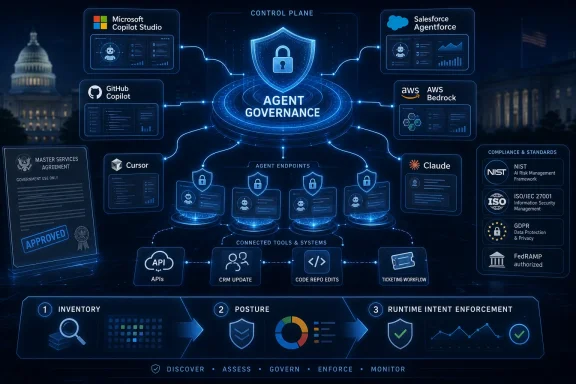 Zenity Is Selling a Security Category Before the Market Has Finished Naming It
The most important thing Zenity did this week was not announce a single feature, partnership, or event. It stitched together a thesis: AI agents are becoming enterprise endpoints, and the security industry’s existing vocabulary is too small to describe the risk.That is a clever position because it borrows from a familiar history. Endpoint detection and response became unavoidable once laptops, servers, and mobile devices became too numerous and too dynamic for perimeter security to manage. Cloud security posture management emerged when cloud assets became too easy to create and too hard to inventory. SaaS security posture management followed the same arc as companies discovered that business users were quietly configuring critical workflows outside the old IT perimeter.
Agent security is trying to become the next version of that story. The agent is not just another app user, another OAuth integration, or another automation script. It can read context, invoke tools, make recommendations, write changes, and sometimes execute tasks with credentials that were originally designed around human accountability.
That is why Zenity’s messaging keeps returning to discovery, posture management, and runtime control. Discovery answers the deceptively basic question: where are the agents? Posture management asks what they can see and do. Runtime control asks whether their behavior is still aligned with business intent after deployment.
The distinction matters. A company may know that it has enabled Copilot Studio or Salesforce Agentforce and still have little understanding of the agents built by departments, contractors, citizen developers, or engineering teams. The security problem is not merely that an agent can be compromised. It is that an agent can be legitimate, sanctioned, and still over-permissioned enough to cause damage.
The Agent Is the New Endpoint, but It Does Not Behave Like One
Calling the agent a new endpoint is useful because it forces the conversation out of the abstract. Security teams understand endpoints as places where identity, data, code, behavior, and policy collide. Agents fit that description uncomfortably well.But agents also break the endpoint metaphor. A laptop has a user, a machine identity, a patch level, a location, and a fairly bounded set of operating behaviors. An agent may have a human owner, a service identity, a prompt-defined objective, model behavior that changes with context, and tool access that spans multiple platforms.
That makes traditional control models leaky. Identity systems can answer who or what is authenticated, but they are less good at interpreting whether an agent’s requested action makes sense in context. DLP can detect certain sensitive data movements, but it may not understand that a seemingly ordinary retrieval step is part of a larger autonomous workflow. Network controls can watch traffic, but much agent activity occurs inside SaaS platforms where the meaningful action is an API call, a document edit, a CRM update, or a ticket workflow.
The old assumption was that automation should be governed by the permissions attached to the account running it. Agentic AI makes that assumption feel reckless. If a human has access to a sales database, a finance folder, a code repository, and a customer-support system, an agent acting on that human’s behalf may inherit a dangerously broad operating surface.
This is where Zenity’s pitch becomes more than vendor opportunism. The security industry has spent years telling enterprises to apply least privilege. Agents expose how difficult that becomes when privileges are contextual, temporary, multi-system, and delegated to software that can reason its way into unexpected action paths.
Microsoft, Salesforce, and AWS Have Created the Surface Area
Zenity’s references to Microsoft Copilot Studio, Salesforce Agentforce, and Amazon Bedrock are not incidental name-dropping. They identify the platforms where agent adoption is likely to spread fastest because the tools are already close to enterprise data and business process.Microsoft has the office documents, Teams conversations, SharePoint sites, identity layer, developer tooling, and Windows estate. Salesforce has customer records, sales workflows, service processes, and revenue operations. AWS has model-hosting infrastructure, Bedrock agents, enterprise integrations, and the gravitational pull of cloud-native development.
For WindowsForum readers, Microsoft’s role is especially important. Copilot is not a single product; it is becoming a pattern across Windows, Microsoft 365, Power Platform, GitHub, Azure, and security tooling. Copilot Studio allows organizations to build agents against business data and workflows, which is precisely where productivity gains and governance failures begin to look alike.
The uncomfortable truth for administrators is that native platform controls may not be enough on their own. Microsoft can govern Microsoft surfaces, Salesforce can govern Salesforce surfaces, and AWS can govern AWS surfaces, but most enterprise workflows do not respect those boundaries. A sales agent may draw from Microsoft 365 documents, update Salesforce records, trigger a workflow through a SaaS connector, and rely on code generated by a developer assistant.
That cross-platform reality is where independent governance vendors see their opening. Zenity’s argument is that enterprises need a layer that can inventory and monitor agents across platforms rather than trust each platform’s native dashboard to tell the whole story. The pitch will resonate with security teams that have already lived through the limits of single-vendor visibility in cloud, SaaS, and identity security.
Coding Assistants Move the Risk Closer to the Build System
Zenity Labs’ focus on Cursor, GitHub Copilot, Claude, and MCP-connected coding environments pushes the story from business automation into software supply chain security. That is a sharper edge. An agent that mishandles a sales workflow can create business risk; an agent that modifies code, dependencies, infrastructure templates, or deployment scripts can create systemic risk.The rise of AI coding assistants has changed the threat model for development teams. These tools are not merely suggesting snippets in an editor. Increasingly, they can inspect repositories, propose multi-file changes, run commands, connect to external context, and interact with developer environments through emerging protocols and plugins.
That makes the developer workstation a crowded place. It already has source code, credentials, build artifacts, package managers, test environments, cloud CLIs, and local secrets that should not be there but often are. Adding an AI assistant with broad file access and tool invocation can amplify mistakes that security teams were already struggling to contain.
The mention of MCP servers is particularly important because model-context plumbing is becoming the connective tissue of agentic systems. The Model Context Protocol has attracted attention because it gives AI tools a standardized way to connect to external systems and data sources. Standardization can help security teams reason about integrations, but it can also accelerate adoption faster than governance can keep up.
EDR and XDR tools were not originally designed to decide whether an AI coding assistant should read a repository file, modify a configuration, call a local tool, or use a connected server to retrieve additional context. They may detect malicious binaries, suspicious process behavior, or known exploitation patterns. They are less likely to understand intent inside an agent-mediated development workflow.
That gap is exactly where agent-security vendors will press their case. If software teams are going to let AI assistants operate inside the build path, the control plane must know not only what process ran but why it ran, what context it used, what files it changed, and whether the requested action matched policy.
Analyst Validation Gives the Pitch a Boardroom Translation
Gartner’s recognition of Zenity as the “Company to Beat” in AI agent governance gives the company something every emerging security vendor wants: language that travels upward. Security architects may debate technical controls, but boards and CIOs respond to category formation, analyst framing, and market signals.That does not mean the category is settled. Analyst reports are snapshots, and “company to beat” language should not be mistaken for a permanent market verdict. But it does tell buyers that AI agent governance has moved from speculative concern to procurement conversation.
The timing helps Zenity. Enterprises have spent the past two years experimenting with generative AI, often under executive pressure to show productivity gains. Now the conversation is shifting from “which model should we use?” to “who is allowed to automate which process, with what data, under whose accountability?”
That transition favors vendors that sell control rather than novelty. It also favors vendors that can explain risk without sounding like they are simply trying to slow adoption. Zenity’s better argument is not that agents are too dangerous to deploy. It is that agents are too useful to deploy blindly.
The most interesting part of the analyst validation is that it sits alongside Zenity’s participation in OWASP, MITRE ATLAS, DEF CON, Black Hat, RSA, TROOPERS26, and Security BSides. The company is trying to speak both languages: the governance language of the CIO and the adversarial language of the security researcher. In a market as immature as agent security, credibility requires both.
The Government Channel Turns Governance Into Procurement
The Carahsoft agreement is the week’s most concrete business move. By making Zenity’s AI agent security and governance platform available through public-sector distribution channels, the company is chasing agencies that are under simultaneous pressure to modernize, automate, and prove control.Government agencies are not early adopters in the consumer-tech sense, but they can be early institutionalizers of security categories. Once a risk becomes part of procurement language, compliance frameworks, modernization programs, and budget planning, it becomes harder for vendors and agencies to ignore.
That is especially true for AI. Public-sector buyers must contend with privacy expectations, records obligations, mission risk, interagency guidance, and political scrutiny. An AI agent that acts unpredictably inside a commercial business can be a costly incident. An AI agent that mishandles sensitive government data or changes a public-service workflow can become a headline, an investigation, or a procurement freeze.
Carahsoft’s role matters because government technology buying is not simply a matter of liking a product. Agencies buy through contract vehicles, reseller ecosystems, approved procurement paths, and compliance processes that can be opaque to companies without public-sector experience. Zenity’s partnership is therefore less about publicity than access.
For enterprise buyers outside government, the public-sector move sends another signal. It implies that Zenity is trying to build a platform durable enough for regulated environments, not just fast-moving technology companies. Whether the product delivers at that level is something customers will decide, but the strategy is clear.
Compliance Is Becoming the Language of Agent Control
Zenity’s references to NIST’s CAISI work, the EU AI Act, Singapore’s governance framework, SOC 2, ISO 27001, GDPR, and HIPAA are part of a larger pattern in AI security marketing. Vendors know that abstract AI risk does not always unlock budgets. Compliance mapping often does.That can be useful, but it can also be slippery. The EU AI Act, privacy law, healthcare compliance, security management standards, and AI safety guidance do not all demand the same controls. A product that helps with agent discovery and monitoring may support compliance work, but it does not automatically make an organization compliant.
Still, the direction is right. Regulators and standards bodies are converging on a few expectations: organizations should know where AI systems are used, understand what data they process, assign accountability, evaluate risk, monitor behavior, and maintain controls across the system lifecycle. Agentic AI intensifies each of those requirements because the system is not merely producing content; it may be acting inside business processes.
This is where runtime monitoring becomes more than a feature phrase. Static reviews are useful before deployment, but agents can behave differently as tools, prompts, permissions, data sources, and model behavior change. If an agent’s authority expands through a connector or a misconfigured identity role, the risk profile changes even if the agent’s original approval record remains pristine.
The compliance challenge is therefore operational. Companies need inventories that stay current, policies that map to business intent, and logs that explain what happened after the agent was released into the wild. In other words, they need governance that behaves less like a spreadsheet and more like a security control.
The Summit Circuit Is How a Vendor Becomes a Convening Power
The AI Agent Security Summit series may sound like standard conference marketing, but it serves a deeper purpose. Emerging security categories are built not only through products but through communities, shared vocabulary, and repeatable stories of failure.By expanding summit activity to Tokyo, London, and New York, Zenity is trying to make agent security feel global before the market calcifies around larger incumbents. A call for papers on hacking AI agents, defensive strategies, and governance standards invites researchers and practitioners to fill in the evidence base that vendors alone cannot credibly supply.
That matters because agent security still suffers from too many hypothetical demos and not enough operational case studies. Security teams want to know what failures look like in production, what attacks are realistic, which controls actually help, and which risks are being inflated by vendors selling fear. A credible conference circuit can separate useful threat research from theatrical prompt-injection stunts.
The summit strategy also gives Zenity a way to shape the market’s language. If CISOs begin using terms like agent discovery, intent-aware policy enforcement, agent posture, and runtime governance, vendors that helped popularize those terms gain an advantage. Category language often becomes procurement language.
There is a risk here, too. A vendor-led summit can become an echo chamber if it amplifies only the threat model that fits the sponsor’s product. The stronger version of Zenity’s play is to make room for independent researchers, cloud-platform teams, red-teamers, compliance experts, and skeptical enterprise operators. If the market is going to trust agent-security claims, it needs adversarial debate as much as polished demos.
The Security Industry Is Replaying the Shadow IT Movie
The broader lesson is that enterprise AI agents are becoming the newest form of shadow IT. The difference is that this time the shadow system may be able to act.Shadow SaaS was about unsanctioned apps. Shadow cloud was about infrastructure created outside central control. Shadow AI started with employees pasting sensitive data into consumer chatbots. Agentic AI adds a more consequential twist: employees and teams can build or configure systems that read internal context, call tools, and perform workflow steps.
That is why discovery sits at the center of Zenity’s pitch. Before a security team can govern agents, it needs to find them across sanctioned platforms, developer environments, SaaS tools, and automation layers. The first uncomfortable audit in many organizations will not be about whether agents are secure; it will be about whether anyone can produce a reliable list of them.
The incentives are not on IT’s side. Business teams want speed. Developers want assistance. Executives want measurable AI adoption. Vendors want agent creation to be easy because usage drives platform value. Every one of those incentives encourages proliferation before governance.
This does not mean enterprises should stop building agents. It means they should assume the agent population will grow faster than central security teams expect. The practical answer is not blanket prohibition, which usually drives adoption underground, but tiered control based on data sensitivity, action authority, and business impact.
Windows Administrators Should Watch the Copilot-to-Agent Pipeline
For Windows administrators, the Zenity story is not just another cloud-security vendor announcement. It is a preview of where desktop, identity, productivity, and automation management are heading.Microsoft’s Copilot strategy increasingly links user experience with enterprise data and workflow automation. Windows, Microsoft 365, Entra ID, Intune, Defender, Power Platform, GitHub, and Azure are all part of the same gravitational field. As agents become easier to build and deploy inside that ecosystem, administrators will be asked to answer questions that do not fit neatly into old management consoles.
Who owns an agent created by a business unit? Which identity does it use? Can it read documents from a SharePoint site whose permissions were never cleaned up? Can it send email, update a ticket, modify a list, query a database, or trigger a Power Automate flow? What happens when the employee who created it changes roles or leaves the company?
These are not theoretical governance riddles. They are the same operational problems that already haunt Microsoft 365 tenants: overshared files, stale groups, abandoned apps, sprawling service principals, permissive connectors, and business-critical workflows owned by individuals rather than teams. Agents give those old problems a new execution engine.
The Windows endpoint also remains part of the picture. AI coding assistants and local agent tools may run on developer machines that are managed by Intune and monitored by Defender, but the meaningful risk may occur above the operating-system layer. If the agent reads a repository, calls a tool, or connects to an MCP server, endpoint telemetry alone may not tell the full story.
The next generation of Windows administration will therefore be less about device management alone and more about activity governance across identities, apps, agents, and data. Zenity’s rise is one sign that the market sees that shift coming.
The Platform Giants Will Not Leave This Market Empty
Zenity’s opportunity is real, but it is not uncontested. Microsoft, Salesforce, AWS, Google, ServiceNow, Palo Alto Networks, CrowdStrike, Cisco, Zscaler, Okta, and a long list of AI-native startups all have reasons to move into agent governance, identity, runtime control, or AI security posture.The platform vendors have distribution. Microsoft can place controls inside the admin experiences customers already use. Salesforce can govern agents where customer data lives. AWS can integrate policy into Bedrock and cloud identity. Security incumbents can extend existing telemetry and response workflows into AI activity.
Independent vendors have a different advantage: cross-platform visibility and speed. They can move where the pain is most acute without defending a single ecosystem’s boundaries. They can also be more blunt about gaps in native controls because they are not selling the platforms that created the sprawl.
The eventual market may not produce a clean winner. Large enterprises often buy native controls for baseline coverage, security platforms for correlation, and specialist tools for the newest risk surface. Agent governance could follow that pattern, with platform-native tools handling local policy and independent systems providing cross-platform inventory, risk scoring, and runtime enforcement.
Zenity’s challenge is to prove that it is not merely an early narrator of the problem. It must show that its controls work at enterprise scale, across messy environments, and against real attacks rather than idealized demos. In security, category leadership is rented, not owned.
The Vendor Pitch Is Strongest When It Admits the Mess
The danger in any emerging security category is over-precision. Vendors are tempted to imply that the problem is fully understood and the solution is already packaged. AI agent security is not there yet.The market is still arguing over definitions. Some “agents” are glorified workflows. Some are chatbots with tool access. Some are autonomous systems with planning, memory, connectors, and delegated authority. Some are embedded features inside larger platforms that administrators may not even recognize as agents.
That definitional mess matters because controls should match capability. A read-only assistant that summarizes documents does not require the same governance as an autonomous procurement agent that can communicate with vendors and update financial systems. A coding assistant that suggests text is different from one that can run commands and modify repositories.
Zenity’s best framing is therefore not “all agents are dangerous.” It is that enterprises need to classify agents by what they can observe, decide, and do. The more an agent can act, the more governance must move from policy documents into runtime enforcement.
Security teams should be suspicious of both extremes. The first extreme treats agents as harmless productivity features and assumes existing controls will absorb the risk. The second treats agents as uncontrollable and blocks useful adoption. The practical middle is harder: inventory everything, tier authority, enforce least privilege, monitor behavior, and build rollback paths before incidents force them.
The Week’s Signal Is Bigger Than Zenity
Zenity’s busy week is notable because it captures where the AI security conversation is moving. The industry is shifting from model risk to operational risk, from prompt safety to workflow safety, and from abstract governance principles to enforceable controls.That shift is overdue. The first wave of enterprise generative AI debate focused heavily on data leakage, hallucinations, copyright, and acceptable use. Those issues remain important, but agents introduce a different class of failure. A hallucinating chatbot may produce a bad answer; an over-permissioned agent may produce a bad action.
This is why the phrase “intent-aware policy enforcement” is more interesting than it first appears. Traditional policy often evaluates identity, resource, location, device state, and data classification. Agent policy also needs to evaluate purpose. Is the agent retrieving customer data to answer an approved support request, or is it assembling a dataset for an unauthorized export? Is it modifying code as part of a reviewed change, or rewriting files because a malicious instruction entered through a dependency or prompt?
Purpose is hard to infer, and no vendor should pretend otherwise. But as agents become more capable, security controls that ignore intent will look increasingly crude. The future of agent governance will likely combine identity, data lineage, tool permissions, prompt and instruction analysis, behavioral baselines, approvals, and audit trails.
Zenity is trying to occupy that future early. Whether it remains a category leader will depend on execution, integration depth, customer proof, and how quickly the platform giants respond. But the market direction is no longer speculative.
The Enterprise Agent Land Grab Now Has Rules
Zenity’s week of announcements and promotions leaves security teams with a practical message: agent adoption is already moving, and governance needs to catch up before autonomy becomes ordinary. The company’s claims should be evaluated like any vendor’s claims, but the underlying risk model is credible enough that IT leaders should not wait for a breach headline to start building controls.- Enterprises should begin with agent inventory across SaaS platforms, developer tools, automation systems, and cloud environments.
- Security teams should classify agents by data access, tool access, write authority, autonomy level, and business criticality.
- Microsoft-centric organizations should pay special attention to Copilot Studio, Power Platform, SharePoint permissions, Entra identities, and abandoned business-owned workflows.
- Developer teams should treat AI coding assistants and MCP-connected tools as part of the software supply chain, not merely as editor features.
- Public-sector and regulated organizations should map agent governance to compliance obligations without assuming that a vendor platform alone satisfies those obligations.
- Buyers should compare native platform controls with independent cross-platform tools before deciding where agent governance should live.
References
- Primary source: TipRanks
Published: 2026-06-27T13:50:12.509977
- Related coverage: zenity.io
Gartner® Names Zenity Company to Beat in AI Agent Governance
Gartner® independently named Zenity the Company to Beat in AI Agent Governance. See what the analysis found and what it means for your security program.zenity.io - Related coverage: businesswire.com
- Related coverage: carahsoft.com
Zenity and Carahsoft Bring AI Agent Security and Governance to Federal, State and Local Agencies | Carahsoft
Zenity and Carahsoft Technology Corp. today announced a strategic partnership. www.carahsoft.com
- Related coverage: labs.cloudsecurityalliance.org
