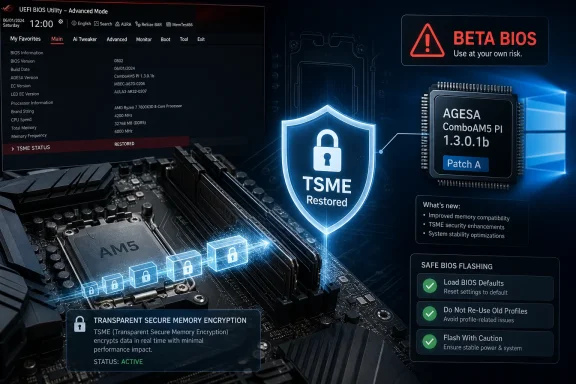
AMD confirmed in June 2026 that it will restore the BIOS option for AMD Memory Guard, also known as Transparent Secure Memory Encryption, on certain non-PRO Ryzen 9000 desktop processors through motherboard firmware updates expected in July 2026. The reversal matters less because most gamers were clamoring for encrypted DRAM, and more because AMD briefly turned a security capability into a segmentation lever after users had already built expectations around it. In a PC market where firmware updates increasingly decide what silicon is allowed to do, this is not just a Ryzen security story. It is a warning about how much of the modern desktop platform now lives in policy, not hardware.
The controversy began the way many platform controversies now begin: not with a glossy product announcement, but with users noticing that a switch had disappeared. Motherboard vendors shipped newer BIOS releases based on updated AGESA firmware, and owners of consumer Ryzen systems found that TSME support was no longer exposed where it had been before. The hardware had not changed. The motherboard had not changed. What changed was the firmware’s willingness to let the feature be used.
That distinction is the core of the backlash. AMD did not remove a broken peripheral from a spec sheet or retire an old driver path. It disabled access to a hardware-backed security function that some users had already treated as part of the platform. For enthusiasts, Linux users, homelab operators, and security-conscious desktop owners, the vanishing act looked less like housekeeping and more like product-tier enforcement after the sale.
AMD’s response was unusually direct by the standards of silicon-vendor damage control. The company said AMD Memory Guard remains a foundational security feature for Ryzen PRO systems, and that it has no plans to remove support from that lineup. It also acknowledged that a BIOS option for certain non-PRO Ryzen 9000-series desktop processors had previously existed, had been removed in a recent update, and would be reinstated in an upcoming July BIOS release based on community feedback.
That wording is careful, and it matters. AMD is not promising that every Ryzen chip that ever exposed TSME will regain it. It is specifically talking about certain non-PRO Ryzen 9000 desktop processors. But even that narrower reversal tells us something important: the company recognized that the cost of pulling the feature from consumer firmware was higher than the benefit of keeping it corralled inside the PRO branding stack.
Its purpose is quieter. TSME encrypts system memory using hardware in the processor, with the work handled transparently beneath the operating system and applications. In the simplest version of the pitch, data written to DRAM is encrypted and data read back by the CPU is decrypted, reducing the value of raw memory contents to an attacker who can physically access the machine or probe memory outside normal software controls.
This is not a magic shield. It does not stop malware already running as an administrator. It does not make a compromised operating system trustworthy. It does not eliminate the need for BitLocker, firmware passwords, secure boot discipline, device encryption, or basic physical security. But it does raise the bar against a class of attacks that security engineers have worried about for decades: cold-boot attacks, direct memory access abuse, and other scenarios where the attacker’s advantage comes from touching the machine rather than logging into it.
That is why the consumer reaction was sharper than AMD may have expected. Many of the people who noticed the change are exactly the people who understand the boundaries of the feature. They were not claiming that TSME transformed a gaming tower into a hardened server. They were arguing that if the silicon can provide a transparent layer of memory protection at tolerable cost, disabling it for market segmentation reasons is a strange direction for a company that routinely sells itself on platform openness and enthusiast goodwill.
The fact that AMD calls the technology AMD Memory Guard in its business materials only added to the awkwardness. “Memory Guard” sounds like a security baseline, not a luxury trim package. Once a vendor teaches users that a capability is part of a trustworthy hardware foundation, it should expect resistance when that foundation is quietly narrowed by firmware.
That is good when it means stability improvements. It is more complicated when it means a security switch can appear or disappear depending on a firmware branch distributed by ASUS, MSI, Gigabyte, ASRock, or another board vendor. The end user sees “BIOS update.” Underneath, a chain of silicon policy, vendor integration, board validation, and release notes determines what the machine becomes after reboot.
This is the bargain modern PC users have accepted, often without noticing. A CPU is no longer just the thing soldered or socketed into the board. It is a living platform contract mediated by microcode, firmware blobs, security processors, fuses, vendor defaults, and UEFI menus. Some of that mutability is necessary, especially in a world of speculative execution bugs, memory training headaches, and complex I/O dies. But the same channel that patches risk can also remove capability.
AMD’s TSME reversal does not erase that concern. It highlights it. If a security feature can vanish from consumer Ryzen systems because a newer AGESA release no longer exposes it, then the practical owner of a desktop PC must think about BIOS updates not merely as bug fixes but as feature migrations. That is a very different relationship from the old enthusiast habit of flashing the latest firmware because newer is presumed better.
For Windows users, this is especially relevant because firmware security and operating-system security are now deeply intertwined. Windows 11’s baseline assumptions around TPMs, secure boot, virtualization-based security, kernel isolation, and device encryption all rely on the platform beneath the OS behaving predictably. If vendors make security capability feel provisional, they weaken trust not only in their own stack but in the broader promise that modern PCs are becoming more secure by default.
But not all features are equally safe to segment. Remote manageability, fleet provisioning, lifecycle guarantees, ECC validation policies, and enterprise support channels are natural candidates for business differentiation. They are valuable because organizations need scale, accountability, and continuity. Security features are trickier, particularly when the feature is already present in silicon and has already been visible to users.
The optics are poor because the consumer interpretation writes itself: the hardware can do the secure thing, but the vendor prefers to reserve the switch for a more expensive product category. That may be an oversimplification. There may be validation costs, support concerns, certification boundaries, platform consistency issues, or legal commitments behind the scenes. Still, when the public-facing result is that memory encryption disappears from non-PRO systems, AMD is left defending the distinction between “not advertised” and “not expected.”
That distinction is legally useful but reputationally thin. Enthusiasts know that consumer Ryzen and professional Ryzen products often share deep architectural commonalities. They know that features can be fused off, hidden, exposed, or unsupported for reasons that have little to do with whether the transistors exist. They also know that AMD has benefited for years from being perceived as the more user-friendly alternative to Intel’s more aggressive platform segmentation.
That is the brand-level risk AMD seems to have recognized. The company can defend Ryzen PRO as the official home of Memory Guard while still allowing a BIOS option on some consumer Ryzen 9000 systems. That compromise does not collapse the PRO business. It simply acknowledges that removing an already-exposed security capability from enthusiasts is a poor way to reinforce the value of business-class SKUs.
The more important comparison is strategic. Both companies are trying to make hardware security sound like a default property of modern computing while also slicing their product lines into consumer, commercial, workstation, and server tiers. That tension is not going away. The same chip families that must appeal to gamers and creators are also expected to support confidential computing, virtualization, endpoint hardening, and enterprise compliance narratives.
For Intel, memory encryption has been part of a broader story that includes client security, vPro manageability, and server-side confidential-computing technologies. For AMD, Memory Guard, Secure Memory Encryption, Secure Encrypted Virtualization, and Infinity Guard have been key pieces of the EPYC and Ryzen PRO pitch. The difficulty is that once these ideas leave the data center and land in consumer discourse, users stop treating them as enterprise checkboxes and start treating them as basic platform hygiene.
That shift is rational. Laptops are stolen. Desktops run password managers, crypto wallets, SSH agents, development secrets, customer data, and cached authentication tokens. Home labs run services that would have been small-business infrastructure a decade ago. The old line between “consumer” and “professional” security assumptions has been blurred by remote work, creator businesses, self-hosting, and the simple fact that ordinary users now store extraordinary amounts of sensitive data on ordinary machines.
So the question is not whether a gaming PC needs every enterprise feature. It does not. The question is whether a transparent hardware memory-encryption option, already present and already exposed on some systems, belongs behind a product-label wall. AMD’s July reversal suggests that, at least for some Ryzen 9000 desktops, the company decided the answer is no.
That process can be uncomfortable for vendors, but it is also one of the PC ecosystem’s strengths. The modern Windows desktop owes a great deal to communities that test hardware outside the polished paths vendors prioritize. Linux users often surface firmware regressions, ACPI quirks, security inconsistencies, and device-enablement problems that eventually matter to everyone.
In this case, the community pressure reframed the story from “a BIOS option changed” to “AMD removed a security capability from consumer Ryzen.” That framing stuck because the removal was difficult to square with the broader industry message that hardware-backed protections should be expanding. Vendors want users to accept firmware updates quickly when vulnerabilities emerge. Users are more likely to do that when updates are perceived as additive, transparent, and trustworthy.
The episode also shows why release notes matter. If a firmware update disables a security-relevant feature, it should not take forum archaeology and cross-platform testing for owners to understand what happened. Silent changes invite the most cynical interpretation, especially when the change benefits product segmentation more visibly than it benefits users.
AMD’s statement cites community feedback, which is the polite version of the story. The sharper version is that the community noticed something AMD should have explained before users had to reverse-engineer it. The fact that AMD is now restoring the option is good. The fact that it had to be pressured into saying so is the part IT pros will remember.
The threat model is also specific. Memory encryption is most relevant when an attacker can obtain physical access or otherwise observe memory contents outside the normal CPU execution path. That is not the first risk most home desktop users face. Phishing, malicious downloads, credential theft, browser exploits, remote access trojans, and supply-chain compromise remain far more common paths to harm.
But narrow is not the same as useless. Security is layered precisely because no single layer addresses every attack. Disk encryption protects data at rest, but once a machine is powered on and secrets are in RAM, the equation changes. Secure boot helps ensure trusted early boot code, but it does not make raw DRAM contents harmless if an attacker can get at them. Operating-system isolation helps contain software attacks, but it is not designed as the only answer to invasive physical attacks.
There is also a class of user for whom this matters more than AMD’s mainstream segmentation may assume. Developers with signing keys, journalists working with sensitive sources, administrators carrying privileged credentials, activists crossing borders, cryptocurrency users, researchers, and self-hosters may all use “consumer” hardware while facing risks that do not look consumer-grade. The PC market’s labels do not map cleanly onto the value of the data stored on the machine.
That is why restoring the option is the right call even if relatively few owners will enable it knowingly. Platform security should not be limited to the median use case. The median user also does not inspect TPM PCR values, configure BitLocker recovery policies, or audit UEFI capsule updates. Yet the industry has correctly decided that many of those protections should exist anyway.
That means affected users should not expect a single universal switch to appear on July 1. BIOS releases tend to arrive in waves, and release notes can be uneven. One board may explicitly mention Memory Guard or TSME. Another may bury the change under “security enhancement” or “AGESA update.” A third may receive the relevant AGESA branch later, after beta firmware circulates first.
There is a practical caution here for administrators and careful desktop owners: do not flash firmware blindly just because the headline says the feature is coming back. Check the board vendor’s release notes, verify the AGESA version, look for user reports on the exact board and CPU combination, and make sure rollback options are understood before updating. Firmware updates are not ordinary application patches; a failed or problematic flash can turn a security improvement into a weekend recovery project.
Windows users should also remember that the BIOS option is only part of the configuration story. Security posture depends on how the firmware setting interacts with secure boot, TPM configuration, virtualization features, operating-system encryption, sleep states, and physical-access controls. TSME is a useful layer, not a substitute for disciplined endpoint configuration.
For OEM systems, the timeline may be slower still. Retail motherboard vendors compete visibly for enthusiast goodwill. OEM desktops and boutique systems may depend on vendor-specific validation and support policies. If AMD’s July code lands promptly, the real-world availability of a toggle may still vary substantially by brand and model.
The less generous reading is that AMD tested a boundary and retreated only after it became a public-relations liability. That interpretation may or may not be fair, but it will be hard to avoid because the removal was not framed clearly before users discovered it. Trust is rarely lost in the technical detail. It is lost in the suspicion that the technical detail was hidden because the vendor knew users would dislike it.
This matters beyond TSME because the firmware surface of the PC is getting more important, not less. CPU vendors are patching speculative execution issues, random-number-generator flaws, USB oddities, memory-training problems, power-management bugs, and security-processor behavior through layers most users cannot inspect. The more invisible that machinery becomes, the more vendors need to overcommunicate when changes affect security capabilities.
AMD also has a particular reputational burden. The company’s comeback in desktop and server CPUs was fueled not just by performance but by a sense that it was giving users more: more cores, more platform longevity, more value, more openness. That identity is commercially useful, but it also creates expectations. When AMD behaves like a company carving up a capability matrix after the fact, the reaction is harsher because it collides with the story many of its best customers believed.
The restoration of TSME on certain Ryzen 9000 systems is therefore a win, but a conditional one. AMD can turn it into a trust-building moment if the July firmware is clear, broadly available where promised, and documented without euphemism. Or it can make the story linger if users have to guess which boards, which BIOS versions, and which CPUs actually regain the option.
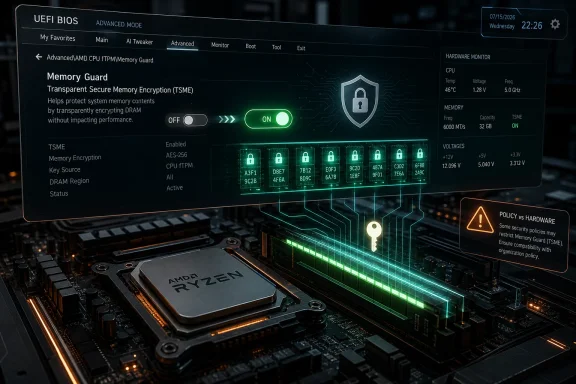 AMD Learned That Firmware Segmentation Has a Memory
The controversy began the way many platform controversies now begin: not with a glossy product announcement, but with users noticing that a switch had disappeared. Motherboard vendors shipped newer BIOS releases based on updated AGESA firmware, and owners of consumer Ryzen systems found that TSME support was no longer exposed where it had been before. The hardware had not changed. The motherboard had not changed. What changed was the firmware’s willingness to let the feature be used.That distinction is the core of the backlash. AMD did not remove a broken peripheral from a spec sheet or retire an old driver path. It disabled access to a hardware-backed security function that some users had already treated as part of the platform. For enthusiasts, Linux users, homelab operators, and security-conscious desktop owners, the vanishing act looked less like housekeeping and more like product-tier enforcement after the sale.
AMD’s response was unusually direct by the standards of silicon-vendor damage control. The company said AMD Memory Guard remains a foundational security feature for Ryzen PRO systems, and that it has no plans to remove support from that lineup. It also acknowledged that a BIOS option for certain non-PRO Ryzen 9000-series desktop processors had previously existed, had been removed in a recent update, and would be reinstated in an upcoming July BIOS release based on community feedback.
That wording is careful, and it matters. AMD is not promising that every Ryzen chip that ever exposed TSME will regain it. It is specifically talking about certain non-PRO Ryzen 9000 desktop processors. But even that narrower reversal tells us something important: the company recognized that the cost of pulling the feature from consumer firmware was higher than the benefit of keeping it corralled inside the PRO branding stack.
TSME Was Never a Gaming Feature, Which Is Why Its Removal Stung
Transparent Secure Memory Encryption is not the sort of feature that sells a boxed CPU at retail. It does not raise frame rates. It does not make Cinebench scores look better. It does not show up in the usual motherboard marketing grid beside PCIe lanes, USB speeds, Wi-Fi versions, and RGB headers.Its purpose is quieter. TSME encrypts system memory using hardware in the processor, with the work handled transparently beneath the operating system and applications. In the simplest version of the pitch, data written to DRAM is encrypted and data read back by the CPU is decrypted, reducing the value of raw memory contents to an attacker who can physically access the machine or probe memory outside normal software controls.
This is not a magic shield. It does not stop malware already running as an administrator. It does not make a compromised operating system trustworthy. It does not eliminate the need for BitLocker, firmware passwords, secure boot discipline, device encryption, or basic physical security. But it does raise the bar against a class of attacks that security engineers have worried about for decades: cold-boot attacks, direct memory access abuse, and other scenarios where the attacker’s advantage comes from touching the machine rather than logging into it.
That is why the consumer reaction was sharper than AMD may have expected. Many of the people who noticed the change are exactly the people who understand the boundaries of the feature. They were not claiming that TSME transformed a gaming tower into a hardened server. They were arguing that if the silicon can provide a transparent layer of memory protection at tolerable cost, disabling it for market segmentation reasons is a strange direction for a company that routinely sells itself on platform openness and enthusiast goodwill.
The fact that AMD calls the technology AMD Memory Guard in its business materials only added to the awkwardness. “Memory Guard” sounds like a security baseline, not a luxury trim package. Once a vendor teaches users that a capability is part of a trustworthy hardware foundation, it should expect resistance when that foundation is quietly narrowed by firmware.
AGESA Has Become the Place Where Platform Promises Are Rewritten
AGESA is one of those pieces of infrastructure that ordinary PC buyers rarely think about until something goes wrong. It is AMD’s low-level initialization code, delivered through motherboard BIOS updates, and it helps bring up the CPU, memory controller, chipset, and platform features before the operating system enters the picture. In the Ryzen era, AGESA has become both a lifeline and a lever: a way to fix bugs, improve memory compatibility, add CPU support, and change platform behavior long after a motherboard has left the factory.That is good when it means stability improvements. It is more complicated when it means a security switch can appear or disappear depending on a firmware branch distributed by ASUS, MSI, Gigabyte, ASRock, or another board vendor. The end user sees “BIOS update.” Underneath, a chain of silicon policy, vendor integration, board validation, and release notes determines what the machine becomes after reboot.
This is the bargain modern PC users have accepted, often without noticing. A CPU is no longer just the thing soldered or socketed into the board. It is a living platform contract mediated by microcode, firmware blobs, security processors, fuses, vendor defaults, and UEFI menus. Some of that mutability is necessary, especially in a world of speculative execution bugs, memory training headaches, and complex I/O dies. But the same channel that patches risk can also remove capability.
AMD’s TSME reversal does not erase that concern. It highlights it. If a security feature can vanish from consumer Ryzen systems because a newer AGESA release no longer exposes it, then the practical owner of a desktop PC must think about BIOS updates not merely as bug fixes but as feature migrations. That is a very different relationship from the old enthusiast habit of flashing the latest firmware because newer is presumed better.
For Windows users, this is especially relevant because firmware security and operating-system security are now deeply intertwined. Windows 11’s baseline assumptions around TPMs, secure boot, virtualization-based security, kernel isolation, and device encryption all rely on the platform beneath the OS behaving predictably. If vendors make security capability feel provisional, they weaken trust not only in their own stack but in the broader promise that modern PCs are becoming more secure by default.
The PRO Line Needed Differentiation, But Security Is a Dangerous Fence
AMD’s segmentation problem is real. Ryzen PRO, Threadripper Pro, and EPYC exist for customers who need manageability, validation, fleet support, longer lifecycle assurances, and enterprise security positioning. Those product lines command different pricing and are sold into very different procurement environments from a DIY Ryzen 7 or Ryzen 9 desktop chip. No vendor wants every business-class feature to become table stakes on consumer hardware overnight.But not all features are equally safe to segment. Remote manageability, fleet provisioning, lifecycle guarantees, ECC validation policies, and enterprise support channels are natural candidates for business differentiation. They are valuable because organizations need scale, accountability, and continuity. Security features are trickier, particularly when the feature is already present in silicon and has already been visible to users.
The optics are poor because the consumer interpretation writes itself: the hardware can do the secure thing, but the vendor prefers to reserve the switch for a more expensive product category. That may be an oversimplification. There may be validation costs, support concerns, certification boundaries, platform consistency issues, or legal commitments behind the scenes. Still, when the public-facing result is that memory encryption disappears from non-PRO systems, AMD is left defending the distinction between “not advertised” and “not expected.”
That distinction is legally useful but reputationally thin. Enthusiasts know that consumer Ryzen and professional Ryzen products often share deep architectural commonalities. They know that features can be fused off, hidden, exposed, or unsupported for reasons that have little to do with whether the transistors exist. They also know that AMD has benefited for years from being perceived as the more user-friendly alternative to Intel’s more aggressive platform segmentation.
That is the brand-level risk AMD seems to have recognized. The company can defend Ryzen PRO as the official home of Memory Guard while still allowing a BIOS option on some consumer Ryzen 9000 systems. That compromise does not collapse the PRO business. It simply acknowledges that removing an already-exposed security capability from enthusiasts is a poor way to reinforce the value of business-class SKUs.
The Intel Comparison Is Less About Who Has the Better Acronym
The Guru3D report frames AMD’s move partly against Intel’s memory-encryption technologies, including Total Memory Encryption and multi-key variants. That comparison is useful, but only up to a point. Intel and AMD have different product stacks, different naming schemes, and different histories of exposing security capabilities across client and server platforms.The more important comparison is strategic. Both companies are trying to make hardware security sound like a default property of modern computing while also slicing their product lines into consumer, commercial, workstation, and server tiers. That tension is not going away. The same chip families that must appeal to gamers and creators are also expected to support confidential computing, virtualization, endpoint hardening, and enterprise compliance narratives.
For Intel, memory encryption has been part of a broader story that includes client security, vPro manageability, and server-side confidential-computing technologies. For AMD, Memory Guard, Secure Memory Encryption, Secure Encrypted Virtualization, and Infinity Guard have been key pieces of the EPYC and Ryzen PRO pitch. The difficulty is that once these ideas leave the data center and land in consumer discourse, users stop treating them as enterprise checkboxes and start treating them as basic platform hygiene.
That shift is rational. Laptops are stolen. Desktops run password managers, crypto wallets, SSH agents, development secrets, customer data, and cached authentication tokens. Home labs run services that would have been small-business infrastructure a decade ago. The old line between “consumer” and “professional” security assumptions has been blurred by remote work, creator businesses, self-hosting, and the simple fact that ordinary users now store extraordinary amounts of sensitive data on ordinary machines.
So the question is not whether a gaming PC needs every enterprise feature. It does not. The question is whether a transparent hardware memory-encryption option, already present and already exposed on some systems, belongs behind a product-label wall. AMD’s July reversal suggests that, at least for some Ryzen 9000 desktops, the company decided the answer is no.
Linux Users Turned a Missing Toggle Into a Platform Story
The backlash gathered force in enthusiast and Linux circles because those communities are unusually good at noticing low-level regressions. Linux tooling, kernel logs, firmware reporting, and public bug trackers create a culture where platform changes are not simply absorbed; they are inspected. When a feature disappears, someone will compare BIOS versions, test across boards, file reports, and ask whether the behavior is a bug or a policy.That process can be uncomfortable for vendors, but it is also one of the PC ecosystem’s strengths. The modern Windows desktop owes a great deal to communities that test hardware outside the polished paths vendors prioritize. Linux users often surface firmware regressions, ACPI quirks, security inconsistencies, and device-enablement problems that eventually matter to everyone.
In this case, the community pressure reframed the story from “a BIOS option changed” to “AMD removed a security capability from consumer Ryzen.” That framing stuck because the removal was difficult to square with the broader industry message that hardware-backed protections should be expanding. Vendors want users to accept firmware updates quickly when vulnerabilities emerge. Users are more likely to do that when updates are perceived as additive, transparent, and trustworthy.
The episode also shows why release notes matter. If a firmware update disables a security-relevant feature, it should not take forum archaeology and cross-platform testing for owners to understand what happened. Silent changes invite the most cynical interpretation, especially when the change benefits product segmentation more visibly than it benefits users.
AMD’s statement cites community feedback, which is the polite version of the story. The sharper version is that the community noticed something AMD should have explained before users had to reverse-engineer it. The fact that AMD is now restoring the option is good. The fact that it had to be pressured into saying so is the part IT pros will remember.
The Real-World Risk Is Narrow, But Not Imaginary
For most WindowsForum readers, the return of TSME will not change daily computing. Games will not suddenly run safer in a way the user can feel. Office workloads, browsers, video editing, and typical desktop tasks will look the same. In many configurations, the performance implications of transparent memory encryption are likely to be modest, but any exact impact depends on platform, workload, firmware implementation, and measurement method.The threat model is also specific. Memory encryption is most relevant when an attacker can obtain physical access or otherwise observe memory contents outside the normal CPU execution path. That is not the first risk most home desktop users face. Phishing, malicious downloads, credential theft, browser exploits, remote access trojans, and supply-chain compromise remain far more common paths to harm.
But narrow is not the same as useless. Security is layered precisely because no single layer addresses every attack. Disk encryption protects data at rest, but once a machine is powered on and secrets are in RAM, the equation changes. Secure boot helps ensure trusted early boot code, but it does not make raw DRAM contents harmless if an attacker can get at them. Operating-system isolation helps contain software attacks, but it is not designed as the only answer to invasive physical attacks.
There is also a class of user for whom this matters more than AMD’s mainstream segmentation may assume. Developers with signing keys, journalists working with sensitive sources, administrators carrying privileged credentials, activists crossing borders, cryptocurrency users, researchers, and self-hosters may all use “consumer” hardware while facing risks that do not look consumer-grade. The PC market’s labels do not map cleanly onto the value of the data stored on the machine.
That is why restoring the option is the right call even if relatively few owners will enable it knowingly. Platform security should not be limited to the median use case. The median user also does not inspect TPM PCR values, configure BitLocker recovery policies, or audit UEFI capsule updates. Yet the industry has correctly decided that many of those protections should exist anyway.
Motherboard Vendors Now Inherit the Clock
AMD’s promise of a July BIOS release is only the beginning of the practical rollout. The company supplies AGESA code, but motherboard manufacturers must integrate it, validate it, package it, publish it, and support it across specific boards. Some vendors will move quickly on flagship X870E and X670E models. Others may take longer, especially for lower-volume boards or systems that are already deep into mature support windows.That means affected users should not expect a single universal switch to appear on July 1. BIOS releases tend to arrive in waves, and release notes can be uneven. One board may explicitly mention Memory Guard or TSME. Another may bury the change under “security enhancement” or “AGESA update.” A third may receive the relevant AGESA branch later, after beta firmware circulates first.
There is a practical caution here for administrators and careful desktop owners: do not flash firmware blindly just because the headline says the feature is coming back. Check the board vendor’s release notes, verify the AGESA version, look for user reports on the exact board and CPU combination, and make sure rollback options are understood before updating. Firmware updates are not ordinary application patches; a failed or problematic flash can turn a security improvement into a weekend recovery project.
Windows users should also remember that the BIOS option is only part of the configuration story. Security posture depends on how the firmware setting interacts with secure boot, TPM configuration, virtualization features, operating-system encryption, sleep states, and physical-access controls. TSME is a useful layer, not a substitute for disciplined endpoint configuration.
For OEM systems, the timeline may be slower still. Retail motherboard vendors compete visibly for enthusiast goodwill. OEM desktops and boutique systems may depend on vendor-specific validation and support policies. If AMD’s July code lands promptly, the real-world availability of a toggle may still vary substantially by brand and model.
AMD’s Reversal Fixes the Symptom, Not the Trust Problem
The most generous reading of AMD’s move is that the company listened. A feature disappeared, users objected, and AMD chose to restore it. In a market where vendors often wait out criticism or hide behind support scripts, that is not nothing.The less generous reading is that AMD tested a boundary and retreated only after it became a public-relations liability. That interpretation may or may not be fair, but it will be hard to avoid because the removal was not framed clearly before users discovered it. Trust is rarely lost in the technical detail. It is lost in the suspicion that the technical detail was hidden because the vendor knew users would dislike it.
This matters beyond TSME because the firmware surface of the PC is getting more important, not less. CPU vendors are patching speculative execution issues, random-number-generator flaws, USB oddities, memory-training problems, power-management bugs, and security-processor behavior through layers most users cannot inspect. The more invisible that machinery becomes, the more vendors need to overcommunicate when changes affect security capabilities.
AMD also has a particular reputational burden. The company’s comeback in desktop and server CPUs was fueled not just by performance but by a sense that it was giving users more: more cores, more platform longevity, more value, more openness. That identity is commercially useful, but it also creates expectations. When AMD behaves like a company carving up a capability matrix after the fact, the reaction is harsher because it collides with the story many of its best customers believed.
The restoration of TSME on certain Ryzen 9000 systems is therefore a win, but a conditional one. AMD can turn it into a trust-building moment if the July firmware is clear, broadly available where promised, and documented without euphemism. Or it can make the story linger if users have to guess which boards, which BIOS versions, and which CPUs actually regain the option.
The July BIOS Will Be a Test of AMD’s Security Promises
The concrete lesson is that hardware security is now part of the consumer platform conversation, even when vendors would prefer to keep it in enterprise brochures. AMD’s next move is not just to ship code. It is to prove that the company understands why this particular missing toggle became a controversy.- AMD says it will restore the Memory Guard or TSME BIOS option for certain non-PRO Ryzen 9000 desktop processors in July 2026.
- The removal appears to have happened through newer AGESA-based firmware rather than through any physical change to the processors.
- Ryzen PRO, Threadripper Pro, and EPYC remain the product lines where AMD officially positions memory-encryption features as part of the commercial and enterprise security stack.
- The real-world benefit for ordinary gaming desktops is limited but meaningful for users who care about physical-access attacks and layered endpoint security.
- Motherboard vendors will determine how quickly the restored option reaches actual systems, and availability will likely vary by board model and BIOS release.
- The larger issue is not whether every consumer needs TSME, but whether vendors should silently remove security capabilities from hardware that can already support them.
References
- Primary source: www.guru3d.com
Published: Mon, 22 Jun 2026 05:01:00 GMT
AMD Restores TSME Memory Encryption on Ryzen Consumer Processors
AMD has confirmed that it will restore Transparent Secure Memory Encryption (TSME) support on consumer Ryzen processors after previously removing the feature through AGESA firmware updates.www.guru3d.com - Related coverage: tomshardware.com
AMD will reinstate memory encryption on Ryzen 9000 CPUs through a BIOS update in July — TSME is coming back after 'valuable community feedback' | Tom's Hardware
The feature was quietly removed through a firmware update on some non-PRO Ryzen CPUs.www.tomshardware.com - Related coverage: epium.com
AMD removes memory encryption from consumer Ryzen chips – DailySynapse
AMD has dropped Transparent Secure Memory Encryption from consumer Ryzen processors after years of broad availability. The feature now appears limited to PRO… epium.com
- Related coverage: tomshw.it
- Related coverage: logicity.in
AMD quietly removes memory encryption from consumer Ryzen CPUs | Logicity
— Read more on the Logicity blog about AI, web development, and digital growth.logicity.in - Related coverage: arstechnica.com
Users cry foul after AMD stripped memory crypto from its consumer CPUs - Ars Technica
AMD's stripping of TSME from consumer CPUs appears to be a deliberate, covert move.arstechnica.com
- Related coverage: kucoin.com
AMD Removes Memory Encryption from Consumer CPUs, Sparks User Concerns | KuCoin
For nearly a decade, AMD offered a quiet but powerful security feature on many of its consumer processors: Transparent Secure Memory Encryption, or TSME. It encwww.kucoin.com - Related coverage: hardwareluxx.de
Speicherverschlüsselung: AMD entfernt TSME-Unterstützung für Ryzen-Prozessoren - Hardwareluxx
Speicherverschlüsselung: AMD entfernt TSME-Unterstützung für Ryzen-Prozessoren. www.hardwareluxx.de
- Related coverage: pcper.com
AMD Seems To Have Silently Cut TSME Memory Encryption From Consumer Chips - PC Perspective
AMD Seems To Have Silently Cut TSME Memory Encryption From Consumer Chips AMD added a feature called TSME, Transparent Secure Memory Encryption, to theirpcper.com - Related coverage: amd.com