Amdocs and Microsoft Launch AI Driven Telco Modernization at MWC 2026

  • Thread Author
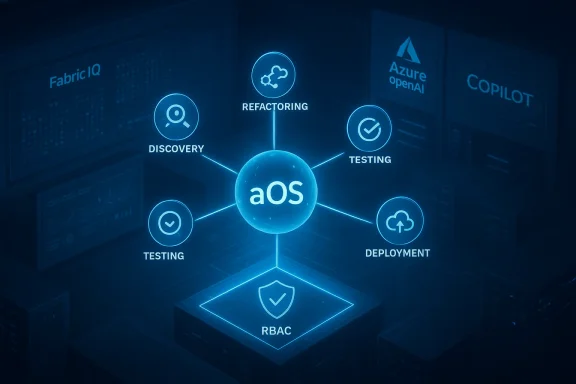
Amdocs’ new partnership with Microsoft, unveiled at Mobile World Congress 2026, formally packages the vendor’s agentic operating system (aOS) and its Agentic Services with Microsoft’s Foundry, Azure OpenAI models, GitHub Copilot and Fabric IQ to deliver an agent-led, AI-accelerated path for large-scale application modernization and cloud migration—promising faster refactoring, repeatable workflows, and measurable business outcomes from “business case to execution.”

A central aOS hub connects discovery, refactoring, testing, deployment, and RBAC.Background​

Modern enterprise application modernization has entered a phase where automation and generative AI are central to delivery, rather than optional accelerators. Legacy portfolios—monolithic ERP, billing platforms, OSS/BSS stacks, and bespoke middleware—are costly to maintain and slow to change. Vendors and systems integrators are responding by building agentic frameworks: coordinated collections of software agents that automate discovery, code analysis, refactoring, test generation, deployment orchestration, and post‑migration observability. Amdocs’ aOS and Microsoft’s Foundry are self-described examples of that shift.
Amdocs positions aOS (the agentic operating system) and Agentic Services as an enterprise-grade orchestration layer that brings telco domain knowledge, prebuilt agent libraries, and end‑to‑end workflows to modernization projects. Microsthe model and runtime fabric—Foundry, Fabric IQ, and Azure OpenAI—plus developer automation through GitHub Copilot. Together the vendors say this combination creates a “Service‑as‑Software” delivery model in which AI agents execute or accelerate work under human supervision.
Why this matters now: operators and large enterprises are under relentless pressure to reduce technical debt, shorten time-to-market, and extract value from AI. The Amdocs‑Microsoft announcement is explicitly timed to address that need with prebuilt, customizable multi‑agent workflows and cloud migration accelerators designed for Azure. Microsoft’s own MWC narrative highlights partners—Nokia, Colt, MTN and others—building production-grade telco AI on top of Fabric and Foundry, which indicates this is intended not a one‑off integration.

What the collaboration actually delivers​

The components, explained​

  • Amdocs Agentic Services / aOS — Amdocs’ orchestration layer that coordinates specialized agents across discovery, refactoring, quality engineering, and migration. It offers a library of prebuilt workflows tailored to telco and large enterprise workloads, designed to reduce manual steps and increase consistency.
  • Microsoft Foundry (Foundry Models & Agent Services) — The enterprise-grade agent runtime and model-management layer that hosts models (including Azure OpenAI variants) and provides the plumbing for multi‑agent orchestration, RBAC, VNet isolation, and monitoring. Microsoft positions Foundry as the runtime that enables connected agents with persistent thread storage and integrated observability.
  • Azure OpenAI in Foundry Models — Grounded model instances that agents can call for code analysis, refactoring suggestions, natural language translation of business requirements, and test-case generation. Amdocs lists Azure OpenAI among the model backends used in Foundry‑hosted agents.
  • Microsoft Migration Agents & GitHub Copilot — Automation artifacts and developer-centric copilots to accelerate repetitive code transformations, generate migration human engineers in validating agent recommendations. These tools help turn agent outputs into deployable code and CI/CD artifacts.
  • Fabric IQ — The unified data layer that indexes business and operational data so agents operate on accurate, contextualized information rather than fragile heuristics. Fabric IQ’s role is to provide provenance and retrieval-driven grounding for agent decisions.
Taken together, the vendors promise actor, harden architecture, and migrate workloads into Azure with “full observability and control,” delivered as configurable, production-grade workflows that can be reused across customers.

How a modernization engagement would look in practice​

  • Discovery agent performs automated inventory and dependency mapping of legacy estates.
  • Analysis agents evaluate code smell, risky patterns, and candidate services for refactoring or replacement.
  • Refactoring agents (with Copilot-assisted code transformations) generate PR-ready code and automated tests.
  • Migration agents orchestrate packaging, environment provisioning, and infrastructure-as-code deployments into Azure.
  • Quality & Observability agents run automated tests, validate telemetry, and set up post-migration SLO dashboards.
Those are the intended multi-agent workflows Amdocs says are now available via its Agentic Services library and orchestrated through aOS and Microsoft Foundry.

Why the pairing is credible — and why vendors are racing to this model​

There are three reasons the Amdocs‑Microsoft combination is likely to attract attention from large enterprises.
  • Domain expertise plus platform scale. Amdocs brings decades of OSS/BSS delivery experience and telco-specific domain models that are valuable when automating complex telecom processes. Microsoft brings a production-ready agent runtime, model hosting, and an enterprise governance stack at hyperscaler scale. The pairing bridges domain knowledge and cloud‑native infrastructure.
  • Prebuilt workflows reduce project uncertainty. Modernization programs often fail or balloon because discovery and refactor stages are unpredictable. Prebuilt agentic workflows—if they truly work across heterogeneous landscapes—convert high‑variance labor into repeatable outputs, which reduces risk and shortens timelines. Amdocs markets exactly that repeatability as the core value of Agentic Services.
  • Ecosystem lock-in that enterprises accept for operational simplicity. Large carriers and enterprises already consume managed services and vendor‑provided OSS/BSS; accepting a blended “software + managed execution” delivery model is a logical extension—provided governance, auditability, and data residency needs are met. Microsoft’s MWC narrative explicitly pushes the ecosystem angle, with partners integrating Fabric and Foundry for carrier-grade use cases.
Financially, Amdocs’ fiscal metrics provide context for the company’s investment capacity: the company reported $4.53 billion in revenue for fiscal 2025, underscoring that this announcement comes from an established service provider with substantial managed‑services scale. The comppublic statements also highlight the risks and investments related to AI and integration—context that companies should factor into any procurement decision.

Critical analysis: strengths, real-world value, and immediate caveats​

Strengths — where this strategy could genuinely move the needle​

  • Operational speed with auditability. AI agents that generate code, tests, and deployment artifacts can compress months of manual labor into weeks—if they are accurate and produce auditable outputs. The inclusion of observability and provenance via Foundry and Fabric IQ addresses the “trust” problem that many enterprises cite when evaluating AI outputs.
  • Reduced labor friction through Copilot integration. Developers can accept, adjust, or reject refactor suggestions generated by agents; combining automated PRs with human review reduces both error rates and cognitive load. This human-in-the-loop model is a practical compromise between full automation and manual migration.
  • Telco‑focused semantics. For communications providers, the value of domain‑aware agents—those that understand OSS/BSS constructs and telco data models—cannot be overstated. Amdocs’ telco proficiency is a structural advantage for migrations where domain nuance is critical.
  • Repeatability and scale through libraries of workflows. Once an agentic workflow is tuned for a particular architecture pattern (e.g., billing, order management), it can be reused across similar customers, yielding predictable time and cost improvements. Amdocs positions its library as a core differentiator.

Caveats and material risks — what vendors are not solving automatically​

  • Data governance, residency, and compliance. Enterprises operating in regulated industries (telecom, finance, healthcare) must ensure that agent decisions, model access, and logs meet jurisdictional rules. While Foundry supports RBAC and private networking, customers must validate that data pipelines and model telemetry meet local compliance requirements. Microsoft’s messaging at MWC underscores governance but concrete compliance mappings are customer responsibilities.
  • Model hallucinations and correctness of refactors. Generative models are powerful but not perfect. Automated refactors suggested by LLMs must be validated by domain experts; otherwise, subtle semantic bugs can be introduced into mission‑critical systems. The human-in-the-loop model reduces this risk but does not eliminate it. Independent verification remains essential.
  • Vendor and ecosystem lock‑in. The combined offering is tightly integrated with Azure, Foundry, and Amdocs’ agent library. Organizations that want portability to other clouds or on‑prem vectors must scrutinize escape clauses, data exportability, and the portability of agent logic. This matters particularly for telcos with sovereign cloud needs. Microsoft’s ecosystem play is a strength, but it increases switching friction.
  • Hidden operational overheads. Agentic deployments introduce new operational constructs—agent lifecycle mane, model versioning, and observability pipelines—that teams must learn to manage. Migrating to an agentic model is not simply a one‑time migration; it’s an operational shift that requires reorganized runbooks and SRE practices.
  • Cost unpredictability. Model calls, large-scale refactors, and extended agent runs incur cloud compute and data costs. While the promise is faster delivery, organizations must model the incremental cost of continuous agent-driven operations during and after migration, including model-hosting fees, Copilot licensing, and specialized managed services. The vendors will tout efficiency gains; procurement teams must demand transparent TCO modeling.
  • Security exposure. Agents that operate across codebases, production environments, and telemetry streams increase the attack surface. Proper isolation, least-privilege credentials, and careful secrets management are required to prevent an agent’s compromised identity from becoming a lateral-movement vector. Amdocs and Microsoft both highlight enterprise controls, but real-world security depends on configuration discipline.

How to evaluate the Amdocs + Microsoft offering if you’re an enterprise buyer​

If your organization is considering this combined agentic modernization approach, here’s a practical checklist to use during procurement and the pilot phase.

Minimum technicalaves)​

  • Confirm the exact model hosting and data residency configuration for Azure OpenAI/Foundry models and who retains access to training or fine‑tuning telemetry.
  • Require audit logs and immutable provenance for agent outputs: who triggered an agent, what prompts and model versions were used, and what changes were produced.
  • Validate RBAC and secret management for agent identities; insist on principle-of-least-privilege roles for each agent.

Operational and organizational checks​

  • Start with **a narrow pilor one business domain) and measure both delivery time and post‑migration defect rates.
  • Model the total cost of ownership including model‑inference costs, Copilot licenses, Foundry runtime fees, and managed‑service hours.
  • Define a roll‑back and remediation plan for automated refactors; ensure manual gates exist before deployment to production.

Governance and compliance steps​

  • Map regulatory constraints (data locality, retention, audit) to the proposed agent architecture.
  • Require contractual language for data handling, telemetry reuse, and IP for generated code/artifacts.
  • Insist on periodic independent security assessments and model‑output QA.

Competitive context: this is an industry pattern, not a one-off play​

Amdocs’ move is part of a broader vendor trend where systems integrators pair domain expertise with hyperscaler AI fabrics. Kyndryl, DXC and other major integrators have announced similar Microsoft‑centric modernization services that combine generative AI tools with migration accelerators and managed operations—evidence that the market is coalescing around the same opportunity set (legacy modernization + generative AI). The choice for enterprises will often come down to sector-specific knowledge, risk appetite, and the quality of agent libraries.

Practical recommendations for CIOs and CTOs​

  • Prioritize pilots on systems with high operational cost and well‑understood interfaces (e.g., billing modules, order management) where measurable ROI can be captured within 3–6 months.
  • Insist on observable metrics for each pilot: unit test coverage increase, post‑migration incident rate, mean time to deploy, and actual consumption costs foruntime.
  • Negotiate escrow or portability terms for agent libraries and transformation artifacts so you aren’t trapped if you later choose to run agents on another platform or on-premises.
  • Invest in internal SRE and platform engineering—agentic automation creates new operational primitives that must be staffed and governed.

An honest look at outcomes: what success looks like — and what failure looks like​

Success indicators​

  • A measurable reduction in time-to‑migrate for targeted application classes (e.g., a 40–60% reduction in classical lift‑and‑shift timelines for billing/commerce systems).
  • Smaller post‑migration defect volumes due to automated test generation and stronger architecture hardening.
  • Repeatable workflows that can be templatized across multiple business units or regional subsidiaries.

Failure modes​

  • Projects that save time up front but introduce subtle semantic bugs that cause cascading operational issues in production.
  • Ballooning cloud and inference costs that erode the promised efficiency gains.
  • Compliance or data residency violations triggered by insufficient data governance in agent pipelines.

Final assessment: a pragmatic, production-focused step — with responsibilities​

Amdocs and Microsoft are offering a pragmatic productization of the agentic-modernization playbook. The partnership is convincing on paper: Amdocs contributes verticalized domain knowledge and runbooks; Microsoft supplies production runtime, governance features, and model hosting at hyperscale. For telcos and large enterprises with complex OSS/BSS estates, the appeal is strong—when the program is scoped, governed, and piloted correctly.
However, the technology is not a silver bullet. The real determinant of value will be disciplined execution: selecting the right pilot, validating agent outputs against domain expertise, enforcing governance and security controls, and modeling long‑term costs. Enterprises that treat this as a co‑engineering program with clear human checkpoints, auditability, and financial transparency stand to benefit. Organizations that accept fully automated refactors without rigorous validation risk operational and compliance surprises.
Amdocs’ fiscal scale and Microsoft’s production-grade Foundry lower the commercial and technical risk compared with smaller vendors, but they also raise the stakes: the decisions made during onboarding will shape an enterprise’s modernization paths for years. That makes the procurement, legal, and architecture review phases more important than ever—because agentic modernization is less about a single migration and more about changing how software is operated and evolved on a day‑to‑day basis.

Closing takeaways​

  • The Amdocs + Microsoft MWC 2026 collaboration formalizes an emerging market approach: pair domain-rich systems integrators with hyperscaler agent runtimes and model fabrics to industrialize application modernization.
  • For enterprises, the opportunity is real—but success requires rigorous pilots, governance, and financial transparency. Demand measurable KPIs up front and insist on auditability for every automated change.
  • Expect the market to fragment into specialized stacks (telco, finance, healthcare) where domain libraries and compliance posture will determine winners. The Amdocs‑Microsoft play is an early exemplar of that direction, offering a high‑credibility option for telcos and similar operators—but it is not a turnkey replacement for careful engineering and governance.
The announcement at MWC 2026 is not the end of a story but the opening of a new chapter: one where coordinated agents become first‑class tools in enterprise modernization. The real test will be whether those agents deliver predictable, auditable outcomes at scale—without transferring hidden risk into production.

Source: The Globe and Mail MWC 2026: Amdocs Collaborates with Microsoft to Bring AI-Accelerated Application Modernization to Enterprises
 

Amdocs’ new partnership with Microsoft at Mobile World Congress 2026 signals a clear pivot in how large enterprises — and telcos in particular — will approach application modernization: not as a sequence of one-off lift-and-shift projects, but as an agentic, AI-orchestrated lifecycle that ties business case to execution with measurable outcomes.

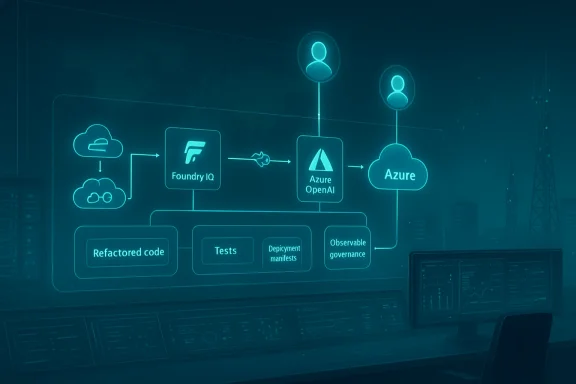
Neon cloud-based AI workflow diagram linking Foundry IQ, Azure OpenAI, and Azure.Background / Overview​

Amdocs announced a collaboration with Microsoft to deliver AI‑accelerated application modernization that pairs Amdocs’ Agentic Services — delivered from its new agentic operating system, aOS — with Microsoft’s AI stack including Microsoft Foundry (and Azure OpenAI models), GitHub Copilot, Microsoft Migration Agents, and Fabric IQ. The stated aim is to automate and orchestrate end‑to‑end modernization activities so organizations can refactor faster, strengthen architecture resilience, and migrate to Microsoft Azure with full observability and control.
This move follows Amdocs’ broader product and strategy shift toward an “agentic” AI layer it unveiled earlier in 2026, in which aOS is presented as an operating layer that runs specialized, domain-aware agents on top of existing OSS/BSS and enterprise stacks. The company has positioned aOS as a modular platform with prebuilt agent libraries and an operational fabric for repetitive, multi‑step modernization workflows.
Microsoft’s industry messaging at MWC 2026 complements that vision by emphasizing three “IQ” workloads — Foundry IQ, Fabric IQ, and Work IQ — which provide knowledge, analytics, and contextual signals for agents to reason over enterprise data and operate in a permissioned, auditable way. Foundry IQ in particular is a managed knowledge layer that connects structured and unstructured data across Azure and enterprise sources so agent workflows can access permission‑aware knowledge for decision making.

What exactly are Amdocs and Microsoft promising?​

The joint value proposition​

  • End‑to‑end modernization “from business case to execution.” The collaboration is positioned to move beyond advisory and fixed‑scope modernization to a model where measurable business outcomes (risk reduction, velocity, cost improvements) are delivered by agentic workflows that can be reused and scaled.
  • Agent orchestration at scale. Amdocs’ Agentic Services — part of aOS — will orchestrate specialized agents from across Amdocs Studios and leverage Microsoft’s agent capabilities to create multi‑agent workflows that automate analysis, code refactoring, testing, migration, and validation.
  • Tight Azure integration. The solution centers on migration and modernization to Microsoft Azure as the cloud fabric, using Azure OpenAI, Microsoft Migration Agents and Fabric IQ for semantic analytics and observability. Microsoft frames these capabilities as part of a carrier/enterprise AI platform that reduces time‑to‑value for AI investments.
These are not abstract product concepts — Amdocs will demonstrate cloud transformation–specialized agents at its partner demo pods during MWC, while Microsoft will showcase related elements at its own booth. That public demo posture suggests both companies want customers to see repeatable agent workflows, not just PowerPoint roadmaps.

What’s in the stack (short, practical list)​

  • Amdocs: Agentic Services (workflows library), aOS (agentic operating system), migration & quality engineering expertise.
  • Microsoft: Foundry (Foundry IQ), Azure OpenAI models, GitHub Copilot (developer productivity and code refactor helpers), Fabric IQ (semantic analytics), Microsoft Migration Agents.

Why this matters now: market and technical contigue is real. Enterprises face large portfolios of legacy apps and technical debt, constrained budgets, and high risk from poorly executed cloud migrations. Vendors and systems integrators that offer structured, repeatable ways to reduce risk and deliver measurable ROI are the ones most likely to win enterprise budgets in 2026.​

Amdocs’ pivot to an agentic model is part product strategy and part sales play: by packaging modernization as Service‑as‑Software — a mix of reusable agent workflows, observability, and managed execution — Amdocs aims to convert advisory engagements into operational programs that run at scale. Microsoft’s portion of the story is to provide the AI and cloud substrate (models, knowledge layers, developer tooling) that makes those agent workflows practical in enterprise environments.
This is not happening in isolation. Competing integrators (DXC, Kyndryl, and hyperscalers’ own partner ecosystems) are racing to the same address: packaged modernization offerings combined with AI‑assisted code transformation and cloud migration accelerators. Expect competition to center on two things: the quality and safety of automated refactorings, and the guarantees (or commercial models) vendors put around migration outcomes.

Deep dive: Amdocs aOS and Agentic Services — what they claim to do​

Agentic OS (aOS) — architecture and intent​

Amdocs describes aOS as an operating fabric that sits above legacy BSS/OSS and enterprise stacks. It exposes a set of specialized agents — each trained and configured for discrete tasks such as code modernization, API wrapping, test automation, data mapping, and compliance checking. These agents can be composed into workflows that:
  • Automatically analyze application portfolios for modernization readiness.
  • Propose refactor targets and categorize migration risk.
  • Generate refactored code templates, tests, and deployment manifests.
  • Orchestrate staged migrations to Azure with validation and rollback capabilities.
  • Provide observability and provenance for every decision an agent takes.
The value claim is repeatability at scale: one proven agentic workflow can be applied across many applications, reducing per‑application effort and increasing predictability.

Agentic Services — delivery model​

Amdocs positions its Agentic Services as a multivendor, outcomes‑focused set of capabilities and pre‑built workflows that customers can consume as Service‑as‑Software. The idea: instead of buying point tools or paying by the hour for consultancy, enterprises subscribe to agentic workflows and pay for realized outcomes (e.g., migration of X applications to cloud, reduction in mean time to recovery, or percentage of code refactored). This is an important commercial shift that could change vendor economics — but also raises questions about measurement and SLAs (covered below).

How Microsoft’s components fit in (Foundry, Fabric IQ, Copilot, Azure OpenAI)​

Microsoft’s contribution is both foundational and tactical:
  • Foundry / Foundry IQ acts as a managed knowledge layer that connects enterprise data sources and indexes permissioned knowledge for agent retrieval. This is critical because agentic workflows require accurate, contextual data to make safe decisions. Foundry IQ is explicitly designed to let agents reason over enterprise data while respecting access controls.
  • Fabric IQ brings semantic analytics and OneLake modeling to the table, enabling agents to act on analytics insights and cross‑dataset reasoning.
  • Azure OpenAI models provide the LLM primitives for code transformation, natural language analysis of requirements and design docs, and for generating migration playbooks.
  • GitHub Copilot supplies developer‑facing code suggestions and can be an execution path for agent‑generated code to be reviewed and accepted by engineering teams.
Combined, these Microsoft pieces form an enterprise agent environment where knowledge, analytics, and generative models feed automation while maintaining governance and audit trails. Microsoft’s own industry messaging at MWC emphasized this integrated IQ approach as a way to accelerate AI ROI for telecoms and large enterprises.

Realistic benefits — what enterprises can expect​

If executed well, the collaboration promises several concrete, enterprise‑grade benefits:
  • Faster refactoring and lower time‑to‑cloud. Agent workflows can standardize repeated refactor patterns, cutting manual analysis and rewrites.
  • Improved quality through automation and observability. Automated testing, instrumentation, and rollback are native parts of agent‑driven migration playbooks, which can reduce post‑migration incidents.
  • Measurable business outcomes. By defining outcomes (e.g., % of apps containerized, cost reduction), the Service‑as‑Software model ties vendor compensation to results rather than hours.
  • Cross‑domain knowledge reuse. Prebuilt agent libraries and templates let telcos and enterprises reuse best practices across domains (billing, OSS, CRM).
  • Developer productivity gains. GitHub Copilot and agentic code generation can dramatically reduce boilerplate work and accelerate developer review cycles.
These are significant if delivered in real environments — but the level of realized benefit will depend on the quality of agent rules, the accuracy of model outputs, and engineering discipline around testing and rollback.

Risks, caveats, and open questions​

No vendor play is risk‑free. Below are the most important areas CIOs and CTOs should scrutinize.

1. Governance, provenance, and compliance​

Agentic automation depends on models making decisions about code, data mapping, and deployment. Enterprises must insist on immutable provenance data, decision logs, and the ability to pause or override agent actions. Without strict governance, an automated refactor or migration step could introduce compliance or security violations that are difficult to trace.

2. Data access and privacy​

To reason effectively, agents need access to domain‑specific data (design docs, DB schemas, production telemetry). Giving agents broad access increases risk. Foundry IQ and Fabric IQ offer permissioned retrieval, but implementation details and tenant‑level configurations matter — enterprises must validate data handling, retention, and model‑training exposure.

3. Model hallucinations and correctness of generated code​

Generative models can produce plausible‑looking but incorrect code or design changes. Robust, automated validation (unit/integration tests, static analysis, canary deployments) is non negotiable. The service model must include acceptance gates where human engineers sign off.

4. Vendor lock‑in and migration portability​

A joint Amdocs‑Microsoft agentic stack optimized for Azure and Microsoft Foundry could make future migration to other clouds more expensive. Enterprises must evaluate how workflows, templates, and provenance data can be exported or reused outside the joint platform.

5. Commercial measurement and warranty​

When vendors promise outcomes, customers should demand clear definitions, measurement criteria, acceptance tests, and financial warranties tied to SLAs. The Service‑as‑Software paradigm opens the door to compelling commercial models, but it also creates accountability expectations that must be contractually enforced.

6. Multivendor and hybrid realities​

Large enterprises often run multicloud and hybrid deployments. A solution tightly coupled to Azure may be a fit for many, but those with strict regulatory, latency, or sovereignty requirements will need hybrid or sovereign cloud options. Microsoft and Amdocs have messaging around sovereign telco clouds and production‑grade AIOps, but customers should validate support for hybrid topologies and multicloud data governance.

Practical implementation roadmap — a conservative five‑phase plan​

Here’s a pragmatic sequence for enterprises that want to pilot and then scale agentic modernization without undue risk.
  • Assess & define outcomes (4–6 weeks).
  • Inventory applications, identify high‑value candidates (low complexity, high business impact).
  • Define measurable outcomes: time to migrate, reduction in operational incidents, cost delta.
  • Pilot agentic workflow (8–12 weeks).
  • Deploy a small, contained agentic workflow for a single non‑critical application.
  • Integrate Foundry IQ for permissioned knowledge access and use Copilot for developer assistance.
  • Validate safety & governance (parallel with pilot).
  • Implement provenance logs, role‑based approvals, and automated test suites.
  • Conduct security reviews and regulatory mapping.
  • Scale progressively (3–12 months).
  • Harden temss similar application families.
  • Expand migration windows and add observability dashboards.
  • Operationalize & commercialize outcomes.
  • Move to an outcomes‑based commercial arrangement for larger portfolios, tied to agreed KPIs and SLAs.
This phased approach balances speed with safety and gives organizations time to observe agent behavior and tune governance controls before scaling.

Technical considerations and integration checklist​

Enterprises should demand clarity on the following technical details before committing:
  • Provenance & audit logs: Are agent decisions and intermediate artifacts immutably recorded? Can auditors reconstruct why an agent changed code?
  • Data residency & training exposures: Will enterprise data used by agents be stored or used to further train models? How is PII handled?
  • Rollback & blue/green strategies: What automated rollback strategies exist when a migration step fails?
  • Testing meta‑automation: Are unit, integration, security, and performance tests part of the agentic workflow by default?
  • Identity & access: How are agents authenticated and authorized to interact with enterprise systems and privileged environments?
  • Interoperability & export: Can workflows, templates, and logs be exported if the customer wants to migrate away from the platform?
  • Third‑party toolchain support: Does the workflow integrate with existing CI/CD, ticketing, and monitoring stacks?
Demanding answers to these items up front reduces the risk of unpleasant surprises during production runs.

Competitive and industry implications​

Amdocs’ public pivot to an agentic operating system and its collaboration with Microsoft places it in direct competition with other systems integrators and cloud partners that are offering packaged modernization and AI acceleration services.
  • Hyperscalers will compete on model capabilities, sovereign cloud options, and native AI services.
  • Integrators like DXC, Kyndryl, and specialist automation providers will differentiate on domain knowledge, verticalized templates, and flexible commercial models.
  • Amdocs’ telco pedigree gives it a natural advantage in OSS/BSS modernization, and the Microsoft tie strengthens its Azure play — but customers will weigh that against other providers’ multicloud flexibility and toolchain independence.
Investors and market watchers should also note Amdocs’ financial scale: the company reported revenue of roughly $4.53 billion for fiscal 2025, which frames how much investment and R&D the company can commit as it builds out aOS and agentic services. Public filings (Form 20‑F) document those figures and give more detail on risk factors and forward‑looking statements.

Governance, auditability and regulatory scrutiny — what regulators will want to see​

Regulators and internal compliance teams will focus on three areas:
  • Explainability and audit trails. Agencies (and internal compliance) will require the ability to demonstrate how decisions were made and to show why certain data transformations or access events occurred.
  • Data protection and sovereign controls. For telcos and critical infrastructure providers, data residency and sovereignty rules are often non‑negotiable. Enterprises must ensure agentic solutionsose legal confines.
  • Liability mapping. When an automated agent makes a mistake that results in customer impact, contractual liability and incident response responsibilities must be clear.
Both Amdocs and Microsoft emphasize governance points in their public messaging, but customers should insist on written architecture and contractual commitments concerning these governance controls.

A pragmatic test: what to look for in a proof‑of‑value​

When you sit down to evaluate an Amdocs‑Microsoft agentic modernization offering, make the trial a real test of the vendor’s claims:
  • Ask for a live demo using your codebase or a redacted-but-realistic dataset.
  • Require demonstrable rollback scenarios and test artifacts generated by agent workflows.
  • Request a sample provenance log for an automated change (complete with rationale and system state).
  • Validate the integration points to your identity provider, CI/CD pipeline, and monitoring stack.
  • Push the agent with an intentionally malformed input and observe how it fails — graceful degradation is a feature.
A vendor that demonstrates transparent failures, strong provenance, and clean rollback paths is much more credible than one that only shows success stories.

Conclusion — opportunity tempered by discipline​

Amdocs’ collaboration with Microsoft at MWC 2026 crystallizes a promising, if high‑risk, direction for enterprise modernization: agentic, AI‑orchestrated modernization that stitches together knowledge, generative models, automation, and observability. For telcos and large enterprises drowning in technical debt, the appeal is obvious — measurable outcomes, repeatable workflows, and faster time‑to‑cloud.
Yet the promise comes with real responsibilities: rigorous governance, immutable provenance, defensive testing, and clear commercial SLAs. Organizations that approach adoption with a staged pilot, strict governance gates, and a focus on exportability and auditability will capture the most value while minimizing systemic risk.
If the Amdocs + Microsoft demonstrations at MWC become the template for production‑grade agentic modernization, the enterprise IT landscape will shift quickly. But the winners will be the customers who insist that speed be matched with traceability, that outcomes be measurable, and that automation can be paused or rolled back when warranted.

Source: The Globe and Mail MWC 2026: Amdocs Collaborates with Microsoft to Bring AI-Accelerated Application Modernization to Enterprises
 

Amdocs and Microsoft used Mobile World Congress 2026 to formally package an agentic approach to large-scale application modernization: Amdocs will surface its Agentic Services from the newly announced Amdocs agentic operating system (aOS) and stitch those services into Microsoft’s enterprise AI stack — including Microsoft Foundry, Azure OpenAI models, Microsoft Migration Agents, GitHub Copilot and Fabric IQ — to automate and accelerate refactoring, testing, migration and observability for complex enterprise and telco applications.

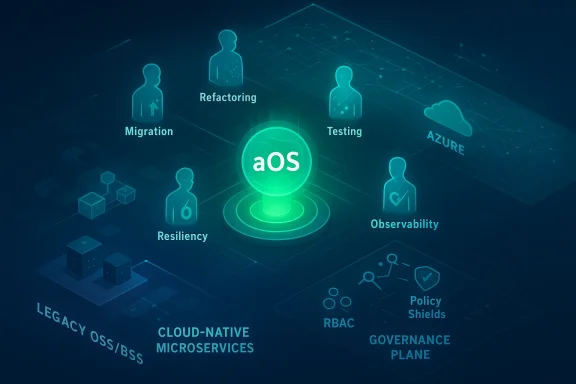
A glowing aOS hub links migration, refactoring, testing, resiliency, observability, and Azure.Background / Overview​

Amdocs unveiled aOS earlier in February as an "agentic operating system" aimed squarely at telecommunications service providers and other large enterprises with sprawling OSS/BSS landscapes. aOS is designed to run domain-aware agents, provide a Cognitive Core with telco-specific agent libraries, and orchestrate multi-step agent workflows across legacy and cloud-native systems. The company has positioned this platform as an operational layer that sits on top of existing stacks and automates repeatable modernization patterns.
On February 27, 2026, Amdocs announced a collaboration with Microsoft at MWC 2026 to bring Amdocs Agentic Services together with Microsoft’s agent and AI capabilities to deliver what both vendors call AI-accelerated application modernization. Microsoft framed this collaboration as part of a broader industry push to make agent-driven automation auditable, policy-aware and enterprise-ready — leveraging layers such as Foundry IQ, Fabric IQ and agent runtimes announced over the past year.
Taken together, these moves reflect two concurrent trends: vendors delivering higher-level, reusable agent workflows (the “workflows as product” model), and hyperscalers embedding agent runtimes, model access and observability into cloud control planes to make agentic automation safe to operate at scale.

What the announcement actually promises​

At a product level, the joint proposition is straightforward: enterprises will be able to deploy coordinated sets of Amdocs and Microsoft IT agents that automate end-to-end modernization tasks. The partners say that this will enable:
  • Accelerated refactoring of legacy application code and packaging for the cloud.
  • Strengthened architectural resilience by automating resilience patterns and validation.
  • Seamless migration to Microsoft Azure by embedding migration logic into agent workflows.
  • Improved quality engineering through automated test generation and validation coupled with observability.
  • Measurable outcomes from "business case to execution" — i.e., linking commercial KPIs to delivered technical improvements.
Amdocs frames these capabilities as delivered via its Amdocs Agentic Services — a library of pre-built, customizable agent workflows — orchestrated by aOS. Microsoft’s role is both as cloud provider (Azure) and AI-capability supplier (Foundry, Azure OpenAI, GitHub Copilot, Fabric IQ, and agent governance capabilities). The combined packaging is described as a Service‑as‑Software model where Amdocs runs the domain logic and Microsoft provides the secure, governed AI and cloud fabric.
Both companies have signaled they will demonstrate cloud-transformation specialized agents on their MWC booths, underscoring that the offering is meant to be shown as repeatable workflows rather than conceptual slides.

How the agentic stack is intended to work​

Architecture and agents​

At the center of the model is an agent orchestration layer that coordinates multiple specialized agents into an end-to-end modernization workflow. Examples of specialized agents discussed by the vendors include:
  • Migration agents that analyze application stacks, generate migration plans and execute migrations.
  • Refactoring agents that produce code-level changes (e.g., modularization, containerization) and create migration artifacts.
  • Testing and validation agents that auto-generate test cases, run tests in CI/CD pipelines, and validate runtime behavior.
  • Observability agents that instrument systems and produce telemetry-driven checkpoints and rollback criteria.
  • Resiliency and troubleshooting agents that inject validation, run chaos tests, and autonomously remediate classifiable faults.
Microsoft has already described a set of six Azure Copilot agents — migration, deployment, optimization, observability, resiliency and troubleshooting — that align closely with the agent types Amdocs references. These agents are intended to run under governance controls and role-based access to ensure actions adhere to enterprise policy.

Cognitive Core and knowledge grounding​

Amdocs describes a Cognitive Core inside aOS that libraries domain knowledge and telco-specific taxonomies to ground agent decisions. Microsoft’s Foundry and Fabric IQ layers provide the managed knowledge and analytics fabric that agents use to make permissioned, auditable decisions over enterprise data. The combination aims to prevent agents from acting without context and to ensure actions are explainable to human engineers.

Observability, control and governance​

Observability is treated as a first-class requirement. The joint message emphasizes full-stack observability and a control plane that ties agent actions to policies, change logs and audit trails. Microsoft’s governance-first approach for agents (Agent 365/agent control-plane concepts) is complementary: identity, federation, RBAC, policy enforcement and telemetry are woven into the runtime fabric.

Why telcos and large enterprises should care​

Large communications providers and enterprises suffer from the same core constraints when it comes to modernization: enormous legacy codebases, tightly coupled OSS/BSS, fragile integrations, mainframes, and a growth of technical debt that turns refactoring into multi-year, high-risk programs.
This agent-first model promises to change the economics by turning repeatable modernization tasks into products — prebuilt workflows that can be applied across similar applications and domains. Key potential benefits are:
  • Faster time-to-modernization by automating discovery, dependency analysis and code transformation.
  • Reduced human effort for repetitive, error-prone tasks, allowing architects to focus on design rather than plumbing.
  • Improved predictability and measurability: workflows can be instrumented to produce concrete KPIs (e.g., reduction in mean time to recover, reduced infrastructure cost, completion of feature parity).
  • Reusable, telco-specific knowledge: Amdocs’ claim of prebuilt telco agent libraries could shorten runbooks for common telco patterns (billing, customer care, service orchestration).
If the technology works as advertised, enterprises may be able to shift from project-by-project modernization to a sustained platform-driven modernization cadence.

Verifying the claims: what’s factual, and what remains aspirational​

Several key claims are verifiable today and have been cross-referenced with independent vendor communications and conference materials:
  • Amdocs publicly launched aOS earlier in February and laid out the aOS architecture and Cognitive Core. That announcement included the idea of prebuilt agent libraries and multi-agent orchestration for telco processes.
  • The February 27 MWC announcement explicitly names Microsoft Foundry, Azure OpenAI, GitHub Copilot, Microsoft Migration Agents and Fabric IQ as part of the integrated approach, and Amdocs’ materials include a fiscal 2025 revenue figure commonly reported in its public filings.
  • Microsoft’s Azure and industry blog postings have described agent-focused capabilities and introduced six Azure Copilot agents for cloud operations that align with the migration/refactor/observability/resiliency motif.
Where caution is warranted:
  • Several claims about delivery speed, measured business outcomes, or reduced timelines (“from months to weeks” or “measurable business outcomes from business case to execution”) are forward-looking. They reflect vendor expectations and early customer engagements, but real-world results will depend on the specifics of each environment and the rigor of pilot programs.
  • The promise of fully automated refactoring across diverse, poorly documented legacy codebases remains technically difficult. Some agentic refactors will likely require significant human review, especially where business logic is embedded in archaic languages or bespoke integrations.
  • Commercial terms, licensing, and the precise contours of the “Service-as-Software” model — who is responsible for production SLAs, who bears rollback risk, how costs are apportioned — are not detailed in the public announcements and will be decided case-by-case in customer contracts.
In short: the technical building blocks exist and are being integrated, but outcomes depend on rigorous governance, testing and vendor contract clarity.

Strengths and notable advantages​

  • Practical, repeatable automation: Turning migration patterns into reusable agent workflows is a pragmatic way to scale modernization work across large estates. Reusability is the core value proposition: the first migration is expensive, subsequent ones should be faster.
  • End-to-end observability and audit trails: By design, Amdocs + Microsoft are emphasizing auditability and telemetry — a non-negotiable requirement for regulated industries and telcos. This reduces the "black box" risk of purely opaque AI automation.
  • Multi-vendor flexibility with a telco focus: Amdocs’ platform promises multivendor support and telco-specific domain knowledge, which matters because OSS/BSS environments are heterogenous. Pairing that with Microsoft’s cloud fabric gives customers an on-ramp that leverages existing Azure investments.
  • Governance-first agent runtime: Microsoft’s agent control-plane concepts focus on identity, RBAC, policy and observability. This is critical for enterprise adoption because it enables compliance, approval gating and human-in-the-loop checks where needed.
  • Proven functional building blocks: GitHub Copilot and Azure OpenAI are already used by many engineering organizations; integrating those capabilities into an operational pipeline — combined with migration-specific agents — is a sensible extension of existing engineering toolchains.

Risks, gaps and governance challenges​

  • Model reliability and hallucinations: LLM-driven code generation and transformation must be validated. Agents that modify code or infrastructure may introduce subtle correctness or security regressions. Long-term operational safety requires robust validation, test coverage and human approvals.
  • Data residency and sensitive telemetry: Telcos and regulated enterprises have strict data residency and privacy obligations. Agent workflows that access telemetry, customer PII or configuration must guarantee data handling meets regional regulations.
  • Vendor lock-in and portability: While Amdocs claims multivendor support and Microsoft provides hybrid governance, orchestrating tightly with Azure Foundry and Fabric IQ can create dependence on Microsoft’s knowledge and runtime layers. Enterprises will want clear exit strategies and portability guarantees.
  • Economic unpredictability: Agentic operations can increase short-term cloud and model consumption (data egress, large-scale model inference, storage for artifacts). Without careful cost management and predictable licensing, modernization runs risk of ballooning bills.
  • Operational complexity and SRE burden: Introducing an agent orchestration layer adds a new runtime to monitor, secure and update. Organizations need SRE processes, incident playbooks and staff trained for agent lifecycle management.
  • Legal and compliance exposure: Automated changes to billing logic or customer-facing services can cause regulatory breaches or financial errors. Contracts must clearly allocate responsibility for defects introduced by automated agents.

Practical checklist for IT leaders evaluating this kind of offering​

If you are considering Amdocs + Microsoft agentic modernization for your estate, use this checklist as due diligence before committing to a large-scale rollout:
  • Proof-of-Value (PoV)
  • Start with a focused PoV on a non-critical but representative application.
  • Require measurable KPIs up front (e.g., refactor time reduction, test coverage, deployment frequency).
  • Data governance and residency
  • Clarify where telemetry, chat logs and model inputs/outputs are stored.
  • Validate encryption, key management and retention policies.
  • Human-in-the-loop controls
  • Define approval gates for code and infra changes.
  • Ensure audit trails capture the entire decision chain and revertability.
  • Testing and validation
  • Demand automated test generation and mandatory test coverage thresholds.
  • Validate behavior in staging with production-like data before cutover.
  • Cost and billing
  • Agree on predictable billing models for agent usage, model inference and cloud consumption.
  • Include guardrails or rate limits for model calls and migration runs.
  • Responsibility and SLAs
  • Clarify vendor responsibilities for rollbacks, production incidents and compliance failures.
  • Include performance and security SLAs in contracts.
  • Portability and lock-in
  • Ask for exported artifacts and portability guarantees for workflows and knowledge stores.
  • Validate multi-cloud or hybrid deployment options if needed.
This checklist is not exhaustive, but it targets the highest-risk operational areas when introducing agentic automation into production.

How this fits into the broader market and competition​

Amdocs is not the only systems integrator racing to productize modernization. Other major integrators and cloud providers have been announcing agentic or AI-accelerated migration toolsets, and Amdocs’ simultaneous collaborations with multiple hyperscalers (Microsoft, AWS and others) show a strategy of multi-cloud enablement while still forming deep platform partnerships.
Microsoft’s studio and Foundry efforts — including Fabric IQ and Azure’s agent runtimes — are designed to be the enterprise-grade foundations for agentic operations. By positioning Azure as the curated data/knowledge layer and execution fabric, Microsoft hopes to make agent-driven workloads safer and easier to govern.
The competitive landscape will likely fragment into:
  • Hyperscalers offering agent runtimes and knowledge fabrics (Microsoft, AWS, Google).
  • Systems integrators and ISVs selling domain-specific agent libraries and workflows (Amdocs, Kyndryl, DXC, Accenture).
  • Open-source and niche vendors offering toolkits and enforcement frameworks for agent governance.
Enterprises that already have significant investments in a particular ecosystem (for example, Azure-heavy shops) will find integrated vendor offers attractive, while others may demand open standards and portability to avoid lock-in.

The near-term implications and recommended approach​

For most large organizations, the sensible path forward is phased:
  • Pilot: Choose one or two modernization targets with clear KPIs and run a time-boxed PoV. Use the pilot to validate assumptions about automation fidelity, test adequacy and cost.
  • Harden governance: Implement an agent control plane, RBAC, telemetry pipelines and approval workflows before scaling. Treat agents like production services — with SRE duties, patching, and security reviews.
  • Measure outcomes: Tie technical work to business outcomes (revenue, cost, time-to-market) and publish results internally to build trust and a steady funding case.
  • Scale selectively: Reuse proven workflows across similar application classes; avoid trying to automate everything at once.
This conservative, results-driven approach will reveal which parts of modernization can be safely automated and which still require human engineering craft.

Final analysis: a pragmatic step in a long journey​

The Amdocs–Microsoft collaboration announced at MWC 2026 is a meaningful evolution in how enterprise modernization will be packaged. It brings together domain-specific modernization IP, prebuilt agent libraries and a hyperscaler-grade agent runtime and knowledge layer. That combination can accelerate migration and refactoring work — particularly for telcos and large enterprises with repeated modernization needs — while providing governance and observability that enterprises demand.
However, the announcement is not a magic wand. Automated refactoring, testing and migration are complex in real-world estates filled with undocumented logic, specialized hardware interfaces and regulatory constraints. The most valuable features of the collaboration will be the ability to instrument, audit and revert automated changes, and the presence of disciplined PoV execution that ties technical gains to measurable business outcomes.
For CIOs and platform leaders, the right takeaway is to explore agentic modernization cautiously but proactively: run strict pilots, demand governance and portability, and require business metrics that justify wider adoption. If vendors deliver on observability, human-in-the-loop controls, and predictable cost models, agentic workflows could become the standard way enterprises do application modernization in the next five years — but only after proven operational maturity replaces early-stage marketing promise.

Source: Stock Titan AI agents from Amdocs and Microsoft target faster app upgrades
 

Back
Top