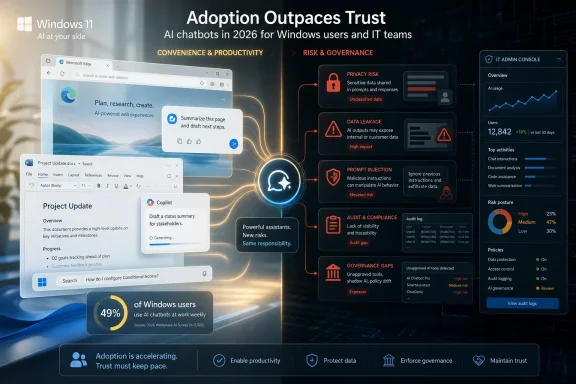
Americans are using AI chatbots at mainstream scale in 2026, with a new Pew Research Center survey finding that 49 percent of U.S. adults use tools such as ChatGPT, Gemini, Copilot, Meta AI, Claude, Grok, or Character.ai. The striking part is not adoption alone; it is adoption without trust. The country has not rejected AI, but it also has not bought the industry’s preferred story that daily use equals social confidence. That gap is where the next fight over consumer protection, workplace policy, schools, privacy, and Windows-era computing will be fought.
The newest Pew numbers land like a status report from a future that arrived before the public had time to consent to its terms. About half of American adults now use AI chatbots, up from roughly a third just two years ago, and about a quarter say they use them daily. That is not a niche technology anymore. It is not a developer toy, a search novelty, or a productivity experiment confined to the venture-capital class.
But the same survey shows a public that remains deeply unconvinced. Forty percent of Americans expect AI to have a negative effect on society over the next two decades, compared with only 16 percent who expect a positive effect. Nearly two-thirds think AI is advancing too quickly. More than two-thirds lack confidence in government’s ability to regulate it effectively.
That is the paradox now defining the AI market: Americans are not waiting for moral certainty before using these systems. They are using them because the systems are useful, available, embedded, promoted, and increasingly unavoidable. The technology has achieved practical adoption before achieving civic legitimacy.
For Windows users and IT administrators, that matters because AI is no longer an app category sitting politely beside browsers, office suites, and antivirus tools. It is being wired into operating systems, search boxes, productivity suites, customer-service flows, device firmware, cloud consoles, and management dashboards. The Pew survey is less a snapshot of chatbot enthusiasm than a warning that the AI layer is becoming normal while public trust remains fragile.
That hierarchy is revealing. The mass-market AI product is not primarily the science-fiction assistant that runs your life. It is a conversational search box that writes back. Americans have discovered that asking a chatbot to summarize, compare, draft, rephrase, troubleshoot, or explain is often easier than navigating ten web pages, three ads, and a forum thread from 2017.
This is why ChatGPT leads the pack. Pew found that more than four in ten Americans have used ChatGPT, making it the most widely used chatbot by a wide margin. Google’s Gemini, Microsoft’s Copilot, and Meta AI follow, with Grok, Claude, and Character.ai each under 10 percent. The order reflects branding, distribution, and habit as much as technical merit.
Microsoft’s place in that ranking is especially interesting for this audience. Copilot is not just a chatbot brand; it is Microsoft’s name for an architectural bet across Windows, Edge, Bing, Microsoft 365, GitHub, Azure, and endpoint management. The company is trying to make AI feel like part of the operating environment rather than a destination. Pew’s numbers suggest that strategy has plenty of room to grow, but also that Microsoft is pushing into a country that may use AI without trusting it.
The chatbot, in other words, is becoming infrastructure. That is wonderful when it reduces friction. It is dangerous when people forget that infrastructure also shapes what users see, what they believe, and what choices remain visible.
The public has had enough exposure to form opinions, and many of those opinions are wary. That does not mean Americans can define transformer models, diffusion systems, retrieval-augmented generation, or synthetic media provenance. It does mean they have seen enough AI in their feeds, workplaces, classrooms, phones, and search results to understand that this is not just another software feature.
There is a crucial distinction between awareness and agency. Americans may know AI is present, but many do not feel they can control when it appears, what data it consumes, or whether its output can be trusted. That is the feeling behind the comment from Johns Hopkins expert Jim Dahbura, who described AI as something that is now “happening to us.” It is a blunt phrase, and it captures the mood better than most industry keynotes.
The industry likes to talk about adoption curves. The public is talking, sometimes implicitly, about exposure curves. Adoption suggests choice. Exposure suggests environment.
That distinction will become more important as AI moves from websites and apps into default workflows. A user can decide not to visit ChatGPT. It is much harder to avoid AI when it appears inside search summaries, customer support calls, writing tools, photo editors, phone keyboards, security products, and operating-system shell experiences.
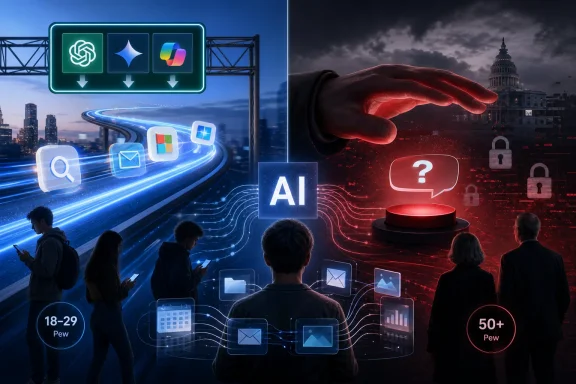
Ordinarily, technology companies read youth adoption as a proxy for cultural acceptance. The smartphone, social media, streaming video, and online gaming all rode younger users into the mainstream. AI is different. Younger Americans appear to be using the tools because they are useful, not because they are untroubled by what the tools imply.
That should unsettle the industry. The people most familiar with AI are not necessarily the least concerned about it. In Pew’s numbers, 48 percent of adults aged 18 to 29 expect AI to have a negative impact on society. Older Americans are less likely to predict a negative outcome, though they are more likely to be unsure.
There are plausible reasons for this split. Younger adults are closer to the school and entry-level labor markets where AI disruption feels immediate. They are more exposed to synthetic content, algorithmic feeds, deepfake risks, automated hiring tools, and AI-generated slop in creative spaces. They are also more likely to have seen chatbots fail confidently, flatten nuance, or turn creative and academic work into a suspicion-laden process.
This matters for employers. A twenty-five-year-old worker who uses AI every day may not be an AI evangelist. They may be a pragmatic user who believes the tool helps with drudge work while also threatening job ladders, creative labor, data privacy, and social trust. Treating usage as endorsement is a management mistake waiting to happen.
For schools, the finding is even sharper. Young people are not waiting for institutions to settle the policy debate. They are already using AI. But use does not erase skepticism; it may sharpen it.
This is where AI differs from earlier software waves. A spreadsheet does not ask to know you. A chatbot becomes more useful the more context it receives. A meeting assistant wants the transcript. A coding assistant wants the repository. A health chatbot wants symptoms, history, diet, medications, maybe a photo. A workplace assistant wants documents, email, calendar context, organizational charts, and task history.
The industry’s answer is usually a mixture of enterprise controls, privacy policies, model-training opt-outs, and assurances that data handling differs by product tier. Those details matter, especially in managed environments. But the public is reacting to the broader pattern: AI products are hungry for context, and context is often personal.
For Windows administrators, this is no longer an abstract consumer concern. AI features in productivity suites, browsers, endpoint tools, and cloud dashboards can create new data-governance questions. Which prompts are logged? Which files are indexed? Which tenant data can be used for grounding? Which plugins or connectors can reach sensitive systems? Which users are allowed to paste customer data, source code, financial forecasts, or legal material into third-party chatbots?
Those questions are not anti-AI. They are the ordinary questions of responsible computing. The difference is that AI makes the boundary between input, processing, and output feel deceptively casual. A prompt box looks harmless. In regulated environments, it may be an exfiltration path with better grammar.
The consumer version of that concern is even harder to manage. People may ask chatbots about medical symptoms, family disputes, finances, workplace conflicts, or emotional distress. Pew found that 10 percent of Americans use chatbots for emotional support. That number is small enough to seem marginal and large enough to represent millions of people.
Dahbura’s caution against leaning on chatbots for emotional support is not technophobic. It is an acknowledgement that conversational systems are unusually good at simulating attention. They can remember details, mirror tone, validate feelings, and produce endless patience. That makes them feel intimate, even when they are not accountable in any human sense.
The industry tends to frame this as a safety and moderation problem. Can the model detect crisis language? Can it refuse harmful instructions? Can it suggest professional resources? Those are necessary guardrails, but they do not address the deeper issue: the business value of a companion-like system may increase as a user becomes more attached to it.
This is not just a Character.ai problem or a teen-safety problem. It is a design problem across the category. The more natural the interface becomes, the more users may forget that there is no professional duty of care on the other side. The system’s fluency can obscure its limitations.
WindowsForum readers have seen versions of this before. Software that begins as a convenience can become a dependency. The difference with AI is that the dependency may be cognitive, emotional, and social, not merely operational.
That gap is risky. Shadow IT used to mean unsanctioned SaaS apps, personal Dropbox accounts, or rogue messaging tools. Shadow AI can mean sensitive data pasted into public chatbots, unverified output entering customer communications, generated code landing in repositories, or hallucinated facts creeping into policy documents. The problem is not that employees are careless. The problem is that the tools are useful enough to tempt normal people into bypassing slow procurement and unclear rules.
Microsoft’s Copilot strategy is designed, in part, to solve this enterprise problem by giving organizations a sanctioned AI layer inside products they already license and manage. That is a compelling pitch for IT: identity integration, tenant boundaries, compliance tooling, and administrative controls are preferable to a free-for-all of consumer AI accounts. But the existence of a sanctioned tool does not eliminate the need for governance.
Organizations still need to decide what AI may do, not merely which vendor may do it. Can it summarize confidential meetings? Can it draft performance reviews? Can it write security policies? Can it generate code without human review? Can it analyze employee sentiment? Can it answer HR questions from internal documents? Each use case carries a different risk profile.
The workplace is where AI’s productivity promise and trust deficit collide most directly. Workers may appreciate time savings while fearing surveillance, deskilling, job cuts, or accountability for machine-generated mistakes. Managers may see efficiency while underestimating verification costs. IT may be asked to secure workflows that leadership barely understands.
The lesson from Pew is that adoption cannot be treated as proof of comfort. Employees may use AI because they feel they must, because competitors are using it, because managers encourage it, or because the work has become structured around it. That is not the same thing as confidence.
The United States has so far taken a fragmented approach to AI governance. Federal agencies have issued guidance, pursued enforcement under existing authorities, and debated frameworks, while states have begun moving on privacy, deepfakes, automated decision-making, and related harms. The result is a patchwork that may be better than nothing but is not the coherent national strategy many experts say the technology requires.
The problem is not simply that regulation lags technology. Regulation almost always lags technology. The sharper problem is that AI is moving into domains where errors, bias, impersonation, and data misuse can scale quickly. Deepfakes are a clear example. A few years ago, high-quality synthetic media required specialized skill. Now the barrier is far lower, and the social cost is distributed across elections, schools, families, celebrities, fraud targets, and ordinary people.
Dahbura’s warning that there are likely side effects we have not yet imagined is worth taking seriously. The history of networked technology is full of second-order effects that seemed obvious only in retrospect. Social media was not sold as a loneliness engine or a disinformation accelerator. Smartphones were not marketed as attention-fragmentation devices. AI will have its own unintended consequences, and some will arrive through perfectly legal, well-funded products.
Industry self-regulation can help, but it cannot carry the whole burden. Companies face competitive pressure to ship features, gather users, reduce friction, and expand use cases. Even well-intentioned firms operate inside markets that reward speed. Public trust requires something more durable than a trust-and-safety blog post.
For IT professionals, the governance vacuum means internal policy becomes more important. If federal rules are slow and vendor defaults are insufficient, organizations need their own standards for data handling, review, logging, acceptable use, procurement, and incident response. Waiting for a perfect regulatory regime is not a strategy.
That invisibility is both a strength and a liability. Mature technology disappears into the background. Nobody marvels that email clients filter spam or phones enhance photos computationally. But when AI becomes ambient, users may lose the chance to evaluate when automation is influencing them.
The chatbot has become the symbolic face of AI because it is the version people can talk to. Yet some of the highest-stakes AI systems do not present themselves as chat partners. They rank, score, flag, predict, recommend, deny, approve, route, summarize, and classify. Their output may shape whether a transaction is blocked, a resume is noticed, a post is amplified, a claim is reviewed, or an alert reaches a security analyst.
This is why public anxiety cannot be answered only by making chatbots more polite. The concern is systemic. Americans are asking, in effect, who gets to deploy intelligence-like systems around them, what those systems optimize for, and what recourse exists when they fail.
Windows itself is becoming part of this story. The PC has always been a mediation layer between the user and the digital world. If AI becomes a default mediation layer inside the PC, the stakes of operating-system design rise. The Start menu, search box, browser sidebar, file explorer, notification surface, and productivity shell can all become places where AI interprets user intent.
That may be useful. It may also be intrusive. The difference will depend on transparency, controls, defaults, and whether users believe they can say no without breaking the experience.
But people use technologies they distrust all the time. They use social networks they think are bad for mental health. They use search engines they believe track too much. They use smartphones they feel addicted to. They use workplace software they dislike because their employer requires it. Utility can overpower discomfort without resolving it.
AI now appears to be entering that category. Americans can see the benefits. Dahbura points to software, medicine, and other domains where AI may produce real gains. The public is not blind to that promise; otherwise adoption would not be rising this quickly. But the promise is not enough to erase fears about misinformation, job disruption, privacy, emotional manipulation, bias, fraud, and weak oversight.
This is a harder market than the AI boom’s early rhetoric allowed. The first wave of generative AI marketing leaned heavily on wonder: instant creativity, infinite assistants, supercharged productivity, a new computing paradigm. The next wave will have to address fatigue and suspicion. Users have seen the magic trick. Now they want to know the cost.
There is an opportunity here for vendors that treat skepticism as a design requirement rather than a public-relations problem. Clear data controls, honest limitations, visible provenance, auditability, admin policy, model transparency where possible, and conservative defaults are not obstacles to adoption. They may become the basis for durable adoption.
The companies that ignore this will still get usage. They may not get trust. And when inevitable failures occur, the lack of trust will make every incident more damaging.
That strategy may prove correct. Microsoft controls surfaces where AI can be genuinely helpful: documents, email, meetings, code, calendars, files, security alerts, spreadsheets, and enterprise knowledge. A well-governed assistant that can safely reason across those contexts could save time and reduce friction in ways that ordinary software never managed.
But Pew’s numbers suggest the company is building this future for a public that is not emotionally aligned with the sales pitch. Users may accept AI features while resenting their prominence. Administrators may deploy Copilot while worrying about data boundaries. Workers may use AI summaries while doubting their reliability. Consumers may appreciate image tools while fearing deepfakes and data leakage.
That tension should influence product design. AI features need obvious off switches, clear explanations, and predictable behavior. They need to respect the difference between local device context, cloud processing, enterprise tenant data, and public model interactions. They need to tell users when they are summarizing, when they are inferring, and when they are guessing.
The Windows world has lived through trust failures before. Telemetry controversies, forced upgrades, default browser battles, cloud-account nudges, and Start menu experiments all taught the same lesson: users tolerate change better when they feel respected. AI raises that lesson to a higher power because the feature is not merely changing where a button lives. It may be interpreting private information and generating decisions or recommendations.
Microsoft is not alone here, but it is uniquely exposed because Windows remains the daily computing environment for so many homes, schools, and enterprises. If AI becomes part of the operating-system contract, the burden of trust rises with it.
The concrete lesson is that organizations should treat AI deployment as a governance project, not just a licensing decision.
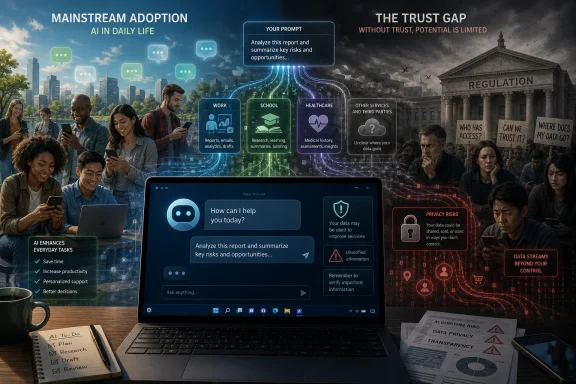 AI Has Crossed Into Habit Before It Has Earned Legitimacy
The newest Pew numbers land like a status report from a future that arrived before the public had time to consent to its terms. About half of American adults now use AI chatbots, up from roughly a third just two years ago, and about a quarter say they use them daily. That is not a niche technology anymore. It is not a developer toy, a search novelty, or a productivity experiment confined to the venture-capital class.But the same survey shows a public that remains deeply unconvinced. Forty percent of Americans expect AI to have a negative effect on society over the next two decades, compared with only 16 percent who expect a positive effect. Nearly two-thirds think AI is advancing too quickly. More than two-thirds lack confidence in government’s ability to regulate it effectively.
That is the paradox now defining the AI market: Americans are not waiting for moral certainty before using these systems. They are using them because the systems are useful, available, embedded, promoted, and increasingly unavoidable. The technology has achieved practical adoption before achieving civic legitimacy.
For Windows users and IT administrators, that matters because AI is no longer an app category sitting politely beside browsers, office suites, and antivirus tools. It is being wired into operating systems, search boxes, productivity suites, customer-service flows, device firmware, cloud consoles, and management dashboards. The Pew survey is less a snapshot of chatbot enthusiasm than a warning that the AI layer is becoming normal while public trust remains fragile.
The Chatbot Became the New Search Box
The most common chatbot use in Pew’s survey is exactly what one would expect: looking for information. Forty-two percent of users turn to chatbots for search-like tasks, while 38 percent of employed users use them for work. Entertainment, image and video creation, health information, diet and fitness advice, and news all trail behind.That hierarchy is revealing. The mass-market AI product is not primarily the science-fiction assistant that runs your life. It is a conversational search box that writes back. Americans have discovered that asking a chatbot to summarize, compare, draft, rephrase, troubleshoot, or explain is often easier than navigating ten web pages, three ads, and a forum thread from 2017.
This is why ChatGPT leads the pack. Pew found that more than four in ten Americans have used ChatGPT, making it the most widely used chatbot by a wide margin. Google’s Gemini, Microsoft’s Copilot, and Meta AI follow, with Grok, Claude, and Character.ai each under 10 percent. The order reflects branding, distribution, and habit as much as technical merit.
Microsoft’s place in that ranking is especially interesting for this audience. Copilot is not just a chatbot brand; it is Microsoft’s name for an architectural bet across Windows, Edge, Bing, Microsoft 365, GitHub, Azure, and endpoint management. The company is trying to make AI feel like part of the operating environment rather than a destination. Pew’s numbers suggest that strategy has plenty of room to grow, but also that Microsoft is pushing into a country that may use AI without trusting it.
The chatbot, in other words, is becoming infrastructure. That is wonderful when it reduces friction. It is dangerous when people forget that infrastructure also shapes what users see, what they believe, and what choices remain visible.
Awareness Is No Longer the Bottleneck
Pew found that 96 percent of Americans have heard or read about AI, up 11 percentage points over four years. That figure should retire one of the lazier explanations for AI anxiety: that people are simply afraid of what they do not understand. Awareness has risen dramatically, but concern has not melted away.The public has had enough exposure to form opinions, and many of those opinions are wary. That does not mean Americans can define transformer models, diffusion systems, retrieval-augmented generation, or synthetic media provenance. It does mean they have seen enough AI in their feeds, workplaces, classrooms, phones, and search results to understand that this is not just another software feature.
There is a crucial distinction between awareness and agency. Americans may know AI is present, but many do not feel they can control when it appears, what data it consumes, or whether its output can be trusted. That is the feeling behind the comment from Johns Hopkins expert Jim Dahbura, who described AI as something that is now “happening to us.” It is a blunt phrase, and it captures the mood better than most industry keynotes.
The industry likes to talk about adoption curves. The public is talking, sometimes implicitly, about exposure curves. Adoption suggests choice. Exposure suggests environment.
That distinction will become more important as AI moves from websites and apps into default workflows. A user can decide not to visit ChatGPT. It is much harder to avoid AI when it appears inside search summaries, customer support calls, writing tools, photo editors, phone keyboards, security products, and operating-system shell experiences.
Younger Users Are Not the Optimists the Industry Expected
One of the survey’s most counterintuitive findings is that younger adults are both more likely to use AI and more likely to expect negative social consequences. Two-thirds of adults aged 18 to 29 use chatbots, as do 61 percent of adults aged 30 to 49. A majority of Americans 50 and older do not use them.Ordinarily, technology companies read youth adoption as a proxy for cultural acceptance. The smartphone, social media, streaming video, and online gaming all rode younger users into the mainstream. AI is different. Younger Americans appear to be using the tools because they are useful, not because they are untroubled by what the tools imply.
That should unsettle the industry. The people most familiar with AI are not necessarily the least concerned about it. In Pew’s numbers, 48 percent of adults aged 18 to 29 expect AI to have a negative impact on society. Older Americans are less likely to predict a negative outcome, though they are more likely to be unsure.
There are plausible reasons for this split. Younger adults are closer to the school and entry-level labor markets where AI disruption feels immediate. They are more exposed to synthetic content, algorithmic feeds, deepfake risks, automated hiring tools, and AI-generated slop in creative spaces. They are also more likely to have seen chatbots fail confidently, flatten nuance, or turn creative and academic work into a suspicion-laden process.
This matters for employers. A twenty-five-year-old worker who uses AI every day may not be an AI evangelist. They may be a pragmatic user who believes the tool helps with drudge work while also threatening job ladders, creative labor, data privacy, and social trust. Treating usage as endorsement is a management mistake waiting to happen.
For schools, the finding is even sharper. Young people are not waiting for institutions to settle the policy debate. They are already using AI. But use does not erase skepticism; it may sharpen it.
The Public Sees the Privacy Bill Coming Due
The survey’s privacy finding is among the most politically potent: 71 percent of Americans expect AI to make their personal information less secure. That is not a fringe concern. It is a supermajority intuition that the data economy’s next phase will ask users to surrender more context, more behavior, more voice, more images, more documents, and more personal inference.This is where AI differs from earlier software waves. A spreadsheet does not ask to know you. A chatbot becomes more useful the more context it receives. A meeting assistant wants the transcript. A coding assistant wants the repository. A health chatbot wants symptoms, history, diet, medications, maybe a photo. A workplace assistant wants documents, email, calendar context, organizational charts, and task history.
The industry’s answer is usually a mixture of enterprise controls, privacy policies, model-training opt-outs, and assurances that data handling differs by product tier. Those details matter, especially in managed environments. But the public is reacting to the broader pattern: AI products are hungry for context, and context is often personal.
For Windows administrators, this is no longer an abstract consumer concern. AI features in productivity suites, browsers, endpoint tools, and cloud dashboards can create new data-governance questions. Which prompts are logged? Which files are indexed? Which tenant data can be used for grounding? Which plugins or connectors can reach sensitive systems? Which users are allowed to paste customer data, source code, financial forecasts, or legal material into third-party chatbots?
Those questions are not anti-AI. They are the ordinary questions of responsible computing. The difference is that AI makes the boundary between input, processing, and output feel deceptively casual. A prompt box looks harmless. In regulated environments, it may be an exfiltration path with better grammar.
The consumer version of that concern is even harder to manage. People may ask chatbots about medical symptoms, family disputes, finances, workplace conflicts, or emotional distress. Pew found that 10 percent of Americans use chatbots for emotional support. That number is small enough to seem marginal and large enough to represent millions of people.
Emotional Support Is the Use Case Nobody Wants to Own
The fact that one in ten Americans use chatbots for emotional support should make every AI company nervous. Not because software can never provide comfort, but because the incentives around emotional dependence are treacherous. A system optimized for engagement, helpfulness, or user satisfaction may not be the system you want near loneliness, grief, anxiety, depression, or crisis.Dahbura’s caution against leaning on chatbots for emotional support is not technophobic. It is an acknowledgement that conversational systems are unusually good at simulating attention. They can remember details, mirror tone, validate feelings, and produce endless patience. That makes them feel intimate, even when they are not accountable in any human sense.
The industry tends to frame this as a safety and moderation problem. Can the model detect crisis language? Can it refuse harmful instructions? Can it suggest professional resources? Those are necessary guardrails, but they do not address the deeper issue: the business value of a companion-like system may increase as a user becomes more attached to it.
This is not just a Character.ai problem or a teen-safety problem. It is a design problem across the category. The more natural the interface becomes, the more users may forget that there is no professional duty of care on the other side. The system’s fluency can obscure its limitations.
WindowsForum readers have seen versions of this before. Software that begins as a convenience can become a dependency. The difference with AI is that the dependency may be cognitive, emotional, and social, not merely operational.
The Workplace Is Quietly Becoming the Test Lab
Pew’s finding that 38 percent of employed chatbot users use the tools for work tasks fits a broader pattern seen across business surveys: AI adoption at work is moving faster than formal policy. Employees are drafting emails, summarizing documents, writing code, analyzing spreadsheets, generating slide outlines, translating text, preparing meeting notes, and troubleshooting systems. In many organizations, the official AI strategy is still a committee, while the unofficial strategy is already in browser tabs.That gap is risky. Shadow IT used to mean unsanctioned SaaS apps, personal Dropbox accounts, or rogue messaging tools. Shadow AI can mean sensitive data pasted into public chatbots, unverified output entering customer communications, generated code landing in repositories, or hallucinated facts creeping into policy documents. The problem is not that employees are careless. The problem is that the tools are useful enough to tempt normal people into bypassing slow procurement and unclear rules.
Microsoft’s Copilot strategy is designed, in part, to solve this enterprise problem by giving organizations a sanctioned AI layer inside products they already license and manage. That is a compelling pitch for IT: identity integration, tenant boundaries, compliance tooling, and administrative controls are preferable to a free-for-all of consumer AI accounts. But the existence of a sanctioned tool does not eliminate the need for governance.
Organizations still need to decide what AI may do, not merely which vendor may do it. Can it summarize confidential meetings? Can it draft performance reviews? Can it write security policies? Can it generate code without human review? Can it analyze employee sentiment? Can it answer HR questions from internal documents? Each use case carries a different risk profile.
The workplace is where AI’s productivity promise and trust deficit collide most directly. Workers may appreciate time savings while fearing surveillance, deskilling, job cuts, or accountability for machine-generated mistakes. Managers may see efficiency while underestimating verification costs. IT may be asked to secure workflows that leadership barely understands.
The lesson from Pew is that adoption cannot be treated as proof of comfort. Employees may use AI because they feel they must, because competitors are using it, because managers encourage it, or because the work has become structured around it. That is not the same thing as confidence.
Government Distrust Leaves a Vacuum the Industry Cannot Fill
Just over two-thirds of Americans in the Pew survey do not have confidence in government to regulate AI effectively. That skepticism is unsurprising, but it has consequences. If the public does not trust government to set guardrails and does not trust companies to prioritize social welfare over growth, then every new AI feature arrives carrying a legitimacy tax.The United States has so far taken a fragmented approach to AI governance. Federal agencies have issued guidance, pursued enforcement under existing authorities, and debated frameworks, while states have begun moving on privacy, deepfakes, automated decision-making, and related harms. The result is a patchwork that may be better than nothing but is not the coherent national strategy many experts say the technology requires.
The problem is not simply that regulation lags technology. Regulation almost always lags technology. The sharper problem is that AI is moving into domains where errors, bias, impersonation, and data misuse can scale quickly. Deepfakes are a clear example. A few years ago, high-quality synthetic media required specialized skill. Now the barrier is far lower, and the social cost is distributed across elections, schools, families, celebrities, fraud targets, and ordinary people.
Dahbura’s warning that there are likely side effects we have not yet imagined is worth taking seriously. The history of networked technology is full of second-order effects that seemed obvious only in retrospect. Social media was not sold as a loneliness engine or a disinformation accelerator. Smartphones were not marketed as attention-fragmentation devices. AI will have its own unintended consequences, and some will arrive through perfectly legal, well-funded products.
Industry self-regulation can help, but it cannot carry the whole burden. Companies face competitive pressure to ship features, gather users, reduce friction, and expand use cases. Even well-intentioned firms operate inside markets that reward speed. Public trust requires something more durable than a trust-and-safety blog post.
For IT professionals, the governance vacuum means internal policy becomes more important. If federal rules are slow and vendor defaults are insufficient, organizations need their own standards for data handling, review, logging, acceptable use, procurement, and incident response. Waiting for a perfect regulatory regime is not a strategy.
AI Is Already in the Room, Even When the Chatbot Is Not
One reason AI debates feel slippery is that many people use the word to mean only the visible chatbot. Pew’s survey focuses on chatbots, but Dahbura rightly notes that Americans may be interacting with AI more than they realize. AI appears in household devices, phone systems, recommendation engines, spam filters, camera software, fraud detection, transcription tools, customer support, search results, and workplace platforms.That invisibility is both a strength and a liability. Mature technology disappears into the background. Nobody marvels that email clients filter spam or phones enhance photos computationally. But when AI becomes ambient, users may lose the chance to evaluate when automation is influencing them.
The chatbot has become the symbolic face of AI because it is the version people can talk to. Yet some of the highest-stakes AI systems do not present themselves as chat partners. They rank, score, flag, predict, recommend, deny, approve, route, summarize, and classify. Their output may shape whether a transaction is blocked, a resume is noticed, a post is amplified, a claim is reviewed, or an alert reaches a security analyst.
This is why public anxiety cannot be answered only by making chatbots more polite. The concern is systemic. Americans are asking, in effect, who gets to deploy intelligence-like systems around them, what those systems optimize for, and what recourse exists when they fail.
Windows itself is becoming part of this story. The PC has always been a mediation layer between the user and the digital world. If AI becomes a default mediation layer inside the PC, the stakes of operating-system design rise. The Start menu, search box, browser sidebar, file explorer, notification surface, and productivity shell can all become places where AI interprets user intent.
That may be useful. It may also be intrusive. The difference will depend on transparency, controls, defaults, and whether users believe they can say no without breaking the experience.
The Industry Mistook Use for Trust
The most important sentence to write about the Pew survey is this: usage is not the same as trust. Technology companies often collapse the two because adoption is the metric they can measure and monetize. If more people use the tool, the product must be winning. If daily use rises, the market must be speaking.But people use technologies they distrust all the time. They use social networks they think are bad for mental health. They use search engines they believe track too much. They use smartphones they feel addicted to. They use workplace software they dislike because their employer requires it. Utility can overpower discomfort without resolving it.
AI now appears to be entering that category. Americans can see the benefits. Dahbura points to software, medicine, and other domains where AI may produce real gains. The public is not blind to that promise; otherwise adoption would not be rising this quickly. But the promise is not enough to erase fears about misinformation, job disruption, privacy, emotional manipulation, bias, fraud, and weak oversight.
This is a harder market than the AI boom’s early rhetoric allowed. The first wave of generative AI marketing leaned heavily on wonder: instant creativity, infinite assistants, supercharged productivity, a new computing paradigm. The next wave will have to address fatigue and suspicion. Users have seen the magic trick. Now they want to know the cost.
There is an opportunity here for vendors that treat skepticism as a design requirement rather than a public-relations problem. Clear data controls, honest limitations, visible provenance, auditability, admin policy, model transparency where possible, and conservative defaults are not obstacles to adoption. They may become the basis for durable adoption.
The companies that ignore this will still get usage. They may not get trust. And when inevitable failures occur, the lack of trust will make every incident more damaging.
The Survey Reads Like a Warning Label for the Copilot Era
For the Windows ecosystem, Pew’s survey arrives at an awkward time. Microsoft has spent the past few years turning Copilot from a product into a brand architecture, attaching it to Windows, Microsoft 365, Edge, Bing, GitHub, Security, Azure, and business workflows. The strategic logic is obvious: if AI is the next interface, Microsoft wants it close to the operating system and the productivity graph.That strategy may prove correct. Microsoft controls surfaces where AI can be genuinely helpful: documents, email, meetings, code, calendars, files, security alerts, spreadsheets, and enterprise knowledge. A well-governed assistant that can safely reason across those contexts could save time and reduce friction in ways that ordinary software never managed.
But Pew’s numbers suggest the company is building this future for a public that is not emotionally aligned with the sales pitch. Users may accept AI features while resenting their prominence. Administrators may deploy Copilot while worrying about data boundaries. Workers may use AI summaries while doubting their reliability. Consumers may appreciate image tools while fearing deepfakes and data leakage.
That tension should influence product design. AI features need obvious off switches, clear explanations, and predictable behavior. They need to respect the difference between local device context, cloud processing, enterprise tenant data, and public model interactions. They need to tell users when they are summarizing, when they are inferring, and when they are guessing.
The Windows world has lived through trust failures before. Telemetry controversies, forced upgrades, default browser battles, cloud-account nudges, and Start menu experiments all taught the same lesson: users tolerate change better when they feel respected. AI raises that lesson to a higher power because the feature is not merely changing where a button lives. It may be interpreting private information and generating decisions or recommendations.
Microsoft is not alone here, but it is uniquely exposed because Windows remains the daily computing environment for so many homes, schools, and enterprises. If AI becomes part of the operating-system contract, the burden of trust rises with it.
The Public Has Already Written the Deployment Checklist
The Pew survey does not tell companies to stop building AI. It tells them what must be true if they want adoption to mature into confidence. The public is not asking for a world without AI. It is asking for a world where AI does not feel like an uncontrolled experiment conducted through every device and workplace at once.The concrete lesson is that organizations should treat AI deployment as a governance project, not just a licensing decision.
- Americans are using chatbots at mainstream scale, but the dominant public mood remains cautious rather than celebratory.
- Younger adults are heavy users of AI, yet they are also among the most likely to expect negative social consequences.
- Privacy and data security are now central AI concerns, not secondary objections raised by specialists.
- Workplace AI policies need to address actual behavior, because employees are already using tools faster than many organizations are governing them.
- Consumer and enterprise trust will depend on visible controls, honest limitations, and meaningful accountability rather than novelty alone.
- The AI market’s next phase will be shaped by whether vendors can make the technology feel useful without making it feel unavoidable.
A Rocky Road Is Still a Road
Dahbura’s prediction of a rocky road ahead is probably the safest forecast in technology. AI will keep advancing because the incentives are enormous, the tools are useful, and the infrastructure is already being built into the platforms people use every day. But Pew’s survey shows that the American public is not sleepwalking into this future with naïve enthusiasm. It is walking in with one hand on the keyboard and the other on the guardrail, willing to use the machine, unwilling to fully trust it, and increasingly aware that the terms of that relationship will define the next era of personal and enterprise computing.References
- Primary source: National Desk
Published: 2026-06-19T19:50:18.129079
Americans embrace AI, but with skeptical eye, Pew survey shows
Americans are skeptical of chatbots and other forms of AI, even as awareness and usage have increased rapidly in a few short years, a new Pew Research Center survey shows. thenationaldesk.com
- Related coverage: pewresearch.org
What the data says about Americans’ views of artificial intelligence | Pew Research Center
Drawing on five years of Pew Research Center surveys, here are 13 findings about how Americans use and view AI, and where they see promise and risk.www.pewresearch.org - Related coverage: benton.org
Key findings about how Americans view artificial intelligence
Artificial intelligence has become part of everyday life for many Americans—at work, at school, in health care and beyond. As AI spreads, the public remains cautious, but somewhat open to its potential benefits. Drawing on five years of Pew Research Center surveys, here are some findings about... www.benton.org
- Related coverage: thenextweb.com
Half of Americans now use AI chatbots, but 40% think AI will make society worse and two-thirds don't trust the government to regulate it
A Pew Research survey of 5,119 US adults found 49% use AI chatbots, but 40% expect AI to worsen society and 67% have little confidence in government oversight.thenextweb.com - Related coverage: techradar.com
Is this the tipping point for AI at work? New Gallup survey finds half of all US employees now use it in some way | TechRadar
Is AI at work now here to stay?www.techradar.com - Related coverage: tomshardware.com
Half of all US employees now use artificial intelligence at work, crossing landmark threshold for first time — Gallup data shows daily and weekly usage hitting all-time high of 28% in Q1 2026, with 65% feeling positive about its impact on produ
There's no stopping the growth of AI in the workforcewww.tomshardware.com
- Related coverage: axios.com
Pew Research: Americans wary of AI in creative, religious, romantic life
New Pew Research report says users are wary of AI in personal and creative pursuits.www.axios.com