

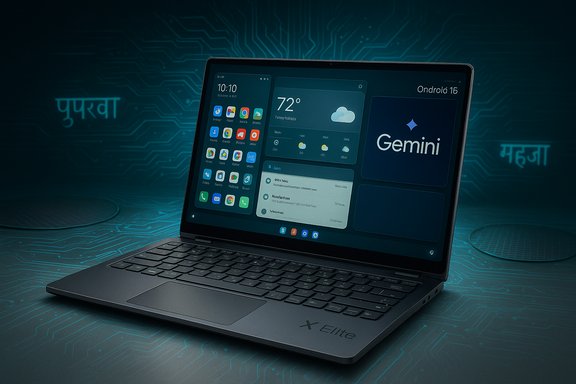
A recent set of repository screenshots and a short social-media thread have reignited talk that Google and Qualcomm could be preparing Android 16 for full laptop-class silicon — specifically Qualcomm’s Snapdragon X family — a move that would place a first-party Android desktop experience within striking distance of Chromebooks and Microsoft’s Copilot+ Windows PCs. The leak centers on an internal codename, “purwa,” which appears in Android 16 manifests tied to camera, audio, Bluetooth and computer-vision modules, and it’s been linked in public reporting to Snapdragon X, X Plus and X Elite hardware. Independent coverage and follow-ups trace the same claim across several outlets and the original tip thread, and the same leak thread hints at another Qualcomm part, “mahua,” reportedly a Windows-on-Arm (WoA) chip still without public specs.
Android has spent years expanding beyond phones and tablets — ChromeOS, DeX, and Android’s large-screen improvements have blurred lines between mobile and desktop. Qualcomm’s Snapdragon X family, engineered for thin, fanless notebooks and mini‑PCs, was built to bring ARM’s power and efficiency to Windows laptops; Microsoft has used X-series silicon in its Copilot+ devices. The new leak suggests Qualcomm’s internal code trees for Android 16 now include support for the Snapdragon X family — a technical pivot with important strategic and market implications if it is true. This isn’t a single-site rumor: reporters and specialist outlets have reproduced the screenshots and summarized the same repo evidence, while the leaker’s original X post is circulating as the primary lead. Taken together, the signals point to engineering work rather than a consumer roadmap announcement — but the inference is meaningful: Android’s runtime and Android 16 dev branches may be being prepared to run on PC-class Arm silicon.
Watch for real builds, certification traces and OEM previews; until then, the leak is a strong signal of engineering direction and a reminder that the PC ecosystem is entering a new phase of OS and silicon cross‑pollination — with winners determined as much by software polish and ecosystem support as by raw TOPS and clock speeds.
Source: Digital Trends Your next Android PC from Google is the new Copilot+ challenger
 Background / Overview
Android has spent years expanding beyond phones and tablets — ChromeOS, DeX, and Android’s large-screen improvements have blurred lines between mobile and desktop. Qualcomm’s Snapdragon X family, engineered for thin, fanless notebooks and mini‑PCs, was built to bring ARM’s power and efficiency to Windows laptops; Microsoft has used X-series silicon in its Copilot+ devices. The new leak suggests Qualcomm’s internal code trees for Android 16 now include support for the Snapdragon X family — a technical pivot with important strategic and market implications if it is true. This isn’t a single-site rumor: reporters and specialist outlets have reproduced the screenshots and summarized the same repo evidence, while the leaker’s original X post is circulating as the primary lead. Taken together, the signals point to engineering work rather than a consumer roadmap announcement — but the inference is meaningful: Android’s runtime and Android 16 dev branches may be being prepared to run on PC-class Arm silicon. What the leak actually shows — parsed and verified
The core artifacts
- The publicly shared screenshot (from the analyst’s X thread) shows a private Android 16 manifest listing that includes an entry named purwa, with subpaths referencing modules that mirror Qualcomm Android trees: camera, audio_handset, btfm (Bluetooth/FM) and cv (computer vision). That layout is consistent with how Qualcomm organizes Android device manifests for other Snapdragon families.
- The same thread claims “purwa” maps to Snapdragon X, and that Android code for device variants labeled “xelite” and “x” already exists in the repository. Multiple outlets repeated those observations after inspecting the same screenshots.
- The leak thread also mentions “mahua,” described as a WoA‑oriented Qualcomm codename located near references to Snapdragon X in the repo snapshot. No hardware specs accompanied that name in the images, and the claim remains unverified beyond the screenshot text.
What can be verified independently
- Qualcomm’s Snapdragon X family exists and is marketed as a PC-class ARM platform (X, X Plus, X Elite) used in thin laptops and Copilot+ devices. Public product pages and OEM listings show the X family’s intended position for Windows laptops.
- The Snapdragon X line’s hardware characteristics — multi-core Oryon CPU designs, Adreno GPU capability and a Hexagon NPU measured in tens of TOPS — are documented in Qualcomm/OEM material and industry coverage. Depending on model generation, the NPU figure commonly quoted is in the 40–45 TOPS range for X‑series, with newer X2/X2‑class chips advertising significantly higher TOPS figures (and new Summit-era announcements claim up to ~80 TOPS for the X2 generation). Those numbers are public and come from vendor specs and independent benchmark reporting.
- Android 16 has a private branch for OEM device trees; it’s plausible and common for chipset vendors to add device manifests for new SoCs well before a public hardware launch, as engineering and driver work must precede consumer releases. That behavior aligns with the repo artifacts shown in the leak screenshot.
What remains unverified or ambiguous
- The screenshot is a repository snapshot (file paths and manifest entries) and does not mean shipping products exist. A repo entry typically means engineering work is underway — it does not guarantee OEMs will ship Android‑on‑Snapdragon‑X laptops nor that Google will certify Android as a full PC OS. This claim should therefore be treated as plausible but speculative until test images or device sightings appear. This caveat is critical.
- The “mahua” codename’s role and specs are unconfirmed. The leak places it near X entries, but no corroborating documentation, benchmark traces or certification logs currently confirm a new WoA part named mahua. Flagged until further evidence appears.
Why this matters: market and technical implications
A direct challenge to ChromeOS, Copilot+ and WoA
- New competitor for light laptops: If Android 16 runs natively on Snapdragon X silicon and OEMs ship laptops with it, buyers focused on battery life, app availability and instant-on behavior could see Android laptops as a viable alternative to Chromebooks and entry-level Windows machines. The Snapdragon X family is explicitly tuned for thin, power‑efficient designs that favor fanless builds and long battery life — properties shoppers choose Chromebooks for today.
- Apple and Microsoft pressure point: Microsoft’s Copilot+ devices lean on NPUs and Windows‑on‑Arm to deliver local AI features. Android on Snapdragon X could offer many of the same advantages — mobile app catalog, long battery life, always-on connectivity — and would simplify the platform stack for OEMs that already build Android devices. That dynamic introduces fresh competitive pressure on Windows‑on‑Arm’s positioning in the thin-and-light and education segments.
- Developer and UX work matters: For Android to be a credible laptop OS it needs a polished desktop UX: proper windowing, keyboard/trackpad handling, reliable multi‑monitor support, and desktop-friendly APIs. Google has been moving Android toward larger screens, but substantial developer tooling and UX refinements remain. Qualcomm adding Android manifests is a hardware step; the broader ecosystem must solve the desktop experience too.
Practical user benefits if it ships
- Long battery and mobile‑optimized app ecosystem on laptop form factors.
- Fanless, thin designs for everyday productivity (mail, docs, browsing, light creative work).
- Direct access to Play Store and Android app distribution — deeper app catalog on day one compared with fledgling alternative stores or web wrappers.
- Potential for fast wake/resume and persistent connectivity using Qualcomm modem integration.
Technical analysis: how feasible is Android on Snapdragon X?
Silicon capabilities
- Snapdragon X and X Elite chips are already built around ARM cores, integrated GPUs and Hexagon NPUs. Public specs show NPU performance in the tens of TOPS for current X-series chips (commonly quoted around 45 TOPS for some X variants), while Qualcomm’s newer X2 / X2 Elite announcements advertise much higher AI throughput (up to ~80 TOPS) for the latest generation. Those NPU resources are the primary enabler for on-device AI (Gemini on-device, local model inference, efficient image/video processing).
- From a raw-hardware perspective, Android can run on Arm64 silicon. The remaining engineering tasks are driver integration, firmware/bootloader alignment, and support for platform-specific features (power management, sensors, camera pipelines) that vendors usually implement in Android tree manifests — exactly the artifacts shown by the leak.
Software and ecosystem gaps
- Android’s large-screen windowing and desktop UX remain work in progress. Samsung DeX and manufacturer extensions have shown what’s possible, but a unified, Google‑led desktop experience with first‑party developer guidance is necessary for broad adoption. Google’s strategy has hinted at bringing Gemini and Android’s AI stack to laptops; repo manifests are consistent with that engineering track but do not prove a final product.
- Enterprise tooling: Windows’ enterprise ecosystem (MDM, legacy app compatibility, domain management) is a core advantage. Android PCs would need comparable management and security features for large-scale deployment in businesses — a significant lift that will determine whether Android PCs remain consumer-focused or expand into enterprise.
Risks, limitations and areas of caution
- Repo evidence ≠ product: A repository record can be exploratory, experimental or legacy. Treat the purwa entries as engineering breadcrumbs rather than proof of imminent retail laptops. Historically, many platform experiments never reach broad shipping status.
- App behavior and developer adoption: Mobile apps are often optimized for single-window, touch-first interaction. Running them on a large-screen laptop requires changes — improved keyboard accessibility, multitasking, resizable windows, and input focus handling. Without developer effort, many apps will feel like phone apps stretched to a laptop screen.
- Enterprise and security concerns: Unless Google and OEMs provide robust enterprise tooling (policy controls, identity integration, secure boot/attestation equivalents), Android PCs may struggle in corporate deployments that currently default to Windows.
- Fragmentation risk: Android’s history of OEM forks and divergent feature sets could magnify if desktop variants splinter the platform. Google’s ability to enforce a consistent desktop UX and API set will be decisive.
- Performance perception vs. raw numbers: TOPS and NPU metrics are useful orientation but do not guarantee a superior user experience. Thermal design, memory bandwidth, OS scheduler, and software optimization matter equally in delivering consistent real‑world performance. Benchmarks posted by vendors should be interpreted alongside real-world tests.
Scenarios OEMs, developers and IT should prepare for
For OEMs — three paths
- Experiment quietly: integrate Android 16 builds on reference Snapdragon X hardware for internal testing and partner demos (low consumer exposure).
- Dual-boot offers: ship devices with Windows and Android images, or fast-switch modes that allow users to boot into either OS for different workloads.
- Android-first SKUs: pursue lower-cost education or consumer lines that rely primarily on Android 16 with desktop extensions — this would require Google‑endorsed desktop UI and Play Store support for large-screen licensing.
For developers
- Prioritize large-screen UX: support multi-window, keyboard/navigation, pointer precision, and richer window resizing semantics.
- Test on real hardware: when test images appear, verify performance, memory usage and input behavior on Snapdragon X devices.
- Reconsider distribution and monetization: Android PCs might shift user expectations for pricing and feature sets.
For IT and procurement
- Pilot before mass rollouts: any Android laptop pilot must validate management integration (MDM), app compatibility and the ability to meet corporate security posture.
- Inventory critical apps and drivers: identify Windows-only dependencies that would preclude migration.
- Plan support models: dual‑OS scenarios complicate imaging, patching and helpdesk support; pilot policies should cover fallbacks.
What to watch next (concrete signals that matter)
- OEM test images and factory build IDs appearing in benchmarks or Android certification logs (these are strong indicators that devices exist beyond repository entries).
- Google developer previews for desktop APIs or an Android 16 “desktop” SDK that documents windowing and keyboard behavior improvements.
- More repo artifacts or driver blobs tied to known Snapdragon X board IDs (e.g., SC8380 or X‑series part numbers) appearing in Android’s AOSP branches or vendor trees.
- Certification and regulatory filings, e.g., Bluetooth SIG, FCC IDs tied to thin laptops referencing Android as the OS.
- OEM product announcements or developer partner demos at trade shows (CES, MWC) or press events.
How credible is the “purwa” story? A measured verdict
- Credibility: Plausible. Multiple independent outlets reproduced the repo screenshot and the leaker’s thread; Qualcomm’s hardware roadmap and Google’s public comments about larger-screen Android and Gemini integration make the engineering work plausible.
- Confidence ceiling: Moderate. Repo entries are indicative of internal development, but absent test builds, device sightings, certification records or OEM commitments, this is still an engineering-stage story. Treat the leak as a signal of intent and capability rather than proof of a consumer product.
- Cross‑checked claims: The claim that Snapdragon X family is present in Android manifests is consistent across sources; the claim that mahua is a forthcoming WoA part is repeated but currently unverified beyond the original screenshot text. Flag mahua as unconfirmed.
Implications for the PC landscape
- Short term (6–12 months): engineering previews and OEM experiments; marketing noise but few retail Android-first laptops unless Google and OEMs accelerate plans.
- Medium term (12–24 months): if engineering yields stable test images and Google provides desktop UX guidance, expect education and budget OEMs to trial Android laptops on Snapdragon X or similar silicon.
- Long term (2–4 years): a successful Android‑on‑PC movement could fragment the low‑end laptop market, forcing Microsoft to defend Copilot+ value and prompting ChromeOS and Windows to adapt to the new battery/performance expectations.
Bottom line
The purwa leak is an important technical breadcrumb: it shows Qualcomm-side engineering artifacts that map Android 16 to Snapdragon X-class hardware, and it aligns with a broader industry story — Google and Qualcomm preparing Android and silicon for larger-screen devices with on-device AI. That combination could yield fast, long‑battery laptops with immediate access to Android’s app ecosystem — a credible competitor to Chromebooks and a new pressure point for Windows-on-Arm and Copilot+. But repository entries are only the first chapter. The platform‑level work (desktop UX, developer tooling, enterprise management) and OEM decisions will determine whether Android laptops become a mainstream category or a contained experiment.Watch for real builds, certification traces and OEM previews; until then, the leak is a strong signal of engineering direction and a reminder that the PC ecosystem is entering a new phase of OS and silicon cross‑pollination — with winners determined as much by software polish and ecosystem support as by raw TOPS and clock speeds.
Source: Digital Trends Your next Android PC from Google is the new Copilot+ challenger
