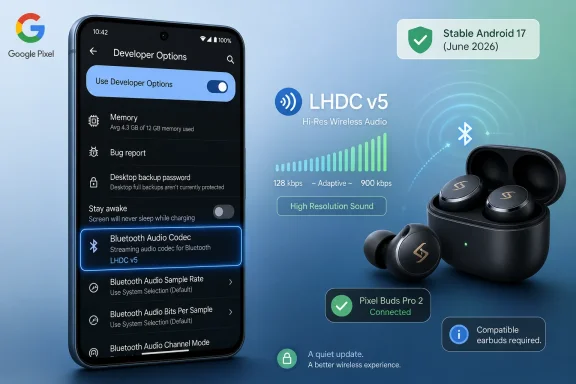
Google’s Android 17 stable release has added native LHDC v5 Bluetooth audio support on Pixel phones in June 2026, letting compatible Pixel models stream higher-resolution wireless audio to earbuds and headphones that previously fell back to AAC or SBC. The change matters less because every listener will suddenly hear studio-grade sound, and more because Google has finally removed a compatibility gap that made Pixel phones feel oddly second-class with some premium Android earbuds. For a platform that sells choice as a virtue, Bluetooth audio has too often been a maze of brand-specific codec support, hidden developer menus, and “it depends” footnotes. Android 17 does not solve all of that, but it takes one of the more annoying walls down.
For years, Pixel phones occupied a strange place in Android audio. They were Google’s reference devices, the phones that were supposed to represent Android at its cleanest and most future-facing, yet they did not always play nicely with the codec choices made by other Android hardware makers.
Sony’s LDAC had long been the safest high-bitrate option on Android because it was already widely supported at the platform level. That made LDAC the de facto answer for users who wanted better-than-AAC Bluetooth quality without buying into a single phone-and-earbud ecosystem. But the Android accessory market did not standardize around LDAC alone.
OnePlus, OPPO, Nothing, Xiaomi, and others have sold earbuds that lean on LHDC for their high-resolution mode. For users inside those ecosystems, the pitch was straightforward: pair the right phone with the right earbuds and unlock higher-bitrate wireless audio. For Pixel owners, that same purchase could turn into a quiet downgrade, with the earbuds falling back to AAC or SBC despite advertising a “Hi-Res” feature on the box.
That is the kind of deficiency that does not show up well in a keynote. It is also exactly the kind of deficiency that enthusiasts notice immediately. Android 17’s LHDC support is therefore a small feature with an outsized symbolic value: Google is acknowledging, through code rather than marketing, that Android’s audio story cannot revolve around Pixel-first assumptions.
In practice, LHDC v5 sits in the same mental category as LDAC for many users. It promises high-resolution wireless audio, but it still operates inside the physical and reliability limits of Bluetooth. The theoretical headline numbers — up to 24-bit/192kHz and around 1Mbps — are impressive on a spec sheet, but they do not mean your earbuds have become a wired DAC and a pair of studio monitors.
That distinction matters because codec marketing often invites magical thinking. Higher bitrate can help, especially with good source material, capable earbuds, and a stable connection. It cannot rewrite the acoustics of tiny drivers, the limits of battery-powered radios, or the compression trade-offs required when a signal has to survive in a crowded wireless environment.
Still, dismissing LHDC as audiophile trivia would miss the point. Bluetooth audio is now the default listening path for millions of people, and the better codecs are not merely vanity features. They can preserve more detail, reduce obvious compression artifacts, and give premium earbuds room to behave like premium earbuds rather than expensive AAC endpoints.
That workflow is still more fiddly than it should be. The codec option lives under Settings, System, Developer Options, Bluetooth, and Bluetooth Audio Codec, and it appears only when compatible hardware is connected. That is classic Android: powerful, flexible, and far too happy to hide meaningful user-facing features in a menu originally meant for debugging.
But the practical change is real. A Pixel paired with earbuds such as OnePlus Buds Pro 3 no longer has to behave as though those buds’ best codec mode belongs to somebody else’s phone. The phone and accessory can negotiate LHDC support natively, which is exactly what should have happened in a mature ecosystem years ago.
The improvement will not be uniform. Some users will hear a wider soundstage or cleaner presentation with high-quality source files. Others will hear little difference, especially in noisy environments, with streaming services set to compressed quality, or with earbuds whose tuning matters more than the codec. Android 17 is enabling a better pipe; it is not guaranteeing better water.
Savitech, the company behind LHDC, said earlier this year that Android 17 would bring native LHDC support. If that holds across future devices from Samsung, Xiaomi, OPPO, vivo, and others, the change could make high-resolution Bluetooth behavior more predictable across Android phones. That predictability is what the ecosystem has lacked.
Android’s strength has always been hardware diversity. Its weakness has been that diversity turning into compatibility roulette. A user might buy expensive earbuds, move from a OnePlus phone to a Pixel or Samsung device, and discover that the advertised high-res mode vanished because the phone did not support the right codec.
Native platform support changes the economics of that problem. Accessory makers can target a codec that Android itself recognizes. Phone makers can implement support without treating it as a proprietary differentiator. Users get a better chance that their next phone and current earbuds will work together as advertised.
This does not make Android audio simple. It does make it less arbitrary. In consumer technology, that is often the more meaningful victory.
Bluetooth codec support is not stage-friendly. There is no dramatic demo when a developer option stops being greyed out. There is no cinematic product video for “your earbuds now use the codec they were designed to use.” Yet for the kind of users who buy Pixels, discuss builds, compare earbuds, and notice audio paths, this is exactly the kind of change that builds or erodes platform trust.
Google has a habit of underplaying infrastructure improvements that make Android better as a platform. That can be frustrating, because these changes often matter more over time than the flashier software features that dominate launch coverage. A new AI shortcut may come and go; a system-level codec can shape accessory compatibility for years.
There is also a competitive angle here. Apple has been conservative with Bluetooth audio codec support, leaning on AAC for its own devices while pushing other audio experiences through tight hardware-software integration. Android, by contrast, has to win through breadth. If Android cannot make premium earbuds work well across brands, it undermines one of its clearest advantages.
LHDC support is therefore not just an audiophile bullet point. It is a platform governance decision. Google is deciding that this codec has become common enough in the Android accessory market to deserve first-class treatment.
LHDC v5 can carry more data than AAC. A 96kHz setting can look impressive in Developer Options. A lossless or high-resolution stream from a music service can provide better input than a low-bitrate file. But Bluetooth remains a constrained wireless link, and the codec will still compress and downsample when necessary to fit within available bandwidth and maintain connection stability.
That means the biggest improvement may not be “you will hear everything the studio engineer heard.” It may be more modest: fewer codec bottlenecks, less unnecessary quality loss, and better use of hardware that already supported LHDC but was waiting for the phone to catch up.
For many listeners, the earbuds’ tuning, fit, seal, noise cancellation, and DSP will matter more than the difference between AAC and LHDC. A poorly fitted premium earbud using LHDC can sound worse than a well-fitted cheaper pair using AAC. Audio quality is a chain, and the codec is only one link.
But the codec link still matters because it is the one Google controls at the platform level. Android 17 does not make every earbud better. It makes fewer earbuds artificially worse.
That is very Android. The platform often exposes immense power while leaving users to discover it through forums, screenshots, and trial-and-error rituals. Enthusiasts may enjoy that hunt; ordinary users should not have to know what a Bluetooth codec is to get the best mode their phone and earbuds both support.
To be fair, automatic codec negotiation should handle most of this. In an ideal world, a Pixel paired with LHDC earbuds would simply select the best stable codec, companion apps would expose a clear “Hi-Res” toggle where necessary, and Developer Options would remain a diagnostic fallback. But the fact that users are verifying support through a hidden menu tells us the experience is not yet fully consumer-grade.
This is where Google and accessory makers still have work to do. If LHDC is now a native Android feature, the user experience around it should become less obscure. Codec status should be visible in normal Bluetooth device details, and high-res modes should explain battery, latency, stability, and quality trade-offs in plain language.
Otherwise, Android risks turning a platform win into another enthusiast-only trick. The feature should not feel like a secret handshake.
Samsung is the biggest question because of scale. Galaxy phones dominate Android’s premium volume in many markets, and Samsung’s codec strategy has long included its own preferences, including Samsung Seamless Codec for Galaxy Buds. If LHDC support becomes routine on Galaxy devices with Android 17, the accessory market gets a much broader common target.
Xiaomi, OPPO, vivo, and OnePlus are different cases. Some of these brands have already supported LHDC on selected devices or leaned into it through their earbuds. For them, Android 17 could reduce fragmentation and make the feature feel less like a vendor-specific perk. The codec becomes part of the Android baseline rather than a regional or model-specific gamble.
This matters for buyers who do not organize their lives around a single brand. A person might use a Pixel today, a Galaxy next year, and OnePlus earbuds throughout. They should not need to maintain a spreadsheet of codec compatibility to know whether their expensive earbuds will work at full capability.
If Android 17 makes LHDC boring, it will have succeeded. The best compatibility improvements are the ones users eventually stop thinking about.
That does not mean Windows laptops will suddenly become seamless LHDC endpoints overnight. Windows Bluetooth audio support has its own history of uneven codec exposure, driver dependencies, OEM choices, and user confusion. Anyone who has tried to verify exactly which codec a Windows machine is using with a given headset knows the pain.
But the direction is notable. As earbuds become the default headset for phones, tablets, and laptops, codec support becomes a cross-device quality issue rather than a phone-only perk. Users increasingly expect one pair of earbuds to move from Pixel to ThinkPad to gaming handheld without losing core capabilities.
Windows has improved in many areas of Bluetooth audio, but it still does not present codec management as transparently as advanced users would like. If LHDC gains traction across Android and accessory makers, pressure will grow for PCs to support it more visibly and consistently. The alternative is a familiar one: the phone sounds better, the laptop falls back to something less capable, and the user has no clear idea why.
The broader story is not that LHDC will conquer every platform. It is that wireless audio is becoming part of the interoperability checklist. Phones, PCs, earbuds, and operating systems are now judged together.
From the user’s perspective, much of it became exhausting. A codec that works only with the “right” phone is not a feature so much as a trapdoor. Earbuds that sound great on one Android device and ordinary on another do not make the ecosystem feel advanced; they make it feel unreliable.
Android 17’s LHDC integration hints at a more mature phase. Not because every codec war is over, but because Google appears to be absorbing a widely used codec into the platform rather than leaving users at the mercy of OEM alignment. That is how a platform should behave when accessory diversity becomes a mainstream reality.
There is still a danger that codec support becomes another marketing arms race. Manufacturers can still advertise extreme sample rates while glossing over real-world limits. Companion apps can still bury toggles behind vague “Hi-Res” branding. Reviewers and buyers can still overvalue codec names while undervaluing tuning and fit.
But native support reduces one avoidable source of disappointment. It means the premium feature is less likely to fail before the music even starts.
Battery life may take a hit. Connection stability may vary depending on environment, distance, and interference. Latency may matter if you are gaming or watching video, though modern earbuds and phones often apply their own compensation and low-latency modes.
The point is not that everyone should force LHDC all the time. The point is that users should have the option when the hardware supports it. Android 17 gives Pixel owners that option in a way they did not reliably have before.
For sysadmins and IT buyers, this is not a fleet-defining feature. Nobody should choose an enterprise phone deployment solely on LHDC. But it is another example of how endpoint experience is shaped by small platform capabilities that users notice when they are absent.
A phone is not just a secure slab that runs apps. It is also a daily audio device, authentication device, camera, wallet, hotspot, and meeting terminal. Codec support lives in that messy human layer where platform quality becomes user satisfaction.
Here is what the change means in concrete terms:
 Google Fixes a Pixel Problem It Barely Acknowledged
For years, Pixel phones occupied a strange place in Android audio. They were Google’s reference devices, the phones that were supposed to represent Android at its cleanest and most future-facing, yet they did not always play nicely with the codec choices made by other Android hardware makers.Sony’s LDAC had long been the safest high-bitrate option on Android because it was already widely supported at the platform level. That made LDAC the de facto answer for users who wanted better-than-AAC Bluetooth quality without buying into a single phone-and-earbud ecosystem. But the Android accessory market did not standardize around LDAC alone.
OnePlus, OPPO, Nothing, Xiaomi, and others have sold earbuds that lean on LHDC for their high-resolution mode. For users inside those ecosystems, the pitch was straightforward: pair the right phone with the right earbuds and unlock higher-bitrate wireless audio. For Pixel owners, that same purchase could turn into a quiet downgrade, with the earbuds falling back to AAC or SBC despite advertising a “Hi-Res” feature on the box.
That is the kind of deficiency that does not show up well in a keynote. It is also exactly the kind of deficiency that enthusiasts notice immediately. Android 17’s LHDC support is therefore a small feature with an outsized symbolic value: Google is acknowledging, through code rather than marketing, that Android’s audio story cannot revolve around Pixel-first assumptions.
LHDC Was Never Just Another Codec Checkbox
The Low Latency High-Definition Audio Codec, usually shortened to LHDC, is one of several attempts to push Bluetooth audio beyond the baseline compromises of SBC and the broad compatibility of AAC. Its appeal is simple enough: it can transmit at much higher bitrates than AAC and can support higher sample rates and bit depths under the right conditions.In practice, LHDC v5 sits in the same mental category as LDAC for many users. It promises high-resolution wireless audio, but it still operates inside the physical and reliability limits of Bluetooth. The theoretical headline numbers — up to 24-bit/192kHz and around 1Mbps — are impressive on a spec sheet, but they do not mean your earbuds have become a wired DAC and a pair of studio monitors.
That distinction matters because codec marketing often invites magical thinking. Higher bitrate can help, especially with good source material, capable earbuds, and a stable connection. It cannot rewrite the acoustics of tiny drivers, the limits of battery-powered radios, or the compression trade-offs required when a signal has to survive in a crowded wireless environment.
Still, dismissing LHDC as audiophile trivia would miss the point. Bluetooth audio is now the default listening path for millions of people, and the better codecs are not merely vanity features. They can preserve more detail, reduce obvious compression artifacts, and give premium earbuds room to behave like premium earbuds rather than expensive AAC endpoints.
Pixel Owners Finally Get the Codec Their Earbuds Expected
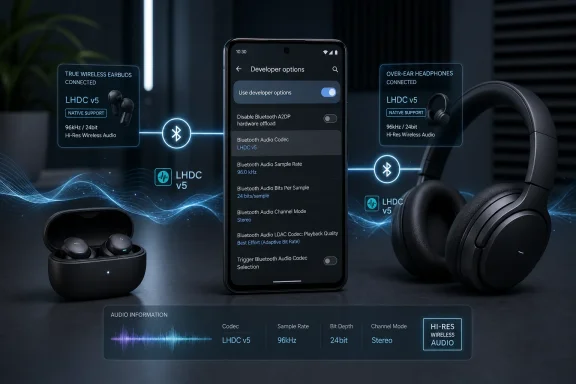
The immediate beneficiary is the Pixel user with LHDC-capable earbuds. Android Authority’s testing on a Pixel 9 Pro XL running stable Android 17 found LHDC v5 available in Developer Options when paired with OnePlus Buds Pro 3, with 96kHz Bluetooth audio selectable and Hi-Res mode enabled through OnePlus’s HeyMelody companion app.That workflow is still more fiddly than it should be. The codec option lives under Settings, System, Developer Options, Bluetooth, and Bluetooth Audio Codec, and it appears only when compatible hardware is connected. That is classic Android: powerful, flexible, and far too happy to hide meaningful user-facing features in a menu originally meant for debugging.
But the practical change is real. A Pixel paired with earbuds such as OnePlus Buds Pro 3 no longer has to behave as though those buds’ best codec mode belongs to somebody else’s phone. The phone and accessory can negotiate LHDC support natively, which is exactly what should have happened in a mature ecosystem years ago.
The improvement will not be uniform. Some users will hear a wider soundstage or cleaner presentation with high-quality source files. Others will hear little difference, especially in noisy environments, with streaming services set to compressed quality, or with earbuds whose tuning matters more than the codec. Android 17 is enabling a better pipe; it is not guaranteeing better water.
The Bigger Win Is for Android Compatibility, Not Audiophiles
The most important part of this story is not the Pixel 9 Pro XL. It is the expectation that LHDC is now part of Android’s common platform plumbing rather than a manufacturer-by-manufacturer add-on.Savitech, the company behind LHDC, said earlier this year that Android 17 would bring native LHDC support. If that holds across future devices from Samsung, Xiaomi, OPPO, vivo, and others, the change could make high-resolution Bluetooth behavior more predictable across Android phones. That predictability is what the ecosystem has lacked.
Android’s strength has always been hardware diversity. Its weakness has been that diversity turning into compatibility roulette. A user might buy expensive earbuds, move from a OnePlus phone to a Pixel or Samsung device, and discover that the advertised high-res mode vanished because the phone did not support the right codec.
Native platform support changes the economics of that problem. Accessory makers can target a codec that Android itself recognizes. Phone makers can implement support without treating it as a proprietary differentiator. Users get a better chance that their next phone and current earbuds will work together as advertised.
This does not make Android audio simple. It does make it less arbitrary. In consumer technology, that is often the more meaningful victory.
The Feature Arrives in the Shadow of Google’s AI Megaphone
The timing is instructive. Android 17 arrived with the usual mix of platform changes, Pixel features, and Google’s increasingly dominant AI messaging. Those are the things that get stage time because they are easy to demonstrate and easier to sell.Bluetooth codec support is not stage-friendly. There is no dramatic demo when a developer option stops being greyed out. There is no cinematic product video for “your earbuds now use the codec they were designed to use.” Yet for the kind of users who buy Pixels, discuss builds, compare earbuds, and notice audio paths, this is exactly the kind of change that builds or erodes platform trust.
Google has a habit of underplaying infrastructure improvements that make Android better as a platform. That can be frustrating, because these changes often matter more over time than the flashier software features that dominate launch coverage. A new AI shortcut may come and go; a system-level codec can shape accessory compatibility for years.
There is also a competitive angle here. Apple has been conservative with Bluetooth audio codec support, leaning on AAC for its own devices while pushing other audio experiences through tight hardware-software integration. Android, by contrast, has to win through breadth. If Android cannot make premium earbuds work well across brands, it undermines one of its clearest advantages.
LHDC support is therefore not just an audiophile bullet point. It is a platform governance decision. Google is deciding that this codec has become common enough in the Android accessory market to deserve first-class treatment.
High-Resolution Audio Still Has a Bluetooth Asterisk
The phrase “Hi-Res audio” needs careful handling. It is technically meaningful in some contexts, but in wireless consumer audio it is also a marketing phrase stretched across codecs, hardware, source files, and app settings that may or may not align.LHDC v5 can carry more data than AAC. A 96kHz setting can look impressive in Developer Options. A lossless or high-resolution stream from a music service can provide better input than a low-bitrate file. But Bluetooth remains a constrained wireless link, and the codec will still compress and downsample when necessary to fit within available bandwidth and maintain connection stability.
That means the biggest improvement may not be “you will hear everything the studio engineer heard.” It may be more modest: fewer codec bottlenecks, less unnecessary quality loss, and better use of hardware that already supported LHDC but was waiting for the phone to catch up.
For many listeners, the earbuds’ tuning, fit, seal, noise cancellation, and DSP will matter more than the difference between AAC and LHDC. A poorly fitted premium earbud using LHDC can sound worse than a well-fitted cheaper pair using AAC. Audio quality is a chain, and the codec is only one link.
But the codec link still matters because it is the one Google controls at the platform level. Android 17 does not make every earbud better. It makes fewer earbuds artificially worse.
The Developer Options Detour Shows Android’s Old Habits
There is something almost comical about the way this feature was discovered. A major compatibility improvement for high-resolution audio did not arrive as a banner notification, a Pixel Tips card, or a polished Settings screen. It surfaced because a Reddit user noticed the codec was available, and Android Authority confirmed it by spelunking through Developer Options.That is very Android. The platform often exposes immense power while leaving users to discover it through forums, screenshots, and trial-and-error rituals. Enthusiasts may enjoy that hunt; ordinary users should not have to know what a Bluetooth codec is to get the best mode their phone and earbuds both support.
To be fair, automatic codec negotiation should handle most of this. In an ideal world, a Pixel paired with LHDC earbuds would simply select the best stable codec, companion apps would expose a clear “Hi-Res” toggle where necessary, and Developer Options would remain a diagnostic fallback. But the fact that users are verifying support through a hidden menu tells us the experience is not yet fully consumer-grade.
This is where Google and accessory makers still have work to do. If LHDC is now a native Android feature, the user experience around it should become less obscure. Codec status should be visible in normal Bluetooth device details, and high-res modes should explain battery, latency, stability, and quality trade-offs in plain language.
Otherwise, Android risks turning a platform win into another enthusiast-only trick. The feature should not feel like a secret handshake.
Samsung and Xiaomi May Matter More Than Pixel
Pixel support gets attention because Pixels receive Android releases first and because Google’s phones act as a platform signal. But the larger test will come when Android 17 reaches the broader device market.Samsung is the biggest question because of scale. Galaxy phones dominate Android’s premium volume in many markets, and Samsung’s codec strategy has long included its own preferences, including Samsung Seamless Codec for Galaxy Buds. If LHDC support becomes routine on Galaxy devices with Android 17, the accessory market gets a much broader common target.
Xiaomi, OPPO, vivo, and OnePlus are different cases. Some of these brands have already supported LHDC on selected devices or leaned into it through their earbuds. For them, Android 17 could reduce fragmentation and make the feature feel less like a vendor-specific perk. The codec becomes part of the Android baseline rather than a regional or model-specific gamble.
This matters for buyers who do not organize their lives around a single brand. A person might use a Pixel today, a Galaxy next year, and OnePlus earbuds throughout. They should not need to maintain a spreadsheet of codec compatibility to know whether their expensive earbuds will work at full capability.
If Android 17 makes LHDC boring, it will have succeeded. The best compatibility improvements are the ones users eventually stop thinking about.
The Windows Angle Is Smaller but Worth Watching
For WindowsForum readers, the mobile audio story has an interesting PC echo. Savitech has framed LHDC as part of a broader cross-platform future that includes Windows 11, suggesting ambitions beyond phones and earbuds.That does not mean Windows laptops will suddenly become seamless LHDC endpoints overnight. Windows Bluetooth audio support has its own history of uneven codec exposure, driver dependencies, OEM choices, and user confusion. Anyone who has tried to verify exactly which codec a Windows machine is using with a given headset knows the pain.
But the direction is notable. As earbuds become the default headset for phones, tablets, and laptops, codec support becomes a cross-device quality issue rather than a phone-only perk. Users increasingly expect one pair of earbuds to move from Pixel to ThinkPad to gaming handheld without losing core capabilities.
Windows has improved in many areas of Bluetooth audio, but it still does not present codec management as transparently as advanced users would like. If LHDC gains traction across Android and accessory makers, pressure will grow for PCs to support it more visibly and consistently. The alternative is a familiar one: the phone sounds better, the laptop falls back to something less capable, and the user has no clear idea why.
The broader story is not that LHDC will conquer every platform. It is that wireless audio is becoming part of the interoperability checklist. Phones, PCs, earbuds, and operating systems are now judged together.
Google’s Quiet Move Exposes the Codec Wars’ Exhaustion
There was a time when Bluetooth codec fragmentation could be spun as innovation. LDAC, aptX variants, LHDC, Samsung’s codec, Apple’s AAC-first approach — each reflected different technical priorities, licensing arrangements, and ecosystem strategies.From the user’s perspective, much of it became exhausting. A codec that works only with the “right” phone is not a feature so much as a trapdoor. Earbuds that sound great on one Android device and ordinary on another do not make the ecosystem feel advanced; they make it feel unreliable.
Android 17’s LHDC integration hints at a more mature phase. Not because every codec war is over, but because Google appears to be absorbing a widely used codec into the platform rather than leaving users at the mercy of OEM alignment. That is how a platform should behave when accessory diversity becomes a mainstream reality.
There is still a danger that codec support becomes another marketing arms race. Manufacturers can still advertise extreme sample rates while glossing over real-world limits. Companion apps can still bury toggles behind vague “Hi-Res” branding. Reviewers and buyers can still overvalue codec names while undervaluing tuning and fit.
But native support reduces one avoidable source of disappointment. It means the premium feature is less likely to fail before the music even starts.
The Practical Upgrade Is Real, but Not Magical
For Pixel owners, the advice is straightforward: if you have LHDC-capable earbuds and have updated to Android 17, check whether your device now exposes LHDC when the earbuds are connected. If your companion app has a Hi-Res mode, you may need to enable it there as well. You will also want a source that can justify the extra bandwidth, such as a lossless or high-resolution streaming tier, local files, or another high-quality source.Battery life may take a hit. Connection stability may vary depending on environment, distance, and interference. Latency may matter if you are gaming or watching video, though modern earbuds and phones often apply their own compensation and low-latency modes.
The point is not that everyone should force LHDC all the time. The point is that users should have the option when the hardware supports it. Android 17 gives Pixel owners that option in a way they did not reliably have before.
For sysadmins and IT buyers, this is not a fleet-defining feature. Nobody should choose an enterprise phone deployment solely on LHDC. But it is another example of how endpoint experience is shaped by small platform capabilities that users notice when they are absent.
A phone is not just a secure slab that runs apps. It is also a daily audio device, authentication device, camera, wallet, hotspot, and meeting terminal. Codec support lives in that messy human layer where platform quality becomes user satisfaction.
The Pixel Audio Upgrade That Should Have Been Boring All Along
The cleanest reading of Android 17’s LHDC support is that Google is finally making a popular Android audio path behave like part of Android. That sounds less exciting than “high-res audio comes to Pixel,” but it is more important.Here is what the change means in concrete terms:
- Pixel phones running Android 17 can expose LHDC v5 as a Bluetooth codec option when paired with compatible earbuds or headphones.
- OnePlus Buds Pro 3 and similar LHDC-capable earbuds can now use their high-resolution mode with supported Pixel hardware instead of falling back to lower-tier codecs.
- LHDC v5’s theoretical ceiling is far above AAC, but real-world quality still depends on source material, connection stability, earbud hardware, fit, and processing.
- Native Android 17 support should make LHDC compatibility more predictable on future Android phones from major manufacturers if OEM implementations follow through.
- The feature remains too hidden for ordinary users, and Google should surface codec status and trade-offs in the standard Bluetooth settings experience.
References
- Primary source: Android Authority
Published: Mon, 22 Jun 2026 09:19:43 GMT
Google quietly added a major high-res audio feature to Pixels with Android 17
Android 17 quietly introduces native LHDC audio support, unlocking high-res wireless audio for Pixel devices with compatible earbuds.www.androidauthority.com - Related coverage: techrepublic.com
Android 17 Is Live on Pixel, but Samsung and Other Android Users Still Have to Wait - TechRepublic
Android 17 is live on supported Pixel devices, but Samsung, Xiaomi, OPPO, OnePlus, and other Android users must wait for OEM rollout schedules.www.techrepublic.com
- Related coverage: techcrunch.com
Android 17 launches with new multitasking tools as Google expands Gemini features | TechCrunch
Google has released Android 17 and Wear OS 7, introducing new multitasking features, parental controls, security tools, and smartwatch upgrades. The launch is also accompanied by a Pixel Drop that brings Google’s latest AI models to its devices.techcrunch.com - Related coverage: phonearena.com
Android 17 expected release date, supported devices and must-know features - PhoneArena
Everything you need to know about the upcoming Android 17 mobile operating system.www.phonearena.com - Related coverage: lhdc.co
LHDC Enables Seamless Cross-Platform Transmission Between Android 17 and Windows 11, Pioneering a System-Agnostic Audio Future
TAIPEI – December 2025 – SAVITECH Corp., the developer of the LHDC™ Bluetooth high-definition audio codec, is redefining...lhdc.co - Related coverage: androidcentral.com
OnePlus Buds Pro 3 review: Masterclass | Android Central
OnePlus made considerable tweaks to the Buds Pro 3, and the result is that they're the best-sounding earbuds released by the manufacturer — by a huge margin.www.androidcentral.com
- Related coverage: privacyguides.org
Android 17 Launched, What New Privacy/Security Features Does it Bring?
Android 17 has now officially launched, bringing with it a slew of new privacy and security upgrades like the new Contact Picker and post-quantum app signing. www.privacyguides.org
- Related coverage: source.android.com