

The European Commission has given Google binding Digital Markets Act instructions that will require equal Android access for rival AI assistants and force the company to share anonymized Google Search data with eligible competitors beginning in January 2027. The decision does not change Android phones overnight, but it sets a concrete compliance path that reaches into voice activation, on-device context, app automation, background execution, and Gemini Nano access.
The development lands as Google’s Gemini 3.5 Pro model has missed its previously stated June release window. As reported by Simply Wall St, the pairing creates an uncomfortable investor narrative around platform control and AI execution. For Windows users and IT professionals, the more immediate story is that the EU is defining what “interoperable AI assistant” will mean on the world’s largest mobile operating system—and Google’s Gemini will no longer be able to keep certain system-level advantages to itself in Europe.
The Commission issued the two specification decisions on July 16, 2026. They are not a fine or a new investigation. They are detailed directions explaining how Alphabet must meet pre-existing DMA obligations after regulators found Google’s proposed arrangements insufficient.
The Android decision centers on 11 system features that competing AI services will need to offer a credible alternative to Gemini. According to the European Commission’s technical explanation, third-party assistants must receive interoperability that is as effective as what Google makes available to its own services, without unnecessary friction or a requirement that a rival become the device’s default assistant.
That is a substantial distinction from merely allowing another chatbot app to be installed from Google Play. Android already supports competing apps, of course, but the DMA measures are aimed at the privileged system hooks that turn an app into an assistant capable of responding to the user’s device state and acting across other apps.
The required capabilities include:
For enterprise mobility teams, this is a regulatory mandate to watch rather than a policy setting to deploy today. If implementation follows the Commission’s framework, organizations operating Android fleets in the EU could eventually have more meaningful choices in sanctioned AI assistants. That may be relevant where a company prefers a particular model provider for data residency, Microsoft 365 integration, developer tooling, or internal AI governance.
It also raises fresh management questions. A system-level assistant with access to screen contents, microphone input, app actions, and background execution is far more consequential than a standalone chat client. The Commission says user consent, privacy, device integrity, and cybersecurity safeguards must remain in place. Administrators will want to see exactly how Android Enterprise controls, managed configurations, work profiles, and app-level permissions intersect with those new hooks.
The Commission’s rationale is straightforward: Google Search has accumulated query, ranking, click, and view signals at a scale no smaller search provider can replicate. Regulators say that advantage should not automatically carry into the emerging market for AI-assisted search and retrieval.
But the decision is narrower than a casual reading of “Google must share search data with AI companies” might suggest. The data must be anonymized, recipients must meet eligibility and security requirements, and the data can be used to develop and optimize search services. It cannot be used to train general-purpose AI models, build unrelated profiling or advertising products, or simply replicate Google’s search results.
That limitation matters. This is not an order to hand over Google’s web index, ranking algorithms, or a broadly usable training corpus. It is a controlled access regime intended to improve query understanding, retrieval, indexing, autocomplete, and search ranking for qualifying competitors.
The Commission also said Google’s earlier proposal was ineffective because it removed between 90% and 100% of unique search queries from the available dataset and excluded AI chatbots that provide search. The new specification adds a defined anonymization method, audit requirements, a process for assessing serious cybersecurity or data-protection risks, and a formula under which Google can recover incremental access costs.
Google has pushed back publicly. Alphabet and Google global affairs president Kent Walker told the Associated Press that the rules could weaken safeguards around third-party AI assistants and expose private searches to unfamiliar companies. That concern should not be dismissed: anonymization at search scale is technically and legally difficult, particularly where rare queries can be identifying in combination. The Commission’s answer is a combination of technical transformation, contractual restrictions, audits, and the ability to deny access where serious risks are found.
That leaves Google more than a year to turn a legal requirement into APIs, permissions, documentation, testing programs, and support processes across its Android ecosystem. It also gives OEMs, carriers, app developers, and enterprise management vendors time to evaluate the impact.
Still, the delay around Gemini 3.5 Pro changes the tone. Google announced Gemini 3.5 Flash at I/O 2026 in May and said Gemini 3.5 Pro would arrive in June. That date passed. 9to5Google, citing Bloomberg, reported that Google is taking more time to improve the model, particularly for coding, while Google said it is testing 3.5 Pro, an upgraded Flash model, and other models with partners.
The key point is not that a model missed a deadline; large models routinely slip. It is that Google is being required to open the Android advantages around Gemini while its next flagship Pro model is still not ready to ship. For developers deciding on coding assistants and enterprise buyers assessing long-lived AI deployments, availability and reliability matter as much as platform integration.
Google retains formidable strengths: Android distribution, Search, Cloud infrastructure, custom silicon, and a large installed base of consumer services. The DMA decisions do not erase those advantages. They do make it harder for Google to rely on Android’s system layer as an exclusive Gemini differentiator in the EU.
The next milestones are now concrete. Search-data access begins in January 2027. Android 18 must carry most of the interoperability work by August 1, 2027. And Gemini 3.5 Pro needs a release date—and credible performance evidence—well before those regulatory changes make rival assistants more capable on the same phones.
The development lands as Google’s Gemini 3.5 Pro model has missed its previously stated June release window. As reported by Simply Wall St, the pairing creates an uncomfortable investor narrative around platform control and AI execution. For Windows users and IT professionals, the more immediate story is that the EU is defining what “interoperable AI assistant” will mean on the world’s largest mobile operating system—and Google’s Gemini will no longer be able to keep certain system-level advantages to itself in Europe.
The Commission issued the two specification decisions on July 16, 2026. They are not a fine or a new investigation. They are detailed directions explaining how Alphabet must meet pre-existing DMA obligations after regulators found Google’s proposed arrangements insufficient.
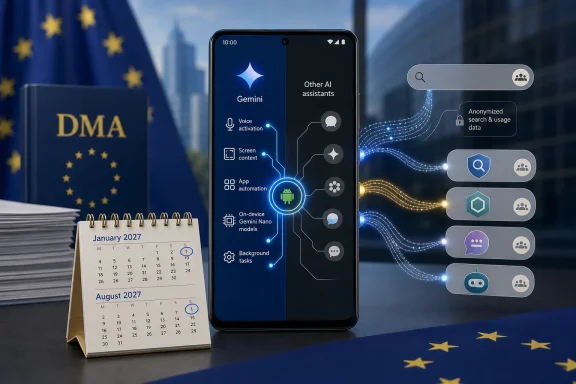 Android’s AI assistant layer must become less Google-exclusive
The Android decision centers on 11 system features that competing AI services will need to offer a credible alternative to Gemini. According to the European Commission’s technical explanation, third-party assistants must receive interoperability that is as effective as what Google makes available to its own services, without unnecessary friction or a requirement that a rival become the device’s default assistant.That is a substantial distinction from merely allowing another chatbot app to be installed from Google Play. Android already supports competing apps, of course, but the DMA measures are aimed at the privileged system hooks that turn an app into an assistant capable of responding to the user’s device state and acting across other apps.
The required capabilities include:
- A competing assistant must be able to use invocation points such as the long-press home gesture and a voice wake word.
- A competing service must be able to access permitted screen, app, and sensor context when the user has explicitly consented.
- A rival assistant must be able to perform structured actions in Android and participating apps, including tasks such as sending a message, making a calendar entry, or creating a note.
- Third parties must be able to access system-level on-device models, including Gemini Nano models, on equal terms where those models are part of Google’s DMA-designated Android operating system.
For enterprise mobility teams, this is a regulatory mandate to watch rather than a policy setting to deploy today. If implementation follows the Commission’s framework, organizations operating Android fleets in the EU could eventually have more meaningful choices in sanctioned AI assistants. That may be relevant where a company prefers a particular model provider for data residency, Microsoft 365 integration, developer tooling, or internal AI governance.
It also raises fresh management questions. A system-level assistant with access to screen contents, microphone input, app actions, and background execution is far more consequential than a standalone chat client. The Commission says user consent, privacy, device integrity, and cybersecurity safeguards must remain in place. Administrators will want to see exactly how Android Enterprise controls, managed configurations, work profiles, and app-level permissions intersect with those new hooks.
January 2027 is the first hard deadline
The search-data measure takes effect before the Android interoperability changes. Google must begin providing anonymized search data to eligible search engines—and qualifying AI chatbots that offer search functionality—by January 2027.The Commission’s rationale is straightforward: Google Search has accumulated query, ranking, click, and view signals at a scale no smaller search provider can replicate. Regulators say that advantage should not automatically carry into the emerging market for AI-assisted search and retrieval.
But the decision is narrower than a casual reading of “Google must share search data with AI companies” might suggest. The data must be anonymized, recipients must meet eligibility and security requirements, and the data can be used to develop and optimize search services. It cannot be used to train general-purpose AI models, build unrelated profiling or advertising products, or simply replicate Google’s search results.
That limitation matters. This is not an order to hand over Google’s web index, ranking algorithms, or a broadly usable training corpus. It is a controlled access regime intended to improve query understanding, retrieval, indexing, autocomplete, and search ranking for qualifying competitors.
The Commission also said Google’s earlier proposal was ineffective because it removed between 90% and 100% of unique search queries from the available dataset and excluded AI chatbots that provide search. The new specification adds a defined anonymization method, audit requirements, a process for assessing serious cybersecurity or data-protection risks, and a formula under which Google can recover incremental access costs.
Google has pushed back publicly. Alphabet and Google global affairs president Kent Walker told the Associated Press that the rules could weaken safeguards around third-party AI assistants and expose private searches to unfamiliar companies. That concern should not be dismissed: anonymization at search scale is technically and legally difficult, particularly where rare queries can be identifying in combination. The Commission’s answer is a combination of technical transformation, contractual restrictions, audits, and the ability to deny access where serious risks are found.
Google has time, but the product clock is already running
The Android obligations have a longer runway. Google must implement the bulk of the measures in Android 18 and no later than August 1, 2027. Concurrent hotword detection—allowing multiple voice services to be available without reserving the wake-word channel for Google—does not have to arrive until Android 19, with an August 1, 2028 deadline.That leaves Google more than a year to turn a legal requirement into APIs, permissions, documentation, testing programs, and support processes across its Android ecosystem. It also gives OEMs, carriers, app developers, and enterprise management vendors time to evaluate the impact.
Still, the delay around Gemini 3.5 Pro changes the tone. Google announced Gemini 3.5 Flash at I/O 2026 in May and said Gemini 3.5 Pro would arrive in June. That date passed. 9to5Google, citing Bloomberg, reported that Google is taking more time to improve the model, particularly for coding, while Google said it is testing 3.5 Pro, an upgraded Flash model, and other models with partners.
The key point is not that a model missed a deadline; large models routinely slip. It is that Google is being required to open the Android advantages around Gemini while its next flagship Pro model is still not ready to ship. For developers deciding on coding assistants and enterprise buyers assessing long-lived AI deployments, availability and reliability matter as much as platform integration.
Google retains formidable strengths: Android distribution, Search, Cloud infrastructure, custom silicon, and a large installed base of consumer services. The DMA decisions do not erase those advantages. They do make it harder for Google to rely on Android’s system layer as an exclusive Gemini differentiator in the EU.
The next milestones are now concrete. Search-data access begins in January 2027. Android 18 must carry most of the interoperability work by August 1, 2027. And Gemini 3.5 Pro needs a release date—and credible performance evidence—well before those regulatory changes make rival assistants more capable on the same phones.