

Google’s Android Auto version 17.2, released to the stable channel in early July 2026, is triggering app crashes for some drivers, especially in wireless sessions, prompting affected users to roll back to earlier builds while Google’s broader Gemini transition compounds reliability complaints. The immediate warning came through autoevolution, with Technobezz framing the update as the latest chapter in a months-long reliability slide rather than an isolated bad build. That distinction matters because Android Auto is not a novelty app; it is a driver-facing interface whose failures arrive at highway speed. Google is discovering, again, that cars are a brutal place to beta-test the future.
The 17.2 reports are narrow enough to resist panic but serious enough to justify attention. Users describe sessions that collapse after a few minutes, with wireless Android Auto taking the worst of the hit and downgrades to Android Auto 17.1 or 17.0 becoming the practical escape hatch. That is not how mainstream automotive software is supposed to behave, particularly when the software is a projection layer sitting between phone, car, navigation, calls, messaging, and media. Android Auto’s great promise was that the phone could make the dashboard smarter; its current problem is that the phone is making the dashboard less predictable.
Android Auto lives in a harsher trust environment than most Google products. A flaky Gmail feature is annoying, a broken smart speaker command is comic, and an unstable phone launcher is a support headache. A crashing car interface turns every regression into a safety-adjacent event, even when the bug does not directly affect vehicle controls.
That is why the version 17.2 crash wave has landed with unusual force. The reports do not merely say that an app is misbehaving; they say that the driver’s interface for maps, music, calls, and voice control can become unreliable mid-session. If the best workaround is to manually sideload or reinstall an older release, the product has already failed the normal-user test.
Google’s position is complicated by the diversity of Android Auto’s ecosystem. The company does not control the car head unit, the cable, the wireless adapter, the phone maker’s USB stack, the app mix, or the user’s background permissions. But that complexity is also the bargain Google accepted when it made Android Auto a mass-market platform rather than a tightly controlled appliance.
The result is a support problem that often looks like fog. One driver blames Waze, another YouTube Music, another the car’s infotainment firmware, another the phone’s latest update. Android Auto sits in the middle, and when the middle collapses, users are rarely interested in the architecture diagram.
The exact trigger remains unsettled. Some user reports suggest the crashes appear under particular app combinations, such as navigation plus media playback, while others describe broader session instability. That matters because a narrow third-party interaction bug would call for one kind of fix, while a projection-layer regression would call for another.
But for drivers, the distinction is academic. Android Auto is marketed as the integrated experience, not as a loose confederation of components that the user must debug from the driver’s seat. If the system only works after guessing which music, maps, assistant, cable, phone firmware, and car firmware combination is safe, the platform is asking consumers to become QA engineers.
Downgrading is the clearest sign that users have lost patience with the normal update cycle. On Android, sideloading an older APK is familiar territory for enthusiasts, but it is not a consumer-grade repair path. It also creates a grim irony: the safest version of the car interface may be the one the platform’s update system is trying to replace.
That earlier incident is important because it changed the story from “a bad update happened” to “Android Auto’s release pipeline is repeatedly allowing disruptive regressions into real cars.” Android Authority reported that Pixel and Samsung Galaxy users were among the most visible complainants, including owners of recent Galaxy S-series devices and multiple Pixel generations. The complaints were not limited to one fringe handset or one obscure aftermarket head unit.
Some owners were reportedly close to returning new phones inside their return windows because Android Auto had become part of the perceived value of the device. That is a remarkable inversion. The car interface, once a helpful extension of the smartphone, had become a reason to question the smartphone purchase itself.
Google eventually pushed a Play Store fix in late March, according to reporting at the time. But the communication pattern did not inspire confidence. Android Police noted that Google confirmed a fix directly to a news outlet while users on help pages were still waiting for clearer answers, a dynamic that made the company look reactive and opaque.
Voice assistants in cars are not mainly about dazzling intelligence. They are about dependable command execution under constraint: call this person, navigate home, read that message, play this playlist, mute the audio. The interface should be brief, predictable, and almost boring. Gemini, by contrast, arrives as a more ambitious conversational system, and that ambition can become a liability when the driver wants a fast command, not a seminar.
Android Authority reported in June that Gemini was failing to place calls for some Android Auto and mobile users, throwing a “Something went wrong” error instead. Google told the outlet it was aware of the issue and said a fix was available through an app update. TechRadar, 9to5Google, and Reddit threads amplified the frustration, including users who switched back to Google Assistant because Gemini could not perform a basic hands-free task.
The harshest criticism is not that Gemini is imperfect. It is that Google appears to be moving a core car function from a mature assistant to a newer one before the newer one has earned enough trust in the constrained environment of a dashboard. In the living room, a verbose AI answer is tedious. In a moving car, it is bad interface design.
Gemini changes that expectation. The branding tells users they are getting a more capable AI system, but the practical reports describe slow responses, missed contacts, broken calls, and chatter where concise action is needed. How-To Geek’s Joe Fedewa, in a piece syndicated by Yahoo Autos, argued that Gemini’s car behavior can feel slower and less useful than the assistant it is replacing, especially when it stumbles over ordinary commands.
That gap between brand promise and product behavior is dangerous. Users are not merely encountering bugs; they are being asked to believe that a strategic AI migration is an upgrade while daily experience suggests otherwise. The more Google insists Gemini is the future, the more every failed call or delayed navigation command becomes evidence against the strategy.
This is where the Android Auto problem widens beyond automotive software. Google is trying to retrofit AI into surfaces where reliability previously mattered more than generative flexibility. Cars expose the tradeoff brutally. A chatbot that can reason about a restaurant review but cannot reliably call “Mom” is not a better assistant in the moment that matters.
The 17.2 reports again point to wireless sessions as especially vulnerable. That fits a broader pattern in which wireless Android Auto is more sensitive to timing, thermal behavior, background restrictions, and car-specific implementation differences. Enthusiasts understand this; ordinary drivers do not, and should not have to.
Google cannot solve every automaker firmware problem, but it can make failure modes more legible. A crash with no useful explanation pushes users toward folklore: try another cable, clear cache, uninstall updates, disable a security setting, downgrade the APK, reboot the car, reset the phone. Some of those steps help some users some of the time, but the overall picture is one of guesswork.
That is especially corrosive because Android Auto competes not only with Apple CarPlay but with the car’s built-in infotainment system. Automakers have spent years building mediocre software, which gave Google an opening. If Android Auto becomes equally unreliable, the advantage narrows.
The USB-cable advice is a good example. It is technically correct that many Android Auto failures trace back to poor cables, marginal ports, or charge-only wires masquerading as data cables. But when the problem follows a known app update, cable replacement becomes a ritual as much as a diagnosis.
The same is true of cache clearing. It is the Android equivalent of “turn it off and on again,” and it sometimes works. But a platform that repeatedly requires cache purges after updates is telling users that its state management cannot be trusted.
Downgrading is the most revealing workaround because it directly contradicts the security and reliability logic of modern software. Users are told to stay current, accept updates, and trust the vendor. Then a car-facing app breaks badly enough that the practical community recommendation becomes: go backward.
In the March connection incident, multiple outlets described user frustration with Google’s help forums and delayed acknowledgment. Android Police reported that Google confirmed a fix by emailing a news outlet, while affected users had been watching support threads for signs of progress. That sequence may be harmless inside a PR workflow, but to users it feels backward.
The June Gemini call bug followed a more conventional path: Android Authority obtained a statement from Google acknowledging the issue and saying a fix was available. That was useful, but it still reinforced the perception that Google’s posture is reactive. Users complain, outlets amplify, Google acknowledges, a fix arrives, and then the next regression appears.
For a web app, that cadence is survivable. For Android Auto, it is too casual. Drivers need to know whether they should update, wait, downgrade, switch assistants, or avoid wireless sessions. Google’s release notes and support messaging rarely meet that moment with the specificity the situation demands.
For enterprises with fleets, field staff, sales teams, emergency-adjacent operations, or mobile workers who rely on hands-free navigation and calling, Android Auto instability is not a lifestyle inconvenience. It can affect route reliability, call handling, and driver distraction policies. The consumer press naturally frames this as annoying; IT departments should read it as uncontrolled change in a safety-sensitive workflow.
There is also a lesson for anyone managing Android devices. Car projection apps depend on a stack that includes the Android Auto app, the Google app, Google Play services, device firmware, security settings, and third-party media or navigation apps. A regression in any layer can surface as “Android Auto is broken.”
That makes staged rollout and update deferral more important, not less. The same caution that applies to Windows feature updates applies here in miniature: do not assume that “stable channel” means stable for your environment. Stable means Google has promoted the build. It does not mean your phone, car, app mix, and assistant configuration have been proven safe.
The rollout, however, is exposing the cost of moving too quickly. Automotive interfaces reward conservatism because the user’s attention is divided by design. A system that adds capability while reducing predictability is not progress; it is a trade that many drivers would refuse if asked plainly.
Google’s AI urgency is obvious across its product line. Gemini is being pushed into phones, search, productivity software, smart home surfaces, and Android itself. Android Auto is part of that strategy, but it should not be governed by the same tolerance for churn as a web sidebar or experimental app feature.
The company needs to treat Android Auto as an automotive product, not just an Android extension. That means clearer release notes, faster public incident acknowledgment, stronger rollback guidance, and a slower handoff from Assistant to Gemini until the new assistant can reliably execute the old assistant’s core commands. Innovation is not the problem. Forcing drivers through the transition before the basics are solid is.
For users not yet affected, caution is rational. If Android Auto is mission-critical for daily driving, waiting before accepting a major app update is not paranoia. It is the same discipline admins use when they hold back a Windows patch long enough to see whether the first deployment wave catches fire.
The Gemini side of the issue calls for a different kind of caution. Users who depend on hands-free calls should test Gemini before assuming it is ready for a commute. If Google Assistant remains available as a fallback in settings, switching back may be the most sensible choice until Gemini’s call handling and command execution become boringly reliable.
The larger point is that Android Auto’s users are now making trust calculations they should not have to make. They are deciding which version to run, which assistant to trust, which connection mode to use, and which workaround to try before driving. That is too much cognitive load for software whose job is to reduce distraction.
The 17.2 reports are narrow enough to resist panic but serious enough to justify attention. Users describe sessions that collapse after a few minutes, with wireless Android Auto taking the worst of the hit and downgrades to Android Auto 17.1 or 17.0 becoming the practical escape hatch. That is not how mainstream automotive software is supposed to behave, particularly when the software is a projection layer sitting between phone, car, navigation, calls, messaging, and media. Android Auto’s great promise was that the phone could make the dashboard smarter; its current problem is that the phone is making the dashboard less predictable.
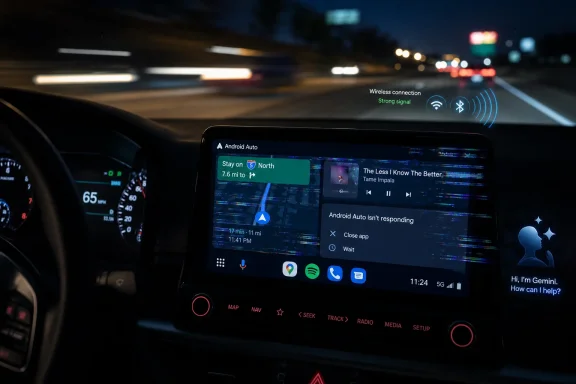 Google’s Car Interface Is Failing in the One Place It Cannot Afford Ambiguity
Android Auto lives in a harsher trust environment than most Google products. A flaky Gmail feature is annoying, a broken smart speaker command is comic, and an unstable phone launcher is a support headache. A crashing car interface turns every regression into a safety-adjacent event, even when the bug does not directly affect vehicle controls.That is why the version 17.2 crash wave has landed with unusual force. The reports do not merely say that an app is misbehaving; they say that the driver’s interface for maps, music, calls, and voice control can become unreliable mid-session. If the best workaround is to manually sideload or reinstall an older release, the product has already failed the normal-user test.
Google’s position is complicated by the diversity of Android Auto’s ecosystem. The company does not control the car head unit, the cable, the wireless adapter, the phone maker’s USB stack, the app mix, or the user’s background permissions. But that complexity is also the bargain Google accepted when it made Android Auto a mass-market platform rather than a tightly controlled appliance.
The result is a support problem that often looks like fog. One driver blames Waze, another YouTube Music, another the car’s infotainment firmware, another the phone’s latest update. Android Auto sits in the middle, and when the middle collapses, users are rarely interested in the architecture diagram.
The 17.2 Bug Looks Like a Symptom, Not the Disease
autoevolution’s report on Android Auto 17.2 is useful because it focuses on the practical reality rather than Google’s release machinery. A stable-channel update appears to have produced enough crash reports that some users are advising others not to install it and are reverting to earlier builds. PhoneArena separately noted that version 17.2.662404 reached the stable channel on Friday, July 3, before complaints surfaced over the following weekend.The exact trigger remains unsettled. Some user reports suggest the crashes appear under particular app combinations, such as navigation plus media playback, while others describe broader session instability. That matters because a narrow third-party interaction bug would call for one kind of fix, while a projection-layer regression would call for another.
But for drivers, the distinction is academic. Android Auto is marketed as the integrated experience, not as a loose confederation of components that the user must debug from the driver’s seat. If the system only works after guessing which music, maps, assistant, cable, phone firmware, and car firmware combination is safe, the platform is asking consumers to become QA engineers.
Downgrading is the clearest sign that users have lost patience with the normal update cycle. On Android, sideloading an older APK is familiar territory for enthusiasts, but it is not a consumer-grade repair path. It also creates a grim irony: the safest version of the car interface may be the one the platform’s update system is trying to replace.
March Was the Moment the Pattern Became Visible
The current crash reports did not arrive in a vacuum. In March, Android Auto connection failures hit Pixel and Samsung users hard enough that Tom’s Guide, Android Authority, ZDNET, and others tracked a swelling wave of complaints. Tom’s Guide quoted a Galaxy S26 Ultra owner describing the failure as a loop: Android Auto would connect, disconnect, reconnect, and disconnect again without ever becoming persistent.That earlier incident is important because it changed the story from “a bad update happened” to “Android Auto’s release pipeline is repeatedly allowing disruptive regressions into real cars.” Android Authority reported that Pixel and Samsung Galaxy users were among the most visible complainants, including owners of recent Galaxy S-series devices and multiple Pixel generations. The complaints were not limited to one fringe handset or one obscure aftermarket head unit.
Some owners were reportedly close to returning new phones inside their return windows because Android Auto had become part of the perceived value of the device. That is a remarkable inversion. The car interface, once a helpful extension of the smartphone, had become a reason to question the smartphone purchase itself.
Google eventually pushed a Play Store fix in late March, according to reporting at the time. But the communication pattern did not inspire confidence. Android Police noted that Google confirmed a fix directly to a news outlet while users on help pages were still waiting for clearer answers, a dynamic that made the company look reactive and opaque.
Gemini Turned a Reliability Problem Into a Product Strategy Problem
The Android Auto story would be easier for Google if it were only about crashes and connections. Instead, it is also about Gemini. Google is replacing Google Assistant with Gemini across its ecosystem, and Android Auto is one of the most sensitive places to attempt that handoff.Voice assistants in cars are not mainly about dazzling intelligence. They are about dependable command execution under constraint: call this person, navigate home, read that message, play this playlist, mute the audio. The interface should be brief, predictable, and almost boring. Gemini, by contrast, arrives as a more ambitious conversational system, and that ambition can become a liability when the driver wants a fast command, not a seminar.
Android Authority reported in June that Gemini was failing to place calls for some Android Auto and mobile users, throwing a “Something went wrong” error instead. Google told the outlet it was aware of the issue and said a fix was available through an app update. TechRadar, 9to5Google, and Reddit threads amplified the frustration, including users who switched back to Google Assistant because Gemini could not perform a basic hands-free task.
The harshest criticism is not that Gemini is imperfect. It is that Google appears to be moving a core car function from a mature assistant to a newer one before the newer one has earned enough trust in the constrained environment of a dashboard. In the living room, a verbose AI answer is tedious. In a moving car, it is bad interface design.
The Assistant Swap Breaks the Old Social Contract
For years, users tolerated Google Assistant’s limitations because the contract was simple. It could misunderstand you, but its job was clear: execute short commands inside a known set of tasks. Android Auto did not need Assistant to be brilliant; it needed it to be consistent.Gemini changes that expectation. The branding tells users they are getting a more capable AI system, but the practical reports describe slow responses, missed contacts, broken calls, and chatter where concise action is needed. How-To Geek’s Joe Fedewa, in a piece syndicated by Yahoo Autos, argued that Gemini’s car behavior can feel slower and less useful than the assistant it is replacing, especially when it stumbles over ordinary commands.
That gap between brand promise and product behavior is dangerous. Users are not merely encountering bugs; they are being asked to believe that a strategic AI migration is an upgrade while daily experience suggests otherwise. The more Google insists Gemini is the future, the more every failed call or delayed navigation command becomes evidence against the strategy.
This is where the Android Auto problem widens beyond automotive software. Google is trying to retrofit AI into surfaces where reliability previously mattered more than generative flexibility. Cars expose the tradeoff brutally. A chatbot that can reason about a restaurant review but cannot reliably call “Mom” is not a better assistant in the moment that matters.
Wireless Android Auto Remains the Weak Link Google Cannot Ignore
Wireless Android Auto is convenient, but it is also the part of the experience most likely to make drivers suspicious of invisible software layers. Wired Android Auto at least gives users a cable to blame, replace, or reseat. Wireless failures feel more like ghosts: Bluetooth negotiation, Wi-Fi Direct behavior, phone power management, head-unit firmware, Google Play services, and Android Auto all become suspects.The 17.2 reports again point to wireless sessions as especially vulnerable. That fits a broader pattern in which wireless Android Auto is more sensitive to timing, thermal behavior, background restrictions, and car-specific implementation differences. Enthusiasts understand this; ordinary drivers do not, and should not have to.
Google cannot solve every automaker firmware problem, but it can make failure modes more legible. A crash with no useful explanation pushes users toward folklore: try another cable, clear cache, uninstall updates, disable a security setting, downgrade the APK, reboot the car, reset the phone. Some of those steps help some users some of the time, but the overall picture is one of guesswork.
That is especially corrosive because Android Auto competes not only with Apple CarPlay but with the car’s built-in infotainment system. Automakers have spent years building mediocre software, which gave Google an opening. If Android Auto becomes equally unreliable, the advantage narrows.
The Workarounds Are Practical, but They Are Also an Indictment
The common advice for affected users is familiar: clear the Android Auto cache, replace the USB cable with a short certified data cable, check permissions, update the Google app, switch back to Assistant if Gemini is causing trouble, or downgrade Android Auto if 17.2 is unstable. These steps are reasonable for enthusiasts and IT pros. They are ridiculous as a baseline expectation for anyone who simply wants directions to work.The USB-cable advice is a good example. It is technically correct that many Android Auto failures trace back to poor cables, marginal ports, or charge-only wires masquerading as data cables. But when the problem follows a known app update, cable replacement becomes a ritual as much as a diagnosis.
The same is true of cache clearing. It is the Android equivalent of “turn it off and on again,” and it sometimes works. But a platform that repeatedly requires cache purges after updates is telling users that its state management cannot be trusted.
Downgrading is the most revealing workaround because it directly contradicts the security and reliability logic of modern software. Users are told to stay current, accept updates, and trust the vendor. Then a car-facing app breaks badly enough that the practical community recommendation becomes: go backward.
Google’s Communication Gap Is Making the Bugs Feel Worse
Software breaks. Users understand that, especially in enthusiast communities. What they forgive less easily is silence, vagueness, or confirmation that arrives through reporters before official support channels.In the March connection incident, multiple outlets described user frustration with Google’s help forums and delayed acknowledgment. Android Police reported that Google confirmed a fix by emailing a news outlet, while affected users had been watching support threads for signs of progress. That sequence may be harmless inside a PR workflow, but to users it feels backward.
The June Gemini call bug followed a more conventional path: Android Authority obtained a statement from Google acknowledging the issue and saying a fix was available. That was useful, but it still reinforced the perception that Google’s posture is reactive. Users complain, outlets amplify, Google acknowledges, a fix arrives, and then the next regression appears.
For a web app, that cadence is survivable. For Android Auto, it is too casual. Drivers need to know whether they should update, wait, downgrade, switch assistants, or avoid wireless sessions. Google’s release notes and support messaging rarely meet that moment with the specificity the situation demands.
The Enterprise Lesson Is About Change Control, Not Brand Loyalty
WindowsForum readers will recognize the deeper story here because it resembles every painful endpoint-management lesson from the PC world. A platform vendor ships a change, telemetry does not catch enough of the edge cases, support channels lag behind user reports, and administrators are left deciding whether to pause, roll back, or absorb the incident. The difference is that Android Auto puts the endpoint in a car.For enterprises with fleets, field staff, sales teams, emergency-adjacent operations, or mobile workers who rely on hands-free navigation and calling, Android Auto instability is not a lifestyle inconvenience. It can affect route reliability, call handling, and driver distraction policies. The consumer press naturally frames this as annoying; IT departments should read it as uncontrolled change in a safety-sensitive workflow.
There is also a lesson for anyone managing Android devices. Car projection apps depend on a stack that includes the Android Auto app, the Google app, Google Play services, device firmware, security settings, and third-party media or navigation apps. A regression in any layer can surface as “Android Auto is broken.”
That makes staged rollout and update deferral more important, not less. The same caution that applies to Windows feature updates applies here in miniature: do not assume that “stable channel” means stable for your environment. Stable means Google has promoted the build. It does not mean your phone, car, app mix, and assistant configuration have been proven safe.
Google’s AI Urgency Is Colliding With Automotive Conservatism
The uncomfortable truth is that Gemini may eventually be much better than Google Assistant in the car. A more capable assistant could handle natural language route changes, summarize messages, coordinate calendar context, and reduce screen taps. The destination is plausible.The rollout, however, is exposing the cost of moving too quickly. Automotive interfaces reward conservatism because the user’s attention is divided by design. A system that adds capability while reducing predictability is not progress; it is a trade that many drivers would refuse if asked plainly.
Google’s AI urgency is obvious across its product line. Gemini is being pushed into phones, search, productivity software, smart home surfaces, and Android itself. Android Auto is part of that strategy, but it should not be governed by the same tolerance for churn as a web sidebar or experimental app feature.
The company needs to treat Android Auto as an automotive product, not just an Android extension. That means clearer release notes, faster public incident acknowledgment, stronger rollback guidance, and a slower handoff from Assistant to Gemini until the new assistant can reliably execute the old assistant’s core commands. Innovation is not the problem. Forcing drivers through the transition before the basics are solid is.
The Downgrade Advice Says More Than Google’s Release Notes
The most concrete guidance right now is also the most damning: if Android Auto 17.2 is crashing, affected users may be better served by rolling back to a previous version until Google ships a fix. That does not mean every driver should panic or disable updates immediately. It means the community has identified a practical response because the official channel has not yet supplied enough confidence.For users not yet affected, caution is rational. If Android Auto is mission-critical for daily driving, waiting before accepting a major app update is not paranoia. It is the same discipline admins use when they hold back a Windows patch long enough to see whether the first deployment wave catches fire.
The Gemini side of the issue calls for a different kind of caution. Users who depend on hands-free calls should test Gemini before assuming it is ready for a commute. If Google Assistant remains available as a fallback in settings, switching back may be the most sensible choice until Gemini’s call handling and command execution become boringly reliable.
The larger point is that Android Auto’s users are now making trust calculations they should not have to make. They are deciding which version to run, which assistant to trust, which connection mode to use, and which workaround to try before driving. That is too much cognitive load for software whose job is to reduce distraction.
The Android Auto 17.2 Mess Leaves Drivers With a Patch Tuesday Mindset
The immediate lesson is not that Android Auto is doomed. It is that Google’s car software has entered the same risk category as any other complex, frequently updated platform: useful, powerful, and no longer safe to treat as invisible plumbing. Drivers and admins should respond accordingly.- Android Auto 17.2 is drawing crash complaints from some users, with wireless sessions appearing especially vulnerable.
- Rolling back to Android Auto 17.1 or 17.0 is the clearest workaround reported by affected users, though it is not an ideal long-term answer.
- The March connection failures and June Gemini call bug make the 17.2 crash wave look like part of a broader reliability pattern.
- Gemini’s Android Auto rollout is strategically important for Google, but basic voice tasks such as calls and navigation must work before conversational features matter.
- Users who rely on Android Auto for work should test updates deliberately rather than assuming stable-channel releases are safe for every phone-and-car combination.
- Google needs more direct public incident communication because silence in a car-facing product quickly becomes a trust problem.
References
- Primary source: Technobezz
Published: 2026-07-06T20:10:40.801711
Android Auto Version 17.2 Update Crashes Apps and Forces Users to Downgrade | Technobezz
Android Auto's latest update crashes apps and forces downgrades, with wireless issues and Gemini AI adding to months of reliability problems.www.technobezz.com - Independent coverage: autoevolution
Published: Mon, 06 Jul 2026 09:24:48 GMT
Don't Update Android Auto to Version 17.2: App Crashes Force Users To Downgrade - autoevolution
A glitch plaguing the most recent version of Android Auto is giving users no other option but downgrading to an earlier release; Android Auto wireless is most o www.autoevolution.com
- Related coverage: androidauthority.com
Gemini call bug on Android Auto leaves drivers staring at error messages (Update)
Dozens of Android Auto users appear to be experiencing an issue that's preventing Gemini from placing calls.www.androidauthority.com - Related coverage: tomsguide.com
Android Auto is broken for Samsung Galaxy S26 and Pixel owners after latest update | Tom's Guide
A new update is breaking Android Auto for Galaxy S26 and Pixel owners, causing constant wired connection crashes while wireless users remain unaffected.www.tomsguide.com - Related coverage: phonearena.com
Android Auto's newest update is already a disaster for many drivers - PhoneArena
Here's why it's already causing headaches, just weeks after Google's last fix.www.phonearena.com - Related coverage: ubergizmo.com
Android Auto Calling Not Working? Gemini Bug And How To Fix It | Ubergizmo
A growing number of Android Auto users are reporting an issue that prevents them from making phone calls using voice commands. The problem stems from...www.ubergizmo.com
- Related coverage: gsmspecs.com
Android Auto update is tripping up Galaxy S26 and Pixel phones — here's what's going on - GSMSpecs | GSMSpecs.com
If your new Galaxy S26 or Pixel phone has started playing musical chairs with Android Auto — connecting, dropping out, then reconnecting — you’re not imagining ...www.gsmspecs.com
- Related coverage: sammyfans.com
Gemini voice call bug affects Android phones and Android Auto
A bug surfacing across Android phones and Android Auto users this week is blocking Gemini from placing phone calls through voice commands. It’s not isolated to one device or one situation; users are hitting a dead wall almost everywhere. Multiple Reddit threads confirmed (via 9to5Google)...www.sammyfans.com - Related coverage: techradar.com
- Related coverage: techenet.com
- Related coverage: 01net.com
Android Auto : pourquoi l'application refuse soudainement de passer vos appels (et comment régler le problème)
L'intégration de Gemini dans Android Auto connaît des débuts difficiles avec un bug qui empêche de passer des appels vocaux. www.01net.com
- Related coverage: t3.com
"Google Assistant has become unusable" on Android Auto – but the future still looks bright | T3
The slow roll-out of Gemini on Android Auto has resulted in a downgraded experience... for nowwww.t3.com - Related coverage: androidcentral.com
Google Assistant could shut down for Android Auto in March 2026 | Android Central
The Gemini transition is well underway, and Google Assistant might start disappearing soon.www.androidcentral.com