

Google’s March 2026 Pixel software update is being blamed by Android Auto users for months of wireless disconnects that began surfacing in early April and, as of July 2, remain unresolved for at least some Pixel and Samsung owners. The complaint is not that Android Auto is cosmetically buggy or briefly awkward after a redesign. It is that the system many drivers now treat as part of the car’s dashboard can collapse every few minutes, often immediately after the engine starts. That makes this less a story about one bad app update and more a reminder that the modern infotainment stack is only as reliable as the least visible link between phone, car, radio firmware, wireless networking, and cloud-era software delivery.
Android Auto used to be a relatively easy thing to understand. Plug a phone into a car, let the car’s screen become a safer interface for maps, music, calls, and messages, and hope that the USB cable was not counterfeit junk from a gas station checkout rack. Wireless Android Auto changed the user experience for the better, but it also made the failure modes more slippery.
A wired failure tends to announce itself plainly. The cable is bad, the port is dirty, the permissions are wrong, or the phone does not trust the host. Wireless failure is murkier. It is Bluetooth, Wi-Fi Direct, device power management, car firmware, regional radio conditions, Android system services, Android Auto itself, and sometimes a dongle pretending to be factory integration.
That is why the latest complaints matter. Users are not describing an obscure corner case where a beta build misbehaves on a no-name head unit after a rooting experiment. They are reporting that wireless Android Auto connects, runs for a few minutes, drops, reconnects, and repeats. The pattern sounds almost engineered to be infuriating: functional enough to make the driver trust it, unstable enough to ruin the drive.
The autoevolution report points to Google’s own support forums, where the first visible reports appeared in April and users continued piling on through the spring and into July. The most frequently named devices are Pixel phones, though at least some Samsung users say they have seen similar behavior. That distinction matters, because it changes the suspected culprit from “Android Auto app update” to “phone platform update that Android Auto depends on.”
That last detail is especially important. A factory reset is the ritual sacrifice of consumer troubleshooting. It wipes away local configuration, stale app state, and half-remembered permission mistakes. When a cleanly reset phone still shows the same failure, the odds shift away from “user misconfiguration” and toward something lower in the stack.
There is still uncertainty. Android Auto itself updates through Google Play services and the Play Store ecosystem, while Pixel system updates ship through the phone’s OS update channel. Users experience the whole thing as “my phone updated,” but the actual breakage could sit in Android’s wireless stack, Bluetooth handoff behavior, Wi-Fi connection management, Android Auto’s projection service, Google Play services, or a changed interaction between the phone and particular cars.
That is the point: modern phone-to-car projection is no longer a single product in the old sense. It is a distributed system wearing the mask of a feature. When it breaks, even technically literate users struggle to name the broken component.
The practical effect is simple. A driver following Google Maps can lose the dashboard view right before a turn. A podcast or call can cut out and restart. The driver may glance down, tap the screen, unlock the phone, or try to force a reconnection while moving. Even when the car remains perfectly controllable, the interface has failed at its central promise: reducing friction.
The timing of the disconnections also undermines confidence. Several users describe the system connecting at startup and then falling over after a few minutes, which is worse than a clean failure. If Android Auto simply refused to launch, the driver would know before leaving the driveway. A projection system that works just long enough to become part of the trip is more dangerous from a usability standpoint.
There is a reason car companies move cautiously with dashboard software, sometimes to the annoyance of phone users accustomed to fast monthly updates. In a car, reliability beats novelty. A small regression can turn into a repeated in-motion distraction, and the person who pays the price is not a product manager reading crash logs.
But from the user’s side, the optics are poor. If the first reports arrived in early April and people are still complaining in July, “we are looking into it” starts to feel like a holding pattern rather than progress. The affected users are not asking for a new icon pack. They are asking for a car feature to stop disconnecting every few minutes.
Google’s challenge is not only engineering. It is communication. Android Auto sits at the intersection of Google, phone OEMs, vehicle manufacturers, aftermarket head-unit vendors, and wireless accessory makers. When something breaks, users often get bounced among all of them. The car dealer blames the phone. The phone maker blames the car. The app team asks for logs. The driver just wants navigation to stay connected.
A good response would separate confirmed facts from suspected causes. If the March Pixel update is involved, say so. If the issue is limited to certain chipsets, cars, regions, or wireless negotiation paths, say that too. Silence leaves a vacuum, and in that vacuum every workaround becomes plausible, every rumor becomes a fix, and every new update becomes a gamble.
That does not mean every Pixel is broken. The autoevolution author says a Pixel 10 Pro XL is running the current stable Android Auto release with factory wireless support and no random disconnects. That is consistent with the broader pattern: the bug appears real for some users but not universal. In engineering terms, that usually points toward a variable such as vehicle hardware, region, radio environment, firmware level, carrier configuration, or a particular combination of services.
Yet the Pixel branding raises expectations. If Google cannot guarantee stable Android Auto behavior on its own phones after its own monthly update, then users will reasonably wonder how much confidence to place in the broader promise of seamless Android integration. Pixel buyers often choose those phones precisely because they want first-party updates and fewer compatibility surprises.
The problem also lands at an inconvenient moment for the broader industry. Car screens are becoming bigger, native infotainment systems are becoming more ambitious, and regulators are increasingly attentive to distraction. Google wants Android Auto and Android Automotive to be treated as serious in-car platforms. Reliability problems, even if limited, cut against that ambition.
The first possibility is that multiple bugs are being conflated. Android Auto is widely used, and support forums tend to collect people with superficially similar symptoms. A Pixel March update regression, a Samsung firmware issue, an aftermarket wireless adapter bug, and a flaky car head unit can all produce the same sentence: “Android Auto keeps disconnecting.”
The second possibility is that the fault sits in a shared Google component rather than Pixel-only firmware. Android Auto, Google Play services, and related connection frameworks cut across brands. A change in how the projection stack negotiates wireless sessions could hit different devices differently, depending on how each OEM configures Bluetooth, Wi-Fi, power saving, and background process rules.
This is why user reports are valuable but not conclusive. They show a pattern. They do not prove root cause. A serious investigation has to sort the reports by phone model, Android version, Android Auto version, car model, wired versus wireless behavior, region, and whether the phone is using factory wireless support or a dongle.
Still, the burden is on Google to make that sorting visible enough that users know what they are dealing with. If Samsung reports are unrelated, the company should say so when it can. If they are connected, that is bigger news and deserves a broader advisory.
That landscape is familiar to IT pros, and not in a good way. When a platform vendor does not provide a clear fix, the community builds a workaround economy. Some of it is useful. Some of it is superstition. Some of it masks the underlying problem long enough for the next update to change the symptoms again.
For ordinary drivers, the advice is unsatisfying. “Factory reset your phone” is an extreme demand when the broken feature is car projection. “Disable mobile data” may make wireless Android Auto stable for some, but it also undercuts the point of a connected navigation and assistant experience. “Try another car” is not a support plan.
For IT departments managing Android fleets, the lesson is more concrete. Mobile OS updates can break workflows that are not traditionally classified as enterprise-critical but still affect daily operations. A field worker who relies on Android Auto for navigation, calls, and scheduling between job sites is affected by this kind of regression. So is a company that standardized on Pixel phones because of the update policy.
Wireless Android Auto bridges those worlds. That makes it convenient when it works and fragile when one side changes assumptions. A Pixel update can alter behavior in a way that is perfectly reasonable under Android’s internal rules but incompatible with a particular 2023 head unit’s wireless implementation. A car can remain unchanged while the phone evolves underneath it.
This mismatch also makes testing brutally broad. Google cannot practically validate every monthly update against every car model, every regional trim, every firmware version, every aftermarket adapter, and every possible combination of paired Bluetooth devices. But that impossibility does not absolve the platform vendor. It argues for better staged rollouts, faster rollback paths, and clearer issue tracking.
The deeper issue is that Android Auto feels like part of the car, even though much of it lives on the phone. Users do not think in layers. They think in outcomes. If the dashboard map dies after a phone update, the car is broken enough for the trip at hand.
But fast updates need fast remediation. If a monthly patch creates a high-impact regression, users need a path other than waiting for the next monthly train. That may mean server-side mitigation, an Android Auto component rollback, a Play services hotfix, a carrier-independent Pixel patch, or at least a public known-issue entry that says what is safe to try and what is a waste of time.
The rollback question is especially important for car-related features. A bad weather widget can wait. A broken in-car projection stack should not have to. Even if the issue affects a minority of users, the usage context raises the severity.
This is where Google’s modular Android strategy should help. Over the years, the company has moved more system components into updateable modules and Play-delivered services. The promise is that fixes can arrive without waiting for full OS upgrades. If that machinery cannot respond quickly to a months-long Android Auto disconnect problem, users will question how much practical resilience modularity really buys them.
The complaints are not always fair to Google. Many car infotainment systems have poor Bluetooth stacks, inconsistent USB behavior, underpowered processors, and vendor firmware that ages badly. Aftermarket wireless adapters add another layer of complexity. Some vehicles implement Android Auto well; others do the minimum required to put the logo on a spec sheet.
But Google owns the user-facing brand. When Android Auto fails, most drivers blame Android Auto. That is the cost of being the platform layer people actually recognize.
Apple has similar exposure with CarPlay, but Apple’s tighter hardware ecosystem gives it fewer phone variables to manage. Google has to support Pixels, Samsung flagships, midrange devices, regional models, and older phones, all while carmakers implement head units at wildly different quality levels. That is harder, but it is also the market Google chose.
From the driver’s seat, a lost GPS fix, a frozen map, a disconnected Android Auto session, and a delayed assistant response all belong to the same bucket: “the car screen failed me.” The technical root causes may be different, but the trust damage accumulates in one place.
Navigation reliability is the crown jewel of Android Auto. Music apps are replaceable. Calls can fall back to Bluetooth. Maps are the reason many drivers tolerate the entire stack. If location glitches and connection drops appear around the same time, even coincidentally, users will infer systemic decline.
That is why Google must be careful not to treat these as isolated tickets forever. At some point, the experience is the product. A dashboard that mostly works except when it loses connection, GPS, voice input, or touch responsiveness is not mostly working in the way drivers need.
Android Auto is not typically managed like a corporate VPN client or endpoint detection agent. It lives in the softer category of productivity convenience. But for mobile workers, technicians, sales staff, home health providers, delivery supervisors, and regional managers, navigation and hands-free calling are part of the workday.
The risk is not just downtime. It is unpredictability. If a company standardizes on a phone line because of update reliability, then a monthly update that breaks in-car connectivity creates support tickets the IT department cannot easily solve. The help desk can reset network settings. It cannot patch Google’s projection stack.
The sensible enterprise posture is not panic. It is staged rollout and observation. Do not assume phone updates are harmless because they are monthly. Watch support forums, vendor advisories, and user feedback before pushing updates broadly to employees whose jobs depend on mobility.
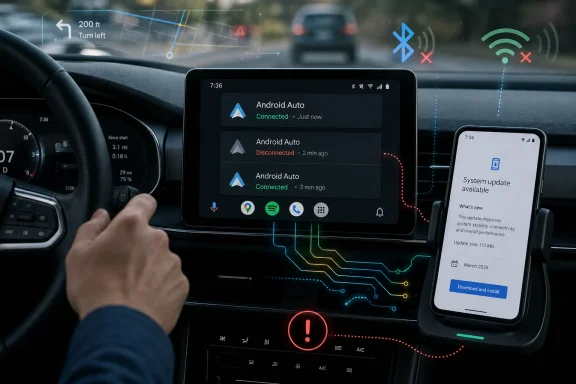 The Car Dashboard Is Now a Moving Target
Android Auto used to be a relatively easy thing to understand. Plug a phone into a car, let the car’s screen become a safer interface for maps, music, calls, and messages, and hope that the USB cable was not counterfeit junk from a gas station checkout rack. Wireless Android Auto changed the user experience for the better, but it also made the failure modes more slippery.A wired failure tends to announce itself plainly. The cable is bad, the port is dirty, the permissions are wrong, or the phone does not trust the host. Wireless failure is murkier. It is Bluetooth, Wi-Fi Direct, device power management, car firmware, regional radio conditions, Android system services, Android Auto itself, and sometimes a dongle pretending to be factory integration.
That is why the latest complaints matter. Users are not describing an obscure corner case where a beta build misbehaves on a no-name head unit after a rooting experiment. They are reporting that wireless Android Auto connects, runs for a few minutes, drops, reconnects, and repeats. The pattern sounds almost engineered to be infuriating: functional enough to make the driver trust it, unstable enough to ruin the drive.
The autoevolution report points to Google’s own support forums, where the first visible reports appeared in April and users continued piling on through the spring and into July. The most frequently named devices are Pixel phones, though at least some Samsung users say they have seen similar behavior. That distinction matters, because it changes the suspected culprit from “Android Auto app update” to “phone platform update that Android Auto depends on.”
The March Update Has Become the Prime Suspect
The chronology is awkward for Google. Users say the trouble began after the March 2026 Pixel update, not after a dramatic visible Android Auto interface change. One Pixel 9 Pro XL user described wireless Android Auto disconnecting every two or three minutes after the March update, despite previously running without issue. Others say clearing Android Auto’s cache, reinstalling the app, resetting wireless settings, and even performing full factory resets did not restore reliability.That last detail is especially important. A factory reset is the ritual sacrifice of consumer troubleshooting. It wipes away local configuration, stale app state, and half-remembered permission mistakes. When a cleanly reset phone still shows the same failure, the odds shift away from “user misconfiguration” and toward something lower in the stack.
There is still uncertainty. Android Auto itself updates through Google Play services and the Play Store ecosystem, while Pixel system updates ship through the phone’s OS update channel. Users experience the whole thing as “my phone updated,” but the actual breakage could sit in Android’s wireless stack, Bluetooth handoff behavior, Wi-Fi connection management, Android Auto’s projection service, Google Play services, or a changed interaction between the phone and particular cars.
That is the point: modern phone-to-car projection is no longer a single product in the old sense. It is a distributed system wearing the mask of a feature. When it breaks, even technically literate users struggle to name the broken component.
Wireless Android Auto Fails in the Worst Possible Place
Software bugs are irritating on a laptop. They are more serious when the software is running the interface a driver uses for navigation and hands-free communication. Android Auto is not steering the vehicle, but it does occupy driver attention, and a system that drops and reconnects every few minutes can become a distraction factory.The practical effect is simple. A driver following Google Maps can lose the dashboard view right before a turn. A podcast or call can cut out and restart. The driver may glance down, tap the screen, unlock the phone, or try to force a reconnection while moving. Even when the car remains perfectly controllable, the interface has failed at its central promise: reducing friction.
The timing of the disconnections also undermines confidence. Several users describe the system connecting at startup and then falling over after a few minutes, which is worse than a clean failure. If Android Auto simply refused to launch, the driver would know before leaving the driveway. A projection system that works just long enough to become part of the trip is more dangerous from a usability standpoint.
There is a reason car companies move cautiously with dashboard software, sometimes to the annoyance of phone users accustomed to fast monthly updates. In a car, reliability beats novelty. A small regression can turn into a repeated in-motion distraction, and the person who pays the price is not a product manager reading crash logs.
Google’s Forum Response Is Necessary but Not Sufficient
A Google Community Specialist reportedly entered the support thread asking for more information, which is the expected first move. Collecting device models, Android Auto versions, car models, head-unit firmware, connection type, log data, and reproduction steps is how these bugs get narrowed down. Wireless projection bugs are hard to reproduce in a lab because the car itself is part of the test environment.But from the user’s side, the optics are poor. If the first reports arrived in early April and people are still complaining in July, “we are looking into it” starts to feel like a holding pattern rather than progress. The affected users are not asking for a new icon pack. They are asking for a car feature to stop disconnecting every few minutes.
Google’s challenge is not only engineering. It is communication. Android Auto sits at the intersection of Google, phone OEMs, vehicle manufacturers, aftermarket head-unit vendors, and wireless accessory makers. When something breaks, users often get bounced among all of them. The car dealer blames the phone. The phone maker blames the car. The app team asks for logs. The driver just wants navigation to stay connected.
A good response would separate confirmed facts from suspected causes. If the March Pixel update is involved, say so. If the issue is limited to certain chipsets, cars, regions, or wireless negotiation paths, say that too. Silence leaves a vacuum, and in that vacuum every workaround becomes plausible, every rumor becomes a fix, and every new update becomes a gamble.
The Pixel Angle Makes This More Embarrassing
Pixel phones are supposed to be Google’s cleanest Android experience. They are the reference-class devices where Google controls the hardware, OS integration, feature drops, update cadence, and support story more tightly than it can on the broader Android ecosystem. When Android Auto breaks most visibly on Pixels, the usual Android fragmentation excuse carries less weight.That does not mean every Pixel is broken. The autoevolution author says a Pixel 10 Pro XL is running the current stable Android Auto release with factory wireless support and no random disconnects. That is consistent with the broader pattern: the bug appears real for some users but not universal. In engineering terms, that usually points toward a variable such as vehicle hardware, region, radio environment, firmware level, carrier configuration, or a particular combination of services.
Yet the Pixel branding raises expectations. If Google cannot guarantee stable Android Auto behavior on its own phones after its own monthly update, then users will reasonably wonder how much confidence to place in the broader promise of seamless Android integration. Pixel buyers often choose those phones precisely because they want first-party updates and fewer compatibility surprises.
The problem also lands at an inconvenient moment for the broader industry. Car screens are becoming bigger, native infotainment systems are becoming more ambitious, and regulators are increasingly attentive to distraction. Google wants Android Auto and Android Automotive to be treated as serious in-car platforms. Reliability problems, even if limited, cut against that ambition.
The Samsung Reports Complicate the Diagnosis
The autoevolution report notes that at least one Samsung user claims similar wireless Android Auto disconnects. Other recent reporting around Android Auto connectivity has also named Samsung devices in broader connection problems. That matters because it opens two possibilities.The first possibility is that multiple bugs are being conflated. Android Auto is widely used, and support forums tend to collect people with superficially similar symptoms. A Pixel March update regression, a Samsung firmware issue, an aftermarket wireless adapter bug, and a flaky car head unit can all produce the same sentence: “Android Auto keeps disconnecting.”
The second possibility is that the fault sits in a shared Google component rather than Pixel-only firmware. Android Auto, Google Play services, and related connection frameworks cut across brands. A change in how the projection stack negotiates wireless sessions could hit different devices differently, depending on how each OEM configures Bluetooth, Wi-Fi, power saving, and background process rules.
This is why user reports are valuable but not conclusive. They show a pattern. They do not prove root cause. A serious investigation has to sort the reports by phone model, Android version, Android Auto version, car model, wired versus wireless behavior, region, and whether the phone is using factory wireless support or a dongle.
Still, the burden is on Google to make that sorting visible enough that users know what they are dealing with. If Samsung reports are unrelated, the company should say so when it can. If they are connected, that is bigger news and deserves a broader advisory.
Workarounds Are Becoming a Substitute for Ownership
The reported fixes read like the usual folk medicine of Android troubleshooting: clear cache, clear data, reinstall Android Auto, reset Bluetooth and Wi-Fi, disable battery optimization, remove paired cars, re-pair from scratch, factory reset the phone. Some users say nothing helps. Others elsewhere have reported temporary stability by disabling mobile data, using airplane mode with Wi-Fi and Bluetooth re-enabled, or changing connection accessories.That landscape is familiar to IT pros, and not in a good way. When a platform vendor does not provide a clear fix, the community builds a workaround economy. Some of it is useful. Some of it is superstition. Some of it masks the underlying problem long enough for the next update to change the symptoms again.
For ordinary drivers, the advice is unsatisfying. “Factory reset your phone” is an extreme demand when the broken feature is car projection. “Disable mobile data” may make wireless Android Auto stable for some, but it also undercuts the point of a connected navigation and assistant experience. “Try another car” is not a support plan.
For IT departments managing Android fleets, the lesson is more concrete. Mobile OS updates can break workflows that are not traditionally classified as enterprise-critical but still affect daily operations. A field worker who relies on Android Auto for navigation, calls, and scheduling between job sites is affected by this kind of regression. So is a company that standardized on Pixel phones because of the update policy.
Cars Are Bad Test Labs for Monthly Software
The auto industry and the smartphone industry operate on different clocks. Phones receive monthly security patches, quarterly feature drops, frequent app updates, server-side changes, and background component revisions. Cars often receive dealership updates, slow over-the-air firmware rollouts, or no meaningful infotainment updates at all after purchase.Wireless Android Auto bridges those worlds. That makes it convenient when it works and fragile when one side changes assumptions. A Pixel update can alter behavior in a way that is perfectly reasonable under Android’s internal rules but incompatible with a particular 2023 head unit’s wireless implementation. A car can remain unchanged while the phone evolves underneath it.
This mismatch also makes testing brutally broad. Google cannot practically validate every monthly update against every car model, every regional trim, every firmware version, every aftermarket adapter, and every possible combination of paired Bluetooth devices. But that impossibility does not absolve the platform vendor. It argues for better staged rollouts, faster rollback paths, and clearer issue tracking.
The deeper issue is that Android Auto feels like part of the car, even though much of it lives on the phone. Users do not think in layers. They think in outcomes. If the dashboard map dies after a phone update, the car is broken enough for the trip at hand.
The Update Machine Needs a Reverse Gear
Fast updates are a security necessity. Nobody serious wants Android to return to the bad old days when phones sat unpatched for months or years. Pixel’s value proposition is built on timely fixes, and Google deserves credit for pushing the Android ecosystem toward a more predictable security cadence.But fast updates need fast remediation. If a monthly patch creates a high-impact regression, users need a path other than waiting for the next monthly train. That may mean server-side mitigation, an Android Auto component rollback, a Play services hotfix, a carrier-independent Pixel patch, or at least a public known-issue entry that says what is safe to try and what is a waste of time.
The rollback question is especially important for car-related features. A bad weather widget can wait. A broken in-car projection stack should not have to. Even if the issue affects a minority of users, the usage context raises the severity.
This is where Google’s modular Android strategy should help. Over the years, the company has moved more system components into updateable modules and Play-delivered services. The promise is that fixes can arrive without waiting for full OS upgrades. If that machinery cannot respond quickly to a months-long Android Auto disconnect problem, users will question how much practical resilience modularity really buys them.
Android Auto’s Reliability Problem Is Bigger Than This Bug
This incident fits a broader pattern: Android Auto is both indispensable and frequently complained about. Users love the concept because it rescues them from bad automaker software. They hate the fragility because the whole system depends on invisible negotiations between devices that were never designed by one accountable party.The complaints are not always fair to Google. Many car infotainment systems have poor Bluetooth stacks, inconsistent USB behavior, underpowered processors, and vendor firmware that ages badly. Aftermarket wireless adapters add another layer of complexity. Some vehicles implement Android Auto well; others do the minimum required to put the logo on a spec sheet.
But Google owns the user-facing brand. When Android Auto fails, most drivers blame Android Auto. That is the cost of being the platform layer people actually recognize.
Apple has similar exposure with CarPlay, but Apple’s tighter hardware ecosystem gives it fewer phone variables to manage. Google has to support Pixels, Samsung flagships, midrange devices, regional models, and older phones, all while carmakers implement head units at wildly different quality levels. That is harder, but it is also the market Google chose.
The GPS Aside Is a Warning Flare
The autoevolution author notes a separate issue: occasional Google Maps GPS signal loss while Android Auto otherwise remains connected. That may be unrelated, and the report treats it cautiously. But it is worth noticing because drivers rarely separate map reliability from projection reliability.From the driver’s seat, a lost GPS fix, a frozen map, a disconnected Android Auto session, and a delayed assistant response all belong to the same bucket: “the car screen failed me.” The technical root causes may be different, but the trust damage accumulates in one place.
Navigation reliability is the crown jewel of Android Auto. Music apps are replaceable. Calls can fall back to Bluetooth. Maps are the reason many drivers tolerate the entire stack. If location glitches and connection drops appear around the same time, even coincidentally, users will infer systemic decline.
That is why Google must be careful not to treat these as isolated tickets forever. At some point, the experience is the product. A dashboard that mostly works except when it loses connection, GPS, voice input, or touch responsiveness is not mostly working in the way drivers need.
Enterprise IT Should Watch the Consumer Forums
This may look like consumer tech drama, but support forums are often the first public telemetry for enterprise-impacting regressions. A fleet administrator may not care about one enthusiast’s Pixel disconnecting in a personal car. They should care when dozens of reports converge around a monthly OS update and a core mobile workflow.Android Auto is not typically managed like a corporate VPN client or endpoint detection agent. It lives in the softer category of productivity convenience. But for mobile workers, technicians, sales staff, home health providers, delivery supervisors, and regional managers, navigation and hands-free calling are part of the workday.
The risk is not just downtime. It is unpredictability. If a company standardizes on a phone line because of update reliability, then a monthly update that breaks in-car connectivity creates support tickets the IT department cannot easily solve. The help desk can reset network settings. It cannot patch Google’s projection stack.
The sensible enterprise posture is not panic. It is staged rollout and observation. Do not assume phone updates are harmless because they are monthly. Watch support forums, vendor advisories, and user feedback before pushing updates broadly to employees whose jobs depend on mobility.
The March Disconnects Leave a Practical Trail
The concrete lesson from this Android Auto episode is not that everyone should avoid Pixel updates or abandon wireless projection. It is that the convenience of phone-powered dashboards has outpaced the maturity of the support model around them. The symptoms are specific enough to act on, even while the root cause remains murky.- Users reporting the bug most often describe wireless Android Auto disconnecting every two or three minutes, usually after the March 2026 Pixel update.
- The most common troubleshooting steps, including cache clearing, re-pairing, wireless resets, and even factory resets, have not consistently fixed the problem.
- Pixel phones appear central to the current complaint pattern, but some Samsung reports mean the issue may not be neatly Pixel-only.
- The fact that many users are unaffected suggests a compatibility interaction rather than a universal Android Auto outage.
- Drivers who depend on Android Auto should test updates before long trips and keep a fallback navigation plan available.
- IT teams managing Android devices should treat in-car connectivity as a real workflow dependency, not a lifestyle feature.
References
- Primary source: autoevolution
Published: Thu, 02 Jul 2026 04:13:27 GMT
New Update Is Bad News for Android Auto Wireless, Some Users Claim It Barely Runs Now - autoevolution
Random disconnects are once again plaguing Android Auto, this time making it impossible for users to enjoy a steady connection behind the wheel www.autoevolution.com
- Official source: support.google.com
- Related coverage: vucense.com
Android Auto Not Working After March 2026 Pixel Update? Fix | Guides & Security | Vucense
Android Auto wired connection broken after the March 2026 Google Pixel update? Here's the confirmed fix for the phone unlock and rotary knob bugs.vucense.com - Related coverage: gsmspecs.com
Android Auto update is tripping up Galaxy S26 and Pixel phones — here's what's going on - GSMSpecs | GSMSpecs.com
If your new Galaxy S26 or Pixel phone has started playing musical chairs with Android Auto — connecting, dropping out, then reconnecting — you’re not imagining ...www.gsmspecs.com
- Related coverage: androidauthority.com
Android Auto is breaking for Pixel and Samsung users, and no one knows why (Updated: Fix incoming)
Android Auto is widely failing to connect or stay connected, especially on Pixel and Samsung phones. Wired connections appear most affected.www.androidauthority.com - Related coverage: androidcentral.com
Google Assistant could shut down for Android Auto in March 2026 | Android Central
The Gemini transition is well underway, and Google Assistant might start disappearing soon.www.androidcentral.com

- Related coverage: androidheadlines.com
Google Is Rolling out Fixes for Android Auto’s Connection-related Bug
Google is rolling out an update that fixes recent Android Auto connection problems, which have plagued hundreds of Pixel and Galaxy users. www.androidheadlines.com
- Related coverage: smartdroid.de
Android Auto macht Probleme auf Google Pixel seit März-2026-Update
Egal ob ihr ein neueres oder ein älteres Pixel-Telefon nutzt, es scheint Probleme mit Android Auto seit dem März-2026-Update zu geben. Immer mehr Nutzerwww.smartdroid.de - Related coverage: piunikaweb.com
Android Auto wireless keeps disconnecting after recent updates? Google is looking into it - PiunikaWeb
Android Auto users are reporting random wireless disconnects after recent March updates, and Google has now acknowledged the issue in official forum threads. piunikaweb.com
- Related coverage: android.gadgethacks.com
Android Auto Not Working on Pixel & Samsung: Causes and Fixes << Android :: Gadget Hacks
Android Auto Not Working on Pixel &amp; Samsung: Causes and Fixes Android Auto is failing for a growing number of Pixel and Samsung users as of today,... android.gadgethacks.com
- Related coverage: chip.de
Pixel-Update stört Android-Auto-Verbindung bei mehreren Google-Smartphones - CHIP
Ein aktuelles Pixel-Update stört die Android-Auto-Verbindung per USB. Nutzer müssen ihr Smartphone vor jeder Fahrt manuell entsperren.www.chip.de
