

Anthropic has reportedly redesigned its developer Workbench, moving it into a new Build area that combines prompt testing, Messages API experimentation and code generation. The change was reported by WinCentral on July 17, but Anthropic had not published a separate public announcement detailing the interface refresh at publication time.
Workbench is Anthropic’s browser-based environment for trying Claude prompts and API settings before moving an application into code. Anthropic’s own API documentation already describes Workbench as a place to test the API in-browser, then create the credentials needed for production use.
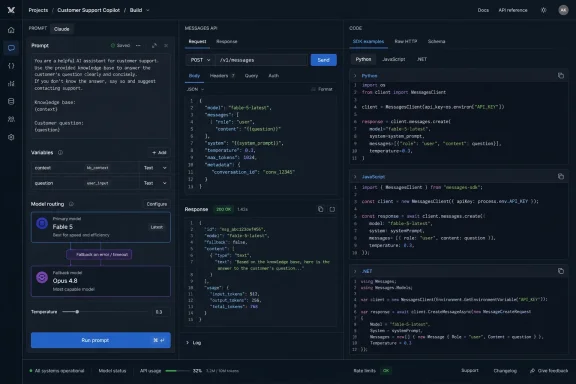
According to WinCentral, the revised interface lets developers submit Messages API requests directly from Workbench, inspect the returned response and copy generated implementation code. That is a modest but useful workflow change for teams that previously used Workbench only for prompt tuning before recreating the request in an SDK or REST client.
The Messages API is Anthropic’s primary endpoint for one-off and multi-turn Claude conversations. In practical terms, a console that accurately reproduces request parameters, message structure and model behavior can reduce the gap between a successful prompt experiment and a deployable request.
For Windows developers, the update is platform-neutral: it does not require a new desktop client or Windows-specific component. Its value is in removing a browser-to-editor handoff while testing integrations for .NET, Python, JavaScript or other supported API environments.
That distinction matters. A fallback is not simply a reliability switch that guarantees every failed request will transparently run on another model. It may apply to specific policy or availability cases, and administrators should confirm the conditions, target model, pricing and output differences before depending on it in production.
Fallback behavior can also affect application testing. A workflow tuned for Fable 5 may produce materially different results when served by Opus 4.8, particularly where reasoning depth, tool use, latency or token budgets matter. Production systems should log the model that fulfilled each request and test their error handling rather than treating fallback as invisible.
The refreshed Workbench should be useful for rapid prompt and API validation, but developers should verify fallback behavior in their own account before enabling it for live workloads.
Workbench is Anthropic’s browser-based environment for trying Claude prompts and API settings before moving an application into code. Anthropic’s own API documentation already describes Workbench as a place to test the API in-browser, then create the credentials needed for production use.
 A more direct path from prompt to API call
According to WinCentral, the revised interface lets developers submit Messages API requests directly from Workbench, inspect the returned response and copy generated implementation code. That is a modest but useful workflow change for teams that previously used Workbench only for prompt tuning before recreating the request in an SDK or REST client.The Messages API is Anthropic’s primary endpoint for one-off and multi-turn Claude conversations. In practical terms, a console that accurately reproduces request parameters, message structure and model behavior can reduce the gap between a successful prompt experiment and a deployable request.
For Windows developers, the update is platform-neutral: it does not require a new desktop client or Windows-specific component. Its value is in removing a browser-to-editor handoff while testing integrations for .NET, Python, JavaScript or other supported API environments.
Fable 5 fallback needs careful configuration
The report also says Workbench adds a fallback-model setting for Claude Fable 5. Anthropic’s public Fable 5 material describes a related safeguard route: requests restricted by its cybersecurity or biology controls can be sent to Claude Opus 4.8 instead. It also states that API customers must configure those fallback settings through its Fallback API.That distinction matters. A fallback is not simply a reliability switch that guarantees every failed request will transparently run on another model. It may apply to specific policy or availability cases, and administrators should confirm the conditions, target model, pricing and output differences before depending on it in production.
Fallback behavior can also affect application testing. A workflow tuned for Fable 5 may produce materially different results when served by Opus 4.8, particularly where reasoning depth, tool use, latency or token budgets matter. Production systems should log the model that fulfilled each request and test their error handling rather than treating fallback as invisible.
The refreshed Workbench should be useful for rapid prompt and API validation, but developers should verify fallback behavior in their own account before enabling it for live workloads.
References
- Primary source: thewincentral.com
Published: 2026-07-17T15:04:57+00:00
Loading…
thewincentral.com - Official source: anthropic.com
Claude Fable \ Anthropic
Next generation of intelligence for the hardest knowledge work and coding problems.www.anthropic.com - Official source: docs.anthropic.com
Loading…
docs.anthropic.com - Related coverage: tanujrajput.com
Loading…
tanujrajput.com