

Anthropic’s decision to recruit former Microsoft Azure AI executive Eric Boyd is more than a headline-grabbing talent move. It is a signal that the company’s next phase will be won or lost on infrastructure: compute capacity, model serving reliability, and the operational discipline required to keep Claude responsive as demand rises. In a market where model quality alone is no longer enough, the battle is shifting toward who can ship frontier AI at scale without breaking enterprise trust.
The hiring move arrives at a moment when Anthropic is transitioning from a fast-growing model lab into a full-scale platform company. Claude has moved from being a strong alternative for careful reasoning and coding to a product family with enterprise relevance, broader distribution, and a heavier operational burden. Microsoft’s own recent documentation confirms that Claude is now part of its Foundry lineup, alongside GPT and other frontier models, underscoring how quickly Anthropic’s systems have become a mainstream cloud offering.
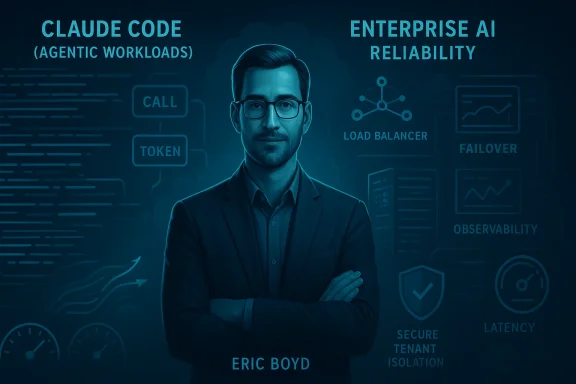
That matters because infrastructure is now a strategic layer, not a back-office concern. As model usage grows, the question is no longer simply whether a model can answer a prompt. It is whether the platform can sustain low latency, high availability, secure tenant isolation, regional coverage, predictable pricing, and enough throughput for agents and coding workloads that can generate thousands of calls per session. Anthropic’s own March 2026 Economic Index shows that Claude Code has grown to represent a large share of sampled traffic on the first-party API, which is a strong indicator that the system is under intensifying load from more agentic, request-heavy workloads.
Boyd’s background makes him a logical fit for that problem. His LinkedIn profile says he spent nearly 30 years at Microsoft across web infrastructure, HPC, Azure, and AI, and that he stepped away in January before joining Anthropic. The same profile places him at MIT and points to a long career building highly scalable platforms, which is exactly the kind of experience frontier model companies now prize when the product becomes the bottleneck.
This is also a story about market structure. Microsoft has spent the last year broadening access to Anthropic models in Azure AI Foundry and Copilot Studio, while Anthropic has been expanding Claude availability and capabilities across both consumer and developer channels. Microsoft’s own blog posts say Azure is now the only cloud offering access to both Claude and GPT frontier models on one platform, a positioning statement that tells you just how central model diversity has become to enterprise purchasing decisions.
The hire therefore lands in the middle of a deeper competitive reset. OpenAI still dominates mindshare in consumer AI, Google continues to push Gemini into workspace and search-adjacent workflows, and Microsoft is trying to turn Foundry into a model marketplace with enterprise guardrails. Anthropic, by adding a former Azure AI leader, is essentially declaring that the next frontier is not just better answers, but better systems.
Boyd’s appointment is especially telling because Azure AI was built around the exact kinds of challenges Anthropic faces today. Serving large models to enterprise customers means more than loading weights into GPUs. It requires careful orchestration across hardware procurement, software scheduling, capacity planning, failover design, and deployment abstractions that can absorb unpredictable traffic spikes. Boyd’s prior role at Microsoft suggests he has spent years inside those tradeoffs, which may be more valuable than generic “AI leadership” experience.
Anthropic’s product mix has also shifted toward workload types that punish weak infrastructure. Claude Code, deep reasoning, and long-horizon agent workflows tend to create larger context windows, more tool calls, and heavier demand per user than basic chat. Microsoft’s Foundry pages describe Claude models as being available through serverless and managed compute, which reflects a broader industry move toward flexible serving models that can absorb varying usage patterns without forcing every customer to become a GPU operator.
There is also a corporate symmetry here that should not be ignored. Microsoft has been one of Anthropic’s most important distribution partners, but it has also been a competitor in adjacent AI services. Hiring a senior Microsoft infrastructure executive gives Anthropic a leader who knows how a hyperscaler thinks, budgets, and scales. That knowledge can be turned inward to sharpen Claude’s own economics and outward to help Anthropic negotiate from a stronger position with cloud partners. That is not just talent acquisition; it is strategic intelligence transfer.
This matters because platform strategy is increasingly about choice. Enterprise customers do not want a single-model future if they can avoid it. They want a portfolio approach that lets them route different tasks to different models based on cost, reasoning depth, speed, or governance requirements. Microsoft Foundry’s own materials emphasize broad model choice, serverless access, and managed compute, which is exactly the kind of enterprise architecture that makes Anthropic’s products feel native to business workflows.
The fact that Boyd now works at Anthropic adds a layer of irony to that relationship. He helped build the infrastructure stack that served Anthropic models on Azure, and now he is on the other side of the table, responsible for Anthropic’s internal scaling strategy. That can be read as either a loss for Microsoft or a sign of how mature the industry has become: top infrastructure leaders now circulate among the largest AI players the way cloud architects once moved among hyperscalers.
That changes the economics of competition. The company with the best model is not automatically the company with the best product if it cannot serve that model reliably enough for production use. A coding agent that stalls, times out, or becomes inconsistent under load is not merely frustrating; it is operationally expensive. For enterprise buyers, reliability becomes a feature they can budget against.
Boyd’s appointment suggests Anthropic understands this shift. His experience at Microsoft includes the sorts of large-scale platform decisions that determine whether an AI system is elegant in demos and durable in production. The real challenge is not getting one inference request to work. It is making millions of requests behave the same way, every hour, across regions and customer tiers.
That trend matters because coding agents are not a side feature anymore. They are becoming the gateway to broader enterprise adoption. When developers trust a model to write code, refactor systems, or explore large codebases, they begin using it for adjacent tasks such as documentation, test generation, security review, and internal tooling. In that sense, Claude Code is not just a product; it is a growth engine for the entire Claude ecosystem.
Anthropic has also been emphasizing agentic architecture in its public messaging, including integrations with Model Context Protocol and enterprise skill-building. Microsoft’s Foundry materials echo the same direction, highlighting reusable skills, Deep Research, and MCP-connected workflows. The overlap suggests the market is converging around a common thesis: the next phase of AI is not chat, but orchestrated action.
The enterprise requirement is distinct from consumer demand. Consumer users want speed, convenience, and low friction. Enterprises want governance, auditability, predictable performance, and service-level consistency. Anthropic’s challenge is to satisfy both without fragmenting the product into incompatible experiences. That is where a seasoned platform builder can have outsized impact. The wrong infrastructure strategy can make a beloved model feel enterprise-unready overnight.
Boyd’s background in Azure AI suggests he is comfortable operating in that environment. Microsoft’s own Foundry materials frame Claude as part of a managed, governed, and deployable platform rather than a standalone model endpoint. Anthropic will need the same kind of discipline internally if it wants to preserve its appeal as usage scales.
But those differentiators only matter if the platform can scale. If Claude becomes the model teams depend on for code generation, internal research, or agent orchestration, then reliability becomes a direct competitive variable. Anthropic cannot afford to be the company with the best model and the weakest production backbone. That is exactly the kind of risk a veteran infrastructure leader is meant to reduce.
Microsoft’s own documents make the stakes clear: Claude is no longer peripheral in enterprise AI; it is embedded in Foundry, Copilot Studio, and Microsoft 365 Copilot scenarios. That means Anthropic is no longer competing only against rivals for usage, but also against the expectation that enterprise AI should be seamless, governed, and always-on.
He also brings institutional memory from the very cloud that helped Anthropic expand its reach. That can be a powerful advantage in negotiations, architectural planning, and capacity strategy. If Anthropic wants to optimize its own compute posture, it helps to have someone who understands how large clouds think about regional placement, service tiers, and model hosting at scale.
The move may also help Anthropic professionalize its internal operating model. Rapidly growing AI companies often accumulate technical debt in the middle stages of success, when product demand outpaces the governance and engineering structure needed to support it. A leader who has spent years inside Microsoft’s enterprise-grade machine may be able to impose just enough process without smothering innovation. That balance is hard to strike, and easier to get wrong than most founders admit.
The second question is whether Anthropic can preserve its identity while scaling like a hyperscaler. The company’s brand is built on being thoughtful, capable, and safer to deploy in serious environments. If the infrastructure team can reinforce that promise rather than dilute it, Anthropic may gain one of the rarest advantages in AI: a reputation for being both powerful and operationally dependable.
What to watch next:
Source: Redmond Channel Partner Anthropic Recruits Microsoft Azure AI Leader to Scale Systems Behind Rapid Claude Growth -- Redmond Channel Partner
 Background
The hiring move arrives at a moment when Anthropic is transitioning from a fast-growing model lab into a full-scale platform company. Claude has moved from being a strong alternative for careful reasoning and coding to a product family with enterprise relevance, broader distribution, and a heavier operational burden. Microsoft’s own recent documentation confirms that Claude is now part of its Foundry lineup, alongside GPT and other frontier models, underscoring how quickly Anthropic’s systems have become a mainstream cloud offering.That matters because infrastructure is now a strategic layer, not a back-office concern. As model usage grows, the question is no longer simply whether a model can answer a prompt. It is whether the platform can sustain low latency, high availability, secure tenant isolation, regional coverage, predictable pricing, and enough throughput for agents and coding workloads that can generate thousands of calls per session. Anthropic’s own March 2026 Economic Index shows that Claude Code has grown to represent a large share of sampled traffic on the first-party API, which is a strong indicator that the system is under intensifying load from more agentic, request-heavy workloads.
Boyd’s background makes him a logical fit for that problem. His LinkedIn profile says he spent nearly 30 years at Microsoft across web infrastructure, HPC, Azure, and AI, and that he stepped away in January before joining Anthropic. The same profile places him at MIT and points to a long career building highly scalable platforms, which is exactly the kind of experience frontier model companies now prize when the product becomes the bottleneck.
This is also a story about market structure. Microsoft has spent the last year broadening access to Anthropic models in Azure AI Foundry and Copilot Studio, while Anthropic has been expanding Claude availability and capabilities across both consumer and developer channels. Microsoft’s own blog posts say Azure is now the only cloud offering access to both Claude and GPT frontier models on one platform, a positioning statement that tells you just how central model diversity has become to enterprise purchasing decisions.
The hire therefore lands in the middle of a deeper competitive reset. OpenAI still dominates mindshare in consumer AI, Google continues to push Gemini into workspace and search-adjacent workflows, and Microsoft is trying to turn Foundry into a model marketplace with enterprise guardrails. Anthropic, by adding a former Azure AI leader, is essentially declaring that the next frontier is not just better answers, but better systems.
Overview
Anthropic’s growth has created a familiar AI-company problem: success increases the complexity of success. Every new customer, every new developer integration, and every new use case compounds the demands on inference infrastructure, observability, routing, security, and cost management. The result is that the company must scale like a cloud provider while still behaving like a research-driven model lab. That tension is now visible in the executive hires it makes.Boyd’s appointment is especially telling because Azure AI was built around the exact kinds of challenges Anthropic faces today. Serving large models to enterprise customers means more than loading weights into GPUs. It requires careful orchestration across hardware procurement, software scheduling, capacity planning, failover design, and deployment abstractions that can absorb unpredictable traffic spikes. Boyd’s prior role at Microsoft suggests he has spent years inside those tradeoffs, which may be more valuable than generic “AI leadership” experience.
Anthropic’s product mix has also shifted toward workload types that punish weak infrastructure. Claude Code, deep reasoning, and long-horizon agent workflows tend to create larger context windows, more tool calls, and heavier demand per user than basic chat. Microsoft’s Foundry pages describe Claude models as being available through serverless and managed compute, which reflects a broader industry move toward flexible serving models that can absorb varying usage patterns without forcing every customer to become a GPU operator.
There is also a corporate symmetry here that should not be ignored. Microsoft has been one of Anthropic’s most important distribution partners, but it has also been a competitor in adjacent AI services. Hiring a senior Microsoft infrastructure executive gives Anthropic a leader who knows how a hyperscaler thinks, budgets, and scales. That knowledge can be turned inward to sharpen Claude’s own economics and outward to help Anthropic negotiate from a stronger position with cloud partners. That is not just talent acquisition; it is strategic intelligence transfer.
Why this hire matters now
The timing matters because the industry has moved from model novelty to operational maturity. Enterprise buyers increasingly ask about uptime, latency, governance, data handling, deployment consistency, and integration fit before they ask about benchmark scores. Anthropic can still differentiate on model behavior and safety posture, but the company now needs a platform story that is just as convincing.- Compute access must grow without making unit economics collapse.
- Model serving has to stay stable as traffic becomes more bursty and agentic.
- Reliability becomes a product feature, not just an SRE metric.
- Capacity planning is now a board-level concern.
- Enterprise trust depends on predictable service at scale.
What Microsoft’s Own Anthropic Strategy Reveals
Microsoft’s public positioning around Anthropic is revealing because it shows how quickly the cloud market has adapted to multi-model reality. In November 2025, Microsoft said Azure was the only cloud offering access to both Claude and GPT frontier models on one platform, and subsequent updates expanded Claude availability further across Foundry and Copilot Studio. That makes Anthropic not just a model vendor, but a pillar in Microsoft’s enterprise AI pitch.This matters because platform strategy is increasingly about choice. Enterprise customers do not want a single-model future if they can avoid it. They want a portfolio approach that lets them route different tasks to different models based on cost, reasoning depth, speed, or governance requirements. Microsoft Foundry’s own materials emphasize broad model choice, serverless access, and managed compute, which is exactly the kind of enterprise architecture that makes Anthropic’s products feel native to business workflows.
The fact that Boyd now works at Anthropic adds a layer of irony to that relationship. He helped build the infrastructure stack that served Anthropic models on Azure, and now he is on the other side of the table, responsible for Anthropic’s internal scaling strategy. That can be read as either a loss for Microsoft or a sign of how mature the industry has become: top infrastructure leaders now circulate among the largest AI players the way cloud architects once moved among hyperscalers.
The Microsoft-to-Anthropic pipeline
Microsoft’s partnership posture suggests Anthropic has become a premium asset in the enterprise model catalog. The company is not merely hosting Claude for convenience; it is integrating Claude into copilots, agent frameworks, and model-routing strategies. That means Anthropic’s technical roadmap now intersects with Microsoft’s enterprise ambitions in a way that rewards operational excellence.- Microsoft wants model diversity to reduce dependence on any one provider.
- Anthropic wants distribution without surrendering technical identity.
- Enterprise customers want governed flexibility without integration chaos.
- The cloud layer wants sticky workloads that expand over time.
- The model layer wants control over service quality and product experience.
Infrastructure as the New Competitive Moat
Frontier AI competition is increasingly an infrastructure contest disguised as a model race. Benchmark wins still matter, but the winners are now the companies that can absorb demand spikes, support longer-running agentic sessions, and keep output quality stable at scale. Anthropic’s own materials around Claude models on Foundry and Claude Code make clear that the company’s workloads are becoming more enterprise-like and more compute-intensive.That changes the economics of competition. The company with the best model is not automatically the company with the best product if it cannot serve that model reliably enough for production use. A coding agent that stalls, times out, or becomes inconsistent under load is not merely frustrating; it is operationally expensive. For enterprise buyers, reliability becomes a feature they can budget against.
Boyd’s appointment suggests Anthropic understands this shift. His experience at Microsoft includes the sorts of large-scale platform decisions that determine whether an AI system is elegant in demos and durable in production. The real challenge is not getting one inference request to work. It is making millions of requests behave the same way, every hour, across regions and customer tiers.
Scaling beyond the demo
The industry has spent years celebrating model launches. The harder part is model operations. Claude’s growth means Anthropic must optimize the entire serving chain, from capacity reservation to routing logic to observability and incident response. That is why infrastructure leaders now matter as much as research leads.- Inference throughput determines whether growth is profitable.
- Queue management affects user experience under load.
- Regional deployment shapes latency and compliance.
- Telemetry and tracing reduce the mean time to recovery.
- Cost controls decide whether a great model becomes a sustainable business.
Claude Code and the Agentic Future
One reason this hire is so important is that Claude’s strongest growth areas are likely the most infrastructure-hungry. Anthropic’s Economic Index notes that Claude Code has become a large share of sampled traffic on the first-party API, reflecting a migration of coding activity toward more agentic, multi-step workflows. Those workflows can be far more demanding than standard chat because they rely on repeated tool use, context retention, and long-running task execution.That trend matters because coding agents are not a side feature anymore. They are becoming the gateway to broader enterprise adoption. When developers trust a model to write code, refactor systems, or explore large codebases, they begin using it for adjacent tasks such as documentation, test generation, security review, and internal tooling. In that sense, Claude Code is not just a product; it is a growth engine for the entire Claude ecosystem.
Anthropic has also been emphasizing agentic architecture in its public messaging, including integrations with Model Context Protocol and enterprise skill-building. Microsoft’s Foundry materials echo the same direction, highlighting reusable skills, Deep Research, and MCP-connected workflows. The overlap suggests the market is converging around a common thesis: the next phase of AI is not chat, but orchestrated action.
Why coding workloads change the infrastructure game
Coding agents are a stress test for every layer of the stack. They need memory, consistency, latency tolerance, and enough throughput to survive iterative use without becoming sluggish or expensive. That is precisely why Anthropic’s infrastructure leadership matters now.- Coding sessions often create many more tokens per user than simple chat.
- Agentic flows need session persistence across multiple tool calls.
- Enterprise developers expect predictable output quality under pressure.
- Longer tasks increase the importance of fault isolation.
- Debugging AI systems requires better observability than consumer chat apps.
Enterprise Demand Is Changing the Product Roadmap
Anthropic’s audience is no longer just researchers and early adopters. It is a mix of enterprises, platform teams, developers, and individual users who increasingly expect Claude to function as infrastructure for real work. That shift puts pressure on product teams to think like enterprise software vendors, not just model publishers. Microsoft’s own rollout of Claude in Copilot Studio and Microsoft 365 Copilot demonstrates how quickly enterprise contexts can elevate a model from a feature to a core dependency.The enterprise requirement is distinct from consumer demand. Consumer users want speed, convenience, and low friction. Enterprises want governance, auditability, predictable performance, and service-level consistency. Anthropic’s challenge is to satisfy both without fragmenting the product into incompatible experiences. That is where a seasoned platform builder can have outsized impact. The wrong infrastructure strategy can make a beloved model feel enterprise-unready overnight.
Boyd’s background in Azure AI suggests he is comfortable operating in that environment. Microsoft’s own Foundry materials frame Claude as part of a managed, governed, and deployable platform rather than a standalone model endpoint. Anthropic will need the same kind of discipline internally if it wants to preserve its appeal as usage scales.
Consumer vs. enterprise pressure
The consumer side may drive visibility, but the enterprise side often drives revenue density and platform stickiness. That means Claude’s future success depends on two different excellence tests at once.- Consumers care about responsiveness and delight.
- Enterprises care about compliance and repeatability.
- Developers care about API ergonomics and documentation quality.
- IT teams care about security posture and change control.
- Finance teams care about cost predictability and utilization.
Competitive Implications for OpenAI and Google
Anthropic’s infrastructure move should be read in the context of a tightening three-way race with OpenAI and Google. OpenAI still enjoys enormous consumer mindshare and a powerful application ecosystem. Google, meanwhile, has a deep advantage in cloud distribution, search-adjacent workflows, and the ability to integrate Gemini across a massive product portfolio. Anthropic’s answer has increasingly been to differentiate on model behavior, safety, and enterprise usability.But those differentiators only matter if the platform can scale. If Claude becomes the model teams depend on for code generation, internal research, or agent orchestration, then reliability becomes a direct competitive variable. Anthropic cannot afford to be the company with the best model and the weakest production backbone. That is exactly the kind of risk a veteran infrastructure leader is meant to reduce.
Microsoft’s own documents make the stakes clear: Claude is no longer peripheral in enterprise AI; it is embedded in Foundry, Copilot Studio, and Microsoft 365 Copilot scenarios. That means Anthropic is no longer competing only against rivals for usage, but also against the expectation that enterprise AI should be seamless, governed, and always-on.
The race to infrastructure maturity
The next competitive edge will not just be model quality. It will be the ability to deliver that quality consistently inside enterprise workflows. That is where Anthropic’s recruitment strategy becomes important.- OpenAI has scale and brand recognition.
- Google has distribution and cloud depth.
- Anthropic has model distinctiveness and safety credibility.
- The winner will need all three: quality, reliability, and adoption.
- Infrastructure leadership is now a prerequisite, not a luxury.
What Boyd Brings to Anthropic
Boyd’s profile suggests he arrives with a rare combination of deep technical platform experience and first-hand knowledge of how hyperscale AI deployments are built. His LinkedIn bio places him across Microsoft’s web infrastructure, HPC, Azure, and AI efforts, which implies comfort with the layers below the model itself. That kind of breadth matters when an AI company needs one executive who can translate between research, product, infrastructure, and business constraints.He also brings institutional memory from the very cloud that helped Anthropic expand its reach. That can be a powerful advantage in negotiations, architectural planning, and capacity strategy. If Anthropic wants to optimize its own compute posture, it helps to have someone who understands how large clouds think about regional placement, service tiers, and model hosting at scale.
The move may also help Anthropic professionalize its internal operating model. Rapidly growing AI companies often accumulate technical debt in the middle stages of success, when product demand outpaces the governance and engineering structure needed to support it. A leader who has spent years inside Microsoft’s enterprise-grade machine may be able to impose just enough process without smothering innovation. That balance is hard to strike, and easier to get wrong than most founders admit.
Likely priorities in the new role
If Boyd’s mandate follows the shape of Anthropic’s public growth, several priorities are easy to infer.- Expand compute planning for bursty Claude Code and API demand.
- Improve model serving reliability across enterprise workloads.
- Strengthen observability for failures, latency, and throughput.
- Reduce operational drag in deployment and incident response.
- Support developer tooling that makes Claude easier to integrate.
- Prepare for future regional and compliance requirements.
Strengths and Opportunities
Anthropic’s strongest advantage is that it appears to understand what stage of the race it is in. The company is not pretending that research leadership alone will secure the market. Instead, it is adding operational firepower at exactly the point where scale becomes decisive. That kind of self-awareness is a genuine asset in a sector full of overconfident assumptions.- Deepening enterprise credibility through infrastructure leadership.
- Better support for Claude Code and other high-throughput workloads.
- Improved service reliability at a time when customers expect production-grade AI.
- Stronger cross-functional translation between research and operations.
- Potentially better cloud negotiation leverage thanks to insider knowledge.
- More resilient scaling posture as usage continues to rise.
- A clearer platform story for enterprise buyers seeking dependable AI.
Risks and Concerns
The obvious risk is that hiring a top infrastructure executive does not automatically solve the underlying scaling problem. Anthropic still faces the hard realities of compute costs, model demand volatility, and the challenge of maintaining a premium experience while competing in a market where rivals can subsidize growth through larger ecosystems. The move is promising, but it is not a substitute for execution.- High inference costs could pressure margins as demand grows.
- Reliability expectations rise faster than infrastructure can be upgraded.
- Talent transitions can create organizational friction during rapid expansion.
- Enterprise dependency increases the cost of even small outages.
- Cloud concentration may limit strategic flexibility.
- Competitors can copy messaging around governance and model choice.
- Rapid growth in agentic use cases may expose unforeseen bottlenecks.
Looking Ahead
The most important thing to watch now is whether Anthropic turns this hiring decision into measurable infrastructure gains. If Claude continues to expand in coding, enterprise workflows, and agentic scenarios, then the company will need to prove that it can remain fast, stable, and cost-effective under real-world pressure. That is especially true if enterprise adoption keeps accelerating through Microsoft’s Foundry and Copilot channels, where Claude is now visible inside major Microsoft AI experiences.The second question is whether Anthropic can preserve its identity while scaling like a hyperscaler. The company’s brand is built on being thoughtful, capable, and safer to deploy in serious environments. If the infrastructure team can reinforce that promise rather than dilute it, Anthropic may gain one of the rarest advantages in AI: a reputation for being both powerful and operationally dependable.
What to watch next:
- Continued expansion of Claude Code and other agentic products.
- New announcements around capacity, reliability, or regional availability.
- Changes in enterprise deployment patterns inside Microsoft Foundry and Copilot.
- Additional senior hires in infrastructure, platform, and systems engineering.
- Any signs that Anthropic is optimizing for cost-per-token efficiency at scale.
Source: Redmond Channel Partner Anthropic Recruits Microsoft Azure AI Leader to Scale Systems Behind Rapid Claude Growth -- Redmond Channel Partner
Last edited:
