

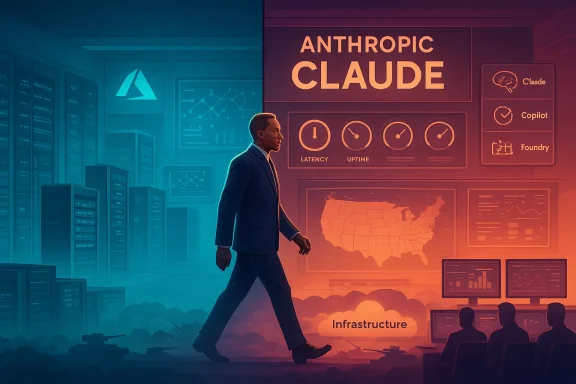
Anthropic’s decision to hire away Microsoft AI veteran Eric Boyd is more than another Silicon Valley talent raid; it is a signal that the most important competition in AI is now moving deeper into infrastructure, model distribution, and enterprise platform control. Boyd, who spent 16 years at Microsoft and most recently led the company’s AI Platform organization, has taken the role of head of infrastructure at Anthropic, underscoring how aggressively the Claude maker is building the operational backbone behind its fast-growing model business. The move also highlights a broader truth about the AI market in 2026: the talent race is increasingly an infrastructure race.
The headline here is simple, but the implications are not. Anthropic is not just recruiting an experienced executive; it is hiring someone who helped shape Microsoft’s AI platform strategy at exactly the moment Microsoft is trying to scale its own model-agnostic enterprise stack around Microsoft Foundry, Copilot Studio, and a broader CoreAI vision. That makes Boyd’s departure relevant not only to Anthropic, but to Microsoft’s plans for AI platform depth and operational execution.
Boyd’s own public remarks frame the move as mission-driven rather than merely opportunistic. He said he was energized by Anthropic’s model quality, culture, and pace, and he pointed specifically to the impact of Claude Code as evidence of how quickly Anthropic’s products have matured into infrastructure-grade assets. Whether you read that as personal conviction, career timing, or a calculated move toward a hotter platform, the underlying message is the same: Anthropic is now attractive enough to pull senior leaders out of deeply entrenched incumbents.
For Microsoft, the timing is awkward but not catastrophic. The company has spent the last year broadening its AI strategy beyond OpenAI, adding Anthropic models across Foundry and Copilot surfaces while also investing in its own infrastructure and executive bench. In that sense, the departure can be read two ways: as a loss of one of the people most familiar with Microsoft’s AI plumbing, and as evidence that Microsoft’s AI ecosystem has become important enough for its senior leaders to be courted by outside rivals.
That reorganization wasn’t cosmetic. Microsoft was trying to align Azure, GitHub, VS Code, and Copilot more tightly, while also making its cloud the default substrate for AI workloads. The company had every incentive to treat its AI platform team as a core asset rather than an adjunct, which is why losing a leader from that group is worth noting even if Microsoft continues to execute well. In AI infrastructure, leadership continuity matters because the work is deeply interdependent across compute, networking, deployment, orchestration, and reliability.
Anthropic, by contrast, has been moving in the opposite direction: from promising model lab to full-stack AI platform company. The startup has expanded its cloud footprint, strengthened enterprise distribution, and publicly committed to a massive buildout of data center capacity in the U.S. It also deepened its relationship with Microsoft through Foundry and Copilot integrations, making the company more visible to enterprise buyers and, inevitably, more competitive with Microsoft’s own AI ambitions.
That combination creates a very modern kind of executive poaching. Boyd is not just a “Microsoft veteran”; he is a systems executive with experience in the AI platform layer, the cloud layer, and large-scale organizational execution. In a market where model quality alone is no longer enough, that kind of hire can accelerate an entire company’s ability to turn product momentum into durable platform advantage. That is the real story here.
Anthropic’s choice suggests it wants more than impressive model benchmarks. It wants a leader who understands how to keep latency low, availability high, and deployment smooth while demand spikes. In an AI economy defined by compute scarcity and customer expectations, that is a strategic hire, not just an HR event.
This is where Boyd’s exit becomes strategically interesting. He spent years inside the part of Microsoft that had to make AI platform ambitions real for developers and customers. When a company shifts from “we have AI” to “we run AI infrastructure at global scale,” it depends on a relatively small number of executives who understand the hidden layers between research, product, and operations. Losing one of those people does not derail the machine, but it can slow the machine’s fine-tuning.
At the same time, Microsoft’s recent partnership work with Anthropic shows how complicated the competitive boundary has become. Microsoft is investing in Anthropic while also using Anthropic models in its own products and infrastructure. That is a very 2026 arrangement: rivals in some layers, partners in others, and customers somewhere in the middle trying to understand which model runs where and under what terms.
Boyd’s old role sat close to that complexity. If Anthropic can absorb that knowledge, it gains a useful shortcut in understanding how large enterprises actually consume AI, not just how they evaluate it in a demo. Microsoft, meanwhile, must keep proving that a broad platform approach can still feel coherent.
Boyd’s background fits that need unusually well. Microsoft AI Platform involved powering first-party Copilot apps and building the kind of platform services that make enterprise AI usable at scale. Anthropic appears to be betting that those experiences translate directly into the challenges of growing Claude’s footprint while preserving performance and reliability. That is a sensible bet, especially if Anthropic intends to keep expanding enterprise-facing features and partnerships.
The company’s own messaging also hints at why the fit is attractive. Boyd praised the “absolute leading models” and Anthropic’s mission, but his note focused heavily on infrastructure and the practical impact of AI products like Claude Code. In other words, he is not walking into a pure research lab; he is joining a company that wants to turn model excellence into dependable industrial-scale capability.
That matters because infrastructure teams do not just manage servers. They shape developer trust, enterprise uptime, and cost structure. If Anthropic wants to keep winning developers and serious customers, it needs leaders who see infrastructure as a product, not as a back-office function.
That reputation matters for Boyd’s move because infrastructure is where AI brand promise becomes measurable reality. If customers believe Claude is the best model for certain tasks, they will expect corresponding excellence in uptime, throughput, and deployment flexibility. A seasoned Microsoft platform executive can help Anthropic bridge the gap between high expectations and production-grade service delivery.
There is also a competitive logic here. The company that controls the most compelling developer experience often controls the most durable customer relationship. Claude Code, in particular, has become a sort of proof point that Anthropic can build products developers want to use repeatedly, not just evaluate once. That makes infrastructure less glamorous but more important than ever.
Boyd’s role will likely be to help ensure that this workflow gravity does not break under scale. If Claude becomes essential to enterprise operations, Anthropic must deliver the kind of stable infrastructure that keeps buyers from worrying about outages, latency spikes, or unpredictable cost curves.
The irony is that the same industry leaders who publicly celebrate ecosystem openness are privately competing for exactly the same technical talent. That is not hypocrisy so much as a sign of maturity: the AI market now has enough money and strategic importance to sustain aggressive executive movement. The result is a revolving door that can strengthen the winners and expose the laggards.
Microsoft has seen this movie before. So have Apple, Google, and Meta. What is different now is the scale of the infrastructure stakes and the speed with which leadership changes can influence product roadmaps. In older platform wars, executive turnover was important. In AI, it can be decisive.
In practice, this means talent wars are no longer merely about prestige. They are about technical leverage. The company that can recruit the best infrastructure minds gains a compounding advantage in service quality, delivery speed, and internal decision-making.
Consumer users may not notice the change immediately, but they are still affected. The quality of consumer-facing AI products often depends on the same underlying infrastructure that powers enterprise workloads. Faster response times, fewer failures, better model availability, and more reliable tool use all trace back to the same technical foundation.
This is why infrastructure hires are not just a B2B concern. They affect every surface where the model appears. If Anthropic gets the underlying stack right, both consumers and businesses benefit from the same investment in operational discipline. That is especially important as Claude becomes more deeply embedded in development and workplace tools.
Anthropic’s challenge is to serve both constituencies without losing focus. The more products it ships, the more likely it becomes that infrastructure discipline will determine whether the company scales cleanly or grows chaotically.
There is also the optics problem. Microsoft has invested heavily in AI infrastructure, hired aggressively, and reorganized its leadership to support the next phase of growth. Losing a prominent AI platform executive to a rival reinforces the sense that the AI talent market is still fluid, even for the biggest incumbent players. In a narrative-driven industry, that matters more than it should.
Yet Microsoft is unlikely to be destabilized. It has deep benches, enormous scale, and strong distribution. The more important question is whether it can keep enough senior technical talent aligned around one complicated story: that Microsoft can both partner with model vendors and remain a first-choice platform for enterprise AI.
If Microsoft’s internal systems are robust, the company will move on quickly. If not, Anthropic may have just picked up a leader who understands the precise seams where AI platform organizations can wobble under pressure.
It also shows how quickly Anthropic has moved from outsider to establishment contender. A few years ago, losing a senior leader to Anthropic would have looked like a bet on a promising startup. Today it looks more like a bet on a platform company with real leverage, real demand, and real distribution. That perception shift is itself a major competitive milestone.
The broader market should also pay attention to the way Microsoft and Anthropic keep alternating between rivalry and cooperation. That pattern suggests the AI industry may not consolidate into neat vertical silos the way earlier tech markets did. Instead, it may remain a tangle of shared infrastructure, overlapping partnerships, and selective competition for years.
That is a sophisticated market posture, but it also raises strategic questions. If everyone depends on everyone else’s infrastructure, the competitive line becomes harder to draw, and each executive hire takes on extra significance.
Microsoft, meanwhile, will likely respond by doubling down on its platform message and continuing to stress that it can be the neutral, enterprise-grade home for multiple frontier models. The company’s challenge is to make sure its own AI narrative remains coherent even as key people move across the industry. In the long run, this kind of executive migration may become normal; in the short run, it is a reminder that the AI race is still very much being shaped by people as much as by models.
Source: Thurrott.com Anthropic Hires Microsoft AI Executive
 Overview
The headline here is simple, but the implications are not. Anthropic is not just recruiting an experienced executive; it is hiring someone who helped shape Microsoft’s AI platform strategy at exactly the moment Microsoft is trying to scale its own model-agnostic enterprise stack around Microsoft Foundry, Copilot Studio, and a broader CoreAI vision. That makes Boyd’s departure relevant not only to Anthropic, but to Microsoft’s plans for AI platform depth and operational execution.Boyd’s own public remarks frame the move as mission-driven rather than merely opportunistic. He said he was energized by Anthropic’s model quality, culture, and pace, and he pointed specifically to the impact of Claude Code as evidence of how quickly Anthropic’s products have matured into infrastructure-grade assets. Whether you read that as personal conviction, career timing, or a calculated move toward a hotter platform, the underlying message is the same: Anthropic is now attractive enough to pull senior leaders out of deeply entrenched incumbents.
For Microsoft, the timing is awkward but not catastrophic. The company has spent the last year broadening its AI strategy beyond OpenAI, adding Anthropic models across Foundry and Copilot surfaces while also investing in its own infrastructure and executive bench. In that sense, the departure can be read two ways: as a loss of one of the people most familiar with Microsoft’s AI plumbing, and as evidence that Microsoft’s AI ecosystem has become important enough for its senior leaders to be courted by outside rivals.
Background
To understand why this move matters, you have to look at how Microsoft reorganized itself around AI. In January 2025, Microsoft created CoreAI — Platform and Tools, led by Jay Parikh, and placed Eric Boyd under that umbrella as the AI platform leader. The new structure was designed to compress platform, tooling, developer infrastructure, and model integration into a single strategic stack, with Boyd as one of the key operators making that stack function at enterprise scale.That reorganization wasn’t cosmetic. Microsoft was trying to align Azure, GitHub, VS Code, and Copilot more tightly, while also making its cloud the default substrate for AI workloads. The company had every incentive to treat its AI platform team as a core asset rather than an adjunct, which is why losing a leader from that group is worth noting even if Microsoft continues to execute well. In AI infrastructure, leadership continuity matters because the work is deeply interdependent across compute, networking, deployment, orchestration, and reliability.
Anthropic, by contrast, has been moving in the opposite direction: from promising model lab to full-stack AI platform company. The startup has expanded its cloud footprint, strengthened enterprise distribution, and publicly committed to a massive buildout of data center capacity in the U.S. It also deepened its relationship with Microsoft through Foundry and Copilot integrations, making the company more visible to enterprise buyers and, inevitably, more competitive with Microsoft’s own AI ambitions.
That combination creates a very modern kind of executive poaching. Boyd is not just a “Microsoft veteran”; he is a systems executive with experience in the AI platform layer, the cloud layer, and large-scale organizational execution. In a market where model quality alone is no longer enough, that kind of hire can accelerate an entire company’s ability to turn product momentum into durable platform advantage. That is the real story here.
Why infrastructure leaders matter
Infrastructure hiring sounds boring until you map it to the current AI market. The companies that win tend to be the ones that can reliably deliver performance, scale, security, and cost control at the same time. A strong infrastructure leader is the difference between a dazzling demo and a dependable platform that enterprise customers trust with production workloads.Anthropic’s choice suggests it wants more than impressive model benchmarks. It wants a leader who understands how to keep latency low, availability high, and deployment smooth while demand spikes. In an AI economy defined by compute scarcity and customer expectations, that is a strategic hire, not just an HR event.
- Model quality gets attention.
- Infrastructure quality sustains revenue.
- Operational reliability converts pilots into contracts.
- Enterprise trust turns usage into retention.
- Platform scale protects margins over time.
The Microsoft Context
Microsoft has not been standing still. In the last year, it expanded its use of Anthropic models inside Microsoft 365 Copilot, Copilot Studio, and Microsoft Foundry, signaling a pragmatic approach to model choice rather than ideological loyalty to a single partner. That flexibility helps Microsoft sell enterprise AI on the basis of best-fit capability, but it also increases the complexity of its own AI operating model.This is where Boyd’s exit becomes strategically interesting. He spent years inside the part of Microsoft that had to make AI platform ambitions real for developers and customers. When a company shifts from “we have AI” to “we run AI infrastructure at global scale,” it depends on a relatively small number of executives who understand the hidden layers between research, product, and operations. Losing one of those people does not derail the machine, but it can slow the machine’s fine-tuning.
At the same time, Microsoft’s recent partnership work with Anthropic shows how complicated the competitive boundary has become. Microsoft is investing in Anthropic while also using Anthropic models in its own products and infrastructure. That is a very 2026 arrangement: rivals in some layers, partners in others, and customers somewhere in the middle trying to understand which model runs where and under what terms.
Microsoft’s multi-model reality
Microsoft’s AI strategy now looks less like a single bet and more like a portfolio. It supports OpenAI, Anthropic, and other model families while trying to present an integrated enterprise experience through Foundry and Copilot. That gives customers choice, but it also makes execution harder because every model integration increases governance, routing, and operational complexity.Boyd’s old role sat close to that complexity. If Anthropic can absorb that knowledge, it gains a useful shortcut in understanding how large enterprises actually consume AI, not just how they evaluate it in a demo. Microsoft, meanwhile, must keep proving that a broad platform approach can still feel coherent.
- Microsoft is pursuing model diversification.
- Anthropic is pursuing platform depth.
- The overlap creates both partnership and rivalry.
- Enterprise customers benefit from choice, but demand clarity.
- The winner will be the company that makes complexity feel simple.
Why Anthropic Wants Him
Anthropic’s hiring decision makes sense because the company has outgrown the “small startup” phase and entered the “operational gravity” phase. When a company is scaling models, enterprise distribution, and infrastructure commitments all at once, the bottleneck is rarely only research talent. More often it is execution across systems that must work every minute of the day.Boyd’s background fits that need unusually well. Microsoft AI Platform involved powering first-party Copilot apps and building the kind of platform services that make enterprise AI usable at scale. Anthropic appears to be betting that those experiences translate directly into the challenges of growing Claude’s footprint while preserving performance and reliability. That is a sensible bet, especially if Anthropic intends to keep expanding enterprise-facing features and partnerships.
The company’s own messaging also hints at why the fit is attractive. Boyd praised the “absolute leading models” and Anthropic’s mission, but his note focused heavily on infrastructure and the practical impact of AI products like Claude Code. In other words, he is not walking into a pure research lab; he is joining a company that wants to turn model excellence into dependable industrial-scale capability.
A better place to build?
Boyd’s comments suggest that he views Anthropic as a place where technical ambition and organizational mission line up more closely than they might have at Microsoft. That may be flattering language, but it also reflects a real market dynamic: the strongest AI companies increasingly distinguish themselves through cultural alignment around speed, product focus, and research-to-production continuity.That matters because infrastructure teams do not just manage servers. They shape developer trust, enterprise uptime, and cost structure. If Anthropic wants to keep winning developers and serious customers, it needs leaders who see infrastructure as a product, not as a back-office function.
- Mission alignment can be a recruitment weapon.
- Infrastructure ownership is becoming a source of differentiation.
- Developer trust depends on predictable performance.
- Operational excellence can outrun brand legacy.
- A strong infrastructure chief can tighten the bridge from research to revenue.
Claude, Code, and the Enterprise Opportunity
One reason Anthropic keeps attracting attention is that Claude has become deeply associated with serious work, especially coding and long-context reasoning. Microsoft’s own product choices reflect that perception, since Claude models have been integrated into Foundry and Copilot-related experiences for enterprise users. The industry is no longer treating Anthropic as a niche alternative; it is treating it as a premium option for demanding workloads.That reputation matters for Boyd’s move because infrastructure is where AI brand promise becomes measurable reality. If customers believe Claude is the best model for certain tasks, they will expect corresponding excellence in uptime, throughput, and deployment flexibility. A seasoned Microsoft platform executive can help Anthropic bridge the gap between high expectations and production-grade service delivery.
There is also a competitive logic here. The company that controls the most compelling developer experience often controls the most durable customer relationship. Claude Code, in particular, has become a sort of proof point that Anthropic can build products developers want to use repeatedly, not just evaluate once. That makes infrastructure less glamorous but more important than ever.
From model quality to workflow gravity
The most important shift in AI is moving from standalone chat interfaces to embedded workflows. Once a model becomes part of a company’s coding flow, document workflow, customer support process, or internal knowledge system, switching costs rise quickly. Anthropic appears to understand this, which is why it has pushed deeper into enterprise integrations.Boyd’s role will likely be to help ensure that this workflow gravity does not break under scale. If Claude becomes essential to enterprise operations, Anthropic must deliver the kind of stable infrastructure that keeps buyers from worrying about outages, latency spikes, or unpredictable cost curves.
- Coding assistants drive habit formation.
- Workflow integration drives retention.
- Reliability drives procurement confidence.
- Context handling drives technical differentiation.
- Infrastructure turns feature popularity into platform dependence.
The Talent War Between Rivals
This hire also fits a larger pattern in AI: top executives are moving between the same handful of companies, and the boundaries between partner and competitor are getting blurry. Microsoft, Anthropic, OpenAI, Amazon, and others are all trying to secure the people who know how to scale systems, manage infrastructure, and keep products running under extreme demand. In a field this capital-intensive, human expertise remains a decisive resource.The irony is that the same industry leaders who publicly celebrate ecosystem openness are privately competing for exactly the same technical talent. That is not hypocrisy so much as a sign of maturity: the AI market now has enough money and strategic importance to sustain aggressive executive movement. The result is a revolving door that can strengthen the winners and expose the laggards.
Microsoft has seen this movie before. So have Apple, Google, and Meta. What is different now is the scale of the infrastructure stakes and the speed with which leadership changes can influence product roadmaps. In older platform wars, executive turnover was important. In AI, it can be decisive.
Why executive poaching is intensifying
Companies are not just buying talent; they are buying operational memory. An executive who knows how a major cloud vendor structures AI services, where bottlenecks appear, and how enterprise customers behave can compress months of trial and error. That can be especially valuable for a company like Anthropic, which is scaling while also juggling multiple distribution channels.In practice, this means talent wars are no longer merely about prestige. They are about technical leverage. The company that can recruit the best infrastructure minds gains a compounding advantage in service quality, delivery speed, and internal decision-making.
- Executive moves can shorten learning curves.
- Institutional knowledge is increasingly portable.
- Infrastructure know-how is a competitive asset.
- AI vendors are recruiting from each other relentlessly.
- The strongest teams are becoming a blend of research, platform, and product veterans.
Enterprise vs Consumer Impact
For enterprise customers, this hire should be read as a positive signal. Anthropic is demonstrating that it cares about the invisible machinery behind its products, and enterprises tend to reward vendors that invest in scale, governance, and uptime. If Boyd helps Anthropic harden infrastructure, customers may see more predictable performance and a smoother path from evaluation to deployment.Consumer users may not notice the change immediately, but they are still affected. The quality of consumer-facing AI products often depends on the same underlying infrastructure that powers enterprise workloads. Faster response times, fewer failures, better model availability, and more reliable tool use all trace back to the same technical foundation.
This is why infrastructure hires are not just a B2B concern. They affect every surface where the model appears. If Anthropic gets the underlying stack right, both consumers and businesses benefit from the same investment in operational discipline. That is especially important as Claude becomes more deeply embedded in development and workplace tools.
Two markets, one engine
Enterprise buyers care about compliance, support, and long-term viability. Consumer buyers care more about speed, usefulness, and price. But both groups ultimately depend on the same infrastructure engine, and that means strategic hires at the infrastructure layer can create benefits across the stack.Anthropic’s challenge is to serve both constituencies without losing focus. The more products it ships, the more likely it becomes that infrastructure discipline will determine whether the company scales cleanly or grows chaotically.
- Enterprises need reliability.
- Developers need responsiveness.
- Consumers need simplicity.
- Operators need efficiency.
- Investors need durability.
The Competitive Stakes for Microsoft
For Microsoft, the biggest risk is not that Boyd left. It is that his departure comes during a period when the company is trying to prove that its AI platform strategy is broader than any one partnership. Microsoft wants to be the place where enterprises choose among multiple frontier models, including Anthropic’s, without losing confidence in Microsoft’s own infrastructure story. That is a delicate balance to maintain.There is also the optics problem. Microsoft has invested heavily in AI infrastructure, hired aggressively, and reorganized its leadership to support the next phase of growth. Losing a prominent AI platform executive to a rival reinforces the sense that the AI talent market is still fluid, even for the biggest incumbent players. In a narrative-driven industry, that matters more than it should.
Yet Microsoft is unlikely to be destabilized. It has deep benches, enormous scale, and strong distribution. The more important question is whether it can keep enough senior technical talent aligned around one complicated story: that Microsoft can both partner with model vendors and remain a first-choice platform for enterprise AI.
A test of organizational depth
Microsoft’s real test is whether the loss of one executive creates only a local disruption or exposes a larger dependency on a few key people. Large companies often discover that their most important AI leaders are not easy to replace because the field itself is so new and so interconnected.If Microsoft’s internal systems are robust, the company will move on quickly. If not, Anthropic may have just picked up a leader who understands the precise seams where AI platform organizations can wobble under pressure.
- Leadership churn is a stress test.
- Talent depth is now a strategic metric.
- AI platform architecture requires continuity.
- Partnerships do not eliminate rivalry.
- Big companies still depend on a handful of operators who truly understand the stack.
What This Means for the Broader AI Market
The Boyd move is a micro-story that reflects a macro-shift. AI companies are increasingly competing not just on model benchmarks, but on their ability to operationalize those models at scale. That means infrastructure leaders are becoming as important as research stars, especially once a company begins selling to enterprises and integrating into mission-critical workflows.It also shows how quickly Anthropic has moved from outsider to establishment contender. A few years ago, losing a senior leader to Anthropic would have looked like a bet on a promising startup. Today it looks more like a bet on a platform company with real leverage, real demand, and real distribution. That perception shift is itself a major competitive milestone.
The broader market should also pay attention to the way Microsoft and Anthropic keep alternating between rivalry and cooperation. That pattern suggests the AI industry may not consolidate into neat vertical silos the way earlier tech markets did. Instead, it may remain a tangle of shared infrastructure, overlapping partnerships, and selective competition for years.
A market that rewards flexibility
Companies that can work across ecosystems will likely have an advantage. Microsoft is already pursuing that strategy by supporting Anthropic models in its products, while Anthropic is clearly willing to engage with Microsoft as both customer and channel partner. The winning firms may be the ones that can treat ecosystem fluidity as a feature rather than a threat.That is a sophisticated market posture, but it also raises strategic questions. If everyone depends on everyone else’s infrastructure, the competitive line becomes harder to draw, and each executive hire takes on extra significance.
- Flexibility is becoming a core strategy.
- Partnerships are no longer binary.
- Infrastructure is the battleground beneath the model layer.
- Enterprise adoption favors vendors that reduce friction.
- Talent mobility is now part of market structure.
Strengths and Opportunities
The strongest reading of this move is that Anthropic just added a proven infrastructure operator at exactly the time it needs to scale with discipline. That could help the company improve reliability, sharpen enterprise delivery, and turn model demand into a more durable platform business. It also gives Anthropic an executive who knows how Microsoft thinks about AI from the inside, which is valuable in any competitive market.- Deeper infrastructure expertise
- Stronger enterprise execution
- Better model-to-production reliability
- Useful insider knowledge of Microsoft’s AI platform playbook
- Potential acceleration in cloud and deployment scaling
- Improved credibility with large customers
- Reinforcement of Anthropic’s mission-driven brand
Risks and Concerns
The risk is that the hire becomes symbolic rather than transformative. Infrastructure organizations are complex, and one executive cannot solve capacity constraints, cost pressure, or product complexity on their own. Anthropic will need to ensure that Boyd’s arrival translates into better systems, not just a better press release.- Execution risk from rapid scaling
- Potential culture clash during integration
- Pressure from rising infrastructure costs
- Customer expectations outpacing operational maturity
- Competitive responses from Microsoft and other rivals
- Overreliance on a small number of senior technical leaders
- Complexity from multi-cloud, multi-partnership execution
Looking Ahead
The next few quarters will show whether this is one of those talent moves that quietly improves a company’s operating posture or one that meaningfully changes its competitive trajectory. Watch for signals in Anthropic’s infrastructure reliability, enterprise rollout pace, and the cadence of new product launches tied to Claude Code and broader developer tooling. If those metrics improve, Boyd’s hire will look prescient in hindsight.Microsoft, meanwhile, will likely respond by doubling down on its platform message and continuing to stress that it can be the neutral, enterprise-grade home for multiple frontier models. The company’s challenge is to make sure its own AI narrative remains coherent even as key people move across the industry. In the long run, this kind of executive migration may become normal; in the short run, it is a reminder that the AI race is still very much being shaped by people as much as by models.
- Anthropic’s infrastructure execution
- Microsoft’s ability to retain and replace AI leaders
- Enterprise adoption of Claude inside Microsoft ecosystems
- Future expansion of Claude Code and adjacent developer tools
- Whether the AI market continues to reward multi-model flexibility
Source: Thurrott.com Anthropic Hires Microsoft AI Executive
