

Microsoft, NVIDIA and Anthropic’s three‑way pact reshaped the week’s real‑time analytics and enterprise AI headlines, anchoring Anthropic’s Claude family to Microsoft Azure at massive scale while bringing NVIDIA into a deep co‑engineering and investment role — moves that promise to change how organizations buy compute, select models, and architect agentic systems in production.
The modern enterprise AI stack is now as much about guaranteed compute and co‑design as it is about model innovation. Over the past year, infrastructure and model vendors have shifted from ad hoc purchases to long‑duration compute commitments and strategic equity or investment relationships that align incentives across cloud providers, chip makers, and model creators. This week’s announcements are a clear example: Anthropic has publicly committed to a very large, multi‑year compute purchase on Azure, while NVIDIA and Microsoft have pledged staged investments and engineering collaboration intended to optimize model performance for new hardware families.
For WindowsForum readers responsible for deploying these technologies, the immediate practical checklist is simple:
Anthropic’s expansion into Azure (with NVIDIA’s co‑engineering and multi‑billion‑dollar investments) is a watershed moment for enterprise AI supply chains — one that creates new opportunities for speed and capability, but also concentrates responsibility and risk in ways that enterprise IT must actively manage. The week’s other product launches — from open, inspectable models like Olmo 3 to agent control planes and AI‑ready data engines — underline the same message: capability is accelerating, and so must governance, observability, and pragmatic procurement discipline.
Source: RT Insights Real-time Analytics News for the Week Ending November 22 - RTInsights
 Background
The modern enterprise AI stack is now as much about guaranteed compute and co‑design as it is about model innovation. Over the past year, infrastructure and model vendors have shifted from ad hoc purchases to long‑duration compute commitments and strategic equity or investment relationships that align incentives across cloud providers, chip makers, and model creators. This week’s announcements are a clear example: Anthropic has publicly committed to a very large, multi‑year compute purchase on Azure, while NVIDIA and Microsoft have pledged staged investments and engineering collaboration intended to optimize model performance for new hardware families. Why this matters for WindowsForum readers and enterprise IT
- Enterprise AI is now a procurement and facilities problem as much as a software one. Long‑term compute deals change cost predictability and vendor negotiation leverage.
- Model availability inside mainstream productivity tools — for example, integrating frontier Claude models into Copilot surfaces — creates new vectors for automation, but also new governance needs.
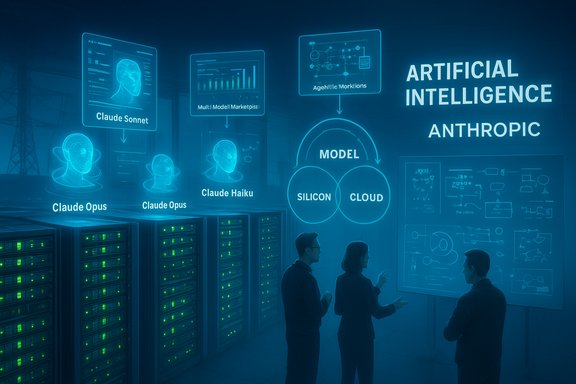
- The new partnerships accelerate a move toward multi‑model marketplaces inside cloud platforms; that matters for architects designing agentic systems, data flows, and observability for real‑time analytics workloads.
The headline facts — what the companies announced (and how to read the numbers)
- Anthropic announced it will scale the Claude family on Microsoft Azure, making specific models available through Azure AI Foundry and across Microsoft’s Copilot product family, including GitHub Copilot and Copilot Studio. The company named model variants such as Claude Sonnet 4.5, Claude Opus 4.1, and Claude Haiku 4.5 as part of this expanded availability.
- Public reports and coordinated statements describe Anthropic’s commitment to purchase roughly $30 billion of Azure compute capacity over a multiyear term. Multiple outlets and the companies framed that number as a reserved, multi‑year spend rather than a single upfront cash payment.
- NVIDIA and Microsoft each committed staged investments in Anthropic: NVIDIA up to $10 billion and Microsoft up to $5 billion, alongside a deep technical partnership between Anthropic and NVIDIA to co‑design and optimize models for NVIDIA architectures (including families described as Grace Blackwell and Vera Rubin). These amounts are presented publicly as “up to” commitments and are likely staged and conditional.
- The announcements referenced access to dedicated NVIDIA‑powered capacity that could scale toward “up to one gigawatt” of electrical capacity — an operational metric that implies very large, facility‑level GPU deployments rather than a simple GPU count. Treat “1 GW” as shorthand for a very large, sustained data‑center power footprint.
Technical implications: what “1 gigawatt” and the system families mean for infrastructure
1. One gigawatt is a facilities-level shorthand
“1 GW” describes electrical capacity, not FLOPS or parameter counts. In practical terms, one gigawatt of IT load implies multiple AI‑dense data halls, significant substation and transformer capacity, extensive cooling and liquid‑cooling deployment, and tens of thousands — potentially hundreds of thousands — of accelerators depending on generation and efficiency assumptions. For IT planners, that translates into:- long procurement lead times for racks and power provisioning,
- the need to model cooling, floor‑space, and network fabrics,
- and ongoing operational cost implications tied to energy prices and regional power availability.
2. Co‑design between models and silicon matters for TCO and performance
NVIDIA’s pledge to co‑engineer with Anthropic signals tighter model↔hardware feedback loops: optimizing model kernels, memory patterns, and communication topologies for specific accelerator generations (Grace Blackwell and Vera Rubin were named) can materially reduce total cost of ownership (TCO) and increase throughput for both training and inference. For enterprise adopters, this can mean:- lower inference latencies for agentic workflows,
- better utilization on GPU clusters for real‑time analytics and long‑context generation,
- and potentially fewer hardware refreshes if architectures are tuned to stable model patterns.
3. Availability inside Azure AI Foundry and Copilot surfaces
Making Claude variants available in Azure AI Foundry and across Copilot products means enterprises can embed frontier model capabilities into internal apps and user productivity flows without moving data outside Azure’s identity and governance controls. That reduces friction for compliance and enterprise embedding — but it also concentrates provider dependencies and requires careful governance.Strategic analysis — who gains, who risks losing, and what this means for the market
What Microsoft gains
- Model choice and enterprise lock‑in. Integrating Anthropic’s frontier models into Azure AI Foundry and Copilot deepens Azure’s multi‑model portfolio, making Azure a one‑stop shop for organizations that want choice between major frontier models.
- Securing long‑term revenue. A $30B reserved buy, even when phased, represents a predictable revenue stream that justifies data‑center expansion and procurement for Microsoft.
- Competitive positioning vs. single‑provider dependence. The move reduces perceived dependence on any single model vendor and strengthens Microsoft’s COO position in enterprise AI distribution.
What NVIDIA gains
- A marquee, high‑volume customer. Co‑designing with Anthropic aligns NVIDIA’s next‑generation architectures with real frontier workloads, increasing the likelihood of broad adoption.
- Upstream validation of system designs. Close engineering collaboration provides NVIDIA with data to tune interconnects, memory hierarchies, and power/thermal tradeoffs for large‑context and agentic workloads.
What Anthropic gains
- Predictable capacity and distribution. Long‑term compute commitments and deep product distribution via Microsoft channels accelerate enterprise reach and reduce infrastructure uncertainty.
- Capital and engineering resources. Staged investments from NVIDIA and Microsoft provide balance‑sheet robustness and access to hardware co‑design resources.
Risks and downsides (market and enterprise perspective)
- Vendor lock‑in and procurement concentration. A massive reserved spend on a single cloud creates negotiation leverage for the cloud provider and concentrates risk — outages, regulatory actions, or pricing shifts could have outsized operational impact.
- Regulatory and competition scrutiny. Such vertically integrated agreements between model owners, cloud providers, and chip makers could attract regulatory attention in multiple jurisdictions concerned about market concentration.
- Environmental and energy implications. Gigawatt‑scale AI deployments bring significant energy consumption. Enterprises and procurement teams must model energy impacts and examine sustainability commitments when planning deployments.
- Operational complexity and SLAs. Long‑duration commitments do not automatically deliver predictable performance for specialized workloads; SLAs, transparency into infrastructure, and benchmarked proof points remain essential.
Practical guidance — what CIOs, architects, and Windows admins should do next
- Run focused pilot projects before any large migration. Use representative data, modelic workloads, and full cost models (including networking and egress).
- Insist on measurable SLAs that include performance, latency, and warm‑start behavior for agentic workflows; include energy/carbon reporting when sustainability is material.
- Maintain multi‑model and multi‑cloud flexibility where possible. Architect agentic systems to be model‑inflation tolerant — that is, to allow switching models or fallbacks if availability or cost changes.
- Validate compliance and data residency. Ensure Copilot or Foundry integrations obey internal data governance, labeling, and access controls before routing production data to any third‑party model.
- Build strong observability into model inference paths and agent orchestration: traceability, auditable prompts, and rollback controls are essential for real‑time analytics and automated decisioning.
- Negotiate visibility and bench‑marking rights: don’t accept opaque performance claims; require the ability to reproduce benchmarks using your workloads.
Other notable real‑time analytics and AI announcements this week
Beyond the Anthropic partnership, the week’s roundup included a number of product launches and platform updates relevant to real‑time analytics, observability, and agentic operations. The following summarizes those items and offers a brief operational read for IT teams. The list mirrors the week’s industry roundup and aggregates vendor claims for readers to triage.Model and open‑source moves
- Olmo 3 (Allen Institute for AI): Ai2 released Olmo 3, a family of fully open models including a 32B “thinking” variant that exposes intermediate reasoning traces and publishes the full model flow — datasets, checkpoints, and training recipes — enabling reproducible research and customization. This is a notable open‑weight contribution for teams that require full transparency or want to run reasoning‑style models on prem.
Observability, telemetry, and pipeline automation
- Bindplane — Pipeline Intelligence: A production‑grade AI automation platform that applies intelligence to telemetry pipeline management. Useful for organizations seeking to automate log parsing, anomaly detection, and routing in large observability pipelines.
- ScaleOut Gen AI Release: ScaleOut added generative AI features to its Active Caching product to auto‑create real‑time analytics visualizations of live cached data — a useful capability for teams needing immediate visual insight into streaming telemetry.
Data and governance platform updates
- Countly 26.01: Introduced a new data engine and an AI‑ready pipeline focused on giving organizations control over the data that feeds their AI — including an AI assistant (Cee) and a next‑gen ingestion pipeline. Useful for privacy‑sensitive analytics operations.
- OpenText AI Data Platform (AIDP): Positioned as a unified platform to converge data management and AI with enterprise security and scalable activation capabilities — relevant for teams managing regulated data and seeking governed AI activation.
- Precisely Gio AI Assistant: A conversational interface for data discovery and integrity tasks, integrated into the Precisely Data Integrity Suite and intended to reduce friction in data quality and governance workflows.
Agent and agentic operations tooling
- CrewAI AOP (Agent Operations Platform): Adds a control plane for designing, deploying, monitoring, and governing agent fleets — combining a no‑code builder with observability and RBAC to help scale agentic operations safely. This aligns with the broader trend of AgentOps control planes for enterprises.
- Iterable — Model Context Protocol (MCP) Server: A new access layer enabling connections between specialized AI tools (e.g., Cursor, Claude Code, Claude Desktop) and the Iterable platform to transform natural language instructions into governed, real‑time marketing actions. Expect this pattern to proliferate across vertical SaaS.
Infrastructure, database, and storage tooling
- pgEdge Control Plane: A distributed control plane for PostgreSQL aimed at easier multi‑host and global deployments. Declarative APIs for DB lifecycle operations help teams scale Postgres in hybrid or distributed environments.
- Datadobi Advanced Storage Optimizer (StorageMAP 7.4): Adds visibility for cost reduction and migration modeling, addressing questions of tiering and storage optimization that matter for long‑tail analytics datasets.
- Hammerspace v5.2: Performance, security, and ecosystem enhancements focused on unifying AI and HPC workloads across hybrid infrastructures, including contributions to client‑side NFS performance improvements.
Security, data classification and software supply chain
- Sentra AI Classifier for Unstructured Data: Claims near‑perfect precision at petabyte scale using small language models optimized for enterprise data — a potential game changer for uncovering sensitive data in large file estates. Organizations should validate precision claims in their data contexts.
- Sonatype Nexus One: A single agentic software supply chain infrastructure unifying OSS intelligence, governance, and automation for dependency management — designed to reduce risk in fast‑moving CI/CD pipelines.
Cross‑checks, verification and flagged claims
Several headline numbers and valuation claims circulated rapidly in industry coverage after the joint announcement. Independent outlets such as Reuters and AP confirmed the headline numbers (Anthropic’s ~$30B Azure compute commitment; NVIDIA up to $10B; Microsoft up to $5B), and Anthropic’s own blog announced the availability of specific Claude models in Microsoft Foundry. These separate confirmations reduce the likelihood that the headline numbers are mere rumor, but the typical contract caveats apply: “up to” clauses, staged tranches, and conditional milestones. Always treat these as contractual caps rather than immediate cash transfers. Unverifiable or variable claims to flag:- Private valuations reported in some outlets varied widely in the immediate aftermath of the announcement. Treat private valuation figures as estimates and verify via company filings or investor statements where possible.
- Exact timelines and tranche schedules for the $30B compute commitment and the $10B/$5B investments were not published in full detail at announcement; if you depend on these figures for procurement or accounting forecasts, insist on contract appendices and escrow‑style commitments.
Bottom line for real‑time analytics teams
This week’s Anthropic–Microsoft–NVIDIA development marks a structural intensification of how models, clouds, and hardware are being bundled. For real‑time analytics teams and IT leaders, the consequences are concrete:- Expect improved access to frontier models inside mainstream cloud tooling, with attendant gains in capability for agents and long‑context analytics.
- Expect a shift in vendor negotiations: compute commitments and co‑design relationships will increasingly influence pricing, SLAs, and roadmap alignment.
- Expect to double down on governance, observability, and pilot rigor: the faster model availability improves capabilities, the more important it is to maintain controls that prevent automated missteps in production.
For WindowsForum readers responsible for deploying these technologies, the immediate practical checklist is simple:
- Build a controlled POC with measurable KPIs,
- Negotiate visibility into vendor performance and cost assumptions,
- Ensure exhaustive audit and governance on agentic systems,
- And keep a multi‑model and multi‑cloud fallback in place while negotiating long‑term commitments.
Anthropic’s expansion into Azure (with NVIDIA’s co‑engineering and multi‑billion‑dollar investments) is a watershed moment for enterprise AI supply chains — one that creates new opportunities for speed and capability, but also concentrates responsibility and risk in ways that enterprise IT must actively manage. The week’s other product launches — from open, inspectable models like Olmo 3 to agent control planes and AI‑ready data engines — underline the same message: capability is accelerating, and so must governance, observability, and pragmatic procurement discipline.
Source: RT Insights Real-time Analytics News for the Week Ending November 22 - RTInsights
