

Anthropic’s clash with the Pentagon has quickly become more than a contract dispute, because it now sits at the intersection of national security, AI governance, and the boundaries of government pressure on private speech. At the same time, Microsoft’s embrace of Anthropic technology inside Copilot shows how fast frontier AI partnerships are hardening into enterprise infrastructure, even as headline-grabbing “Stargate” dreams run into the familiar problems of capital, coordination, and execution. The result is a week in which the AI industry looked simultaneously more powerful and more fragile than it did a month ago. That tension is what makes today’s news so important: the technology is advancing, but the politics around it are becoming more adversarial and more consequential.
The Anthropic-Pentagon dispute did not appear out of nowhere. It grew out of a broader pattern in which frontier AI companies have tried to define ethical limits around military, surveillance, and high-risk deployment scenarios, while public-sector buyers increasingly want access to the most capable models available. That collision is especially sharp in defense procurement, where ordinary vendor discretion can become a national-security issue overnight.
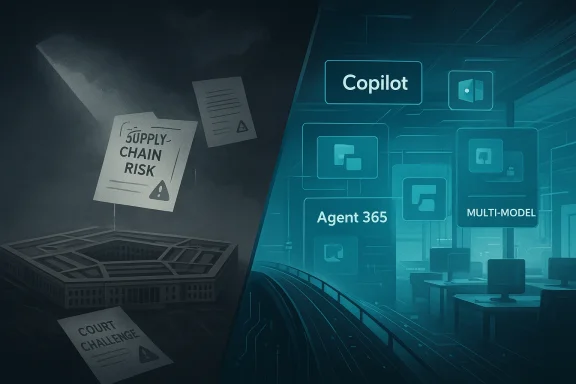
In the reporting surfaced this week, the Pentagon formally informed Anthropic on March 5, 2026, that the company had been designated a supply-chain risk, and Anthropic soon moved to challenge that action in court. The company’s legal argument, as described in the file search material, is that the government’s designation followed a refusal to allow the technology to be used for mass domestic surveillance and fully autonomous weapons. That framing matters because it turns a procurement decision into a constitutional and administrative-law fight.
The controversy is made more combustible by the sworn declarations cited in the reporting. One declaration reportedly points to a March 4 email from Under Secretary Emil Michael to Dario Amodei saying the parties were “very close” on the relevant issues, which would suggest the relationship was not as irreparably broken as the Pentagon later implied. If that sequence holds, it weakens the image of a clean-cut security judgment and makes the case look more like a policy rupture that hardened into formal retaliation.
Microsoft’s role is equally important. The company has been turning Copilot from a drafting assistant into a more autonomous workplace agent, and the latest wave of work around Copilot Cowork places Anthropic technology directly inside that effort. The file search results describe Copilot Cowork as a permissioned, long-running agent intended to plan, execute, and return finished work across Microsoft 365, with deeper model diversity and a new Agent 365 control plane supporting the shift.
That means Anthropic is now in the unusual position of being both politically contested and commercially essential. It is fighting one of the world’s most powerful defense institutions while simultaneously powering one of the world’s most important productivity platforms. That duality is a sign of maturity in the AI market, but it is also a sign of friction: the same model provider can be celebrated as a workplace innovation engine and treated as a supply-chain concern depending on who is buying it.
The most striking detail in the reporting is the tension between private reassurance and public hostility. If senior Defense Department officials were indeed “very close” on key issues before the designation landed, the shift looks abrupt and politically loaded. That does not automatically prove wrongdoing, but it does suggest the government may have been trying to enforce a position through reputational leverage rather than through a fully transparent process.
That possibility will resonate far beyond one company. Other AI vendors watching the case will ask whether moral restraint in military use can become a liability when federal contracts are at stake. The result could be a chilling effect, or it could create a stronger norm that the government must explain itself more carefully when it tries to blacklist a model provider. Either way, the case is likely to become a reference point.
Key implications include:
That is a big change in product philosophy. It also changes how customers evaluate value, because the question is no longer whether the AI can write a cleaner paragraph. The question is whether it can safely manage files, coordinate actions, understand permissions, and produce usable output across Microsoft 365.
Microsoft’s move also confirms that model pluralism is becoming the new enterprise default. Instead of treating one provider as the entire stack, Microsoft is blending capabilities and optimizing for workflow control. That reduces lock-in, but it also means the company is assuming more responsibility for orchestration, governance, and support. In other words, Microsoft is not just buying capability; it is buying complexity.
Important takeaways:
The file search material suggests Anthropic is now being treated not only as a model vendor, but as a strategic architecture provider. That is a major shift from the early LLM era, when companies were mostly judged by raw benchmark performance. Now they are being evaluated on how well their systems integrate into enterprise policy, human workflow, and platform governance.
This is why the Pentagon dispute is so consequential. If Anthropic wins, it reinforces the idea that an AI company can define usage constraints without being punished by the government. If it loses, the market may conclude that ethical restrictions are negotiable once public procurement enters the picture.
What this means in practice:
Even without treating every rumor literally, the lesson is clear. The AI ecosystem is full of extraordinary promises about compute, data centers, and platform-scale coordination, but the industry is still constrained by economics and politics. The more ambitious the plan, the more likely it is to be delayed, diluted, or restructured into something less glamorous. That does not mean the strategy is dead; it means the timing and ownership are unstable.
The deeper issue is that infrastructure promises often sound like industrial policy, but they are still subject to market discipline. If financing tightens, if demand softens, or if partner incentives diverge, the project can stall even if the technology remains compelling. That is why “collapse” in AI usually means something more nuanced than cancellation: it often means the original grand design gets broken into smaller, less visible pieces.
The key dynamics are:
But enterprise adoption will hinge on trust, not demos. Businesses will ask who can see the data, what actions the agent can take, how permissions are enforced, and what happens when the model makes a bad decision. Those questions matter more as agents become capable of acting across systems rather than merely generating text.
This also changes the economics of deployment. Organizations will likely need new audit workflows, stronger access controls, and clearer human approval paths. In other words, agentic AI will not simply reduce labor; it may shift labor toward supervision, exception handling, and policy enforcement.
A few enterprise realities stand out:
At the consumer level, the biggest effect is likely to be normalization. Once people see AI agents handling tasks inside a familiar Microsoft environment, they will become more comfortable delegating. That can be empowering, but it can also create overconfidence, especially if users assume the AI understands context better than it really does.
This is especially relevant because the consumer market tends to copy the enterprise market’s language. When businesses start calling models “coworkers,” ordinary users begin to think of them as colleagues instead of tools. That is a subtle but important shift, and it raises the risk of misplaced confidence.
Consumer-facing consequences include:
Google, OpenAI, and the rest of the ecosystem now have to respond not just to better models but to better integration. The platform battle has moved up the stack. Winning on raw intelligence is no longer enough if another company can turn that intelligence into a governed, enterprise-ready workflow.
For competitors, that creates a dilemma. They can race to build the best model, but if they do not have distribution and workflow integration, they may still lose the enterprise seat. Alternatively, they can try to build their own agent platforms, but that is expensive and slow. The market is increasingly rewarding the companies that can do both.
Competitive consequences to watch:
The upside is real, but it will only materialize if vendors solve for governance, transparency, and reliability at the same pace they improve raw capability.
There is also a broader risk that the industry’s enthusiasm for “coworkers” and “agents” outruns the maturity of the underlying systems. The more autonomous these tools become, the more damage they can do when they are wrong, misconfigured, or misunderstood.
Microsoft’s rollout path is equally important. If Copilot Cowork performs well in research previews and enterprise channels, the company will have a persuasive story about what agentic AI can do inside a controlled environment. If it struggles, the market may become more skeptical of claims that autonomous workplace agents are ready for mainstream deployment.
What to watch next:
Source: Fathom Journal Fathom - For a deeper understanding of Israel, the region, and global antisemitism
 Background
The Anthropic-Pentagon dispute did not appear out of nowhere. It grew out of a broader pattern in which frontier AI companies have tried to define ethical limits around military, surveillance, and high-risk deployment scenarios, while public-sector buyers increasingly want access to the most capable models available. That collision is especially sharp in defense procurement, where ordinary vendor discretion can become a national-security issue overnight.In the reporting surfaced this week, the Pentagon formally informed Anthropic on March 5, 2026, that the company had been designated a supply-chain risk, and Anthropic soon moved to challenge that action in court. The company’s legal argument, as described in the file search material, is that the government’s designation followed a refusal to allow the technology to be used for mass domestic surveillance and fully autonomous weapons. That framing matters because it turns a procurement decision into a constitutional and administrative-law fight.
The controversy is made more combustible by the sworn declarations cited in the reporting. One declaration reportedly points to a March 4 email from Under Secretary Emil Michael to Dario Amodei saying the parties were “very close” on the relevant issues, which would suggest the relationship was not as irreparably broken as the Pentagon later implied. If that sequence holds, it weakens the image of a clean-cut security judgment and makes the case look more like a policy rupture that hardened into formal retaliation.
Microsoft’s role is equally important. The company has been turning Copilot from a drafting assistant into a more autonomous workplace agent, and the latest wave of work around Copilot Cowork places Anthropic technology directly inside that effort. The file search results describe Copilot Cowork as a permissioned, long-running agent intended to plan, execute, and return finished work across Microsoft 365, with deeper model diversity and a new Agent 365 control plane supporting the shift.
That means Anthropic is now in the unusual position of being both politically contested and commercially essential. It is fighting one of the world’s most powerful defense institutions while simultaneously powering one of the world’s most important productivity platforms. That duality is a sign of maturity in the AI market, but it is also a sign of friction: the same model provider can be celebrated as a workplace innovation engine and treated as a supply-chain concern depending on who is buying it.
The Pentagon Fight
The Pentagon lawsuit is the clearest sign that AI policy has moved from abstract debate to real institutional conflict. The company is not just arguing that it was treated unfairly; it is arguing that the government’s own communications undermine the rationale for the designation. That makes the case as much about evidentiary credibility as about AI safety.The most striking detail in the reporting is the tension between private reassurance and public hostility. If senior Defense Department officials were indeed “very close” on key issues before the designation landed, the shift looks abrupt and politically loaded. That does not automatically prove wrongdoing, but it does suggest the government may have been trying to enforce a position through reputational leverage rather than through a fully transparent process.
Why the legal theory matters
Anthropic’s legal posture is significant because it attempts to recast a procurement dispute as protected speech and government retaliation. In practical terms, that gives the company a route to challenge not just the designation itself, but the process that produced it. If that theory gains traction, it could make agencies think twice before punishing vendors whose policy positions are unpopular but whose products are still technically viable.That possibility will resonate far beyond one company. Other AI vendors watching the case will ask whether moral restraint in military use can become a liability when federal contracts are at stake. The result could be a chilling effect, or it could create a stronger norm that the government must explain itself more carefully when it tries to blacklist a model provider. Either way, the case is likely to become a reference point.
Key implications include:
- Procurement power may be more fragile than agencies assume.
- Ethical limits on AI deployment could be tested in court.
- Vendor credibility may become a strategic asset in defense contracting.
- Administrative records will matter more than press statements.
- Policy disagreement may no longer be separable from legal retaliation claims.
Microsoft’s Copilot Strategy
Microsoft’s decision to deepen its relationship with Anthropic is one of the most consequential enterprise AI moves of the year. The company is no longer selling Copilot as a chat box that drafts text faster; it is selling a framework for autonomous work. Copilot Cowork represents a shift from helping humans do tasks to helping systems perform multi-step tasks with limited intervention.That is a big change in product philosophy. It also changes how customers evaluate value, because the question is no longer whether the AI can write a cleaner paragraph. The question is whether it can safely manage files, coordinate actions, understand permissions, and produce usable output across Microsoft 365.
From assistant to agent
The file search results repeatedly describe Copilot Cowork as permissioned, long-running, and capable of planning and execution rather than just generation. That matters because enterprise buyers have been asking for exactly this kind of transition, but they have also been wary of the risk. A drafting tool is easy to review; an agent that takes actions across systems introduces security, compliance, and audit concerns.Microsoft’s move also confirms that model pluralism is becoming the new enterprise default. Instead of treating one provider as the entire stack, Microsoft is blending capabilities and optimizing for workflow control. That reduces lock-in, but it also means the company is assuming more responsibility for orchestration, governance, and support. In other words, Microsoft is not just buying capability; it is buying complexity.
Important takeaways:
- Copilot is becoming agentic, not merely conversational.
- Anthropic’s technology is now embedded in workplace workflows.
- Microsoft is betting on multi-model flexibility rather than single-vendor purity.
- Enterprise buyers will demand stronger governance tools.
- The value proposition is shifting from productivity help to task completion.
Why Anthropic Matters to Both Sides
Anthropic’s position in this story is unusually powerful because it bridges two very different worlds. On one side, it is the company under scrutiny from the Pentagon. On the other, it is the technical partner that helps Microsoft make Copilot feel more autonomous and more credible. That dual role gives Anthropic leverage, but it also multiplies the risks around its brand.The file search material suggests Anthropic is now being treated not only as a model vendor, but as a strategic architecture provider. That is a major shift from the early LLM era, when companies were mostly judged by raw benchmark performance. Now they are being evaluated on how well their systems integrate into enterprise policy, human workflow, and platform governance.
Strategic upside, strategic exposure
Anthropic benefits from being seen as the more cautious, governance-minded frontier lab. That reputation helps when selling into regulated industries and the public sector, and it explains why enterprise partners may trust it with mission-critical workflows. But that same reputation can collide with defense customers who want broad operational latitude and do not appreciate vendor-imposed limits. The better Anthropic is at asserting boundaries, the more likely it is to face boundary-testing customers.This is why the Pentagon dispute is so consequential. If Anthropic wins, it reinforces the idea that an AI company can define usage constraints without being punished by the government. If it loses, the market may conclude that ethical restrictions are negotiable once public procurement enters the picture.
What this means in practice:
- Anthropic’s safety-first image is a commercial asset.
- Its policy stances can also become procurement liabilities.
- Enterprise partners value its governance posture.
- Defense buyers may view the same posture as obstruction.
- The company is becoming a test case for frontier AI independence.
The Stargate Problem
The “Stargate collapses” part of today’s AI news may sound dramatic, but it reflects a familiar pattern in the sector: mega-ambitions often crash into implementation reality. Whenever a project promises giant infrastructure, huge funding, or a transformational national-scale AI buildout, it immediately collides with the slow mechanics of power, procurement, and capital allocation.Even without treating every rumor literally, the lesson is clear. The AI ecosystem is full of extraordinary promises about compute, data centers, and platform-scale coordination, but the industry is still constrained by economics and politics. The more ambitious the plan, the more likely it is to be delayed, diluted, or restructured into something less glamorous. That does not mean the strategy is dead; it means the timing and ownership are unstable.
Why big AI infrastructure is hard
A project like Stargate depends on a chain of assumptions that are easy to state and hard to execute. You need large capital commitments, predictable regulatory environments, a durable energy plan, vendor alignment, and enough customer demand to justify the build. Each of those variables can wobble, and when they do, the narrative of inevitability falls apart fast.The deeper issue is that infrastructure promises often sound like industrial policy, but they are still subject to market discipline. If financing tightens, if demand softens, or if partner incentives diverge, the project can stall even if the technology remains compelling. That is why “collapse” in AI usually means something more nuanced than cancellation: it often means the original grand design gets broken into smaller, less visible pieces.
The key dynamics are:
- Massive AI infrastructure requires long-horizon trust.
- Partner misalignment can slow even the biggest plans.
- Capital intensity makes projects vulnerable to market swings.
- Public narratives of inevitability often outrun operational reality.
- Big announcements are easier than big deployments.
Enterprise Impact
For enterprise customers, the Microsoft-Anthropic alignment is the most immediate story to watch. Copilot Cowork and related agentic tooling promise real productivity gains, especially in organizations that already live inside Microsoft 365. If the system can reliably handle scheduling, document assembly, spreadsheet work, and research tasks, it could meaningfully reduce time spent on repetitive coordination.But enterprise adoption will hinge on trust, not demos. Businesses will ask who can see the data, what actions the agent can take, how permissions are enforced, and what happens when the model makes a bad decision. Those questions matter more as agents become capable of acting across systems rather than merely generating text.
Governance becomes the real product
Microsoft’s addition of an Agent 365 control plane, according to the file search results, is a strong signal that governance is no longer an add-on. It is part of the value proposition. That is the right move because the biggest obstacle to enterprise AI adoption is not lack of ideas; it is fear of uncontrolled behavior, data leakage, and compliance exposure.This also changes the economics of deployment. Organizations will likely need new audit workflows, stronger access controls, and clearer human approval paths. In other words, agentic AI will not simply reduce labor; it may shift labor toward supervision, exception handling, and policy enforcement.
A few enterprise realities stand out:
- Adoption will be fastest in knowledge-work-heavy departments.
- Governance tools will matter as much as model quality.
- Security teams will become part of the buying process.
- Workflow redesign will be necessary for real ROI.
- Human review will remain indispensable for high-stakes tasks.
Consumer Impact
Consumers will feel these shifts more indirectly, but they will feel them. As Microsoft improves Copilot’s agentic capabilities, the line between consumer assistant and workplace automation will continue to blur. Features that begin in enterprise settings often migrate into mainstream productivity products later, and that typically changes expectations across the whole market.At the consumer level, the biggest effect is likely to be normalization. Once people see AI agents handling tasks inside a familiar Microsoft environment, they will become more comfortable delegating. That can be empowering, but it can also create overconfidence, especially if users assume the AI understands context better than it really does.
The psychology of delegation
Consumer AI adoption is no longer just about novelty. It is about trust calibration. If a system can reliably draft, organize, summarize, and coordinate, users start to treat it like a teammate. That is useful, but it also encourages people to pay less attention than they should to edge cases, hidden assumptions, and silent errors.This is especially relevant because the consumer market tends to copy the enterprise market’s language. When businesses start calling models “coworkers,” ordinary users begin to think of them as colleagues instead of tools. That is a subtle but important shift, and it raises the risk of misplaced confidence.
Consumer-facing consequences include:
- More willingness to delegate routine digital chores.
- Higher expectations for speed and polish.
- Greater exposure to hallucinations and workflow mistakes.
- A stronger sense that AI is becoming ambient infrastructure.
- Blurring between personal assistant and productivity platform.
Competition and Market Structure
The competitive implications of these moves are substantial. Microsoft is not simply defending its Copilot franchise; it is repositioning the product as an orchestration layer for workplace AI. That puts pressure on rivals that still think in terms of standalone chatbots or isolated assistant experiences.Google, OpenAI, and the rest of the ecosystem now have to respond not just to better models but to better integration. The platform battle has moved up the stack. Winning on raw intelligence is no longer enough if another company can turn that intelligence into a governed, enterprise-ready workflow.
Multi-model platforms are the new battleground
The file search results suggest Microsoft is embracing model diversity, and that is strategically important. If Microsoft can mix and match providers while keeping control of the user experience, it can reduce dependence on any one lab and improve bargaining power. That also means the value is migrating from the model itself to the platform’s ability to mediate access, permissions, and output.For competitors, that creates a dilemma. They can race to build the best model, but if they do not have distribution and workflow integration, they may still lose the enterprise seat. Alternatively, they can try to build their own agent platforms, but that is expensive and slow. The market is increasingly rewarding the companies that can do both.
Competitive consequences to watch:
- Platform control is becoming more valuable than model novelty.
- Model providers need durable distribution partners.
- Enterprise buyers may prefer orchestration over exclusivity.
- Smaller AI vendors will struggle without platform alliances.
- The next moat is workflow lock-in, not just model quality.
Strengths and Opportunities
The strongest feature of this week’s AI news is that it exposes where the real value is heading: into systems that can safely take action, not just generate content. That creates opportunities for faster work, better enterprise tooling, and more meaningful automation. It also gives companies like Microsoft and Anthropic a chance to define the standards of the next platform era.The upside is real, but it will only materialize if vendors solve for governance, transparency, and reliability at the same pace they improve raw capability.
- Agentic AI can save time on repetitive coordination tasks.
- Multi-model platforms reduce dependence on a single provider.
- Governance layers can make enterprise adoption more credible.
- Defense litigation may clarify vendor rights and limits.
- Microsoft’s distribution can accelerate mainstream adoption.
- Anthropic’s safety posture may attract cautious enterprise buyers.
- Workflow automation could produce measurable productivity gains.
Risks and Concerns
The downside is just as clear. When AI systems move from suggestion to action, errors become more expensive and more visible. The Pentagon case also shows how quickly policy disagreements can escalate into legal and reputational conflict, especially when large institutions perceive a threat to procurement control or operational flexibility.There is also a broader risk that the industry’s enthusiasm for “coworkers” and “agents” outruns the maturity of the underlying systems. The more autonomous these tools become, the more damage they can do when they are wrong, misconfigured, or misunderstood.
- Hallucinations become more dangerous when agents can act.
- Security exposure grows with broader permissions.
- Procurement conflicts may chill useful public-sector innovation.
- Vendor dependence could deepen despite claims of flexibility.
- Hype cycles can distort investment and deployment decisions.
- Over-automation may replace judgment with brittle workflows.
- Regulatory backlash could intensify if deployments go wrong.
Looking Ahead
The next few weeks will tell us whether the Pentagon case becomes a landmark dispute or just a temporary flare-up. If court filings continue to surface evidence that the government’s internal posture was more conciliatory than its public designation suggested, Anthropic’s legal arguments will gain force. If not, the Pentagon may succeed in framing the issue as a routine security judgment rather than a retaliatory act.Microsoft’s rollout path is equally important. If Copilot Cowork performs well in research previews and enterprise channels, the company will have a persuasive story about what agentic AI can do inside a controlled environment. If it struggles, the market may become more skeptical of claims that autonomous workplace agents are ready for mainstream deployment.
What to watch next:
- Court filings in the Anthropic-Pentagon case.
- Enterprise adoption signals for Copilot Cowork.
- Any policy guidance on AI procurement and national security.
- Microsoft’s pricing and packaging for agentic features.
- Competitor responses from Google, OpenAI, and cloud rivals.
Source: Fathom Journal Fathom - For a deeper understanding of Israel, the region, and global antisemitism
Last edited:
