

Anthropic’s recent pivot from a conversational-first product to an explicit bet on autonomous, always‑on “AI agents” is no incremental product update — it is a strategic re‑definition of how enterprise software will get built and bought over the next decade.
Anthropic launched in 2021 with an unusually explicit mission: build large language models that are safe, interpretable, and steerable. That mission has shaped both the company’s research posture — notably its adoption of Constitutional AI as a training method — and its product roadmap as Claude evolved from a chat assistant into a platform capable of direct action. Constitutional AI and Anthropic’s safety research are central to how the company markets Claude to risk‑sensitive enterprise customers.
The technical and commercial contours of the company changed rapidly through 2024–2025. Anthropic introduced a computer use capability that allows Claude to see and interact with a desktop environment — taking screenshots, moving cursors, clicking buttons and typing — and exposed that functionality to developers in beta. That capability, paired with APIs that let Claude call services, write and run code, and orchestrate tools, is the foundation for what the industry now calls agentic AI. Reporting and technical previews make clear that Anthropic’s agents are meant to do more than answer questions: they can plan, execute, and iterate on multi‑step workflows across apps.
Anthropic’s fundraising and commercial momentum are non‑trivial context for this shift. The company closed a multibillion‑dollar financing in early 2025 and entered the enterprise platform race with considerable capital and partner commitments — moves that let it prioritize production‑grade features like longer context windows, enterprise tooling, and agent governance. Independent reporting shows a pattern of rapid revenue growth in 2025 as enterprise adoption widened, though headline figures vary between outlets and should be treated with care.
Why that matters: the marginal cost of an agent doing repeated cognitive tasks is tiny relative to a human employee’s salary and overhead. Vendors pitch agents as 24/7 digital coworkers that remove “digital friction” — the lost time from switching contexts and manually moving data across tools. For finance, legal, customer support, and other knowledge‑work areas, that friction is large and measurable; automating even a fraction of it produces quantifiable ROI.
Inside firms, two simultaneous forces are already visible in planning documents and pilot reporting: a near‑term compression of repetitive, entry‑level tasks; and an acute demand for specialized talent that can design, govern, and extend agents (prompt engineers, model ops, agent workflow designers, security and compliance specialists). Industry threads show businesses treating this as a planned “realignment,” where headcount is shifted into AI‑adjacent roles — but that depends entirely on firms investing in reskilling and providing real redeployment pathways.
There are early empirical signs of change. Independent payroll and sectoral studies have documented reductions in certain entry‑level roles exposed to generative AI tasks; investment bank modeling and consultant surveys project large reductions in specific back‑office and repetitive functions if adoption deepens. These shifts are not deterministic outcomes — they depend on adoption speed, regulation, and companies’ choices about redeployment. But the direction of change is clear: the demand profile for workers is moving toward AI supervision and orchestration skills.
Regulatory action is beginning to catch up — but unevenly. The European Union’s AI Act entered a phased implementation in 2024–2025 and establishes obligations that touch general‑purpose models and systems deemed “high‑risk,” creating a legal baseline for audits, documentation, and human oversight. In contrast, the United States still lacks a comprehensive federal AI statute; regulation remains a patchwork of state rules and sectoral guidance. That divergence matters: global vendors must navigate regionally differentiated compliance regimes as they roll out agents across multinational customers.
That said, not all published numbers in the broader press are consistent. Some articles and summaries have aggregated different rounds or extrapolated future funding totals in ways that are not directly supported by primary reporting. Where press claims conflict with contemporaneous filings or major financial press investigations, treat them as estimates rather than established fact; for example, an aggregated $15 billion funding figure appearing in downstream summaries does not match primary coverage of the March 2025 round and should be flagged as unverifiable until corroborated by primary disclosures. Readers should always check funding claims against original filings or reporting from primary financial outlets.
The promise is real: measurable productivity gains, faster decision cycles, and the automation of tedious but essential tasks. The risks are structural: brittle automation producing harmful actions, a governance vacuum trailing deployment, and a labor market that must adapt quickly if the social benefits are to outweigh the costs.
For IT leaders, the practical calculus is straightforward but urgent: pilot narrowly, instrument exhaustively, build governance first, and invest in human capacity to supervise and improve agents. For policymakers, the imperative equally clear: close the governance gaps and align incentives so that agent-driven productivity raises social value without leaving whole classes of workers behind.
Anthropic is staking its future on the notion that a safety‑first agent can win enterprise trust and dollars. Whether that bet pays off commercially — and whether society adapts equitably — will be one of the defining technology stories of the decade.
Source: WebProNews Anthropic Bets Big on AI Agents That Work While You Sleep — And It’s Reshaping the Future of White-Collar Labor
 Background / Overview
Anthropic launched in 2021 with an unusually explicit mission: build large language models that are safe, interpretable, and steerable. That mission has shaped both the company’s research posture — notably its adoption of Constitutional AI as a training method — and its product roadmap as Claude evolved from a chat assistant into a platform capable of direct action. Constitutional AI and Anthropic’s safety research are central to how the company markets Claude to risk‑sensitive enterprise customers. The technical and commercial contours of the company changed rapidly through 2024–2025. Anthropic introduced a computer use capability that allows Claude to see and interact with a desktop environment — taking screenshots, moving cursors, clicking buttons and typing — and exposed that functionality to developers in beta. That capability, paired with APIs that let Claude call services, write and run code, and orchestrate tools, is the foundation for what the industry now calls agentic AI. Reporting and technical previews make clear that Anthropic’s agents are meant to do more than answer questions: they can plan, execute, and iterate on multi‑step workflows across apps.
Anthropic’s fundraising and commercial momentum are non‑trivial context for this shift. The company closed a multibillion‑dollar financing in early 2025 and entered the enterprise platform race with considerable capital and partner commitments — moves that let it prioritize production‑grade features like longer context windows, enterprise tooling, and agent governance. Independent reporting shows a pattern of rapid revenue growth in 2025 as enterprise adoption widened, though headline figures vary between outlets and should be treated with care.
What “Agentic AI” Actually Is (and Why It Matters)
At a functional level an AI agent bundles several capabilities that together allow autonomous execution:- A powerful foundation model for planning and language reasoning.
- Tool and connector access (APIs, browsers, app automation).
- Persistent state or memory across sessions.
- An orchestration layer that decomposes objectives into concrete steps.
- Observability, auditing, and permissioning so actions can be traced and controlled.
Why that matters: the marginal cost of an agent doing repeated cognitive tasks is tiny relative to a human employee’s salary and overhead. Vendors pitch agents as 24/7 digital coworkers that remove “digital friction” — the lost time from switching contexts and manually moving data across tools. For finance, legal, customer support, and other knowledge‑work areas, that friction is large and measurable; automating even a fraction of it produces quantifiable ROI.
Anthropic’s Technical Moves: Claude, “Computer Use,” and Multi‑Agent Orchestration
Anthropic’s public demos and product notes emphasize two technical vectors:- Generalized UI automation: the computer use beta trains Claude to interpret screenshots and issue mouse/keyboard actions, enabling it to use existing apps the same way a human would. That bypasses the need for bespoke APIs for every target app and opens automation to any tool with a GUI. Early coverage and developer previews emphasized both the promise and the brittleness — screenshot‑based control is powerful but error‑prone and needs robust guardrails.
- Agent orchestration and “agent fleets”: rather than one omniscient agent, Anthropic’s product direction points to specialized agents that coordinate — breaking complex problems into sub‑tasks and handing those off to goal‑oriented workers. The company’s roadmap and industry reporting indicate a focus on multi‑agent orchestration so agents can collaborate (for example: one agent gathers data, another validates numbers, a third prepares a report and distributes it). Threaded community analysis shows IT leaders treating multi‑agent orchestration as the next hard engineering challenge for scalable deployments.
Competition and the Enterprise Gold Rush
Anthropic is one player in a crowded field where the line between research lab and enterprise vendor is blurring. The competitive set includes:- OpenAI, which has pushed agentic features via Operator, the Responses API and function calling that let models drive actions and integrate tools; Operator sits behind careful controls and research previews aimed at building trust for web‑action tasks.
- Microsoft, which embeds agentic and copiloting features deep into Office and Copilot Studio, prioritizing governance primitives and identity‑backed agents inside tools enterprises already use.
- Google, pushing agent capabilities through Gemini and Workspace integrations and partnering with enterprise software providers to run agents tied to search, documents, and big context windows.
What Agentic Work Looks Like in Practice: Short Use Cases
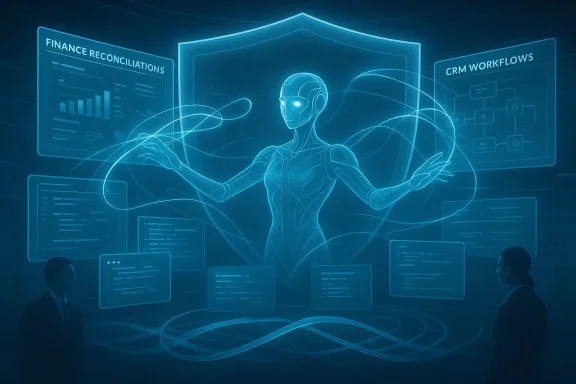
- Finance reconciliation: an agent logs into accounting platforms, pulls expense ledgers, flags mismatches, generates reconciliations and emails stakeholders with an audit trail. Human auditors review exceptions only. (This is a common enterprise pilot pattern.)
- Customer support automation: agents pre‑populate case notes, triage tickets across systems, draft replies, and trigger escalation workflows when confidence thresholds are low — increasing throughput while preserving human judgment for edge cases.
- Developer productivity: an agent inspects a failing CI run, reproduces the failure locally using browser/terminal automation, attempts a fix or otherwise composes an actionable PR with diagnostics for a human reviewer. Anthropic’s Claude Code and related CLI-focused tooling are explicitly positioned for these scenarios.
- Sales/marketing research: agents scan competitor pages, compile a one‑page briefing, pre‑populate CRM fields, and schedule a follow‑up outreach — compressing hours of manual work into a single automated run.
The Labor Market Shock: Augmentation or Displacement?
The stakes here are profound. Recent macro analyses show that generative AI and agentic automation could materially change the distribution of tasks and roles across developed economies. The McKinsey Global Institute’s modeling found that, under plausible adoption scenarios, up to 30% of hours worked in the U.S. could be automated by 2030, with generative AI accelerating the transition. That projection places knowledge‑work roles — not just factory or manual jobs — squarely in the exposure set.Inside firms, two simultaneous forces are already visible in planning documents and pilot reporting: a near‑term compression of repetitive, entry‑level tasks; and an acute demand for specialized talent that can design, govern, and extend agents (prompt engineers, model ops, agent workflow designers, security and compliance specialists). Industry threads show businesses treating this as a planned “realignment,” where headcount is shifted into AI‑adjacent roles — but that depends entirely on firms investing in reskilling and providing real redeployment pathways.
There are early empirical signs of change. Independent payroll and sectoral studies have documented reductions in certain entry‑level roles exposed to generative AI tasks; investment bank modeling and consultant surveys project large reductions in specific back‑office and repetitive functions if adoption deepens. These shifts are not deterministic outcomes — they depend on adoption speed, regulation, and companies’ choices about redeployment. But the direction of change is clear: the demand profile for workers is moving toward AI supervision and orchestration skills.
Safety, Trust, and the Governance Gap
Autonomous agents introduce failure modes that are qualitatively different from earlier automation:- Action errors: agents can take concrete actions such as financial transfers or emails to external recipients, amplifying the impact of a hallucination or mis‑parsing.
- Attack surface expansion: granting agents tool access and credentials adds new vectors for fraud, prompt injection, and privilege escalation.
- Audit and liability ambiguity: when an agent decides and acts, who bears responsibility for mistakes — the vendor, the deploying company, or the human approver? Current legal frameworks often don’t map cleanly to these scenarios.
Regulatory action is beginning to catch up — but unevenly. The European Union’s AI Act entered a phased implementation in 2024–2025 and establishes obligations that touch general‑purpose models and systems deemed “high‑risk,” creating a legal baseline for audits, documentation, and human oversight. In contrast, the United States still lacks a comprehensive federal AI statute; regulation remains a patchwork of state rules and sectoral guidance. That divergence matters: global vendors must navigate regionally differentiated compliance regimes as they roll out agents across multinational customers.
Commercial Reality Check: Funding, Revenues, and the Hype Line
Multiple reputable outlets reported that Anthropic closed a major funding round in early 2025 that materially increased its valuation and balance sheet — the Financial Times and other publishers documented a $3.5 billion Series E that implied a valuation in the tens of billions. Other reporting throughout 2025 then followed Anthropic’s rapid revenue trajectory, with several outlets noting big jumps in annualized revenue run rate as enterprise demand rose. These data points are consequential: capital and cash flow enable aggressive productization, global expansion, and safety engineering — all necessary to scale agentic offerings.That said, not all published numbers in the broader press are consistent. Some articles and summaries have aggregated different rounds or extrapolated future funding totals in ways that are not directly supported by primary reporting. Where press claims conflict with contemporaneous filings or major financial press investigations, treat them as estimates rather than established fact; for example, an aggregated $15 billion funding figure appearing in downstream summaries does not match primary coverage of the March 2025 round and should be flagged as unverifiable until corroborated by primary disclosures. Readers should always check funding claims against original filings or reporting from primary financial outlets.
How Enterprises Should Approach Agents — A Practical Playbook
Enterprises that want to capture agent value without creating catastrophic risk should consider a staged approach:- Pilot: scope very narrow, instrument heavily, and measure ROI in hard terms (time saved, error reduction). Start with backend tasks that are impactful but low‑risk (e.g., report generation, sanitized data aggregation).
- Governance: implement least‑privilege identities for agents, centralize plugin and connector approval, and require human sign‑offs for financial or external communications.
- Observability: log every agent action (inputs, tool calls, outputs) and store immutable audit trails for forensic reconstruction.
- Validation: treat agent outputs like code — version, test, and validate in sandboxed production‑like environments before rollout.
- Workforce planning: invest in reskilling programs aimed at agent‑orchestration roles and clearly communicate redeployment paths for affected staff.
The Road Ahead: What to Watch
- Multi‑agent orchestration at scale: the real inflection will be when multiple agents reliably coordinate on long‑running projects, with traceable decision chains and bounded failure modes. If Anthropic or competitors crack this at enterprise scale, productivity gains could be historic.
- Interoperability and standards: the market needs common formats for agent observability, tool call semantics, and permissioning. Expect standards bodies, cloud providers and observability vendors to race to define these primitives.
- Regulation and liability: the EU AI Act’s phased rules will create baseline obligations for providers and deployers; U.S. and other jurisdictions may follow with patchwork or sectoral laws. Legal tests around liability for agentic actions — who is responsible when an agent acts badly — will be litigated in the coming years.
- Labor markets and reskilling outcomes: whether organizations choose to redeploy savings into higher‑value human work or to permanently shrink certain roles will determine the social outcomes of agent adoption. Public policy choices about retraining, income support and educational pathways will materially shape the human cost.
Conclusion
Anthropic’s push for agentic Claude — pairing UI automation, tool use, and multi‑agent orchestration with a safety‑focused research posture — is emblematic of the second phase of generative AI: from conversation to authority to act. That shift will amplify benefits where work is highly repeatable and cross‑system, and it will exacerbate the most difficult questions where jobs, privacy, and legal responsibility collide.The promise is real: measurable productivity gains, faster decision cycles, and the automation of tedious but essential tasks. The risks are structural: brittle automation producing harmful actions, a governance vacuum trailing deployment, and a labor market that must adapt quickly if the social benefits are to outweigh the costs.
For IT leaders, the practical calculus is straightforward but urgent: pilot narrowly, instrument exhaustively, build governance first, and invest in human capacity to supervise and improve agents. For policymakers, the imperative equally clear: close the governance gaps and align incentives so that agent-driven productivity raises social value without leaving whole classes of workers behind.
Anthropic is staking its future on the notion that a safety‑first agent can win enterprise trust and dollars. Whether that bet pays off commercially — and whether society adapts equitably — will be one of the defining technology stories of the decade.
Source: WebProNews Anthropic Bets Big on AI Agents That Work While You Sleep — And It’s Reshaping the Future of White-Collar Labor
