

In Malaysia, Prime Minister Anwar Ibrahim is getting an AI avatar as a Johor state election unfolds on Saturday, while Bursa’s ACE market is showcasing companies that market themselves through AI branding or dependence on existing platforms rather than building the full technology stack. The Malaysianist’s sharp joke—A(nwar) I(brahim)—captures a serious problem: artificial intelligence is becoming a label attached to leaders, products and investment stories before anyone agrees on what the label proves. The distinction that matters is no longer whether an organisation “uses AI,” because almost any organisation can now make that claim. It is where the intelligence comes from, who controls it, and who remains accountable when it fails.
The avatar and the market listings may look like separate stories, one political and one financial. They are really two versions of the same transition: AI is moving from a difficult engineering discipline into a mass-market layer that can be rented, wrapped, personified and promoted.
The Malaysianist introduces Anwar’s avatar as a punchline about permanent political messaging: an automated prime minister, available around the clock. Other reporting presents the project more functionally, describing a digital version of Anwar intended to converse with the public and guide people through government information and services.
Those interpretations are not mutually exclusive. A system can help citizens navigate bureaucracy while also extending a politician’s voice, image and preferred framing into every interaction.
That dual role is precisely why a political avatar deserves more scrutiny than an ordinary chatbot. A government website is recognisably an institutional publication; an avatar resembling a sitting prime minister creates the impression that the leader himself is answering, even when the response is generated by software, selected data and rules established by other people.
The interface therefore does more than communicate information. It borrows Anwar’s personal authority and transfers it to a machine.
That transfer can be powerful. People who would never search a policy portal, read a departmental circular or decipher a government form may be willing to ask a familiar-looking figure a simple question. Conversational systems can reduce the distance between administrative language and daily life, particularly when they understand how citizens actually speak rather than forcing users to learn the vocabulary of government.
But familiarity also makes the system harder to challenge. A generic assistant can be treated as a tool. A digital prime minister can feel like an official answer delivered personally, even if the underlying response is incomplete, outdated or assembled from material that reflects the government’s own priorities.
The Malaysianist calls the result propaganda. That is an argumentative judgment, not a neutral technical description, but it identifies the central governance risk: the avatar may blur service delivery, political communication and personal promotion inside a single interface.
The truthful response is not simply “Anwar Ibrahim.” It is a chain of contributors: the people who select the training material, the engineers who configure the system, the officials who approve its answers, the vendors that provide its technical foundations and the administrators who decide what information it may access.
The public sees the face at the end of that chain. Accountability must travel in the opposite direction.
If the avatar gives a citizen incorrect instructions, the government cannot plausibly blame the model as though it were an independent official. If it describes a disputed policy using partisan language, the output should not acquire neutrality merely because software generated the final sentence. If it completes or initiates an administrative task, the user needs to know which agency owns the transaction and which human process exists for correcting it.
This is where the difference between an informational avatar and an agent becomes important. An informational system suggests where to go. An agentic system may attempt to take steps on the user’s behalf.
The second category raises much harder questions. A wrong answer is damaging, but a wrong action can affect payments, applications, records or access to services. Once an avatar moves from explaining government to operating government, identity verification, authorisation, audit logs, appeal mechanisms and data retention become part of the product.
The leader’s likeness can obscure those mechanics. Users may believe they are dealing with the prime minister when they are actually moving through a collection of databases, APIs, contractors and administrative rules. The face is political; the transaction underneath it is technical and bureaucratic.
The most responsible implementation would make that distinction visible at every consequential step. It would identify the responsible agency, explain when an answer was generated rather than written, show the source of official information and require explicit confirmation before taking action.
A disclaimer shown once at the beginning would not be enough. Transparency has to accompany the user through the interaction, especially when the system shifts from conversation to execution.
Political technology does not enter a vacuum. An avatar based on a sitting prime minister inevitably becomes part of the contest over his image, competence and modernity.
The political advantage is easy to understand. An AI avatar presents Anwar as technologically fluent and permanently accessible. It compresses a broad digital-governance agenda into an image voters can immediately recognise: the leader, replicated as software, ready to speak whenever summoned.
That is more emotionally legible than a data-exchange programme or a redesigned government portal. It also makes the prime minister—not an agency, ministry or civil-service team—the visible centre of digital administration.
This is a familiar political pattern even if the technology is new. Governments often personalise policies that are institutionally produced. AI allows that personalisation to be automated and scaled.
The risk is that the boundary between governing and campaigning becomes even less distinct. If the avatar explains policies, repeats official achievements and uses Anwar’s communication style, citizens may reasonably ask whether they are receiving administrative help or participating in a continuous political encounter.
The answer may be both. That makes disclosure more important, not less.
A digital representation of a political leader should not be treated exactly like a campaign video because it can respond dynamically to individuals. Nor should it be treated like an ordinary public-service portal because its persuasive power comes partly from the leader’s identity.
It is a third category: personalised political infrastructure. Malaysia’s challenge will be to develop controls appropriate to that category rather than assuming existing labels already cover it.
The newsletter summarises the first model with a deliberately blunt line: “OpenAI, the company behind ChatGPT, spent more than its entire revenue doing exactly this.”
OpenAI’s own public descriptions of its strategy support the underlying point, even when they frame the spending as investment rather than excess. The company portrays compute, infrastructure, models, products and distribution as a reinforcing system: more computing capacity supports more capable models, which support broader products and usage, which are intended to generate the revenue needed for further expansion.
That is not a normal software cost structure. A conventional software company can often build once and distribute additional copies cheaply. A frontier AI provider must pay to train models and then continue paying to run them whenever users ask questions, generate images, analyse documents or invoke automated tools.
The model is therefore not merely intellectual property stored on a server. It is an industrial service consuming chips, data-centre capacity, electricity, networking, engineering labour and capital.
This matters because the word AI company now describes organisations with radically different exposures. One may own or control core models and carry their research and infrastructure costs. Another may pay for access to those models and package the output for a particular market. A third may use an AI feature supplied by an existing cloud or software vendor while changing little else about its underlying business.
All three may produce useful products. They are not the same kind of company.
The table is not a hierarchy of moral worth. A specialist company built on another provider’s model can be profitable, defensible and valuable. Most businesses do not need to manufacture their own processors, operate their own cloud or train a general-purpose model.
The problem begins when the second category is priced, promoted or discussed as though it were the first.
Reporting by The Edge illustrates why that distinction cannot be made by reading a company name alone. AI-branded businesses may still derive their revenue from familiar activities such as consulting, cloud subscriptions, managed services, implementation work, software resale or hardware supply.
Those operations can be perfectly legitimate. They may also benefit from AI adoption. But benefiting from the AI cycle is not equivalent to owning the technology that drives it.
A reseller may earn more because customers are buying cloud services associated with AI workloads. An infrastructure contractor may benefit because data centres need power and cooling. A consultancy may help enterprises deploy assistants from larger vendors. A software company may insert generated text, image analysis or automation into an established product.
Each sits somewhere in the AI value chain, but at a different layer and with a different risk profile. Calling all of them AI companies can hide more than it reveals.
For investors, the key question is not whether a prospectus contains an AI strategy. It is whether that strategy materially changes the company’s economics.
Does AI create a product that customers cannot easily obtain elsewhere? Does it improve margins, or does the company merely pass platform costs through to clients? Does the business own valuable data and workflow knowledge? Can customers replace it by buying directly from a larger vendor? What happens if the upstream platform changes its pricing, technical limits or partner terms?
Those are ordinary due-diligence questions sharpened by an extraordinary wave of marketing. The suffix attracts attention, but cash flow still comes from contracts, renewals, utilisation and pricing power.
That leverage is the attraction. It is also the dependency.
The upstream provider can change prices, usage limits, safety rules, supported features or access conditions. A model update can improve the downstream product, but it can also alter behaviour in ways the application developer did not anticipate. A feature introduced directly into ChatGPT or another general-purpose service can absorb functionality that previously supported an entire startup.
This is sometimes called platform risk, but the phrase can sound more abstract than the consequence. The practical consequence is that a company may not control the component its customers perceive as the product’s intelligence.
That does not make the company uninvestable or the product unusable. Microsoft software resellers, cloud consultancies and managed-service providers have built durable businesses without owning the platforms they sell. They survive by adding deployment expertise, local support, integration, compliance knowledge and long-term customer relationships.
An AI integrator has to prove the same value. Merely connecting a user interface to a model is unlikely to remain defensible because competitors can obtain access to similar capabilities.
The stronger businesses will own the difficult last mile: industry-specific workflows, proprietary or contractually protected data, trusted deployment practices, measurable outcomes and integration with systems customers cannot casually replace.
The weak businesses will rely on the novelty of generated output. Novelty depreciates quickly.
A more useful examination begins with provenance. Which model produces the output? Is it operated by the vendor, a cloud partner or another third party? Can the customer choose or change it?
The next issue is data. What information is sent to the model, where is it processed, how long is it retained and whether it can be used for further training are not procurement trivia. They determine whether the product can safely handle corporate documents, personal information, legal material or government records.
Then comes evaluation. A vendor that claims an AI feature improves productivity should be able to define the work being improved and show how performance was measured. A demonstration in which the system produces an impressive answer is not the same as evidence that it reduces errors, lowers cost or completes real work reliably.
Finally, there is failure ownership. Vendors often describe successful AI output as a product capability but describe unsuccessful output as a limitation inherent to the model. Customers should reject that asymmetry.
If a company sells the system, it owns the responsibility for presenting its limitations accurately, monitoring its behaviour and creating a usable remedy when it causes harm.
That principle applies equally to a Bursa-listed technology provider and to a government avatar wearing the face of Anwar Ibrahim. The interface may depend on third-party technology, but accountability cannot simply be outsourced upstream.
This is where the distinction between core model builder and integrator becomes operationally important. The vendor selling an AI assistant may control the application but not the model. It may rely on another company for hosting, yet use a different provider for identity, logging or document retrieval.
An apparently simple assistant can therefore create a long chain of processors and permissions. Documents may move from a Windows endpoint into a business application, through a connector, into a retrieval system and finally to a model provider. The answer may then be stored in logs controlled by several parties.
Administrators need an architecture diagram, not an AI slogan.
They also need to examine identity boundaries. If an assistant can search internal documents or take actions, it should inherit the user’s permissions rather than receiving broad service-level access. A conversational interface must not become a shortcut around carefully designed access controls.
The same rule applies to government systems. An avatar should not obtain expansive access merely because it needs to make public services feel seamless. Convenience is not a substitute for least privilege.
Output controls matter as well. Generated text can look authoritative while being wrong, and an avatar that resembles a leader intensifies that impression. High-impact answers should be grounded in identifiable official records, with sensitive actions separated from the conversational layer and recorded for later review.
AI procurement is therefore partly ordinary enterprise security work. The technology is new, but the enduring questions concern identity, data classification, supplier management, auditability and incident response.
Both reduce complexity. Voters do not need to understand model architecture to see a digital prime minister. Investors do not need to study a company’s dependency graph to notice two letters added to its branding.
That compression is valuable because AI is difficult to explain. It is also dangerous because it allows presentation to outrun substance.
The avatar may represent a carefully engineered public-service system, a political communication vehicle or both. An AI-branded company may possess deep integration expertise, valuable data and a credible product strategy, or it may be repackaging ordinary services around a popular term.
The surface does not settle the question.
The most revealing evidence sits underneath: technical ownership, revenue composition, operating costs, contractual dependencies, data rights and measurable outcomes. In politics, the equivalent evidence includes the source of answers, editorial controls, disclosure rules and the line of accountability when the digital representative says something the real officeholder would not defend.
The temptation is to divide the field into “real AI” and “fake AI.” That is too crude. Useful applications often come from companies that do not build foundational models, just as useful public services can be delivered through technology purchased from outside vendors.
A better division is between organisations that are candid about their position in the stack and those that use the ambiguity of AI to imply more capability, ownership or independence than they possess.
AI is not less real because it is built on somebody else’s platform. Its risks are simply located somewhere else.
That ambiguity benefits promoters. It does not benefit citizens, customers, administrators or investors trying to compare systems.
A useful vocabulary would distinguish model developers from application vendors, infrastructure suppliers, integrators, resellers and AI-enabled businesses. It would also distinguish a political avatar that communicates approved information from an autonomous agent authorised to perform government tasks.
Without those distinctions, debates collapse into extremes. Enthusiasts treat every AI attachment as transformation; sceptics treat every platform-based service as a wrapper. Neither position reflects how technology markets actually develop.
Most commercially useful systems will combine components from many organisations. Their value will often come not from inventing the model but from embedding it into a process safely and effectively. Integration is real work.
Yet integration deserves to be judged as integration. A company should not receive the strategic aura of a frontier laboratory simply because it consumes that laboratory’s output. A government should not describe a leader-shaped assistant as public-service modernisation without confronting its political and administrative implications.
Better labels will not solve bad products or misleading promotions. They will at least make the right questions harder to evade.
AI is likely to follow a similar path. As models become embedded in ordinary software, the presence of an AI feature will stop distinguishing a product. Reliability, cost, workflow fit, security and customer outcomes will regain their usual importance.
That transition will be uncomfortable for businesses whose principal advantage is the label. It will favour those that use rented intelligence to build something customers genuinely need and cannot cheaply reproduce.
Political avatars face a comparable test. The first encounter may attract attention because a digital prime minister is novel. Continued use will depend on whether the system gives accurate answers, respects citizens’ data and completes useful tasks without turning every interaction into a performance of political loyalty.
Anwar’s likeness may bring people to the interface. It cannot, by itself, make the interface trustworthy.
The avatar and the market listings may look like separate stories, one political and one financial. They are really two versions of the same transition: AI is moving from a difficult engineering discipline into a mass-market layer that can be rented, wrapped, personified and promoted.
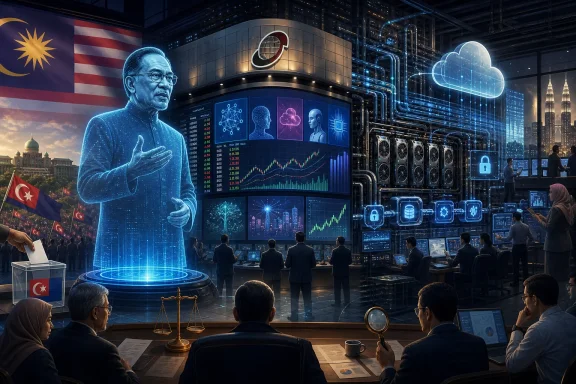 Anwar’s Avatar Turns Political Authority Into a Software Interface
The Malaysianist introduces Anwar’s avatar as a punchline about permanent political messaging: an automated prime minister, available around the clock. Other reporting presents the project more functionally, describing a digital version of Anwar intended to converse with the public and guide people through government information and services.Those interpretations are not mutually exclusive. A system can help citizens navigate bureaucracy while also extending a politician’s voice, image and preferred framing into every interaction.
That dual role is precisely why a political avatar deserves more scrutiny than an ordinary chatbot. A government website is recognisably an institutional publication; an avatar resembling a sitting prime minister creates the impression that the leader himself is answering, even when the response is generated by software, selected data and rules established by other people.
The interface therefore does more than communicate information. It borrows Anwar’s personal authority and transfers it to a machine.
That transfer can be powerful. People who would never search a policy portal, read a departmental circular or decipher a government form may be willing to ask a familiar-looking figure a simple question. Conversational systems can reduce the distance between administrative language and daily life, particularly when they understand how citizens actually speak rather than forcing users to learn the vocabulary of government.
But familiarity also makes the system harder to challenge. A generic assistant can be treated as a tool. A digital prime minister can feel like an official answer delivered personally, even if the underlying response is incomplete, outdated or assembled from material that reflects the government’s own priorities.
The Malaysianist calls the result propaganda. That is an argumentative judgment, not a neutral technical description, but it identifies the central governance risk: the avatar may blur service delivery, political communication and personal promotion inside a single interface.
A Digital Leader Cannot Be Allowed to Become an Unanswerable One
Any system representing a political leader needs to answer a basic question before it answers citizens: Who is speaking?The truthful response is not simply “Anwar Ibrahim.” It is a chain of contributors: the people who select the training material, the engineers who configure the system, the officials who approve its answers, the vendors that provide its technical foundations and the administrators who decide what information it may access.
The public sees the face at the end of that chain. Accountability must travel in the opposite direction.
If the avatar gives a citizen incorrect instructions, the government cannot plausibly blame the model as though it were an independent official. If it describes a disputed policy using partisan language, the output should not acquire neutrality merely because software generated the final sentence. If it completes or initiates an administrative task, the user needs to know which agency owns the transaction and which human process exists for correcting it.
This is where the difference between an informational avatar and an agent becomes important. An informational system suggests where to go. An agentic system may attempt to take steps on the user’s behalf.
The second category raises much harder questions. A wrong answer is damaging, but a wrong action can affect payments, applications, records or access to services. Once an avatar moves from explaining government to operating government, identity verification, authorisation, audit logs, appeal mechanisms and data retention become part of the product.
The leader’s likeness can obscure those mechanics. Users may believe they are dealing with the prime minister when they are actually moving through a collection of databases, APIs, contractors and administrative rules. The face is political; the transaction underneath it is technical and bureaucratic.
The most responsible implementation would make that distinction visible at every consequential step. It would identify the responsible agency, explain when an answer was generated rather than written, show the source of official information and require explicit confirmation before taking action.
A disclaimer shown once at the beginning would not be enough. Transparency has to accompany the user through the interaction, especially when the system shifts from conversation to execution.
The Johor Election Makes the Timing Impossible to Ignore
The Malaysianist published its observation while a state election was taking place in Johor on Saturday. That context changes how the avatar is likely to be interpreted, regardless of whether the project’s designers regard it primarily as a public-service tool.Political technology does not enter a vacuum. An avatar based on a sitting prime minister inevitably becomes part of the contest over his image, competence and modernity.
The political advantage is easy to understand. An AI avatar presents Anwar as technologically fluent and permanently accessible. It compresses a broad digital-governance agenda into an image voters can immediately recognise: the leader, replicated as software, ready to speak whenever summoned.
That is more emotionally legible than a data-exchange programme or a redesigned government portal. It also makes the prime minister—not an agency, ministry or civil-service team—the visible centre of digital administration.
This is a familiar political pattern even if the technology is new. Governments often personalise policies that are institutionally produced. AI allows that personalisation to be automated and scaled.
The risk is that the boundary between governing and campaigning becomes even less distinct. If the avatar explains policies, repeats official achievements and uses Anwar’s communication style, citizens may reasonably ask whether they are receiving administrative help or participating in a continuous political encounter.
The answer may be both. That makes disclosure more important, not less.
A digital representation of a political leader should not be treated exactly like a campaign video because it can respond dynamically to individuals. Nor should it be treated like an ordinary public-service portal because its persuasive power comes partly from the leader’s identity.
It is a third category: personalised political infrastructure. Malaysia’s challenge will be to develop controls appropriate to that category rather than assuming existing labels already cover it.
OpenAI Shows What Building the Stack Actually Costs
The Malaysianist divides the AI economy into two broad camps. The first hires researchers, acquires chips, trains models and spends enormous sums attempting to build foundational technology; the second attaches AI to an existing company or builds a service on top of platforms created elsewhere.The newsletter summarises the first model with a deliberately blunt line: “OpenAI, the company behind ChatGPT, spent more than its entire revenue doing exactly this.”
OpenAI’s own public descriptions of its strategy support the underlying point, even when they frame the spending as investment rather than excess. The company portrays compute, infrastructure, models, products and distribution as a reinforcing system: more computing capacity supports more capable models, which support broader products and usage, which are intended to generate the revenue needed for further expansion.
That is not a normal software cost structure. A conventional software company can often build once and distribute additional copies cheaply. A frontier AI provider must pay to train models and then continue paying to run them whenever users ask questions, generate images, analyse documents or invoke automated tools.
The model is therefore not merely intellectual property stored on a server. It is an industrial service consuming chips, data-centre capacity, electricity, networking, engineering labour and capital.
This matters because the word AI company now describes organisations with radically different exposures. One may own or control core models and carry their research and infrastructure costs. Another may pay for access to those models and package the output for a particular market. A third may use an AI feature supplied by an existing cloud or software vendor while changing little else about its underlying business.
All three may produce useful products. They are not the same kind of company.
| Test | Full-stack AI builder | Platform-based AI company |
|---|---|---|
| Core activity | Researches, trains and operates models | Builds services using existing AI platforms |
| Major costs | Researchers, chips, training and model operation | Integration, software development, sales and platform fees |
| Technical control | Greater control over models and infrastructure | Dependent on upstream providers |
| Defensible asset | Model capability, infrastructure and research | Workflow knowledge, customers, data and execution |
| Principal risk | Extreme capital consumption | Commoditisation and supplier dependence |
| “AI” claim | Based on creating core technology | Based on applying or packaging technology |
The problem begins when the second category is priced, promoted or discussed as though it were the first.
Bursa’s ACE Market Is Testing the Value of the Suffix
The Malaysianist says Bursa’s ACE market has recently become a stage for companies in the second category. Its point is not necessarily that these businesses have no technology or that every AI-branded listing is unserious. It is that the market must separate genuine business transformation from a fashionable change in vocabulary.Reporting by The Edge illustrates why that distinction cannot be made by reading a company name alone. AI-branded businesses may still derive their revenue from familiar activities such as consulting, cloud subscriptions, managed services, implementation work, software resale or hardware supply.
Those operations can be perfectly legitimate. They may also benefit from AI adoption. But benefiting from the AI cycle is not equivalent to owning the technology that drives it.
A reseller may earn more because customers are buying cloud services associated with AI workloads. An infrastructure contractor may benefit because data centres need power and cooling. A consultancy may help enterprises deploy assistants from larger vendors. A software company may insert generated text, image analysis or automation into an established product.
Each sits somewhere in the AI value chain, but at a different layer and with a different risk profile. Calling all of them AI companies can hide more than it reveals.
For investors, the key question is not whether a prospectus contains an AI strategy. It is whether that strategy materially changes the company’s economics.
Does AI create a product that customers cannot easily obtain elsewhere? Does it improve margins, or does the company merely pass platform costs through to clients? Does the business own valuable data and workflow knowledge? Can customers replace it by buying directly from a larger vendor? What happens if the upstream platform changes its pricing, technical limits or partner terms?
Those are ordinary due-diligence questions sharpened by an extraordinary wave of marketing. The suffix attracts attention, but cash flow still comes from contracts, renewals, utilisation and pricing power.
Platform Dependence Is Not a Footnote
A company that builds on OpenAI or another existing AI platform can move quickly because it avoids the cost of training a frontier model. It inherits sophisticated capabilities through an interface and can concentrate on solving a narrower customer problem.That leverage is the attraction. It is also the dependency.
The upstream provider can change prices, usage limits, safety rules, supported features or access conditions. A model update can improve the downstream product, but it can also alter behaviour in ways the application developer did not anticipate. A feature introduced directly into ChatGPT or another general-purpose service can absorb functionality that previously supported an entire startup.
This is sometimes called platform risk, but the phrase can sound more abstract than the consequence. The practical consequence is that a company may not control the component its customers perceive as the product’s intelligence.
That does not make the company uninvestable or the product unusable. Microsoft software resellers, cloud consultancies and managed-service providers have built durable businesses without owning the platforms they sell. They survive by adding deployment expertise, local support, integration, compliance knowledge and long-term customer relationships.
An AI integrator has to prove the same value. Merely connecting a user interface to a model is unlikely to remain defensible because competitors can obtain access to similar capabilities.
The stronger businesses will own the difficult last mile: industry-specific workflows, proprietary or contractually protected data, trusted deployment practices, measurable outcomes and integration with systems customers cannot casually replace.
The weak businesses will rely on the novelty of generated output. Novelty depreciates quickly.
The Better Test Is Not “Do You Use AI?”
Almost every software company can now answer yes to that question. Productivity suites, search tools, security products, customer-service platforms, creative applications and operating-system features increasingly incorporate models developed internally or purchased from elsewhere.A more useful examination begins with provenance. Which model produces the output? Is it operated by the vendor, a cloud partner or another third party? Can the customer choose or change it?
The next issue is data. What information is sent to the model, where is it processed, how long is it retained and whether it can be used for further training are not procurement trivia. They determine whether the product can safely handle corporate documents, personal information, legal material or government records.
Then comes evaluation. A vendor that claims an AI feature improves productivity should be able to define the work being improved and show how performance was measured. A demonstration in which the system produces an impressive answer is not the same as evidence that it reduces errors, lowers cost or completes real work reliably.
Finally, there is failure ownership. Vendors often describe successful AI output as a product capability but describe unsuccessful output as a limitation inherent to the model. Customers should reject that asymmetry.
If a company sells the system, it owns the responsibility for presenting its limitations accurately, monitoring its behaviour and creating a usable remedy when it causes harm.
That principle applies equally to a Bursa-listed technology provider and to a government avatar wearing the face of Anwar Ibrahim. The interface may depend on third-party technology, but accountability cannot simply be outsourced upstream.
Windows Shops Will Meet These Companies at the Integration Layer
For Windows administrators and Microsoft-centric IT departments, the Malaysian AI branding debate is not remote financial-market gossip. Platform-based AI companies often reach organisations through familiar channels: cloud services, productivity software, identity systems, managed devices, browsers and line-of-business applications.This is where the distinction between core model builder and integrator becomes operationally important. The vendor selling an AI assistant may control the application but not the model. It may rely on another company for hosting, yet use a different provider for identity, logging or document retrieval.
An apparently simple assistant can therefore create a long chain of processors and permissions. Documents may move from a Windows endpoint into a business application, through a connector, into a retrieval system and finally to a model provider. The answer may then be stored in logs controlled by several parties.
Administrators need an architecture diagram, not an AI slogan.
They also need to examine identity boundaries. If an assistant can search internal documents or take actions, it should inherit the user’s permissions rather than receiving broad service-level access. A conversational interface must not become a shortcut around carefully designed access controls.
The same rule applies to government systems. An avatar should not obtain expansive access merely because it needs to make public services feel seamless. Convenience is not a substitute for least privilege.
Output controls matter as well. Generated text can look authoritative while being wrong, and an avatar that resembles a leader intensifies that impression. High-impact answers should be grounded in identifiable official records, with sensitive actions separated from the conversational layer and recorded for later review.
AI procurement is therefore partly ordinary enterprise security work. The technology is new, but the enduring questions concern identity, data classification, supplier management, auditability and incident response.
Action checklist for admins
- Identify every model provider, hosting provider and subcontractor behind the proposed AI service.
- Map what data leaves managed Windows devices and where prompts, files, outputs and logs are retained.
- Require the product to respect existing user permissions instead of indexing data through an overprivileged service account.
- Test the system with inaccurate, ambiguous and adversarial prompts, not only the vendor’s demonstration scenarios.
- Separate informational answers from actions involving payments, records, approvals or account changes.
- Confirm that administrators can disable integrations, export audit logs and remove organisational data if the contract ends.
- Document who owns incident response when the application, upstream model or cloud platform causes a failure.
The Avatar and the Suffix Solve the Same Marketing Problem
Anwar’s avatar gives an abstract national technology agenda a recognisable face. An AI suffix gives a conventional company a recognisable market narrative.Both reduce complexity. Voters do not need to understand model architecture to see a digital prime minister. Investors do not need to study a company’s dependency graph to notice two letters added to its branding.
That compression is valuable because AI is difficult to explain. It is also dangerous because it allows presentation to outrun substance.
The avatar may represent a carefully engineered public-service system, a political communication vehicle or both. An AI-branded company may possess deep integration expertise, valuable data and a credible product strategy, or it may be repackaging ordinary services around a popular term.
The surface does not settle the question.
The most revealing evidence sits underneath: technical ownership, revenue composition, operating costs, contractual dependencies, data rights and measurable outcomes. In politics, the equivalent evidence includes the source of answers, editorial controls, disclosure rules and the line of accountability when the digital representative says something the real officeholder would not defend.
The temptation is to divide the field into “real AI” and “fake AI.” That is too crude. Useful applications often come from companies that do not build foundational models, just as useful public services can be delivered through technology purchased from outside vendors.
A better division is between organisations that are candid about their position in the stack and those that use the ambiguity of AI to imply more capability, ownership or independence than they possess.
AI is not less real because it is built on somebody else’s platform. Its risks are simply located somewhere else.
Malaysia’s AI Moment Needs Better Labels Than the Market Provides
The Malaysianist’s joke works because “AI” now carries multiple meanings at once: frontier research, a commercial platform, an application feature, a corporate strategy and, in Anwar’s case, a set of initials ready-made for satire.That ambiguity benefits promoters. It does not benefit citizens, customers, administrators or investors trying to compare systems.
A useful vocabulary would distinguish model developers from application vendors, infrastructure suppliers, integrators, resellers and AI-enabled businesses. It would also distinguish a political avatar that communicates approved information from an autonomous agent authorised to perform government tasks.
Without those distinctions, debates collapse into extremes. Enthusiasts treat every AI attachment as transformation; sceptics treat every platform-based service as a wrapper. Neither position reflects how technology markets actually develop.
Most commercially useful systems will combine components from many organisations. Their value will often come not from inventing the model but from embedding it into a process safely and effectively. Integration is real work.
Yet integration deserves to be judged as integration. A company should not receive the strategic aura of a frontier laboratory simply because it consumes that laboratory’s output. A government should not describe a leader-shaped assistant as public-service modernisation without confronting its political and administrative implications.
Better labels will not solve bad products or misleading promotions. They will at least make the right questions harder to evade.
What Survives After the AI Label Stops Impressing
The market’s fascination with AI terminology will eventually fade because all successful general-purpose technologies become less visible as they become more common. Companies once advertised that they were internet businesses; later, internet connectivity became an assumed part of doing business.AI is likely to follow a similar path. As models become embedded in ordinary software, the presence of an AI feature will stop distinguishing a product. Reliability, cost, workflow fit, security and customer outcomes will regain their usual importance.
That transition will be uncomfortable for businesses whose principal advantage is the label. It will favour those that use rented intelligence to build something customers genuinely need and cannot cheaply reproduce.
Political avatars face a comparable test. The first encounter may attract attention because a digital prime minister is novel. Continued use will depend on whether the system gives accurate answers, respects citizens’ data and completes useful tasks without turning every interaction into a performance of political loyalty.
Anwar’s likeness may bring people to the interface. It cannot, by itself, make the interface trustworthy.
The claims worth carrying forward
The Malaysianist’s satire points toward several practical conclusions that outlast the joke:- Anwar Ibrahim’s AI avatar combines public-service ambitions with unavoidable political messaging.
- The Johor state election context makes questions about timing, persuasion and institutional neutrality especially relevant.
- OpenAI and ChatGPT represent the capital-intensive model-building end of the AI economy.
- Companies on Bursa’s ACE market may participate in AI without owning the models or infrastructure beneath their services.
- Platform-based businesses should be judged by integration value, customer outcomes and resilience to supplier changes.
- Citizens, investors and IT buyers should demand clear ownership of data, decisions and failures.
References
- Primary source: The Malaysianist
Published: 2026-07-11T09:50:08.186958
In Malaysia, even AI is a suffix - by Emmanuel Samarathisa
Do a Microsoft reseller and a photo-app count?www.themalaysianist.com - Related coverage: bursamalaysia.com