

An industry-wide “API explosion” is changing the perimeter of enterprise security, but it is also quietly amplifying costs and compliance risk — and unless organisations treat the API layer as a first-class security and finance control point, the bills and breach headlines will follow. CASA Software’s CTO Michael Brink set out this argument in a recent interview, warning that the rapid proliferation of APIs combined with surging AI integration creates a new, concentrated attack surface that demands centralised management, runtime protection and cost controls. The technical problem is simple to state: every LLM call, every autonomous agent workflow and every third‑party SaaS integration traverses APIs — and most of the high‑impact failure modes for AI (prompt injection, data exfiltration, model abuse) appear at the API boundary. The solution space is already populated — API gateways and management platforms such as Broadcom’s Layer7 provide central policy enforcement, analytics and rate‑control — but the success of any strategy will depend on aligning engineering, security, governance and finance around the API lifecycle.
APIs have moved from a developer convenience to an enterprise control plane. Analysts at KuppingerCole capture this shift: modern, AI‑native systems depend on API calls for every model interaction and automated decision path, making API security essential for securing AI. At the same time security research and industry telemetry show a steady rise in API‑targeted attacks, placing APIs squarely at the intersection of product velocity, cost and risk. Why this matters right now:
The practical pieces Brink highlights:
Takeaway: treat APIs as first‑class assets. Discover them, govern them centrally, instrument them for both security and cost, and continuously test the weakest link — the model and the API boundary it uses. Failure to do so will not only increase breach risk but also expose organisations to runaway AI costs and regulatory scrutiny.
Source: ITWeb CASA Software: Addressing the rising risks, costs of an ‘explosion’ of APIs
 Background
APIs have moved from a developer convenience to an enterprise control plane. Analysts at KuppingerCole capture this shift: modern, AI‑native systems depend on API calls for every model interaction and automated decision path, making API security essential for securing AI. At the same time security research and industry telemetry show a steady rise in API‑targeted attacks, placing APIs squarely at the intersection of product velocity, cost and risk. Why this matters right now:- AI adoption is driving an order‑of‑magnitude increase in API volume (more integrations, more tool chains and more agentic workflows).
- APIs expose data and business logic; vulnerabilities in APIs — from object‑level authorization flaws to unsafe consumption of third‑party APIs — lead to high‑impact data leakage and privilege escalation.
- LLMs and agent systems frequently depend on external APIs for retrieval and tools, which makes the API boundary the primary place to apply controls that stop prompt injection and data exfiltration.
The problem in detail: attack surface, governance gaps and runaway costs
APIs as the new corporate perimeter
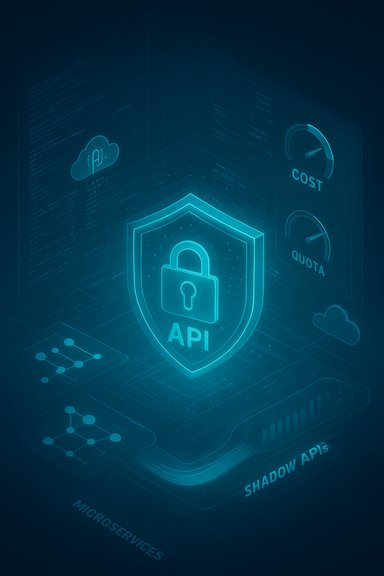
APIs are different from traditional web front ends. They are machine‑to‑machine interfaces, often undocumented to business teams, and they multiply quickly:- Internal microservices spawn new endpoints with every release.
- Third‑party SaaS and AI providers introduce new external dependencies.
- “Shadow” and “zombie” APIs (undocumented or unmaintained endpoints) proliferate across environments.
AI amplifies existing risks and introduces new ones
LLM integrations expand risk in two ways:- They increase API traffic and the number of endpoints that may carry sensitive data (retrieval pipelines, embeddings services, model inference calls).
- They introduce new, model‑specific attack classes such as prompt injection, tool poisoning and model backdoors.
Cost: the less‑spoken operational risk
LLM inference is not free. Modern model APIs are priced per token or per call, and the aggregate spend for automated agents, high‑volume chatbots or document‑retrieval pipelines can become a continuous operating cost. Industry reporting has already documented “inference whales” — a few heavy consumers that can blow out platform economics under flat‑rate subscriptions — and many vendors have moved to stricter rate limits and usage‑based billing to avoid unsustainable usage patterns. Without per‑API quotas, chargeback and monitoring, AI usage can silently become a material line‑item in cloud bills.CASA Software’s take, and where policy enforcement fits
CASA’s Michael Brink argues that developer‑centric API management leaves security and cost controls as afterthoughts. In many organisations APIs are created and maintained by engineering teams focused on feature velocity; policy, DLP and cost controls often lag until compliance or a security incident forces a fix. Brink’s view — reflected in current analyst guidance — is that security and risk teams must take a central role in governing the API surface and that an API management platform with central policy enforcement, runtime monitoring and analytics is the correct place to implement those controls.The practical pieces Brink highlights:
- A centralized policy enforcement point that lets you apply consistent security rules across thousands of APIs.
- Runtime monitoring and analytics to detect anomalous usage and data flows.
- Quotas and chargeback controls to prevent runaway AI spend.
- Integration with data loss prevention (DLP) tools to stop sensitive data being shipped to public LLMs.
What API management platforms can — and cannot — solve
Realistic feature checklist (what to expect from a modern API management platform)
- Central policy enforcement for auth, input validation, transformation and header rewriting.
- Rate limiting and per‑key quotas to limit both abuse and cost exposure.
- API key lifecycle and developer portal features for managing consumers.
- Usage analytics, access logs and alerting to feed SOC workflows.
- Integration points for DLP, WAF, SIEM and identity systems.
- Lifecycle support: discovery, testing, publishing, versioning and retirement of APIs.
Where platforms add highest value
- Enforcing consistent security controls across many teams and microservices.
- Discovering shadow APIs through telemetry and inventorying the API surface.
- Implementing quota/chargeback models so finance, product and security can align on acceptable consumption.
- Applying runtime transformations (redaction, encryption, tokenization) at the gateway before data reaches either internal services or third‑party AI models.
Limitations and common pitfalls
- Policy enforcement is only as good as the policies defined. Poor policy models mean false negatives or excessive friction for developers.
- Platforms must be embedded into CI/CD and developer lifecycles; if deployment remains “outside the team” the gateway becomes a tactical band‑aid.
- Consolidation risk: depending on a single gateway for discovery, policy and telemetry can create a monoculture; misconfiguration or supply‑chain flaws at the platform level become systemic risks.
- Cost monitoring is necessary but not sufficient — effective control requires organisational processes (budget approvals, API product owners) as much as technical quotas.
Practical security controls: an implementer’s checklist
- Inventory and classify every API
- Map APIs by business criticality, data sensitivity and consumer (internal, partner, public).
- Target “shadow” APIs for immediate discovery and remediation.
- Apply centralised runtime controls
- Enforce authentication, scope‑based access tokens, object‑level authorization checks and JSON schema validation at the gateway.
- Implement strict rate limits, quotas and request size controls to limit abuse and accidental cost spikes. (Example: Azure API Management’s quota and rate‑limit policies demonstrate how to implement per‑key quotas and rate limits.
- Stop sensitive data leakage at the edge
- Integrate DLP and content inspection at the policy layer. Redact or block fields containing PII or high‑value intellectual property before transit to third‑party LLMs.
- Use response filtering to scrub model outputs that might inadvertently include sensitive values.
- Monitor and hunt
- Feed API telemetry to SIEM/XDR and enable anomaly detection for unusual endpoints, sudden spikes in data volume, or atypical destination patterns (external LLM providers).
- Monitor both application logs and gateway logs — many service‑to‑service tokens don’t generate obvious tenant logs.
- Build cost governance and chargeback
- Create API product tiers (free/test, internal, premium) with quotas and billing back to consuming teams.
- Track tokens, calls and data transfer to model providers and associate usage to cost centers.
- Shift‑left security
- Embed API security checks in CI/CD: contract testing, schema checks, static analysis and automated vulnerability scans.
- Use API mocks and contract tests to detect excessive data exposure early in the pipeline.
- Red team AI integrations
- Regularly test retrieval chains and prompt handling for prompt injection and tool poisoning.
- Treat any third‑party tool descriptions or plugins as untrusted inputs and vet them thoroughly.
Layer7 and CASA: strengths, caveats and fit for enterprise
Broadcom’s Layer7 platform is widely deployed in regulated industries and mature enterprises for API security, policy enforcement and developer governance. Product releases and documentation emphasise:- Policy templates and central policy lifecycle management that can be published at scale.
- Enhanced API developer portals, API key management and analytics for cross‑organizational reporting.
- Support for multi‑protocol integrations and configurable logging/assertions for runtime inspection.
- Central policy enforcement reduces duplication of security code and lowers the maintenance burden when vulnerabilities or compliance changes arise.
- Enterprise‑grade analytics and key management make it straightforward to implement quotas and usage reports that feed finance and product governance.
- Proven deployment in finance, retail and public sector organisations means operational maturity and vendor support.
- Vendor claims of one‑click governance or effortless DLP must be evaluated against real operational complexity: DLP rules, privacy law constraints, and cross‑jurisdictional data residency cannot be solved solely by a gateway.
- Integration with modern devops pipelines can require additional tooling or custom automation; platform APIs and “policy as code” practices must be validated in a proof‑of‑concept.
- Broadcom/Layer7 may be a natural choice for organisations already invested in that stack; organisations with cloud‑native, multicloud or serverless architectures should validate the fit carefully.
Cross‑referenced evidence and why it matters
- Analyst corroboration: KuppingerCole’s Leadership Compass frames APIs as foundational to AI integrations and stresses that securing AI requires securing APIs first. That analysis matches the technical trajectory of agentic systems relying on APIs for tooling and retrieval.
- Industry telemetry: Akamai’s State of the Internet reporting and its API studies show dramatically rising API attacks and that a significant fraction of web attacks now target APIs. Those measurements are visible in their SOTI reporting and reinforced by multiple vendor studies. Use those numbers to justify investment in API discovery, runtime protection and developer training.
- Technical guidance: The OWASP API Security Top 10 (2023) and related guidance provide a practical threat model for API deployments and should be used as a baseline for threat modelling and testing.
- Prompt injection and AI‑specific incidents: Multiple independent demonstrations and academic papers show that prompt injection and tool poisoning are real, exploitable vectors that can lead to data exfiltration and unauthorized actions — especially when models control downstream systems. These findings underline why gateways and runtime controls must be paired with model‑centric defenses.
- Cost evidence: Reporting on “inference whales” and vendor rebuttals illustrate how a small number of high‑volume consumers can cause disproportionate cloud/AI bills; quota enforcement and chargeback are practical levers to mitigate this class of risk.
Recommended roadmap for WindowsForum (enterprise) readers
- Rapid discovery (30 days)
- Run an automated API inventory and tag endpoints by sensitivity.
- Identify any publicly exposed endpoints and catalogue consumer lists.
- Deploy gateway policies for high‑risk paths (60–90 days)
- Implement enforcement for authentication, schema validation and object‑level authorization for the most sensitive APIs.
- Configure per‑key quotas and rate limits on AI model calls.
- Add DLP and model‑aware filters at the edge (90–180 days)
- Integrate DLP for common PII patterns and build a denylist for fields that must never transit to public models.
- Apply output filters and sandboxing for any model tools that take actions on behalf of users.
- Integrate into CI/CD (3–6 months)
- Add contract tests, API schema validation and security gates to pipelines.
- Require API product owners to approve changes and enforce policy templates as part of merge checks.
- Finance & governance (ongoing)
- Implement chargeback: tie API usage and model calls to cost centers and enforce hard quotas for experimental projects.
- Publish internal SLAs and billing rules for AI consumption.
- Continuous red teaming and validation (ongoing)
- Test prompt injection, tool poisoning, and model poisoning scenarios.
- Use independent audits of DLP effectiveness and gateway policy drift.
Conclusion
APIs are now the essential infrastructure that connects applications, partners, and AI — and therefore they are the natural battleground for security, privacy and operational cost control. CASA Software’s warnings reflect a broader reality captured by analysts and telemetry: as AI increases API volume and complexity, organisations must move security and cost controls up the stack and into the API layer itself. Platforms such as Broadcom’s Layer7 provide the technical mechanisms to centralise policy, monitor runtime behaviour, and impose quotas; but platform selection and governance changes are only the beginning. Success depends on organisational alignment: developer workflows, security operations, procurement and finance must all share responsibility for the API surface and the AI pipelines that traverse it.Takeaway: treat APIs as first‑class assets. Discover them, govern them centrally, instrument them for both security and cost, and continuously test the weakest link — the model and the API boundary it uses. Failure to do so will not only increase breach risk but also expose organisations to runaway AI costs and regulatory scrutiny.
Source: ITWeb CASA Software: Addressing the rising risks, costs of an ‘explosion’ of APIs
