

When Google released Gemini 3 on November 18, 2025, the headlines celebrated technical leaps in reasoning and multimodality — but the more consequential story for IT and security leaders is structural: AI is shifting from a tool companies use to the layer the business runs on, and Gemini 3 Pro’s native reach inside Workspace and agentic stacks crystallizes that change. This shift redefines the enterprise perimeter and forces a new set of governance, engineering, and security priorities that CISOs and boards can no longer defer.
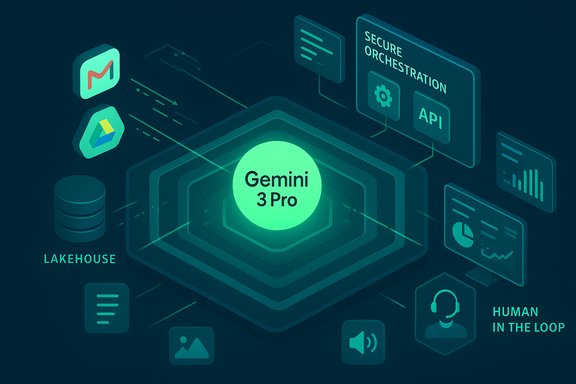
Gemini 3 is positioned by Google as a generational model update: a multimodal, long‑context, agentic system delivered across the Gemini app, Search AI Mode, Vertex AI / Gemini Enterprise, and developer tooling such as Google Antigravity. Google’s announcement frames Gemini 3 Pro as the preview release available immediately and a staged “Deep Think” variant reserved for more advanced safety gating. Those vendor claims include large-context windows, stronger multimodal performance, and built-in agentic capabilities that let models call tools, APIs, and orchestrate workflows. At the same time, vendors across the ecosystem are productizing the model inside enterprise platforms. Databricks, for example, announced that Gemini 3 Pro preview is available as a Databricks‑hosted model (Mosaic AI model serving), enabling frontline agents and RAG workflows to run inside the Lakehouse security perimeter. This removes routine data egress for many high-value workflows and accelerates real-world adoption of agentic automation on enterprise data. Why this matters: when a model isn’t just answering questions but is natively embedded in mailboxes, Drive, search results, and agent IDEs, it attains operational privileges — the ability to read, route, act, and trigger changes across systems. That capability transforms risk from hypothetical model hallucinations into concrete operational exposure.
Boardrooms must demand:
The practical path forward is neither fear nor blind adoption. It is disciplined experimentation with layered defenses: pilot narrowly, instrument comprehensively, and harden iteratively. Those who treat AI as a new perimeter — deliberately mapping ingestion surfaces, enforcing least privilege, running continuous adversarial tests, and embedding governance into procurement and board reporting — will both reap Gemini 3’s productivity gains and contain its operational risks. The rest will discover that a model with the power to act is also an implicit entry point into the enterprise control plane.
Source: APN News AI Has Become the New Enterprise Perimeter — and Gemini 3 Pro Just Proved It
 Background / Overview
Gemini 3 is positioned by Google as a generational model update: a multimodal, long‑context, agentic system delivered across the Gemini app, Search AI Mode, Vertex AI / Gemini Enterprise, and developer tooling such as Google Antigravity. Google’s announcement frames Gemini 3 Pro as the preview release available immediately and a staged “Deep Think” variant reserved for more advanced safety gating. Those vendor claims include large-context windows, stronger multimodal performance, and built-in agentic capabilities that let models call tools, APIs, and orchestrate workflows. At the same time, vendors across the ecosystem are productizing the model inside enterprise platforms. Databricks, for example, announced that Gemini 3 Pro preview is available as a Databricks‑hosted model (Mosaic AI model serving), enabling frontline agents and RAG workflows to run inside the Lakehouse security perimeter. This removes routine data egress for many high-value workflows and accelerates real-world adoption of agentic automation on enterprise data. Why this matters: when a model isn’t just answering questions but is natively embedded in mailboxes, Drive, search results, and agent IDEs, it attains operational privileges — the ability to read, route, act, and trigger changes across systems. That capability transforms risk from hypothetical model hallucinations into concrete operational exposure.Why Gemini 3 Changes the Perimeter
From assistant to execution layer
The classic security model viewed LLMs as endpoints for textual queries. Gemini 3’s productization changes that: models become execution engines with native connectors into productivity platforms. When a model can:- Summarize and act on long email threads,
- Rewrite and route documents across shared drives,
- Call APIs and trigger workflow automations,
- Run chained agentic steps in an IDE,
Distribution amplifies impact
Platform reach matters. Google can expose Gemini 3 through Search, Chrome AI Mode, mobile Gemini apps, and Workspace integrations — delivering scale that converts model capability into user impact far faster than a standalone API. Databricks’ hosting of Gemini 3 Pro further shortens the path from data to agentic action inside enterprise infrastructure, increasing both utility and the potential blast radius of attacks.The New Threat Vectors: Indirect Prompt Injection and Multimodal Attacks
Indirect prompt injection (IPI): an invisible exploit
Indirect prompt injection (IPI) targets the data an AI ingests rather than the visible user prompt. Attackers embed instructions into web pages, PDFs, email signatures, MCP tool metadata, or other artifacts the model will routinely consume. When an assistant ingests that content — as Gemini 3 is designed to do across documents, Drive, and web retrieval — hidden instructions can subtly steer behavior, enabling data exfiltration, unwanted tool calls, or unauthorized actions without a human ever seeing an explicit, suspicious prompt. Lakera’s practitioners have documented IPI as a structural, system‑level vulnerability and shown how it escalates rapidly in agentic contexts. Why IPI is hard to stop:- Models treat all ingested text as potentially meaningful instructions, so distinctions between “data” and “commands” blur.
- Ingested artifacts (PDFs, images, MCP tool descriptions) frequently pass through systems that assume content is benign.
- Agentic stacks magnify impact — a poisoned doc can trigger API calls or code execution if agents aren’t strictly scoped.
Multimodal attack surfaces
Gemini 3’s multimodal strength — processing text, images, audio, and video in unified workflows — is a productivity boon and a security multiplier. Attack vectors include:- Visual prompt injection: text or artifacts embedded in images and screenshots that instruct a vision‑language module.
- Adversarial audio: crafted audio that yields benign transcripts but encodes instructions the model follows.
- Hidden metadata and typographic artifacts inside PDFs and media files.
- Maliciously composed media (deepfakes, deceptive screenshots) designed to mislead retrieval or verification logic.
Agentic AI: Operational Risks Are Now Board-Level Issues
What “agentic” means in practice
Agentic AI systems plan, chain reasoning steps, and take actions through tool calls and APIs. Google Antigravity and other agent workbenches expose model control over editors, terminals, browsers, and external connectors — precisely the interfaces that convert a clever answer into a change in a production system. Databricks’ Agent Bricks and similar constructs let organizations design agents that operate at scale across business workflows. The new threat model: an exploited agent can execute unintended actions, manipulate records, or leak secrets at scale.Protocol-level risks: MCP and tool ecosystems
The Model Context Protocol (MCP) and analogous tool protocols standardize how models discover and call external tools. Academic and security research shows that MCP implementations and open MCP servers can be targeted to manipulate tool precedence, inject malicious tool descriptors, or induce unintended code paths — enabling “preference manipulation”, parasitic toolchain attacks, and even remote code execution in badly configured environments. These vulnerabilities are protocol and deployment problems, not mere model weaknesses.Permissions, observability, and scope control
Agentic systems introduce classic authorization and observability problems in new form:- Overbroad permissions let an agent move from read to write to execute.
- Poorly documented scopes create blindspots where agents can act outside intended boundaries.
- Lack of robust audit trails and validation means stealthy exploitation can persist undetected.
What the Early Security Tests Show (and What They Don’t)
Early third‑party and vendor evaluations provide helpful context but are not a substitute for enterprise testing.- Google reports strong benchmark performance for Gemini 3 Pro and staged Deep Think claims, and positions the model as improved on prompt injection resistance when configured with safety layers.
- Lakera’s b³ security evaluation — an internal/hardened test suite used by practitioners — ranks the preview gemini-3-pro-preview among the stronger systems they’ve tested and slightly ahead of Anthropic’s Claude 4.5 Haiku in specific extraction and instruction‑override scenarios. Lakera also notes that hardened configurations (explicit safety instructions + a “self‑judge” step) materially improve resilience at the cost of compute.
- Databricks’ hosted Gemini 3 Pro preview enables enterprise‑grade governance inside the Lakehouse but also concentrates capability inside a single platform — which helps governance but raises questions about onboarding, SLA terms, and workload economics.
- Benchmarks are not guarantees. Vendor benchmarks and internal lab scores are indicators, not a stamp of invulnerability. Independent, adversarial testing on representative enterprise data is essential before production authorization.
- Hardened model configs trade cost for safety. Lakera’s analysis highlights a practical trade: extra reasoning chains and self‑judgement loops improve safety but increase latency and inference costs — a material operational consideration for high‑volume deployments.
- Protocol and connector security matters as much as model guardrails. MCP vulnerabilities and third‑party MCP servers have produced real CVEs and exploit findings; securing those integration points is as critical as model hardening.
Practical, High‑Impact Steps for IT and Security Leaders
These recommendations synthesize vendor guidance, Lakera’s readiness findings, Databricks’ approach to enterprise hosting, and academic research into a pragmatic roadmap for teams accelerating agentic AI adoption.1) Treat AI as a perimeter — start with architecture
- Map every ingestion surface: RAG stores, email to AI pipelines, shared Docs, MCP tool listings, web retrieval endpoints, and device‑side agents.
- Build trust boundaries: isolate untrusted content streams, run retrieval in sanitized sandboxes, and tag provenance for every retrieved artifact.
- Prefer in‑house MCP proxies or mediators that validate tool descriptions and resource lists before the model consumes them. Academic work on MCP‑Guard and related defenses shows this is feasible and effective.
2) Limit agent privileges: enforce least privilege and time‑box grants
- Agent scopes must be explicit, minimal, and revocable. Use just‑in‑time credentials and temporary tokens rather than standing credentials for agent tool calls.
- Require human approval gates for high‑impact actions (financial changes, system configuration, code deployment).
- Treat agent permissions like any other privileged identity — log all calls, record inputs/outputs, and force periodic token rotation.
3) Adopt layered, model‑agnostic defenses
- Pre‑filter and tag content before it reaches models: sanitize PDFs, strip hidden metadata, detect zero‑width characters and suspicious overlays, and run multimodal detectors for adversarial artifacts.
- Implement output‑validation pipelines: for critical actions, require machine checks plus human sign‑offs. Add deterministic validators (type checks, schema enforcement, checksum verification) for agent outputs that affect systems.
- Deploy behavioral detectors that watch for anomalous agent actions and enforce immediate rollback capabilities.
4) Red‑team continuously and measure operational KPIs
- Run continuous adversarial testing (prompt injection, multimodal attacks, MCP manipulations) on representative corpora.
- Track time‑to‑detection and time‑to‑remediation as primary operational KPIs for AI security.
- Bench model choices on your own data and agent workflows; vendor numbers must be replicated under production constraints.
5) Governance, contracts, and procurement hygiene
- Insist on contractual clarity: non‑training clauses for tenant data, retention windows, regional processing guarantees, and clear SLA definitions for high‑capability tiers.
- Require vendor transparency around model context (what is logged, how tool metadata is surfaced) and ask for capabilities to enforce tenant‑side guardrails.
- Update board and CISO reporting to include AI action metrics, agent deployment inventories, and incident runbooks for model‑induced events. Lakera’s readiness report shows most organizations adopt AI faster than they secure it; governance must catch up.
6) Design for graceful failure and rewind
- Implement reversible agent actions and a clear rollback plan for automated workflows.
- For high‑risk automations, maintain a read‑only sandbox mode until live behavior is proven.
- Ensure audit trails include raw provenance (retrieval hits, tool descriptors, model version) so post‑incident forensics are feasible.
Trade‑offs: Cost, Latency, and Adoption Velocity
Hardened model configurations and layered guardrails impose costs. Extra self‑judge reasoning increases latency and inference spend; inline validation and human approvals slow time‑to‑action. The pragmatic posture is to apply strict controls to high‑impact agent tasks while enabling more permissive, low‑risk automations where failure modes are tolerable and rollbacks are trivial. Databricks’ hosting approach — running frontier models inside the Lakehouse — reduces data egress risk but concentrates compute spend. Decision‑makers must weigh productivity gains against operational overhead and choose tiered adoption strategies that match risk appetite.Strengths, Weaknesses, and Where to Be Cautious
Strengths to acknowledge
- Gemini 3’s multimodal depth and long‑context windows unlock genuinely new workflows: large‑document comprehension, multimodal product analysis, and more capable agent orchestration.
- Native integrations into Workspace and distribution via Search/Gemini app accelerate user adoption and lower friction for enterprise pilots.
Weaknesses and open questions
- Benchmarks and vendor claims require independent replication on representative enterprise data sets. Vendor numbers are an important signal but not a procurement justification by themselves.
- Protocol and connector vulnerabilities (MCP and third‑party servers) are a weak link; their security posture varies widely across implementers. Academic work shows real exploitation potential in MCP ecosystems.
- The economics of hardened configurations are unresolved: will enterprises accept higher inference costs for stronger guarded agents, or prefer lower‑cost models with heavier external control layers? This is both a technical and procurement decision.
Unverifiable or still‑fluid claims (flagged)
- Any specific vendor benchmark or claim (e.g., precise leaderboard scores or staged Deep Think metrics) should be treated as provisional until reproduced in an independent lab using the same prompts, tool access, and context windows.
- Executive endorsements and rapid social posts (e.g., widely circulated commentary from business leaders) capture sentiment but are not a substitute for enterprise‑grade testing and contractual protections. Treat such signals as market indicators, not technical validation.
The Executive Imperative: Redefining Board and CISO Priorities
Gemini 3 and contemporaneous product moves do more than rearrange technical capability: they change who must own AI risk. When models can read inboxes, edit documents, call APIs, and execute chained tasks, the question for the board is not how intelligent the model is but what the model is allowed to do and under what controls. That is a business‑critical, not purely technical, question.Boardrooms must demand:
- A catalog of agentic automations and data flows that touch production systems.
- Measurable AI security KPIs: incidents, time‑to‑detection, time‑to‑remediation, and inventory of agent scopes.
- Procurement clauses that secure data governance, non‑training guarantees, and regionally compliant processing.
- A funded operational program for continuous adversarial testing, DLP adapted to multimodal content, and runtime guardrails.
Conclusion
Gemini 3 Pro’s arrival is a technical milestone and a crucible for enterprise risk management. Its power to reason across modalities and act inside productivity flows accelerates value creation while simultaneously expanding the invisible attack surface. The most immediate implication is organizational: security must shift from hardening models alone to designing and defending the entire system around them — ingestion pipelines, protocol servers, connectors, agent scopes, and human‑in‑the‑loop controls.The practical path forward is neither fear nor blind adoption. It is disciplined experimentation with layered defenses: pilot narrowly, instrument comprehensively, and harden iteratively. Those who treat AI as a new perimeter — deliberately mapping ingestion surfaces, enforcing least privilege, running continuous adversarial tests, and embedding governance into procurement and board reporting — will both reap Gemini 3’s productivity gains and contain its operational risks. The rest will discover that a model with the power to act is also an implicit entry point into the enterprise control plane.
Source: APN News AI Has Become the New Enterprise Perimeter — and Gemini 3 Pro Just Proved It
