

In an era when the word “agent” has leapt from academic papers into boardroom roadmaps, Dona Sarkar’s conversation with John Siefert on the AI Agent & Copilot Podcast cuts past the hype: building an AI agent is now the easy part; making that agent production‑ready, governable, and valuable at enterprise scale is where organizations win or lose. Sarkar—whose role as Microsoft’s self‑styled Chief Troublemaker for Copilot and AI extensibility positions her at the intersection of product, customer advocacy, and hard lessons learned—offers a candid playbook for moving agents from experimentation to repeatable, auditable production deployments. Her frank admission that roughly half the agents she’s built had to be taken down is less a confession than a blueprint: failure gives shape to the guardrails, processes, and tooling enterprises now must adopt if they want AI agents to be safe, scalable, and sustainable.
AI agents and copilots are transforming how businesses think about automation. No longer limited to single‑session chat answers, modern agents are multi‑step, identity‑bound systems that plan, call tools, read and write to systems, and in some cases act autonomously on behalf of users. Microsoft’s Copilot platform and companion tooling—Copilot Studio, Azure AI Foundry, Model Context Protocol (MCP), and the emerging Copilot SDKs—are coalescing around a developer and maker experience that aims to make agent deployment straightforward. Yet the technical plumbing alone won’t get enterprises to outcomes.
Two realities dominate the landscape today:
This matters because a technical demo answers a narrow question: “Can this model do X?” Production adoption asks a broader one: “Can this model operate reliably, securely, and cost‑effectively inside our control environment?” Enterprise advocacy bridges that gap by:
Key production challenges:
Why this matters:
Practical prioritization:
Mitigation: grounding, deterministic pre/post checks, and stepwise approvals.
Mitigation: central inventory, automated access reviews, and least‑privilege enforcement.
Mitigation: Purview labeling, DLP enforcement, and SIEM integration.
Mitigation: use abstraction layers and provider‑agnostic orchestration where feasible.
Mitigation: environment caps, meter reporting, and chargeback mechanisms.
Dona Sarkar’s blunt lessons are a practical compass: build fast, fail fast, learn deliberately, and bake guardrails into the fabric of every agent. That means identity, traceability, bounded autonomy, human‑in‑the‑loop control, and operational visibility must be non‑negotiable checkpoints on any production‑ready path.
For IT leaders embarking on this journey, the prescription is straightforward:
Source: Cloud Wars AI Agent & Copilot Podcast: Dona Sarkar of Microsoft on Moving AI Agents from Experimentation to Production
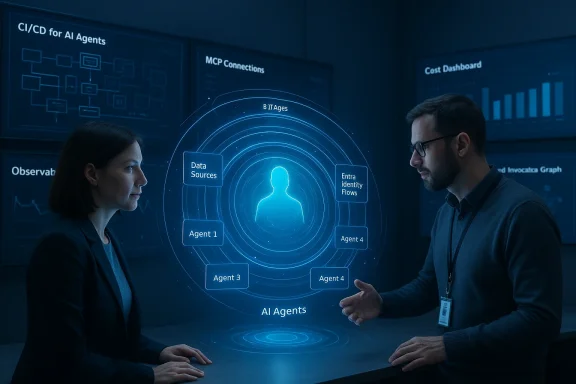 Background / Overview
AI agents and copilots are transforming how businesses think about automation. No longer limited to single‑session chat answers, modern agents are multi‑step, identity‑bound systems that plan, call tools, read and write to systems, and in some cases act autonomously on behalf of users. Microsoft’s Copilot platform and companion tooling—Copilot Studio, Azure AI Foundry, Model Context Protocol (MCP), and the emerging Copilot SDKs—are coalescing around a developer and maker experience that aims to make agent deployment straightforward. Yet the technical plumbing alone won’t get enterprises to outcomes.Two realities dominate the landscape today:
- The toolkit for building agents is maturing fast. Low‑code and pro‑code paths, multi‑model orchestration, and connector ecosystems make it possible to prototype agents in days.
- The organizational work—permissions, ownership, data readiness, governance, monitoring, and human‑in‑the‑loop controls—takes months and requires cross‑functional execution.
Why enterprise advocacy matters: translating capability into adoption
The role of enterprise advocacy
Enterprise cloud advocacy is no longer a marketing veneer. It must translate product capability into real business outcomes. According to Sarkar’s description of her team’s work, the goal is not to sell tools but to enable teams: build demos that map to business processes, deliver hands‑on workshops, and create lab environments where IT, security, and business owners can validate assumptions together.This matters because a technical demo answers a narrow question: “Can this model do X?” Production adoption asks a broader one: “Can this model operate reliably, securely, and cost‑effectively inside our control environment?” Enterprise advocacy bridges that gap by:
- Mapping product features to business scenarios.
- Running workshops that include legal, security, and finance stakeholders.
- Providing templates, governance playbooks, and migration paths from lab to staging to production.
Why enablement beats sales‑first pitches
Enterprises buy outcomes, not features. Advocacy teams that prioritize enablement accelerate adoption by reducing the friction between the product team and the line of business. Practical artifacts—reference architectures, CI/CD pipelines for agents, and consent flows for Entra/identity—shorten the feedback loop and expose hidden assumptions early.From “demo magic” to production discipline
The illusion of quick wins
Modern agent frameworks can produce impressive demos quickly. That’s the double‑edged sword. A PoC can show feasibility in a day; production readiness requires confronting messy realities: inconsistent data, edge cases, authentication flows, regulatory constraints, and unknown failure modes.Key production challenges:
- Permissions and least privilege: agents often need fine‑grained access to systems. Untethered permissions lead to risk.
- Ownership and lifecycle: who owns an agent, who approves changes, and who enforces retirement or rollback?
- Data readiness: agents require structured and unstructured data that is discoverable, labeled, and auditable.
- Monitoring and observability: telemetry, traceability, and alerts must exist before agents act on high‑value processes.
The organizational gap
Bringing an agent into production is a cross‑disciplinary project. Successful launches combine:- IT/Cybersecurity to design identity, network, and DLP controls;
- Data teams to prepare and classify grounding data;
- Business owners to define acceptable outcomes and human‑in‑the‑loop thresholds;
- Legal and compliance to validate disclosures and risk tolerances.
Tooling and platform directions: what’s now available and why it helps
Copilot Studio, Azure AI Foundry, and the Model Context Protocol
The ecosystem of Microsoft tools is converging on the concept of identity‑first, groundable agents that can be built in both low‑code and pro‑code environments. The important primitives are:- Copilot Studio: a low‑code authoring and runtime environment for agents, with templates, validation tools, and publishing paths that create managed agent identities.
- Azure AI Foundry: a pro‑code platform for building more advanced or specialized agents that need dedicated compute, bespoke models, or custom orchestration.
- Model Context Protocol (MCP): a standard bridge that lets agents call into tenant data stores (e.g., Dataverse) in a controlled, auditable way.
Copilot SDKs and the agentic runtime
For developers embedding agentic behavior directly into applications, emerging SDKs expose production‑tested runtimes—multi‑model orchestration, tool invocation, session state, and streaming. The SDKs abstract the hard work of the agentic execution loop, letting teams focus on domain tools, constraints, and business logic rather than rebuilding runtime scaffolding.Why this matters:
- Reduces the amount of undifferentiated infrastructure teams must build.
- Brings established runtime patterns—session management, tool security, and streaming—to production apps.
- Helps organizations move from “experiment” to “product” faster.
Observability, security, and governance primitives
A production agent must be observable. That means:- Correlation IDs and execution traces for every decision and tool call.
- Integration with enterprise logging, SIEM, and DLP.
- Automated policy enforcement at the identity and API level.
- Deployable human‑in‑the‑loop gates and rollback flows.
Human‑centered AI: what we should automate — and what we should not
Draw the line: human‑to‑human, AI‑to‑human, AI‑to‑AI
Sarkar’s cautionary guideline—explicitly delineating which interactions should remain human‑to‑human, which should be AI‑assisted, and which can be fully automated—is pragmatic and necessary. Automation for its own sake misses the point: responsibility and trust must guide adoption.Practical prioritization:
- Automate repetitive tasks and predictable clerical work first (triage, routing, summarization).
- Use AI for prioritization and analysis where it amplifies human judgment (insights, trend detection).
- Preserve meaningful human interactions for creative, relational, and ethically sensitive work.
Avoiding the empathy deficit
The podcast highlights an industry irony: rather than reducing in‑person interactions, AI is driving demand for real‑world gatherings where leaders seek perspective rather than raw information. This underlines the need for human judgment layered on top of AI outputs—an essential guardrail when agents act at scale.Failure as a design input: the 50% truth
Sarkar’s admission—that roughly half the agents she built had to be taken down—deserves unpacking. This isn’t evidence of incompetence; it’s evidence of a rapid learning cycle. Each failure taught practical lessons about:- Edge cases that models don’t handle reliably.
- Unanticipated permission escalations triggered by chained tool calls.
- Data validity issues that only surface under load or adversarial input.
- The human factors—user expectations and misuse—that turn a seemingly harmless agent into a risk.
A practical playbook: 12 steps to move agents into production
- Inventory candidate automations and rank by value and risk.
- Define owner, sponsor, and lifecycle policy for each agent.
- Prepare grounding data: catalog, label, and verify quality.
- Choose the platform path: Copilot Studio for low‑code, Foundry for pro‑code.
- Build in a staging tenant with MCP and Entra integration enabled.
- Implement least‑privilege identities and conditional access for agent identities.
- Add human‑in‑the‑loop gates for write‑back or high‑impact decisions.
- Instrument observability: correlation IDs, traces, and log shipping to SIEM.
- Run adversarial tests: prompt injection, exfiltration scenarios, and permission escalation checks.
- Meter cost: set Copilot credit and environment caps; implement chargebacks.
- Publish with version control and release gating (CI/CD for agents).
- Operate with a Copilot Center of Excellence: monthly audits, cost reviews, and incident playbooks.
Technical design patterns that matter
Grounded responses (RAG and deterministic fallback)
Always ground generative outputs to authoritative data sources. Use retrieval‑augmented generation (RAG) with strict fallbacks: if the retrieval confidence is below threshold, the agent should escalate or return a “don’t know” answer.Bounded autonomy and circuit breakers
Design agents to fail gracefully. Circuit breakers prevent runaway actions: they limit actions per session, restrict write‑access time windows, and require human approval for certain state changes.Agent identity and audit
Agents must have identities—cataloged, discoverable, and permissioned. Identity allows auditing, revocation, and lifecycle management. Enforce per‑agent audit trails that show input, plan, tool calls, and human approvals.Agent to Agent (A2A) orchestration
Multi‑agent ecosystems are powerful but complex. Use orchestrators that enforce execution contracts, timeouts, and error handling at the network and protocol levels.Vendor and ecosystem signals: who’s solving what
- Infrastructure partners are addressing performance and inference needs. High‑throughput inference partners accelerate production workloads where latency matters.
- Agent lifecycle platforms promise end‑to‑end OS‑like features for agents: building, testing, deploying, monitoring, and governance.
- SDKs from GitHub and runtime contributions from major cloud vendors are commoditizing the agent execution loop, making production implementations more standardized.
Risks, blind spots, and how to mitigate them
Hallucinations and business harm
Risk: agents produce plausible but incorrect outputs and take actions that propagate errors.Mitigation: grounding, deterministic pre/post checks, and stepwise approvals.
Agent sprawl and privilege creep
Risk: uncontrolled proliferation of agents with excess permissions.Mitigation: central inventory, automated access reviews, and least‑privilege enforcement.
Data leakage and compliance gaps
Risk: unsecured connectors or “computer use” flows might exfiltrate regulated data.Mitigation: Purview labeling, DLP enforcement, and SIEM integration.
Vendor lock‑in
Risk: tightly coupling agent logic to a single provider’s API or model family.Mitigation: use abstraction layers and provider‑agnostic orchestration where feasible.
Cost overruns
Risk: agents can consume compute and Copilot credits rapidly in production.Mitigation: environment caps, meter reporting, and chargeback mechanisms.
Governance and policy: moving from paper to runtime
Governance is not a checklist. It must be enforced at runtime. That means:- Policies implemented as code: conditional access and DLP rules tied to agent identities.
- Automated lifetime checks: agents that don’t have active owners are automatically quarantined.
- Financial controls: consumption budgets and automated alerts for unusual spend.
- Legal and compliance signoffs embedded in deployment pipelines for high‑risk agents.
The human equation: training, trust, and change management
Deploying agents changes jobs and workflows. Successful programs invest early in:- Training for end users and approvers on what agents can and cannot do.
- Communications that set expectations and define escalation paths.
- Measuring adoption not by number of agents but by process outcomes: time saved, error reductions, and employee satisfaction.
The economics of scale: cost, ROI, and operational models
Because agents can be both compute‑intensive and high‑value, financial governance matters. Real deployments require:- TCO models that include compute, Copilot credits, integration, monitoring, and human oversight.
- Chargeback models that align owners with consumption.
- Continuous ROI measurement—preferably before scaling—so the business case remains intact as the agent fleet grows.
Where conferences and community learning fit in
Sarkar and Siefert both argued that conferences are thriving because people crave perspective. For teams migrating agents into production, community learnings—failure modes, governance playbooks, and practical templates—are often the most valuable artifacts. Peer sessions that expose “what broke and how we fixed it” accelerate organizational learning far more than polished vendor presentations.Conclusion — treat agents like products, not experiments
The transition from experimentation to production is not a maturity problem to be fixed by better models; it is an organizational discipline problem that requires product thinking, governance automation, and cross‑functional commitment. The toolset—Copilot Studio, Azure AI Foundry, MCP, Copilot SDKs, and vendor lifecycle platforms—reduces the engineering burden, but it does not absolve teams of responsibility.Dona Sarkar’s blunt lessons are a practical compass: build fast, fail fast, learn deliberately, and bake guardrails into the fabric of every agent. That means identity, traceability, bounded autonomy, human‑in‑the‑loop control, and operational visibility must be non‑negotiable checkpoints on any production‑ready path.
For IT leaders embarking on this journey, the prescription is straightforward:
- Align business outcomes and risk appetite before you build.
- Start small with monitor‑only agents and progressively introduce autonomy.
- Invest in common infrastructure—identity, observability, and policy—as a shared service.
- Treat agents as product artifacts with owners, roadmaps, and versioning.
- Share failures openly: they are the raw material for scalable, responsible AI.
Source: Cloud Wars AI Agent & Copilot Podcast: Dona Sarkar of Microsoft on Moving AI Agents from Experimentation to Production
