

Apple, traded as AAPL, is a Cupertino, California consumer technology company best known for the iPhone, Mac, iPad, Apple Watch, AirPods, and its expanding subscription-services business. The company describes its strategy as integrating hardware, software, and services across a tightly controlled device ecosystem.
The supplied 9to5Mac backgrounder is not breaking news and its product list is substantially dated: it references the iPhone 12 generation, Apple Watch Series 6, and the original M1 Mac transition. Apple’s current hardware families and software platforms have moved on considerably.
Apple was founded on April 1, 1976, by Steve Jobs, Steve Wozniak, and Ronald Wayne. Its early success came from the Apple II, while the Macintosh’s arrival in 1984 helped bring graphical, mouse-driven computing into the mainstream.
Jobs left Apple in 1985 after a leadership dispute and returned in 1997 when Apple acquired NeXT. That acquisition also brought the operating-system foundations that became Mac OS X and, later, macOS. Under Jobs, Apple simplified its sprawling Mac range, launched the iMac in 1998, then expanded beyond computers with the iPod in 2001, iPhone in 2007, iPad in 2010, and Apple Watch in 2015.
The other major platform shift began in 2020, when Apple started replacing Intel processors in Macs with its own Apple Silicon. That transition is now effectively complete across the mainstream Mac portfolio. Apple’s March 2026 announcement of a MacBook Air using its M5 chip underscores that the company’s in-house silicon strategy is now central to both its PC and mobile businesses, according to Apple’s newsroom.
Apple’s own March 2026 anniversary material marks 50 years since its founding and frames the company’s current business around that combined hardware, software, silicon, and services model.
For Windows users and IT administrators, Apple remains a competing endpoint platform whose consumer-device ecosystem increasingly overlaps with enterprise identity, device management, collaboration, and cross-platform security planning.
The supplied 9to5Mac backgrounder is not breaking news and its product list is substantially dated: it references the iPhone 12 generation, Apple Watch Series 6, and the original M1 Mac transition. Apple’s current hardware families and software platforms have moved on considerably.
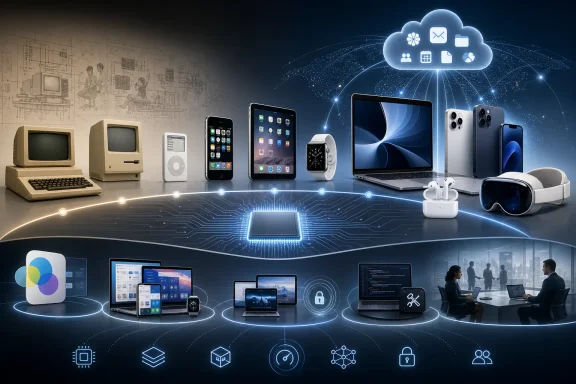 From Apple I to Apple Silicon
Apple was founded on April 1, 1976, by Steve Jobs, Steve Wozniak, and Ronald Wayne. Its early success came from the Apple II, while the Macintosh’s arrival in 1984 helped bring graphical, mouse-driven computing into the mainstream.Jobs left Apple in 1985 after a leadership dispute and returned in 1997 when Apple acquired NeXT. That acquisition also brought the operating-system foundations that became Mac OS X and, later, macOS. Under Jobs, Apple simplified its sprawling Mac range, launched the iMac in 1998, then expanded beyond computers with the iPod in 2001, iPhone in 2007, iPad in 2010, and Apple Watch in 2015.
The other major platform shift began in 2020, when Apple started replacing Intel processors in Macs with its own Apple Silicon. That transition is now effectively complete across the mainstream Mac portfolio. Apple’s March 2026 announcement of a MacBook Air using its M5 chip underscores that the company’s in-house silicon strategy is now central to both its PC and mobile businesses, according to Apple’s newsroom.
The current product map
Apple’s primary hardware lineup is broader than the older four-model iPhone and three-watch description suggests:- iPhone: The current flagship family includes iPhone 17, iPhone Air, iPhone 17 Pro, and iPhone 17 Pro Max. Apple introduced iPhone Air in September 2025 as a new thin-and-light tier rather than a direct revival of the old “mini” approach.
- Mac: MacBook Air, MacBook Pro, iMac, Mac mini, Mac Studio, and Mac Pro remain the core families, with the newer MacBook Neo expanding the entry-level notebook side.
- iPad: Apple sells iPad, iPad mini, iPad Air, and iPad Pro. The iPad Air was updated with M4 in March 2026.
- Wearables and home devices: Apple Watch Series 11, Apple Watch Ultra 3, Apple Watch SE 3, AirPods, Apple TV 4K, HomePod, and Apple Vision Pro make up the major adjacent hardware categories.
More than a hardware vendor
Apple’s software stack includes iOS, iPadOS, macOS, watchOS, tvOS, visionOS, and related cloud services. Its services operation spans the App Store, iCloud, Apple Music, Apple TV, Apple Pay, Apple Arcade, Fitness+, and AppleCare.Apple’s own March 2026 anniversary material marks 50 years since its founding and frames the company’s current business around that combined hardware, software, silicon, and services model.
For Windows users and IT administrators, Apple remains a competing endpoint platform whose consumer-device ecosystem increasingly overlaps with enterprise identity, device management, collaboration, and cross-platform security planning.
References
- Primary source: 9to5Mac
Published: 2026-07-16T13:00:13.786656
Loading…
9to5mac.com