

Background
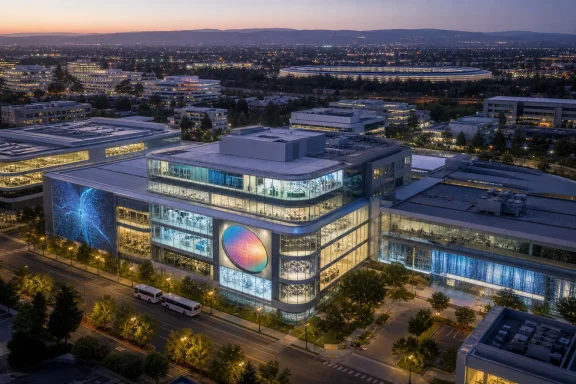
Apple has agreed to lease the North Mary Avenue property from Peery Arrillaga, one of Silicon Valley’s most prominent privately held real estate firms. The lease covers approximately 125,800 square feet, although the price, duration, occupancy schedule, and intended business unit have not been publicly disclosed.
That lack of detail is typical for Apple. The company frequently expands through entities and transactions that reveal little about the eventual purpose of a building, leaving its location, physical design, neighboring facilities, and subsequent permits to provide clues.
Sunnyvale as Apple’s second center of gravity
Apple Park remains the company’s symbolic and operational headquarters, but Cupertino alone has never contained the full Apple workforce. The company owns or leases an extensive network of facilities across Sunnyvale, Santa Clara, San Jose, and other parts of the Bay Area.
Sunnyvale is especially important because it offers a mixture of conventional offices, research-and-development buildings, flexible laboratories, and relatively large campuses close to Apple Park. Sites near Mathilda Avenue, Maude Avenue, Wolfe Road, and Peery Park can operate as extensions of Cupertino without forcing Apple to place every sensitive project inside its circular headquarters.
The North Mary Avenue lease fits that distributed model. It gives Apple another sizable location in a city where the company already has established infrastructure, transportation arrangements, security operations, and a deep pool of employees and suppliers.
A city built around technical industry
Sunnyvale’s significance predates the modern consumer technology era. The city has long hosted semiconductor, aerospace, defense, computing, and video-game companies, including the former headquarters of Atari and numerous businesses associated with Silicon Valley’s early hardware ecosystem.
That industrial history matters because advanced product development requires more than attractive office floors. Buildings may need laboratories, loading access, specialized electrical capacity, environmental controls, secure prototype areas, testing rooms, and physical separation between teams.
A property that can support those requirements is harder to replace than generic downtown office space. Apple’s continued concentration in Sunnyvale therefore reflects both geography and the city’s unusually mature research-and-development infrastructure.
The North Mary Avenue Deal
The new lease concerns 580 North Mary Avenue, a location northwest of central Sunnyvale and within the broader network of technology properties surrounding Peery Park. At nearly 126,000 square feet, the building is large enough to accommodate a substantial engineering organization, several cross-functional product teams, or a combination of offices and laboratories.
It is not, however, a headquarters-scale transaction. Its importance comes from how it connects with Apple’s other holdings rather than from the building’s size in isolation.
What Apple has confirmed—and what it has not
Reports attribute the transaction to people familiar with the arrangement, but Apple has not publicly identified which employees will occupy the building. There is no confirmed timetable for the move, nor any indication that the lease represents a corporate relocation from another named facility.
Several possibilities remain open:
- Apple could use the building to support a growing engineering organization whose work requires proximity to existing Sunnyvale teams.
- The facility could absorb employees displaced by renovations or reorganizations elsewhere in the company’s property network.
- The building could provide laboratory, prototype, or validation space that cannot be replicated efficiently through remote work.
- Apple could be reserving capacity ahead of future hiring, even if the facility is not immediately occupied at full density.
- The lease could become a bridge to eventual ownership, following the pattern seen in other recent Apple transactions.
Any more specific claim about the building’s purpose would be speculative. Apple’s secrecy makes that uncertainty unavoidable, particularly when facilities could house unannounced hardware, silicon, wireless, health, robotics, or artificial-intelligence projects.
Why leasing still makes strategic sense
Apple has enough cash and financial capacity to buy the property outright, but leasing offers flexibility while the company evaluates a building. Engineers can begin planning an interior build-out, assess access and infrastructure, and determine how effectively the location integrates with nearby operations.
A lease may also allow Apple to secure the property quickly without waiting for a sale. If the owner is not yet prepared to sell—or if valuation expectations remain unsettled—the occupancy agreement can prevent a competing tenant from taking the space.
In effect, Apple can separate two decisions: whether it wants to use the building and whether it wants to own it. The first can be made immediately, while the second can wait for more favorable pricing or a clearer long-term operational requirement.
Apple’s Lease-First, Buy-Later Pattern
The most revealing precedent is Apple’s handling of 684 West Maude Avenue. Apple initially took the approximately 194,800-square-foot Sunnyvale building through a sublease and later acquired it for $162.2 million in June 2026.
The sequence demonstrates why the North Mary Avenue lease deserves attention. For Apple, a lease may be the opening stage of a property acquisition rather than a temporary commitment.
The West Maude Avenue example
The West Maude property had changed hands for $222 million in 2022. Apple’s subsequent $162.2 million purchase represented a reduction of nearly $60 million, or roughly 27%, from that earlier transaction price.
That discount illustrates the leverage available to cash-rich corporate buyers in a market still recovering from the remote-work shock. Institutional owners that bought buildings near the market’s peak may face pressure from refinancing costs, weaker tenant demand, or changing portfolio priorities.
Apple can afford to wait. By first occupying a property and later negotiating a purchase, it gains operational knowledge while avoiding the need to buy at the seller’s preferred moment.
Why ownership can be preferable
A long-term owner has more freedom to reconfigure a building than a conventional tenant. Apple can make extensive changes to security systems, power distribution, internal networking, laboratories, sound isolation, mechanical systems, and exterior access without worrying that a lease expiration will strand the investment.
Ownership also protects sensitive operations from landlord changes and renewal negotiations. For facilities expected to remain in use across several product generations, those benefits can outweigh the flexibility of renting.
The practical advantages include:
- Apple can customize the property around confidential engineering workflows.
- The company can control physical security from the property boundary inward.
- Major infrastructure investments can be amortized over decades rather than a single lease term.
- Apple avoids future rent increases in locations it considers strategically indispensable.
- The underlying land may appreciate even when short-term office valuations remain depressed.
The North Mary Avenue building may never be purchased, but recent history makes that outcome plausible enough to monitor.
A Billion-Dollar South Bay Expansion
The new lease follows an unusually active period for Apple’s real estate organization. During 2025 and the first half of 2026, the company assembled or acquired several major properties around Sunnyvale and Cupertino.
Taken together, those deals suggest a coordinated strategy rather than unrelated opportunities.
The Mathilda corridor acquisitions
In 2025, Apple acquired two office buildings at 615 and 625 North Mathilda Avenue for approximately $350 million. The company then moved to acquire the neighboring four-building Mathilda Campus, located at 505 through 599 North Mathilda Avenue and 605 West Maude Avenue, for about $365 million.
Apple also bought a roughly 220,700-square-foot property in the Tantau or Cupertino Gateway area for approximately $160 million. Adding the $162.2 million West Maude purchase brings the publicly reported value of these transactions comfortably above $1 billion.
The spending is significant even by Apple’s standards. More importantly, the properties are concentrated within a relatively compact area rather than scattered across distant markets.
Clustering creates an operating campus
A group of neighboring buildings can function as a single campus even when it was assembled through separate transactions. Apple can share cafeterias, conference facilities, prototype logistics, shuttle routes, security personnel, maintenance teams, data connectivity, and employee amenities across multiple addresses.
This approach offers more adaptability than constructing another Apple Park. Teams can expand into adjacent buildings, facilities can be renovated in phases, and individual properties can be assigned to work requiring different levels of security or laboratory infrastructure.
The sequence resembles a five-step campus-building strategy:
- Apple identifies a district with existing technical buildings and strong transport links.
- It leases or acquires an initial property to establish operational capacity.
- The company adds neighboring sites when pricing or availability becomes favorable.
- Shared services gradually connect the properties into a unified operational cluster.
- Long-term ownership allows Apple to redevelop or specialize the buildings as product requirements evolve.
The North Mary Avenue lease expands the radius of that network while keeping the company close to its Sunnyvale base.
Why Apple Needs Physical Space in an AI Era
The technology industry’s renewed emphasis on artificial intelligence might appear to reduce the importance of offices. Software can be written remotely, cloud infrastructure can be accessed from almost anywhere, and distributed collaboration has become routine.
Apple’s product model complicates that assumption. Its AI ambitions must be integrated with custom chips, operating systems, cameras, microphones, sensors, batteries, wireless components, and unreleased consumer devices.
Hardware and software must meet somewhere
A conventional software company can give developers controlled remote access to cloud systems. Apple engineers may need to work with prototype hardware that cannot leave a secured laboratory, especially when the shape, function, or components of the device would reveal an unannounced product.
The same constraint applies to silicon development. Chip architecture begins in software, but validation eventually involves physical boards, test equipment, thermal analysis, performance measurement, and coordination with device teams.
Apple’s model depends on close interaction among specialists in several disciplines:
- Silicon engineers must understand the workloads future operating systems will run.
- Windows-facing software teams must test services and applications across non-Apple platforms.
- Machine-learning developers need access to prototype neural-processing hardware.
- Industrial designers and mechanical engineers must evaluate physical constraints.
- Security teams must inspect both hardware and software attack surfaces.
- Quality-assurance teams need controlled fleets of pre-release devices and configurations.
These tasks benefit from secure, purpose-built facilities. Remote work can supplement them, but it cannot entirely replace the laboratories and tightly controlled networks required for unreleased products.
AI increases cross-functional pressure
Generative AI is also forcing Apple to coordinate teams that historically could work with greater separation. Models, data pipelines, privacy systems, operating-system interfaces, developer frameworks, cloud services, and chips now affect one another directly.
A change to an on-device model may alter memory requirements. That can affect the system-on-chip, battery consumption, application behavior, and the features exposed through developer APIs.
Additional office and laboratory capacity does not prove that North Mary Avenue will house AI teams. It does, however, fit the broader operational demands created when AI becomes a layer spanning nearly every product group.
Implications for Apple Silicon and the PC Market
WindowsForum readers should not treat Apple’s property expansion as a purely local real estate story. Apple’s most consequential technical work ultimately affects competition across laptops, desktops, workstations, mobile devices, cloud services, and operating systems.
The company’s transition from Intel processors to Apple silicon changed expectations for performance per watt across the PC industry. Microsoft, Intel, AMD, Qualcomm, and Windows hardware manufacturers have all had to respond to a market in which battery life, neural processing, and tightly integrated hardware have become central selling points.
More capacity for vertical integration
Apple designs the processor, operating system, many core applications, developer frameworks, and cloud-connected services used by its devices. That vertical integration demands large teams working across boundaries that competing PC vendors often divide among several companies.
A new engineering site could support almost any part of that chain. Even if North Mary Avenue is assigned to a relatively narrow function, the broader Sunnyvale expansion gives Apple room to deepen its internal capabilities.
This matters because future competition will depend less on a single benchmark and more on system-level optimization. A laptop’s perceived intelligence, responsiveness, battery life, media performance, security, and compatibility will emerge from the interaction of hardware and software.
Pressure on Windows on Arm
Apple’s Mac transition demonstrated that a desktop-class Arm ecosystem can succeed when the platform owner controls the processor roadmap and provides a strong application-translation layer. Microsoft and Qualcomm have since intensified their attempt to establish Windows on Arm as a mainstream alternative to x86 PCs.
Apple’s continued investment suggests that it has no intention of allowing that lead to stand still. New generations of Apple silicon, neural accelerators, graphics architectures, and developer tools will place continuing pressure on Windows partners.
The competitive questions now include:
- Can Windows on Arm match Apple’s combination of performance, battery life, and application compatibility?
- Can x86 processors improve efficiency without sacrificing the broad software support that remains their greatest advantage?
- Will Microsoft provide consistent AI APIs across processors from AMD, Intel, and Qualcomm?
- Can PC manufacturers differentiate their devices when Apple controls more of its own stack?
- Will enterprise buyers accept new processor architectures if management and security tools remain dependable?
Apple’s offices will not answer those questions directly, but the engineering work performed inside them may shape the products that force the Windows ecosystem to respond.
What the Expansion Means for Microsoft
Microsoft and Apple compete in some markets while depending on each other in others. Microsoft 365, Teams, OneDrive, Edge, GitHub, and other services need strong support across Apple devices, while Apple benefits when widely used Microsoft software remains available on macOS and iOS.
Apple’s growth in Sunnyvale therefore has both adversarial and collaborative implications.
Competition for platform relevance
Microsoft wants Windows to remain the primary platform for productivity, development, business computing, and increasingly AI-assisted work. Apple wants the Mac to gain share among consumers, developers, creative professionals, executives, and enterprises.
The next competitive phase will focus heavily on AI experiences embedded into operating systems. Microsoft has promoted Copilot and Copilot+ PCs, while Apple is working to make intelligence features feel native to its devices and privacy model.
Success will depend on more than adding a chatbot window. Both companies must integrate AI into search, settings, accessibility, writing tools, image creation, coding, application automation, notifications, and personal data management without making the operating system less predictable.
Microsoft must support Apple’s customers
Even if Apple’s investments lead to stronger Mac growth, Microsoft still has an opportunity to sell services to those users. A Mac deployed in a business may connect to Microsoft Entra ID, use Intune management, store files in OneDrive, communicate through Teams, and run Microsoft 365 applications.
That makes cross-platform execution essential. Microsoft cannot assume every valuable enterprise user will operate Windows, and Apple cannot assume businesses will abandon Microsoft’s identity, collaboration, and management systems simply because they buy Macs.
Apple’s physical expansion reinforces the likelihood of prolonged platform competition, but it also increases the importance of interoperability. The most successful enterprise vendors will be those that profit regardless of which logo appears on the employee’s laptop.
Enterprise Impact
Corporate technology leaders should view Apple’s real estate activity as a signal of long-term platform commitment rather than evidence of any immediate product announcement. Buildings are multiyear investments, and they generally support roadmaps extending well beyond the next annual hardware refresh.
If Apple is preparing for a larger engineering workforce, more internal development, or greater control over critical technologies, enterprise customers can expect its platform ambitions to continue expanding.
Macs in managed environments
Apple has gradually improved the Mac’s position in businesses through automated enrollment, declarative device management, hardware-backed security, platform single sign-on capabilities, and stronger integration with third-party management systems.
More Apple engineering capacity could accelerate work across these areas, although the purpose of the Sunnyvale lease remains unknown. The important point is that Apple increasingly treats enterprise support as a platform requirement rather than an incidental consequence of employee demand.
Organizations evaluating Macs should still focus on operational facts:
- Application compatibility must be verified for both native Apple silicon and translated software.
- Identity workflows should be tested against the organization’s chosen cloud and directory services.
- Security teams need equivalent logging, detection, and incident-response coverage across macOS and Windows.
- Peripheral, printer, VPN, and specialized hardware support should be confirmed before deployment.
- Lifecycle costs should include management labor, repair processes, warranties, and employee training.
- AI features require separate review for data handling, retention, regulatory compliance, and user consent.
Apple’s investment does not eliminate these concerns. It does suggest that businesses should plan for Apple devices to remain a meaningful part of mixed-platform fleets.
Talent competition will remain intense
A larger Sunnyvale footprint could also intensify competition for engineers specializing in AI, semiconductors, wireless systems, security, graphics, operating systems, and cloud infrastructure. Apple competes for many of the same people sought by Google, Microsoft, Nvidia, Meta, Amazon, semiconductor companies, and heavily funded AI laboratories.
Physical proximity to that talent pool is one reason Apple continues buying and leasing in Silicon Valley despite high labor and property costs. For enterprise employers in the region, the downside is continuing wage pressure and employee turnover in strategically important technical roles.
Consumer Impact
Consumers will not see an immediate change when Apple takes possession of another office building. There is no reason to expect a product launch, software feature, or pricing adjustment tied directly to the lease.
The eventual impact is indirect: more capacity can support the research, testing, and integration work behind future products.
Better products are not guaranteed
Real estate expansion can indicate confidence, but it does not automatically produce successful innovation. Large organizations can add employees and buildings while increasing bureaucracy, duplicating effort, or slowing decisions.
Apple will need to ensure that its distributed campus network does not undermine the collaboration it is intended to support. Teams spread across Cupertino and Sunnyvale require reliable transport, carefully designed secure networks, compatible laboratories, and management structures that prevent geographic silos.
Consumers should therefore interpret the lease as evidence of investment, not proof of a breakthrough.
The likely areas of downstream influence
If the expansion supports product engineering, consumers may eventually feel its effects in several categories:
- Mac performance and efficiency could improve through future Apple silicon generations.
- On-device AI could become more capable while exposing less personal data to cloud systems.
- Health and wearable technologies could gain new sensors or analytical functions.
- Home and spatial-computing products could receive greater engineering attention.
- Wireless, modem, and connectivity work could reduce Apple’s dependence on outside suppliers.
- Software quality could improve if Apple dedicates more resources to testing and reliability.
The final point may matter most to existing users. Ambitious features attract attention, but customers experience a platform through its daily stability, application compatibility, battery behavior, and security updates.
The Silicon Valley Office Market Is Changing
Apple’s move arrives during an uneven recovery in commercial real estate. Silicon Valley still carries substantial office vacancy following the pandemic-era shift toward remote and hybrid work, yet the strongest technology companies have begun absorbing selected high-quality properties.
Sunnyvale entered 2026 with an overall office vacancy rate of roughly 15%, depending on the precise property definitions and reporting methodology used. That is elevated by historical Silicon Valley standards but healthier than some neighboring office submarkets.
A buyer’s market for exceptional tenants
High vacancy gives large tenants negotiating power. Landlords may offer lower effective rents, tenant-improvement allowances, flexible expansion rights, purchase options, or other concessions to secure a company with Apple’s credit quality.
The opportunity becomes even greater when Apple is willing to buy. Properties acquired near previous market peaks may now be available below their former prices, as demonstrated by the West Maude transaction.
This creates an unusual combination:
- Apple has the capital to act without relying heavily on expensive financing.
- Sellers may need liquidity or relief from underperforming office investments.
- Apple can select buildings close to facilities it already controls.
- Reduced competition lets the company negotiate patiently.
- Long-term operational value may matter more to Apple than short-term market valuations.
For Apple, the office downturn can be treated as an acquisition cycle. For landlords, Apple offers the possibility of stable occupancy or a clean exit.
Not every office market is recovering equally
It would be misleading to describe the lease as evidence that conventional office demand has returned everywhere. Technology companies remain selective, and many older buildings face functional obsolescence even when they are offered at substantial discounts.
Properties attractive to Apple may have characteristics that ordinary office tenants do not value as highly: secure setbacks, laboratory potential, heavy power capacity, loading access, proximity to existing engineering operations, or the ability to control an entire building.
The recovery is consequently splitting the market. Well-located technical properties can attract major tenants while generic offices continue to struggle.
Regional Infrastructure and Community Effects
Apple’s expansion brings tax revenue, construction work, service demand, and employment to Sunnyvale. It can also create pressure on housing, roads, public transport, and local businesses.
These effects depend heavily on whether the North Mary Avenue building houses transferred employees or supports net workforce growth.
Transport and commuting
Sunnyvale benefits from access to Caltrain, Highway 101, State Route 237, and other South Bay transport corridors. Apple also operates an extensive private shuttle network, enabling employees to travel among corporate facilities and residential areas.
Even so, clustering thousands of additional workers across multiple campuses can worsen peak-hour congestion. A collection of offices assembled incrementally may also be harder to serve efficiently than a single purpose-built headquarters.
Apple and local authorities will need to consider:
- Shuttle and public-transit connections must scale with occupancy.
- Safe walking and cycling routes are necessary for shorter trips between campuses.
- Parking capacity should not become the default substitute for transport planning.
- Intersections and access roads may require redesign as employee density increases.
- Nearby housing production will influence how far workers must commute.
The lease itself will not determine these outcomes, but repeated expansion makes them increasingly important.
Housing remains the harder problem
High-paying technology employment can benefit a region while making it less affordable for teachers, service workers, public employees, and early-career professionals. Office growth without corresponding housing development pushes workers farther from employment centers and increases transport emissions.
Apple cannot solve the Bay Area housing shortage alone. Nevertheless, large employers influence demand and have the resources to support housing funds, transport programs, and development policies that reduce the burden created by job concentration.
Sunnyvale’s ability to pair commercial growth with housing will determine whether expansion strengthens the broader community or deepens existing inequality.
Strengths and Opportunities
Apple’s North Mary Avenue lease gives the company additional flexibility at a time when premium Silicon Valley properties remain available on comparatively favorable terms. The opportunity is especially strong because the site complements rather than replaces Apple’s existing South Bay network.
Strategic advantages
- The lease secures nearly 126,000 square feet without requiring an immediate purchase commitment.
- The location expands an established Sunnyvale cluster close to Apple Park and other Apple facilities.
- Apple can evaluate the building before deciding whether long-term ownership is justified.
- Current office-market conditions may provide favorable rent, improvement, or acquisition terms.
- Additional secure space can support hardware, silicon, AI, operating-system, and services teams whose work cannot be fully remote.
- A larger engineering footprint strengthens Apple’s ability to integrate chips, devices, software, and cloud services internally.
- The investment signals long-term confidence in Silicon Valley as a center for advanced technical work.
For the wider technology sector, Apple’s activity may help establish clearer pricing for distressed or discounted offices. It may also encourage redevelopment of older properties into laboratories and modern research facilities rather than leaving them vacant.
Risks and Concerns
The transaction also carries uncertainties that should not be dismissed simply because Apple can afford the lease. Real estate is a long-duration commitment, and the technology industry can change faster than buildings can be redesigned or sold.
Operational and market risks
- Apple could accumulate more space than it needs if hiring slows or workplace policies change.
- Operating many separate buildings may duplicate security, transport, dining, maintenance, and networking costs.
- A lease-to-buy strategy can fail if the landlord refuses to sell or demands an inflated price.
- Specialized renovations may reduce the property’s resale appeal if Apple later changes direction.
- Concentrating critical operations in the South Bay increases exposure to earthquakes, power constraints, and regional costs.
- Additional local employment can worsen housing affordability and congestion without coordinated public investment.
- More engineering capacity could increase organizational complexity rather than accelerate product development.
- Secrecy around facility use can encourage unsupported speculation about products and hiring plans.
Apple also faces a broader strategic danger: infrastructure spending can create pressure to continue projects because resources have already been committed. Management must remain willing to cancel weak initiatives even when teams, laboratories, and buildings were created to support them.
What to Watch Next
The clearest evidence about the North Mary Avenue building will probably emerge gradually rather than through an Apple announcement. Planning documents, construction permits, exterior security changes, specialist contractors, job postings, and occupancy patterns may indicate how extensively Apple intends to modify the site.
A purchase would provide an even stronger signal that the company considers the property strategically important.
Key indicators
The next developments worth monitoring are:
- Whether Apple files permits for major laboratory, electrical, mechanical, or security upgrades.
- Whether the lease includes a purchase option or leads to a recorded sale within the next several years.
- Whether Apple adds neighboring properties and turns North Mary Avenue into another multi-building cluster.
- Whether local job listings show increased hiring in silicon, AI, wireless, hardware validation, security, or enterprise software.
- Whether Apple consolidates employees from older leased sites into its recently acquired campuses.
- Whether Sunnyvale’s office vacancy continues falling as Apple, Amazon, Databricks, and other technology companies absorb space.
- Whether Apple’s capital spending and headcount trends confirm a broader expansion rather than a reshuffling of existing teams.
- Whether new Mac, AI, wearable, home, or connectivity initiatives eventually reveal the technical priorities behind the property strategy.
The timing requires patience. A building leased in 2026 may support products that do not appear publicly until 2028 or later, particularly when the work involves custom silicon or entirely new hardware categories.
Apple’s latest Sunnyvale lease is therefore best understood as a piece of long-range industrial planning. The company is using a weak commercial property cycle to secure scarce technical space, deepen its geographic cluster around Cupertino, and preserve room for engineering programs that require secrecy and physical collaboration. Whether 580 North Mary Avenue becomes another Apple-owned facility remains uncertain, but the broader direction is unmistakable: as Microsoft and the Windows ecosystem race to compete in AI PCs, custom processors, and tightly integrated computing, Apple is investing not only in code and chips, but in the physical infrastructure needed to design what comes next.